Security patrols
Security patrols: how to plan them, run them and show they happened
A security patrol is a planned round of a site by a security officer, on foot or by vehicle, to check that the premises are secure, to spot and deal with anything out of the ordinary, and to deter crime by being seen.
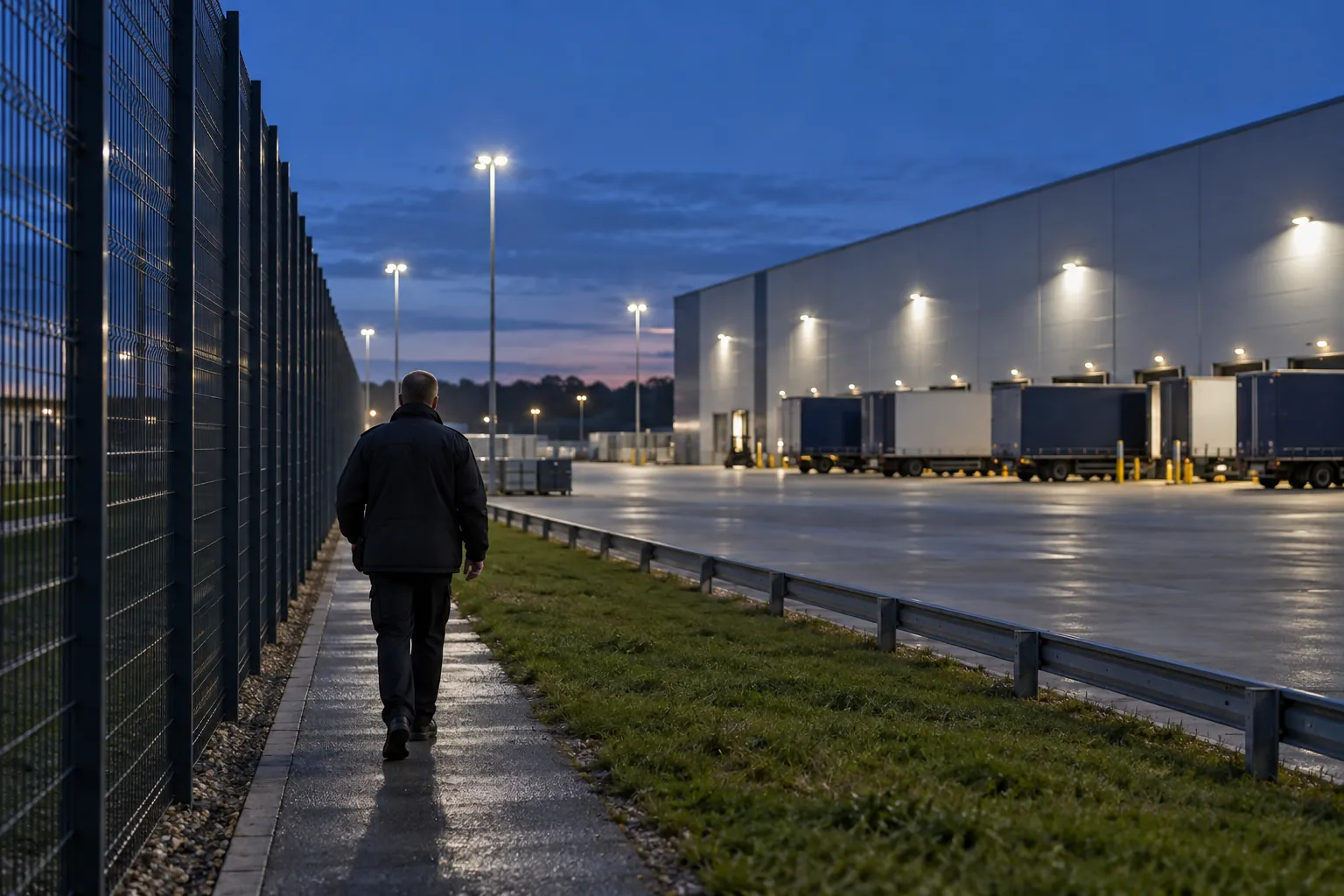
It is the part of the shift that nobody else sees: a walk round the site, often at night or out of hours, looking for what has changed. This guide covers how to plan patrol routes and timings, what officers should look for, how to record each patrol, and how to hand over so that the next shift knows what the last one found.
01
What a security patrol is, and the rules behind it
A security patrol is a planned round of a site by a security officer, on foot or by vehicle, to check that the premises are secure, to spot and deal with anything out of the ordinary, and to be seen. Most manned guarding contracts combine static duties, such as reception, gatehouse or control room work, with patrols of the buildings and grounds at set times through the shift. A patrol is how one officer covers a site that is too large to watch from a single post.
Security services use several kinds of patrol, and one site may use more than one:
- Static patrols: the on-site officer leaves their post at intervals to patrol the building and grounds, then returns.
- Foot patrols: an officer or a pair of security personnel dedicated to patrolling a large site, such as a hospital, campus or shopping centre.
- Vehicle patrols: a patrol vehicle used on sites too large to walk, such as distribution parks, ports, estates or solar farms.
- Mobile patrols: an officer who drives between several clients' sites, visiting each at agreed times.
No UK law says a site must be patrolled, or how often. The need comes from the site's own security risk assessment, the client's insurer, and the contract. What the law does regulate is who can do the work. Under the Private Security Industry Act 2001, a security officer supplied under contract to guard premises against unauthorised access, damage or theft must hold a valid licence from the Security Industry Authority (SIA), usually the security guard licence or the door supervisor licence, which also covers guarding. As passed, the Act extended to England and Wales only; it was extended to Scotland in 2006 by the Serious Organised Crime and Police Act 2005 and to Northern Ireland from 8 March 2009 by section 48 of the Justice and Security (Northern Ireland) Act 2007, so it now applies across the UK. Staff employed directly by the occupier to guard their own premises are generally outside the licensing requirement, but many organisations hold in-house officers to the same training standard.
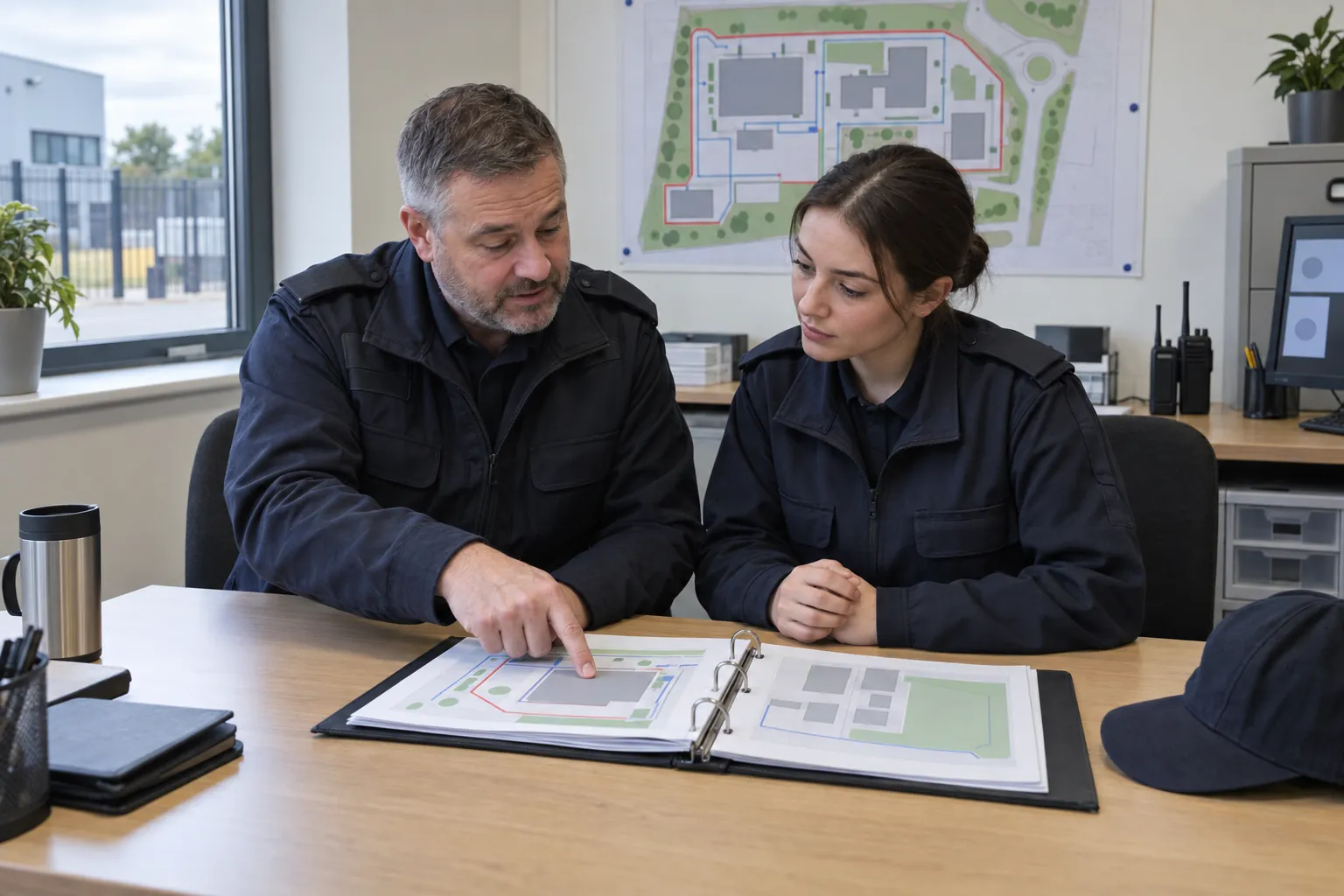
The industry's code of practice for this work is BS 7499, which covers the provision of static guarding (mobile patrol services have their own code, BS 7984-3), including the assignment instructions that set out an officer's duties on each site. Security companies that belong to the SIA's voluntary Approved Contractor Scheme are assessed on how they manage services such as these. The patrols themselves are written into the site's assignment instructions: where the officer goes, how often, what they check and what they do about what they find.
This guide is about patrols on a site with its own officer. A mobile patrol, where one officer drives between several clients' sites, is a different service with its own contract terms, covered in our guide to mobile security patrols. The equipment that records each checkpoint is covered in our guide to guard tour systems.
02
What a patrol covers in practice
A useful patrol plan starts with a list of the places that matter and why. For most commercial sites that list includes:
- The perimeter: fences, gates, barriers, walls and boundary lighting, looking for damage, gaps, climbing aids left against a fence and gates left unlocked.
- External doors and windows: fire exits, loading bay doors, roller shutters, roof access and ground-floor windows, checked closed and secure, with no signs of forced entry.
- Vulnerable internal areas: server rooms, stores, cash offices, plant rooms, pharmacy or laboratory stores, and anywhere holding high-value stock.
- Car parks and yards: vehicles left overnight, vehicles that should not be there, stacked pallets, skips and anything that could be used to climb or start a fire.
- Fire safety: fire exits unobstructed, fire doors shut, no build-up of combustible waste against the building, the fire alarm panel showing normal.
- Building faults: water leaks, lights out, doors that will not latch, alarms on plant, temperatures out of range in cold stores or server rooms.
- People: anyone on site out of hours, contractors working late, and signs of rough sleeping or anti-social behaviour, handled in line with the assignment instructions.
Each of these becomes a checkpoint on the patrol route: a named place where the officer stops, checks what the instructions say to check, and records that they were there. A patrol with twenty checkpoints on a large site and five on a small office can be equally thorough; what matters is that the list reflects the risk rather than the floor plan.
Officers should also know what a patrol is not for. A security officer has no more powers than any other member of the public: they can ask someone to leave, observe and report, and call the police or emergency services, but a patrol that finds an intruder is an occasion to follow the site's procedures, not to take risks. Our guide to security officer duties covers those limits.
03
Planning patrol routes and timing
Patrols are one security measure among several, alongside locks, lighting, intruder alarms, access control and CCTV, and the patrol plan should fill the gaps the others leave. It answers three questions: which route, how often, and when. Each should come from the site's security needs, as set out in the risk assessment, and be written down, so that a relief officer on their first night does the same patrol as the regular one.
- Route: a logical sequence of checkpoints that covers the perimeter, the external doors and the high-risk internal areas without doubling back. Most sites need the officer to conduct an external patrol of the perimeter and an internal patrol inside the premises, which may be done separately or combined.
- Frequency: how many patrols per shift. A common pattern is a patrol at lock-up, patrols at regular intervals through the night, and a final patrol before the building opens or the shift hands over, but the right number depends on the site. Busy periods, recent incidents and seasonal risks, such as dark evenings or a building closed for the holidays, may justify more.
- Timing: when each patrol starts. The most effective patrols are not predictable. If an officer leaves the gatehouse on the hour, every hour, anyone watching the site knows exactly when the back fence is unobserved. Patrol plans should vary the start times within a window, and where the layout allows, vary the direction of the route too.
Random patrols make the record harder to read, because a check that was due at 02:00 might properly happen at 02:20. The answer is to schedule each patrol within a time window, such as "one patrol between 01:00 and 03:00", and to record the actual time each checkpoint was reached. Proof that the patrol happened is then a matter of the checkpoints, not the timetable.
Lone working is part of the plan, not an afterthought. An officer patrolling alone at night should be covered by the employer's lone working arrangements, such as scheduled check calls with a control room, and the Health and Safety Executive's guidance Protecting lone workers explains what employers need to consider.
04
What officers look for, and what they do about it
A patrol is only as good as the attention paid on it. Well-trained security patrol officers know the site well enough to notice what has changed since the last round: a door that was locked and is now open, a vehicle that was not there an hour ago, a light that has gone out. Training and familiarity count for more than the number of patrols.
At each checkpoint the officer should:
- check what the instructions list for that point, such as doors secure, shutters down, fence intact;
- look for signs of attempted entry, damage, graffiti, suspicious activities or items left that should not be there;
- note anything unusual, even if it turns out to be innocent, because a pattern often shows only across several nights;
- deal with what can be dealt with on the spot, such as closing a window or switching off a tap, and record it;
- report what cannot, following the escalation steps in the assignment instructions.
Escalation should be clear before the patrol starts. The assignment instructions should say which findings go straight to the police or emergency services, which go to the control room or a duty manager, and which can wait for the morning. A security breach in progress needs an immediate call, and the site may have agreed response times with a keyholder or alarm response service; a broken light in the car park needs a fault report that reaches whoever fixes it. Most findings on a patrol are faults, not crimes, and a patrol that finds and reports faults is doing much of its job.
Deterrence is also part of the purpose. A visible presence on the site helps deter criminal activities such as vandalism and trespass, especially when patrol timing varies, reduces the likelihood of theft, and helps officers detect a problem that would otherwise go unnoticed until the morning. CCTV can extend what one officer sees, but a camera cannot try a door handle or notice a smell of burning.
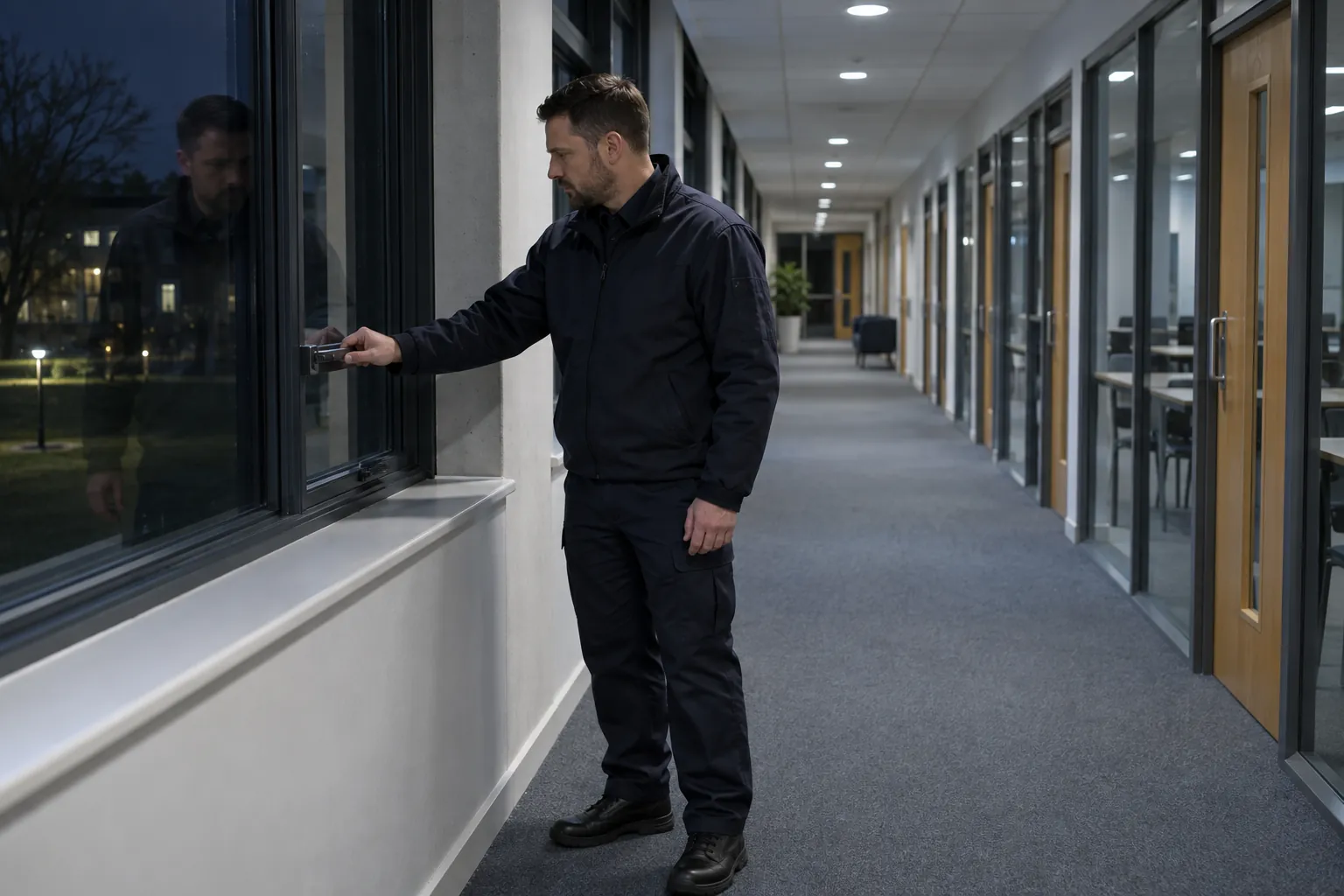
05
Recording each patrol and handing over
A patrol that leaves no record cannot be shown to have happened. At a minimum, every patrol should be recorded in the daily occurrence book with its start and finish time, and anything found. A better record shows each checkpoint separately, so that a patrol that stopped halfway is visible. A good patrol record gives:
- the name of the officer who carried out the patrol, not only the shift;
- the actual time each checkpoint was reached, recorded at the time;
- what was found at each checkpoint, including "all secure" where it was;
- each security incident or fault, with a photo where it helps, who it was reported to and when;
- any patrol or checkpoint missed, with the reason, such as an alarm activation or another call that took the officer away to respond to incidents elsewhere;
- a supervisor's review, so that someone other than the officer looks at the record.
Paper records and the occurrence book are still common, and electronic guard tour systems, with a tag or code at each checkpoint read by a handheld reader or a mobile device, give the patrol a time-stamped proof of presence; some add real-time monitoring by a control room. Our guide to guard tour systems compares the types. Whatever the method, the record should be written as the patrol happens, not reconstructed at the end of the shift.
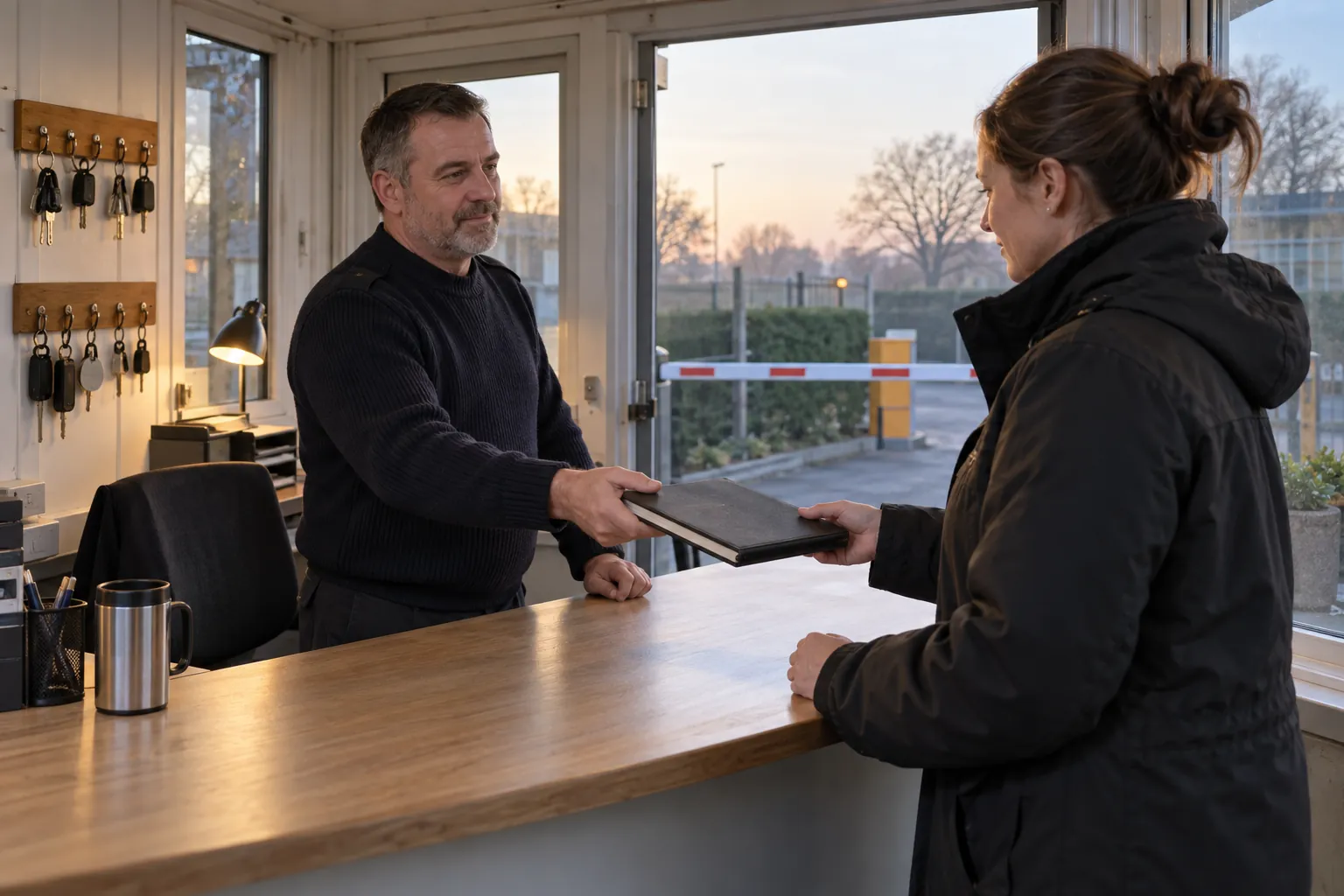
Handover is where patrol information is most often lost. The outgoing officer should brief the incoming one on what the patrols found, what is still open and anything to keep an eye on, and the handover should be recorded in the occurrence book with both names. A door that would not lock at 04:00 is the day shift's problem too, and the rest of the security team should hear about it, and a separate security officer report is the place for any incident that needs more than a line.
Supervisors and clients should read patrol records for patterns as well as gaps. Patrol completion across a month, the same fire exit found open every Friday night, or a patrol that always runs short on one shift, is information the site can act on.
06
Where patrol records fail, and where SiteClara fits
The usual patrol record is one line in the occurrence book: "22:00 patrol, all secure". It tells a supervisor that the officer says they patrolled, but not which checkpoints were reached or when. A fault found at 03:00 stays in the book rather than reaching the people who fix it, and the client, who is paying for the patrols, sees nothing unless they ask.
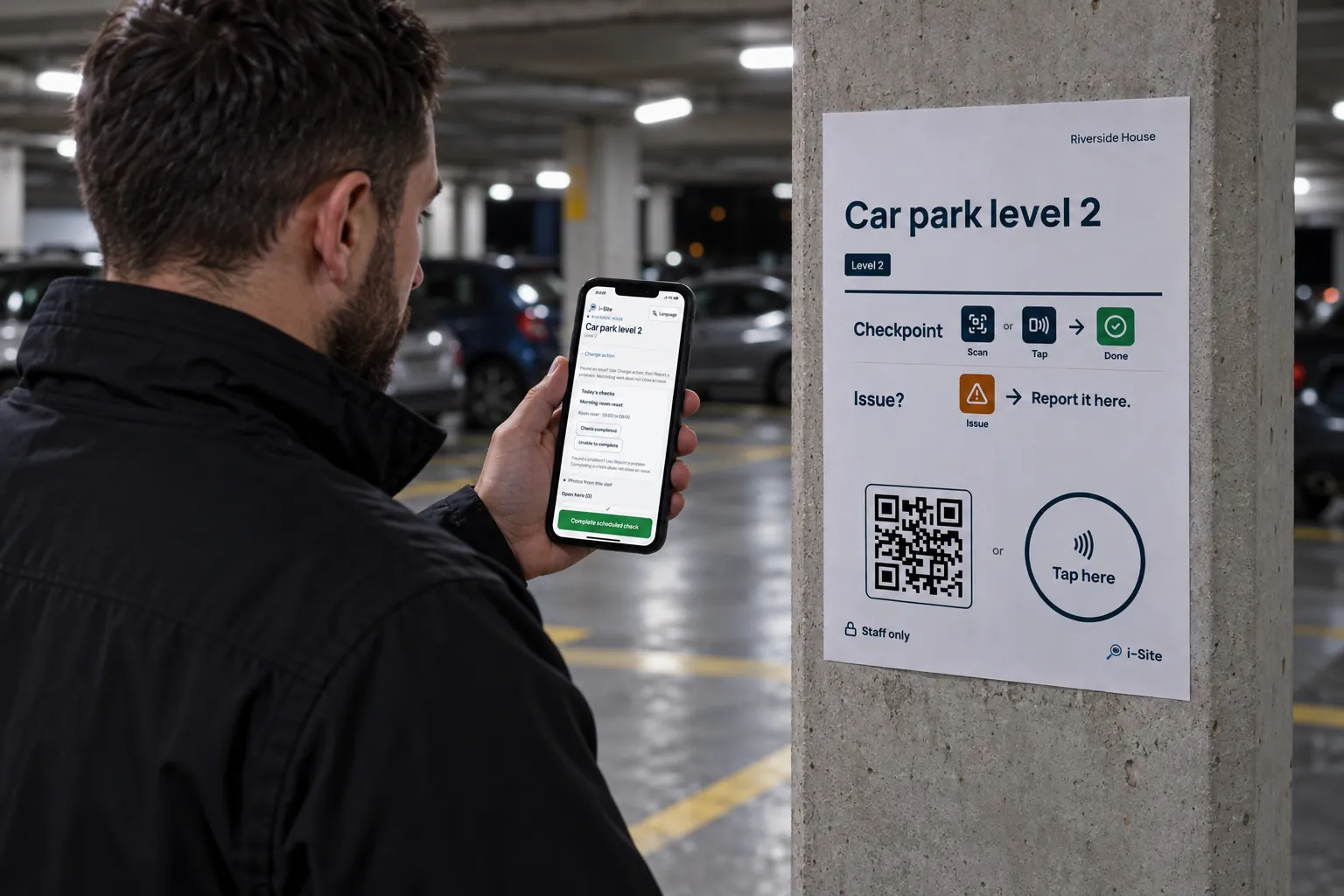
SiteClara records the patrol checkpoint by checkpoint. A printed QR poster, with an optional NFC tag behind it, goes at each checkpoint on the route. The officer scans the code or taps the tag on their own phone, with no app to install; officers are enrolled by text and sign in with a link. At each checkpoint they see the checks due there and mark them done, or explain what stopped them, and they can report an issue or incident with a photo. A reported issue goes onto the team's list of jobs until someone closes it, and the supervisor can escalate a job to the building manager.
The supervisor sees what was due, done and missed, and can record the reason a patrol was missed. Each day the supervisor reviews and approves a report that goes to nominated management or client contacts at 8am the next morning, showing what was reported, what was completed, what is still open and how the scheduled checks went, for example 12 of 12 completed. It is priced per building, with no per-person fees.
07
Further reading, and a list to take away
The Security Industry Authority publishes the licensing requirements for security guards and door supervisors, and the standards for its Approved Contractor Scheme. BS 7499 is available from the British Standards Institution. The Health and Safety Executive publishes Protecting lone workers, and the National Protective Security Authority publishes guidance on protecting sites and buildings. Your local police force can advise on crime risks and security concerns in your area.
Before the next patrol plan is agreed, check that:
- the patrol plan comes from the site's security risk assessment and is written into the assignment instructions;
- each checkpoint is named, with what to check there;
- patrols are scheduled in time windows, with start times and directions varied;
- the post is covered, or secured, while the officer patrols;
- escalation for each kind of finding is written down, with contact numbers;
- each checkpoint is recorded at the time, by a named officer, with findings and faults;
- missed patrols are recorded with a reason;
- handovers are recorded, and a supervisor reviews the patrol records for gaps and patterns.
Sources
Every document this guide quotes or links to, in the order it first cites them.
- Private Security Industry Act 2001 legislation.gov.uk
- Serious Organised Crime and Police Act 2005 legislation.gov.uk
- Section 48 of the Justice and Security (Northern Ireland) Act 2007 legislation.gov.uk
- BS 7499 knowledge.bsigroup.com
- BS 7984-3 knowledge.bsigroup.com
- Protecting lone workers hse.gov.uk
Related guides
 Security patrolsGuard tour systems: how they work, what they prove, and how to choose oneHow guard tour systems record security patrols – wands, RFID, NFC, QR codes, GPS apps – what the data shows and does not, and what to ask before choosing one.
 Security patrolsSite security checklist: what to check, how often, and how to show it was doneSite security checklist for UK construction sites and business premises: perimeter, access, lighting, CCTV, alarms, keys, and how to record the checks.
 Security patrolsSecurity assignment instructions: what they should say, and how to keep them workingSecurity assignment instructions (AIs): what they should include, who agrees and signs them, how often to review them, and how to check they are followed.
 Security patrolsDaily occurrence book: what to record, and how to keep one that stands upDaily occurrence book (DOB): what to record, how to write entries that stand up, how it differs from an incident report, and paper or digital.