Security patrols
Security patrols: how to plan them, walk them and show they happened
A security patrol is a planned round of a site by a registered security officer, on foot or by vehicle, to check that the premises are secure, to find and deal with anything out of place, and to deter crime by being seen.
Also written for United Kingdom · United States · Canada
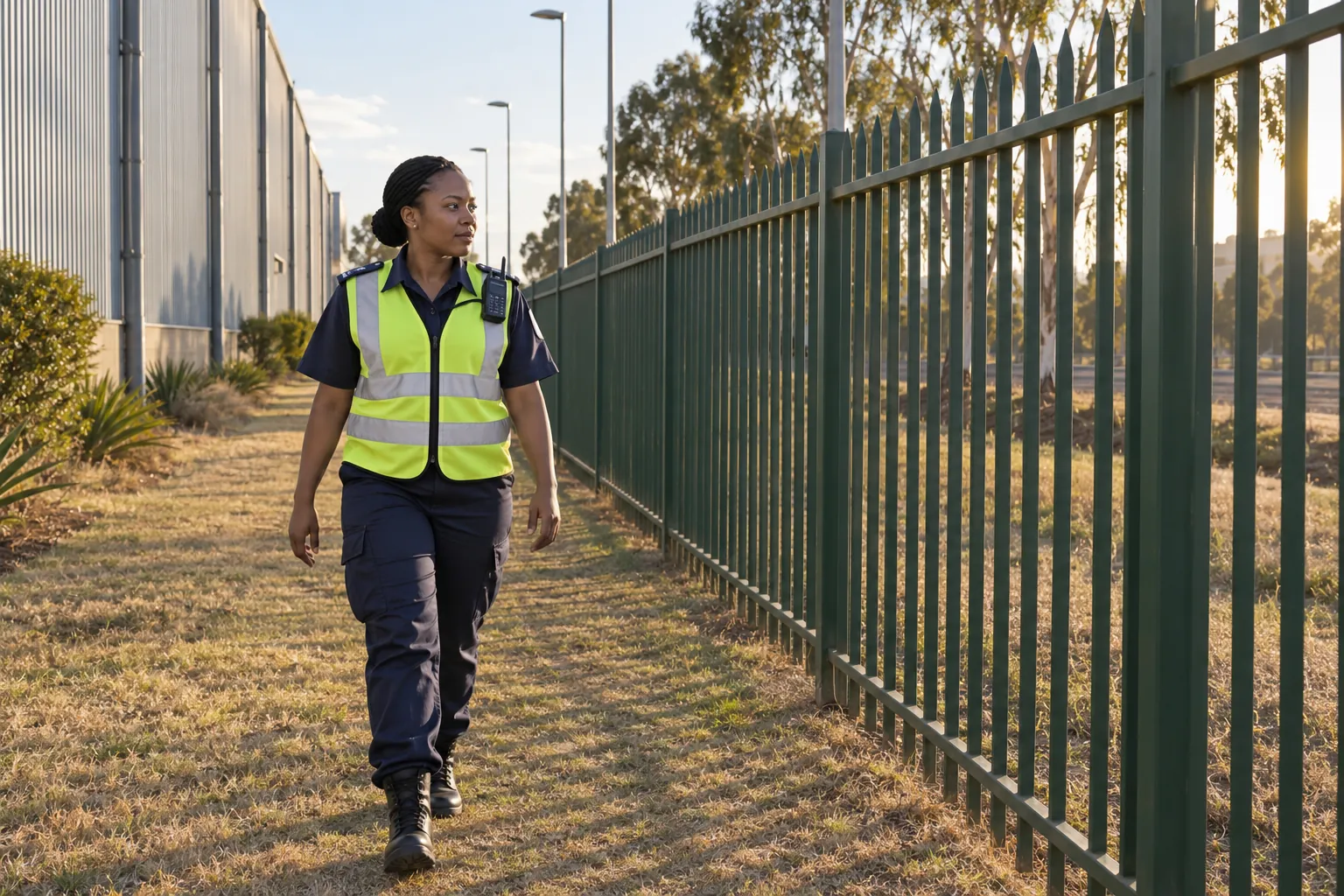
No South African law says how often a site must be patrolled; the routes and times come from the client's contract and the site instructions, while the Private Security Industry Regulation Act 56 of 2001, the Private Security Industry Regulations, 2002 and PSIRA's Code of Conduct govern who may do the work, how it is supervised and what records are kept. This guide covers the types of security patrol, how to plan routes and timing, the procedures and checklist an officer follows, and how to keep a patrol log that a supervisor and a client can rely on.
01
What a security patrol is, and the rules behind it
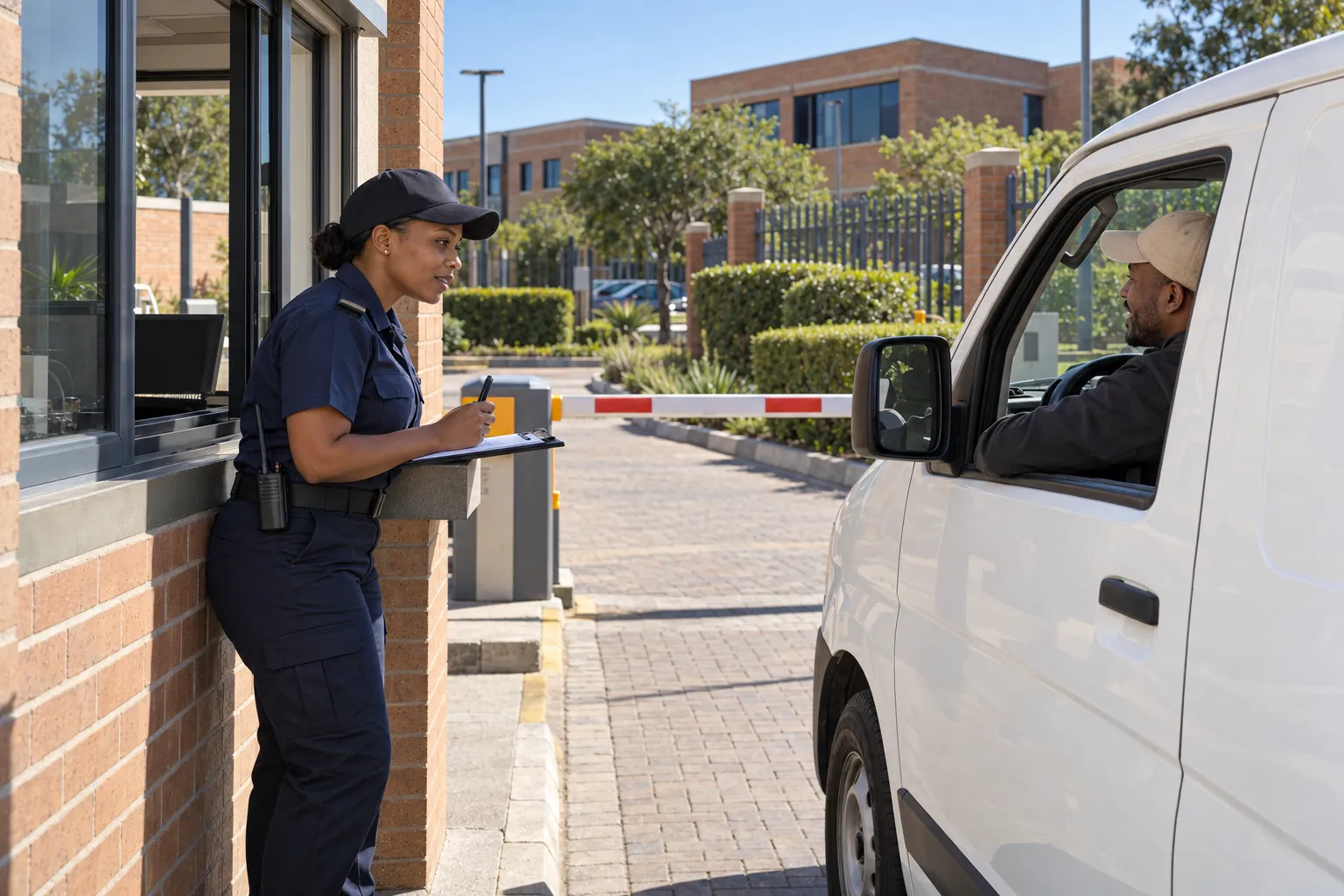
A security patrol is a planned round of a site by a security officer, often called a security guard, on foot or by vehicle, to check that the premises are secure, to spot and deal with anything out of the ordinary, and to be seen. Many guarding contracts combine a static post, such as the guardhouse at a boom gate or a reception desk, with patrols of the buildings, parking areas and perimeter at set times through the shift, and the same security guards usually do both.
The purpose of a security patrol follows from the duty every security service provider carries. Regulation 8(3) of the Code of Conduct for Security Service Providers, 2003 says every provider "must endeavour to prevent crime, effectively protect persons and property". A patrol does that by detecting what has changed since the last round, deterring anyone watching the site, and finding faults before they become losses.
No South African law says that a site must be patrolled, or how often; that comes from the contract and the site instructions. The law regulates who may patrol and how the work is run:
- Registration. Section 1 of the Private Security Industry Regulation Act 56 of 2001 defines a security service to include "protecting or safeguarding a person or property in any manner" and "providing a reactive or response service in connection with the safeguarding of a person or property in any manner". Section 20(1)(a) says no person may render a security service for remuneration, reward, a fee or benefit unless registered as a security service provider with PSIRA. Under regulation 23(a) of the Code, an employer guarding its own premises with its own staff may use only registered, trained employees.
- Doing what the contract says. Regulation 9(5) of the Code requires a provider to render the service "in accordance with the terms and conditions of the contract", with the skill, diligence and care expected of a reasonable, competent and qualified provider.
- Supervision. Regulation 11(5)(b) requires a provider to take reasonable steps to ensure each officer it deploys "is properly managed, controlled and supervised", and regulation 13(2)(a) requires systems that ensure "effective control over the rendering of security services". Under regulation 22(1)(b) both apply to employers of in-house security officers too, as far as applicable.
A patrol is not a legal requirement in itself, but once it is in the contract it is a service the provider must deliver, supervise and be able to show the client.
02
Types of security patrol, and what each one covers
Security companies, estates and in-house security teams use several types of security patrol, and one site often uses more than one. The guards may be a contracted company's personnel or the owner's own registered staff:
- Foot patrols from a static post: the officer on the post leaves at intervals to walk the building and grounds, then returns. This is a common pattern at office parks, schools, warehouses and sectional title complexes.
- Dedicated foot patrols: an officer, or a pair, whose whole shift is patrolling a large site such as a hospital, a campus or a shopping centre.
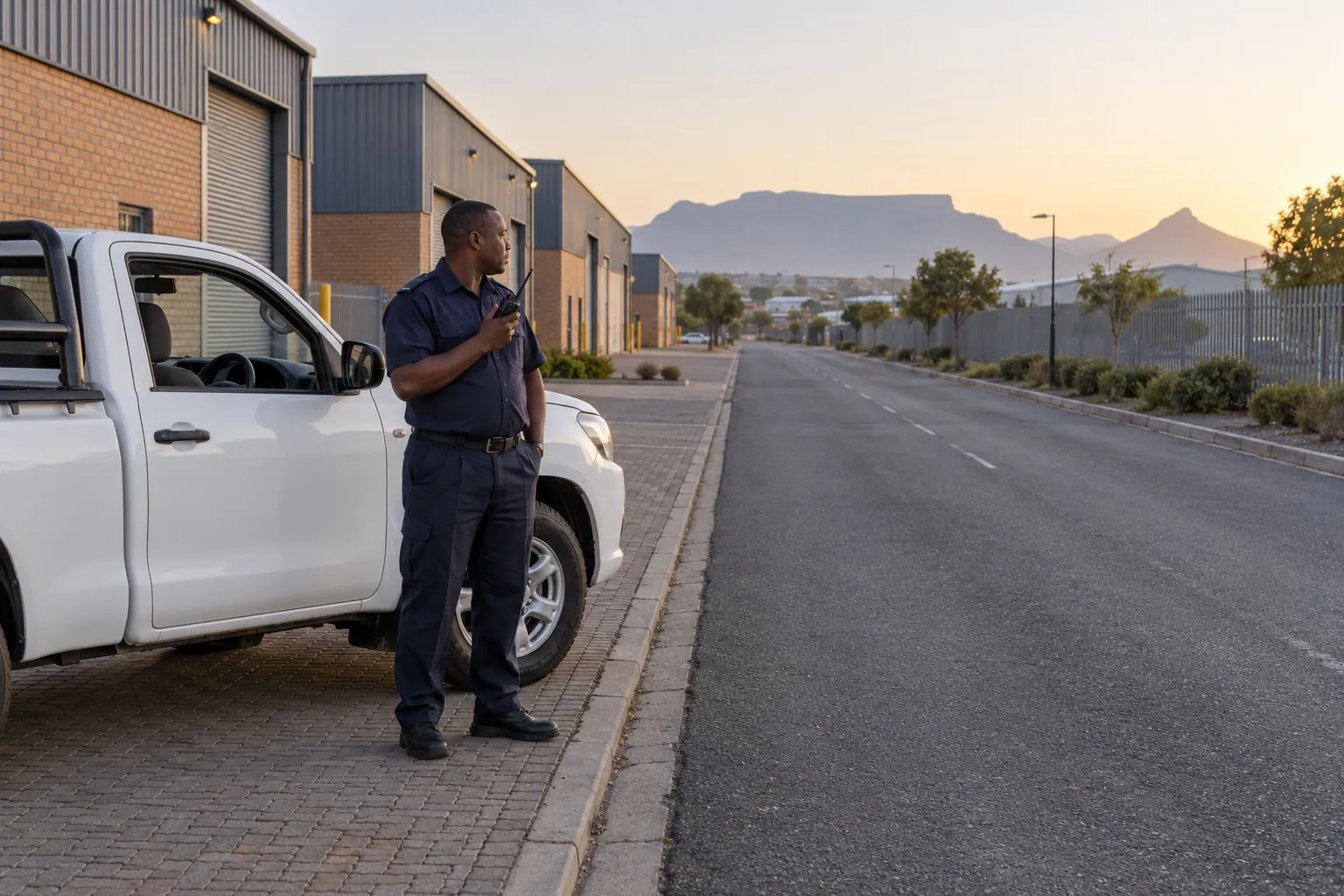
- Vehicle patrols: a bakkie, quad bike or bicycle on a site too large to walk, such as an industrial estate or a solar plant.
- Mobile patrols between sites: one crew drives between several clients' premises, checking each at agreed times.
- Armed response and estate patrols: response crews who patrol a residential area or estate between alarm activations, a reactive or response service under the Act's definition.
Whatever the type, a patrol is built from checkpoints: named locations on the route where the officer stops, checks what the site instructions say to check there, and records that they were there. For most commercial sites the checkpoints cover:
- The perimeter: palisade or wall, gates and boom gates, the electric fence and its energiser, boundary lighting, and anything left against the fence that would help someone climb it.
- Openings: external doors, roller shutters, loading bay doors, fire escapes, roof access and ground-floor windows, checked closed and secure, with no sign of forced entry.
- Vulnerable areas: stores, server rooms, cash offices, plant rooms, the generator room and the diesel tank, the water tanks, copper cable runs and anywhere holding stock worth stealing.
- Parking areas and yards: vehicles left overnight or that should not be there, pallets and skips left where they give cover or a way over the fence.
- Fire safety and faults: escape routes clear, fire doors shut, the alarm panel normal; leaks, lights out, failed gate motors and doors that will not latch.
- People: anyone on site after hours, contractors working late, and trespassers or loiterers, handled as the site instructions say.
A site with twenty checkpoints and one with five can be equally well patrolled. What matters is that the list follows the risk, not the floor plan.
03
Planning patrol routes and timing: the principles of patrolling
A patrol plan should cover the gaps the fence, lighting, alarms and CCTV leave. The principles of patrolling come down to five:
- Patrol where the risk is. Put checkpoints where a thief would want to be or would get in: the far corner of the fence, the cable trench, the back of the loading bay.
- Write it down. The route, the checkpoints, the number of patrols and the time windows go into the site instructions, so that a relief officer on their first night walks the same patrol as the regular one.
- Be unpredictable. An officer who leaves the guardhouse on the hour, every hour, tells anyone watching exactly when the back fence is unobserved. Schedule each patrol in a time window, such as "one patrol between 01:00 and 03:00", vary the start time within it, and where the layout allows, vary the direction of the route.
- Be seen and be thorough. An officer who walks past a door without trying it only looks like a patrol: each checkpoint should carry a check, not just a presence.
- Plan for the officer's safety. Section 8(2)(d) of the Occupational Health and Safety Act 85 of 1993 requires an employer to establish, as far as is reasonably practicable, the hazards attached to the work and the precautions needed, and section 8(2)(e) to provide the necessary information, instructions, training and supervision. A night patrol alone across an unlit yard needs radio contact or check calls, and a clear rule on what to do on finding an intruder.
The right number of security patrols depends on the site. A common pattern is a patrol at lock-up, patrols at intervals through the night, and a last patrol before the building opens or the shift hands over. Recent incidents, the December shutdown and load shedding, when lights, gate motors and alarms may be down, can justify more.
04
Security patrolling procedures: what the officer checks and does
Security patrolling procedures are the steps every officer follows, written into the site instructions so that they do not depend on who is on duty. A typical procedure runs:
- Before setting out: write the start of the patrol in the occurrence book, take the radio and keys, and tell the control room or secure the post.
- At each checkpoint: check what the instructions list there, look for signs of attempted entry or damage, and record the time and what was found.
- On finding a fault: deal with it if it is safe and simple, such as closing a window, and report what cannot be, so that it reaches whoever fixes it.
- On finding something suspicious: observe, report to the control room or supervisor, and call armed response or the police where the instructions say.
- On return: write the end of the patrol and anything found in the OB.
A patrol that finds an intruder is an occasion to follow the procedure, not to take risks. Regulation 8(2)(b) of the Code says a security service provider may not enter premises, search, seize property, arrest, detain or interrogate anyone unless the conduct "is reasonably necessary in the circumstances and is permitted in terms of law", and regulation 8(4) allows force only where it is reasonably necessary and lawful. The guide to security officer duties sets out those limits.
A security patrol checklist turns the site instructions into the questions asked at each checkpoint. A short one for an office park at night might read:
- Perimeter: palisade intact, no gaps, nothing stacked against it; electric fence energiser showing normal.
- Gates and booms: closed and locked; gate motor working; pedestrian gate latched.
- Building: external doors and roller shutters secure; no broken windows; fire escapes closed and clear.
- Plant: generator room locked; no diesel smell or leak; water tanks and pumps normal.
- Parking and lighting: vehicles left overnight noted; boundary and parking lights working.
- Fire: alarm panel normal; extinguishers in place; no rubbish piled against the building.
05
The security patrol log, the OB and the handover
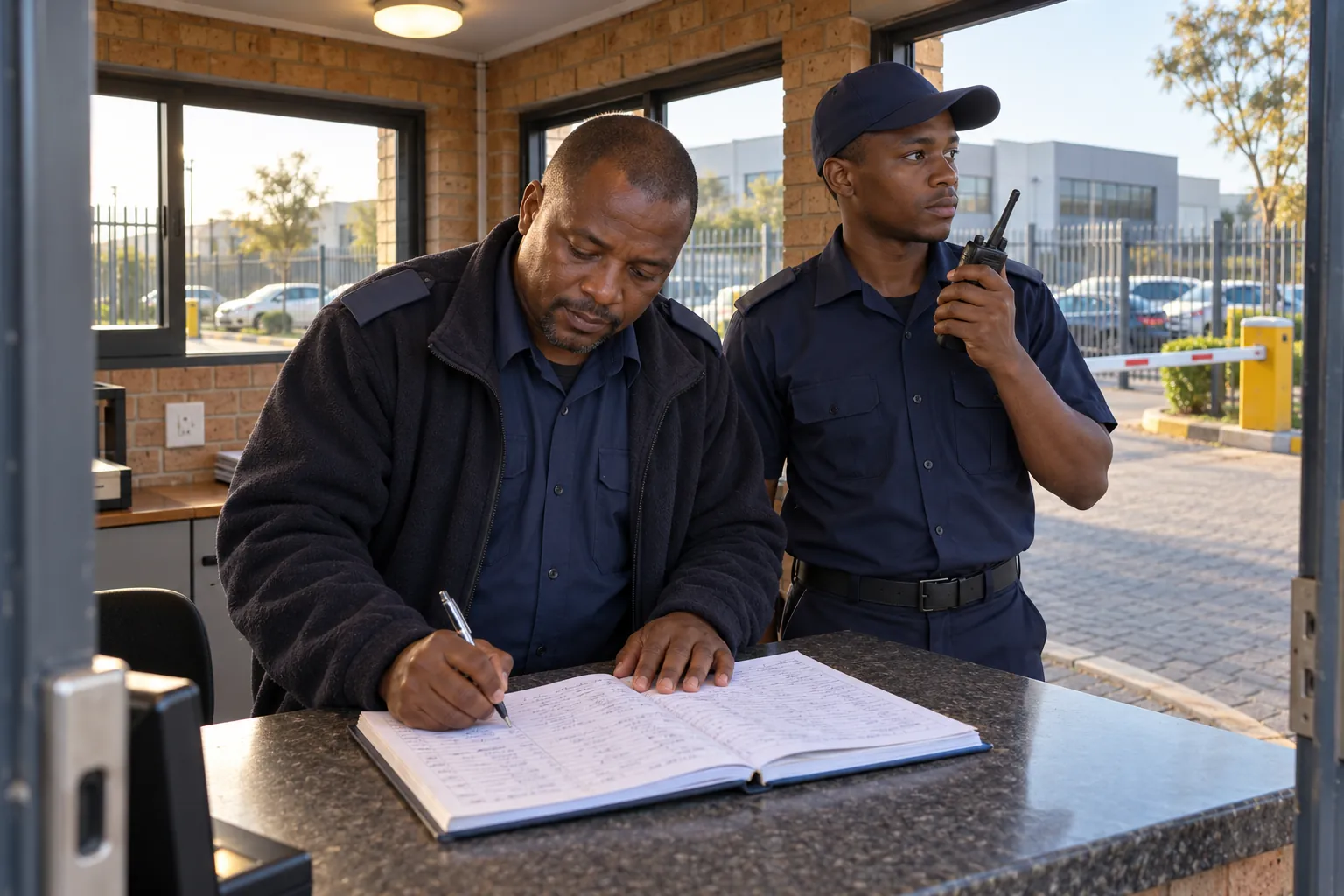
A patrol that leaves no record cannot be shown to have happened. On many South African sites every patrol is written in the occurrence book with its start and end time and anything found. A better security patrol log shows each checkpoint separately, so that a patrol that stopped halfway is visible. It records:
- the officer's name, not just the shift or the post;
- the actual time each checkpoint was reached, written at the time;
- what was found at each checkpoint, including "all correct" where it was;
- each fault or incident, with a photo where it helps, who it was reported to and when;
- any patrol or checkpoint missed, with the reason;
- a supervisor's review, so that someone other than the officer reads it.
The law sets a floor for keeping it. Regulation 10(1) of the Private Security Industry Regulations, 2002 requires every security business to keep "all the records and documents concerning the management, administration and other matters relating to the rendering of security service by it". Under regulation 10(2) they must be kept in a secure and orderly manner, available for PSIRA's inspection, for at least four years. Regulation 10(4) allows them to be kept electronically, with an accurate, dated back-up copy made separately on every day the business renders a service and a record changes or is added. Patrol logs are not named in regulation 10(7)'s list, which includes the attendance register and the daily posting sheet, but the general duty in regulation 10(1) is broad.
Patrol photos and notes can hold personal information, such as a face or a number plate, and the Protection of Personal Information Act 4 of 2013 applies to them. Section 10 says personal information may only be processed if, given its purpose, "it is adequate, relevant and not excessive": photograph the fault or the damage, not everyone who walks past.
Handover is where patrol information is most often lost. The outgoing officer should brief the incoming one on what the patrols found and what is still open, and the handover should be written in the OB with both names.
Supervisors and site managers should read patrol logs and incident reports for patterns as well as gaps: the same fire escape found open every Friday, a checkpoint always missed on one shift, a thirty-minute route walked in ten. That is the "effective control" regulation 13 of the Code asks for, and the information about supervision a client may ask for under regulation 9(2)(f).
06
Where patrol records fail, and where SiteClara fits
The usual patrol record is one line in the OB: "02:00 patrol complete, all correct". It reads the same whether the officer walked the perimeter or wrote it from the guardhouse chair, it does not say which checkpoints were reached, and a fault found on the round often stays in the book instead of reaching maintenance. The client, who pays for the patrols, sees nothing unless they ask.
SiteClara records the patrol checkpoint by checkpoint. A printed QR poster, with an optional NFC tag behind it, goes at each checkpoint: a gate, a fence corner, a fire escape, the generator room. The officer scans the code or taps the tag on their own phone, with no app to install. At each checkpoint they see the checks due there and mark each one done, or say what stopped them, and they can report a fault or incident with a photo. The time and the named officer are recorded as it happens, and a reported fault goes onto the team's list of open jobs until someone closes it.
The supervisor sees what was due, done and missed, and can record the reason a patrol was missed. Each day the supervisor reviews and approves a daily report that goes to nominated management or client contacts the next morning, showing what was reported, what was completed, what is still open and how the scheduled checks went.
07
Questions people ask
What is the purpose of a security patrol?
To prevent crime and protect people and property on the site, which is the duty regulation 8(3) of the Code of Conduct for Security Service Providers, 2003 puts on every provider. In practice a patrol detects what has changed, deters anyone watching by being seen, and finds faults and hazards before they become losses.
What are a patrolling security officer's responsibilities?
To walk the patrol the contract and site instructions set, with the skill, diligence and care regulation 9(5) of the Code of Conduct for Security Service Providers, 2003 expects of a reasonable, competent and qualified provider, and to endeavour to prevent crime and protect persons and property under regulation 8(3). Regulation 8(2)(b) forbids a search, a seizure, an arrest or a detention unless it is reasonably necessary in the circumstances and permitted in terms of law, and section 20(1)(a) of the Private Security Industry Regulation Act 56 of 2001 means only a registered security service provider may do the work for reward.
How long should a security patrol log be kept?
At least four years, if it is one of the security business's records. Regulation 10(2)(b) of the Private Security Industry Regulations, 2002 requires records concerning the rendering of the service to be kept for at least four years from the date they come into existence, available for PSIRA's inspection, unless a longer period applies.
08
Further reading, and a list to take away
PSIRA publishes the Private Security Industry Regulation Act, the Private Security Industry Regulations, 2002 and the Code of Conduct together, and the Code of Conduct for Security Service Providers, 2003 on its own. The Department of Employment and Labour administers the Occupational Health and Safety Act, and the Protection of Personal Information Act is published on gov.za. The guide to guard patrol systems compares the guard tour equipment that records each checkpoint.
Before the next patrol plan is agreed, check that:
- the routes, checkpoints, numbers of patrols and time windows are written in the site instructions and match the contract;
- every officer who patrols is registered with PSIRA and trained for the post;
- checkpoints are where the risk is, each with a short list of what to check;
- the post is covered or secured while the officer patrols, and the officer's safety on a night patrol has been assessed;
- escalation and reporting for each kind of finding are written down, with contact numbers for the control room, armed response and the police;
- each checkpoint is recorded at the time, by a named officer, with findings and faults;
- patrol records are kept for at least four years and backed up if electronic;
- handovers are written in the OB, and a supervisor reads the patrol log for gaps and patterns.
Sources
Every document this guide quotes or links to, in the order it first cites them.
Related guides
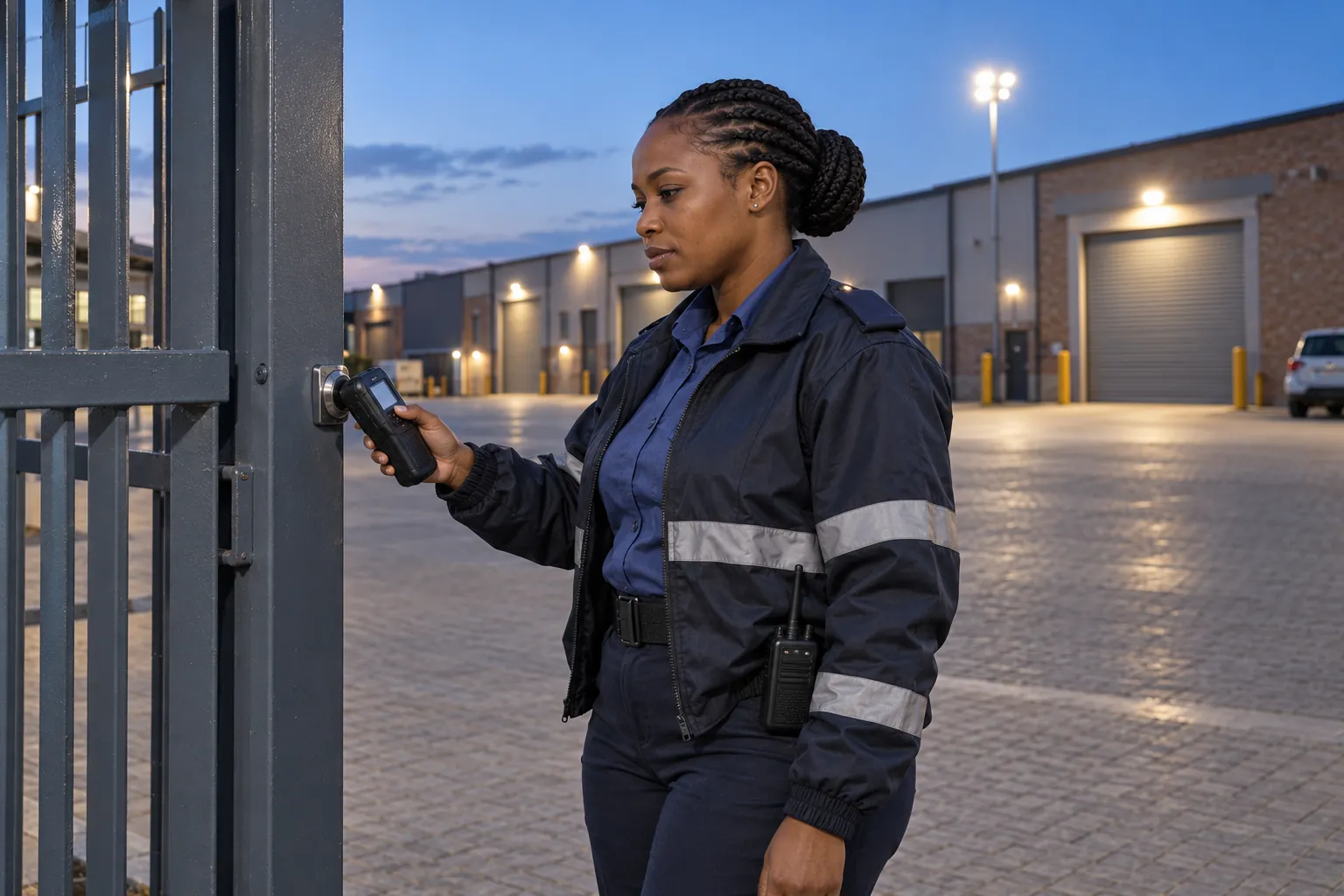 Security patrolsGuard patrol systems: how they work, what they prove, and how to choose oneHow a guard patrol system records security patrols in South Africa: wands, RFID, NFC, QR and GPS, what PSIRA and POPIA mean for the data, and what to ask.
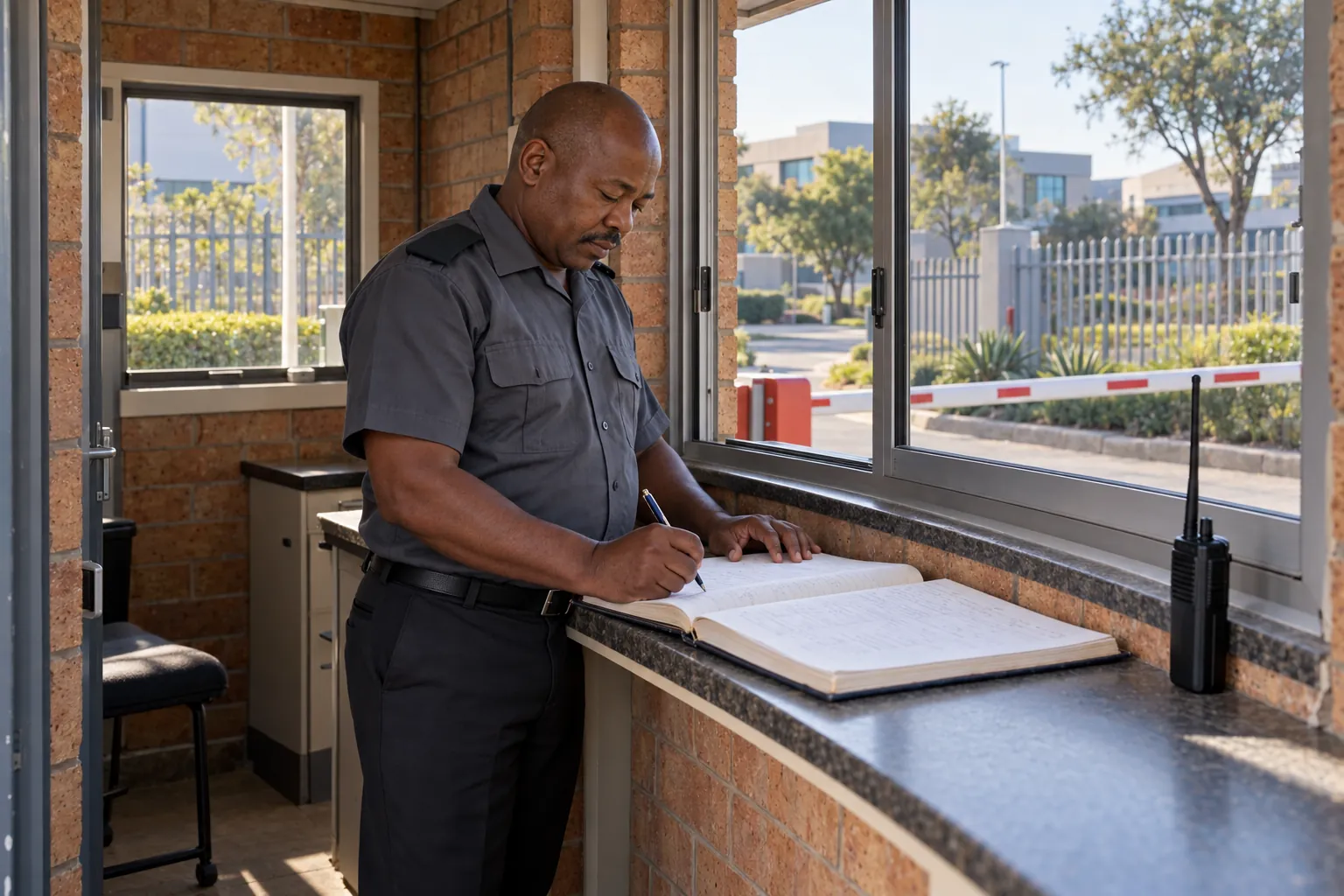 Security patrolsOccurrence book: what goes in the OB, and how to keep one that stands upThe security occurrence book (OB) in South Africa: what to record each shift, how to write entries, what PSIRA and the OHS Act require, and paper or electronic.
 Security patrolsSecurity officer duties and responsibilities: what the post involves, and how it is checkedSecurity officer duties in South Africa: PSIRA registration, patrols, access control, the OB, incidents, what officers may not do, and how duties are checked.
 Security patrolsDuties of a security supervisor: what the role involves, and what PSIRA expectsWhat a security supervisor does in South Africa: the PSIRA Code's duty to supervise, grade B, post visits, the OB, incidents, discipline and the records behind them.