Security patrols
Construction site security: what a jobsite needs, who patrols it, and how to show it was done
Construction site security is the set of measures that protect a jobsite, its tools, materials and equipment and the building going up from theft, vandalism, unauthorized access and arson: a fence and gates that lock, access control, lighting, secure storage, patrols, and a fire watch when the fire code calls for one.
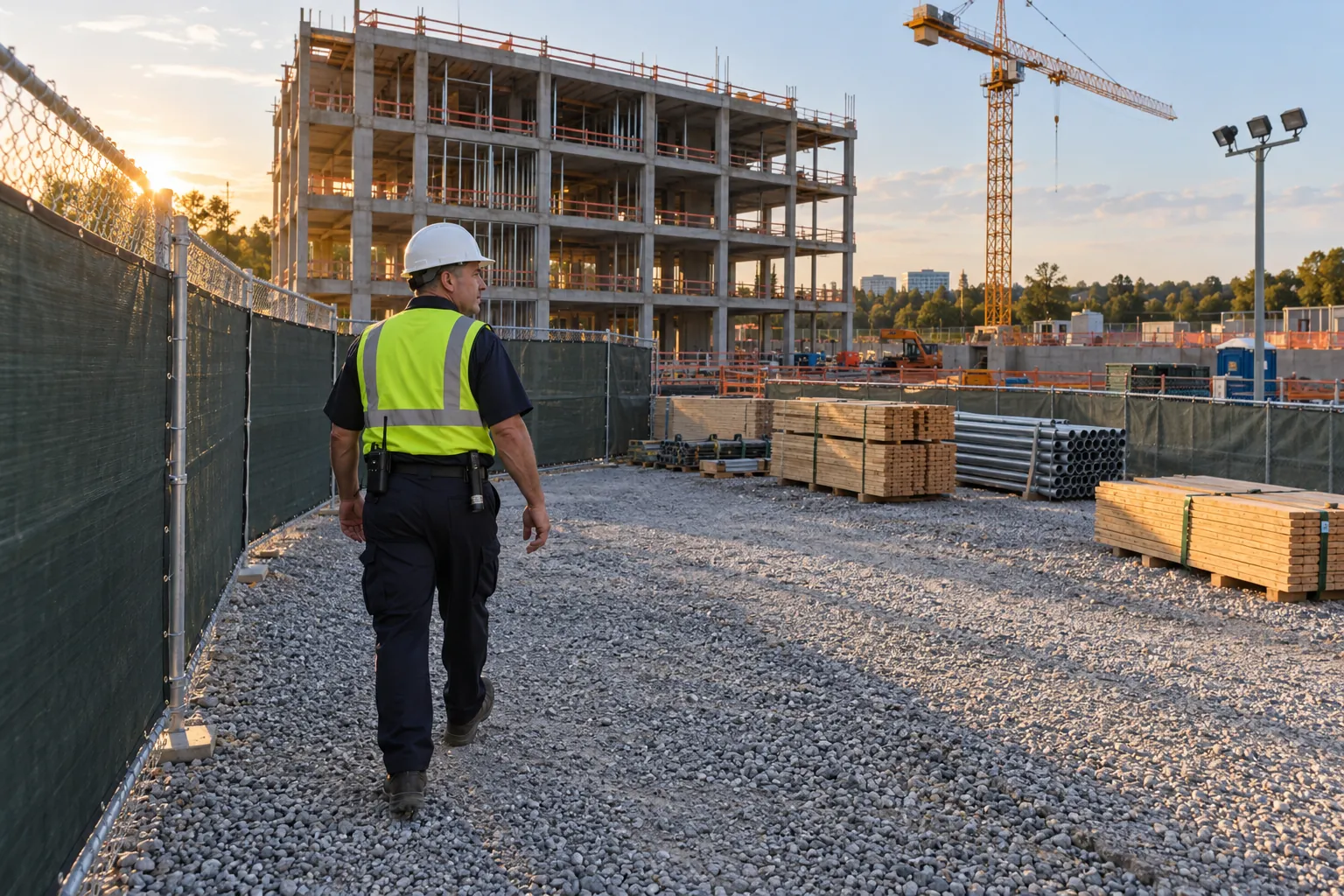
Most of it matters most in the hours when nobody is working, and most of it is never written down. This guide sets out which rules touch security on an American construction site, what a construction site security checklist should cover, how patrols and fire watch work after hours, who is responsible for what, and what a record that stands up afterward looks like.
01
What construction site security is, and which rules apply
On a jobsite, security means preventing unauthorized access, keeping tools, materials and equipment where they were left, and keeping an unfinished, often unwatched structure from being damaged or set on fire. Jobsite theft prevention is a large part of it, but not all: on construction sites the risk includes theft, vandalism, arson and injury to people who get in.
The National Fire Protection Association (NFPA) puts the risk plainly. Its Construction Site Fire Safety fact sheet, written for the 2022 edition of NFPA 241, Standard for Safeguarding Construction, Alteration, and Demolition Operations, says that "construction sites are often unsecured and are vulnerable to trespassing, which can lead to vandalism, theft, and intentionally set fires," and that they "must be safeguarded around the clock, not just when work is being done." It gives NFPA Research's annual averages for 2016 to 2020: 4,300 construction site fires a year and $376 million in direct property loss. It also notes that NFPA 1, the International Fire Code (IFC) and the International Building Code all require compliance with at least portions of NFPA 241.
No federal regulation sets out a security program for an ordinary jobsite or says it must have a guard. What does exist comes from three directions:
- OSHA's construction standards. Under 29 CFR 1926.20(b)(2), an employer's safety programs "shall provide for frequent and regular inspections of the job sites, materials, and equipment to be made by competent persons designated by the employers." Under 29 CFR 1926.24, the employer is responsible for "an effective fire protection and prevention program at the job site throughout all phases of the construction, repair, alteration, or demolition work." Neither is a security rule, but both are hard to meet on a site anyone can walk into.
- The local fire code. Chapter 33 of the IFC, "Fire Safety During Construction and Demolition," makes the owner responsible for a written site safety plan, and in the 2021 edition its listed components include "provisions for site security." Fire codes are adopted by states and cities, often with amendments, so the version that applies is the one your authority having jurisdiction (AHJ) enforces.
- The contract and the insurer. Owner-contractor agreements, builder's risk insurance policies and security services contracts often say more about guards, fencing, cameras and remote video monitoring than any law does.
OSHA covers private employers directly or through a state plan: its State Plans page lists 22 State Plans covering private sector workers, so check which applies before citing 29 CFR 1926.
02
A construction site security checklist
What security is needed on a construction site depends on its size, what is stored there, the neighborhood and how long it stands unattended. A construction site security checklist should cover each of these that applies, to protect the people and assets on site.
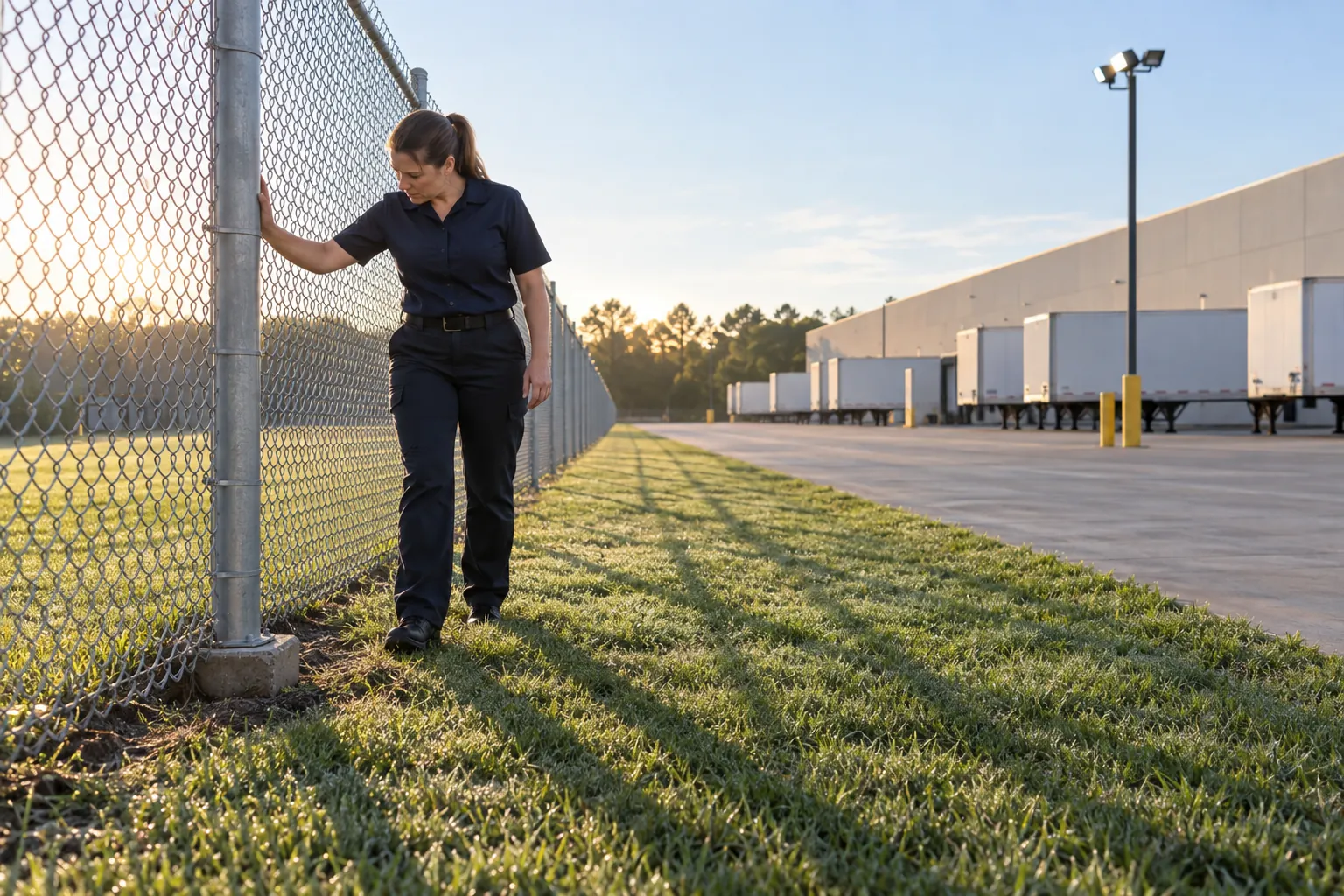
- Perimeter: fencing with no gaps at the bottom, panels clamped together, screening intact, nothing stacked against it to climb, and no trespassing signs. The perimeter security checklist covers a fence walk in detail.
- Gates: every vehicle and pedestrian gate named, with who opens it, when, and who locks it at the end of the day.
- Access control: one main entrance where possible, a sign-in for workers, visitors and deliveries, and someone who knows what to do with a person who is not on the list.
- Lighting: the gate, the storage area, the equipment parking and ground floor openings lit after dark, with failed lamps reported the same day.
- Cameras, alarms and monitoring systems: powered, aimed where they should be and not blocked by stored material, with a named person or monitoring center that responds to an alert and an agreed response time.
- Tools and materials: job boxes, gang boxes and storage containers locked; copper wire, pipe and fixtures delivered close to when they are needed; small, valuable items such as power tools locked away each night.
- Heavy equipment: keys removed and controlled, equipment parked inside the fence and away from it, and fuel storage locked.
- The structure itself: ground floor doors and windows secured where the plan or the fire code official requires it, stairs and hoists closed off after hours, ladders taken down or locked.
- Keys: who holds the gate, container and equipment keys, recorded. See key control.
- Fire safety items that overlap with security: fire department access roads clear, hydrants and fire department connections visible, combustible waste removed, and the site address and emergency number posted.
Keep each line specific. "Site secure" produces a check mark; "west gate locked, container 2 locked, excavator keys in the office lockbox, fence panel 14 re-clamped" produces a record someone can use the next morning.
03
Construction site security patrols and the fire watch after hours
A construction site security patrol covers the hours when the crews have gone home: nights, weekends and holidays. It may be an officer posted on site, a mobile patrol that visits several times a night, or the superintendent's own last walk. There is no national frequency; the site safety plan, the guard contract and the post orders are where the pattern is written down.
A sound pattern has three parts. A closing round confirms every gate, container and opening is locked and every machine secured. Night rounds vary in timing and route so they cannot be predicted from outside the fence, and each covers named points: gates, storage, the equipment yard, the fence corners and each enclosed floor. An opening round before the crews arrive looks for anything that changed overnight, before the evidence is walked over.
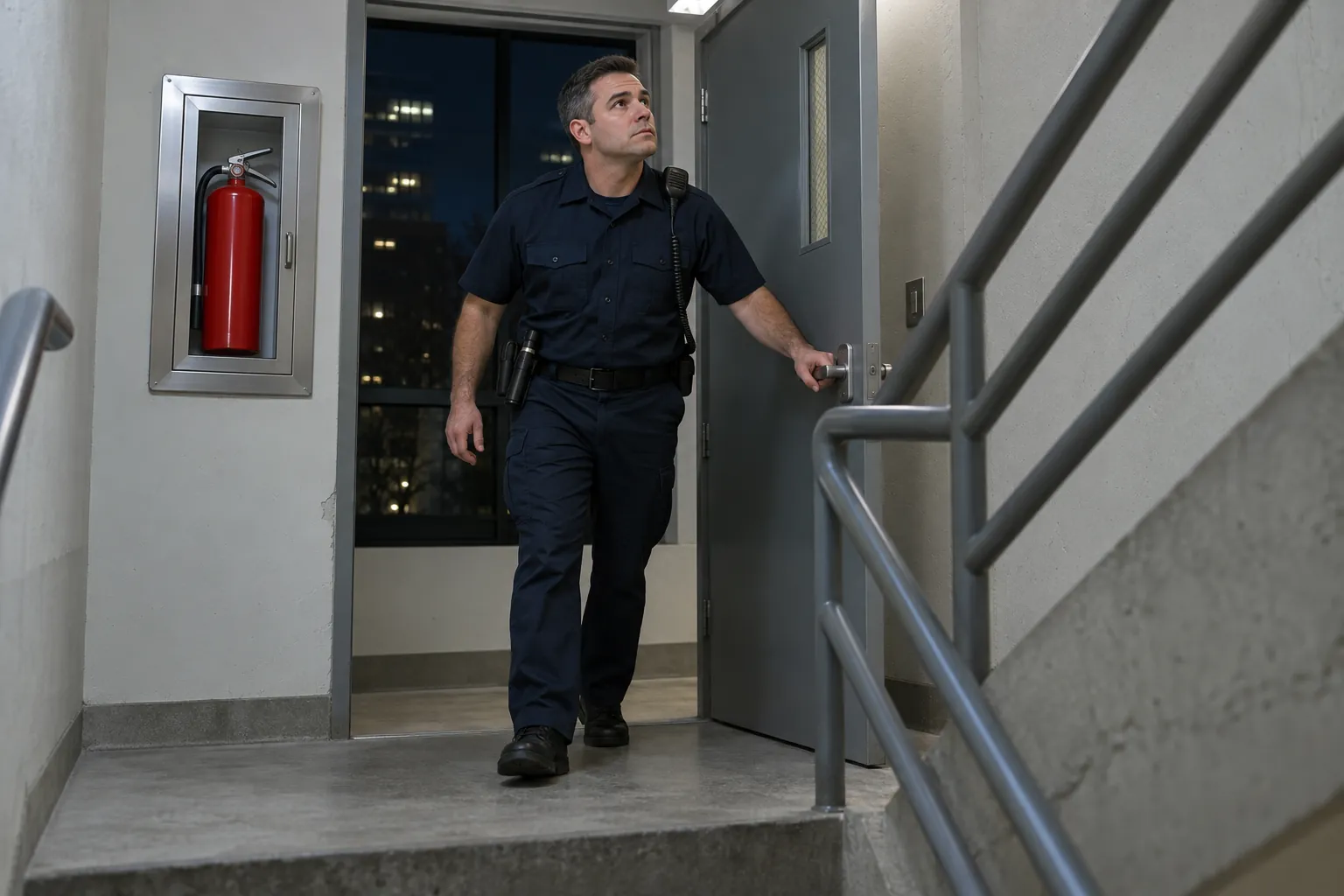
Taller and larger buildings may need a formal fire watch as well. Seattle's 2021 Seattle Fire Code, Chapter 33, which publishes the 2021 IFC with Washington State and Seattle amendments, requires a fire watch "during nonworking hours for new construction that exceeds 40 feet (12 192 mm) in height above the lowest adjacent grade at any point along the building perimeter, for new multistory construction with an aggregate area exceeding 50,000 square feet (4645 m2) per story or as required by the fire code official." The model 2021 IFC places its fire watch during construction in Section 3305.5; Washington State's amendments, carried in Seattle's code, renumber it 3303.5, and other jurisdictions amend it their own way.
The same code says "the primary duty of fire watch personnel shall be to perform constant patrols and watch for the occurrence of fire," that they must be trained, including in portable fire extinguishers, and that they "shall be provided with not fewer than one approved means for notifying the fire department." It adds that "the combination of fire watch duties and site security duties is acceptable." Where one person does both, both records still have to be kept.
Seattle's amendments also show what a fire code official can ask for: "Guard service and/or security fences shall be provided where required by the fire code official." Guards must then be trained in notification procedures "that include calling the fire department and management personnel," fire protection equipment, fire hazards, construction elevators and "any special status of emergency equipment or hazards."
Hot work carries its own fire watch, covered in the hot work permit guide; the log itself is covered in the fire watch guide.
04
Who is responsible: owner, general contractor, subcontractors and guard company
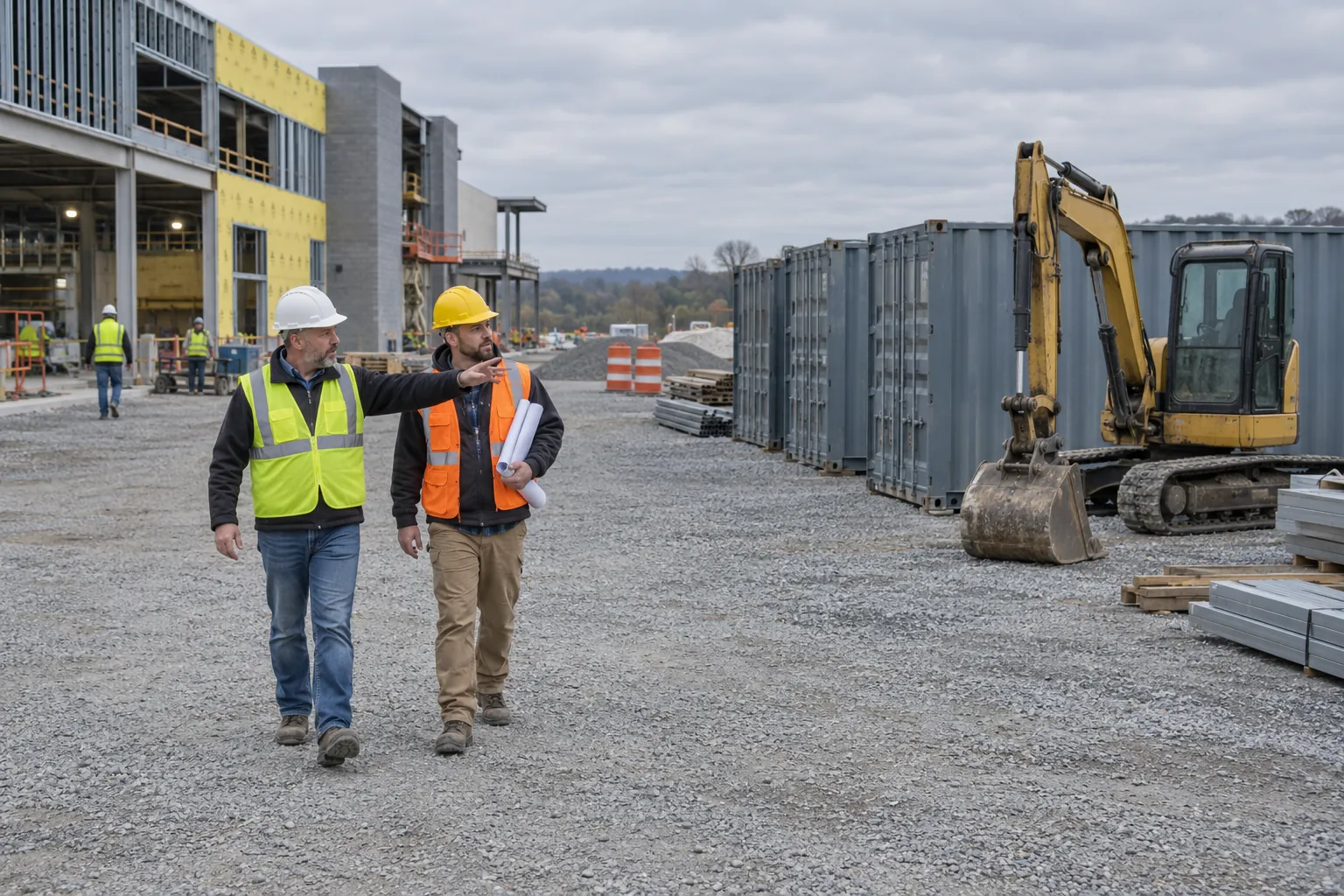
Security on construction sites often fails in the gaps between contractors. Write down who owns each piece, and share it with the whole site team.
- The owner is responsible under IFC Chapter 33 for the site safety plan, and designates a site safety director (the fire prevention program superintendent in older editions) to see it followed. The owner may hand the daily work to the general contractor by contract.
- The general contractor usually runs the gate, the sign-in, the fence, the lighting, the cameras and the guard contract, and carries OSHA's inspection and fire protection program duties for its own workers.
- Subcontractors secure their own tools, job boxes and materials, return equipment keys, and report anything missing as soon as they find it, because late reports make losses harder to trace and to claim on insurance.
- The guard company patrols as the post orders say, logs what it finds, and calls the contact list in the agreed order: superintendent, project manager, owner's representative, fire department and police as the situation needs.
Guards are licensed by the states, and the rules differ. Texas is a clear example. Under Texas Occupations Code Chapter 1702, as published by the Texas Department of Public Safety in Texas Private Security Statutes and Rules, 2023-2024 Edition, a person acts as a guard company if it provides "a private watchman, guard, or street patrol service on a contractual basis for another person" to "prevent entry, larceny, vandalism, abuse, fire, or trespass on private property" (section 1702.108), and it may not do so without a security services contractor license (section 1702.102). A noncommissioned security officer needs an individual license and must work for a company license holder (section 1702.221), and an officer who carries a firearm needs a security officer commission (section 1702.161). Section 1702.323 sets out when a business's own employees guarding its own affairs fall outside the chapter. Check the rules in the state where the site is before hiring a patrol.
05
What a good construction site security record looks like
After a theft, a fire or a trespasser's injury, the first questions are when the site was last checked, by whom and what they found. A good record answers them without anyone having to remember.
- A map of named checkpoints: gates, storage containers, the fuel area, the equipment yard, fence corners and each floor of the structure, so "container 3, northeast corner" means the same to every shift.
- Closing and opening checks, each with the person's name and the time, made at the time, not filled in at the end of the week.
- Each patrol round, with the time each checkpoint was reached. For a fire watch, Seattle's code says personnel "shall keep a record of all time periods of duty, including the log entry for each time the site was patrolled and each time a structure was entered and inspected," available to the fire code official on request.
- Findings with a photo: a cut fence, a forced container, an open second-floor window, missing wire, any sign of unauthorized entry.
- Incidents written up properly, with the police report number when the police were called. See security incident report.
- Defects that stay open until fixed: a broken gate lock or a failed light is a job with an owner, closed when repaired and checked on the next round.
The fire code's own records are separate. In Seattle the site safety director is responsible for a daily fire safety inspection of all building and outdoor areas, and "the results of each inspection shall be documented and maintained on-site until a certificate of occupancy has been issued"; failure to conduct, document and keep these inspections is a violation, and on the third offense the fire code official may issue a stop work order. Check what your AHJ requires.
Someone should read it: the superintendent each morning, the project manager each week. The same fence panel pushed in twice is a reason to move the storage, add lighting or change the patrol. On projects that run for months, that review is how the security plan keeps up with the risk as the building rises.
06
Questions people ask
Is security required at a construction site?
Not by any one federal rule; it usually comes from the fire code your city or state has adopted, and from the contract and the insurer. In the 2021 Seattle Fire Code, Chapter 33, which publishes the model code with Washington State and Seattle amendments, the owner's written site safety plan must include, as applicable, "provisions for site security," and "guard service and/or security fences shall be provided where required by the fire code official."
How often should a construction site be patrolled?
There is no national frequency for a security patrol; the site safety plan, the contract and the post orders set it. A required fire watch is different: the 2021 Seattle Fire Code, Chapter 33 calls for "constant patrols" during nonworking hours on new construction more than 40 feet tall or with more than 50,000 square feet per story, or where the fire code official requires it, with a log entry "for each time the site was patrolled."
Do construction site security guards need a license?
In most states, yes. The Bureau of Labor Statistics' Occupational Outlook Handbook entry for security guards says "most states require that security guards be licensed by the state in which they work." In Texas, for example, the Texas Private Security Statutes and Rules, 2023-2024 Edition require a guard company to hold a security services contractor license and each noncommissioned security officer to hold an individual license.
How much does construction security pay?
The Bureau of Labor Statistics does not publish a figure for construction sites alone. Its Occupational Outlook Handbook entry for security guards gives a median annual wage for security guards of $38,020 in May 2025, and $37,350 in the investigation, guard, and armored car services industry; of the industries it lists, healthcare and social assistance paid the most, at $44,920.
Is it hard to get hired as a security guard?
The requirements are modest but checked. The Bureau of Labor Statistics' Occupational Outlook Handbook entry for security guards says security guards typically need a high school diploma or equivalent, and that the basic qualifications for a state license include being at least 18, passing a background check and completing training. It projects about 157,200 openings a year for security guards and gambling surveillance officers, on average, from 2025 to 2035.
07
Where construction site security records fail, and where SiteClara fits
The usual jobsite security record is a line in the guard's daily activity report, "site secure, rounds completed," and the superintendent's memory of locking the gate. It cannot show which containers were checked, when the second floor was last walked, or whether the cut in the fence was there at midnight or only at 5 a.m.
SiteClara records the checks at the location. A printed QR poster, with an optional NFC tag behind it, goes at each checkpoint: the main gate, each storage container, the fuel area, the equipment yard, the fence corners and each enclosed floor. Whoever does the check, an officer on patrol, the superintendent on the closing round or a foreman on the opening round, scans the code or taps the tag on their own phone, with no app to install, sees the checks due there, such as "gate locked" or "container locked, no sign of forcing," and marks each one done or says what stopped them. The time and the named person are recorded as it happens, with a photo when one is asked for. A problem found on the round, a cut fence panel or a failed light, is reported there and goes onto the team's list of jobs until someone closes it.
The supervisor sees what was due, done and missed, and records the reason when a check was missed. Each day the supervisor reviews the checks and photos, adds a note and approves a report that goes to nominated contacts, such as the project manager or the owner's representative, at 8 a.m. the next morning.
08
Further reading, and a list to take away
Read the fire code your AHJ has adopted, Chapter 33 in the IFC, and ask the fire code official whether your project needs a fire watch, guard service or security fencing. NFPA's Construction Site Fire Safety fact sheet summarizes NFPA 241, which NFPA offers free to read online. For guards, read your state's private security licensing rules.
Before you sign off a construction site security plan, check that:
- the contract, the insurer's requirements and the fire code official's requirements have all been read and met;
- the site safety plan names the site safety director and includes provisions for site security;
- every gate, container, fuel area and equipment yard is a named checkpoint on a site map;
- closing and opening rounds have a named person each day, weekends and holidays included;
- night patrols are in the post orders, with their checkpoints and an irregular pattern;
- you know whether a fire watch is required during nonworking hours, and who keeps its log;
- the guard company holds the licenses your state requires;
- each check is recorded at the time by a named person, with a photo of anything found wrong;
- every defect becomes a job with an owner and is checked again after the repair.
Sources
Every document this guide quotes or links to, in the order it first cites them.
- Construction Site Fire Safety fact sheet nfpa.org
- 29 CFR 1926.20 osha.gov
- 29 CFR 1926.24 osha.gov
- State Plans osha.gov
- 2021 Seattle Fire Code, Chapter 33 seattle.gov
- Texas Private Security Statutes and Rules, 2023-2024 Edition dps.texas.gov
- Occupational Outlook Handbook entry for security guards bls.gov
Related guides
 Security patrolsPerimeter security checklist: how to inspect a fence line, its gates and the ground around itA perimeter security checklist for US sites: what a fence inspection covers, gates and barriers, how often to walk the line, and the record that shows it was done.
 Fire and water checksFire watch logs: patrolling a building while its fire protection is out of serviceWhen a fire watch is required under IFC 901.7 and NFPA 25, who can stand it, how often to patrol, and what a fire watch log should show the fire marshal.
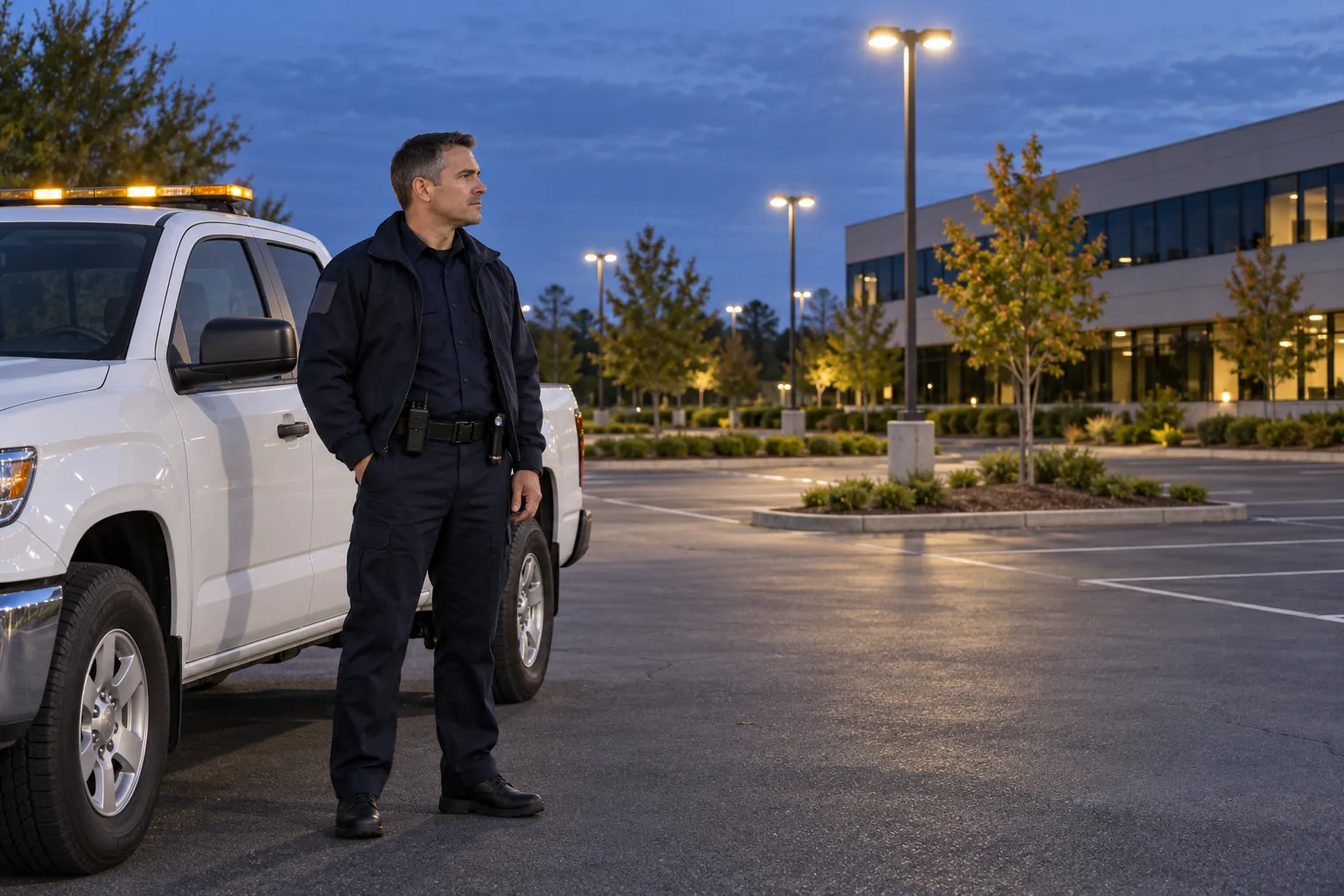 Security patrolsSecurity patrols: what they are, how to run them and how to prove themWhat a security patrol is in the US: the five common types, mobile patrol, state licensing, a patrol checklist, routes and timing, and records that hold up.
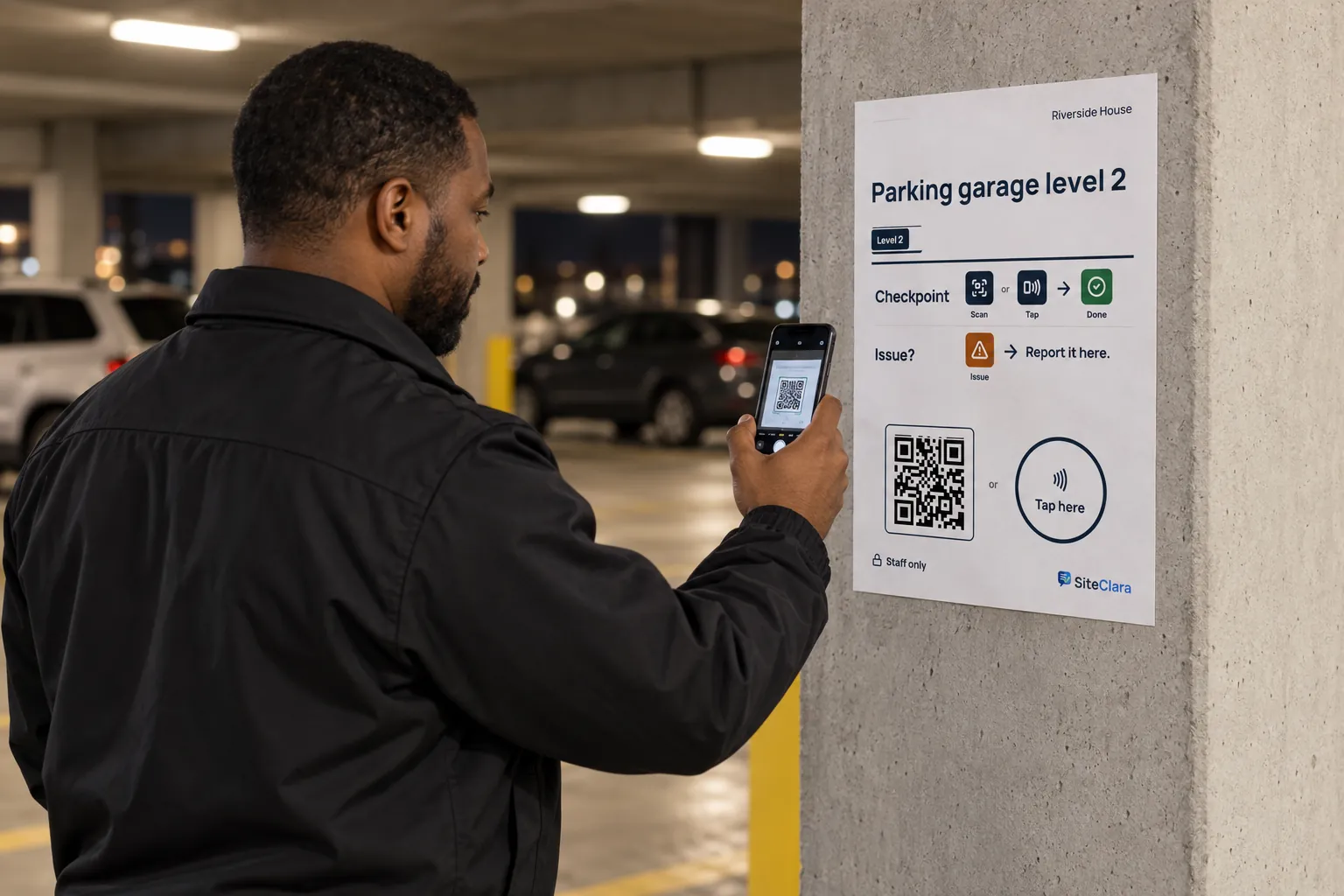 Security patrolsGuard tour systems: how they work and how to choose oneHow guard tour systems record security patrols – wands, RFID, NFC, QR codes and GPS apps – what the patrol data shows, and what to ask before you choose one.