Security patrols
Lone worker policy: what OSHA expects, and what to put in yours
A lone worker policy is an employer's written plan for keeping employees safe when they work by themselves, out of sight and earshot of coworkers: who works alone, which tasks are never done alone, how lone workers check in, and what happens when someone misses a check-in.
Also written for United Kingdom · Canada · New Zealand
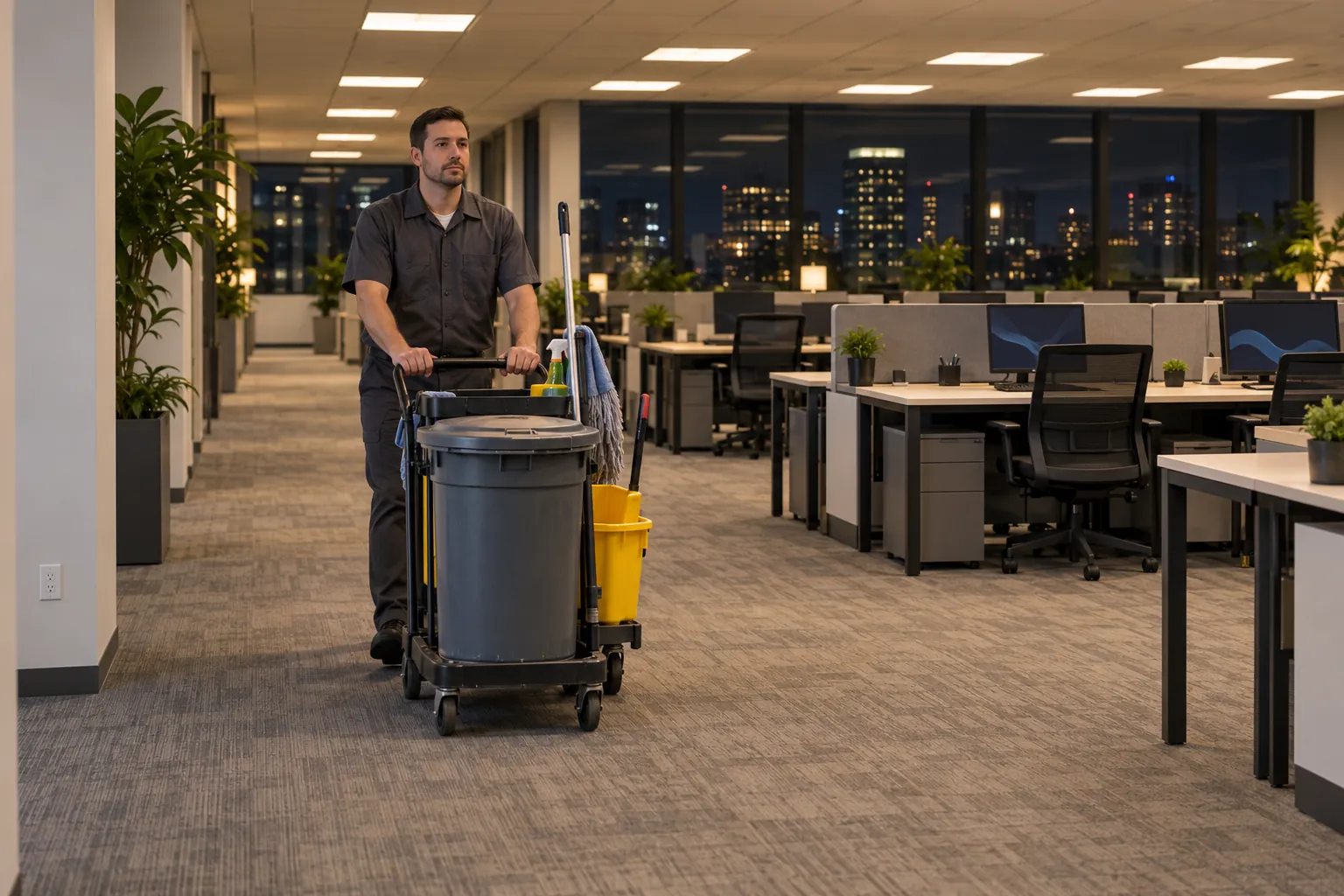
No federal OSHA standard requires a document with that name, and outside a few industries there is no general federal rule on working alone, but the General Duty Clause of the Occupational Safety and Health Act requires every employer to protect workers from recognized hazards, and working alone at night is one OSHA itself names as a risk factor for violence. This guide covers the law, the few rules that do address working alone, the hazard assessment, the check-in procedures that make a policy work for night custodians, security officers and building engineers, and an outline you can adapt.
01
What the law requires, and where a lone worker policy fits
There is no federal OSHA standard on working alone in general. In a letter of interpretation of February 22, 1999 on the working alone provisions of 1910.269, OSHA's Directorate of Enforcement Programs wrote that outside electric power generation, transmission and distribution "there is no general OSHA Standard that deals with the situation of an employee 'working alone' except in specific situations such as emergency response, interior structural firefighting, or working in permit required confined spaces."
That does not leave working alone unregulated. In an ordinary building the duties are general ones:
- Section 5 of the Occupational Safety and Health Act of 1970. Section 5(a)(1), the General Duty Clause, requires each employer to furnish "employment and a place of employment which are free from recognized hazards that are causing or are likely to cause death or serious physical harm to his employees". Section 5(b) requires employees to comply with the standards and rules that apply to their own conduct.
- The standards that apply whether or not anyone is alone, such as 29 CFR 1910.38, Emergency action plans, and 29 CFR 1910.151, Medical services and first aid.
- The few rules written for working alone, for confined spaces, shipyards and underground work, set out in section 04.
Violence is where working alone most often comes up. OSHA's workplace violence page says "There are currently no specific OSHA standards for workplace violence", but adds that "Working alone or in isolated areas may also contribute to the potential for violence", as does "working late at night or in areas with high crime rates". OSHA's workplace violence enforcement page explains that the General Duty Clause still applies where the employer or its industry recognizes the hazard and "there is a feasible method to abate the hazard."
Check the state requirements too. According to OSHA's State Plans page, there are 29 OSHA-approved State Plans: 22 cover private employers as well as state and local government workers, and seven cover only state and local government workers. State Plans must be at least as effective as OSHA, and some ask for more: California requires every employer to have a written Injury and Illness Prevention Program under Title 8, section 3203.
So a lone worker policy is not a legal form with a fixed name. It is the written part of how a business or other organization meets these general duties and regulations for the people who work on their own, with the hazard assessment behind it.
02
Who works alone in a building
OSHA's shipyard rule gives a usable description: an employee "working alone, such as in a confined space or isolated location". In the buildings that facility managers, janitorial and security contractors and property managers look after, the lone workers, people who work alone without direct supervision for some or all of a shift, are usually:
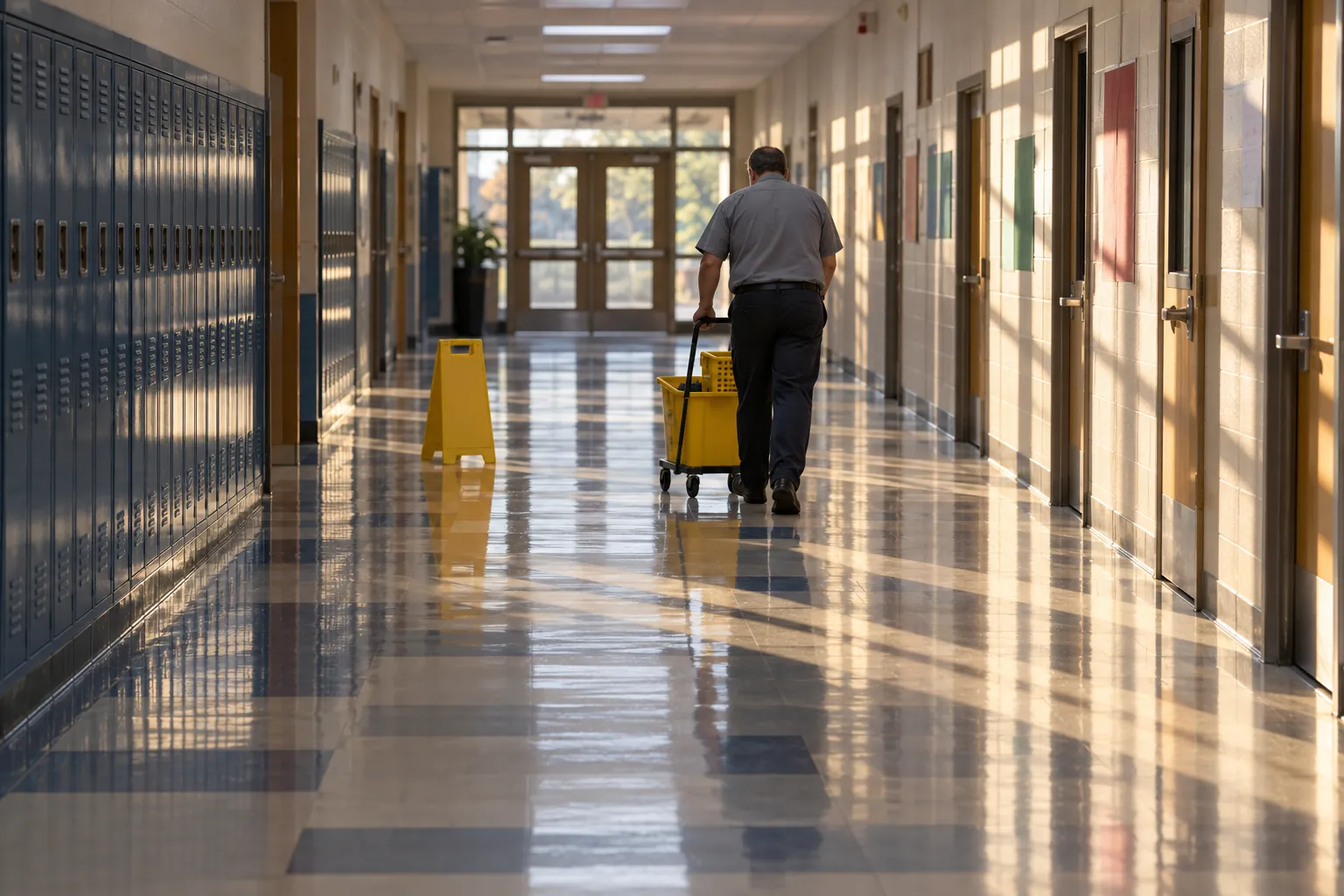
- Night custodians and janitorial crews cleaning an office tower, school or medical office after it empties, often one person to a floor.
- Security officers on a single-officer post overnight or at weekends, and mobile patrol officers driving between sites alone, including alarm response calls at remote properties.
- Building engineers and maintenance technicians in mechanical rooms, on roofs, in electrical rooms, boiler rooms and parking garages that nobody else visits.
- Day porters, concierge and leasing staff opening up before anyone else arrives, covering a desk after hours, or inspecting vacant units.
A person can be a lone worker for part of a shift. The custodian who finishes the top floor after the rest of the crew has gone down, or the officer whose relief is late, is alone when help is furthest away. Describe lone work by the situation, not only by the job title.
Contracted work needs care: the building side knows the alarms and who else may be in at 2 a.m.; the contractor knows its own people. Each employer owes the duty to its own employees, so agree in the contract, the post orders or the janitorial scope of work who answers a missed check-in and how a lone worker reaches building security or the property manager.
03
Assessing the hazards of working alone
Many organizations call this a lone worker risk assessment; OSHA calls it hazard assessment, and the work is the same: find the risks of working alone and decide how to control them. The hazard assessment decides what the policy says. OSHA's page on hazard identification and assessment calls for "a proactive, ongoing process to identify and assess such hazards", and its action items include inspecting the workplace, investigating incidents and identifying "hazards associated with emergency and nonroutine situations". For the risks associated with lone work, look at:
- The worker: experience in the job and in working alone, training, and anything that makes them more vulnerable, such as being new, a trainee or having a relevant medical condition.
- The place: isolated areas, poor lighting in parking lots and loading docks, and whether a phone or radio actually works in the basement and mechanical rooms.
- The task: lifting too much for one person, ladder and roof work, electrical work, chemicals, and asking a member of the public to leave.
- Violence: the factors on OSHA's list, including handling money, working late at night, working in a high-crime area and contact with volatile or unstable people.
- Foreseeable emergencies: fire, a fall, a medical emergency, an elevator entrapment, a power outage, an intruder.
Some work should not be done alone at all. Entry into a permit-required confined space always needs an attendant outside. Most policies add their own list: work on a roof edge or a ladder above a set height, live electrical work, moving heavy equipment, and going into a building where the intruder alarm has activated.
Involve the people who do the work. OSHA's hazard identification page says to "Have workers participate on the inspection team and talk to them about hazards that they see or report". Review the assessment when anything changes: new staff, a new site, new hours, or an incident. California's section 3203(b)(1) also requires records of inspections, naming who conducted them, what was found and what was done to correct it.
04
Check-in procedures and the rules that do address working alone
A procedure has to work at 2 a.m. with nobody to ask. The clearest model in federal law is the shipyard rule, 29 CFR 1915.84, Working alone, which applies only to shipyard employment but is written in words any policy can borrow. Whenever an employee is working alone, the employer "shall account for each employee":
- "Throughout each workshift at regular intervals appropriate to the job assignment to ensure the employee's safety and health"; and
- "At the end of the job assignment or at the end of the workshift, whichever occurs first."
It adds that the employer "shall account for each employee by sight or verbal communication." The other working-alone rules are narrower. 29 CFR 1910.146, Permit-required confined spaces, requires "at least one attendant outside the permit space into which entry is authorized for the duration of entry operations" (paragraph (d)(6)). For underground construction, OSHA's letter of interpretation of May 3, 2001 on lone employees underground quotes 1926.800(f)(5): anyone working alone underground in a hazardous location, out of voice range and not observed, "shall be provided with an effective means of obtaining assistance in an emergency."
Turn those principles into steps for your own sites:
- Checking in at the start. The worker tells a named person, or the system, when they start, where they are and when they expect to finish.
- Check-in intervals. No federal rule sets a number for most workplaces, so set them by the hazard assessment and write them down: for example, a call every hour for an officer on a quiet overnight post, and a shorter interval for higher-risk or more dangerous work.
- A missed check-in. Say exactly what happens and how quickly when check-ins stop: call the worker, call again, then send someone or call 911.
- Checking out. Someone confirms the worker has left the site safe and well; a shift that is not closed is followed up.
- A code word. If a worker can raise concern discreetly on a call, everyone involved must know the word.
Lone worker safety technology, such as apps and devices, adds a panic button, fall detection and a monitoring center, but an alert that reaches nobody is not a procedure: test who will respond, and how fast.
Emergencies need the lone worker in them. Under 1910.38, an emergency action plan must include "Procedures for reporting a fire or other emergency" and "Procedures to account for all employees after evacuation"; it must be in writing, except that "an employer with 10 or fewer employees may communicate the plan orally to employees." Under 1910.151(b), where there is no infirmary, clinic or hospital in near proximity, "a person or persons shall be adequately trained to render first aid" and supplies must be readily available.
For violence, OSHA's Recommendations for Workplace Violence Prevention Programs in Late-Night Retail Establishments (OSHA 3153, revised 2009) is advisory, but carries over to any building at night: "Use the 'buddy system,' especially when personal safety may be threatened", and make sure workers "can walk to garbage areas and outdoor storage areas without increasing their risk of assault." Add a rule that nobody confronts an intruder.

05
Writing the policy: an outline to adapt
A lone worker policy template is useful only as a list of headings; the answers come from your own hazard assessment, and the policy works only if managers implement it. A workable policy covers:
- Purpose and scope: who it applies to, including contractors, temporary staff and volunteers.
- Responsibilities: the member of senior management who owns it, the managers and supervisors who apply it, and the lone workers themselves.
- Hazard assessment: how lone work is assessed, where the assessments are kept, and when they are reviewed.
- Work that must not be done alone.
- Keeping in touch: checking in and out, intervals, devices, and the escalation for a missed check-in, with names and times.
- Emergencies: illness, injury, fire, intruders and violence, first aid, and how the lone worker fits the emergency action plan.
- Training and supervision: orientation, personal safety, the equipment provided, and how new staff are paired with someone at first.
- Reporting: incidents, near misses and concerns, and who reads them.
- Monitoring and privacy: what any app or device used to monitor lone workers records, who sees it and how long it is kept.
- Review: tests of the procedures, the review date and the version in force.
OSHA 3153 says the extent to which a violence prevention program is in writing "is less important than how effective the program is in practice", but a state may require more. In California, Labor Code section 6401.9 has required most employers to have a workplace violence prevention plan since July 1, 2024, and its violent incident log classifies, among other things, whether the employee was "working during a low staffing level, isolated or alone, unable to get help or assistance"; the log is kept for at least five years.
Monitoring lone workers involves personal information, and the rules are set by states. New York's Civil Rights Law section 52-c, for example, requires an employer who monitors employees' telephone, email or internet use to give "prior written notice upon hiring to all employees who are subject to electronic monitoring" and to post the notice. Check each state's law before an app tracks where a lone worker is.
06
Where the record fails, and what SiteClara does about it
Most lone worker policies are sound on paper. The weak point is the record of the night itself: a check-in that lives in a night supervisor's call history, a sign-in sheet at the security desk nobody reads, a patrol walked with nothing to show for it. After an incident, or when a client asks whether the building was checked, the employer often cannot say where the worker was last seen, or when.
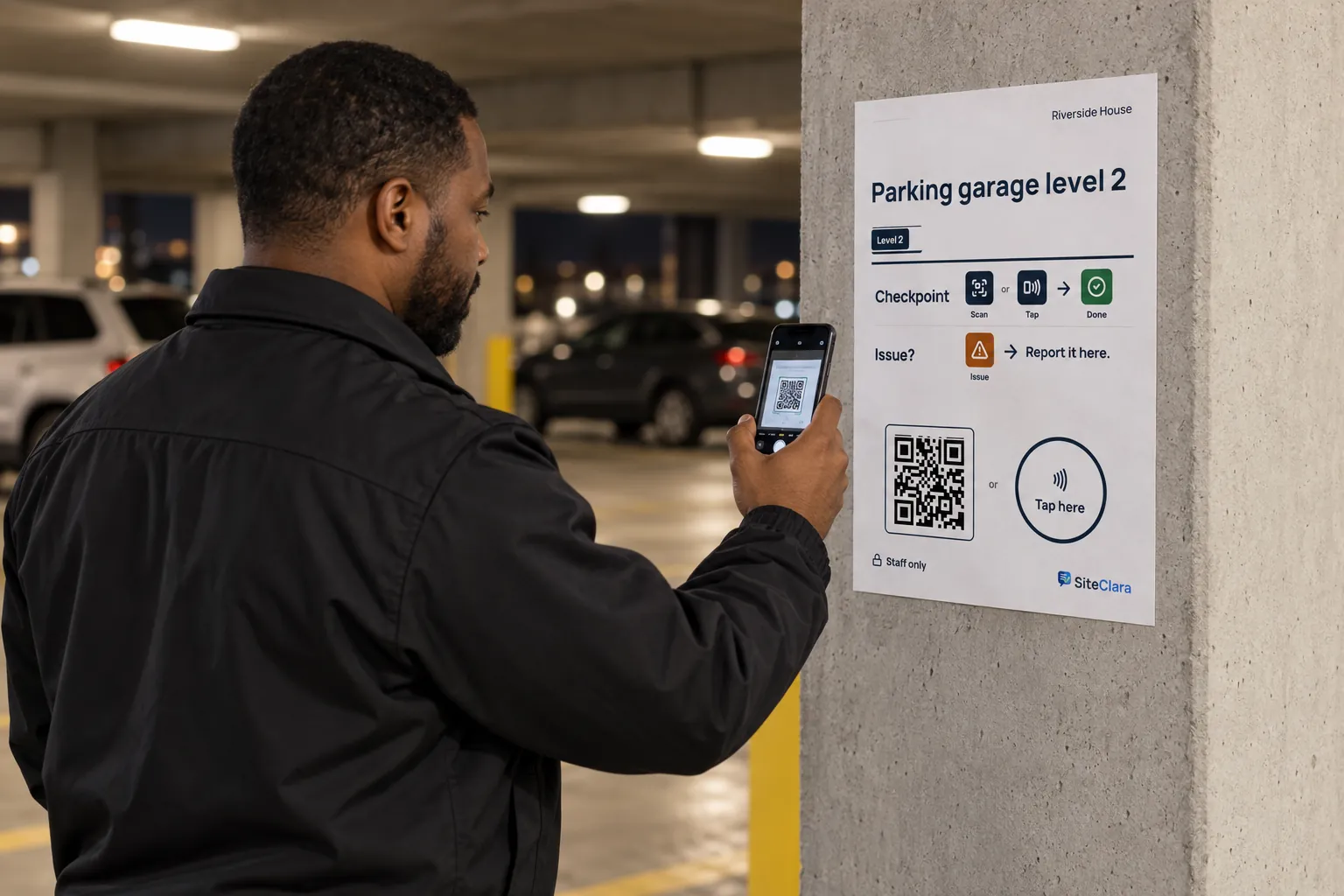
SiteClara is a record of visits and checks, not a lone worker system. A printed QR poster, with an optional NFC tag behind it, sits at each place where work is checked, such as a mechanical room, a restroom corridor or a patrol point in a parking garage. The custodian, officer or building engineer scans the code or taps the tag on their own phone, with no app to install, sees the checks due there, and marks each one done or says what stopped them, with a photo when one is asked for. Each confirmation is recorded with the named person and the time, at the location. A problem reported there, such as a burned-out light, goes onto the team's list of jobs until someone closes it.
The supervisor sees what is due, done and missed, records the reason a check was missed, and approves a daily report for the client or property manager the next morning. For a lone worker policy, that is a timed trail of where each person confirmed work during the shift, useful when reviewing an incident or the hazard assessment. Where a state requires a specific record, such as California's violent incident log, SiteClara can hold part of the working record that log is built from, but it is not the statutory log.
07
Questions people ask
Is it legal to work alone?
Yes: no federal law bans working alone in general, and in its letter of interpretation of February 22, 1999 on the working alone provisions of 1910.269 OSHA said there is no general standard on it outside a few situations such as permit-required confined spaces, emergency response and interior structural firefighting. The employer must still deal with the hazards of working alone under the General Duty Clause, and a specific standard may require a second person, as the confined space rule does with its attendant.
Does OSHA have a lone worker standard?
Not one that applies to most workplaces. The only federal rule titled working alone is 29 CFR 1915.84, which applies to shipyard employment and requires the employer to account for each lone employee at regular intervals during the shift and at the end of it, by sight or verbal communication.
Which states have lone worker laws?
No state has a general lone worker law that we know of, but some state rules touch on it in particular settings. California Labor Code section 6401.9 requires a violent incident log that records whether the employee was isolated or alone. Washington's Late Night Retail Worker Crime Prevention rule, chapter 296-832 WAC, does not mention working alone, but sets training, store safety and outside lighting requirements for "all retail businesses operating between the hours of 11:00 p.m. and 6:00 a.m." other than restaurants, hotels, taverns and lodging facilities. In a State Plan state, check its own rules as well as federal OSHA's.
08
Further reading, and a list to take away
OSHA publishes its workplace violence pages, the hazard identification and assessment guidance and the 1999 letter on working alone; the standards are on osha.gov under 29 CFR 1910, 1915 and 1926. If you have employees in a State Plan state, start from the State Plans page and read that state's own rules.
Before you sign off a lone worker policy, check that:
- lone work is in the hazard assessment, by situation as well as job title, and the findings are written down;
- the tasks that must never be done alone are listed, including confined space entry;
- every lone worker knows how to check in, how often, and what happens if they do not;
- the escalation for a missed check-in names a person and a time, and has been tested;
- lone workers are in the emergency action plan's head count, and first aid is available to them;
- contractors and building owners have agreed in the post orders or scope of work who does what at each site;
- any monitoring has been explained to workers and meets the state's rules;
- the policy has an owner, a version and a review date.
Sources
Every document this guide quotes or links to, in the order it first cites them.
- Letter of interpretation of February 22, 1999 on the working alone provisions of 1910.269 osha.gov
- Section 5 of the Occupational Safety and Health Act of 1970 osha.gov
- 29 CFR 1910.38, Emergency action plans osha.gov
- 29 CFR 1910.151, Medical services and first aid osha.gov
- Workplace violence page osha.gov
- Workplace violence enforcement page osha.gov
- State Plans page osha.gov
- Injury and Illness Prevention Program under Title 8, section 3203 dir.ca.gov
- Hazard identification and assessment osha.gov
- 29 CFR 1915.84, Working alone osha.gov
- 29 CFR 1910.146, Permit-required confined spaces osha.gov
- Letter of interpretation of May 3, 2001 on lone employees underground osha.gov
- Recommendations for Workplace Violence Prevention Programs in Late-Night Retail Establishments osha.gov
- Section 6401.9 leginfo.legislature.ca.gov
- Civil Rights Law section 52-c nysenate.gov
- Late Night Retail Worker Crime Prevention rule, chapter 296-832 WAC app.leg.wa.gov
Related guides
 Security patrolsGuard tour systems: how they work and how to choose oneHow guard tour systems record security patrols – wands, RFID, NFC, QR codes and GPS apps – what the patrol data shows, and what to ask before you choose one.
 Security patrolsPanic button testing: how to know the alarm will bring helpHow to test panic buttons in US buildings: what state laws and standards say, fixed and wearable devices, placing the alarm on test, how often, and the record.
 Security patrolsSecurity guard shift checklist: what to check from post-up to pass-downA security guard shift checklist for US sites: what to check at post-up, on each round and at shift change, the state rules behind it, and how to prove it.
 Premises and facilities managementCustodian duties: what the job involves, and how to show it was doneCustodian duties in schools, offices, churches and public buildings: cleaning, restrooms, opening and locking, safety checks, OSHA rules and a record of the work.