Security patrols
Checking PSIRA registration: how to verify a security company and its officers
A security company's PSIRA registration is verified online on the Private Security Industry Regulatory Authority's business verification, by PSIRA number or company name, and each of its officers on PSIRA's individual verification, by ID or PSIRA number.

Both checks matter because section 20 of the Private Security Industry Regulation Act 56 of 2001 says nobody may render a security service for reward unless registered. The check is not only for the security company. Under section 38(3)(g) a client who contracts for security services contrary to the Act, knowingly or without reasonable care, commits an offence. This guide is for that client, and for the facilities manager, managing agent or body corporate acting for it: what to check, where and how, how often, and what to do when a check fails.
01
Why a client has to check: sections 20 and 38(3)(g)
Registration is the gate into the industry. Section 20(1)(a) of the Private Security Industry Regulation Act 56 of 2001 says no person, other than a security service of the State under section 199 of the Constitution, "may in any manner render a security service for remuneration, reward, a fee or benefit, unless such a person is registered as a security service provider in terms of this Act". Section 20(2) goes further for a company: a security business may only be registered if everyone performing executive or managing functions, and every director, member, partner or trustee, is registered too.
The Act puts part of the duty on the buyer. Section 38(3)(g) makes it an offence for any person who "knowingly or without the exercise of reasonable care contracts for the rendering of security services contrary to a provision of this Act". On conviction the penalty is a fine or imprisonment of up to 24 months, or both. PSIRA's notice Consumer obligations in terms of the Private Security Industry Regulation Act reads it plainly: a client "must therefore make a reasonable enquiry as to the legitimacy of the security business, its officials and persons deployed by it to provide a security service, before making use of its services or to continue to use its services".
The contract itself is also at stake. Section 20(3) says a contract that is inconsistent with section 20(1) or (2) "is invalid to the extent to which it is so inconsistent". A client paying an unregistered company, or a company whose directors are not registered, is paying under a contract the Act does not recognise.
02
What to check: the company, its people and its paperwork
PSIRA's consumer awareness page and its Private Security Consumer Information Pack list what a client should establish before signing, and again before continuing to use a provider:
- The security business is registered with PSIRA, and a registration certificate "must be made available on request".
- A valid letter of good standing from PSIRA can be produced.
- Every officer deployed to render a security service is registered with PSIRA.
- Every officer's training: the information pack asks whether each officer holds "the necessary training certificates from accredited training establishments" and whether the business guarantees they are "specifically trained for the task that they have been allocated to do". PSIRA grades explains which grade suits which post.
- The employer's registrations: COIDA, the Unemployment Insurance Fund, the Private Security Sector Provident Fund (or an exemption letter and proof of another fund), the National Bargaining Council for the Private Security Sector, and SARS.
- Pay: whether guarding officers are paid at least the statutory minimum for the sector.
Registration is not only for guards. PSIRA's consumer obligations notice lists who must register, including the guarding sector, close protection officers, security advisers, response security, assets in transit, event and venue security, private investigators, security trainers, installers and repairers of security equipment such as alarms, CCTV and access control, those monitoring signals from electronic security equipment, control room operators, locksmiths and "persons managing, controlling or supervising security services". A building that buys alarm monitoring, a CCTV maintenance contract or a locksmith's call-out is buying a security service too.
Two further points often get missed. If the company brings in another security company for part of the work, regulation 9(10)(b) of the Code of Conduct for Security Service Providers, 2003 says it may do so only with the client's consent and only if that provider is registered and able to render the service. And an organisation that employs its own guards is an employer of in-house security officers: regulation 23 of the Code says it may only use employees who are registered and trained for the function, and must take "all reasonable steps necessary to verify the registration status as security service provider, level of training, qualifications" of each one first.
03
How to check a security company and an officer
PSIRA's own tools are the only reliable source. Its frequently asked questions explain that registration is verified from the PSIRA website through individual verification or business verification: "Individual verification can be done through ID or PSiRA number search. Business verification can be done through PSiRA number or company name search. Users can also check certificate status and expiry date." The same checks are in PSIRA's mobile app, linked from the consumer awareness page.
- Get the details in writing. Ask for the company's PSIRA registration number, its registered name and trading names, and the names and PSIRA numbers of the officers it proposes for the site. Regulation 9(2)(e) of the Code says a provider must give a client "the registration status as security service provider, training level and relevant conditions of service of the security officers used or to be used" whenever the client reasonably needs it to make an informed decision.
- Check the business on PSIRA's business verification, by PSIRA number rather than by name where you can, and compare the result with the name on the tender and the contract.
- Check each officer on PSIRA's individual verification, including the site supervisor and relief officers, not only the officers named in the proposal.
- Ask for the letter of good standing, and read its date. PSIRA's consumer obligations notice says the letter "is valid for a period of 90 days".
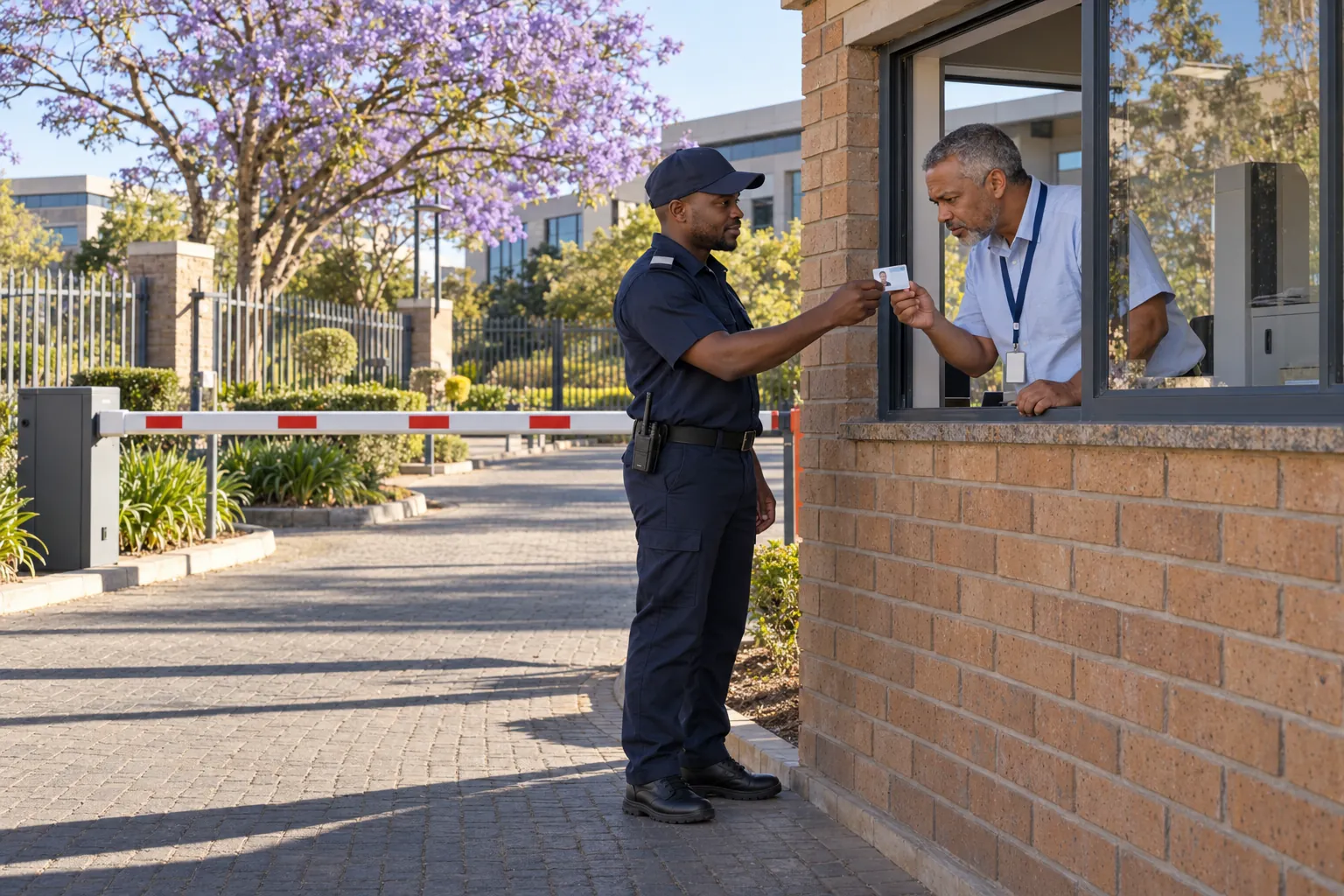
- Check the certificate on the post. Regulation 9(5) of the Private Security Industry Regulations, 2002 says an officer must always carry their certificate of identification while rendering a security service or wearing the uniform in public, and must immediately produce it when asked by a client they are serving or a person the client has authorised in writing. Refusing without sufficient cause is an offence under regulation 9(6).
- Keep a note of the check: who checked, when, and what PSIRA's result showed.
Paper can be out of date. The certificate of identification is a card with a photograph, name and registration number (regulation 9(2)), and PSIRA's FAQ says the ID card is mandatory. The separate printed ink certificate is optional and valid for 24 months, and PSIRA advises employers to use the proof of registration from the PSIRA app or website, which includes a photo, so they are "not relying on a potentially outdated printed certificate". The same FAQ says the QR code on a certificate "is active and functional" and is recommended for verifying the certificate's details on the PSIRA website. Scan it rather than trust the card.
Training is shown separately. PSIRA's FAQ says its Competency Certificate, in effect from April 2026, confirms that a registered person has completed approved training and achieved prescribed competencies, can be verified on the official verification platform, and "complements, but does not replace, registration".
04
Checking during the contract, not only at tender
A clean check at signing says little about month nine: registration can be suspended, withdrawn or allowed to lapse, and officers change. PSIRA's consumer obligations notice says "the registration status of a security service provider may change depending on the conduct by a security service provider", and asks for "continuous verification of compliance" after the provider is appointed.
The Act gives the reasons a status changes. Under section 26 PSIRA may suspend a registration where there is a prima facie case of improper conduct or of an offence in the Act's Schedule, until its own inquiry or the criminal case is concluded, and may withdraw it for false information, being found guilty of a Schedule offence or of improper conduct, no longer being fit and proper, or, for a company, a director or manager whose own registration is withdrawn. Section 26(3) is the part that matters on site: a provider whose registration is suspended "may not render any security service, unless the prior written permission of the Authority has been obtained". Section 26(5) says a registration lapses if it is not renewed, and PSIRA's FAQ adds that unpaid annual fees can mean no renewed certificate or letter of good standing, and "may lead to the suspension or even withdrawal of registration".
A practical rhythm for a site with a guarding contract:
- Every 90 days: a fresh letter of good standing, since each one is valid for 90 days. Put it in the contract as a deliverable, not a favour.
- Monthly: the list of officers who worked the site, from the provider's posting sheets, checked against PSIRA's individual verification. Regulation 10(7)(f) of the Regulations requires a posting sheet for every day of service, with each officer's name, registration number and level of training.
- Whenever a new face appears: a new officer, a reliever or a new supervisor is checked before, or on, their first shift.
- Whenever the provider changes: a new trading name, a merger or a subcontractor needs a new business check, and the subcontractor needs the client's consent under the Code.
- At each contract review: the company, its directors where you can identify them, and the letter of good standing, as at tender.
Write the checks into the site instructions and the contract, so the provider sends the list and the letter unasked and a security supervisor knows an unchecked reliever is not accepted. Security officer duties and security supervisor duties cover what goes in those instructions.
05
When a check fails
Most failed checks have an ordinary cause, such as an expired certificate or a name typed differently, but handle each the same way: record what the check showed, ask the provider in writing, and do not let the officer or company carry on until it is resolved.
- An officer not found, or shown as suspended or withdrawn: ask the provider to take them off the post and replace them with a registered officer. Regulation 9(10)(a) of the Code says a provider may not use anyone for a security service unless they are registered and have completed the required training.
- The company suspended: under section 26(3) it may not render any security service without PSIRA's prior written permission. Ask to see that permission, and plan for cover if there is none.
- No letter of good standing, or one more than 90 days old: ask why. PSIRA's notice says the letter is only issued to a provider whose registration is valid, whose account with PSIRA is up to date, whose monthly returns are in order, whose directors are registered, whose company records are up to date with CIPC and whose premises and infrastructure have been assessed.
- A company you did not contract on site: under regulation 9(10)(b) a subcontractor needs your consent. Ask who they are and check them as you would the main provider.
Report what cannot be resolved. PSIRA's consumer awareness page says complaints about unregistered or untrained officers and unregistered businesses can be made at any PSIRA office, through the PSIRA app or in writing by email to its complaints office, and that contraventions of the Code of Conduct can be reported to PSIRA by email; its helpdesk is 086 133 3850. The PSIRA Code of Conduct guide explains how PSIRA enforces it.
Keep the record of what you checked and what you did: dated checks, a written query and a replaced officer are what a client can point to when asked whether it exercised reasonable care.
06
Where the record fails, and where SiteClara fits
A registration check answers one question: is this company, and this named officer, registered today. It cannot say who actually stood at the gate on Saturday night. The officers checked at tender are not always the officers on the post; the reliever who covered a shift may never appear on the list the client was sent; and the occurrence book may show one handwriting from start to finish. Monthly checks then test a list the provider wrote, not the people who did the work.
SiteClara records the work at the place it is done. A printed QR poster, with an optional NFC tag behind it, is fixed at each checkpoint: the main gate, the loading bay, a fire escape, the generator room. The officer scans or taps with their own phone, with no app to install, and marks the scheduled check done or records what stopped them. The time and the named officer are recorded as it happens, with a photo when one is asked for, and a fault found goes onto the team's list of open jobs until someone closes it.
The supervisor sees what is due, done and missed and records why a check was missed. Each day they review the totals and photos, add a note and approve a report that goes to nominated client or management contacts at 08:00 the next morning. A client with that report can compare the names on the rounds against the officers it has checked with PSIRA, and ask about any name it has not seen.
07
Questions people ask
Does a security company have to be PSIRA registered?
Yes. Section 20(1)(a) of the Private Security Industry Regulation Act 56 of 2001 says no person, other than a security service of the State, may render a security service for remuneration, reward, a fee or benefit unless registered as a security service provider. Section 20(2) adds that a security business may only be registered if everyone performing executive or managing functions, and every director, member, partner or trustee, is registered too.
How do I register a new security company with PSIRA?
By applying to PSIRA under section 21 of the Private Security Industry Regulation Act 56 of 2001. The application must come with the fingerprints of every person performing executive or managing functions and of each director, member, partner or trustee, the application fee PSIRA determines, and any other document PSIRA requires. PSIRA may grant it if the Act has been complied with, and under section 20(2) those people must be registered themselves before the business can be.
08
Further reading, and a list to take away
The Private Security Industry Regulation Act 56 of 2001 is on gov.za; sections 20, 26 and 38 are the ones a client needs. PSIRA publishes the Private Security Industry Regulations, 2002, the Code of Conduct for Security Service Providers, 2003, its notice on consumer obligations, the Private Security Consumer Information Pack and its frequently asked questions. The verification links and the mobile app are on its consumer awareness page.
Before you sign, and while the contract runs, check that:
- the business is registered, checked by PSIRA number on PSIRA's business verification;
- a letter of good standing less than 90 days old is on file, with the next one diarised;
- every officer, supervisor and reliever on the site has been checked on the individual verification;
- each officer's training suits the post they fill;
- the contract requires the posting sheet list and a fresh letter of good standing without asking;
- no subcontractor works on the site without your written consent and a check of its own;
- alarm monitoring, CCTV, access control and locksmith contractors are registered too;
- each check is recorded with the date, who did it and what PSIRA showed.
Sources
Every document this guide quotes or links to, in the order it first cites them.
- Private Security Industry Regulation Act 56 of 2001 gov.za
- Consumer obligations in terms of the Private Security Industry Regulation Act psira.co.za
- Consumer awareness psira.co.za
- Private Security Consumer Information Pack psira.co.za
- Code of Conduct for Security Service Providers, 2003 psira.co.za
- Frequently asked questions psira.co.za
- Business verification digitalservices.psira.co.za
- Individual verification digitalservices.psira.co.za
- Private Security Industry Regulations, 2002 psira.co.za
Related guides
 Security patrolsPSIRA grades: what grades E to A mean, and which grade a post needsPSIRA grades E to A explained for clients and security providers: where the grades come from, what each covers, which grade a post needs and how to check it.
 Security patrolsThe PSIRA Code of Conduct: what it requires, and how a client can hold a provider to itThe PSIRA Code of Conduct for Security Service Providers, 2003 for clients and security companies: who it binds, what it requires and how PSIRA enforces it.
 Security patrolsSecurity officer duties and responsibilities: what the post involves, and how it is checkedSecurity officer duties in South Africa: PSIRA registration, patrols, access control, the OB, incidents, what officers may not do, and how duties are checked.
 Security patrolsDuties of a security supervisor: what the role involves, and what PSIRA expectsWhat a security supervisor does in South Africa: the PSIRA Code's duty to supervise, grade B, post visits, the OB, incidents, discipline and the records behind them.