Cleaning
Hospital cleaning: what the norms and the national IPC manual expect
Hospital cleaning is the planned environmental cleaning of a hospital's wards, theatres, toilets, kitchens and public areas, done to a schedule so that the risk of infection to patients, staff and visitors is kept as low as possible.
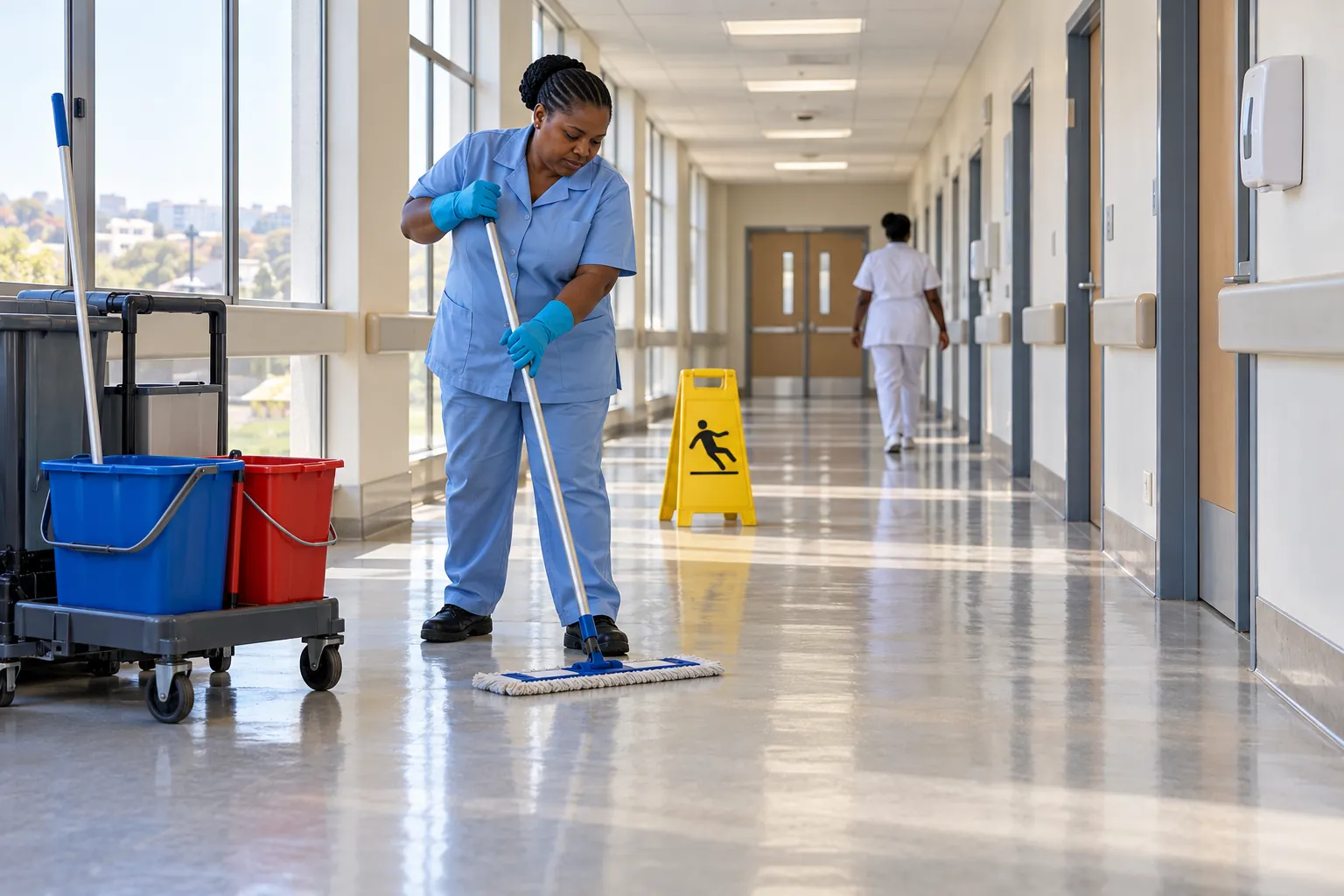
In South Africa, regulation 8 of the Norms and Standards Regulations Applicable to Different Categories of Health Establishments requires a health establishment, to the extent the National Department of Health's measurement tools apply it, to maintain an environment that minimises the risk of disease outbreaks and the transmission of infection to users, health care personnel and visitors. How that is done is set out in the National Department of Health's infection prevention and control (IPC) guidance: planned schedules, detergent before disinfectant, colour-coded equipment, terminal cleans and checklists signed by the cleaner and the supervisor. This guide is for the facilities managers and hospital managers responsible for that work, and for the contract cleaning company that provides the cleaning services, and covers the law, the method, who does what and how the cleaning is checked.
01
The law behind hospital cleaning
The starting point is the Norms and Standards Regulations Applicable to Different Categories of Health Establishments, Government Notice R. 67 in Government Gazette 41419 of 2 February 2018, made under section 90(1A) of the National Health Act 61 of 2003. They came into operation 12 months after promulgation (regulation 23) and apply to health establishments "to the extent specified in the measurement tools" issued by the National Department of Health (regulation 2).
No regulation in R. 67 uses the word cleaning. The duty is an outcome, in regulation 8(1): the health establishment "must maintain an environment, which minimises the risk of disease outbreaks, the transmission of infection to users, health care personnel and visitors". Regulation 8(2) adds hand washing facilities in every service area, isolation units or cubicles, and clean linen. Other duties land on the cleaning and facilities teams too:
- Regulation 9: waste handled, stored and disposed of safely, with containers at the point where it is generated.
- Regulation 14: a maintenance plan for the buildings and grounds, and emergency exits kept clear at all times.
- Regulation 20: compliance with the Occupational Health and Safety Act, 1993.
- Regulation 21: a register of all adverse events.
Compliance is inspected by the Office of Health Standards Compliance (OHSC). Its frequently asked questions say it has "a legal mandate to inspect all health establishments at least once every four years", public and private, and that its enforcement actions include a fine, a written warning or a recommendation to close the whole or part of an establishment.
Cleaning staff are also employees. Section 8(1) of the Occupational Health and Safety Act 85 of 1993 requires a working environment that is safe and without risk to health, as far as is reasonably practicable, and the Regulations for Hazardous Biological Agents, 2022 include work in health care, "including isolation and post-mortem units", in their indicative list of work where exposure to a hazardous biological agent can occur. Where the cleaning is contracted out, the contractor is the cleaners' employer, and the hospital usually sets out the split of safety duties in a section 37(2) agreement.
02
What hospital cleaning covers, and who cleans what
The National Department of Health's Practical Manual for Implementation of the National Infection Prevention and Control Strategic Framework (March 2020) has a chapter on environmental cleaning, written "for the cleaning workforce, whether these are in-house or out-sourced contractors". It says all clinical and non-clinical areas must be cleaned: floors, walls, windows, beds, curtains, utensils, furniture and waste bins.
In practice a hospital cleaning contract or in-house housekeeping department covers:
- Wards and patient rooms: floors, beds, mattresses, lockers, over-bed tables, chairs and curtains, including the gap between bed and mattress, which the manual says is often missed.
- High-risk areas: the manual lists operating theatres, ICUs and neonatal ICUs, transplant and oncology units, trauma and emergency, milk kitchens, isolation rooms and sluice rooms.
- Toilets and bathrooms, the patients' and the public ablution facilities.
- Kitchens and food service areas, which must also meet the Regulations Governing General Hygiene Requirements for Food Premises (R638 of 2018) and hold a certificate of acceptability.
- Public areas: entrances, waiting areas, corridors and lifts.
- Waste: emptying and relining bins, and moving health care waste to the storage area.
The manual draws one line that every contract should repeat: there must be "clearly defined areas of (cleaning) responsibility for both the cleaners and nursing staff". Cleaners generally clean and maintain non-clinical equipment; nursing staff clean clinical equipment, such as monitors, pumps and patient care articles, unless those tasks are delegated by mutual consent and the cleaners are trained for them.
03
The method: detergent first, colour coding and the order of work
The manual's main instruction surprises people outside health care: routine use of a disinfectant "is strongly discouraged", because it is wasteful and promotes antimicrobial resistance. Most routine cleaning is done with water, a neutral detergent and friction. A disinfectant is used where it is indicated, and only after thorough cleaning: for a terminal clean after an infectious patient, for a blood spill, and in the high-risk areas, where its Table 14 allows a wipe-over with a 1 000 ppm hypochlorite solution after detergent and water, as the IPC team recommends. Its other rules for the method include:
- Order: from the least soiled to the most soiled area, from top to bottom, and from the furthest point towards the entrance, leaving infectious patient areas for last.
- Damp, not dry: dust with a damp cloth and a damp (not wet) mop. Dry dusting, feather dusters and brooms only move dust about and are not recommended.
- Two buckets, clean and used, the water changed per bed space in a high-risk area or once it is discoloured.
- Spray the cloth, never the surface, which can irritate the lungs and put contamination into the air.
- Cloths and mop heads changed daily, or per bed space in high-risk areas, and washed in detergent, at 60 °C or more in a machine; flat mops are preferred to string mops.
Colour coding keeps equipment from carrying contamination between areas. The manual's scheme is red for toilets, showers, sluice rooms and bathroom floors; blue for general areas such as wards and offices; green for bathroom and ward basins, baths and showers; white for kitchens; and yellow for isolation areas. Buckets, cloths and mops follow the same colours, and the manual recommends colour-coded gloves and aprons too. Chemicals stay in their original or properly labelled containers, never in cold drink or milk bottles, and belong in the risk assessments the Regulations for Hazardous Chemical Agents require.
04
Schedules, frequencies, deep cleans and terminal cleans
The manual says cleaning should be planned, with a cleaning schedule drawn up for each area that includes all its equipment, fixtures and fittings. "Most areas of a health facility will require at least daily cleaning." Frequently touched surfaces, such as door handles, light switches, bed rails, patient monitors and equipment buttons, are "a high-risk for cross-transmission" and must be cleaned more often. Among its routine frequencies:
- floors daily, and at once after a spill (blood and body fluid spills have their own procedure, below);
- bathrooms and toilets daily, and toilets through the day to a schedule;
- all horizontal surfaces daily;
- waste bins emptied and relined with new plastic liners, and washed with detergent at least weekly or whenever they leak;
- kitchen fridges and cupboards emptied and wiped out at least weekly.
Deep cleaning, often called spring cleaning, reaches what the daily routine does not: walls from the top down, air vents, grilles, light fittings and curtain tracks, and beds pulled out so the floor beneath and every part of the frame and mattress can be cleaned.
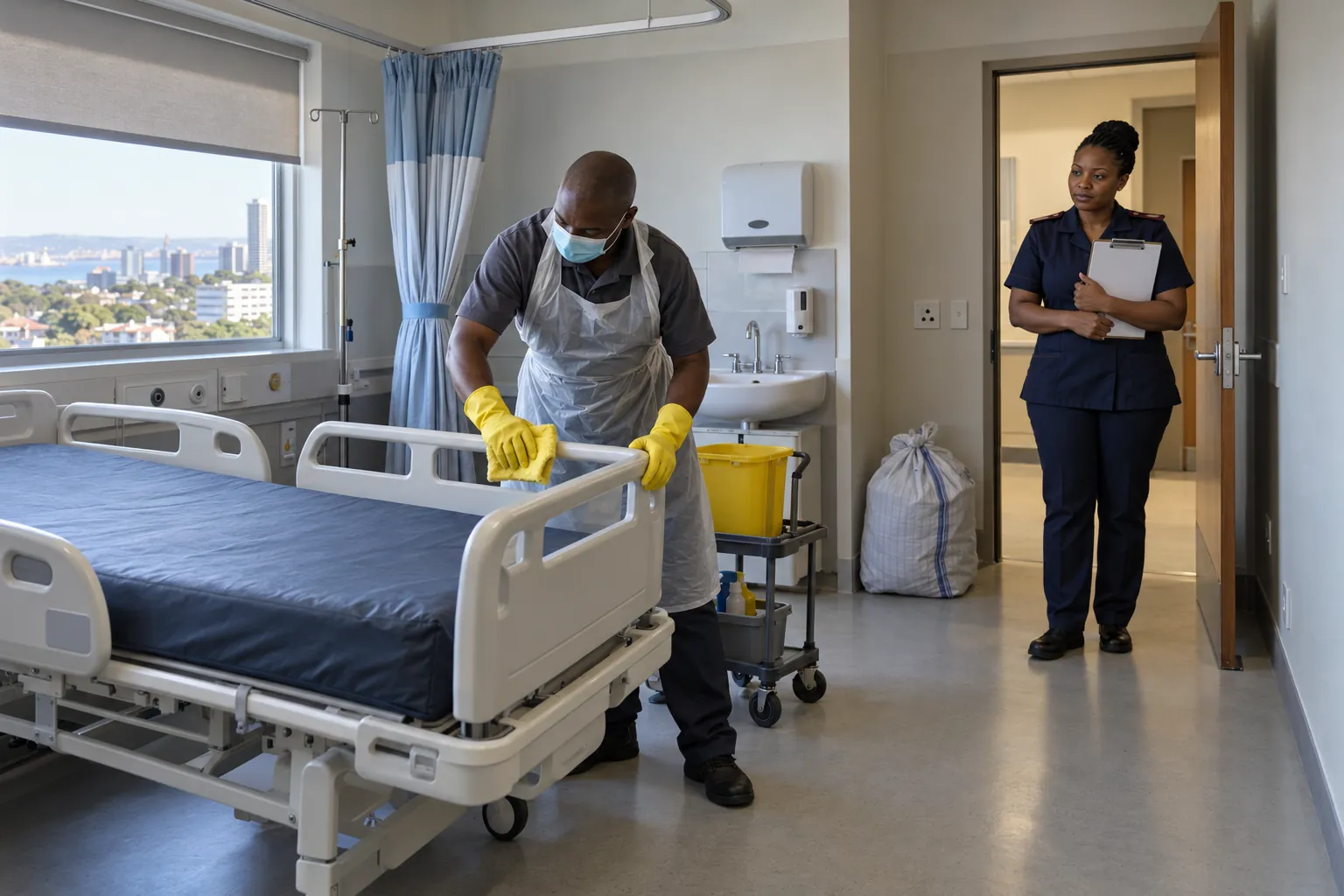
Terminal cleaning is done by cleaners after a patient with an infectious disease has been discharged from a ward or isolation room. Nursing staff notify the cleaners that the room is ready. The cleaners wear the PPE the precautions call for, use only equipment coded for isolation rooms, bag the linen and curtains, treat all the waste as health care risk waste, and clean every surface with detergent and water before the disinfectant. The manual's checklist (Table 32), from the switches and door handles to the mattress, castors and en-suite, must be completed and signed by the IPC co-ordinator or the unit or facility manager before another patient is admitted. The isolation signs stay up until the IPC team has checked the room.
05
How hospital cleaning is checked, and what a good record looks like
The manual is specific about sign-off: "Cleaning checklist must be put up in all areas. Cleaners must sign the checklist after having cleaned. After carrying out checks, supervisors must co-sign the checklists at least daily." Checklists are aligned to the cleaning schedule, with the cleaner's signature at every session and the supervisor's every day. That is the everyday record of a hospital's cleaning, and the one a cleaning supervisor is judged on.
The manual's Table 33 sets out how cleaning is monitored:
- Performance observations by cleaning supervisors, at least weekly, and more often with new cleaning staff.
- Visual assessments by supervisors and the IPC or hygiene committee.
- Fluorescent markers, which show under UV light whether a marked surface was wiped. The manual suggests marking at least 5% of beds each week in a hospital of 150 beds or more, and at least 15 beds or patient care areas in a smaller one, with 10 to 15% in the first year of monitoring if resources allow.
- Laboratory cultures: expensive, the gold standard for residual contamination, and usually kept for outbreaks.
Whatever the method, the frequency must be one the hospital can keep up, so results can be compared over time, and feedback to cleaners and managers is essential.
The people matter as much as the surfaces. The manual requires cleaners to be trained for their area, with training records available for inspection, and for isolation rooms it makes the staff member in charge of housekeeping ensure that procedures are in place and that all housekeeping staff are familiar with the infection control policies and procedures. The Regulations for Hazardous Biological Agents require the employer to train staff before they are exposed (regulation 4), review its risk assessment at least every two years (regulation 6) and keep records of both (regulation 9). Cleaners wear domestic rubber gloves, not examination gloves, and the manual says a cleaner may refuse to work in an infectious area without the right PPE.
Waste is collected from the wards every day in closed trolleys washed at the end of each round, and health care risk waste is stored in a locked, vermin-proof area, with SANS 10248-1, Management of healthcare waste, Part 1, as the standard for its containers and storage.
06
Where the cleaning record fails, and what SiteClara does about it
A co-signed checklist is only as good as the moment it was signed: a sheet on the ward door can be filled in for a whole shift at once. The National Department of Health's own draft National Infection Prevention and Control Strategic Framework (March 2020), published by the NICD, reports the Ideal Clinic assessment of 3 467 public primary health care facilities in 2018/19: the measure that cleaning schedules are available for all areas averaged 81%, but "all work completed is signed off by cleaners and verified by the manager or delegated staff member" averaged 73%, toilets clean, intact and functional 53%, and disinfectant, cleaning materials and equipment available 32%. Those are clinics, not hospitals, but the pattern is familiar: the schedule exists, and the proof lags behind it. A broken dispenser written on a sheet has told nobody who can fix it.
SiteClara replaces the sheet with a tag at each place that is checked: a printed QR poster, with an optional NFC tag behind it, at the ward toilet, the sluice room, the waiting area or the waste store. The cleaner scans or taps it on their own phone, with no app to install, and completes the check there; the time and the named person are recorded as it happens, and a check can ask for a photo. A fault such as a leaking tap or a broken paper towel dispenser is reported on the spot, with a photo if it helps, and stays on the team's list of open jobs until someone closes it.
Scheduled checks are set per location. Staff see what is due there and mark a check done, or say what stopped them, such as a room still occupied or no cleaning materials. The supervisor sees what was done and what was missed, gives the reason for a missed check, and approves a daily report that goes to the hospital's facilities manager or other nominated contacts at 08:00 the next morning: what was reported, completed and still open.
07
Questions people ask
What is hospital cleaning called?
In South African health care guidance it is called environmental cleaning: the National Department of Health's Practical Manual for Implementation of the National Infection Prevention and Control Strategic Framework has a chapter under that name, and calls the cleaners housekeeping or domestic staff.
What are the duties of a cleaner in a hospital?
Under the National Department of Health's Practical Manual for Implementation of the National Infection Prevention and Control Strategic Framework, a hospital cleaner cleans the areas and non-clinical equipment on the cleaning schedule, from the least soiled to the most soiled area and from top to bottom, with the right colour-coded equipment, signs the checklist after cleaning, handles waste and linen safely, and terminally cleans isolation rooms when nursing staff say they are ready. The manual also requires hand hygiene at the beginning and end of each shift, after removing gloves and between tasks, and the PPE the area calls for.
What skills do I need for hospital cleaning?
The National Department of Health's Practical Manual for Implementation of the National Infection Prevention and Control Strategic Framework says all cleaning staff must be trained in the correct methods of cleaning and disinfection for their job category, including the right equipment, the use of detergents and disinfectants, the methods for each area and infection prevention and control, and that records of the training must be kept and be available for inspection. Staff in isolation wards must be trained for that work too.
Do hospital cleaners disinfect everything?
No. The National Department of Health's Practical Manual for Implementation of the National Infection Prevention and Control Strategic Framework says the routine use of a disinfectant in the environment is strongly discouraged, because it is wasteful and promotes antimicrobial resistance; soap or detergent, water and friction are the first step. A disinfectant is used after thorough cleaning where the IPC team says it is indicated, such as a terminal clean after an infectious patient.
08
Where to read the official guidance, and a list to take away
The Norms and Standards Regulations Applicable to Different Categories of Health Establishments and the National Health Act 61 of 2003 are on gov.za. The method is in the National Department of Health's Practical Manual for Implementation of the National Infection Prevention and Control Strategic Framework, chapters on environmental cleaning and health care waste. The OHSC explains inspections in its frequently asked questions. SANS 10248-1 is sold by the SABS. Provinces and hospital groups publish their own IPC manuals, so check which one your hospital follows.
For a hospital, or a hospital cleaning contract, check that:
- every area has a written cleaning schedule covering its equipment, fixtures and fittings, with frequencies set by risk;
- the contract and the ward routines say which equipment cleaners clean and which nursing staff clean;
- buckets, cloths and mops follow one colour code, and cloths and mop heads are changed and laundered daily;
- cleaners sign after each session and the supervisor checks and co-signs every day;
- terminal cleans are requested by nursing, done to the checklist and signed off before the next admission;
- training records and hazardous biological agent risk assessments are current for every cleaner, in-house or contracted;
- every fault is reported to someone who will fix it, and stays open until it is fixed.
Sources
Every document this guide quotes or links to, in the order it first cites them.
- Norms and Standards Regulations Applicable to Different Categories of Health Establishments gov.za
- National Health Act 61 of 2003 gov.za
- Frequently asked questions ohsc.org.za
- Occupational Health and Safety Act 85 of 1993 gov.za
- Regulations for Hazardous Biological Agents, 2022 labour.gov.za
- Practical Manual for Implementation of the National Infection Prevention and Control Strategic Framework health.gov.za
- Draft National Infection Prevention and Control Strategic Framework nicd.ac.za
Related guides
 CleaningCleaning schedule: what to clean at work, how often, and how to show it was doneWhat a workplace cleaning schedule should cover in South Africa, which tasks are daily, weekly or monthly, who does what, and how to show the schedule was kept.
 CleaningCleaning supervisor duties: what the role involves, and what good looks likeWhat a cleaning supervisor does in South Africa: the main duties, a typical shift, the OHS Act, managing the team, checking the work and reporting to the client.
 CleaningCleaning contract: what to put in it, and how to show the service was deliveredWhat a contract cleaning agreement in South Africa should include: scope, specification, standards, Sectoral Determination 1 wages, the 37(2) agreement, evidence.
 CleaningHazardous chemical agents: what the 2021 regulations mean for cleaning chemicalsWhat the Regulations for Hazardous Chemical Agents, 2021 require of cleaning chemicals: the assessment, the SDS file, labels, the store, training and records.