Fire and water checks
SANS 10139: maintaining, testing and recording a fire alarm system
SANS 10139 is the South African National Standard code of practice for the design, installation, commissioning and maintenance of fire detection and alarm systems in non-domestic premises, published by the SABS, and the current edition is SANS 10139:2021 (edition 4).
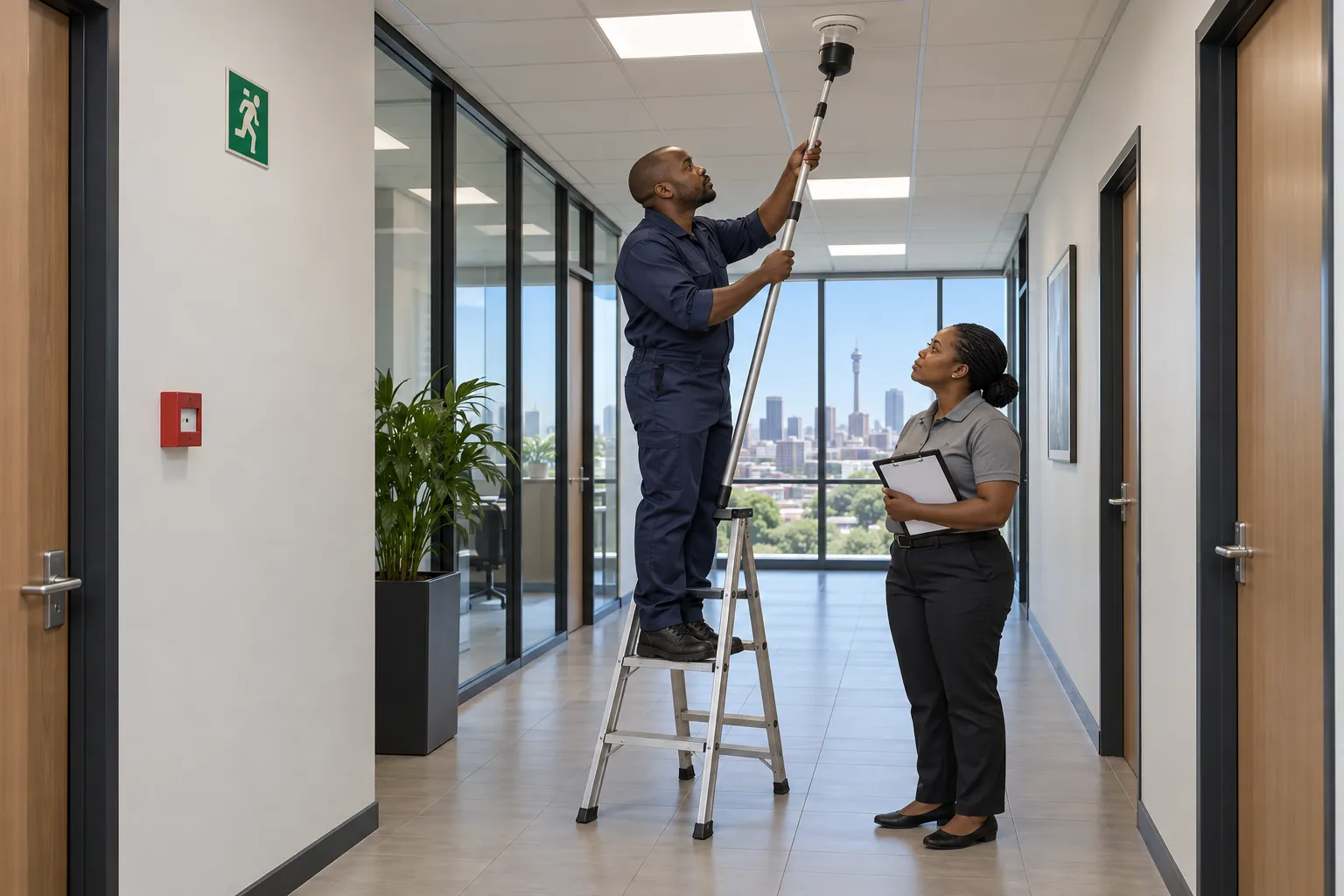
Like any SANS it is voluntary until a law calls it up, and for maintenance that is usually the fire by-law of the municipality where the building stands: eThekwini's, for example, sets the testing and maintenance interval for fire alarm and detection systems "as per SANS10139". This guide covers when the standard applies, what the system includes, the routine tests done on site, servicing by a registered competent person, and what the log book and service record should show.
01
What SANS 10139 is, and when it applies
SANS 10139:2021, Code of practice for design, installation, commissioning and maintenance of fire detection and alarm systems in non-domestic premises is published by the South African Bureau of Standards. The SABS describes it as providing "recommendations for the planning, design, installation, commissioning and maintenance of fire detection and fire alarm systems in and around buildings, other than dwellings". Edition 4 was approved on 3 May 2021 and replaces edition 3.02 of 2012. It is a paid document, so this guide cites it and does not reproduce it.
A South African National Standard is voluntary until a regulation, a by-law or a contract calls it up. Three layers of law matter here:
- National workplace law. Section 8(1) of the Occupational Health and Safety Act 85 of 1993 requires every employer to provide and maintain, as far as is reasonably practicable, a safe working environment. Regulation 13J(2) of the General Safety Regulations, 2025 (Government Notice 5954 of 6 March 2025) requires fire-fighting equipment to be provided and "maintained in good working order". Neither names SANS 10139.
- The National Building Regulations. Part T (fire protection), read with SANS 10400-T, applies when the building is designed and its plans approved, and two of the by-laws below refer back to it.
- The municipal fire by-law. Fire safety in a building in use is municipal, and this is where SANS 10139 is most often called up for maintenance, testing and records.
Three metros show how the by-laws differ:
- eThekwini (Durban). Section 26 of the eThekwini Fire By-law, 2022 requires a fire detection or alarm system to comply with SANS 10400 Part T where applicable, and to be "designed, installed, and maintained by a competent person". Section 31(1) requires fire protection systems to be installed, inspected, tested and maintained "on a regular basis by a competent person, registered with the relevant controlling body recognised by the municipality", with service records kept, and Table 2 gives the interval for fire alarm and detection systems as "Varies as per SANS10139", read with the manufacturer's specifications.
- City of Cape Town. Section 18(1) of the Community Fire Safety By-law, 2002 requires the owner or person in charge to ensure that a fire protection system "is tested and maintained on a regular basis and that a detailed record of such tests and maintenance of the system be kept". Section 18(3) requires it to be maintained in accordance with the National Building Regulations (T2) "read in conjunction with a recognised national code or standard". Its definition of a fire protection system includes any device or system designed to detect a fire or alert occupants or the fire service.
- City of Johannesburg. Section 16 of the City of Johannesburg Emergency Services By-laws covers every "service installation", which the by-law defines to include a "fire detection, locating or alarm system". The owner must ensure each one is maintained in good working condition by a competent person, serviced in accordance with the manufacturer's specifications, and inspected "by an appropriately registered and competent person at least once every 12 months".
02
What a fire detection and alarm system includes
Maintenance to SANS 10139 covers the whole fire detection system, not only the panel at reception or in the guardhouse:
- the fire panel and any repeater panels at reception, the control room or the guardhouse;
- automatic detectors: smoke and heat detectors in offices, corridors, ceiling voids, plant rooms, stores and the basement parking;
- manual call points on escape routes and at final exits;
- sounders and visual alarm devices, including those in ablutions, plant rooms and the loading bay;
- power supplies: the mains, the charger and the standby batteries;
- the link to whoever monitors the alarm: a monitoring company, an on-site control room or an armed response provider;
- the interfaces it drives: fire doors released from hold-open devices, lifts, ventilation shutdown and access control.
The work divides in two. The owner, person in charge or responsible person, and the facilities, maintenance and security staff who act for them, keep the system in use: they check the panel, run the routine tests, record faults and false alarms, and call in the servicer. The fire detection company, whose technicians are the competent, registered persons the by-laws describe, does the inspection, servicing, repairs and anything that changes the system. Write that split into the service contract, so routine tests do not fall between the owner, the managing agent and the security provider.
03
The routine checks between services
The routine that keeps a fire alarm system honest is short and frequent. The user checks and their intervals for your system come from SANS 10139 and the manufacturer, so ask your fire detection company to write them into the service contract or the log book. On most sites they come down to two things, often set as daily and weekly checks:
- A daily look at the panel. Someone, often the security officer on the first patrol or the receptionist at opening, confirms the panel shows normal operation and no fault, disablement or battery warning. Anything else is written up and reported to the servicer the same day.
- A regular call point test. A trained member of staff operates one manual call point with its test key, confirms the panel shows the right zone and the sounders work, then resets the system. A different call point is used each time, in rotation, so that over time every call point in the building has been proved.
Both Cape Town (section 18(2)) and eThekwini (section 31(2)) require the occupants to be told the start and completion times before a system that alerts them to a fire is tested, and Cape Town adds the parties who monitor the system. A sensible routine for the call point test:
- Pick the next call point on the numbered rotation list, not the one beside the panel.
- Notify the occupants and the monitoring company or control room of the start time.
- Operate the call point with its test key, rather than breaking the glass.
- Check the panel shows the correct zone. A panel that names the wrong area sends people and the fire service the wrong way. On an addressable system the panel also names the device, so check it is the call point you operated.
- Confirm the sounders were heard across the building, including ablutions, plant rooms, the basement and the guardhouse. Keep the alarm short.
- Reset the call point and the panel, and check it returns to normal with no faults.
- Confirm the monitoring company received the signal, and tell the occupants the test is over.
- Record the test in the log book, including anything that did not work.
A sounder that did not operate, a wrong zone on the panel or no signal at the control room is a fault. Record it and report it to the fire detection company straight away; a fault left until the next service visit could be a fault for months.
04
Inspection and servicing by a registered, competent person
Routine tests by site staff prove only what they exercise: one call point, the panel and the sounders. The detectors, batteries and charger, the programmed cause and effect and the interfaces are for the fire detection company, at the intervals SANS 10139 and the manufacturer recommend for your system. eThekwini's by-law points to exactly that; Johannesburg's sets a floor of an inspection by an appropriately registered and competent person at least once every 12 months.
Only a competent person should service the system, and the by-laws say more than that. Section 32(c) of the eThekwini by-law says a person may not service, install or maintain any fire protection system "unless such person is registered with the relevant controlling body recognised by the Municipality". Before appointing or renewing a fire detection company, ask to see each technician's current registration for fire detection work, and check the servicing covers every item in the list above.
At the end of each visit the servicer should leave a written record. The by-laws say what it must contain:
- Johannesburg, section 16(2): the person who inspects, services or repairs a service installation must certify in writing that it is "fully functional" and give that certificate to the owner, or, if it cannot readily be repaired to a functional state, notify the Chief Fire Officer in writing without delay.
- Cape Town, section 18(5): the person maintaining the system must inform the owner or person in charge in writing "of any defects discovered, maintenance performed or still outstanding".
- eThekwini, section 31(4) and (5): the system must be certified as functional or the owner and the Chief Fire Officer told in writing of outstanding defects, and the owner must have those defects attended to promptly.
When the system, or part of it, is out of service, the municipality must be told. eThekwini's section 31(6) requires the owner or person in charge to notify the Municipality immediately, and Cape Town's section 18(6) the controlling authority (the chief fire officer, a municipal manager or their delegates), when the system or a component of it is rendered inoperable or taken out of service, and again when it is restored. Both by-laws cover a component as well as the whole system, which can include a zone isolated for building work or hot works. Isolating zones, moving detectors after a refit and changing the cause and effect are all for the fire detection company.
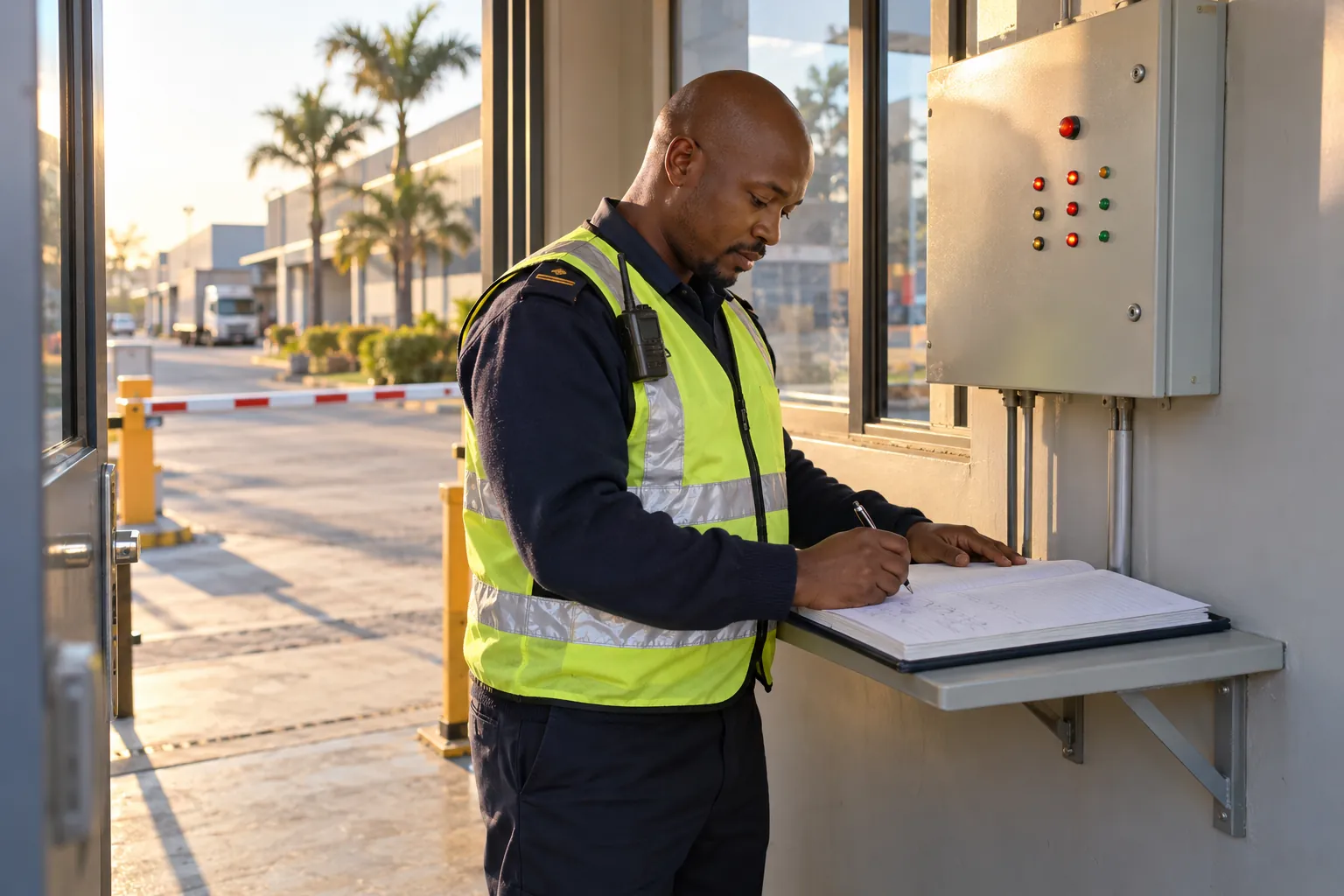
05
The log book and the service record
Every by-law quoted here asks for a record. Cape Town requires "a detailed record of such tests and maintenance", eThekwini requires detailed service records kept for the Municipality to examine, and Johannesburg requires "a comprehensive service record of all fire-fighting equipment and service installations on the premises" to be maintained and furnished to the Chief Fire Officer every 12 months. The usual way is a log book beside the panel, with the servicer's certificates filed behind it.
For each routine call point test, an entry should show:
- the date and time of the test;
- the call point used, by its number or location;
- the result: the panel showed the correct zone, the sounders were heard throughout, the monitoring company received the signal;
- any fault found, who it was reported to and when;
- the name of the person who did the test.
The same log book should record the daily panel checks where something was wrong, every false alarm and its cause, faults and when they were cleared, disablements and isolations with the times they started and ended, the notifications to the municipality, and every visit by the fire detection company. A pattern of false alarms from one detector or area is something the servicer needs to see.
Keep the rotation list with the log book, with the date each call point was last tested, so that one in a locked plant room does not drop out. When the servicer visits, show them the log book first.
06
Where the record fails, and what SiteClara does about it
The log book usually looks fine. What it hides is how the entries got there. The same call point is tested every time because it is nearest the panel. The officer who knew the routine moved to another site and the new grade C officer was never shown it. The ticks for the week are filled in on a Friday, in one pen. A sounder fault found on a night shift was told to whoever was at the guardhouse and never reached the servicer. And a managing agent with many buildings cannot tell which sites tested this week without phoning round.
SiteClara records routine checks where they happen. A printed QR poster, with an optional NFC tag behind it, is put up at each location, such as the fire panel or a call point on each floor. Whoever does the check scans the code or taps the tag on their own phone, with no app to install, sees the checks due there, such as the call point test or the daily panel check, and marks each one done or says what stopped them, with a photo when one is asked for. The time and the named person are recorded as it happens. A fault found there, such as a sounder that did not operate, goes onto the team's list of open jobs until someone closes it.
The supervisor sees what is due, done and missed, gives the reason a check was missed, and approves a daily report that goes to the client's facilities manager and other nominated contacts at 8am the next morning: what was reported, completed and still open, and how the scheduled checks went.
07
Questions people ask
Is SANS 10139 compulsory?
SANS 10139 is voluntary in itself and becomes compulsory where a law, a by-law or a contract calls it up. The eThekwini Fire By-law, 2022, for example, sets the testing and maintenance interval for fire alarm and detection systems "as per SANS10139", and Cape Town's by-law requires maintenance in line with the National Building Regulations read with a recognised national code or standard.
How often must a fire alarm be serviced in South Africa?
There is no single national interval: it depends on the municipality and on SANS 10139. Johannesburg's Emergency Services By-laws require an inspection by an appropriately registered and competent person at least once every 12 months, while eThekwini's says the interval varies as per SANS 10139 and the manufacturer's specifications.
What is the SANS standard for fire extinguishers?
Portable fire extinguishers are serviced to SANS 1475-1 and their selection, use and maintenance follow SANS 10105-1, not SANS 10139. Section 25(2) of the eThekwini Fire By-law, 2022 requires fire extinguishers to be maintained "strictly in accordance with" the Occupational Health and Safety Regulations, SANS 1475: Part 1, SANS 11601, SANS 1572 and SANS 10105: Part 1, and section 16 of the City of Johannesburg Emergency Services By-laws requires portable and mobile extinguishers to be serviced and maintained in accordance with SABS 0105 and SABS 1475, the earlier numbers of the same standards.
08
Further reading, and a list to take away
The standard itself, SANS 10139:2021, is sold by the SABS. The duties to maintain, test and keep records are in your municipality's fire by-law; the Cape Town Community Fire Safety By-law, the eThekwini Fire By-law and the Johannesburg Emergency Services By-laws are on Open By-laws South Africa, and your municipality's fire safety section can tell you what applies. For the rest of the building's fire equipment, see the fire equipment register and SANS 1475 extinguisher servicing.
Before the next routine test, check that:
- you know which by-law applies to the building and what it says about testing, records and out-of-service notices;
- the service contract names SANS 10139, the service interval and the checks the site team does between visits;
- every manual call point is numbered on a rotation list, with the date it was last tested;
- a named person and a deputy can run the test, and the occupants and the monitoring company are told before and after;
- someone confirms the sounders are heard across the building, not only at the panel;
- every test, fault, false alarm and isolation is written in the log book, and faults go to the servicer the same day;
- the servicer's technicians are registered, and each visit ends with a written certificate or a list of defects;
- the service record is ready for the fire service, and furnished to it where the by-law says so.
Sources
Every document this guide quotes or links to, in the order it first cites them.
- SANS 10139:2021, Code of practice for design, installation, commissioning and maintenance of fire detection and alarm systems in non-domestic premises store.sabs.co.za
- Occupational Health and Safety Act 85 of 1993 gov.za
- General Safety Regulations, 2025 (Government Notice 5954 of 6 March 2025) gov.za
- EThekwini Fire By-law, 2022 openbylaws.org.za
- Community Fire Safety By-law, 2002 openbylaws.org.za
- City of Johannesburg Emergency Services By-laws openbylaws.org.za
Related guides
 Fire and water checksFire equipment checklist: the register of everything, and when each item is dueA fire equipment checklist for South Africa: the register of every extinguisher, hose reel, hydrant and installation, service intervals and the record by-laws want.
 Fire and water checksSANS 1475: the annual fire extinguisher service, and what the record should showWhat SANS 1475 means for a fire extinguisher service in South Africa: who may do it, how often, the certificate, and how it differs from the monthly check.
 Fire and water checksFire drills: how to plan, run and record an evacuation drillHow often South African by-laws ask for a fire drill, how to plan and time one, what the drill register must record, and how to follow up what it finds.
 Fire and water checksFire marshal duties: the daily checks, the job in an evacuation, and the recordWhat a fire marshal does in a South African workplace: the law behind the role, the daily walk round, the job in an evacuation, training and the record.