Premises and facilities management
Cyclone preparation checklist: getting a commercial building ready for the season
A cyclone preparation checklist for a commercial building lists the jobs to do before the cyclone season, when the Bureau of Meteorology issues a watch or warning, and after the cyclone has passed, each with a named owner.
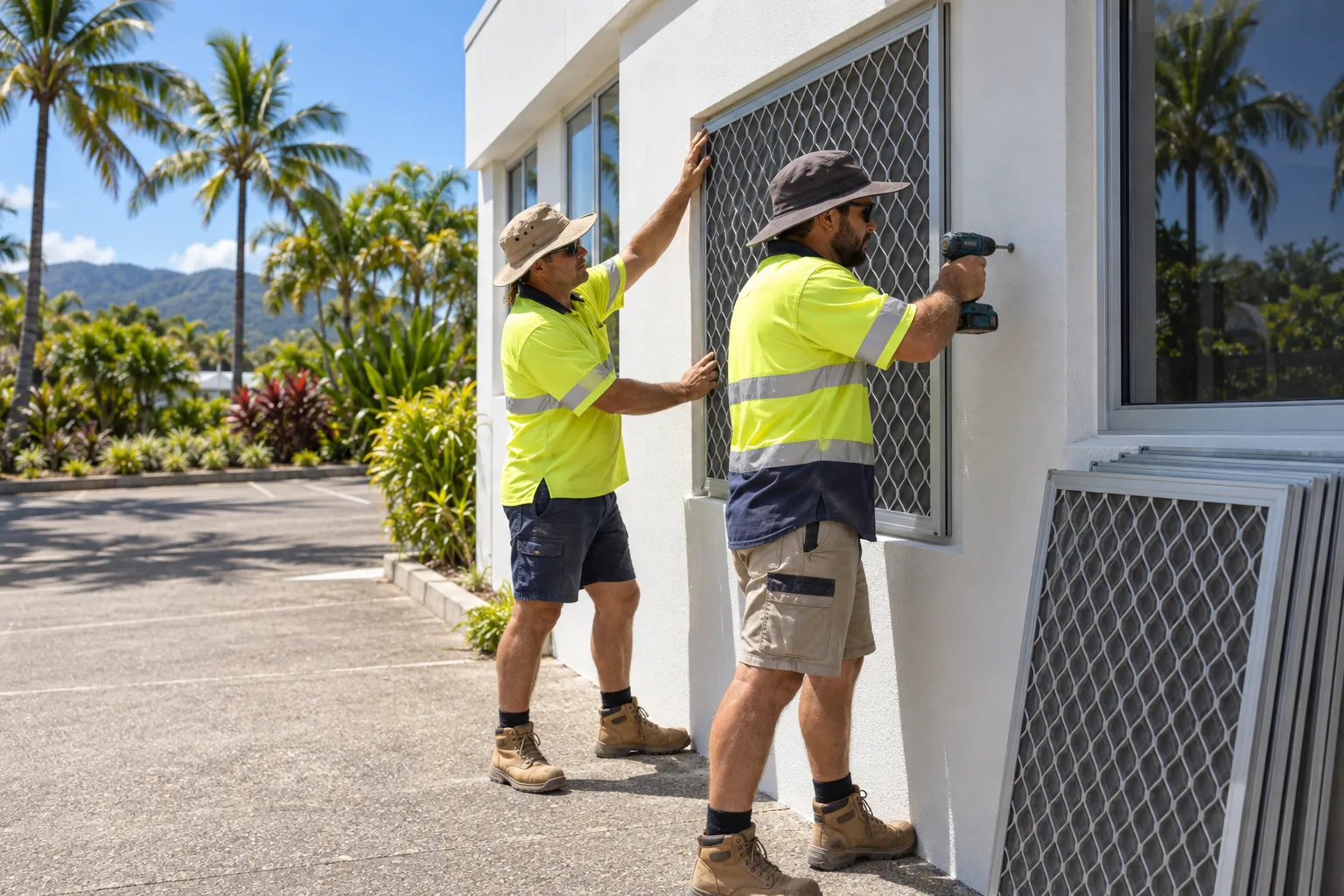
In northern Australia a cyclone is not an unforeseeable event; it is part of the calendar. For a facilities manager, building manager, body corporate manager or cleaning and security contractor, preparation is a run of ordinary jobs done in the right order: a pre-season inspection walk-through, a plan that says who decides what, a short list of actions for when a watch or warning comes, and a careful re-entry afterwards. This guide sets out that checklist for a non-domestic building, and the Work Health and Safety duty behind it.
01
The duty: a workplace emergency plan that allows for where you are
There is no separate cyclone law for an ordinary commercial building. The duty is the general one to plan for emergencies. In Queensland, section 43 of the Work Health and Safety Regulation 2011 (Qld) says a person conducting a business or undertaking (PCBU) at a workplace must ensure that an emergency plan is prepared for the workplace. The plan must provide for emergency procedures, including an effective response to an emergency, evacuation procedures, notifying emergency service organisations at the earliest opportunity, medical treatment and assistance, and effective communication between the person authorised to coordinate the response and everyone at the workplace. It must also provide for testing those procedures, and for information, training and instruction to the workers who will carry them out.
The same section says the PCBU must maintain the emergency plan for the workplace so that it remains effective, and must implement it in an emergency. In preparing and maintaining it, the PCBU must have regard to all relevant matters, including the nature of the hazards at the workplace and the size and location of the workplace. For a building in Cairns, Townsville, Mackay, Darwin, Broome or Karratha, location means cyclones. A plan written for fire alone does not meet that test.
The Northern Territory imposes the same duty in the same terms at regulation 43 of the Work Health and Safety (National Uniform Legislation) Regulations 2011 (NT), as in force from 17 July 2026. In Western Australia, check the equivalent provision in the state's own work health and safety regulations. On a shared site several PCBUs usually hold the duty at once: the owner or body corporate, the managing agent, each tenant employer, and the cleaning, security and maintenance contractors. Each of them needs to know what the others will do, and the cyclone arrangements are one of the clearest places where that has to be agreed in writing.
The planning method most buildings already use is AS 3745-2010 Planning for emergencies in facilities, with its emergency planning committee and emergency control organisation. It is a paid Australian Standard, so this guide does not quote it; a cyclone sub-plan fits inside that structure rather than beside it.
The public guidance comes from the state emergency agencies. Get Ready Queensland's page on Cyclone and storm surge speaks directly to anyone near the coast between Bundaberg and the Torres Strait, where it says being ready is part of Queensland life. Western Australia's Department of Fire and Emergency Services (DFES) says in its Cyclone overview that cyclones can affect the north west coast from November to April. The Bureau of Meteorology issues the watches and warnings everyone else acts on.
02
What a cyclone preparation checklist covers
A useful checklist is organised by time, not by trade: before the season, when a cyclone forms, under a watch or warning, and afterwards. Across those stages it covers:
- People and decisions: who decides to close the building, stop outdoor work and send staff and contractors home, and how that decision reaches everyone, including tenants and visitors.
- The building envelope: roof sheeting and fixings, gutters and downpipes, eaves, flashings, windows, doors, roller doors and cyclone shutters or screens.
- The grounds: trees and overhanging branches, outdoor furniture, bins and skips, signs, shade sails, planters, stored materials and anything else that could become airborne.
- Rooftop plant: condensers, ductwork, solar panels and hatches, checked for fixing.
- Water, drainage and storm surge: drains, grates and pits kept clear; chemicals and valuable stock lifted above flood level where the site is low-lying.
- Services: where and how to isolate electricity (including solar), gas and water, and who is allowed to do it.
- Supplies: an emergency kit for anyone who may have to shelter on site, drinking water, torches, a battery radio and spare batteries.
- Records and contacts: the plan, contacts, insurance details and floor plans kept where they can be reached if the building cannot.
- After the event: safe re-entry, the damage inspection and a review.
Get Ready Queensland's advice for businesses, Protect your business from severe weather, puts it in three steps: know your risk, plan for continuity, and pack a kit. It also warns that severe weather can stop employees safely reaching the workplace and can affect suppliers, contractors and delivery networks, so do not assume the cleaning or maintenance crew can get in the day after.
03
Before the season: the pre-season inspection
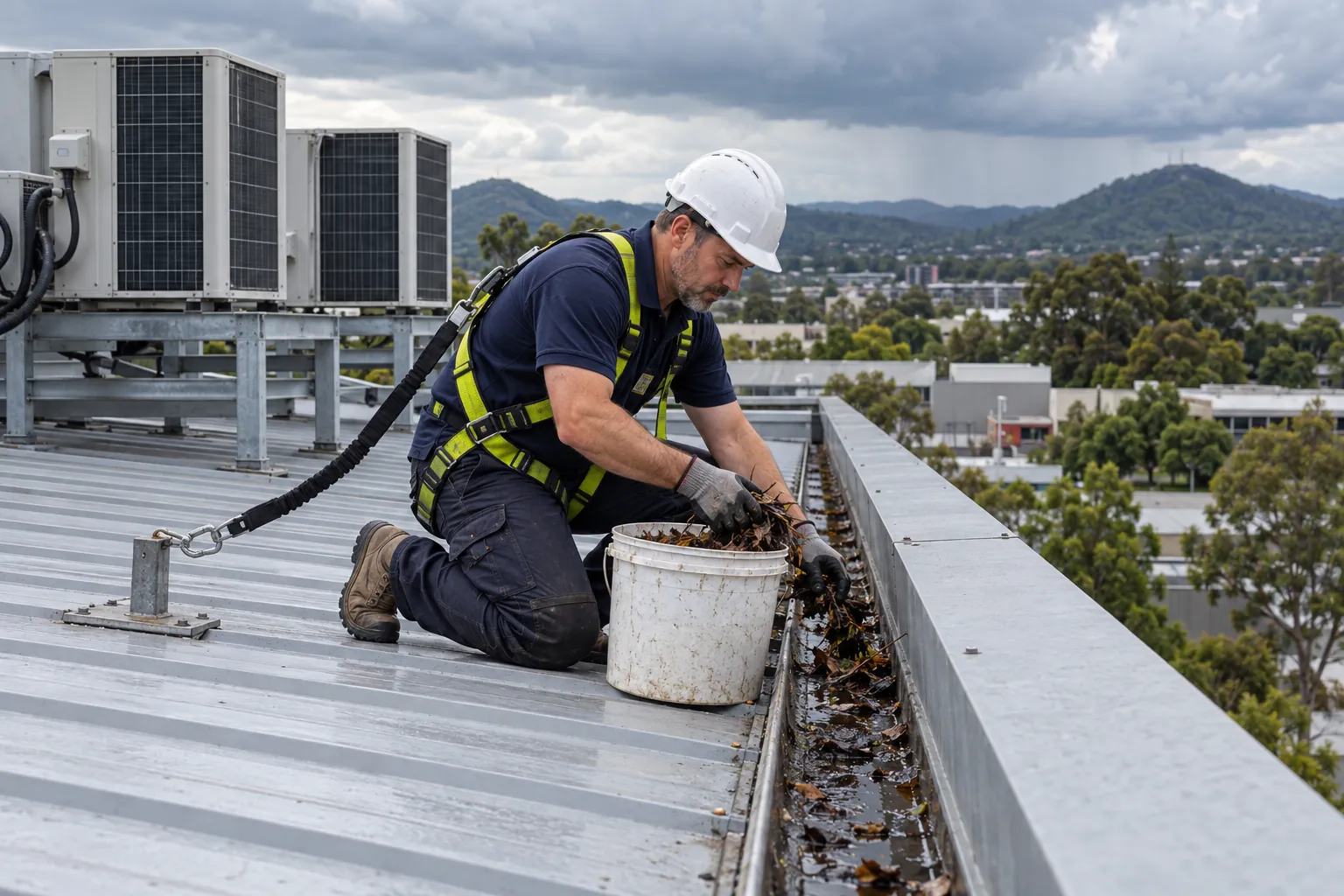
The most useful work happens months before any cyclone forms. DFES says to prepare property well before cyclone season begins, and its Prepare for a cyclone page lists the maintenance: check the roof and repair loose tiles, eaves and screws; check for rust, corrosion and general wear and tear; clean gutters and downpipes; trim trees and overhanging branches; secure loose items that could cause damage in high winds; and consider shutters or metal screens for the windows. It also recommends having a professional builder check the structural integrity of the building. For a commercial site, schedule that walk-through for the months before November, and write it down as a dated inspection with named responsibilities rather than an intention.
A pre-season checklist for a commercial building usually adds:
- Roof and rooftop plant. Sheeting, screws and flashings; condenser and exhaust units fixed to their frames; nothing stored on the roof. See the roof inspection checklist for the working-at-height side.
- Gutters, downpipes, box gutters and drains. Cleared and running.
- Trees and landscaping. Dead limbs and branches over roofs, car parks and power lines cut back by an arborist, not by whoever is on site.
- Loose external items. An inventory of everything outside that must be moved or tied down when a warning is issued: bins, furniture, planters, A-frame signs, shade sails, stored pallets, skip bins, trolleys.
- Shutters, screens and boarding. Cyclone screens present, labelled to their openings and in working order; timber and fixings on hand for any opening that has none.
- Service isolation points. The main switchboard, solar isolators, gas and water mains marked on a plan, with the people authorised and trained to use them.
- Emergency power and lighting. Generator serviced and fuelled if there is one; emergency and exit lighting tested in the normal routine.
- Low-lying areas. DFES advises storing chemicals and poisons well above ground level where flood or storm surge is possible, and identifying what needs to be raised. That applies to cleaners' stores, plant rooms and basement car parks.
- The plan and the people. The emergency plan reviewed for cyclone, the chief warden and wardens confirmed, contractor contacts updated, and the procedures tested at the frequency the plan sets, as the regulation requires the plan to state.
Each item needs an owner and a date. On a strata or body corporate site, agree before the season which items are common property and which belong to lot owners or tenants.
04
When a watch or warning is issued: the action list
Get Ready Queensland's Tropical Cyclone FAQs set out how much notice to expect. The Bureau of Meteorology issues a Tropical Cyclone Advice when a cyclone is likely to cause gale-force winds or stronger within 48 hours. That includes a Tropical Cyclone Watch, updated every six hours, when gales are expected to start within 24 to 48 hours, and a Tropical Cyclone Warning, updated every three hours, when gales are expected within 24 hours or are already happening. On the Bureau of Meteorology's forecast track map, described on its Tropical cyclone warning services page, darker orange shading marks the warning area and lighter orange the watch area. Western Australia also uses three warning levels, Advice, Watch and Act, and Emergency Warning, which DFES introduced for cyclones from 15 July 2024 in place of the old Blue, Yellow and Red alerts.
The same FAQ page describes five categories based on the strongest wind speeds near the centre of the cyclone, from Category 1 under 125 km/h to Category 5 above 280 km/h, with significant loss of roofing and dangerous airborne debris typical at Category 4.
Turn that into an action list for the building, with each step owned by a named role:
- When a cyclone forms. Check the plan and the contact list are current, check the emergency kit, confirm who will make the closing decision, and tell contractors to expect changes to their schedules.
- When a watch covers the site. Clear and secure everything on the loose-items inventory. DFES lists boats, caravans, trailers, garden sheds, outdoor furniture, rainwater tanks, LPG bottles, loose material and rubbish around the home and workplace. Fasten cyclone screens and board exposed windows and doors. Move vehicles under cover. Fill containers with drinking water. DFES advises charging devices such as mobile phones in case of power outages, so charge the wardens' mobile phones and the site's radios. Stop roof and outdoor work.
- When a warning covers the site. Get Ready Queensland advises closing windows, shutters and curtains, taping plastic sheeting to the inside of windows if needed to keep wind-driven rain out, and unplugging electrical items and computer equipment to avoid power-surge damage. It warns against taping an X on glass, which can make large, dangerous pieces if a window breaks. Close the building early enough for staff and contractors to get home safely.
- Storm surge areas. Get Ready Queensland says a storm surge or storm tide often reaches the coast first, sometimes 24 hours before the cyclone itself, so a site in a surge zone should decide on closure and evacuation well ahead.
Anyone who has to stay, such as a caretaker in a residential block or a security officer at a site that cannot be left, needs a shelter room chosen in advance, away from windows, and a clear instruction from the plan. DFES's advice is to stay away from doors and windows and keep them closed. Get Ready Queensland also suggests having a chat with your neighbours about who might need a hand later; for a building, that means the businesses next door and any tenant whose staff may struggle to get home. Get Ready Queensland warns that the calm of the eye does not mean the cyclone is over: the second half often brings stronger winds with little warning. Nobody goes outside to check the building until official advice says it is safe.
05
After the cyclone: re-entry and the first inspection
Re-entry is where injuries happen. DFES's advice after a cyclone is to wait until emergency services say it is safe to go out or return, and it lists the hazards to expect: fallen power lines and trees, broken water and sewerage pipes, loose roof sheeting and other material. It advises keeping electricity and all electrical and gas appliances turned off until a qualified tradesperson has checked them, never using matches, lighters or naked flames when entering a building because there may be a gas leak, and running generators only outside.
For a commercial building, a re-entry checklist usually runs in this order:
- Confirm official advice that it is safe to return, and that access roads are open.
- Walk the outside first, looking for fallen lines, damaged roofing, broken glass and flooding, before anyone goes in.
- Take photographs of the damage before any clean-up starts; DFES advises this for insurance, along with contacting the insurer.
- Keep services isolated until a licensed electrician, plumber or gas fitter has checked them.
- Check inside for water: Get Ready Queensland notes rain can be driven in through vents, gaps, flashings, windows and sliding doors, so look at ceilings, risers, lift pits and plant rooms.
- Ask the fire services contractor to check the fire safety installations before the building is reopened to occupants, and record what they find.
- Wear boots, gloves and protective clothing for the clean-up, as DFES advises, and stack debris away from water meters, valves and power lines.
- Throw away refrigerated or frozen food if the power was off, including in staff kitchens and tenancies.
The Business Queensland guide to an incident response plan recommends an event log recording times, decisions, actions and who was involved during and after an incident, and a review afterwards with everyone who took part to find the gaps. After a cyclone, use it to fix the plan for next season. The damage defects then belong in the normal reactive maintenance process, each with an owner and a date.
06
Where the record fails
Most cyclone plans are sound on paper; what fails is the evidence they were carried out. The pre-season inspection is agreed in a meeting and done by whoever has a spare afternoon, with no note of which gutters were cleared. The loose-items inventory exists, but when the watch comes nobody can say whether the bins behind the loading dock were tied down, because the only confirmation was a thumbs-up in a group chat. After the event, a crack in a box gutter is mentioned to the security officer on the gate, who passes it on to nobody in particular. Later, when an insurer asks what was done, the answer is a recollection.
SiteClara records that kind of check where it happens. A tag at each place that matters, the roof access hatch, a box gutter, the loading dock, the bin enclosure, a shutter bank, lets the person doing the check scan it with their phone and mark the check done, with a photograph when one is asked for, so the record shows which point was checked, by whom and when. A check that was due and not done shows as missed rather than disappearing, and a supervisor can record why it was missed. A fault found at a tag, a loose sheet or a blocked drain, is reported there and goes to the team responsible for that work. Each day the supervisor reviews what was done and what is open, and approves a report for the building manager or client.
07
Questions people ask
What should be in a cyclone emergency kit?
DFES's Prepare for a cyclone page lists a portable battery-operated radio and spare batteries; a waterproof torch with extra batteries, or a wind-up torch; a complete first aid kit; bottled drinking water and non-perishable food, with a can opener and cutlery; protective clothing such as sturdy footwear, gloves and goggles; a waterproof bag holding important documents such as identification, insurance documents and prescriptions; the cyclone plan; cash; and toiletries and sanitary supplies. It advises canned food and water to last five to seven days. A building where a caretaker or security officer may have to shelter needs the same kit on site, not only at home.
Where is the safest place to be during a cyclone?
Inside, in a shelter room chosen in advance. DFES's Prepare for a cyclone page says to identify which room is the strongest part of the house in case you need to take shelter, and to stay in the strongest, safest part of the building. Get Ready Queensland's Cyclone and storm surge page says the shelter room is usually the smallest room with no windows, like a bathroom, and that where windows cannot be avoided you should plan to have a mattress or heavy blanket to protect yourself. In a commercial building, pick that room in the emergency plan, away from glass.
What should you do and not do during a cyclone?
Get Ready Queensland's Cyclone and storm surge page says to stay inside, away from windows and glass doors, preferably in your shelter room, until official advice confirms it is safe to go outside, and to keep following official Bureau of Meteorology updates and your local council's disaster dashboard. Do not go out in the calm of the eye: the page warns that the second half of the cyclone often brings stronger winds that return quickly with little warning. In Western Australia, DFES says to listen to ABC local radio and check Emergency WA.
How do you prepare for a cyclone in Australia?
Start well before the season. DFES's Prepare for a cyclone page says the cyclone season runs between November and April each year and advises preparing your home and property well before the season begins: check the roof and repair loose tiles, eaves and screws, clean gutters and downpipes, trim trees and overhanging branches, and secure loose items that could cause damage in high winds. When a cyclone is forecast to head your way, Get Ready Queensland's Cyclone and storm surge page adds securing loose items such as outdoor furniture and shade sails, parking vehicles on high ground away from trees and powerlines, and filling containers with drinking water in case essential services go down. DFES also asks you to make sure pets are identified with a name tag or microchip and to pack food and water bowls and enough pet food for several days if you relocate.
08
Where to read more, and a list to take away
For the legal duty, read section 43 of the Work Health and Safety Regulation 2011 (Qld) or regulation 43 of the Work Health and Safety (National Uniform Legislation) Regulations 2011 (NT). For preparation, Get Ready Queensland's Cyclone and storm surge page and its Tropical Cyclone FAQs, its business page Protect your business from severe weather, and DFES's Prepare for a cyclone. For live forecasts and track maps, the Bureau of Meteorology's Tropical cyclone page.
Before the season, check that:
- the workplace emergency plan deals with cyclone and storm surge, not only fire, and has been reviewed this year;
- every PCBU on the site knows who makes the closing decision and how it will reach them;
- the pre-season inspection of roof, gutters, drains, trees and rooftop plant is booked, owned and recorded;
- cyclone screens and boarding are on hand and labelled to their openings;
- service isolation points are marked, and the people allowed to use them are trained;
- the contact list, insurance details and floor plans can be reached if the building cannot;
- the watch, warning and re-entry actions each have a named owner;
- there is a review after every event, and the plan changes because of it.
Sources
Every document this guide quotes or links to, in the order it first cites them.
- Work Health and Safety Regulation 2011 (Qld) legislation.qld.gov.au
- Work Health and Safety (National Uniform Legislation) Regulations 2011 (NT) legislation.nt.gov.au
- Cyclone and storm surge getready.qld.gov.au
- Cyclone dfes.wa.gov.au
- Protect your business from severe weather getready.qld.gov.au
- Prepare for a cyclone dfes.wa.gov.au
- Tropical Cyclone FAQs getready.qld.gov.au
- Tropical cyclone warning services bom.gov.au
- Incident response plan business.qld.gov.au
- Tropical cyclone bom.gov.au
Related guides
 Premises and facilities managementBuilding maintenance checklist: what to check, how often, and who byA building maintenance checklist for Australian commercial and strata buildings: daily to annual tasks, the WHS and fire safety law behind them, and who does each.
 Premises and facilities managementRoof inspection checklist: getting up safely, checking the right things, and keeping the recordA roof inspection checklist for Australian commercial buildings: the WHS falls duties, safe access, what to check, how often, and the records that prove it.
 Premises and facilities managementVacant property inspection: what to check, how often, and what to recordHow to inspect a vacant commercial building in Australia: security, water, fire safety, asbestos, the insurer's unoccupancy conditions and the record of each visit.
 Premises and facilities managementPreventative maintenance: how to plan it for a building and prove it was donePreventative maintenance for Australian buildings: the WHS duty, the asset register and schedule, statutory and discretionary tasks, and keeping good records.