Cleaning
School cleaning checklist: what an Australian school cleans, how often, and how to show it was done
A school cleaning checklist lists every cleanable area of a school, from classrooms, toilet blocks and the sick bay to kitchenettes, corridors and entrances, with what is done there each school day, each week and in each term break; in metropolitan Melbourne's government schools the minimum is set by the Department of Education's Cleaning Standards and Frequency Guide, which has most areas cleaned and checked daily.
Also written for United Kingdom · Ireland · United States · Canada
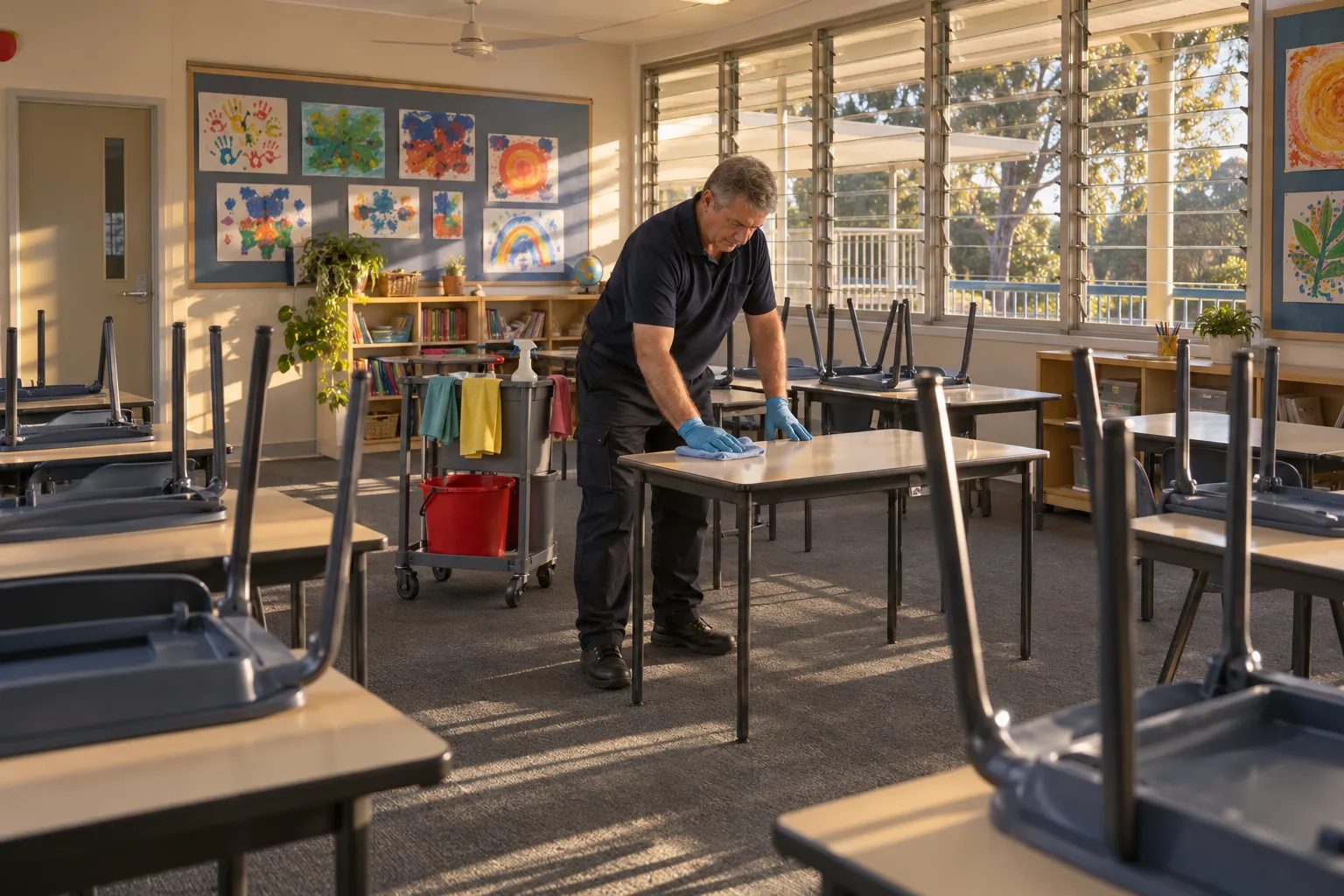
No national law prescribes the list itself. Work health and safety law requires the school, as a workplace, to be kept clean and its toilets and washing facilities clean and in good working order, and each state's education department decides how its government schools are cleaned. This guide turns those rules into a checklist area by area, sets out who does what under the main state models, and covers how a principal or business manager can tell that the cleaning is actually being done.
01
The rules behind a school cleaning checklist
A school is a workplace, so the work health and safety law of its state or territory applies to it. Under the model law adopted everywhere except Victoria, section 19 of the Act requires a person conducting a business or undertaking to ensure, so far as is reasonably practicable, the health and safety of its workers and that "the health and safety of other persons is not put at risk" from its work; students and visitors are those other persons. In Queensland, for example, that is section 19 of the Work Health and Safety Act 2011 (Qld).
The regulations' requirements are more specific. Section 41 of the Work Health and Safety Regulation 2011 (Qld), which follows the model regulations, requires adequate facilities for workers, "including toilets, drinking water, washing facilities and eating facilities", maintained so that they are "in good working order" and "clean, safe and accessible". The code of practice Managing the work environment and facilities, based on Safe Work Australia's model code and approved in New South Wales (the version of August 2019), puts it plainly: "The work environment must be maintained so that it remains in a clean and safe condition." It adds that consumables such as soap and toilet paper "should be replenished regularly", that spills on floors "should be cleaned up immediately", and that workplaces and facilities should be cleaned regularly, taking into account the type of work performed, the likelihood of contamination, the number of workers using them and the type of facility.
Victoria has its own law, the Occupational Health and Safety Act 2004, and WorkSafe Victoria's Compliance code: Workplace facilities and the working environment (edition 1, December 2023) says workplaces and facilities "need to be cleaned regularly", possibly at each shift change or daily, with a schedule that accounts for high-use areas "like dining areas, toilets, urinals, hand washing facilities and showers".
None of these sets a school cleaning checklist. For government schools, each state's education department decides how cleaning is bought and what standard it must meet; Catholic and independent schools set their own, usually in a cleaning contract. Victoria publishes its standard in full, and it is a sound benchmark for any Australian school.
02
What a school cleaning checklist covers, area by area
Write the checklist by area, because that is how cleaners work and how a business manager walks the school. Victoria's Cleaning Standards and Frequency Guide for metropolitan Melbourne schools describes the standard each area must reach, and its list makes a good skeleton for a classroom cleaning checklist and the rest of the school:
- Classrooms and learning spaces: student tables and benches wiped clean; floors swept, mopped or vacuumed, with floor-based learning spaces and early learning areas mopped with detergent and disinfectant; bins emptied and relined; sinks cleaned; light switches, door handles and other touch points cleaned; chairs, shelves and vents on a weekly round.
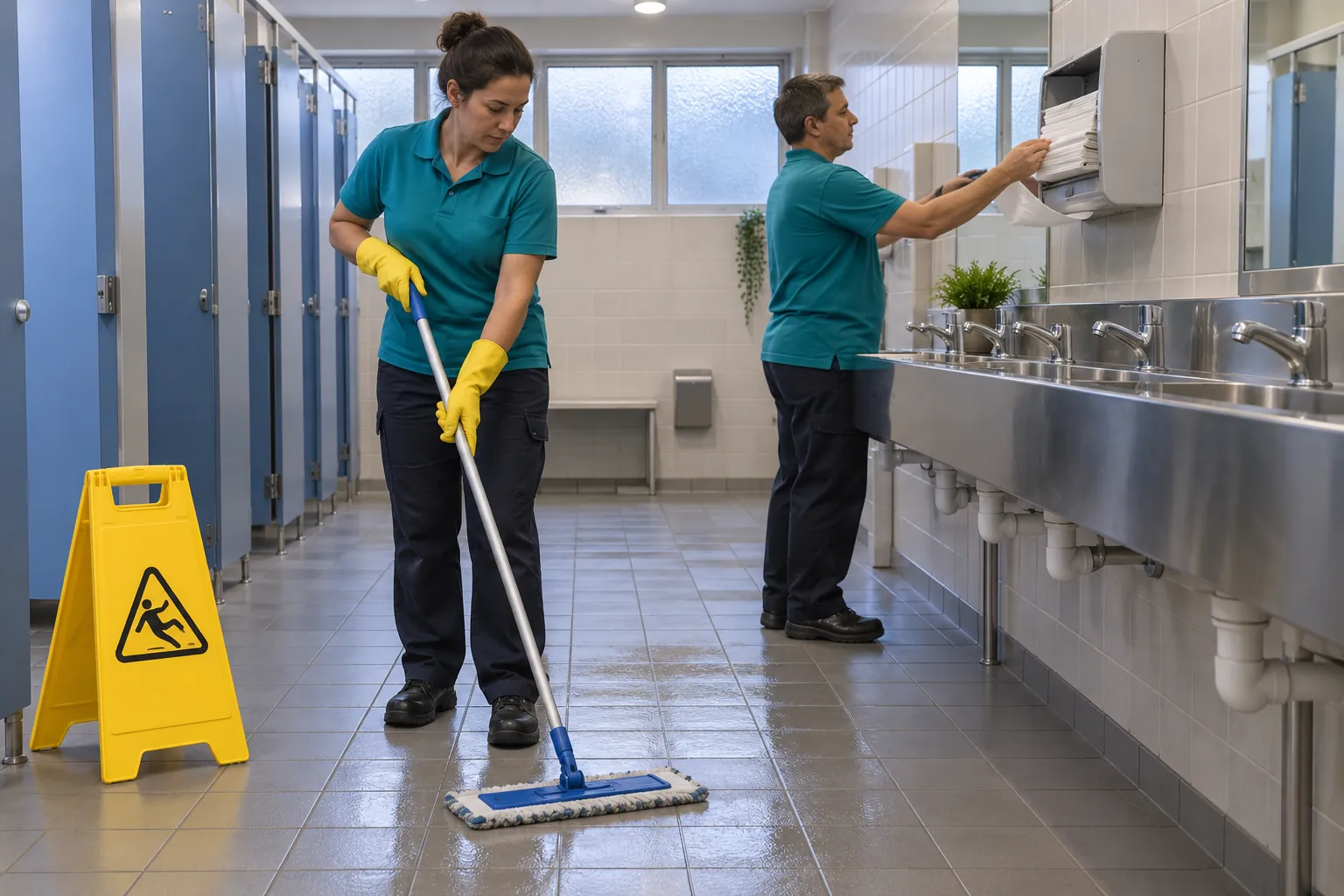
- Toilet blocks, bathrooms and change rooms: in the guide's words, all furnishings, fixtures, floors and touch points "to be cleaned with disinfectant", the floor disinfected, walls and ceilings "free from cobwebs and wet paper towel/toilet paper residue", the room free of unpleasant odours, and personal consumables "in sufficient supply and appropriately restocked in dispensers". School toilet cleaning is where parents and students judge the whole school.
- Sick bay or first aid room: surfaces "hygienically clean and sanitised", and floors mopped with detergent and disinfectant daily.
- Kitchenettes, staff rooms and food areas: benches, tables, fridges and microwaves cleaned with food-grade sanitiser. A canteen or tuckshop run by a caterer cleans to its own food safety arrangements, so say where that line falls.
- Drinking troughs and bubblers, inside and in the schoolyard: cleaned with detergent and food-grade sanitiser, including the surrounds and underneath.
- Corridors, hallways and entrances: traffic areas mopped daily; the main entrance cleaned daily, extending 2 metres outside the door, and other entrances weekly; mats lifted and vacuumed.
- Bins, including external schoolyard bins: "not overflowing, unsightly, soiled, foul smelling", emptied, wiped clean and with liners replaced.
- Cleaners' storeroom: clean, tidy and uncluttered, cleaning supplies stored safely and tidily, and cleaning equipment clean and ready for use.
Two exclusions are worth copying: the school cleans specialist teaching equipment first, to its own instructions, and sanitary and clinical waste go to separate contracts rather than the cleaner's bin round.
Keep chemicals on the checklist too. Section 346 of the Queensland regulation requires a register of hazardous chemicals used, handled or stored at the workplace, with the current safety data sheet for each, although consumer products that need no safety data sheet are exempt. Victoria's guidance asks the cleaning provider to give the school the details of its chemicals so the school's own register can be updated, to use "the safest practical chemicals", and to keep safety data sheets that are no more than 5 years old.
03
Daily, weekly and term-break tasks
School cleaning follows the school day and the school year. The Victorian guide's frequency key is worth borrowing: a daily check and a daily clean, each once per school day; weekly, during term; term, once in each term break; biannual, twice a year in separate term breaks; and annual, once a year in a term break. Providers must clean more often if that is what it takes to meet the standard.
- Every school day, a daily check: clean all high-touch points (door handles, push plates, shared tabletops, counters, light switches, lift buttons, taps, cupboard handles and shared phones), and any element where excessive dirt, grime, soiling or stains are evident, or where litter, spills or body fluids such as vomit or blood are present.
- Every school day, a daily clean: toilet and change room fixtures, toilets, sick bay and food area floors, traffic areas, student tables and benches, sinks, bins, kitchenettes, drinking troughs and bubblers, and the main entrance; in other areas, floors swept or vacuumed.
- Weekly: mop hard floors and vacuum carpet in lower-use areas; damp dust doors, walls and skirtings below 2 metres in areas other than the toilets, sick bay and food areas; internal glass, vents and grilles below 2 metres; student chairs, electrical fixtures and other furnishings; door mats; and the other entrances.
- Each term break: buff or scrub hard floors; deep clean the toilets by pressure washing, steam cleaning, stripping and sealing, or buffing or scrubbing, as suits the surface; strip and seal the main foyer and high-traffic areas; clean elevated surfaces and windows in toilets, foyers and high-traffic areas; deep clean kitchenettes.
- Twice a year: steam-extract carpets in learning areas, foyers and high-traffic areas; wash external windows that can be reached from the ground; pressure wash external doorways; and attend to closed areas, including flushing their taps for 5 minutes.
- Once a year: strip and seal hard floors throughout, steam-extract all carpets, and clean all elevated surfaces and windows.
That periodic program is the school deep clean checklist. In metropolitan Melbourne it must be finished before students return: the policy says the periodic clean must be delivered "to ensure the cleaning standards are met before students return for the first day of term". No routine cleaning is provided during term breaks unless the school pays for it, which matters when the school runs a holiday program or hires out its hall.
04
Who does what: the state models
How a government school's cleaning is organised depends on the state, and the checklist should match the model:
- Victoria, metropolitan Melbourne: under the Department of Education's Cleaning policy (last updated 13 March 2026), five providers clean schools across 10 areas under agreements that took effect on 26 December 2024. The model is "performance-based": an agreed standard and frequency, "not on the number of hours spent cleaning". The principal, or a member of staff the principal nominates as school representative (usually the principal or the school business manager), agrees a cleaning services plan drafted by the provider, covering access times, security, cleaning tasks, cleaners' rosters, periodic (holiday) cleaning and induction. The VSBA School Cleaning Unit administers the contracts.
- Victoria, regional schools: the school council contracts a cleaning provider, for up to 5 years at a time, and the principal manages its performance against the contract.
- New South Wales: the Department of Education manages the whole-of-government cleaning services arrangement, according to NSW School Infrastructure's Cleaning services page, with contracts for most regions and department-employed cleaning staff in the Hunter and Central Coast.
- Queensland: state schools employ their own cleaners. The department's School support roles page says it employs over 5,900 cleaners in schools, and its induction page for cleaners says their line manager will be the business services manager or the principal, and that they must hold a blue card to work in a school.
Whatever the model, write down the split. In Victoria's metropolitan model the provider supplies bin liners and the school supplies toilet paper, soap, hand towels and hand sanitiser, so running out of soap is as often a school problem as a cleaner's. Where a community group hires the hall, the guidance says the hire agreement must state who cleans it.
Check what your state requires of cleaners on a school site by way of a working with children clearance: Victoria has regional principals validate each cleaner's Working with Children Check annually or when a new cleaner starts, and Queensland requires a blue card.
What are a school cleaner's duties?
A school cleaner's duties are the daily clean of classrooms, toilets, sick bay, kitchenettes, corridors and entrances, emptying bins, and the term-break periodic clean. The Queensland Department of Education's school support roles page lists, among others, "cleaning and sanitising toilet facilities and sick bays", cobweb and mildew control, dusting student and office furniture, removal of graffiti, sweeping and vacuuming, and "vinyl/timber floor maintenance including buffing, stripping and polishing".
05
How to check the checklist is being followed
A checklist ticked by the person who did the work is a start, not assurance. Victoria's guidance gives schools a ladder of checks that works anywhere:
- Routine checks by the school, with feedback to the provider on its performance.
- A communication book or another agreed method, where the school logs minor requests and issues for the cleaning team. Minor issues should be fixed "within the next cleaning cycle".
- Monthly on-site cleaning audits, where needed.
- Termly review meetings, recommended in the last 2 weeks of each term, to review performance, agree the periodic cleaning and flag building works and site closures.
- An annual review of the cleaning services plan, and, in metropolitan Melbourne, independent third-party quality audits.
Unresolved problems escalate. In metropolitan Melbourne an issue the cleaning team has not fixed is logged as a cleaning incident in the department's Asset Information Management System (AIMS), so the VSBA can hold the provider to account.
Students and staff notice slipping standards early: full bins in the morning, empty soap dispensers by lunch. A dated record of each issue and its fix is the evidence a termly review needs.
06
Where the school cleaning record fails
Most school cleaning happens after 3:30 pm, when the business manager has gone home. The record is a tick sheet on the cleaners' storeroom door, filled in for the week in one go, or a provider's assurance. The communication book says what the school asked for, not whether it happened. The first sign of a missed toilet block is a teacher's email the next morning.
SiteClara is built for that gap. A printed QR poster, with an optional NFC tag behind it, goes at each place on the checklist where a check is scheduled: each toilet block, the sick bay, the staff room kitchenette, each corridor. A cleaner scans or taps with their own phone, with no app to install, and marks the scheduled check done, with a photo when the check asks for one, or says what stopped them. A fault such as a blocked toilet or a broken dispenser can be reported from the same tag and stays on the team's list of open jobs until someone closes it. A check nobody did shows as missed the next morning, not at the next audit. The cleaning supervisor sees the day's checks and open jobs, records why anything was missed, and approves a daily report for the school's nominated contacts.
Place staff posters where students are unlikely to reach them, and set any check that asks for a photo to show the surface or fixture, never a student.
07
Questions people ask
What should a school deep clean checklist include?
A school deep clean checklist covers the periodic work done in term breaks, when students are away. Victoria's Cleaning Standards and Frequency Guide lists hard floors stripped and resealed, carpets, rugs and mats cleaned by hot water extraction, elevated walls, ceilings, ceiling fans, light fittings and vents cleaned, internal and external windows washed, external doorways pressure washed for 2 metres around the door, and kitchenettes and teaching kitchens deep cleaned, with everything removed from fridges, cupboards and drawers, appliances such as fridges, microwaves and dishwashers cleaned, and range hoods and exhaust filters removed and degreased. Toilets are pressure washed, steam cleaned, stripped and sealed, or buffed or scrubbed, as suits the surface.
How often should school toilets be cleaned?
At least once every school day, with a daily check of high-touch points such as taps and door handles and any spill or body fluid cleaned when it is found. Victoria's Cleaning Standards and Frequency Guide requires all toilet furnishings, fixtures, floors and touch points "to be cleaned with disinfectant" and personal consumables to be restocked, and the toilets are deep cleaned in term breaks. Providers must clean more often if that is what it takes to meet the standard.
Who pays for cleaning consumables in a school?
In Victoria's metropolitan government schools the school does: the Department of Education's guidance Cleaning metropolitan Melbourne schools says "Schools are required to fund their own cleaning consumables (except for bin liners)." Elsewhere the cleaning contract decides, so name who supplies each consumable on the checklist.
08
Where to read the official guidance, and a list to take away
For the standard and frequencies, read Victoria's Cleaning Standards and Frequency Guide and the Department of Education's Cleaning guidance in the Policy and Advisory Library. For the duty, read the code of practice Managing the work environment and facilities (the New South Wales edition; check the version approved in your state or territory), or in Victoria WorkSafe's Compliance code: Workplace facilities and the working environment. Non-government schools should check the cleaning schedule in their own contract against them.
Before next term starts, check that your school cleaning checklist:
- lists every cleanable area, including the sick bay, change rooms, kitchenettes, bubblers and early learning rooms;
- gives each area its tasks and a frequency: daily check, daily, weekly, term, twice a year or annual;
- covers high-touch points and body fluid spills during the school day, not only the after-school clean;
- says who supplies soap, toilet paper and hand towels, and who cleans after a hall hire;
- says where the canteen's cleaning ends and the cleaners' begins;
- sets out the term-break deep clean with dates, finished before students return;
- names the chemicals in use, with current safety data sheets and a locked storeroom;
- records each clean and each issue with a date, and is reviewed with the cleaning provider each term.
Sources
Every document this guide quotes or links to, in the order it first cites them.
- Work Health and Safety Act 2011 (Qld) legislation.qld.gov.au
- Work Health and Safety Regulation 2011 (Qld) legislation.qld.gov.au
- Managing the work environment and facilities safework.nsw.gov.au
- Occupational Health and Safety Act 2004 legislation.vic.gov.au
- Compliance code: Workplace facilities and the working environment content-v2.api.worksafe.vic.gov.au
- Cleaning Standards and Frequency Guide content.sdp.education.vic.gov.au
- Cleaning policy www2.education.vic.gov.au
- Cleaning services schoolinfrastructure.nsw.gov.au
- School support roles qed.qld.gov.au
- Induction page for cleaners qed.qld.gov.au
- Cleaning metropolitan Melbourne schools www2.education.vic.gov.au
- Cleaning guidance www2.education.vic.gov.au
Related guides
 CleaningChildcare cleaning checklist: what an Australian service cleans, how often, and how to show it was doneA childcare cleaning checklist built on the National Regulations and NHMRC's Staying healthy: what to clean, how often, how, and who signs for it.
 CleaningToilet cleaning checklist: what to check, how often, and how to make the record believableWhat a toilet cleaning checklist should cover in Australian workplaces, how often to check, the WHS and OHS duties behind it, and how to make the record believable.
 CleaningCleaning log sheet: what to record, who signs it, and what a signature provesWhat a cleaning log sheet should record in Australian workplaces and food businesses, the WHS and food safety rules behind it, and what a signature proves.
 CleaningCleaning contracts in Australia: what to put in them, and how to know they are workingWhat an Australian commercial cleaning contract should cover, how the Cleaning Services Award and Fair Work Act shape it, and how to show the work was done.