Cleaning
School cleaning checklist: room by room, for Irish schools
A school cleaning checklist lists the cleaning tasks for every area of a school, from classrooms and toilets to corridors, the general purpose room and the staff room, with how often each is done, and the HSE's guidance for Irish schools says written cleaning schedules should be available and should be monitored to ensure they are being followed.
Also written for United Kingdom · United States · Canada · Australia
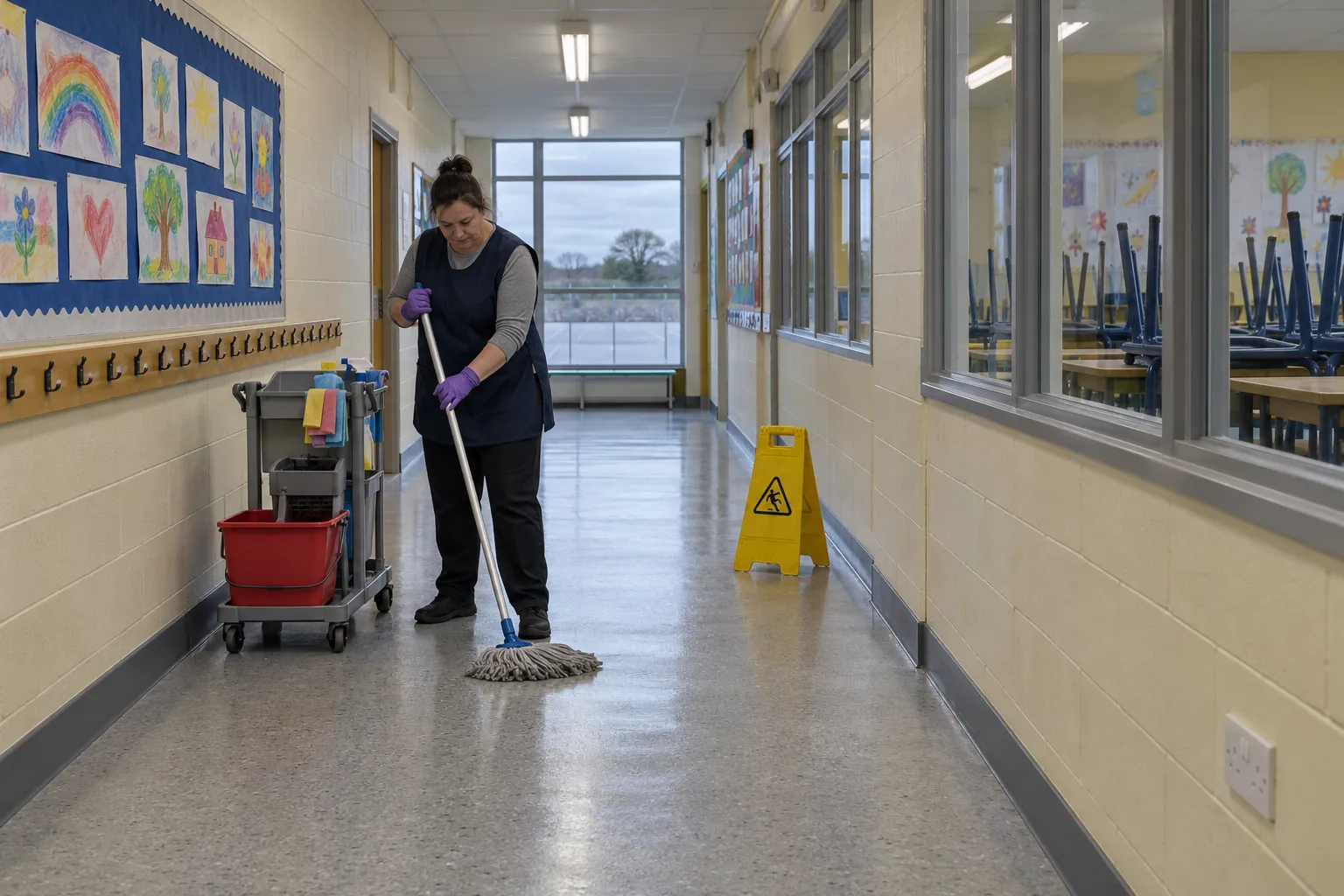
A school is cleaned in the few hours when pupils are not in it, and judged every minute they are. This guide sets out the duty behind the checklist in Irish law, the checklist room by room, what is done daily, weekly and in the holidays, who does what, and how a school can tell the checklist is being followed.
01
The duty behind a school cleaning checklist in Ireland
No Irish law requires a document called a school cleaning checklist. The law requires a school, as a place of work, to be kept clean and safe, and the checklist is how the school shows that the cleaning is planned, done and looked at.
In a school, the employer is the board of management, or the Education and Training Board (ETB) for an ETB school. The Health and Safety Authority's Guidelines on Managing Safety, Health and Welfare in Primary Schools say the board of management, as employer, is responsible for the safety, health and welfare of its employees and of those affected by the school's work, and that ultimate responsibility stays with the board even when it delegates tasks to the principal or the caretaker.
The general duty is in the Safety, Health and Welfare at Work Act 2005, section 8, which includes maintaining the place of work "in a condition that is safe and without risk to health". Section 12 extends the employer's duty to people who are not its employees, so pupils and visitors are covered too. The specific duties are in Chapter 1 of Part 2 of the Safety, Health and Welfare at Work (General Application) Regulations 2007 (S.I. No. 299 of 2007):
- Regulation 18(a) and (b): every place of work must be "kept in a clean state", with dirt, refuse and waste removed "by a suitable method as frequently as necessary to maintain an appropriate level of safety and health", and the floor of every workroom cleaned in the same way.
- Regulation 20: sanitary and washing facilities, lavatories and washbasins must be provided, maintained and kept "in a clean state".
- Regulation 9(1)(a): floors must be, so far as is reasonably practicable, "not slippery".
- Regulation 12(h): emergency routes and exits must be "free from obstruction so that they can be used at any time without hindrance". A cleaning trolley left in a corridor that is an escape route breaks this one.
The health guidance is the HSE's Management of Infectious Disease in Schools (October 2014), produced by a subgroup of the HSE's Public Health Medicine Communicable Disease Group and published on the Health Protection Surveillance Centre's website. Its Chapter 6, Environmental Hygiene, says inadequate routine cleaning "has been implicated in the transmission of gastrointestinal and respiratory illnesses", that cleaning "is essential in the prevention of infection", and that normal cleaning with household detergent and warm water is enough "to reduce the number of germs in the environment to a safe level". It also says a written cleaning schedule for cleaning staff should set out the items and areas to be cleaned, the frequency, the cleaning materials, and the equipment and its method of operation. A school cleaning checklist is that schedule turned into a list a cleaner can follow on the night.
02
What a school cleaning checklist covers, room by room
A two-teacher rural primary and a post-primary campus with prefabs and a sports hall share the same areas. Divide the checklist by area, so each part can be done and checked on its own:
- Classrooms: empty bins and recycling; sweep, mop or vacuum; wipe desks, tables and chairs; clean door handles, light switches and classroom sinks; leave pupils' work where it is. This classroom cleaning checklist is the longest part of the night.
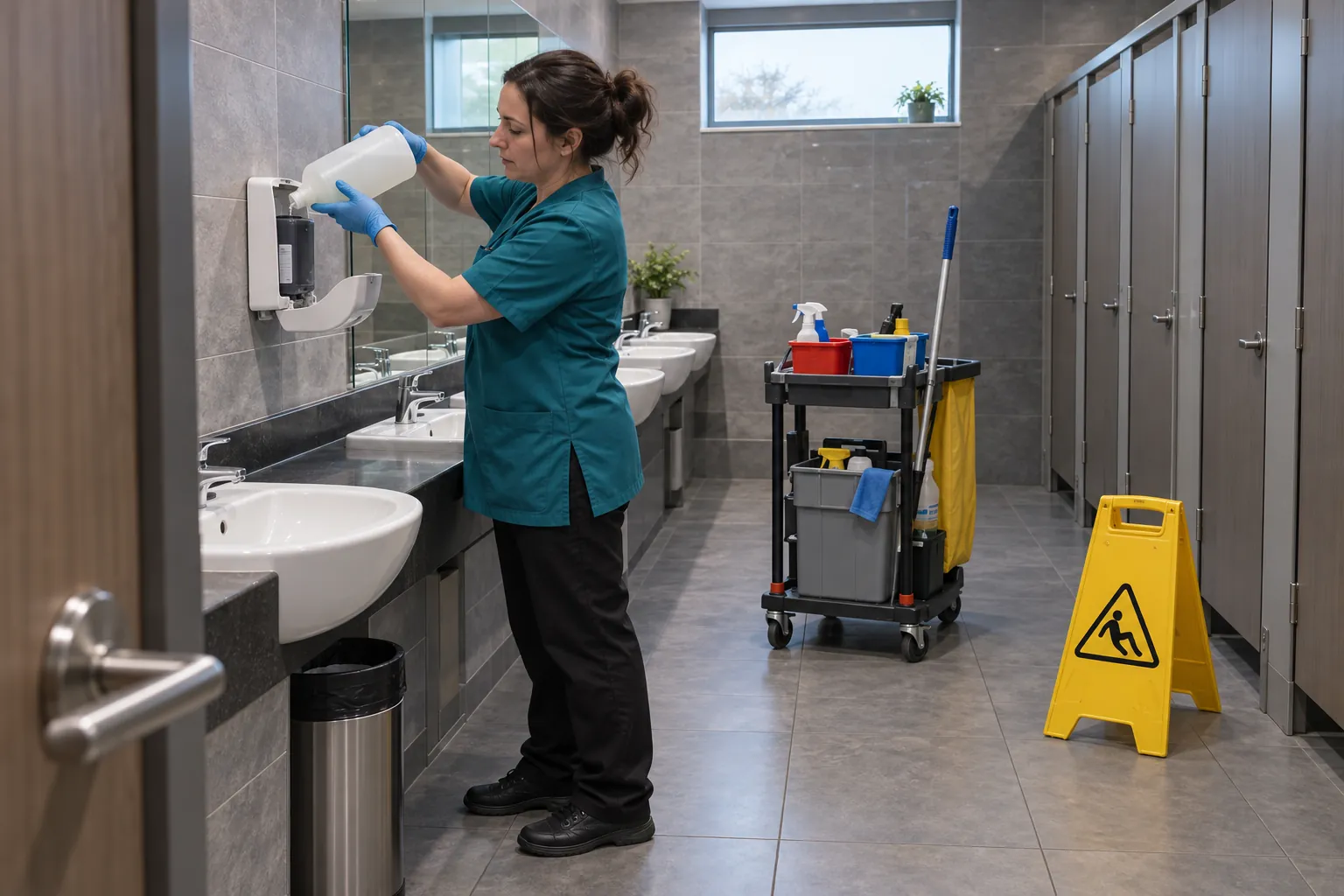
- Toilets and wash hand basins: toilets, seats, flush handles, basins, taps, mirrors and cubicle door handles; floors; soap dispensers refilled, paper towels and toilet rolls restocked; bins emptied; locks working and nothing blocked.
- Corridors, hallways, stairs and entrances: floors, handrails, push plates, entrance matting, and walls and glass at hand height.
- Science labs and practical rooms in a post-primary school: floors, bins and sinks once the students have gone, and benches once the teacher has cleared them. Leave chemicals and equipment alone.
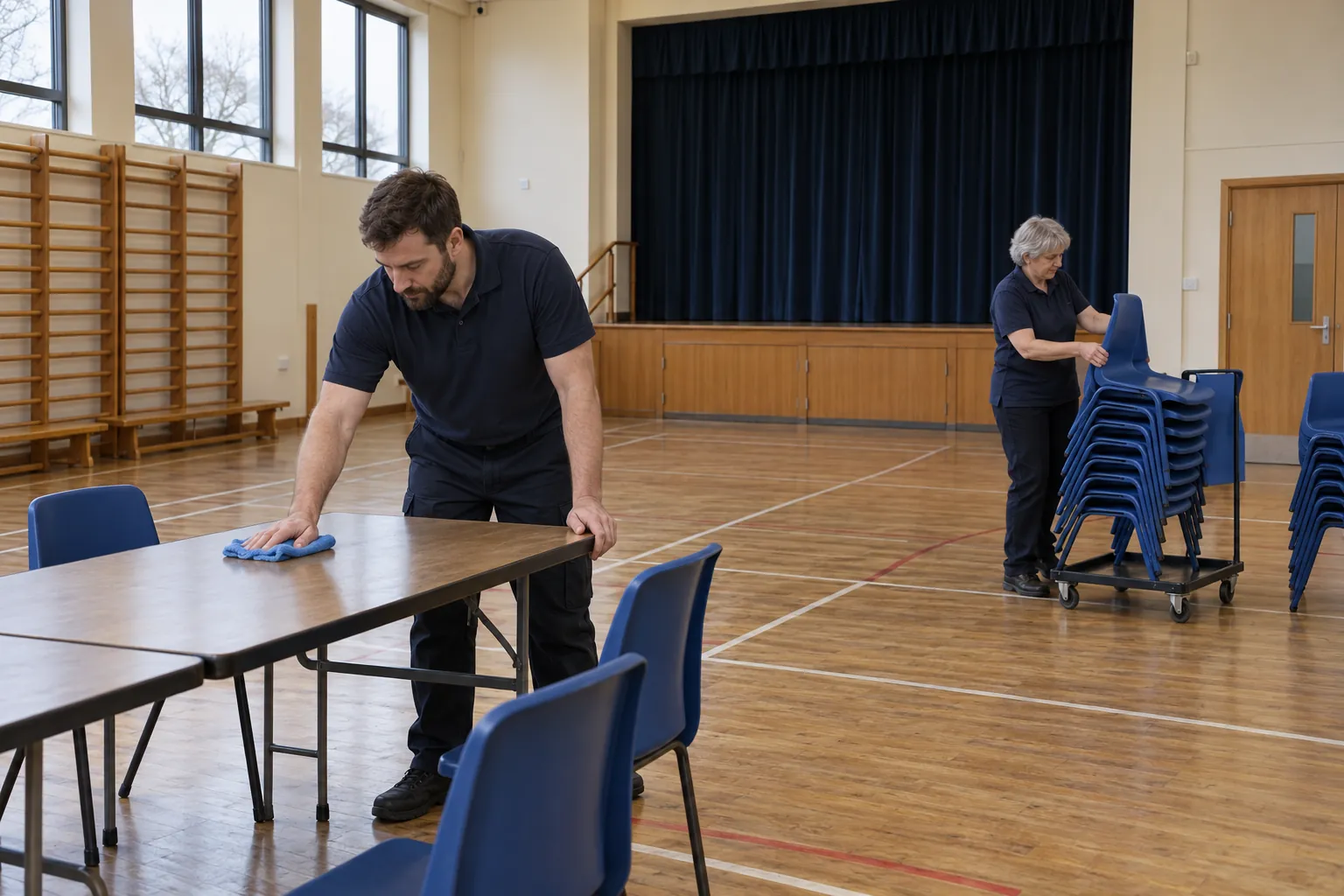
- General purpose room and dining areas: tables and chairs wiped after lunch, floors swept and mopped, stacked chairs kept clear of exits.
- Sports hall, changing rooms and showers: floors cleaned by the method the surface needs, benches and showers. The HSE guidance notes showers can spread verrucas and athlete's foot if not cleaned, and shower heads need regular cleaning to prevent scaling.
- Staff room and offices: worktops, sinks, fridge, desks, bins and floors.
- Infant classes, special classes and sensory rooms: low surfaces, floors children sit on, and toys, which the HSE guidance says should be cleaned on a regular basis, for example weekly.
- The school kitchen: where a caterer runs it, the caterer cleans it to its own food safety management system, and the checklist should say where its area ends.
Keep the cleaning store on the list too. The HSE guidance says chemicals should be stored out of reach of young children and never in recycled food or drink containers. The HSA's Safety in Contract Cleaning says safety data sheets should be easily accessible to the worker, and that bleach should not come in contact with ammonia, toilet cleaners or drain cleaners, because a harmful gas can be created.
03
Daily, weekly and holiday tasks, and the deep clean
School cleaning follows the school day and the school year, so a workable checklist splits its cleaning tasks into four rhythms:
- During the school day: toilet checks after small break and lunch, spills dealt with as they happen, the hall cleaned between sittings, usually by the caretaker. The HSE guidance asks for soap and paper towels to be topped up regularly so pupils use them.
- Daily, after school: classrooms, toilets, corridors, entrances, the general purpose room, staff room and offices. The HSE guidance says toilets, wash hand basins and surrounding areas "should be cleaned at least daily and whenever there is visible soiling", paying particular attention to frequently touched areas such as flush handles, toilet seats, taps and door handles, that disposable cloths are thrown out each day, and that mop heads are ideally washed at 60°C at the end of each day.
- Weekly: toys and shared equipment, high-level dusting within safe reach, internal glass, scuff marks, skirting boards and the bin store. Weekly tasks are where checklists quietly slip.
- Holidays: deep cleaning. Over the summer, hard floors are stripped and resealed, carpets deep cleaned, lights and vents cleaned, and furniture moved so every room is cleaned thoroughly. Mid-term breaks take the periodic tasks that cannot wait a year.
A school deep clean checklist should end with the reopening. The HSE guidance says that if a school has been closed for a prolonged period, such as the holidays, water outlets, toilets, taps and especially showers should be flushed by running them for 3 minutes when it reopens, because poorly maintained water systems can harbour bacteria including legionella. Put it on the list with a name against it.
On disinfectant, the HSE guidance is clear: detergent and warm water are sufficient, and "the routine use of disinfectants is not necessary and is not recommended". A disinfectant is recommended during an outbreak of vomiting or diarrhoea or after a spillage of blood, faeces or vomit, always after cleaning first, because most disinfectants are inactivated by dirt.
04
Who does what in school cleaning
School cleaning is shared between people who are rarely in the building at the same time:
- The board of management is the employer. It approves the safety statement and employs the cleaners or engages a contractor.
- The principal, often a teaching principal in a small primary school, runs safety day to day for the board and is usually the contractor's point of contact.
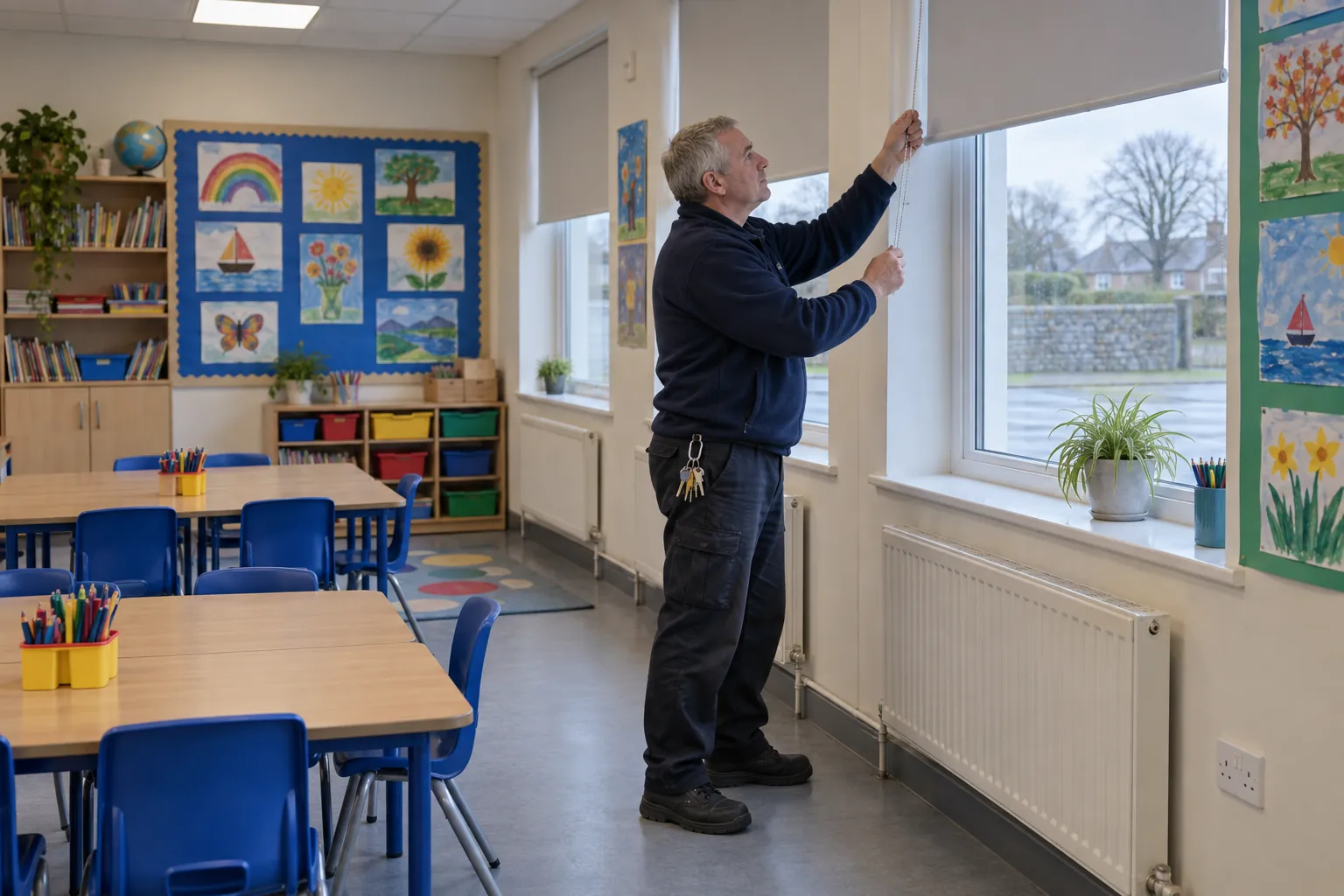
- The caretaker deals with spills and toilets during the day, opens and locks up, and often supervises in-house cleaners (see caretaker duties). The Department of Education and Youth's Ancillary Services Grant covers the cost of employing secretarial and caretaker staff in primary schools not given that help under the 1978/1979 schemes.
- The cleaners, in-house or contracted, carry out the evening clean and the holiday programme.
- Teachers and special needs assistants leave rooms clear enough to clean and report problems.
- The caterer, where there is one, cleans its own kitchen.
Where the board engages a cleaning company, the HSA's primary schools guidelines say the board must ensure the contractor is competent, meaning suitably qualified and experienced. Safety in Contract Cleaning says a risk assessment should be completed for each place of work before the cleaner starts there, and the workplace should make its own risk assessment available to the cleaning staff. Under section 19 of the 2005 Act the assessment must be reviewed after a significant change, such as a new prefab or new hours.
The HSA guidelines also say cleaners, caretakers and non-teaching staff should be involved in the school's safety communication, "as they are often involved in the highest risk work activity in schools". Their risk assessment templates list typical controls: wet floor signs, stairways washed outside heavy usage times, the condition of toilets and hand basins checked by the cleaner daily, and scalding water reported to the caretaker.
Write the split down. Who cleans the hall between lunch sittings and who checks the toilets at lunchtime are the questions that turn into complaints when nobody has been named.
05
How to check the school cleaning checklist is followed
The HSE guidance asks for written cleaning schedules to be "monitored to ensure that they are adequate and are being followed". A checklist ticked by the person who did the work is a start, not assurance. Schools usually add:
- A morning walk-round by the principal or caretaker before pupils arrive, when the evening clean is easiest to judge.
- The toilet checklist. The HSE guidance says cleaning staff should inspect toilets at regular intervals for working locks, blockages, supplies of soap, paper towels and toilet rolls, and overflowing bins, and that "a checklist should be located in the toilets which is dated and signed at regular intervals". See the toilet cleaning checklist.
- A periodic audit against the cleaning specification, jointly with the contractor, scoring a sample of rooms.
- A review each term covering complaints, missed cleans, staffing and the holiday programme.
Read complaints against the record: full bins in the morning, sticky tables after lunch and toilets without soap are the early signs. The HSE guidance adds that inadequate or inaccessible toilets have been found to lead pupils to drink less to avoid using them, with dehydration, headaches and poor concentration as the result, and that toilets that are locked or remote may not be cleaned regularly.
A checklist ticked every night with never an exception usually means nobody is reading it. A good record shows the nights something was not done and why, such as a room locked for an exam, and the faults the cleaners found.
06
Where the school cleaning record fails, and what SiteClara does about it
Most school cleaning happens after the principal has gone home. The record is a sheet on the back of the toilet door or a folder in the cleaning store, often filled in at the end of the shift, and the first sign of a missed clean is a teacher's comment the next morning.
SiteClara puts a printed QR poster at each area on the checklist, such as each toilet block, the general purpose room and each corridor, with an optional NFC tag behind it, placed where pupils are unlikely to reach. A cleaner or the caretaker scans the code or taps the tag on their own phone, with no app to install, sees the checks due there, and marks each one done or explains what stopped them, with a photo if one helps. The time and the named person are recorded as it happens. A fault such as a blocked toilet or a broken lock can be reported there and goes onto the team's list of jobs until someone closes it.
The supervisor sees what is due, done and missed, and records why a check was missed. At the end of the day they review the checks and photos, add a note and approve the daily report, which goes to the principal or other nominated contacts the next morning, before pupils arrive.
07
Questions people ask
What should I include in a school deep clean checklist?
Start with what the HSE's Management of Infectious Disease in Schools says every written cleaning schedule should detail: the items and areas to be cleaned, the frequency, the cleaning materials, and the equipment and its method of operation. For the holiday deep clean, the same guidance says that after a prolonged closure water outlets, toilets, taps and especially showers should be flushed by running them for 3 minutes when the school reopens, and it asks for shower heads to be descaled regularly and water storage tanks cleaned periodically.
What are the typical tasks of a school cleaner?
The HSE's Management of Infectious Disease in Schools describes them: cleaning every area to a written schedule with detergent and warm water, cleaning toilets, wash hand basins and surrounding areas at least daily, inspecting the toilets at regular intervals for working locks, blockages, supplies of liquid soap, paper towels and toilet rolls, and overflowing waste bins, checking soap dispensers at frequent intervals, and following the manufacturer's instructions for mixing, using and storing cleaning products.
What are five rules to keep my classroom clean?
The general principles for routine cleaning in the HSE's Management of Infectious Disease in Schools include these five: clean the least dirty items and surfaces first, clean high surfaces before low ones, change the water when it looks dirty, use separate colour-coded cloths and equipment for classrooms, toilets and kitchen areas, and throw disposable cloths out each day.
08
Further reading, and a list to take away
The law is sections 8, 12 and 19 of the Safety, Health and Welfare at Work Act 2005 and Regulations 9, 12, 18 and 20 of the General Application Regulations 2007, on the Irish Statute Book, quoted as enacted and made. The HSE guidance is on the HPSC's School Health page. The HSA's primary schools guidelines include risk assessment templates for cleaning and for toilets and showers, and its advice on rescheduling floor wet cleaning suggests cleaning a floor as the last job before leaving so it can dry overnight.
Before the next term starts, check that your school cleaning checklist:
- lists every area, including special classes, changing rooms, prefabs and the staff room;
- gives each area specific tasks and a frequency;
- covers toilet checks, soap and spills during the school day, not only the evening clean;
- says where the caterer's cleaning ends;
- keeps separate colour-coded cloths for toilets, classrooms and kitchen areas, as the HSE guidance advises;
- keeps chemicals locked away from pupils, with safety data sheets to hand;
- sets out the holiday deep clean, ending with flushing the outlets before reopening;
- has room to record tasks not done, and why, and faults found;
- is checked by someone other than the person who completed it, and reviewed each term.
Sources
Every document this guide quotes or links to, in the order it first cites them.
- Guidelines on Managing Safety, Health and Welfare in Primary Schools hsa.ie
- Safety, Health and Welfare at Work Act 2005, section 8 irishstatutebook.ie
- Section 12 irishstatutebook.ie
- Safety, Health and Welfare at Work (General Application) Regulations 2007 irishstatutebook.ie
- Management of Infectious Disease in Schools file.hpsc.ie
- Safety in Contract Cleaning hsa.ie
- Managing cuts and blood/body fluid spills in a school or childcare setting file.hpsc.ie
- Ancillary Services Grant gov.ie
- Section 19 of the 2005 Act irishstatutebook.ie
- Safety, Health and Welfare at Work Act 2005 irishstatutebook.ie
- School Health hpsc.ie
- Rescheduling floor wet cleaning hsa.ie
Related guides
 Premises and facilities managementCaretaker duties in Ireland: what the job involves, and how to show it was doneCaretaker duties in Irish schools, parish halls, offices and apartment developments: the law behind the job, the daily and weekly checks, lone working and records.
 CleaningToilet cleaning checklist: what to check, how often, and a record that stands upWhat a toilet cleaning checklist should cover in an Irish workplace, how often to check, the duty in Regulation 20 of the 2007 Regulations, and a credible record.
 CleaningCommercial cleaning checklist: area by area, for Irish workplacesA commercial cleaning checklist for Irish offices and shared premises, area by area: the 2007 Regulations behind it, using it on shift and checking it is followed.
 CleaningCleaning specification: what it should say in Ireland, and how to show it is metWhat a cleaning specification should contain in Ireland: the 2007 Regulations behind it, frequencies by area, checks to I.S. EN 13549 and a change of contractor.