Premises and facilities management
Reactive maintenance: how to run it well, and keep it in proportion
Reactive maintenance is building maintenance work that is not planned or cyclical but done after something goes wrong: the unexpected failure of a component, vandalism, accidental damage or an urgent health and safety issue.
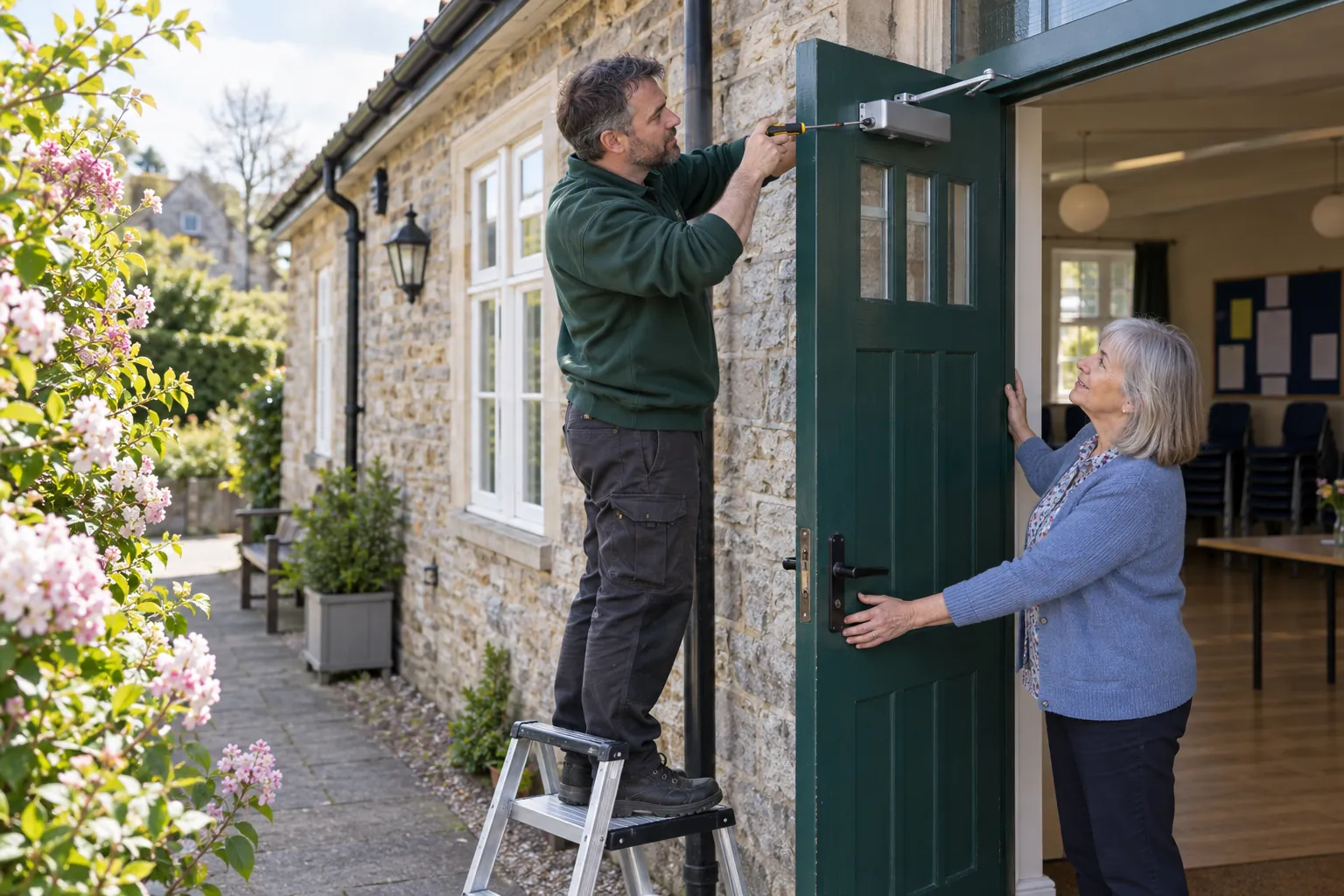
It is the work done after something breaks. Every building needs some, and too much of it is a sign that something else is wrong. This guide covers how to prioritise it, set response times, control the cost, manage contractors and close the loop with the person who reported the fault.
01
What reactive maintenance is
Reactive maintenance, sometimes called unplanned maintenance, is building maintenance work carried out in response to a failure or a fault: a leaking pipe, a boiler that will not fire, a door that will not lock, a light that has gone out. It is also called corrective maintenance or breakdown maintenance, and its most urgent form is emergency maintenance, where the fault creates an immediate risk to people, the building or its security.
Reactive maintenance is one of several maintenance strategies, and the types of reactive maintenance differ mainly in urgency. It sits alongside the proactive maintenance a building uses to prevent equipment failures:
- Planned preventative maintenance: work on a schedule to reduce the chance of failure, such as servicing, inspection and testing.
- Predictive maintenance, or condition-based maintenance: work triggered by monitoring that shows an asset is deteriorating.
- Run-to-failure maintenance: a deliberate choice to let a non-critical asset fail and then replace it, because maintaining it would cost more than the failure. A light fitting in a store cupboard is a fair example; a fire alarm panel is not.
There is no law that sets how much reactive maintenance a building may have, but the duty behind it is clear. The Workplace (Health, Safety and Welfare) Regulations 1992 require a workplace and its equipment, devices and systems to be maintained in efficient working order and good repair. When a fault makes something unsafe, it has to be made safe, or taken out of use, until it is repaired. Other regulations, such as those covering electrical systems, work equipment and fire safety, carry the same expectation for their own equipment.
What is the difference between reactive and proactive maintenance?
Reactive maintenance is done after something fails; proactive maintenance, planned preventative or predictive, is done before, to stop it failing. The Department for Education's Good Estate Management for Schools draws the line the same way: planned preventative maintenance is work undertaken before something fails, to prevent building condition or equipment failure or to fulfil a legal duty, while reactive maintenance is work that is not planned or cyclical, undertaken because of unexpected failure of a component, vandalism, accidental damage or urgent health and safety issues.
02
What reactive maintenance covers in practice
In a typical office, school, shop or block, reactive work falls into a few familiar groups:
- Plumbing and drainage: leaks, blocked toilets and drains, dripping taps, failed water heaters.
- Heating, ventilation and air conditioning: no heating, no cooling, noisy or failed fans, faulty controls.
- Electrical: lighting failures, tripped circuits, damaged sockets, faulty hand dryers.
- Doors, windows and locks: doors that will not close or lock, broken closers, damaged glazing, faulty access control.
- Fabric and finishes: roof leaks, damaged ceiling tiles, loose flooring, broken furniture and fittings.
- Safety systems: a fire door that does not close, an emergency light that fails its test, a fault on the fire alarm panel.
- Damage and incidents: vandalism, forced entry, storm damage, flooding.
Each of these follows the same path, whether the work is done by an in-house maintenance team or bought in from reactive maintenance services: the fault is reported, logged, given a priority and assigned; someone attends, makes it safe if needed, and fixes it; the job is checked and closed; and the person who reported it is told. How faults reach you in the first place is covered in our guide to a fault reporting system. This guide is about what happens next.
03
Priorities and response times
Reactive work needs a priority scale that everyone uses the same way. Most maintenance contracts and service level agreements use four or five levels. The times below are examples only, to show the shape; yours belong in the contract and should reflect the building and what it is used for.
- Priority 1, emergency: an immediate risk to health, safety, security or the building. Attend and make safe within an hour or two, around the clock.
- Priority 2, urgent: a fault that stops part of the building being used or will get worse quickly. Attend the same day or within 24 hours.
- Priority 3, routine: a fault that is inconvenient but not a risk. Attend within a few working days.
- Priority 4, planned: work that can wait to be grouped with other jobs, or done at a quiet time, within weeks.
Three things make a priority scale work in practice:
- Separate attendance from completion. The response time is when someone arrives or makes the fault safe; the fix time is when it is resolved. Measure both, or a contractor can meet every response target while jobs stay open for weeks.
- Judge the fault, not the complaint. Priority should follow the risk and the criticality of the asset, not how loudly the fault was reported. The same fault can be routine in one place and urgent in another: a failed light is a nuisance in an office, and a safety risk on a stairwell.
- Plan for out of hours. Say who answers an emergency at night and at weekends, who can authorise a callout, and what the security or cleaning team on site should do while they wait.
A make-safe is not a repair. A leak isolated at the valve, a door boarded up or an area cordoned off is the right first response, but the job should stay open until the permanent fix is done.
04
The balance between planned and reactive work, and the cost
Reactive maintenance is not a failure in itself. Some faults cannot be foreseen, and for non-critical assets letting them fail can be the cheapest option. The problem is a building that is purely reactive, where most of the maintenance budget goes on reactive repairs and there is little planned work to prevent them.
The disadvantages of reactive maintenance as a main strategy are well understood:
- Higher cost per job: callout charges, out-of-hours rates, parts bought at short notice, and secondary damage, such as a ceiling ruined by a leak that a routine check would have caught.
- Unplanned downtime: rooms, floors or services out of use while the fault is fixed, which costs more in disruption than the repair.
- Shorter asset life: equipment run until it breaks usually wears out sooner than equipment that is serviced.
- Compliance risk: safety systems that are only looked at when they fail are, by definition, not being maintained.
- A budget nobody can plan: reactive maintenance costs arrive unevenly and is hard to forecast.
The apparent benefits of reactive maintenance, lower initial costs and less planning, are real in the short term. They are why some organisations take a reactive approach to maintenance by default, and why buildings drift into it when budgets are cut. The short-term cost savings usually return later as larger bills.
No ratio of planned to reactive work suits every building, but there is a benchmark: the Department for Education's Good Estate Management for Schools says it is recognised good practice to allocate planned preventative and reactive maintenance budgets in the region of a 70:30 ratio, citing CIPFA. A more useful habit than chasing a ratio is to track reactive jobs by asset and cause. Repeat faults on the same piece of equipment point to something that needs replacing or adding to the planned maintenance schedule; a cluster of faults in one area points to a root cause, such as a failing roof or an undersized drain. A computerised maintenance management system (CMMS), or a CAFM system, makes that analysis far easier, because every job is linked to an asset and a location, which is the basis of asset management.
The aim is not to eliminate reactive work but to choose it, balancing reactive and proactive maintenance activities across the overall maintenance programme. A sensible maintenance approach decides, asset by asset, whether preventive and predictive work is worth its cost or whether a reactive strategy is acceptable, and writes that decision into the maintenance plan. Critical assets get regular maintenance and planned maintenance tasks; non-critical ones may be left to fail and be replaced. Faulty or neglected plant also tends to use more energy, so poor maintenance shows up in energy consumption as well as in repair bills.

05
Contractors, and closing the loop
Most buildings use contractors for at least some reactive work. The arrangements that matter are:
- Approved contractors: a short list per trade, with insurance, competence and, where it applies, registration checked. Gas work must be done by a Gas Safe registered engineer.
- How they are paid: a schedule of rates, a fixed price per job, or a comprehensive contract. Agree callout charges, minimum charges and out-of-hours rates before the first emergency, not during it.
- Authorisation: who can instruct a contractor and up to what value, so that a routine job does not become an expensive one without anyone deciding.
- Safety on site: many repairs count as construction work under the Construction (Design and Management) Regulations 2015. Contractors need site induction, access arrangements, permits to work where the risk calls for them, and the asbestos register checked before any intrusive work.
- Evidence of completion: a job sheet from the maintenance engineers with what was found and done, photos where they help, and any further work recommended.
Closing the job has two halves, and the second is the one that gets forgotten:
- Check the fix. Someone on site, not only the contractor, confirms the fault is resolved before the job is closed. A job closed by the engineer who did it is a claim, not a check.
- Tell the person who reported it. A short message that the fault has been fixed, or when it will be, is what turns a fault report into trust. People who never hear back stop reporting, and the next fault is found by a complaint instead.
Response and fix times are also the basis of contractor performance management: review them monthly with each contractor, alongside repeat visits and jobs reopened. Keep reactive maintenance records long enough to answer questions about them, and link them to the asset. When a claim, an insurer or an enforcing authority asks what was done about a fault, the answer should be a record, not a recollection.
06
Where the record fails, and what SiteClara does about it
Reactive maintenance records are usually good from the moment a job is raised in the maintenance system. They are weak before that point and after it. Before, because faults found by cleaning, security and premises staff on their rounds are passed on verbally or not at all. After, because nobody goes back to check the fix or tell the person who reported it.
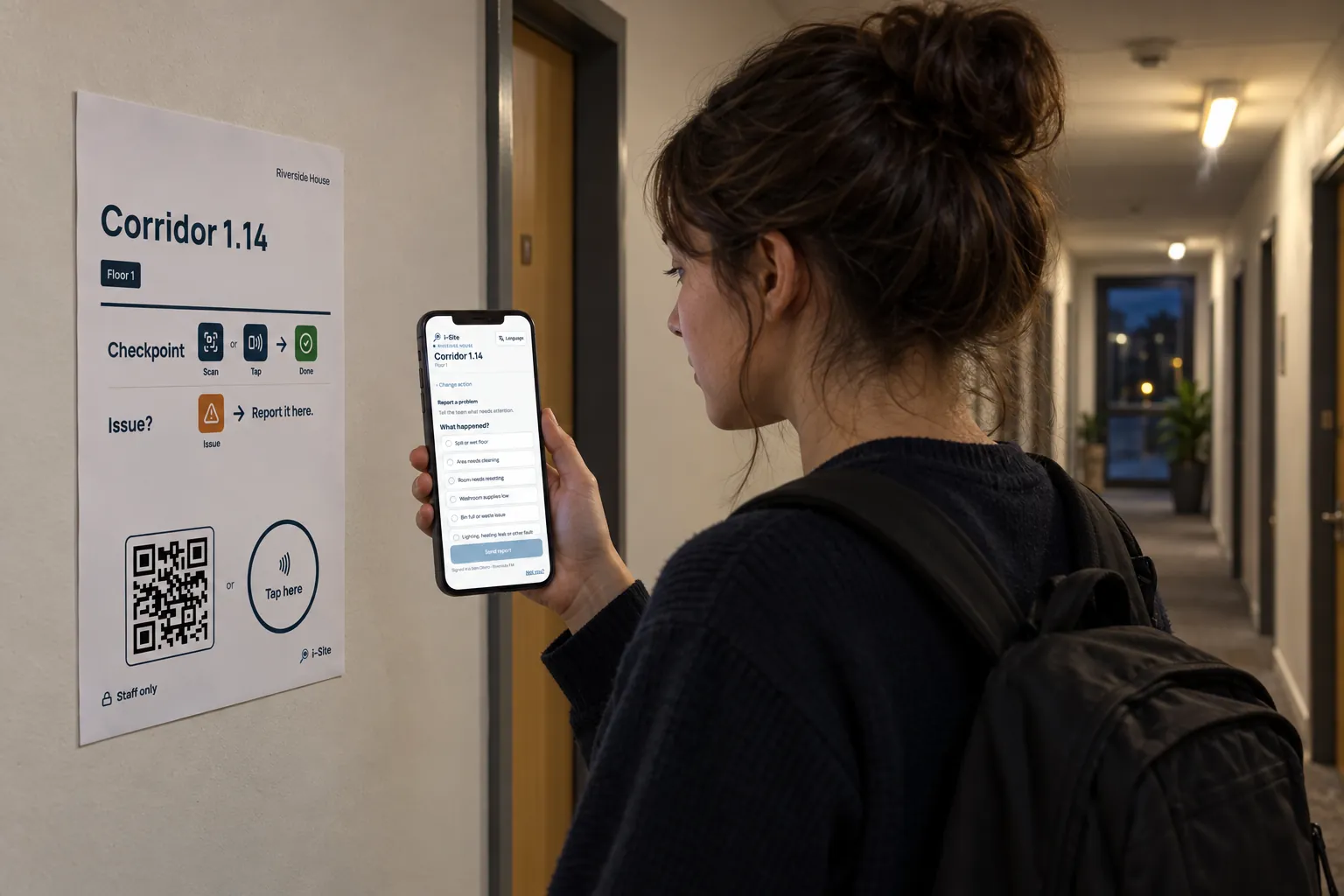
SiteClara covers the teams on the ground. A printed QR poster at each location, with an NFC tag behind it if you want staff to tap, lets staff scan or tap on their own phone, with no app to install, and report an issue with a photo. The report already knows the building and the location, and it goes onto the team's list of jobs until someone closes it. The supervisor's queue groups open jobs by building and floor, and a supervisor can escalate a job to the building manager, who can answer it. On sites led by the building owner, occupants can also report a fault at a tag.
Each day the supervisor approves a report that goes to nominated management or client contacts at 8am the next morning, showing what was reported, what was completed and what is still open.
07
Further reading, and a list to take away
The Health and Safety Executive publishes guidance on the Workplace Regulations (L24), on the Construction (Design and Management) Regulations 2015 (L153), and on managing asbestos in premises. BS EN 13306 sets out standard maintenance terminology, including corrective and preventive maintenance, and BS 8210 is the code of practice for facility maintenance management. The Institute of Workplace and Facilities Management (IWFM) publishes guidance on maintenance and helpdesk practice.
To keep reactive maintenance under control, check that:
- every fault is logged with a location and a priority, whoever reports it;
- priorities follow risk and criticality, with example faults for each level;
- response and fix times are measured separately;
- out-of-hours emergencies have a named route and an authorised person;
- contractors are approved, inducted and told about asbestos before intrusive work;
- make-safes stay open until the permanent repair is done;
- repeat faults are reviewed and fed into the planned maintenance schedule;
- the person who reported the fault is told when it is fixed.
Sources
Every document this guide quotes or links to, in the order it first cites them.
- Workplace (Health, Safety and Welfare) Regulations 1992 legislation.gov.uk
- Good Estate Management for Schools gov.uk
- Construction (Design and Management) Regulations 2015 legislation.gov.uk
- The Workplace Regulations (L24) hse.gov.uk
- The Construction (Design and Management) Regulations 2015 (L153) hse.gov.uk
Related guides
 Premises and facilities managementPlanned preventative maintenance: how to plan it and prove it was donePlanned preventative maintenance (PPM): what it is, how to build an asset register and schedule, statutory versus discretionary tasks, and evidencing the work.
 Premises and facilities managementFault reporting system: how faults are reported, prioritised and closedHow a fault reporting system for a building should work: how occupants report faults, how facilities teams log and prioritise them, and how a fault is closed.
 Premises and facilities managementFacilities helpdesk: what it does, and how to run one wellWhat a facilities helpdesk does, how it logs, prioritises and closes jobs, the people and systems behind it, and how to tell whether it is working.
 Premises and facilities managementCAFM system: what it does, and how to choose and implement oneWhat a CAFM system is and does, how it differs from a CMMS or IWMS, how to choose and implement one, and what it will not fix on its own.