Premises and facilities management
Reactive maintenance: dealing with faults in a building, and keeping them in proportion
Reactive maintenance is repair work done after something in a building has already failed or been damaged – a burst geyser, a tripped distribution board, a lift that has stopped, a roof that leaks after a storm – rather than on a schedule before it fails.
Also written for United Kingdom · United States · Canada · Australia
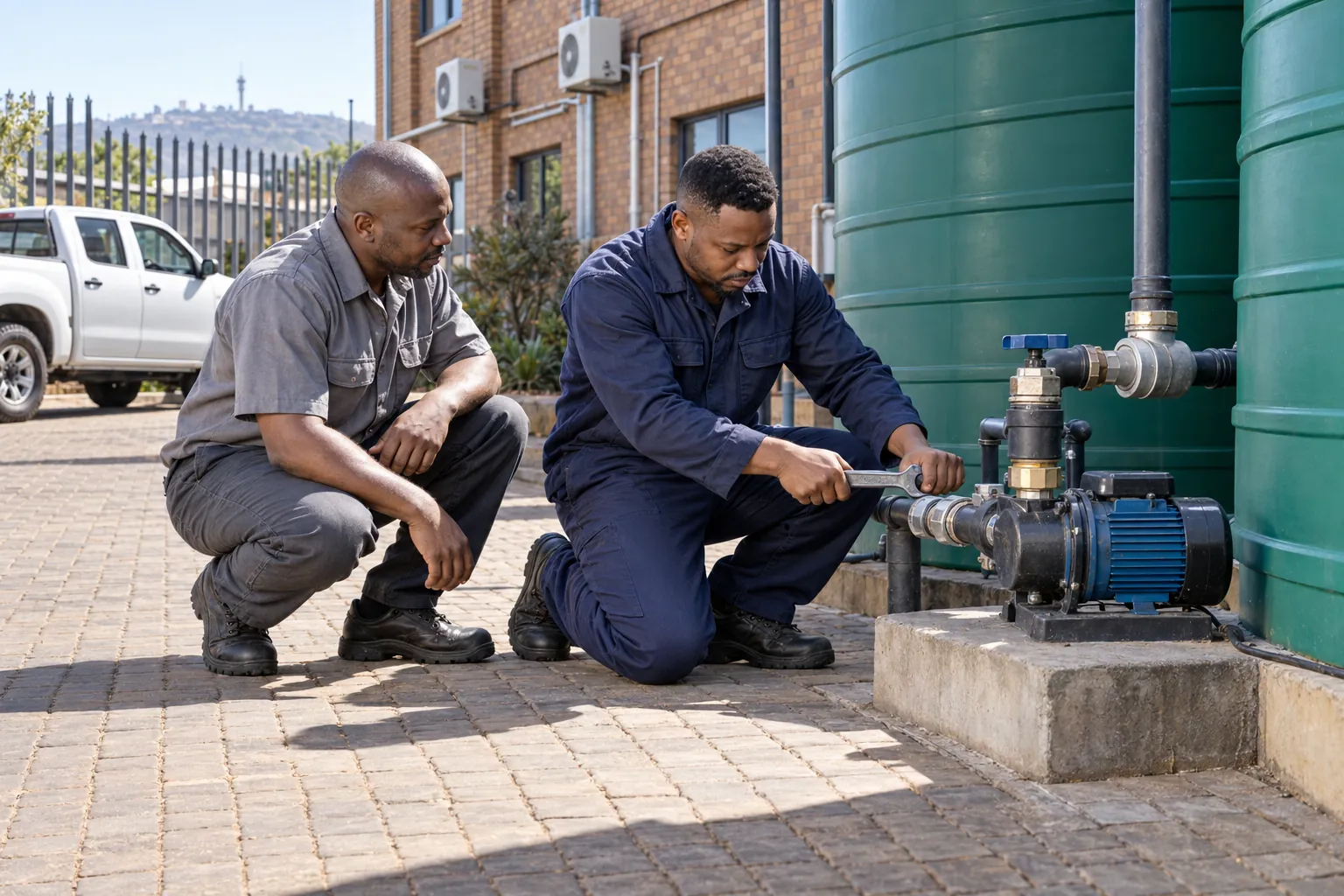
It is also called breakdown, corrective or run-to-failure maintenance. No South African law limits how much of it a building may have, but section 8 of the Occupational Health and Safety Act 85 of 1993 requires an employer to provide and maintain a working environment that is, as far as is reasonably practicable, safe and without risk to health, so a fault that makes a workplace unsafe has to be dealt with, not left for the next service. Most writing on the subject is about factory machines; this guide is about buildings: what reactive maintenance includes, how to set priorities and make a fault safe, who fixes what, what it costs, and how to close each job properly.
01
What reactive maintenance is, and the duty behind it
Reactive maintenance is work triggered by a failure rather than by a calendar: someone reports that the ablutions on the second floor are flooding, the boom at the main gate will not lift, or the generator did not start when load shedding began, and a technician is called out. In plant and factory settings it is often called breakdown or run-to-failure maintenance; in buildings people also say corrective maintenance, call-outs or day-to-day repairs. Its most urgent form is emergency maintenance, where the fault puts people, the building or its security at immediate risk.
The difference between reactive and proactive maintenance is simply whether the work comes before or after the failure:
- Reactive or breakdown maintenance: repair after the failure, when someone notices or reports it.
- Preventative maintenance: servicing, inspection and testing to a schedule, such as the monthly lift examination or the six-monthly generator service.
- Predictive or condition-based maintenance: work triggered by monitoring that shows an asset is wearing out, such as a battery that no longer holds its charge.
- Planned run-to-failure: a deliberate decision to let a cheap, non-critical item fail and then replace it. A light fitting in a store room is a fair example; the fire alarm panel, a critical asset, is not.
No South African law uses the phrase, but the duty to put faults right is plain. Section 8(1) of the Occupational Health and Safety Act 85 of 1993 requires every employer to "provide and maintain, as far as is reasonably practicable, a working environment that is safe and without risk to the health of his employees", and section 8(2)(a) includes "the provision and maintenance of systems of work, plant and machinery" that are safe and without risks to health. The Act defines plant as including "fixtures, fittings, implements, equipment, tools and appliances", which in a building covers most of what breaks. Section 9(1) extends the duty to people other than employees who may be directly affected, such as visitors and tenants' staff.
"Reasonably practicable" is defined in section 1 of the Act by the severity and scope of the hazard, what is known about it, the means available to remove or mitigate it, and their cost in relation to the benefits. A dripping tap and a loose stair nosing are both faults, but they are not the same risk.
02
Reactive maintenance examples in a South African building
In a typical office block, school, shopping centre, clinic or sectional title scheme, reactive work falls into familiar groups:
- Plumbing and ablutions: burst geysers and pipes, leaking taps and cisterns, blocked toilets and drains, failed booster pumps, an empty JoJo tank, and the faults that put an ablution facility out of use.
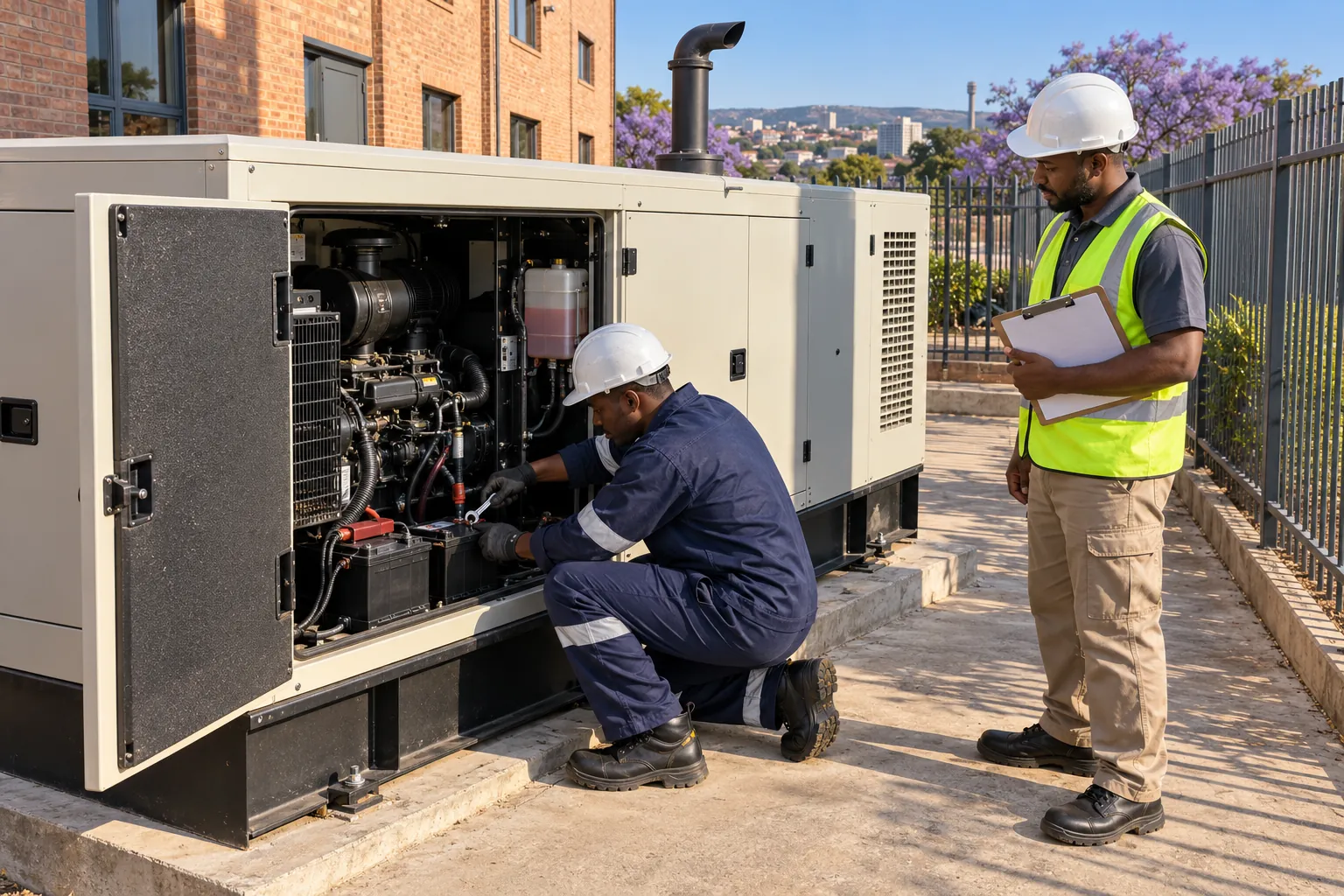
- Electrical and standby power: a tripped earth leakage unit, failed lights, damaged plugs, surge damage when the supply returns, and a generator, changeover switch, inverter or UPS that fails when load shedding begins.
- Lifts and air conditioning: a lift out of order or a passenger trapped, air conditioners not cooling or leaking, extraction fans stopped.
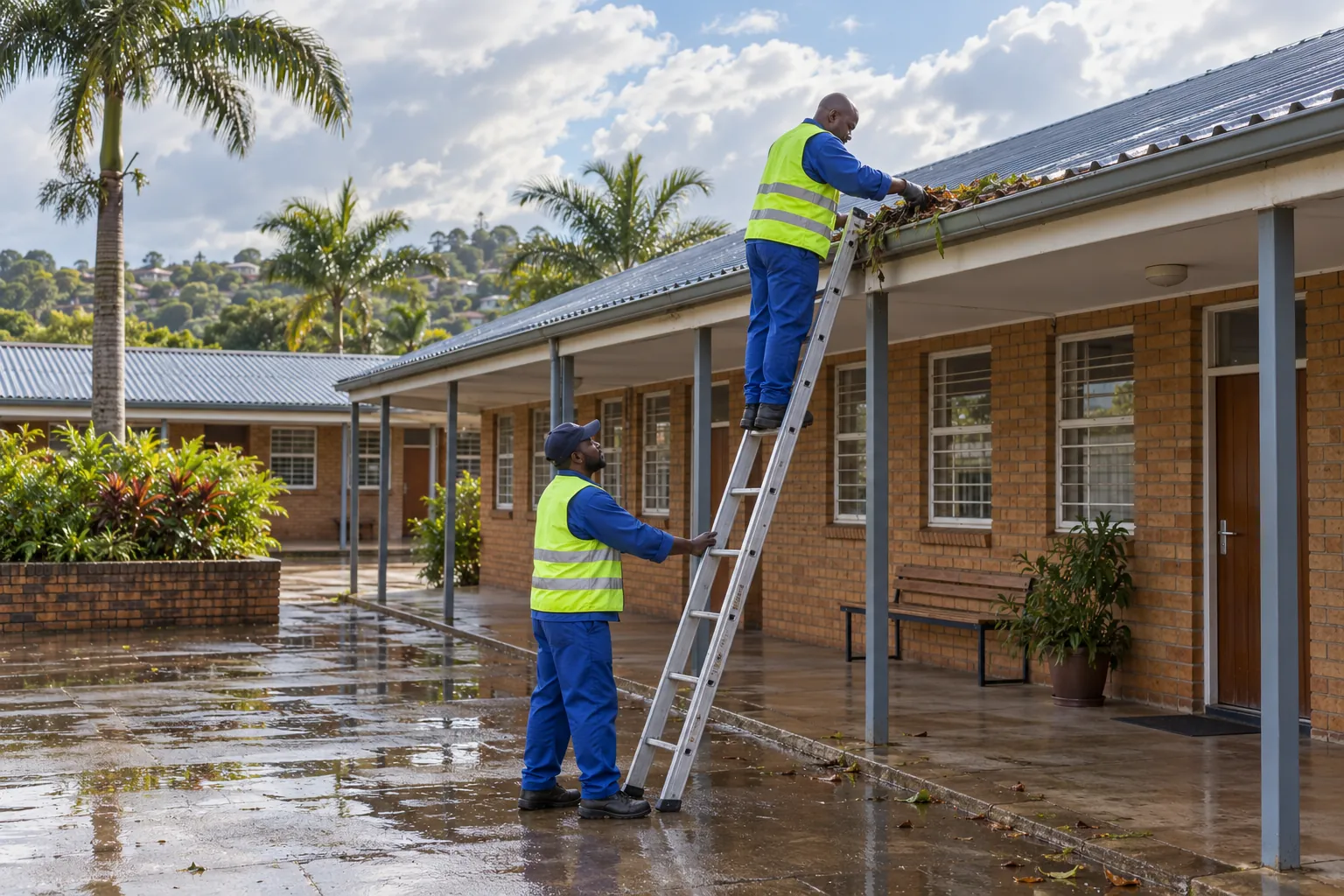
- Fabric: roof leaks and blocked gutters after a storm, damaged ceiling boards, loose floor tiles, broken windows.
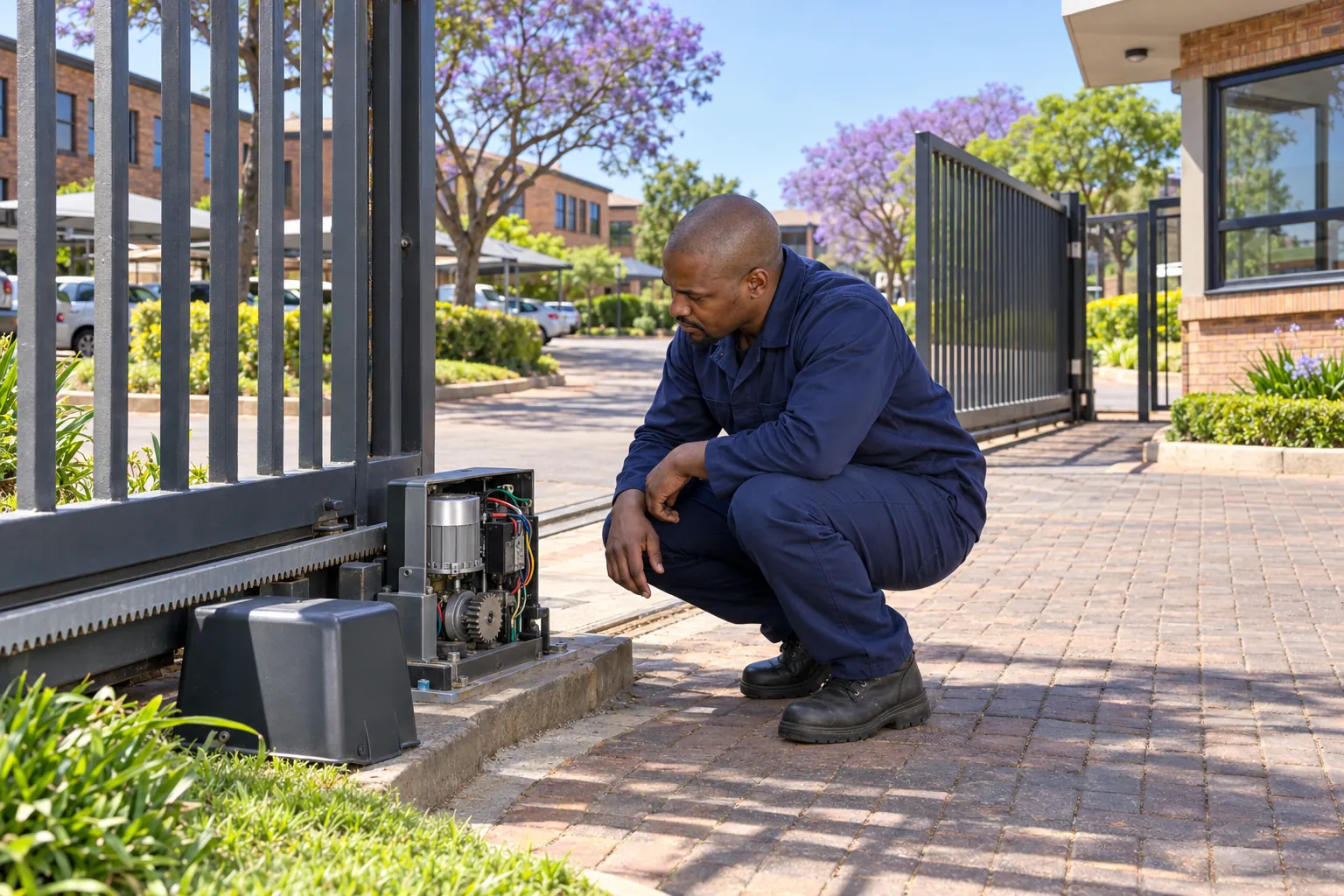
- Security and fire: a gate motor or boom that has failed, an access control reader or CCTV camera down, an electric fence fault, a discharged extinguisher, a leaking hose reel, an emergency light that does not come on.
- Damage: vandalism, forced entry, cable theft, vehicle damage to walls and gates, flooding.
Each follows the same path, whether the work is done in-house or by contractors: the fault is reported with where it is and what is wrong; it is logged and given a priority; if it is dangerous it is made safe at once; it is assigned to someone competent, attended and repaired; the repair is checked and the job closed; and the person who reported it is told.
Reporting is a legal duty for employees as well as good practice. Section 14(d) of the Occupational Health and Safety Act requires every employee who becomes aware of a situation which is unsafe or unhealthy to report it "as soon as practicable" to the employer or to the health and safety representative. A cleaner who sees water coming through a ceiling is doing what the Act expects, and the route should make that easy.
03
Priorities, making safe and response times
Reactive work needs a priority scale that everyone applies the same way. Most maintenance contracts use four or five levels; the times below are examples only.
- Emergency: an immediate risk to people, the building or its security, such as a person trapped in a lift, a burst geyser, exposed live wiring or a gate that will not close at night. Attend and make safe within an hour or two, day or night.
- Urgent: a fault that puts part of the building out of use or will get worse quickly, such as the only ablutions on a floor out of order or a roof leak. Attend the same day.
- Routine: an inconvenience but not a risk, such as a dripping tap or a failed office light. Attend within a few working days.
- Planned: work that can wait to be grouped with other jobs, within weeks.
Three habits make the scale work. Measure attendance and completion separately, or a contractor can meet every response target while jobs wait weeks for parts. Judge the fault, not the complaint: a failed light is a nuisance in an office and a hazard on a stairwell, and a dead generator matters more on a site that relies on it during load shedding. And plan for after hours: who answers an emergency at night, at weekends and on public holidays, who may authorise a call-out, and what the security officer or caretaker should do while they wait.
Making safe is the first response to a dangerous fault, and sometimes the law requires it. Regulation 7(4) of the Lift, Escalator and Passenger Conveyor Regulations, 2009 (Government Notice R. 828 of 17 September 2010) requires the user of a lift to "immediately take steps to stop the working thereof and to prevent the starting thereof if its use is or is likely to be dangerous to persons". Under regulation 7(3), a defect that endangers people must be reported by the lift service provider to the user and the provincial director, and nobody may be conveyed until it has been rectified to the satisfaction of an inspection service provider. Regulation 13H(2)(f) of the General Safety Regulations, as amended by Government Notice 5954 of 6 March 2025, requires openings in floors and open sides from which people could fall to be boarded over, fenced or otherwise guarded, and regulation 13H(2)(d) and (e) require floors, walkways, stairs, passages and gangways to be kept in a good state of repair, and the roof and walls of every indoor workplace to be kept sound and leak-free.
A make-safe is not a repair. A geyser isolated at the valve or a cordon round a broken floor is the right first response, but the job stays open until the permanent repair is done.
04
Who fixes what: owners, tenants, bodies corporate and contractors
A fault report is only useful if it reaches whoever is responsible for the repair:
- A leased building: the lease decides. Typically the landlord or its managing agent looks after the structure, roof, lifts and central plant, and the tenant the fittings inside its premises, but leases differ. Regulation 2(1) of the Electrical Installation Regulations, 2009 makes the user or lessor responsible for the "safety, safe use and maintenance" of an electrical installation, and regulation 2(3) moves that to the lessee where a written undertaking transfers it.
- A sectional title scheme: under section 3(1)(l) of the Sectional Titles Schemes Management Act 8 of 2011 the body corporate must "maintain all the common property and to keep it in a state of good and serviceable repair", and sections 3(1)(q) and (r) add the plant, machinery, fixtures and fittings used in connection with the common property and sections, and, subject to the rights of the municipality, the pipes, wires, cables and ducts that serve more than one section or the common property, or one section across the common property. Under section 13(1)(c) each owner must "repair and maintain his or her section in a state of good repair", and section 13(1)(a) lets the body corporate's authorised person in to repair shared pipes and cables, with no notice needed in an emergency. Disputes about who pays are for the rules and the Community Schemes Ombud Service; see our guide to body corporate maintenance duties.
Some repairs need a registered person. The Electrical Installation Regulations, 2009 define installation work to include "the installation, extension, modification or repair of an electrical installation", and regulation 5(4) requires a registered person to "exercise general control over all electrical installation work being carried out". Under regulation 7(4), where an installation already has a certificate of compliance, an addition or alteration needs a certificate for at least that work; an installation that existed before 23 October 1992, has not changed owner since 1 March 1994 and has no certificate needs one for the whole installation once anything is added or altered (regulation 7(3)). Lift faults go to the competent lift service provider the user has designated, not to whoever is on site.
For contractors, the arrangements that matter are:
- Approved contractors: a short list per trade, with competence, insurance and, where the law requires it, registration checked before the first job.
- A written agreement: a contractor is a mandatary under the Act, and section 37(2) moves the employer's liability for a mandatary's acts only where "the parties have agreed in writing to the arrangements and procedures between them to ensure compliance by the mandatary with the provisions of this Act". See our guide to the section 37(2) agreement.
- Rates and authority: call-out fees and after-hours rates agreed before the first emergency, and a named person who may approve a job up to a set value.
05
Reactive against preventative maintenance, and what it costs
Reactive maintenance is not a failure in itself. Vandalism, storm damage and other unexpected failures cannot be foreseen, and letting cheap, non-critical items fail can be sensible. Most buildings use a mix of maintenance strategies, and the right strategy for each asset depends on the impact its failure would have on people and on the building's operations. The problem is a building that is reactive by default. The disadvantages are well known:
- Higher cost per job: call-out fees, after-hours rates, spare parts bought in a hurry, and secondary damage, such as ceiling boards and stock ruined by a geyser that a regular check would have caught.
- Downtime: floors, ablutions or a lift out of use, which often costs more in disruption than the repair.
- Shorter asset life: equipment and other assets run until they break usually wear out sooner.
- Safety risk: a fire system, emergency light or standby generator only looked at when it fails is not being maintained, and the failure is found at the worst moment.
- A budget nobody can plan: reactive costs arrive unevenly.
There is no correct ratio of planned to reactive work for every building. More useful is to look at the data from reactive jobs by asset and location each month. The same fault on the same equipment again and again belongs on the preventative maintenance schedule or needs replacing; a cluster of faults in one area points to a root cause, such as a failing roof membrane or a supply that trips whenever power returns after load shedding.
When a fault causes harm, it becomes an incident too. Section 24(1) of the Act requires certain incidents to be reported to an inspector, including an injury or illness after which a person is likely to be unable to work, or to continue the activity they were employed for, for at least 14 days, and cases where someone's health or safety was endangered and machinery fractured or failed, resulting in flying, falling or uncontrolled moving objects. See our guide to incident reporting and investigation.
A useful job record shows where the fault is, what was reported, by whom and when; the priority; any make-safe; who attended and when; what was found and done, with photographs where they help; when it was checked and closed, and by whom; and when the reporter was told. When an insurer, an inspector or a body corporate asks what was done about a fault, the answer should be a record, not a recollection.
06
Where the record fails, and what SiteClara does about it
Reactive maintenance records are usually good from the moment a job is logged with the managing agent, the maintenance team or the contractor. They are weak before that point, because faults found by cleaners, security officers and caretakers on their rounds are passed on by word of mouth or a WhatsApp message to whoever answers, and after it, because nobody checks the repair or tells the person who reported the fault.
SiteClara covers the teams on the ground. A printed QR poster at each location, with an optional NFC tag behind it, lets staff scan or tap on their own phone, with no app to install, and report a fault with a photo. The report already knows the building and the location, and it goes onto the team's list of open jobs until someone closes it. The supervisor's queue groups open jobs by building and floor, and a supervisor can escalate a job to the building manager, who can answer it. Each day the supervisor approves a report that goes to nominated managers or client contacts at 08:00 the next morning, showing what was reported, completed and still open.
07
Questions people ask
What are the four types of maintenance?
The US Department of Energy's O&M Best Practices Guide, Release 3.0, Chapter 5: Types of Maintenance Programs describes four: reactive maintenance, which waits for equipment to fail; preventive maintenance, done on a time- or machine-run-based schedule; predictive maintenance, based on measurements of the equipment's actual condition; and reliability centred maintenance, which combines the other three according to how much each asset matters. It notes that equipment which is inexpensive and unimportant to reliability may best be left to reactive maintenance.
What is the difference between reactive and proactive maintenance?
Reactive maintenance waits for the failure; proactive maintenance acts before it. The O&M Best Practices Guide, Release 3.0, Chapter 5: Types of Maintenance Programs describes reactive maintenance as the "run it till it breaks" mode, in which no actions are taken to maintain equipment as its designer intended, and defines preventive maintenance as actions on a time- or machine-run-based schedule that "detect, preclude, or mitigate degradation of a component or system". Predictive maintenance is proactive too, acting on measurements that detect the onset of degradation.
What are the disadvantages of reactive maintenance?
The O&M Best Practices Guide, Release 3.0, Chapter 5: Types of Maintenance Programs lists increased cost due to unplanned downtime of equipment, higher labour costs, especially if overtime is needed, the cost of repairing or replacing equipment, possible secondary damage from the failure, and inefficient use of staff resources. Its advantages are low cost and fewer staff in the short term, but the guide estimates that a preventive maintenance programme saves 12% to 18% over a reactive one.
08
Where to read the official text, and a list to take away
The Occupational Health and Safety Act 85 of 1993, the amendments to the General Safety Regulations made by Government Notice 5954 of 6 March 2025 and the Sectional Titles Schemes Management Act 8 of 2011 are on gov.za; the Department of Employment and Labour publishes the Electrical Installation Regulations, 2009 and the Lift, Escalator and Passenger Conveyor Regulations, 2009. Regulations are amended by notice in the Government Gazette, so check for the current text. To keep reactive maintenance under control, check that:
- everyone on site knows how to report a fault, and reports reach the person responsible;
- every fault is logged with its location, a priority and who reported it;
- priorities follow risk, with example faults for each level;
- response and fix times are measured separately;
- after-hours emergencies have a named route and a person who may authorise a call-out;
- make-safes stay open until the permanent repair is done;
- electrical repairs are under a registered person's control, and lift faults go to the lift service provider;
- contractors are approved and have signed a section 37(2) agreement;
- repeat faults are reviewed monthly and fed into the preventative maintenance schedule;
- the person who reported the fault is told when it is fixed.
Sources
Every document this guide quotes or links to, in the order it first cites them.
- Occupational Health and Safety Act 85 of 1993 gov.za
- Lift, Escalator and Passenger Conveyor Regulations, 2009 labour.gov.za
- Electrical Installation Regulations, 2009 labour.gov.za
- Sectional Titles Schemes Management Act 8 of 2011 gov.za
- O&M Best Practices Guide, Release 3.0, Chapter 5: Types of Maintenance Programs www1.eere.energy.gov
- General Safety Regulations made by Government Notice 5954 of 6 March 2025 gov.za
Related guides
 Premises and facilities managementPreventative maintenance for buildings: how to plan it and show it was donePreventative maintenance for South African buildings: the OHS Act duty, the asset register and schedule, lift, electrical and fire tasks, and records that hold up.
 Premises and facilities managementBody corporate maintenance: what the law requires, and how to show it was doneWhat a body corporate must maintain under the Sectional Titles Schemes Management Act, the 10-year plan, the reserve fund, who does the work and the records to keep.
 Premises and facilities managementFacilities manager duties: what the job covers under South African law, and how to show it is doneA facilities manager's duties in South Africa: the OHS Act duties they carry, contractors, lifts, electrics, fire and ablutions, and the records that show it.
 Premises and facilities managementCaretaker duties: what the job involves in South Africa, and how to show it was doneCaretaker duties in South African sectional title schemes, estates, schools, offices and churches: the law behind the job, daily checks, repairs and the record.