Cleaning
School cleaning checklist: what to clean, how often, and how to show it was done
A school cleaning checklist lists the cleaning tasks for every area of a school, from classrooms, toilets and corridors to the dining hall, sports hall and medical room, with how often each is done: during the school day, after school each day, weekly, or in the holidays.
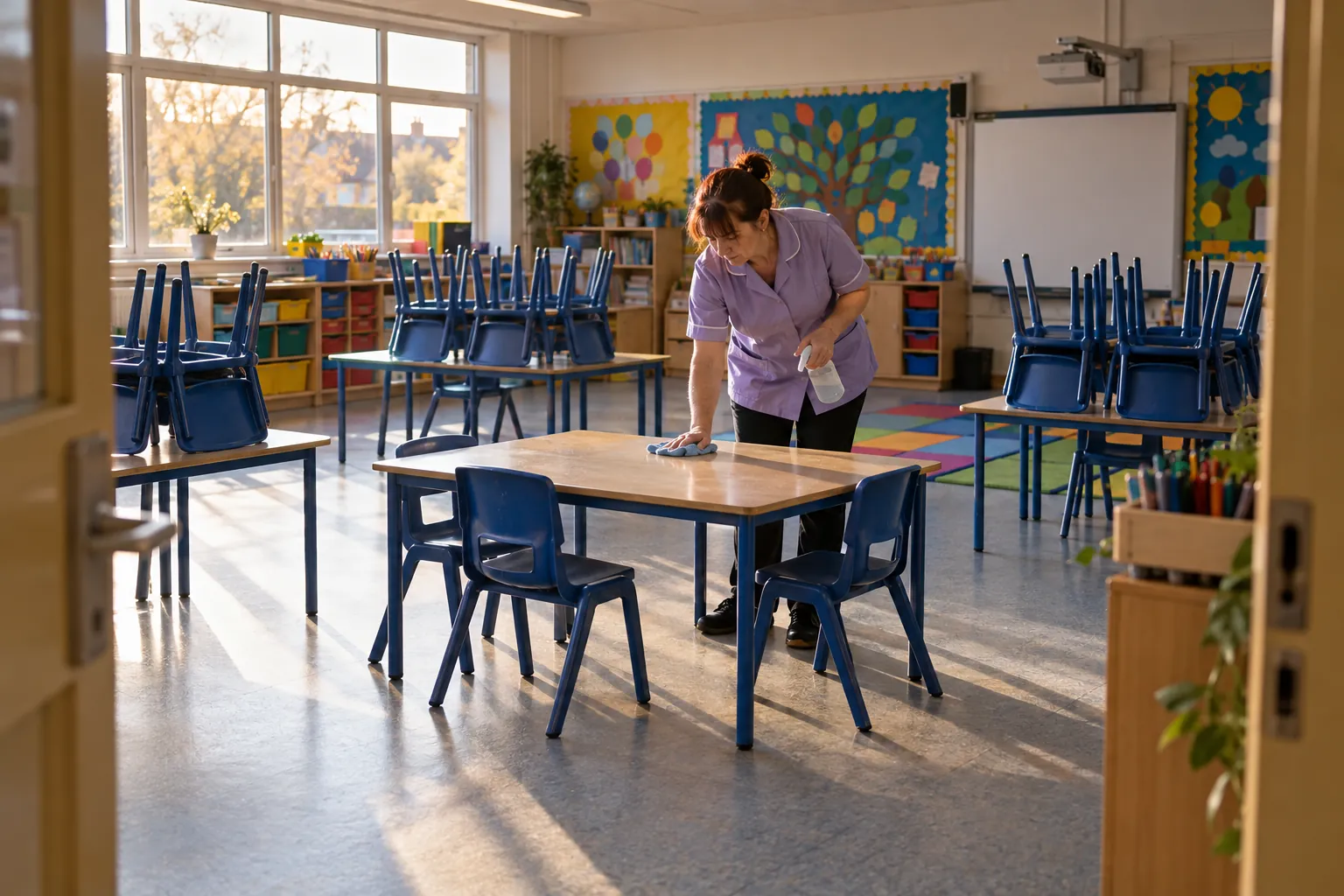
A school is cleaned in the few hours when pupils are not in it, and judged every minute they are. This guide sets out that checklist area by area, what needs daily attention and what can wait for the holidays, who is responsible, and how to keep a record the school business manager and governors can rely on.
01
The duty behind a school cleaning checklist
No regulation prescribes a school cleaning checklist, but the Workplace (Health, Safety and Welfare) Regulations 1992 set the outcome it has to deliver in Great Britain: a school is a workplace, so regulation 9 requires it to be kept sufficiently clean and regulation 20 (toilets) and regulation 21 (washing facilities) require the toilets and washing facilities provided for the people who work there to be kept in a clean and orderly condition. The toilets and washing facilities a school must provide for pupils are set by the school premises rules below. The Health and Safety at Work etc. Act 1974 requires the employer to protect the health and safety of staff and of pupils and visitors affected by its work.
In England, the School Premises (England) Regulations 2012 set standards for maintained schools, including suitable toilet and washing facilities for pupils, and independent schools and academies meet similar standards under their own regulations. Wales, Scotland and Northern Ireland have their own school premises rules, but the cleaning principles are the same.
The UK Health Security Agency's guidance Health protection in children and young people's settings, including education sets out what good cleaning looks like for infection control in England: a written cleaning schedule, colour-coded equipment, attention to frequently touched surfaces, safe handling of blood and body fluid spills, and enhanced cleaning during an outbreak. Germs spread easily where children share desks, equipment and toilets, and routine cleaning of the surfaces hands touch most, alongside handwashing, is one of the simplest ways to reduce the spread of germs and illness among students and staff. Public Health Scotland and the other nations publish equivalent guidance.
Who holds the duty depends on the type of school: the local authority, the governing body or the academy trust. Cleaning itself may be done by in-house staff under the site manager or by a commercial cleaning company under contract. Either way, the checklist is how the school shows the cleaning routine is actually happening, and how it keeps a clean and hygienic learning environment rather than one that is clean on inspection day.
02
What a school cleaning checklist covers, area by area
Every school is different, but the same areas of the school appear in almost every school's cleaning schedule. Each needs its own list of cleaning tasks, and the high-traffic areas, toilets and dining hall deserve the most regular attention:
- Classrooms: empty bins; sweep, mop or vacuum floors; wipe desks, tables and chairs; clean door handles, light switches and shared equipment; clean sinks in practical rooms; tidy but do not disturb pupils' work.
- Toilets and washrooms: clean toilets, urinals, basins and taps; mop floors; restock toilet paper, soap and paper towels; empty sanitary bins; check for leaks, blockages and graffiti. School washrooms are the hotspot for germs to spread, and the first place pupils and parents judge the school's hygiene standards.
- Corridors, stairs and hallways: sweep and mop, wipe handrails and door push plates, clear litter from lockers and coat areas.
- Entrances and reception: entrance matting, glass doors, the reception counter and visitors' seating.
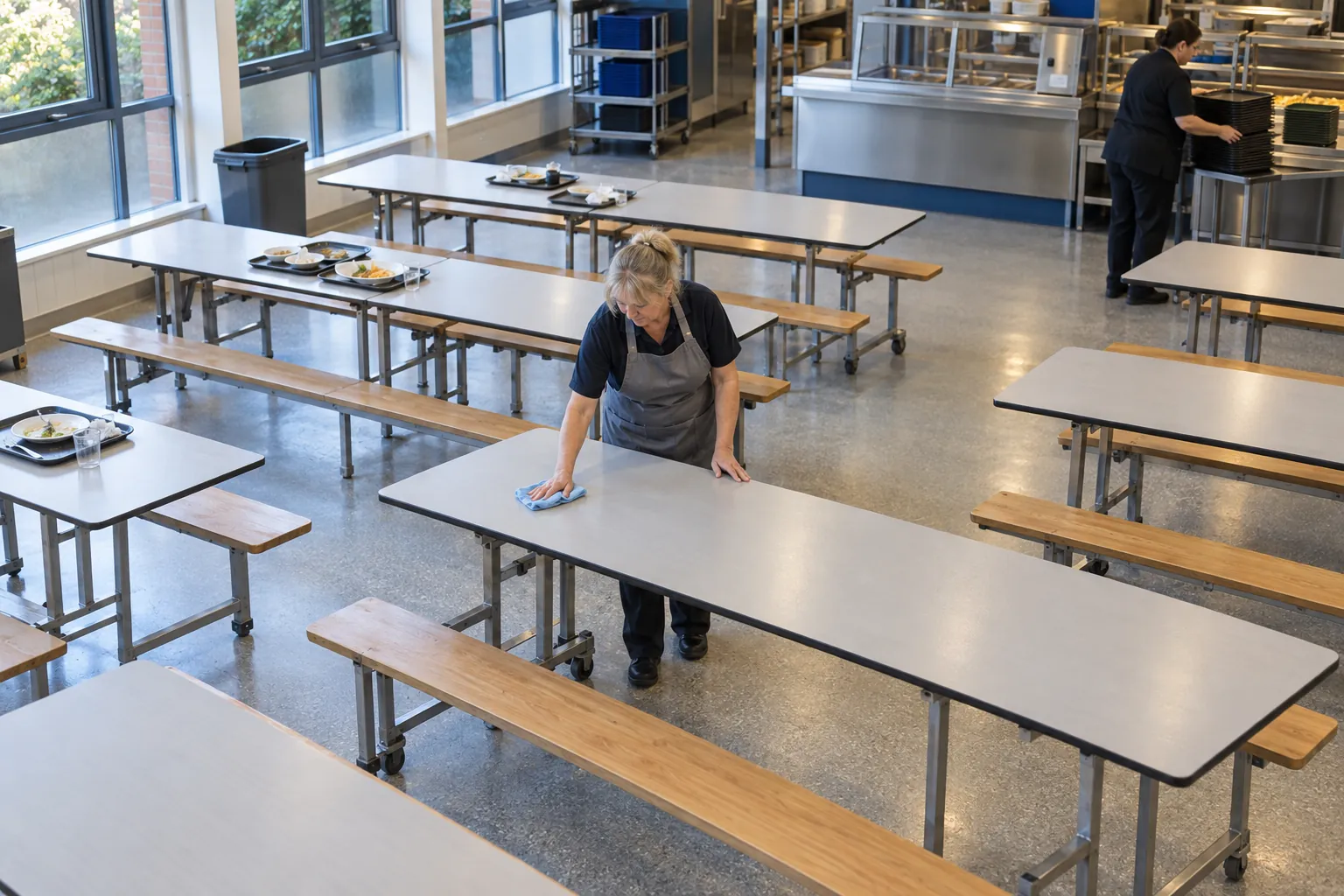
- Dining hall and canteen: tables and chairs wiped after lunch, floor swept and mopped, bins emptied. The kitchen itself is usually the caterer's responsibility under food hygiene law, and the checklist should say where the line falls.
- Sports hall and changing rooms: floors, benches, showers and toilets, with the sports hall floor cleaned by the method its surface needs.
- Staff rooms and offices: kitchens, worktops and fridges, desks and bins.
- Medical room: surfaces, couch, sink and clinical waste arrangements, cleaned to a higher standard than a classroom.
- Early years and nursery rooms: floors children sit and play on, low surfaces, toys and nappy-changing areas, on the setting's own schedule.
Keep the cleaning cupboard on the checklist too. Cleaning supplies and cleaning products chosen for use around children, chemicals stored safely and locked away from pupils, COSHH data sheets to hand, colour-coded cloths and mops kept separate, and equipment clean and dry at the end of the shift. Sanitisation products and disinfectants should be used where the schedule or an outbreak calls for them, not as a substitute for cleaning, because dirt left on a surface stops a disinfectant working.
03
Daily, weekly, termly and holiday tasks
School cleaning follows the school day and the school year. A workable checklist splits tasks into four rhythms, so the cleaning team can prioritise what needs doing daily and weekly from what can wait:
- Daily clean, usually after school: classrooms, toilets, corridors, entrances, dining hall, staff room and offices, with bins emptied and high-touch surfaces cleaned throughout.
- During the school day: toilet checks after break and lunch, spills and accidents dealt with as they happen, the dining hall cleaned between sittings. This is often the caretaker or a day cleaner, not the evening team.
- Weekly: high-level dusting within reach, internal glass and partitions, skirting boards, sports hall floor care, bin store, and a closer look at the areas the daily clean passes quickly. This weekly cleaning is where most checklists quietly slip.
- Holiday deep clean: the summer holiday is when hard floors are stripped and resealed, carpets deep cleaned, high-level surfaces, lights and vents cleaned, and furniture moved so every room is cleaned properly. Shorter holidays take the periodic tasks that cannot wait a year.
How often a school needs a deep clean beyond the holiday programme depends on use and on illness. During an outbreak of diarrhoea and vomiting, for example, the school's health protection team may advise enhanced cleaning of toilets and frequently touched surfaces, with suitable disinfectant, until the outbreak is over.
04
Who does what in school cleaning
School cleaning is usually split between people who are rarely in the building at the same time:
- The cleaning team, in-house or from a cleaning contractor, carries out the daily clean after school and the holiday programme.
- The site manager or caretaker deals with spills and accidents in the school day, supervises in-house cleaners, and is often the day-to-day link with the cleaning company.
- The school business manager owns the cleaning contract or budget, agrees the specification and handles complaints.
- Teachers and staff keep rooms clear enough to be cleaned and report problems.
- The caterer cleans the kitchen to its own food safety management system.
Write the split down. Most disputes in school cleaning are about the gaps between these people: whose job it is to clean the dining hall between sittings, who wipes the tables in the staff room, and who checks the toilets at lunchtime.
What are the typical tasks of a school cleaner?
A school cleaner's typical tasks are the daily clean after school: emptying bins, cleaning floors, wiping desks and frequently touched surfaces, cleaning and restocking toilets, and cleaning corridors, entrances and the dining hall, with deeper cleaning in the holidays. The National Careers Service's cleaner job profile adds mixing cleaning chemicals and detergents safely and in the right amounts, maintaining stock levels of cleaning products and following health and safety regulations, and says cleaners need to pass enhanced background checks.
05
How to check the checklist is being followed
A checklist ticked by the person who did the work is a starting point, not assurance. Whether the school buys school cleaning services from a professional cleaning company or employs its own team, it needs to know the cleaning process is followed the same way every night. Schools usually add three kinds of checking:
- Walk-rounds by the site manager or business manager first thing in the morning, before pupils arrive, when the result of the evening clean is easiest to see.
- Periodic audits against the specification, jointly with the cleaning company where there is one, scoring a sample of rooms.
- A cleaning review meeting each term with the contractor, covering audit results, complaints, missed cleans, staffing, the holiday programme and any change in how the building is used.
Students, staff and visitors are quick to notice when cleanliness slips, and the early signs are predictable: full bins in the morning, sticky tables in the dining hall, and toilets without soap by the end of lunch. A school with an underperforming school cleaning contractor usually knows from complaints long before it has the evidence to act, which is why a record of each clean, and each missed one, matters when the contract is reviewed.
06
Where the school cleaning record fails, and what SiteClara does about it
Most school cleaning happens between four and seven in the evening, when the business manager has gone home. The record is a signing sheet in the cleaning cupboard or an assurance from the contractor, and the first sign of a missed clean is a teacher's email the next morning.
SiteClara puts a printed QR poster at each location on the checklist, such as each toilet block, the dining hall and each corridor, with an optional NFC tag behind it. Posters for staff can be placed where pupils are unlikely to reach. A cleaner scans the code or taps the tag on their own phone, with no app to install, sees the checks due there, and marks each one done or explains what stopped them, with a photo if needed. A fault such as a blocked toilet or a broken lock can be reported there, and it goes onto the team's list of jobs until someone closes it; the supervisor can escalate it to the site or building manager.
The supervisor sees what was done and what was missed, and can record why. They review the day's totals and photos, add a note and approve the daily report, which goes to the school business manager or other nominated contacts at 8am the next morning, before pupils arrive, showing what was completed, what is still open and how scheduled checks went.
07
Further reading, and a list to take away
The UK Health Security Agency publishes Health protection in children and young people's settings, including education, with sections on cleaning and outbreaks. The Department for Education publishes advice on standards for school premises and on health and safety in schools. The Health and Safety Executive publishes the Approved Code of Practice Workplace health, safety and welfare (L24) and guidance on COSHH. The British Institute of Cleaning Science (BICSc) publishes training for cleaning operatives.
Before the next term starts, check that your school cleaning checklist:
- lists every area of the school, including the medical room, changing rooms and early years rooms;
- gives each area specific tasks and a frequency;
- covers toilet checks and spills during the school day, not only the evening clean;
- says where the caterer's cleaning ends and the cleaning team's begins;
- sets out the holiday deep clean with dates;
- covers colour coding, COSHH and a locked cleaning cupboard;
- says how each clean is recorded and who sees the record;
- is reviewed each term with the cleaning team or contractor.
Sources
Every document this guide quotes or links to, in the order it first cites them.
- Workplace (Health, Safety and Welfare) Regulations 1992 legislation.gov.uk
- Regulation 9 legislation.gov.uk
- Regulation 20 legislation.gov.uk
- Regulation 21 legislation.gov.uk
- Health and Safety at Work etc. Act 1974 legislation.gov.uk
- School Premises (England) Regulations 2012 legislation.gov.uk
- Cleaner job profile nationalcareers.service.gov.uk
- Health protection in children and young people's settings, including education gov.uk
Related guides
 Premises and facilities managementSchool site manager duties: the role, the routine checks and the recordWhat a school site manager does: security, health and safety checks, repairs, cleaning and contractors, how often checks are due, and how to record them.
 CleaningToilet check sheet: what to record and how to make it credibleWhat a washroom check sheet should record, how often to check, the legal duty behind it, and how to keep a record a client or inspector will believe.
 CleaningCleaning specification: what it should say, and how to show it is metWhat a cleaning specification should contain, input and output standards, setting frequencies by area, and how to show the specification is being delivered.
 CleaningCleaning quality control: how to inspect, correct and prove the standardHow quality control works in commercial cleaning: QA versus QC, setting standards, running inspections, corrective action and a record that holds up.