Cleaning
Cleaning specification: what it should say in Ireland, and how to show it is met
A cleaning specification is the part of a cleaning contract that sets out which areas of a building are cleaned, the tasks in each, how often each is done, the standard the result must meet and how performance will be checked.
Also written for United Kingdom · United States · Canada
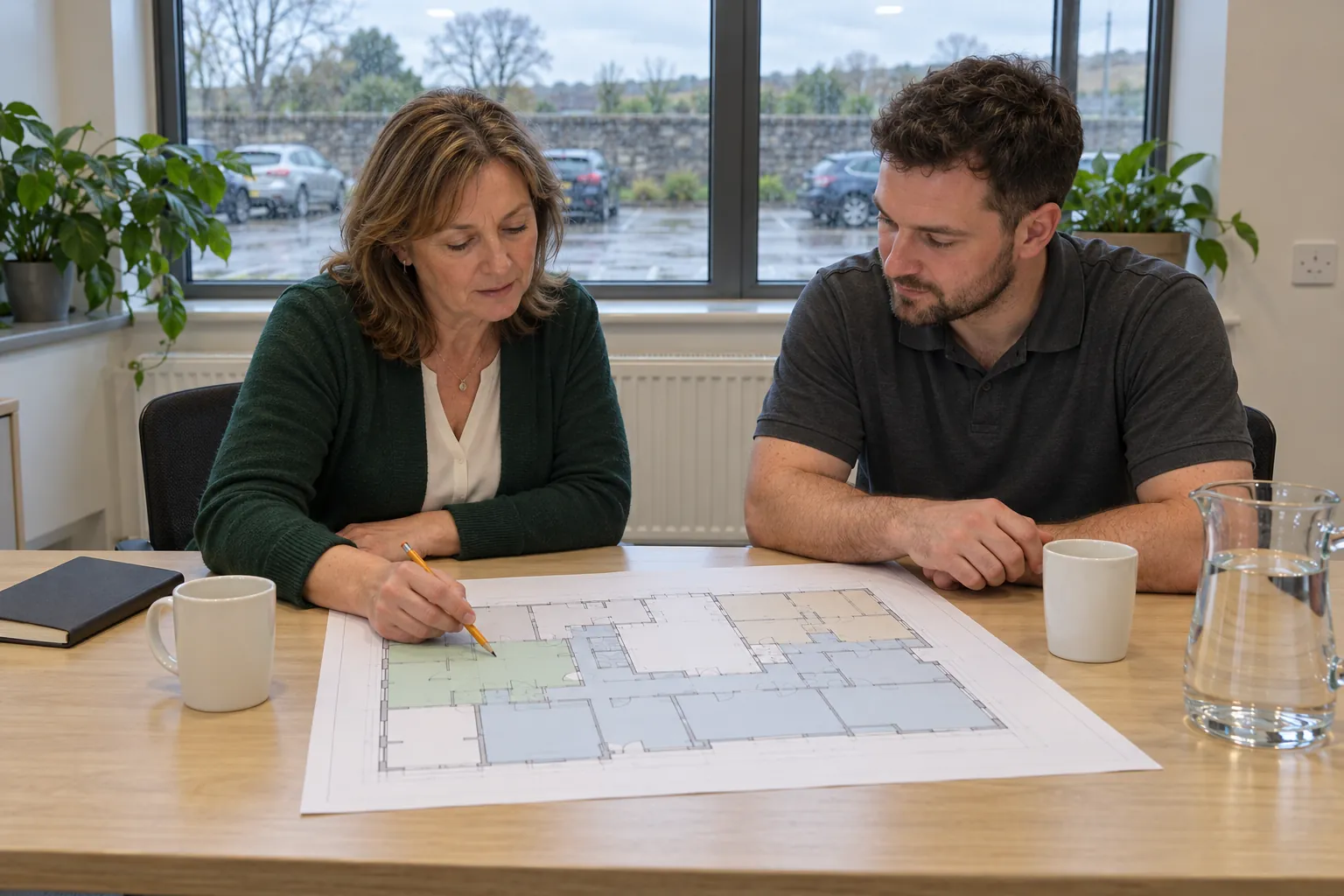
In Ireland it is how a client and a cleaning company give effect to Regulations 18 and 20 of the General Application Regulations 2007, which require the place of work and its sanitary facilities to be kept in a clean state. This guide covers what to put in one, how to set frequencies area by area, how to measure quality with I.S. EN 13549, what a change of contractor brings with it, and how to show the specification is being delivered rather than promised.
01
What a cleaning specification is, and the law behind it
A cleaning specification sets out the cleaning service a building needs, whether an office, a school or a health centre, area by area: the scope, the cleaning tasks, the frequency of each, the standard expected and how the client will check it. In a commercial cleaning tender it is often called the scope of work. Whatever the name, it turns "keep the building clean" into detailed cleaning requirements a cleaning company can price and deliver and a client can hold them to, and it is the reference point for every dispute that follows.
No Irish law requires a document called a cleaning specification. The law requires a clean and safe workplace, and the specification is where client and contractor agree how that will be delivered. The duties are in Chapter 1 of Part 2 of the Safety, Health and Welfare at Work (General Application) Regulations 2007 (S.I. No. 299 of 2007):
- Regulation 18(a) and (b): every place of work must be "kept in a clean state", with "accumulations of dirt, refuse, trade refuse and waste" removed, and the floor of every workroom cleaned, "by a suitable method as frequently as necessary to maintain an appropriate level of safety and health".
- Regulation 20: sanitary and washing facilities, lavatories and washbasins must be provided, maintained and kept "in a clean state".
- Regulation 10(b): windows and skylights must be capable of being cleaned without risk to the people cleaning them or anyone else present.
Above them sits the Safety, Health and Welfare at Work Act 2005. Section 8 of the Act requires an employer to maintain the place of work, so far as is reasonably practicable, "in a condition that is safe and without risk to health". Section 15 of the 2005 Act puts a similar duty on anyone who controls a non-domestic place of work used by other people's employees, such as a landlord or an owners' management company. Section 21 of the 2005 Act requires employers sharing a place of work to co-operate and inform each other of risks, "including by the exchange of safety statements or relevant extracts".
So contracting the cleaning out does not move the duty away from the client. The client controls the building; the contractor employs the cleaners and controls how the work is done. A good specification is where the two meet, in writing, as part of the cleaning contract.
Keep three documents apart. The specification is the contract: what is cleaned, to what standard, how often and how it is checked. The cleaning schedule turns the frequencies into rotas and routes. The checklist is the working list for a shift or an area; the commercial cleaning checklist guide covers that one.
02
What a cleaning specification should include
When creating one from scratch, walk the building with its floor plans first. A detailed specification a contractor can price and a client can check usually covers the following. Use it as a template, and leave out any heading that does not apply.
- Scope: the buildings, floors and spaces included and excluded, ideally as a room schedule grouped by type.
- Tasks by area type: toilets, kitchens and tea points, entrances, offices and desks, meeting rooms, corridors, stairs and lifts, and anything specialist, such as a crèche room or a GP surgery's treatment room.
- Frequency for each task: several times a day, daily, weekly, monthly, quarterly or periodic.
- The standard: what "clean" means for each area, in words two inspectors would read the same way.
- Times and access: when cleaning happens, when rooms are free, and who holds keys and alarm codes.
- Periodic work: floor care, high-level dusting, internal glass and window cleaning, and deep cleans of toilets and kitchens, set out as a plan for the year.
- Consumables, equipment and chemicals: who supplies soap, toilet roll, hand towels, liners and machines, which products may be used, and the colour code for cloths and mops.
- Health and safety: the contractor's risk assessment and safety statement for the site, the client's risk assessment and safety statement extracts shared in return, and where cleaning equipment must never be left.
- Hours and supervision: the hours on site the price assumes, the staffing requirements behind them and how the team is supervised.
- Reactive cleaning: spillages and one-off requests, how they are raised and how quickly each type is dealt with.
- Quality and reporting: how cleaning is inspected and sampled, the pass mark, what happens to a failure, what the contractor reports and when the specification is reviewed.
Leave out anything nobody will check. A specification that lists two hundred tasks but is inspected on ten is really a specification of ten tasks.
03
Setting frequencies area by area
Irish law sets no fixed cleaning frequencies. Regulation 18 asks for cleaning "as frequently as necessary", so the frequency is a judgment, and the specification is where it is written down. Base it on risk and footfall: group every area into a few types and ask of each how many people use it, and what happens if it is dirty.
- Toilets and washrooms: a full clean at least daily and checks through the day, more often wherever the public uses them. The toilet cleaning checklist covers the checks.
- Kitchens and tea points: daily, with sinks, worktops and appliances cleaned after the busiest times; a food business has food hygiene law to meet as well.
- Entrances and reception: daily, with matting checked and changed in wet weather.
- Offices and meeting rooms: bins, clear desk surfaces and touch points such as door handles and light switches daily, with vacuuming and dusting on a stated cycle.
- Corridors, stairs and lifts: the circulation areas, daily or on a cycle, with handrails, push plates and lift buttons treated as touch points.
- Plant rooms, stores and low-use areas: weekly or monthly, if at all.
Then put the periodic work on its own calendar. High-level ledges, vents and the tops of partitions are where specifications quietly fail, because they are never urgent on any given night. A periodic task with a month against it, and a record of the month it was done, is worth more than "as required".
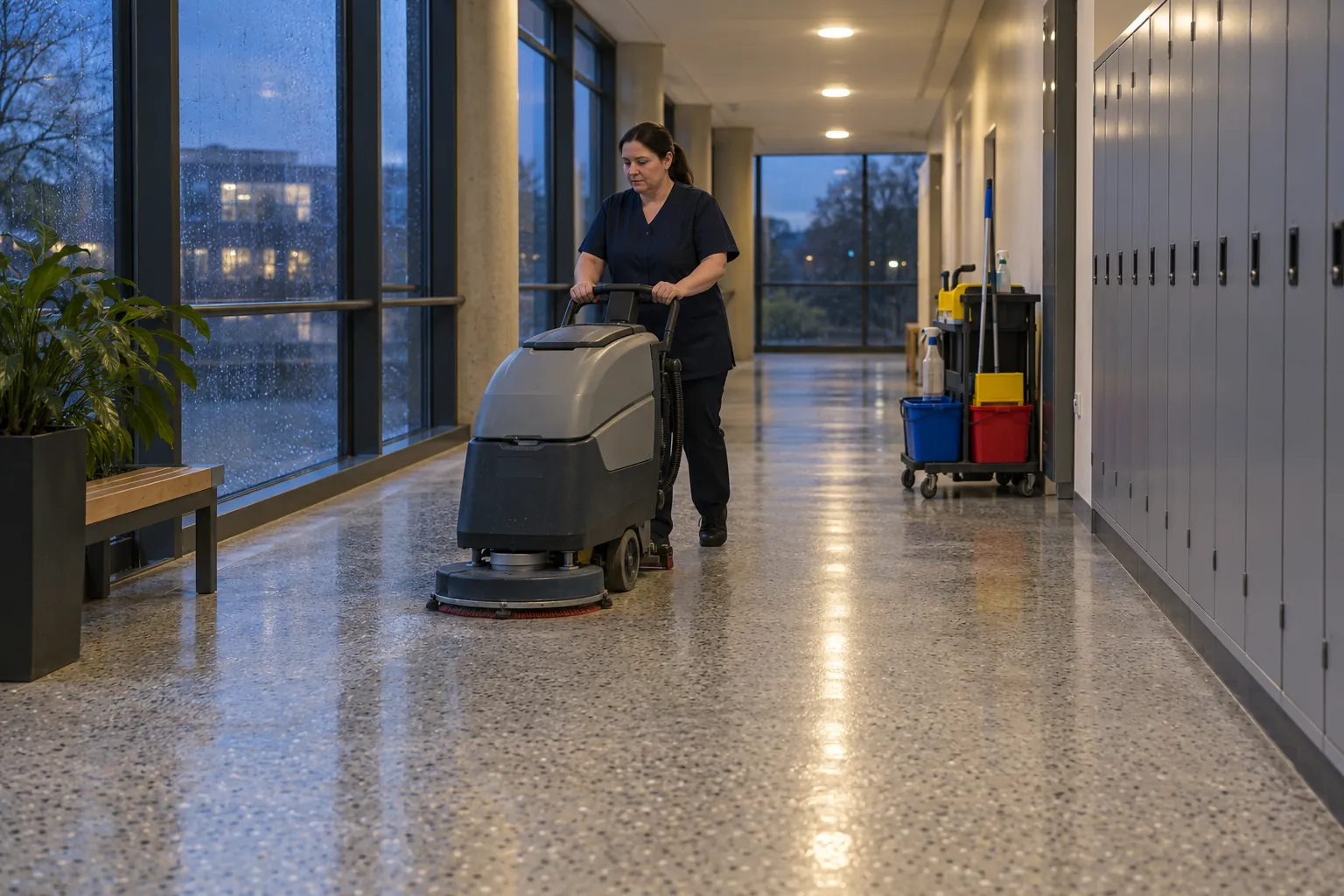
Timing matters as much as frequency. The Health and Safety Authority's advice on rescheduling floor wet-cleaning to control slip risks is to reduce wet-cleaning where possible, replace some of it with dry cleaning, move it to a low-traffic time, allow the maximum drying time, for example by cleaning the floor last so it can dry overnight, and arrange the floor cleaning schedule "in consultation with building operators and users". A specification that requires a mopped reception while staff are arriving has written a slip risk into the contract.
04
Writing the standard, and measuring it with I.S. EN 13549
There are two ways to write the standard, and most good specifications mix them.
- An input specification says what the contractor must do and how often: "vacuum carpets daily". It is easy to price and check, but it rewards doing the task rather than achieving the result.
- An output specification says what the result must be: "washbasins clean, with no residue or smears, whenever the building is open". It lets an experienced contractor decide how, but means nothing without regular inspection.
- A hybrid sets the outcome and a minimum frequency. It is the usual shape in contract cleaning, because it protects each side against the other's worst habit.
Measuring the result is where a European standard helps. I.S. EN 13549:2001, Cleaning services – Basic requirements and recommendations for quality measuring systems is the Irish adoption of EN 13549, published by the National Standards Authority of Ireland and listed by NSAI as current. Its abstract says it "gives basic requirements and recommendations for quality measurement systems for cleaning performance". It is not a list of tasks or frequencies: its contents cover inspection, sampling, quality levels, understandability, objective methods, periodic work, corrective actions and minimum sample sizes, with tables of sample sizes in an annex.
A specification that follows its approach does four things:
- Defines the items inspected in each kind of area, such as floors, bins, sanitaryware and touch points, and what counts as a fault on each.
- Samples the building rather than every room, with the sample spread across area types so a weak area cannot hide behind a strong one.
- Sets the quality level that counts as a pass before the first inspection, not after it.
- Says what happens to a fault: who is told, how quickly it is put right and how the area is rechecked.
The test of any standard is whether two people inspecting the same room would reach the same answer. Joint inspections, client and supervisor walking together, settle most disagreements early. Inspections measure quality; they do not show that every scheduled clean happened between them. That needs a record of work done.
05
Pricing, people and a change of contractor
A specification is priced in hours, and hours in contract cleaning have a statutory floor. The Workplace Relations Commission's page on the contract cleaning Employment Regulation Order says it applies to "workers employed by undertakings engaged in whole or in part on the provision of cleaning and janitorial services". The Employment Regulation Order (Contract Cleaning Industry Joint Labour Committee) 2025 (S.I. No. 430 of 2025), in effect from 17 October 2025, set €14.10 an hour, rising to €14.80 an hour on 1 January 2026, with lower percentages for workers under 20. When the hours in a tender cannot be worked at that rate for the price offered, something in the specification will not be delivered.
A change of contractor raises a second question: whether the cleaners move with the work. The European Communities (Protection of Employees on Transfer of Undertakings) Regulations 2003 (S.I. No. 131 of 2003) apply to "the transfer of an economic entity which retains its identity" (Regulation 3). Where there is a transfer, existing contracts of employment pass to the new employer (Regulation 4), the transfer is not in itself grounds for dismissal (Regulation 5), and both employers must inform the employees' representatives, where reasonably practicable, not later than 30 days before it (Regulation 8). The Workplace Relations Commission's guidance on transfer of undertakings summarises the same duties. Whether a particular retender is a transfer depends on its facts and is a matter for the employers and their advisers; the specification's part is to state the hours, shifts and equipment clearly, so every bidder prices the same service.
Health and safety moves with the contract too. The HSA's Safety in Contract Cleaning (2013) says a risk assessment "should be completed for each place of work prior to the worker commencing cleaning activities there", that the workplace "should also make available their own risk assessment to the cleaning staff", and that safety data sheets should be easily accessible to the worker. Under section 19 of the 2005 Act that risk assessment must be written; the specification should say when it and the client's documents are exchanged.
06
Where the specification record fails, and what SiteClara does about it
Most specifications promise more than anyone can show happened. "Toilets checked hourly" becomes a sheet on the back of the door, filled in by whoever passes. "Reception cleaned before 8am" becomes an assurance at the monthly meeting. When the client asks whether the third-floor tea point was cleaned last Tuesday, the contractor can describe the specification but cannot show it, and the first sign of a missed clean is a complaint.
SiteClara turns each specified check into a scheduled check at a location. A printed QR poster at each place, with an optional NFC tag behind it, lets the team scan the code or tap the tag on their own phone, with no app to install, and see the checks due there. They mark each one done, or say what stopped them, and add a photo when one is asked for. The time and the person are recorded as it happens. Anything found wrong, such as a broken dispenser, can be reported there and goes onto the team's list of jobs until someone closes it.
The supervisor sees what is due, done and missed, with the reason where one was given. At the end of the day they review the checks and photos and approve the report, which goes to the nominated client or management contacts the next morning: checks completed against those scheduled, and what is still open. That is the delivery half of the specification, beside the quality half that inspections measure.
07
Questions people ask
What are the cleaning standards in Ireland?
The legal standard is in Regulations 18 and 20 of the Safety, Health and Welfare at Work (General Application) Regulations 2007. Every place of work must be "kept in a clean state", with dirt, refuse and waste removed and workroom floors cleaned "as frequently as necessary to maintain an appropriate level of safety and health", and sanitary and washing facilities must be kept "in a clean state". Beyond that, the working standard is the one written into the specification, and I.S. EN 13549:2001 sets out how a quality measuring system should check it.
What are the rules of good housekeeping at work?
There is no official numbered list. The Health and Safety Authority's page on housekeeping to control slips, trips and falls says housekeeping is vital, especially when busy, and gives the essentials: do not leave tidying up until the end of the shift, keep floors and access routes clear, keep particularly messy operations away from pedestrian routes, and make sure cleaning staff have received proper training, instruction and demonstrations where required.
08
Further reading, and a list to take away
The law is sections 8, 15, 19 and 21 of the Safety, Health and Welfare at Work Act 2005 and Regulations 10, 18 and 20 of the General Application Regulations 2007, quoted as enacted and made. The HSA publishes Safety in Contract Cleaning and its floor wet-cleaning advice; NSAI sells I.S. EN 13549:2001; the Workplace Relations Commission publishes guidance on the contract cleaning Employment Regulation Order (S.I. No. 430 of 2025) and on transfer of undertakings. The contractor's side is in the cleaning supervisor duties guide, and the working lists for an office are in the office cleaning checklist guide.
Before a specification goes into a tender or a renewal, check that it:
- lists every area by type, with anything excluded named;
- gives each task a frequency and each area a standard two inspectors would read the same way;
- puts periodic work on a calendar, with a month against each task;
- plans wet cleaning for quiet times, agreed with the building's users;
- says who supplies consumables, equipment and chemicals;
- names the risk assessments and safety statement extracts to be exchanged, and when;
- sets rectification times, sampling and the quality level that counts as a pass;
- can be delivered in the hours priced at the Employment Regulation Order rate;
- says how completed work will be evidenced, not only scored;
- has a date for its next review.
Sources
Every document this guide quotes or links to, in the order it first cites them.
- Safety, Health and Welfare at Work (General Application) Regulations 2007 irishstatutebook.ie
- Section 8 of the Act irishstatutebook.ie
- Section 15 of the 2005 Act irishstatutebook.ie
- Section 21 of the 2005 Act irishstatutebook.ie
- Rescheduling floor wet-cleaning to control slip risks hsa.ie
- I.S. EN 13549:2001, Cleaning services – Basic requirements and recommendations for quality measuring systems shop.standards.ie
- Workplace Relations Commission's page on the contract cleaning Employment Regulation Order workplacerelations.ie
- Employment Regulation Order (Contract Cleaning Industry Joint Labour Committee) 2025 irishstatutebook.ie
- European Communities (Protection of Employees on Transfer of Undertakings) Regulations 2003 irishstatutebook.ie
- Workplace Relations Commission's guidance on transfer of undertakings workplacerelations.ie
- Safety in Contract Cleaning hsa.ie
- Section 19 of the 2005 Act irishstatutebook.ie
- Housekeeping to control slips, trips and falls hsa.ie
- Safety, Health and Welfare at Work Act 2005 irishstatutebook.ie
Related guides
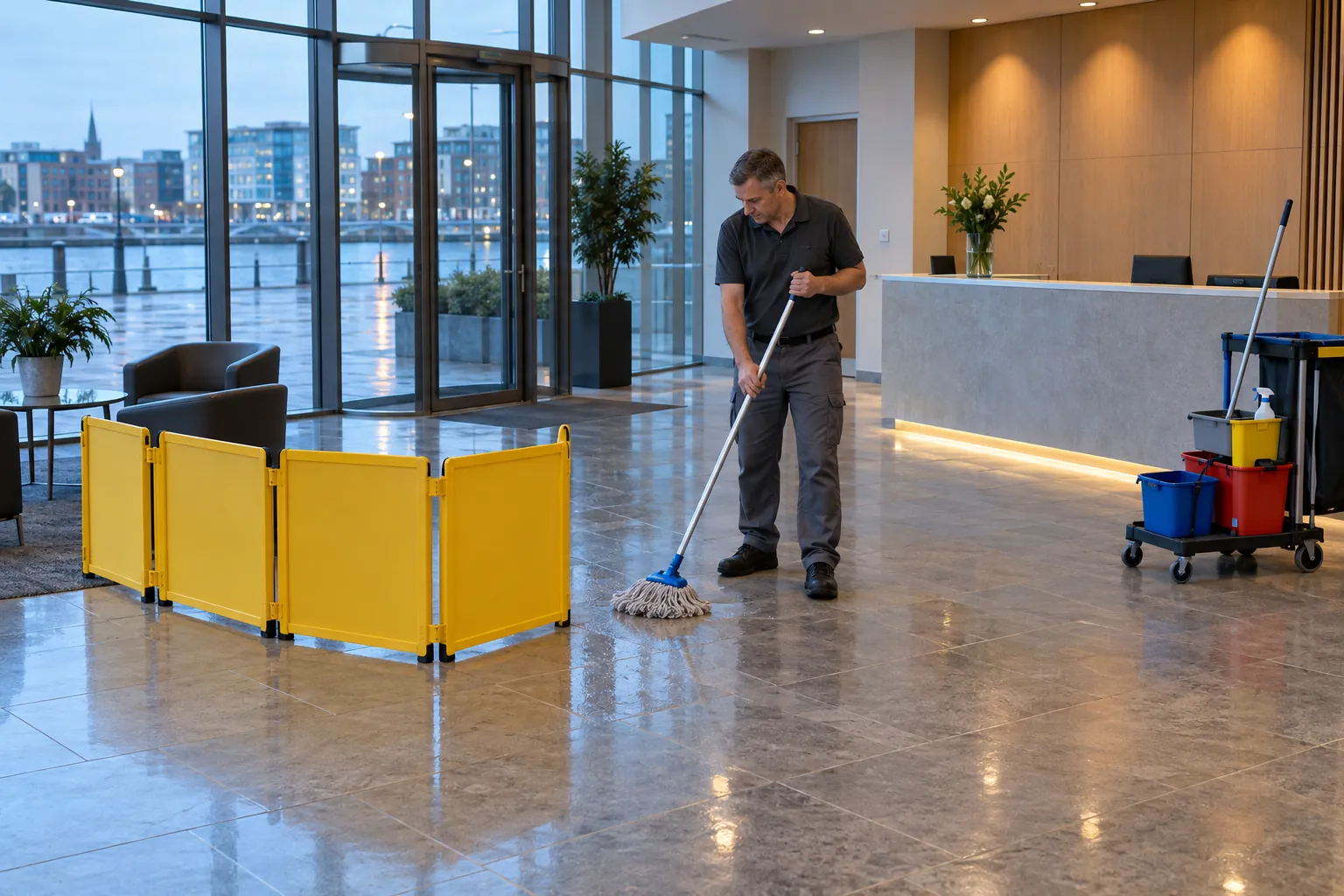 CleaningCommercial cleaning checklist: area by area, for Irish workplacesA commercial cleaning checklist for Irish offices and shared premises, area by area: the 2007 Regulations behind it, using it on shift and checking it is followed.
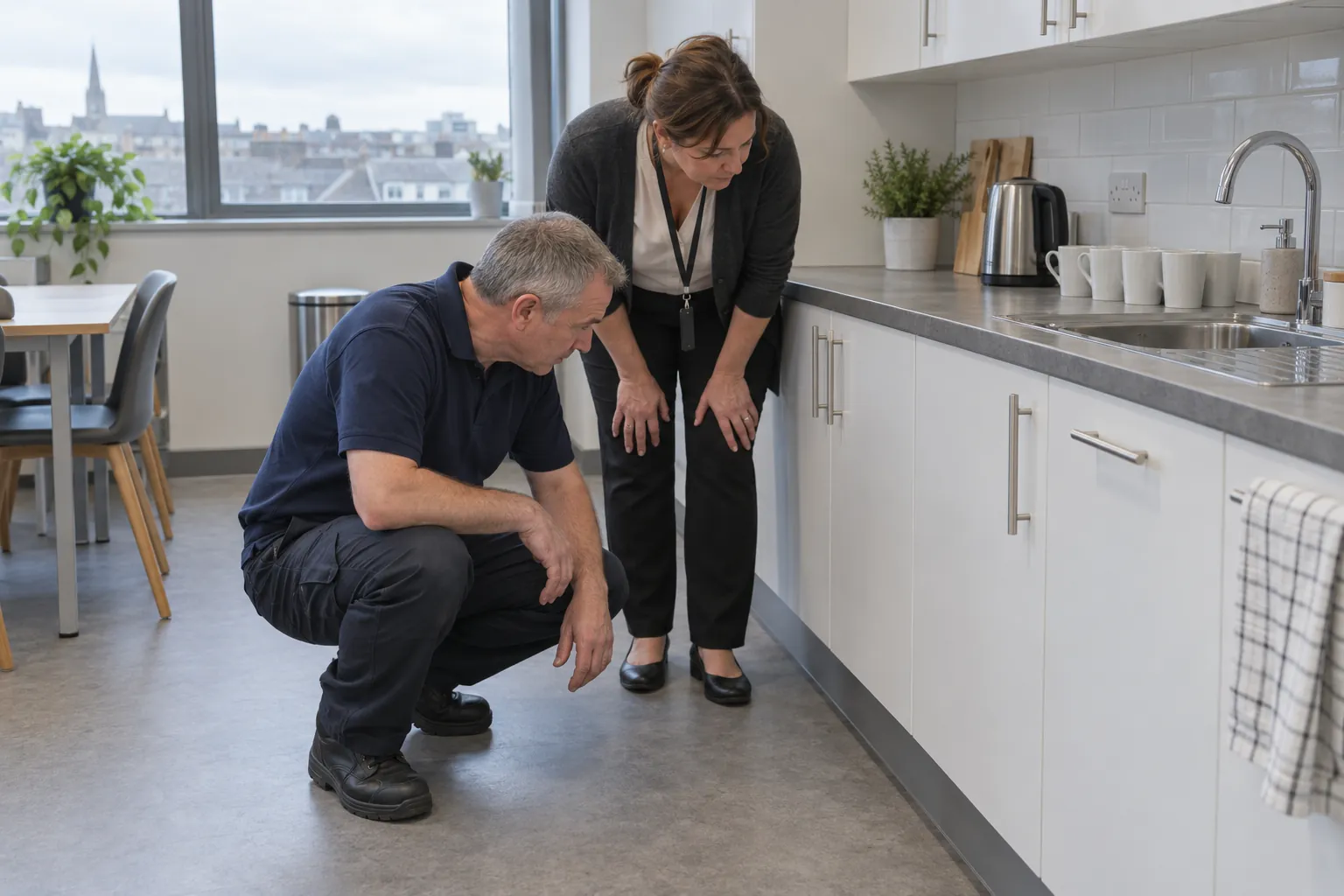 CleaningCleaning KPIs: what to measure on an Irish cleaning contract, and how to know the figures are trueCleaning KPIs for Irish contracts: which to measure, how to define and target them, the I.S. EN 13549 standard, monthly reporting, and when green figures mislead.
 CleaningCleaning supervisor duties: what the role involves in Ireland, and what good looks likeWhat a cleaning supervisor does in Ireland: the duties, a typical shift, the 2005 Act and 2007 Regulations, the contract cleaning ERO, checking work and reporting.
 CleaningOffice cleaning checklist: what to clean, how often, and a record that shows it was doneWhat an office cleaning checklist should cover in an Irish workplace, how often each task is done, the duty in Regulation 18 of the 2007 Regulations, and the record.