Cleaning
Cleaning KPIs: what to measure on an Irish cleaning contract, and how to know the figures are true
Cleaning KPIs (key performance indicators) are the measurable targets, such as audit scores, task completion, response and rectification times, complaints and hours delivered, that a client and a cleaning contractor agree in the contract to judge whether the cleaning service is being delivered as specified.
Also written for United Kingdom · United States · Canada · Australia
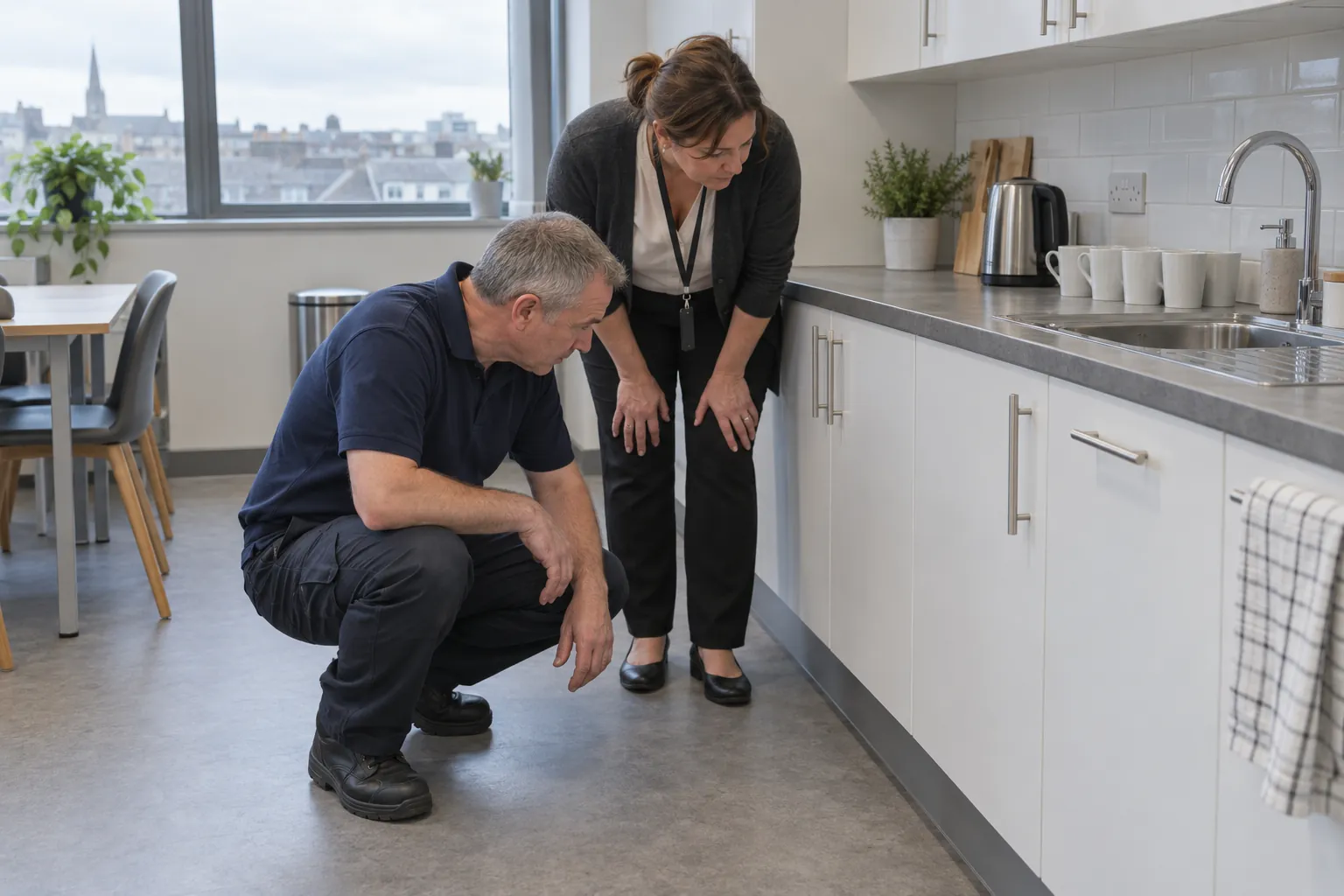
No Irish law sets them: the law sets the outcome, a place of work kept in a clean state under the General Application Regulations 2007, and the KPIs are how both sides show it is being achieved. Chosen well, five to ten of them tell a facilities manager whether the building is clean, whether the agreed work was done and whether problems are put right. Chosen badly, they produce a green dashboard and a steady stream of complaints. This guide covers which cleaning KPIs to use, how to define and target them, the Irish standard for measuring cleaning quality, and how to report them honestly.
01
What cleaning KPIs are, and the Irish law and standard behind them
A key performance indicator (KPI) is a measurable figure that shows whether a service is meeting an agreed standard. On a contract cleaning job in Ireland the key performance indicators usually sit in the service level agreement or the schedule to the contract, each with a definition, a target, a measurement period and a source of evidence, and they are reviewed at a regular contract meeting between the client's facilities manager and the contractor's area or contract manager.
No Irish regulation sets cleaning KPIs for an ordinary place of work. The legal duty is the outcome. Regulation 18 of the Safety, Health and Welfare at Work (General Application) Regulations 2007 (S.I. No. 299 of 2007) requires the employer to ensure that "every place of work is kept in a clean state" and that accumulations of dirt, refuse, trade refuse and waste are removed "by a suitable method as frequently as necessary to maintain an appropriate level of safety and health", and that the floor of every workroom is cleaned the same way. Regulation 20 requires sanitary and washing facilities to be provided, maintained and kept in a clean state. KPIs are how a client that has outsourced the work shows it is managing that duty, and how the contractor shows it delivered what it was paid for.
The safety KPIs on a shared site rest on two duties in the Safety, Health and Welfare at Work Act 2005. Section 12 of the Safety, Health and Welfare at Work Act 2005 requires every employer to conduct its undertaking so that people at the place of work who are not its employees are not exposed to risks, so far as is reasonably practicable. Section 10(5) requires every employer to make sure that employees of another employer working in its place of work, such as a contractor's cleaners, "receive instructions relating to any risks to their safety, health and welfare in that place of work".
Where a contract does want a recognised method for measuring quality, the reference in Ireland is I.S. EN 13549:2001 Cleaning services – Basic requirements and recommendations for quality measuring systems, the European standard as published by the National Standards Authority of Ireland (NSAI) and listed there as current. It gives basic requirements and recommendations for quality measurement systems for cleaning performance, and its contents cover inspection, sampling, quality levels and corrective actions, so that an audit score can be produced and read the same way by both parties. The target score is for the contract to set.
02
The cleaning KPIs worth measuring
Most contracts need between five and ten KPIs. Fewer, and something that matters goes unmeasured; more, and nobody reads them. These are the cleaning KPI examples that earn their place on almost any Irish site:
- Cleaning quality: the audit score, as the percentage of inspected elements that meet the standard, by area or room type, from an audit method both sides have agreed. It is the KPI most clients start with, and the one most open to argument unless the method is written down.
- Task completion rate: scheduled cleans and checks completed against those planned, for example toilet checks completed as a share of those due, or the periodic tasks on the commercial cleaning checklist done in the month. It measures whether the service happened at all.
- Response and rectification time: how quickly a reported spill, blocked toilet or missed area is attended to, and how quickly it is put right, by priority. A wet floor in a busy entrance needs a different target from a cobweb in a stairwell.
- Complaints, re-cleans and repeat failures: the number of cleaning complaints in the period, the re-clean rate (how often an area has to be cleaned again because it failed inspection or a complaint), and how many concern something already raised. Repeat failures usually say more than the total.
- Periodic work completed: deep cleans, hard floor maintenance, carpet cleaning, high-level dusting and window cleaning delivered against the periodic schedule.
- Hours delivered and cover: contracted hours actually worked, and whether absences were covered. A contract running short of hours fails every other KPI in the end. Clients that require evidence of hours usually ask for the rota or timesheets each month.
- Training and compliance: operatives inducted on the site and trained on its equipment and chemicals. Section 10 of the 2005 Act requires training on recruitment, on a transfer or change of task, and on the introduction of new work equipment or systems of work, given in a form, manner and language the employee is reasonably likely to understand.
- Health and safety: accidents and near misses on the contract and how each was followed up. The HSA's page on accident and dangerous occurrence reporting says an injury must be reported where the employee cannot carry out their normal work for more than three consecutive days, excluding the day of the accident, and that non-fatal accidents are reported within ten working days. A KPI that counts reportable accidents reported on time is one a client can check.
- Customer satisfaction: a short periodic survey of building users or the client's team, used beside the other measures rather than instead of them.
Cost per square metre and area cleaned per hour are useful for comparing sites or planning labour, but they measure cost and efficiency, not whether the building is clean. Judge the contract on the result. A cleaning company's own internal measures, such as staff turnover, average hours per site or margin, help it run the business, but they belong in its management reports rather than the client's contract.
Contract cleaning in Ireland has one compliance measure of its own. The Employment Regulation Order (Contract Cleaning Industry Joint Labour Committee) 2025 (S.I. No. 430 of 2025), in effect from 17 October 2025 according to the Workplace Relations Commission, fixes minimum pay and conditions for workers of businesses providing cleaning and janitorial services. A client may ask the contractor to confirm compliance with it as a term of the contract. That is a compliance check rather than a performance KPI, and the evidence is the contractor's, but it belongs in the same review.
03
Defining each KPI and setting the target
Keep every KPI in a single schedule to the contract, each with a written definition that both sides sign up to before the contract starts. For each one, set out:
- What is measured, precisely. "Toilet checks completed" must say whether a check done 40 minutes late counts.
- The source of the data: audit sheets, check records, the helpdesk log, the rota or timesheets.
- Who measures it, and whether the client verifies it. A contractor marking its own work needs some independent check, such as a joint audit each month or quarter.
- The method, for anything scored by inspection: which elements, which areas, how many rooms are sampled and how a pass is judged. This is where I.S. EN 13549 helps.
- The period: daily, weekly, monthly or quarterly.
- The target, and the level below which it counts as a failure.
- What happens on a failure: a corrective action, an improvement plan, or a service credit where the contract has them.
Set targets from a baseline, not from ambition. The first month of a new contract, or the last three months of an existing one, shows what the building actually achieves, and that is the figure to improve on. A target of 100% on anything judged by a person walking a building will be missed, and a contract that fails a KPI every month soon stops taking it seriously. A target nobody ever misses is not measuring anything either.
Weight the KPIs to the building, as the next section shows: the same set of measures can carry different targets in different areas.
Involve the cleaning team. Operatives and supervisors know which tasks will not fit in the hours, and KPIs they can see each week improve the service far more than targets that arrive in a monthly email.
04
Housekeeping KPIs and other sectors
The method is the same everywhere, but the measures that matter change with the building.
- Hotels: housekeeping KPIs usually include rooms passing the supervisor's inspection first time, rooms ready by the agreed time, cleanliness complaints per occupied room, and re-cleans. Rooms cleaned per attendant per shift is a labour-planning figure; pushed as a target, it rewards speed over standard. The hotel housekeeping checklist is where the room standard is written down.
- Offices: toilets and kitchens checked on time through the day, entrance and reception ready before opening, response to spills and requests, and complaints. Most of the cleaning happens out of hours, so a morning audit sample is the main quality measure.
- Schools and colleges: toilets checked after each break, classrooms ready for the morning, and the summer and mid-term periodic work done on time.
- Apartment developments: common areas, stairwells, lifts and bin stores cleaned on the agreed days. Where an owners' management company (OMC) has appointed a managing agent, the agent usually agrees and reviews the KPIs on the OMC's behalf.
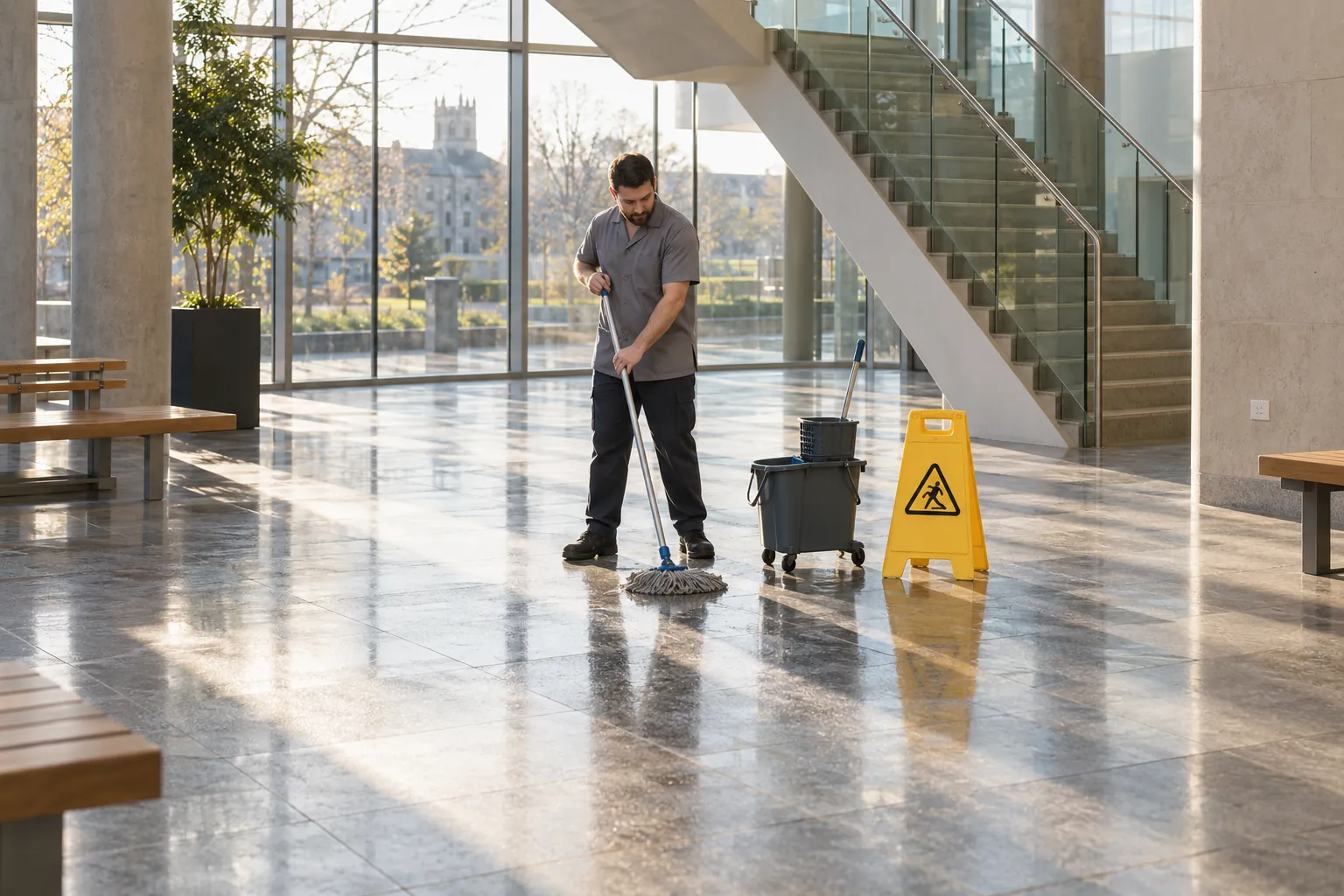
Timing can be a KPI in its own right. The HSA's advice on rescheduling floor wet cleaning to control slip risks is to wet-clean at a low-traffic time, allow the most drying time before the floor is used again, and arrange the schedule in consultation with the building's operators and users. A target for main floors wet-cleaned outside occupied hours measures safety as well as service.
Hospitals, nursing homes and other healthcare settings have their own infection prevention and control requirements. If a contract is in healthcare, take the KPIs and audit method from the client's infection prevention team, not from a general list.
05
Reporting cleaning KPIs, and when green figures mislead
Cleaning KPIs are usually reported monthly, in a short report or dashboard reviewed at the contract meeting, and often feed the client's wider facilities management report. A useful KPI report shows each KPI against its target with a simple red, amber or green status; the trend over several months; the reason behind any failure and the corrective action taken; open actions, who owns them and whether any are overdue; and anything that keeps coming back. A spreadsheet, a CAFM system or a check-recording tool can all hold the figures; what matters is tracking the same KPIs the same way each month, so the trend is worth reading. End each review with a decision on every failed KPI: accept the reason, agree a corrective action, or apply the remedy the contract sets out.
Monthly is often too slow on its own: a missed clean on the 3rd reported on the 30th has already become a complaint. A short daily or weekly summary of what was done, missed and still open lets problems surface while they can still be fixed.
Every experienced facilities manager has seen a contract with good KPIs and unhappy building users. The usual causes are:
- Measuring only activity. Tasks ticked, with no check on the result, reward visiting a room rather than cleaning it.
- Measuring only the audit. A small, predictable sample at nine in the morning says little about the rooms nobody inspected, or the toilets at two in the afternoon.
- Closing actions without fixing them. An issue is raised, marked complete, and appears again next month. Count repeat failures, not only closed actions.
- Self-reported data nobody checks. A contractor's own figures, never verified, drift upwards.
- Stale targets. KPIs set for how a building was used three years ago measure a building that no longer exists. Review them at least once a year and whenever the use changes.
When the contract changes hands, keep the KPI history with the client, so the new contractor's baseline can be compared with the old one, measured the same way.
06
Where the delivery data fails, and what SiteClara does about it
Of all cleaning KPIs, task completion is the one most often built on the weakest evidence. The figure in the monthly report is usually assembled from check sheets on the backs of doors and supervisors' notes, some signed for the whole day in advance, so it cannot show when a check was done or by whom, and a missed check is rarely written down as missed.
SiteClara records the checks at the location. A printed QR poster, with an optional NFC tag behind it, sits at each place a check is scheduled. Staff scan or tap on their own phone, with no app to install, see the checks due there, and mark each one done or say what stopped them. The time and the named person are recorded as it happens, with a photo when one helps, and a reported fault goes onto the team's list of open jobs until someone closes it.
The supervisor sees what is due, done and missed, and records the reason a check was missed from their company's own list. Each day they review the totals and photos, add a note and approve a report that goes to nominated managers or client contacts the next morning, showing what was reported, what was completed, what is still open and how the scheduled checks went, for example 12 of 12 completed. That gives the task completion and open-job figures a daily source recorded at the time.
07
Questions people ask
Is there a standard for measuring cleaning quality in Ireland?
Yes: I.S. EN 13549:2001, published by the NSAI, sets basic requirements and recommendations for systems that measure the quality of cleaning. Its contents cover inspection, sampling and quality levels, which helps build an inspection method that both parties can rely on; the target score is for the contract to set.
Are cleaning KPIs a legal requirement?
No. Irish law sets the outcome, not the measures: Regulation 18 of the General Application Regulations 2007 requires every place of work to be kept in a clean state, and Regulation 20 requires sanitary and washing facilities to be kept clean. KPIs are a contract tool the client and contractor agree to show that outcome is being met.
08
Further reading, and a list to take away
The primary sources are short and, apart from the standard, free to read:
- Safety, Health and Welfare at Work (General Application) Regulations 2007, Regulations 18 and 20.
- I.S. EN 13549:2001 from NSAI, for the method behind an audit score.
- The HSA's pages on accident and dangerous occurrence reporting and on rescheduling floor wet cleaning.
- The Workplace Relations Commission's summaries of Employment Regulation Orders, and of the contract cleaning ERO.
Before you agree or review a set of cleaning KPIs, check that:
- there are between five and ten, and each one matters to this building;
- they measure delivery as well as quality;
- each has a written definition, data source, owner, period and target;
- the audit method is written down, and both sides read a score the same way;
- targets come from a baseline, not from ambition;
- some of the data is verified by the client, for example through joint audits;
- repeat failures are tracked, not only closed actions;
- there is a daily or weekly view of delivery as well as the monthly report;
- the KPI history stays with the client if the contractor changes;
- they are reviewed at least once a year, and whenever the building's use changes.
Sources
Every document this guide quotes or links to, in the order it first cites them.
- Safety, Health and Welfare at Work (General Application) Regulations 2007 irishstatutebook.ie
- Section 12 of the Safety, Health and Welfare at Work Act 2005 irishstatutebook.ie
- I.S. EN 13549:2001 Cleaning services – Basic requirements and recommendations for quality measuring systems shop.standards.ie
- Section 10 of the 2005 Act irishstatutebook.ie
- Accident and dangerous occurrence reporting hsa.ie
- Employment Regulation Order (Contract Cleaning Industry Joint Labour Committee) 2025 workplacerelations.ie
- Rescheduling floor wet cleaning to control slip risks hsa.ie
- Employment Regulation Orders workplacerelations.ie
Related guides
 CleaningCleaning specification: what it should say in Ireland, and how to show it is metWhat a cleaning specification should contain in Ireland: the 2007 Regulations behind it, frequencies by area, checks to I.S. EN 13549 and a change of contractor.
 CleaningCleaning supervisor duties: what the role involves in Ireland, and what good looks likeWhat a cleaning supervisor does in Ireland: the duties, a typical shift, the 2005 Act and 2007 Regulations, the contract cleaning ERO, checking work and reporting.
 CleaningCommercial cleaning checklist: area by area, for Irish workplacesA commercial cleaning checklist for Irish offices and shared premises, area by area: the 2007 Regulations behind it, using it on shift and checking it is followed.
 Premises and facilities managementFacilities management report: what to include, and what makes it believableWhat a facilities management report in Ireland should contain: the duties behind it, the fire safety register, statutory checks, OMC reporting and believable KPIs.