Cleaning
Office cleaning checklist: what to clean, how often, and a record that shows it was done
An office cleaning checklist is a written list of every area of an office, the cleaning tasks in each, how often each task is done and who does it, so that a named person can do the work and a supervisor can check it.
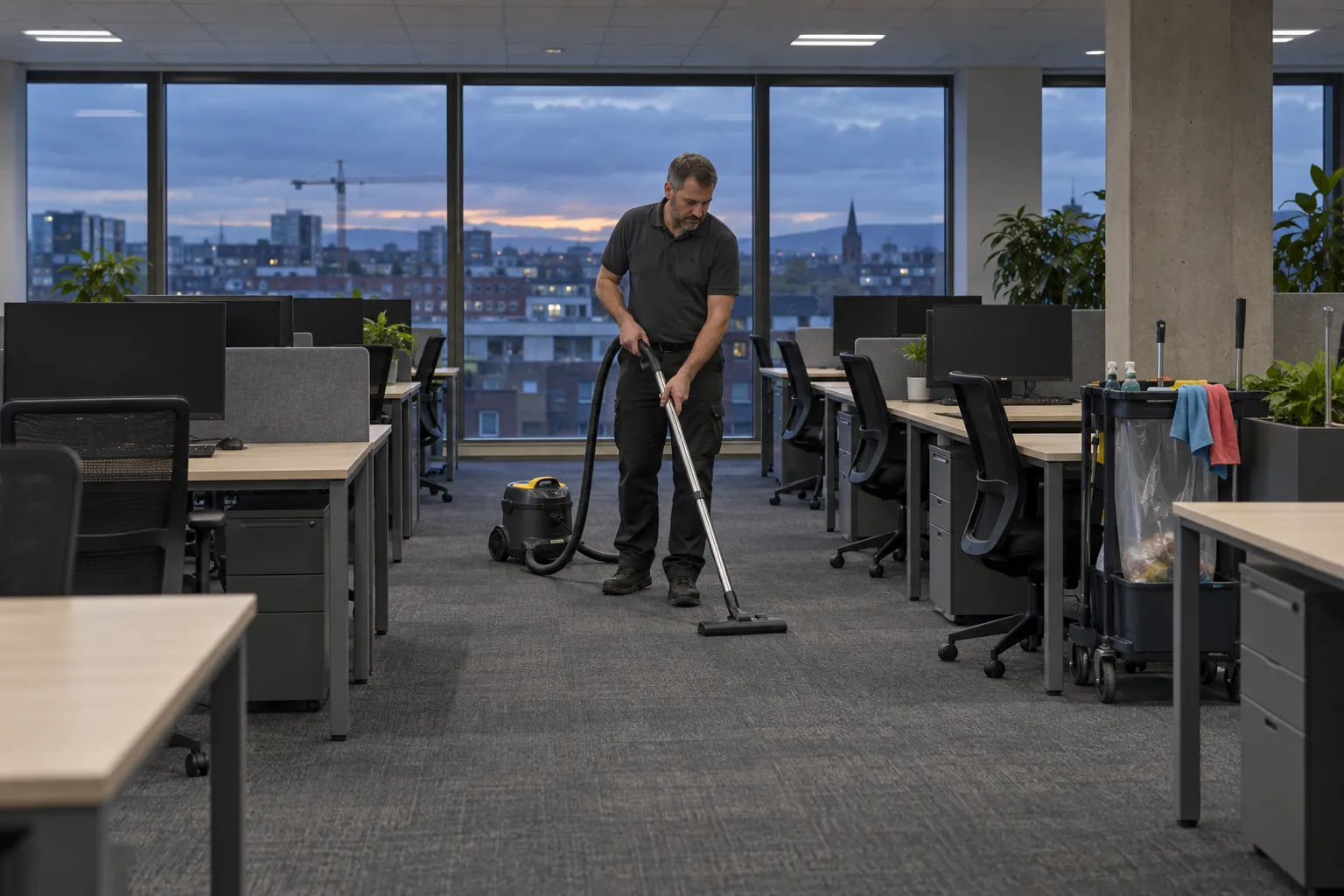
It turns "keep the office clean" into a schedule the whole team can follow. This guide sets out the duty behind it in the General Application Regulations 2007, what an Irish office checklist should cover, which tasks are daily, weekly, monthly or periodic, who owns each part when the cleaning is contracted out or the building is multi-let, and what makes the record believable.
01
The duty behind an office cleaning checklist
No Irish law says an office must have a written cleaning checklist. The law sets the outcome, and the checklist is how most employers and contract cleaning companies show they are achieving it.
The general duty is in the Safety, Health and Welfare at Work Act 2005, section 8: every employer must ensure, so far as is reasonably practicable, the safety, health and welfare at work of their employees, including, under section 8(2)(f), "providing and maintaining facilities and arrangements for the welfare of his or her employees at work".
The specific duty is in Chapter 1 of Part 2 of the Safety, Health and Welfare at Work (General Application) Regulations 2007 (S.I. No. 299 of 2007), which covers the workplace. The regulations that matter most to an office cleaning checklist are:
- Regulation 18(a): every place of work is "kept in a clean state and accumulations of dirt, refuse, trade refuse and waste are removed by a suitable method as frequently as necessary to maintain an appropriate level of safety and health".
- Regulation 18(b): "the floor of every workroom is cleaned by a suitable method as frequently as necessary to maintain an appropriate level of safety and health".
- Regulation 20: the employer must "provide and maintain and keep in a clean state" adequate and suitable sanitary and washing facilities, including an adequate number of lavatories and washbasins with hot and cold running water.
- Regulation 12(a) and (h): emergency routes to emergency exits and the exits themselves "kept clear at all times", and emergency routes and exits, and the traffic routes and doors giving access to them, "free from obstruction so that they can be used at any time without hindrance", which is a cleaning matter when bins, trolleys and bags of waste are left in corridors and stairwells.
The Regulations set no frequency and ask for no particular form. "As frequently as necessary" leaves it to the employer to decide how often is often enough, and a checklist is how that decision is written down and shown to have been carried out.
The Health and Safety Authority's Guide to the Safety, Health and Welfare at Work (General Application) Regulations 2007, Chapter 1 of Part 2: Workplace, published in December 2007, explains what this means: the employer must ensure the place of work "is maintained in a clean and hygienic condition", that rubbish and waste are removed on a regular basis, and "that a suitable cleaning regime is in place". The quotations here are from the Regulations as made and from that guide; check the current consolidated text if an amendment matters to your case.
02
What an office cleaning checklist covers
A good checklist lists every area of the office, the tasks in each, how often, and who does them. Most offices in Ireland need the same areas covered, whether it is a floor in a Dublin office block, a business park unit outside Cork or a small practice above a shop in a county town:
- Entrance and reception: floors and entrance matting, glass doors, the reception desk and seating. On a wet day this is where rain comes in on shoes.
- Open-plan areas and private offices: desks, chairs, bins, floors and shared touch points.
- Meeting rooms: tables, chairs, whiteboards and screens, cleared and wiped.
- Kitchens, tea stations and canteens: worktops, sinks, taps, fridges, microwaves, kettles, water boilers and coffee machines, tables, and the floor beneath them.
- Toilets and washrooms: toilets, urinals, washbasins, mirrors, dispensers, sanitary bins and floors, with soap, toilet paper and towels restocked. The toilet cleaning checklist covers these in detail.
- Corridors, stairs and lifts: floors, handrails, lift buttons, door plates and push pads.
- Shared equipment: phones, keyboards on hot desks, printers and photocopiers, wiped with suitable products.
- Waste and recycling: general waste, dry mixed recycling, food waste and glass emptied, liners replaced, and taken to the bin store, not left on an escape route.
- Low-use areas: stores, comms rooms, archive rooms, shower and changing areas for cyclists, on their own cycle.
Write each task as something a person can do and a supervisor can check: "vacuum carpet in the open-plan area on the second floor" rather than "floors". A checklist written in general terms is easy to tick and impossible to audit.
The HSA guide adds the choice of method: it depends on the effectiveness of the regime, the materials ("an inappropriate method can destroy a floor surface, including destruction of its anti-slip properties") and the contaminant. A checklist that names the method, such as "damp mop kitchen floor", carries that decision to the person doing the work.
03
Daily, weekly, monthly and periodic tasks
Frequencies follow how the office is used, not habit. A busy floor of three hundred people and a small office of eight need the same list of areas but very different frequencies, and an office used mainly on certain days of the week needs a checklist that follows those days. As a starting point, drawn from common practice rather than any HSA figure, which each office should adjust to its own pattern of use:
- Daily: empty bins and recycling; clean toilets and washrooms and restock supplies; clean kitchen worktops, sinks, taps and appliance fronts; wipe high-touch surfaces, where germs pass from hand to hand, such as door handles, push plates, light switches, lift buttons, handrails and shared phones; vacuum or mop entrance and reception floors; spot-clean glass doors; tidy and wipe meeting room tables.
- Through the day: in a busy office, toilets and kitchens need checking and restocking at least once after the morning clean, especially after lunch.
- Weekly: vacuum all carpets if not done daily; mop hard floors; dust clear desks, sills, partitions and the tops of filing cabinets; clean inside microwaves; wipe shared equipment; clean internal glass.
- Monthly: high-level dusting of vents and light fittings; skirting boards and door frames; descale taps; clean under desks; deep clean kitchen fridges.
- Periodic: carpet deep cleaning, typically once or twice a year and more often on heavy traffic routes; hard floor stripping and sealing; external windows; washroom deep cleans; upholstery. These belong on a calendar with dates, because they are never urgent on any given day.
Ventilation belongs on the list too. Regulation 6(d) requires "any deposit or dirt likely to create an immediate danger to the safety and health of employees by polluting the atmosphere" to be removed without delay. The office checklist covers the grilles and diffusers people can see; ductwork is specialist work for whoever maintains the system.
Windows need a decision rather than a tick. Regulation 10(b) requires that windows and skylights "can be cleaned without risk to the safety, health or welfare of persons carrying out this work or of other persons present". Internal glass is on the office checklist; external glass above ground level is usually a separate contract, and the checklist should say so.
04
Who does what, and who owns the duty
A checklist only works if every task has an owner. In most offices there are four:
- The cleaning operatives, in-house or from a contract cleaning company, carry out the tasks, usually early in the morning or in the evening when the office is quiet.
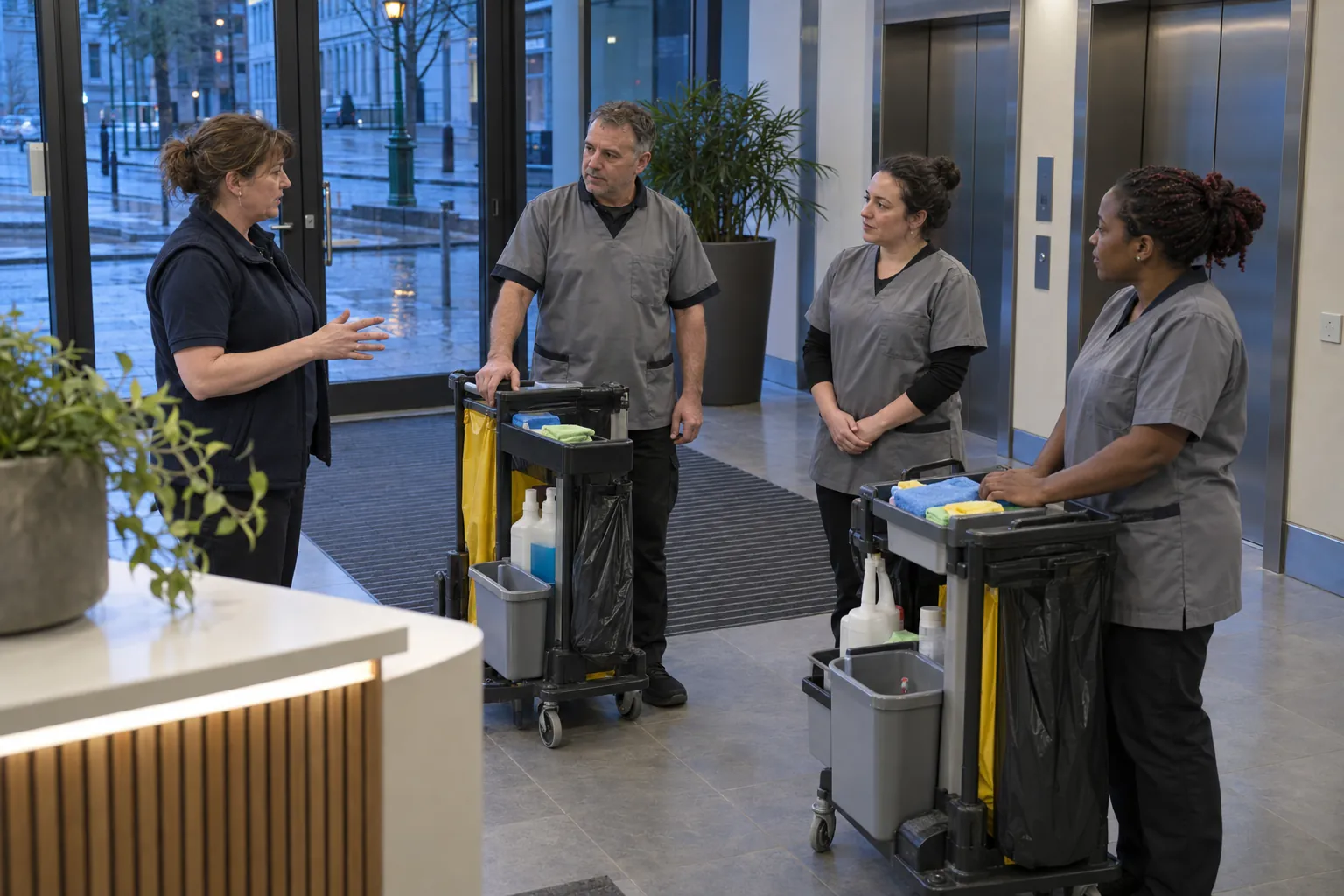
- The cleaning supervisor plans the routes, checks the work, covers gaps and absences, and reports to the client.
- The office manager or facilities manager owns the checklist, agrees changes with the contractor, and takes complaints and requests.
- Staff keep their desks clear enough to be cleaned, clear up after themselves in the kitchen, and report spills and faults.
Contracting out the cleaning does not move the legal duty. The employer keeps its duties under section 8 and Regulations 18 and 20; the checklist is how it can show the contract is being delivered. The contract cleaning company is an employer too, and under section 12 of the 2005 Act every employer must manage its work so that people at the place of work who are not its employees are not exposed to risks to their safety, health or welfare. A wet floor left open to office staff is the contractor's problem as much as the client's.
In a multi-let office building, the landlord or the managing agent usually arranges the cleaning of reception, lifts, stairs and common toilets under the service charge, while each tenant arranges its own floor. The person in control of the common parts has duties under section 15 of the 2005 Act, which applies to anyone with control of a non-domestic place of work made available to others, and, under section 15(2), to anyone with an obligation under a contract or tenancy to maintain or repair it. Employers who share a place of work must co-operate and co-ordinate under section 21 of the 2005 Act. The practical answer is two checklists that meet at the tenant's door, and a written note of who cleans what.
Under Regulation 4 of the Safety, Health and Welfare at Work (Chemical Agents) Regulations 2001 (S.I. No. 619 of 2001, since amended), an employer must assess the risk from hazardous chemical agents, taking into account the supplier's safety data sheet, and record the assessment in writing. For contract cleaning that usually means the contractor assesses the products its operatives use. The checklist can say which product is used where; it is not the risk assessment. The findings, including the wet-floor procedure, belong in the employer's safety statement, which section 20 of the 2005 Act requires to specify the hazards, the measures taken and the people responsible.
05
How to check the checklist is being kept, and cleaned safely
A checklist is a promise. Whether it is being kept is a separate question with its own answer. Whether the work is done in-house or by a contractor, the usual ways to keep it honest are:
- Walk-rounds: the supervisor or office manager inspects a sample of areas against the checklist, at different times of day and without warning.
- Joint audits: client and contractor walk the office together each month or quarter and agree what was found against the cleaning standards in the contract, which settles disagreements before they become disputes. The commercial cleaning checklist sets out how.
- Records of work done: showing each task was carried out, by whom and when.
- Complaints and requests: logged, with the time raised and the time put right.
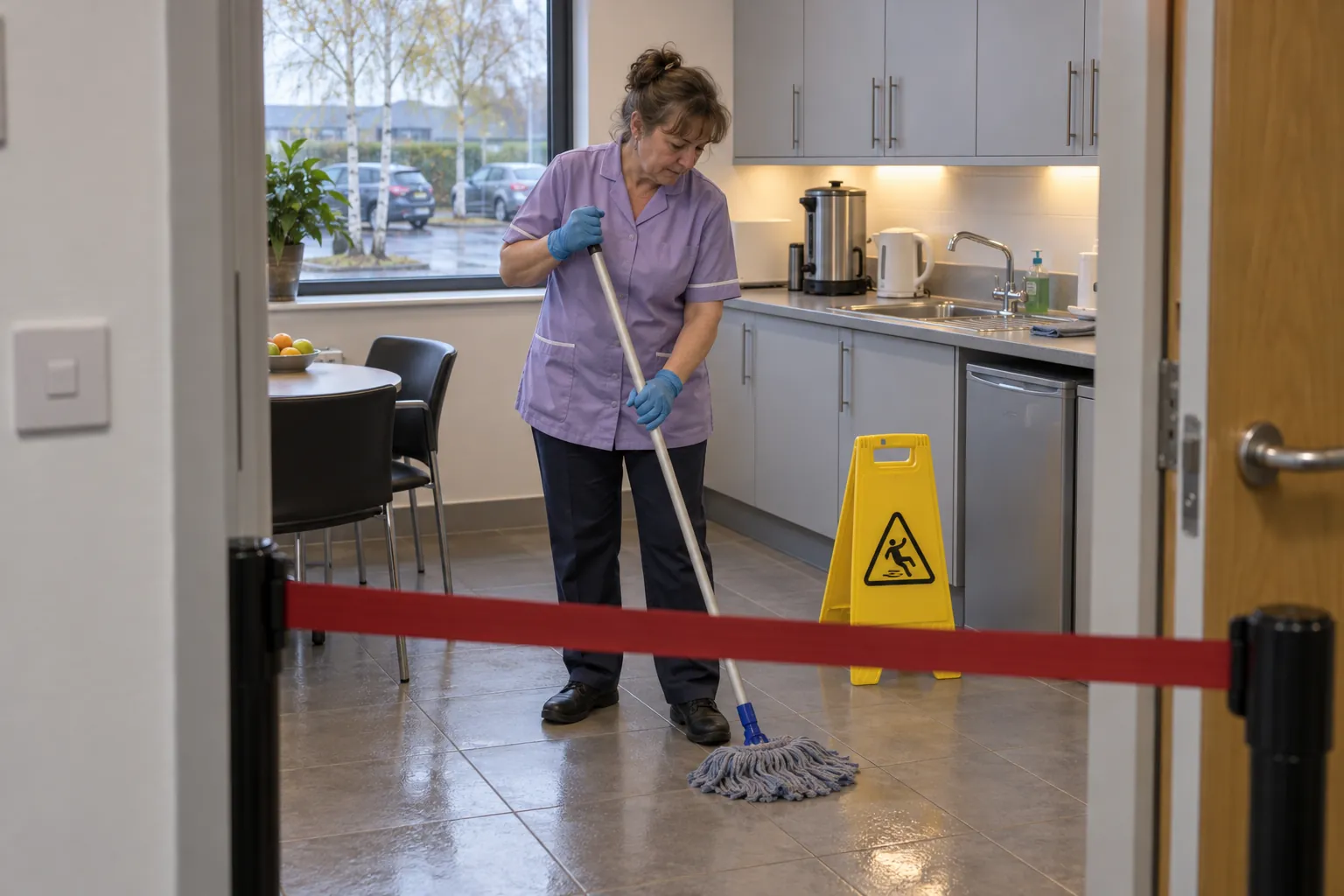
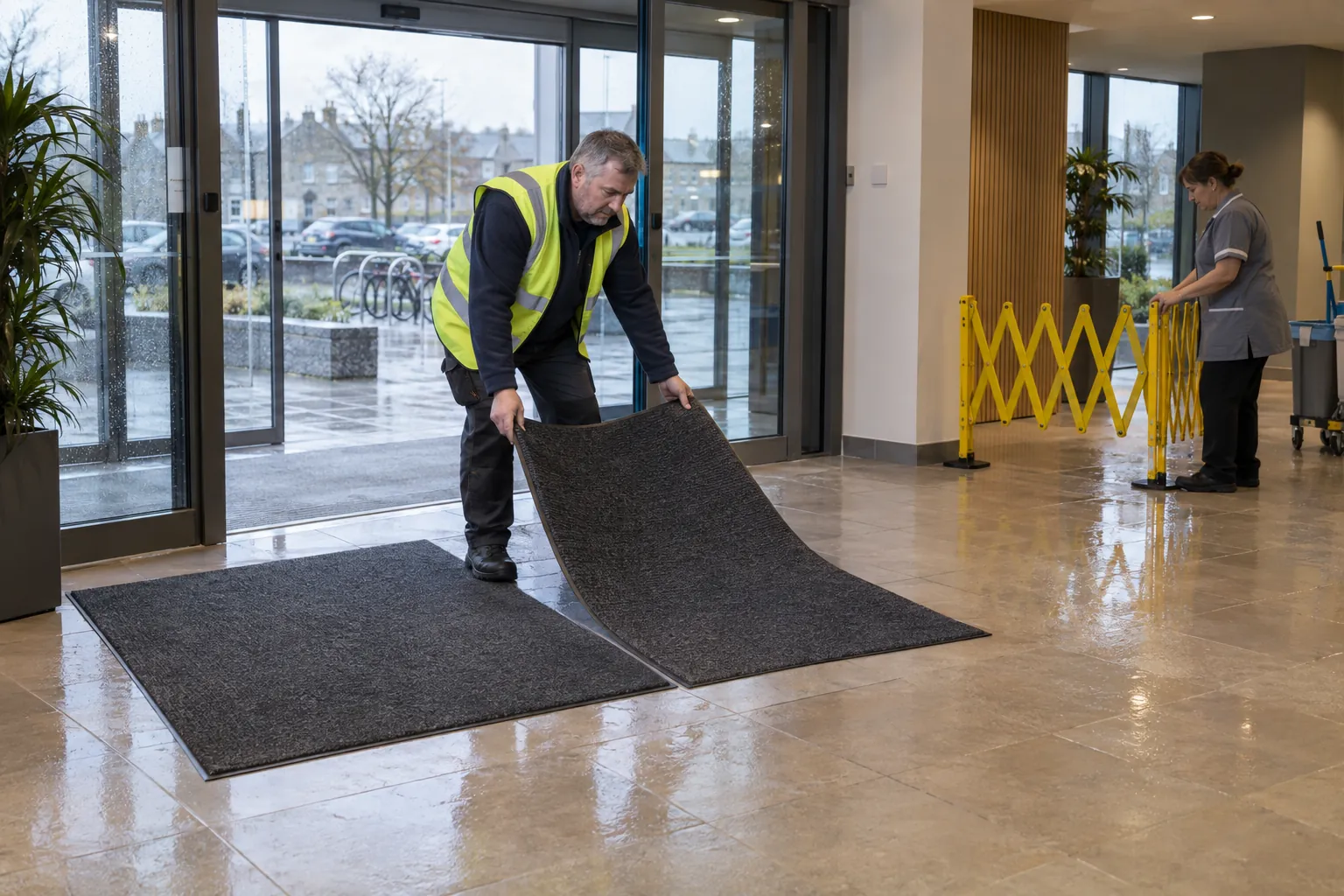
Floors are where office cleaning most often causes harm rather than preventing it. The HSA's guidance on segregating wet and damp floors warns that "a damp floor can be more dangerous than a wet floor as it may be just as slippery but it may look dry", advises preventing or limiting access "until the floor is bone-dry", and says signs alone did not prevent all slips on wet floors; they may be part of a cordon, and are removed when they no longer apply. Its guidance on rescheduling floor cleaning suggests wet-cleaning at a low-traffic time and cleaning the floor last so it can dry overnight.
That gives the checklist lines of its own: when each floor is wet-cleaned, how it is cordoned, and when the sign comes in. The HSA's housekeeping guidance adds: keep floors and access routes clear, and make sure cleaning staff have had proper training and instruction. See also slips, trips and falls.
Review the checklist when the office changes: a new floor let, a kitchen refit, a move to hot desking, or a complaint that keeps coming back.
06
Where the checklist record fails, and what SiteClara does about it
Most offices can show a checklist. Far fewer can show it was followed. The daily tasks happen out of hours, when nobody from the client is in, and the record is usually a sheet in the cleaners' store. A missed kitchen clean comes to light when someone complains about the fridge, and a tick cannot say whether it was written at 18:10 or at 21:45.
SiteClara puts a printed QR poster at each location on the checklist, such as the kitchen, each toilet and reception, with an optional NFC tag behind it. The cleaner scans the code or taps the tag on their own phone, with no app to install, and sees the checks due there. They mark each one done, or explain what stopped them, such as a meeting room still in use, and can add a photo. If something needs fixing, such as a leaking tap or a broken soap dispenser, they report it there and it goes onto the team's list of jobs until someone closes it.
The supervisor sees what is due, done and missed at each location, and can record the reason a check was missed. At the end of the day they review the checks and photos, add a note and approve the report, which goes to the office manager or the client the next morning, showing what was completed, what is still open and how the scheduled checks went.
07
Questions people ask
What should I include on my office cleaning list?
Every area of the office, the tasks in each, how often each is done and who does it. The Health and Safety Authority's Guide to the General Application Regulations 2007, Chapter 1 of Part 2: Workplace says "interior walls, floors, ceilings and work surfaces must be cleaned at suitable intervals", and that the intervals "will depend on the type and level of work activity and the frequency of use". It adds that windows and glass partitions used for lighting workrooms "should be kept clean on both inner and outer surfaces", and that washing facilities should be "appropriately maintained and kept clean".
What does office cleaning usually include?
Removing waste, cleaning floors and work surfaces, and cleaning and restocking toilets and washrooms, at a frequency that suits how the office is used. The HSA's Guide to the General Application Regulations 2007, Chapter 1 of Part 2: Workplace says the employer must ensure that "any rubbish, dirt, refuse and waste is not allowed to accumulate and is removed on a regular basis", that the floor of any workroom is kept clean, and that "a suitable cleaning regime is in place". For washrooms, it says facilities for washing should include running hot and cold, or warm, water "as well as soap and clean towels" or other suitable means of cleaning or drying.
08
Further reading, and a list to take away
The law is Regulations 6, 10, 12, 18 and 20 of the Safety, Health and Welfare at Work (General Application) Regulations 2007, read with sections 8, 12, 15, 20 and 21 of the Safety, Health and Welfare at Work Act 2005, all on the Irish Statute Book. The HSA's Guide to the General Application Regulations 2007, Chapter 1 of Part 2: Workplace explains each workplace regulation, and the HSA's slips, trips and falls pages cover wet floor cleaning and housekeeping. The HSA's safety statement and risk assessment questions and answers explain how the findings are written down.
Before you agree the next version of your office cleaning checklist, check that:
- every area of the office is listed, including stores, comms rooms and showers;
- each task is specific enough for a supervisor to check, and names the method where it matters;
- each task has a frequency: daily, through the day, weekly, monthly or periodic;
- periodic tasks such as carpet deep cleans and external windows have dates on a calendar;
- high-touch surfaces are named, not left to judgement;
- the checklist says who cleans desks and fridges;
- wet floor cleaning is timed for quiet periods and cordoned until bone-dry;
- waste goes to the bin store, and escape routes stay clear;
- in a multi-let building, it is written down who cleans the common parts and each floor;
- the products used are covered by a written chemical risk assessment;
- you know how completed work will be recorded and who will see the record.
Sources
Every document this guide quotes or links to, in the order it first cites them.
- Safety, Health and Welfare at Work Act 2005, section 8 irishstatutebook.ie
- Safety, Health and Welfare at Work (General Application) Regulations 2007 irishstatutebook.ie
- Guide to the Safety, Health and Welfare at Work (General Application) Regulations 2007, Chapter 1 of Part 2: Workplace hsa.ie
- Section 12 of the 2005 Act irishstatutebook.ie
- Section 15 of the 2005 Act irishstatutebook.ie
- Section 21 of the 2005 Act irishstatutebook.ie
- Safety, Health and Welfare at Work (Chemical Agents) Regulations 2001 irishstatutebook.ie
- Section 20 of the 2005 Act irishstatutebook.ie
- Segregating wet and damp floors hsa.ie
- Rescheduling floor cleaning hsa.ie
- Housekeeping guidance hsa.ie
- Safety statement and risk assessment hsa.ie
Related guides
 CleaningCommercial cleaning checklist: area by area, for Irish workplacesA commercial cleaning checklist for Irish offices and shared premises, area by area: the 2007 Regulations behind it, using it on shift and checking it is followed.
 CleaningToilet cleaning checklist: what to check, how often, and a record that stands upWhat a toilet cleaning checklist should cover in an Irish workplace, how often to check, the duty in Regulation 20 of the 2007 Regulations, and a credible record.
 CleaningCleaning supervisor duties: what the role involves in Ireland, and what good looks likeWhat a cleaning supervisor does in Ireland: the duties, a typical shift, the 2005 Act and 2007 Regulations, the contract cleaning ERO, checking work and reporting.
 Premises and facilities managementSlips, trips and falls: what Irish law requires, and how to prevent them day to dayPreventing slips, trips and falls in Irish workplaces: the 2005 Act and 2007 Regulations, spills, floor cleaning, entrances, stairs and the checks that show it.