Fire and water checks
Fire door inspection: the duty, the checks and the record
A fire door inspection is a door-by-door check by a competent person that each fire door's leaf, frame, gaps, closer, latch, glazing, seals, hinges and signs still work as the door was tested, and in Ireland the Department of Housing's guidance recommends one every six months.
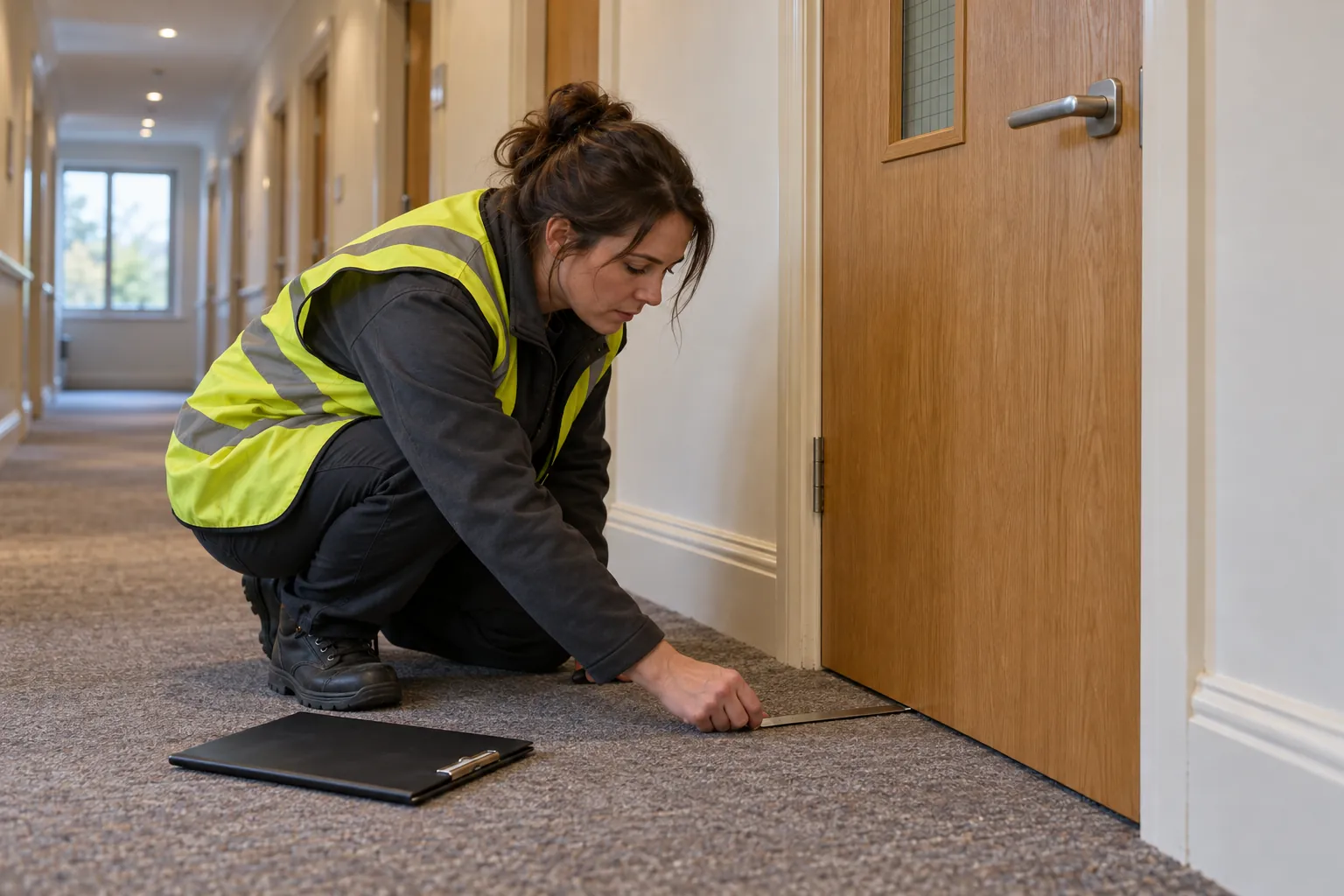
The legal duty to keep fire doors working sits with the person having control under the Fire Services Acts. This guide covers what the Department of Housing's guidance says about fire doors, the daily and monthly checks, the six-monthly inspection by a competent person, and how it all belongs in the fire safety register.
01
What a fire door inspection is, and the duty behind it
Fire doors do two jobs. The Department of Housing, Local Government and Heritage's Fire Safety Guide for Building Owners and Operators (August 2023) puts them plainly: to maintain the fire resistance of compartmentation in buildings, and to protect escape routes by keeping them free of smoke and fire so that occupants can evacuate to a place of safety. A fire door is not just the leaf. The guide says a reference to a fire door "includes the door leaf(s), frame, hardware, including seals and automatic door closers", and every one of those parts has to be right for the door to hold.
The legal duty is in section 18 of the Fire Services Act 1981, as amended by section 29 of the Licensing of Indoor Events Act 2003, together cited as the Fire Services Acts 1981 and 2003. Section 18 covers premises used for sleeping accommodation (other than a house occupied as a single dwelling), treatment or care, entertainment, recreation, instruction, teaching, training or research, public access and, since 2003, any workplace. Section 18(2), as substituted, requires every person having control over such premises to:
Paragraph (c) is the reason fire doors need checking: a door wedged open, or whose closer has failed, is a measure not being applied. The Act sets no frequency; the Department's guide fills that gap. Its section 6.4 says all fire doors "should be inspected and maintained in accordance with the recommendations in Table 2", its maintenance programme schedule, and that "any inspection or maintenance of the fire doors or any alterations or work on a fire door, should be carried out only by a competent person."
Workplaces carry a second duty: under section 11 of the Safety, Health and Welfare at Work Act 2005 every employer must plan for emergencies, including fire-fighting and evacuation. The Health and Safety Authority's guidance on emergency escape and fire fighting says fire safety measures and equipment, fire doors first among them, "must be kept in effective working order", with "regular checks, periodic servicing and maintenance" whatever the size of the workplace.
02
What a fire door inspection covers
Table 2 of the Department's guide lists fire doors against BS 8214, the British code of practice for timber-based fire door assemblies, and sets out the questions a six-monthly inspection should answer; section 6.4 adds identification and signage. Put in order, door by door, an inspection looks at:
- Identification: whether the door is a fire door at all. The guide says fire doors should be identified by a label on the top edge or by colour-coded plugs, and that identification marks "should not be removed or painted over".
- The door leaf: does it sit against the door stop, free from distortion? If veneered or lipped, is the glue still holding? Is it free from damage, including dents and holes?
- The frame: is it firmly attached to the wall, and any planted door stop firmly fixed? Is the gap between frame and leaf consistently 3mm, with a tolerance of plus or minus 1mm?
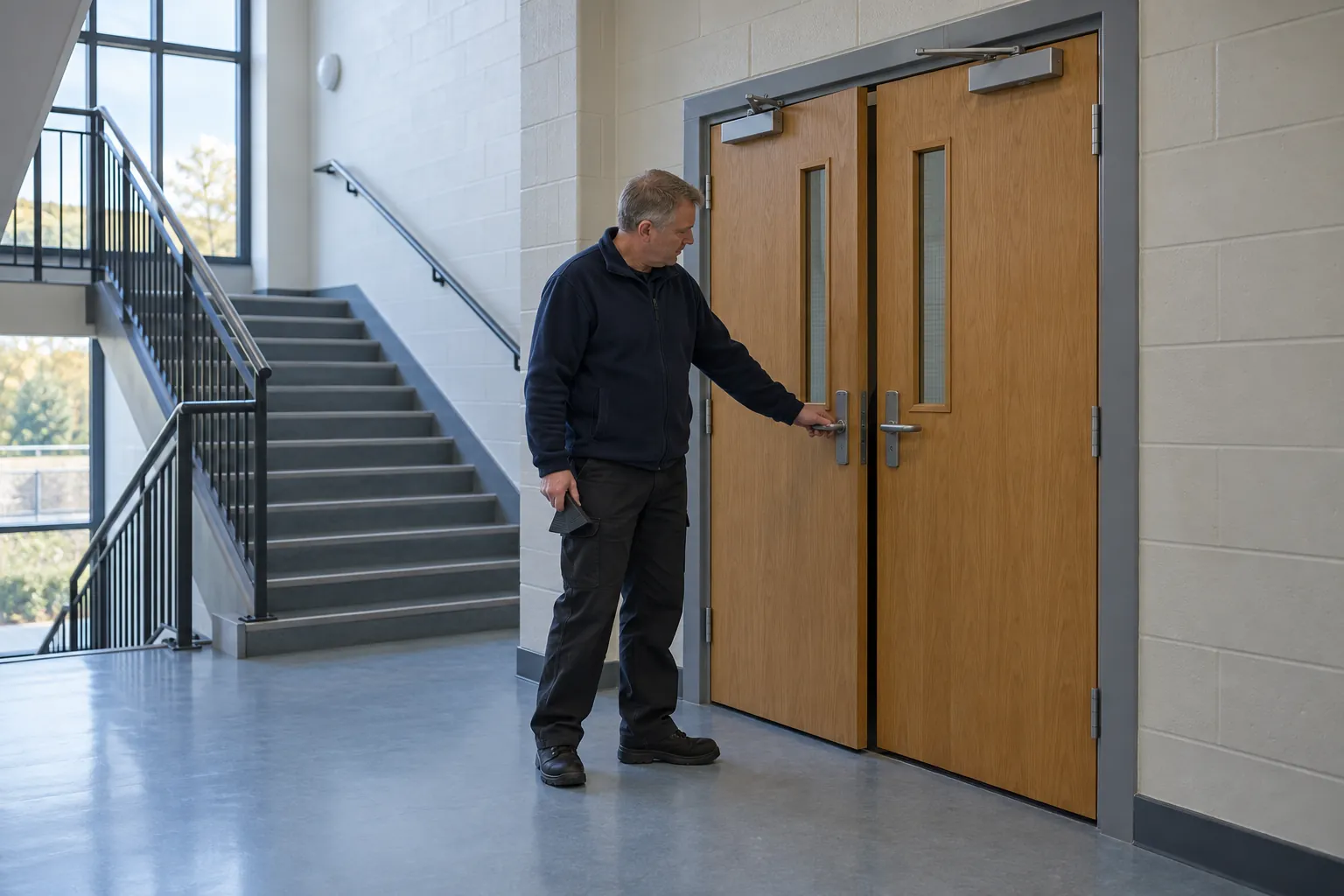
- The closer: opened to 5 degrees or 75mm, does the door close and engage the latch? Is the closer correctly attached, undamaged and not leaking? If unlatched, does it hold the door in line with the frame and seal? Do a pair of doors close in line when both are released together?
- Hold-open devices: the guide allows only "electronically powered" ones, and asks whether each releases the door when required.
- Lock and latch: does the latch hold the door firmly without rattling?
- Glazing: is the intumescent seal continuous and attached to the glass and bead, are the beads secure, and is the glass free from damage? If it has been replaced, is it fire-rated glass, and below 1500mm, is it safety glass?
- The threshold gap: a consistent gap that lets the door swing clear of the floor covering, 10mm or less when closed.
- Seals: intumescent, smoke and acoustic seals in place, well seated in their groove, continuous around the frame and undamaged. The guide adds that seals "should not be removed or painted over".
- Hinges: at least three, with every screw fitted and of the correct size, free from metal fragments and oil leakage, which are signs of wear, and free from packing.
- Signage: a permanent "fire door keep shut" sign on both faces, except on entrance doors to flats, doors within flats and bedroom doors in some other residential buildings.
An inspector will also note how the door is used. A door found wedged, or a closer disconnected because the door was heavy, is a management problem, not just a defect. The guide says fire doors must not be "rendered ineffective by being held open by wedges or other objects".
03
How often: daily, monthly and six-monthly
Table 2 gives fire doors three layers, across its escape route, hold-open and fire door rows. Regular checks are for a designated person, such as a caretaker or security officer who has been trained for them; the six-monthly inspection is for a competent person.
- Daily: fire doors on escape routes closed, unless held on a permitted hold-open device that lets them close when the fire alarm operates; nothing propping them open; and all doors held open by automatic release mechanisms released each day. Section 5.4 of the guide asks for escape routes to be checked every day.
- Monthly: the operation of hold-open devices tested "by simulating failure of the mains power supply or operation of the fire detection and fire alarm system". The guide says the results "should be recorded" and any door found faulty should be repaired or replaced.
- Six-monthly: the full door-by-door inspection in the previous section. For flat and apartment entrance doors the table gives the interval as "biennially".
In between, the guide asks everyone to keep their eyes open: "Staff moving about buildings on a daily basis who note damage or ineffective operation of a fire door should bring it to the attention of the relevant person, and it should be noted in the Fire Safety Register and remedial action taken." It adds that "particular attention should be paid to fire doors where people movement is higher", because hinges, locks, latches, closers and floor springs wear. A school corridor or a busy stair lobby may need looking at more often.
Arrange an inspection outside the cycle when you take on a building of unknown history, when a fire officer raises the doors, when the same fault keeps coming back, after a refurbishment or new cabling through fire-resisting walls, and after a door or its hardware has been repaired or replaced.
04
Who can inspect fire doors, and who does what
Section 3.1 of the Department's guide draws the line clearly. Daily routines, such as checking that doors on escape routes are in working order, "can be undertaken by persons who have received a suitable level of training". Planned periodic maintenance and repairs call for competent persons. For fire doors specifically, the guide says inspection, maintenance, alterations and any work on the door should be carried out only by a competent person, because "any slight alteration to the door or its surrounds can affect the performance of the fire door."
Neither the Acts nor the guide name a qualification for a fire door inspector. Competence means knowing fire door construction, test certification, ironmongery and installation well enough to judge each door, and reporting honestly. Ask inspectors what fire door experience they have, what the report will look like, and whether they also sell the repairs.
Where work goes beyond maintenance, the guide asks for more. Alterations to fire doors "should be carried out by competent persons, and where necessary, designed, specified, supervised and certified by a competent professional". For building works affecting fire safety it names registered architects (RIAI), registered building surveyors (SCSI), chartered engineers on the Engineers Ireland register, and members of the Institution of Fire Engineers who hold the title Chartered Engineer.
The person having control keeps overall responsibility even when tasks are delegated, and may be more than one party: a landlord for the common stairs, each tenant for its own space. In an apartment block, the guide says section 18(2) responsibilities are likely to fall on the building owner or the owners' management company, which usually appoints a managing agent to arrange the work. The guide says entrance doors to flats and apartments "should be fire doors", should not be replaced with non-fire-resisting doors, and should be inspected, maintained and repaired regularly, and it asks residents to give the OMC's contractors reasonable access. Make sure the lease, the management agreement or the contract says who inspects which doors.
05
Standards, the report, and putting defects right
An inspector judges each door against what it was meant to be, and for most buildings that means the Building Regulations guidance in force when it was built or altered. The current version is Technical Guidance Document B 2024, Fire Safety, Volume 1: Buildings other than Dwelling Houses (reprinted January 2026), which applies to works and changes of use from 1 May 2025, with transitional arrangements. Its Appendix B says:
- a fire door means the complete assembly, and its performance "critically depends on the correct installation of the complete door assembly, strictly in accordance with the terms of the relevant test certification supplied by the door manufacturer", including fire-stopping between frame and structure;
- performance is classified to I.S. EN 13501-2, in minutes of integrity (E), with Sa where restricted smoke leakage is needed, for example E30 Sa; internal doorsets tested to BS 476 Part 22 are expressed as FD30, with S for smoke;
- every fire door should have an automatic self-closing device tested to I.S. EN 1154, able to close the door from any angle and against any latch, except doors to cupboards and service ducts kept locked shut;
- hinges should be of Class A1 materials, tested to I.S. EN 1935, with a melting point of at least 800°C, unless proved as part of the tested doorset;
- a label on the top or leading edge should give the manufacturer, the product, a unique reference and the classification;
- signs should be permanently fixed between 1.6m and 1.8m above the floor, on both sides, or on the outside only for cupboards and ducts.
A good report sets out the findings door by door. It gives each door a reference matching the fire door inventory, its rating or a note that it could not be confirmed, each defect with a photograph, a verdict (sound, adjust, repair or replace) and a priority. A door that will not close on a protected stair needs putting right at once; tired signage can wait.
The guide says worn hardware should be replaced "with products to the same specification as that outlined in the test certification supplied by the door manufacturer". Planing a sticking door, packing a hinge or fitting an untested lock can quietly take away the fire resistance the door was bought for.
06
Where the record fails, and what SiteClara does about it
The six-monthly report is usually thorough. What fails is the time in between. The daily check becomes a tick on a sheet on the back of the plant room door, filled in before the day starts. A cleaner mentions a closer that no longer latches to whoever is passing. The monthly hold-open test is done but not written down. Six months later the inspector finds the same defects, plus a door wedged every afternoon, and the register shows none of it.
SiteClara records the routine checks and the faults they turn up, at the door, as they happen. A printed QR poster, with an optional NFC tag behind it, goes by a fire door or a group of doors, such as a stair core or a floor's corridor doors. The caretaker, cleaner or security officer doing the round scans the code or taps the tag on their own phone, with no app to install, sees the checks due there, such as the daily escape route check or the monthly hold-open test, and marks each one done or explains what stopped them. Their name and the time are recorded, with a photo when one is asked for. A fault, such as a missing seal, a damaged leaf or a door propped open, is reported there with a photo and goes onto the team's list of jobs until someone closes it; a supervisor can escalate it to the building manager, who can answer it.
The supervisor sees what was due, done and missed across the building, and records the reason for anything missed. Each day they approve a report that goes to nominated managers or client contacts the next morning, showing what was reported, completed and still open, and how the scheduled checks went, for example 14 of 14 completed.
07
Questions people ask
What is involved in a fire door inspection?
The inspector goes door by door and assesses the whole assembly against Table 2 of the Department of Housing's Fire Safety Guide for Building Owners and Operators: whether the leaf sits against the stop free from distortion and damage, whether the frame is firmly fixed with a gap of 3mm (plus or minus 1mm), whether the closer shuts the door from 5 degrees or 75mm and engages the latch, whether hold-open devices release, whether glazing, seals and hinges are sound, and whether the gap under the door is 10mm or less when closed. The findings for each door, and anything that needs putting right, belong in the fire safety register.
Do you have to be qualified to inspect fire doors?
No particular qualification is named in law, but section 6.4 of the Department's Fire Safety Guide for Building Owners and Operators says any inspection or maintenance of fire doors, and any alteration or work on one, "should be carried out only by a competent person". Section 3.1 of the same guide lets trained staff do the daily routines, such as checking that doors on escape routes are in working order.
How often do fire doors have to be checked?
Table 2 of the Department's Fire Safety Guide for Building Owners and Operators asks for doors held open by automatic release mechanisms to be released daily, hold-open devices to be tested once a month with the results recorded, and a full inspection every six months, or "biennially", in the table's word, for flat and apartment entrance doors. Doors where people movement is higher wear faster and deserve closer attention.
What does a fire door checklist include?
For the six-monthly inspection, the headings in Table 2 of the Department's Fire Safety Guide for Building Owners and Operators make a good form: door leaf, door frame, door closers, hold-open devices, lock and latch, glazing and glass, threshold gap, intumescent, smoke and acoustic seals, and hinges, with the "fire door keep shut" sign from section 6.4. A daily checklist is shorter: doors on escape routes closed and working properly, nothing wedging them open, and automatic hold-open devices released.
08
Further reading, and a list to take away
The Department of Housing, Local Government and Heritage's Fire Safety Guide for Building Owners and Operators is the place to start: section 6.4 on fire doors, section 7.6 on flat and apartment doors, section 5.6 on the register, and Table 2 for the schedule. Technical Guidance Document B 2024, Volume 1 sets out what a fire door in a building other than a dwelling house should be, in its Appendix B and Table 36. The Irish Standards named above are available from the National Standards Authority of Ireland, and BS 8214 from the British Standards Institution. Your local authority fire service can give advice under section 18 of the Fire Services Acts.
Before and after the next fire door inspection, check that:
- every fire door has a reference, a location and a place in the register's inventory;
- you know who the person having control is for each door, and the lease or contract says who inspects it;
- doors on escape routes are checked every day, and automatic hold-open devices released daily and tested monthly, with the result recorded;
- the six-monthly inspection, or the interval Table 2 gives for flat entrance doors, is booked with a competent person, and covers leaf, frame, gaps, closer, latch, glazing, seals, hinges and signs;
- the report gives every door a verdict, with photographs and priorities;
- repairs use parts to the door's test certification, and repaired doors are re-inspected;
- faults found between inspections are reported, fixed and closed in the fire safety register.
Sources
Every document this guide quotes or links to, in the order it first cites them.
- Fire Safety Guide for Building Owners and Operators assets.gov.ie
- Fire Services Act 1981 irishstatutebook.ie
- Section 29 of the Licensing of Indoor Events Act 2003 irishstatutebook.ie
- Section 11 of the Safety, Health and Welfare at Work Act 2005 irishstatutebook.ie
- Emergency escape and fire fighting hsa.ie
- Technical Guidance Document B 2024, Fire Safety, Volume 1: Buildings other than Dwelling Houses assets.gov.ie
Related guides
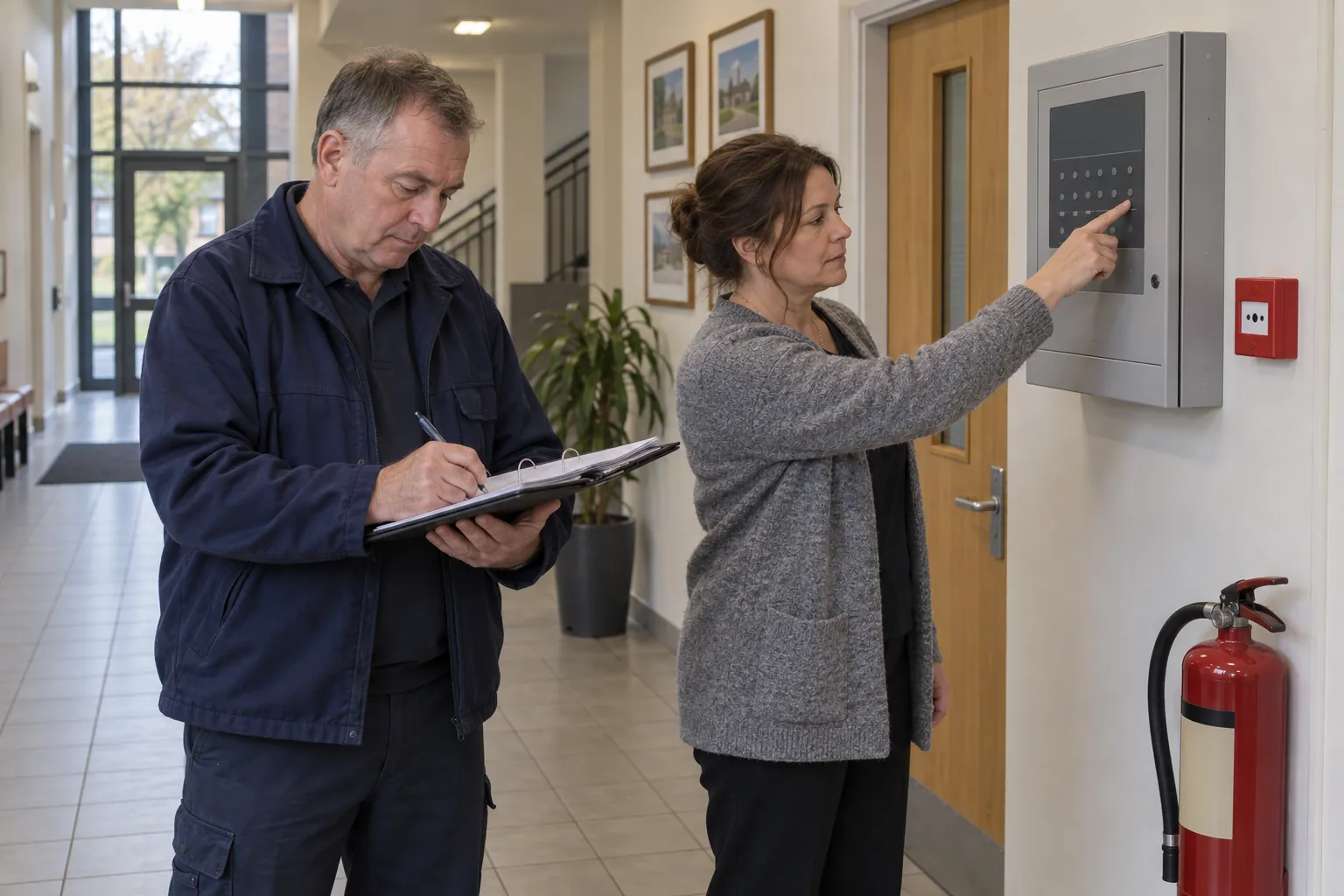 Fire and water checksFire safety register: what to record, who keeps it and how to make it credibleWhat a fire safety register should hold under section 18(2) of the Fire Services Acts, the routine checks behind it, who keeps it, and what makes it credible.
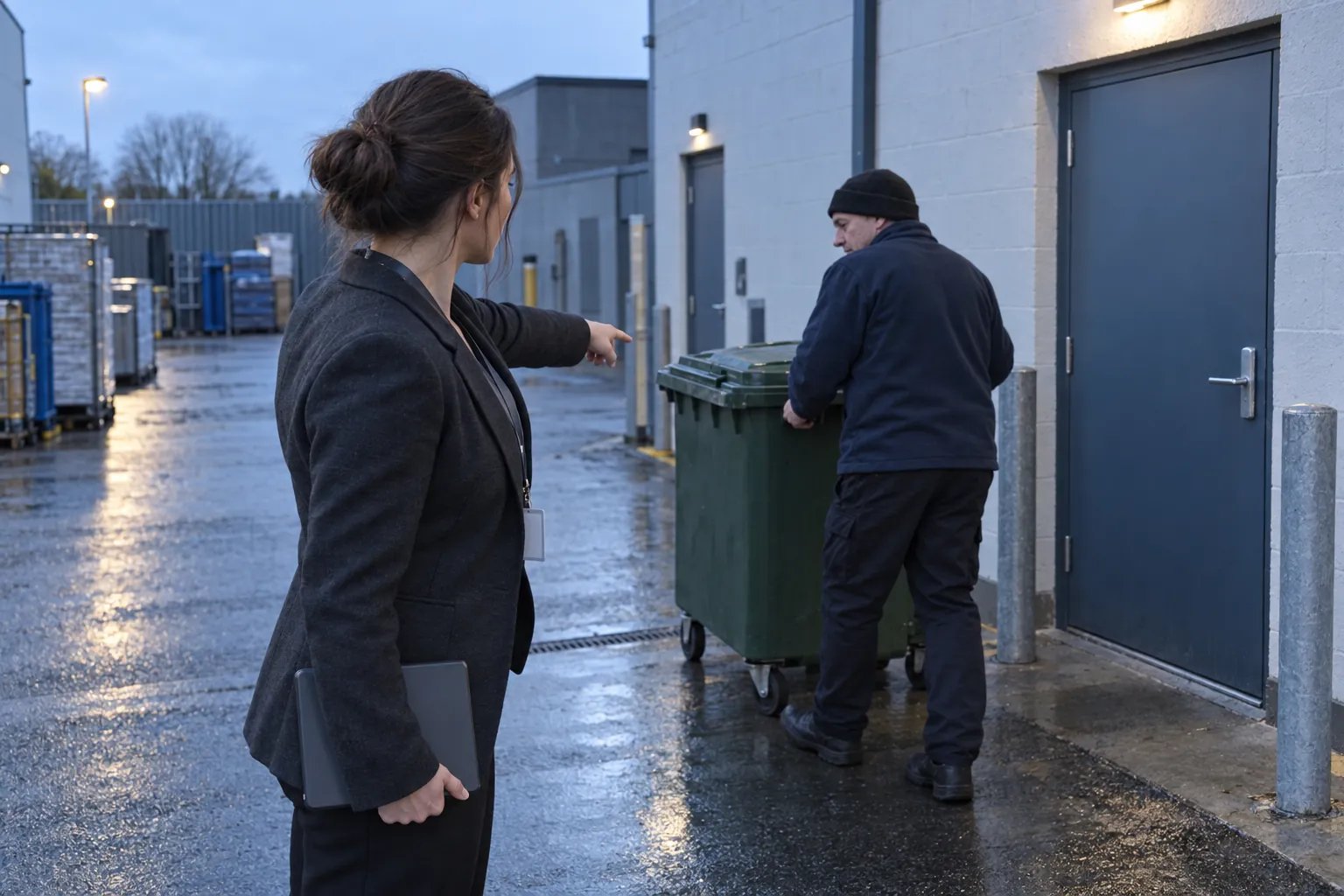 Fire and water checksWorkplace fire safety checklist: what to check, how often, and who does itA workplace fire safety checklist for Ireland: the daily, weekly and monthly checks under the Fire Services Acts, who does each one, and what to record.
 Fire and water checksFire warden duties: the daily checks, the evacuation and the recordWhat a fire warden does in an Irish workplace: the law behind the role, the daily and weekly checks, the job in an evacuation, and a record that stands up.
 Premises and facilities managementOwners' management companies: what an OMC must do, and how to show the common areas are looked afterWhat an owners' management company (OMC) is under the Multi-Unit Developments Act 2011, what it must do, who does the work, and the records that show it was done.