Security patrols
Lock-up patrols: securing a building at close, and showing it was done
A lock-up service is a security visit at the end of the day in which a certified security officer makes sure nobody is left inside a closed building, secures every door and window, sets the alarm and records the visit.
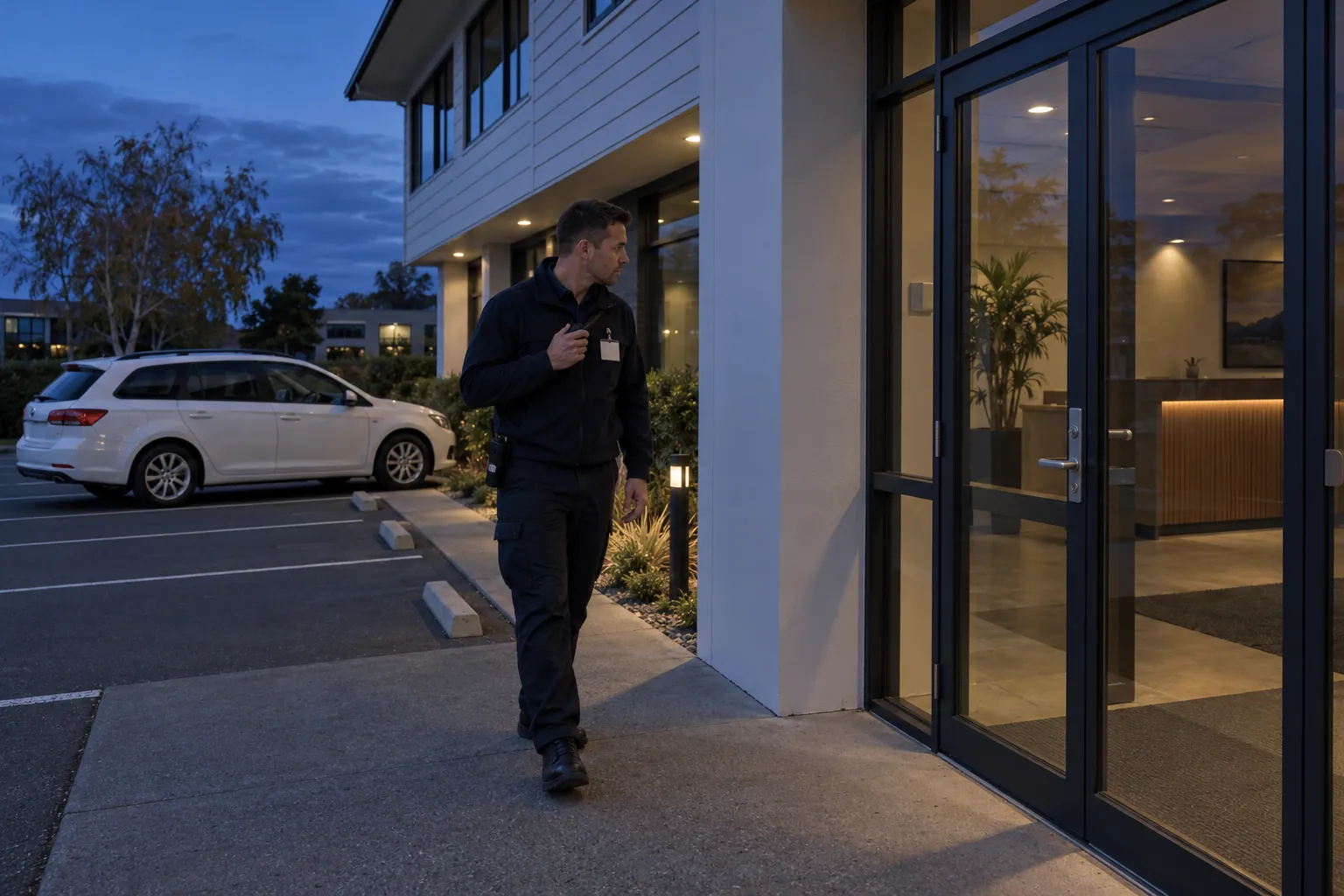
Done well, nobody notices it. Done badly, a building sits open all night and nobody knows until the morning. This guide covers what a lock-up service in New Zealand involves, the licensing behind it, the order a lock-up should follow, what to do when something is wrong, and what each visit should leave on record.
01
What a lock-up patrol is, and the licence behind it
A lock-up service, or lock-up patrol, is a visit by a security officer to secure a building once the people who use it have gone. It is usually one stop on a mobile patrol run: an officer in a patrol vehicle works through a list of client sites each evening, locking up business premises such as offices and shops, as well as schools, community halls, clubrooms and other commercial buildings, once business hours are over. Many of the same firms offer the reverse, an unlock first thing in the morning, and pair both with alarm response and keyholding services, so an officer rather than the owner attends when the alarm goes off at 3am.
No statute sets out what a lock-up must include. The content comes from the contract and the site instructions agreed with the client. What the law does govern is who may be paid to do it. Private security in New Zealand is regulated under the Private Security Personnel and Private Investigators Act 2010, administered by the Private Security Personnel Licensing Authority (PSPLA) within the Ministry of Justice. The PSPLA's list of work you need a licence or certificate for describes the property guard class as "Guarding property and answering alarm callouts on site (security guards)", which is the work a lock-up and alarm response patrol does. Watching alarms remotely without attending is a different class, monitoring officer, and installing or repairing alarm systems is security technician.
The PSPLA's page Licence or certificate? sets out who needs what:
- a company that provides private security services for money needs a company licence, with fines of up to $40,000 for an individual and $60,000 for a company that does not have one;
- a sole trader providing those services for money needs an individual licence;
- an officer employed or contracted by a security company needs a certificate of approval (COA), with a fine of up to $20,000 for working without one.
A caretaker or the last member of staff who locks their own workplace is in a different position from a firm paid to lock up other people's buildings. The PSPLA's page on who doesn't need a licence or certificate lists exceptions, among them unpaid volunteers and employees of a government agency such as the Police, and points readers to their own legal advice or the Act itself. A client engaging a lock-up service should expect a licensed company and certified officers, and can check both (see section five). The scheme is national: a local patrol firm in Auckland, Christchurch or a small town needs the same licence and certificates as a national one.
02
What a lock-up covers
The detail belongs in the site instructions, because every building locks up differently. A typical lock-up covers:
- A sweep of the building to confirm it is empty: meeting rooms, toilets, changing rooms, kitchens and stairwells.
- External doors and gates: every entrance, fire exit, roller door and loading dock door closed and secured, and every gate in the perimeter fence locked.
- Windows and skylights closed and latched.
- Fire and smoke doors inside the building closed, not wedged open.
- Lights off, or set to the night pattern the client wants; security lighting on.
- Taps, heaters and appliances named in the instructions checked.
- The alarm set, and confirmation that it set, with any zone that would not arm noted.
- The fire alarm panel glanced at, where the instructions ask for it, to see that it shows normal rather than a fault or an isolated zone.
- The outside: a walk around the building and the car park for damage, a forced door or anyone sheltering who should not be there.
- The record: the time of arrival and departure, what was found, and anything reported to the client.
An unlock reverses the order: disarm, walk the building before anyone arrives, open the doors and gates at the agreed time, and report anything that happened overnight. Both belong in writing, because the officer on the run changes more often than the building does.
03
The order of a lock-up, and why it matters
A lock-up has one rule that sits above the rest: nobody is locked in. The Fire and Emergency New Zealand (Fire Safety, Evacuation Procedures, and Evacuation Schemes) Regulations 2018 require the means of escape from fire to be kept. Fire and Emergency's page Regulations for building owners explains that under regulation 5 the owner of a building listed in schedule 2 must maintain the means of escape so that "exit doors are unlocked and not blocked, so occupants can get out of the building in case of a fire emergency", and that "smoke-control and fire-stop doors are kept closed unless they are kept open in a way that complies with the building code". Its page Regulations for building tenants and occupants adds that the means of escape must be "always free of obstacles".
Securing the exits is the point of a lock-up, so the sweep has to come first. A sensible order is:
- Arrive and check the outside before going in: doors, windows, signs of forced entry, anyone waiting in the car park.
- Disarm if the building was already set, and note whether it was.
- Sweep every area the instructions list, calling out in toilets and changing rooms, and ask anyone found to leave (see section four).
- Close internal fire and smoke doors, and note any wedge, failed door closer or blocked escape route for the client.
- Secure windows and internal doors the instructions name, then lights, taps and appliances.
- Secure the external doors, working towards the exit the officer will leave by.
- Set the alarm, wait for confirmation, and deal with any zone that will not arm rather than leaving it unset.
- Leave, lock the last door and the gates, and check them from outside.
- Record the visit before driving to the next site, while the detail is still fresh.
A lock-up that happens before the building is empty is not a lock-up. If an evening class, a cleaner or a tenant working late is still inside, the instructions should say what happens: the officer returns later, or the late worker locks up and tells the patrol. The lock-up routine should also be consistent with the building's fire evacuation scheme, where it has one.
04
When something is wrong: people, break-ins and faults
Most lock-ups find nothing. The site instructions earn their keep on the nights that do not.
- Someone still inside. Most are staff, contractors or hirers who lost track of time; they are asked to finish up and leave, and their name and the time are recorded. Someone with no reason to be there can be asked to leave, and a person who owns or legally occupies the property can give them a trespass notice. New Zealand Police's guidance on trespass notices explains that the occupier can ask someone else to serve a notice on their behalf and that written permission is a good idea, that a notice lasts two years, that the person must be given a reasonable time to leave, and that if they do not, to call 111 and ask for Police. A verbal notice should be recorded with the date and time, the reason, and a name or description. The site instructions should say whether the patrol is authorised to give notices for this client.
- Signs of a break-in. A forced door or broken window changes the job. Police's personal safety advice for new arrivals, written for anyone who finds they have been burgled at home but sound anywhere, says that if you think the burglar may still be inside, "do not go inside" and call 111, and not to touch or move anything that may be evidence. Police's page on how to report theft, burglary or robbery says to call 111 if it is happening now, and otherwise to report online or call 105. The officer then tells the keyholder, and if the building cannot be secured, stays or arranges a guard or a boarding-up contractor as the instructions allow.
- A door or window that will not secure. A broken lock, a failed door closer or a roller door off its track leaves the building open. The officer reports it to the client that night and records what was done: a temporary fix, a return visit or a guard left on site.
- An alarm zone that will not set. Usually a door or window left ajar, sometimes a faulty sensor. Isolating the zone and leaving should be a decision the instructions allow, recorded with the zone and the reason.
- Water, heat, smell or noise. A leak, a fridge alarm or a plant room running hot is reported to the client's after-hours contact straight away. Anything that could be a fire is a 111 call first.
Lock-up patrols are mostly done alone and at night. Under the Health and Safety at Work Act 2015 the security company and the client are each a PCBU, and WorkSafe's guidance on PCBUs working together says they "must consult, cooperate and coordinate" and cannot use a contract to escape their duties (see overlapping duties). WorkSafe's page on lone working singles out "lone workers – particularly those working late night shifts" and advises assessing safe entry and exit points and the likelihood of confrontation. For a lock-up that means an agreed check-in, a rule that the officer does not enter where an intruder may be, and a client who tells the patrol about anything that makes a site riskier.
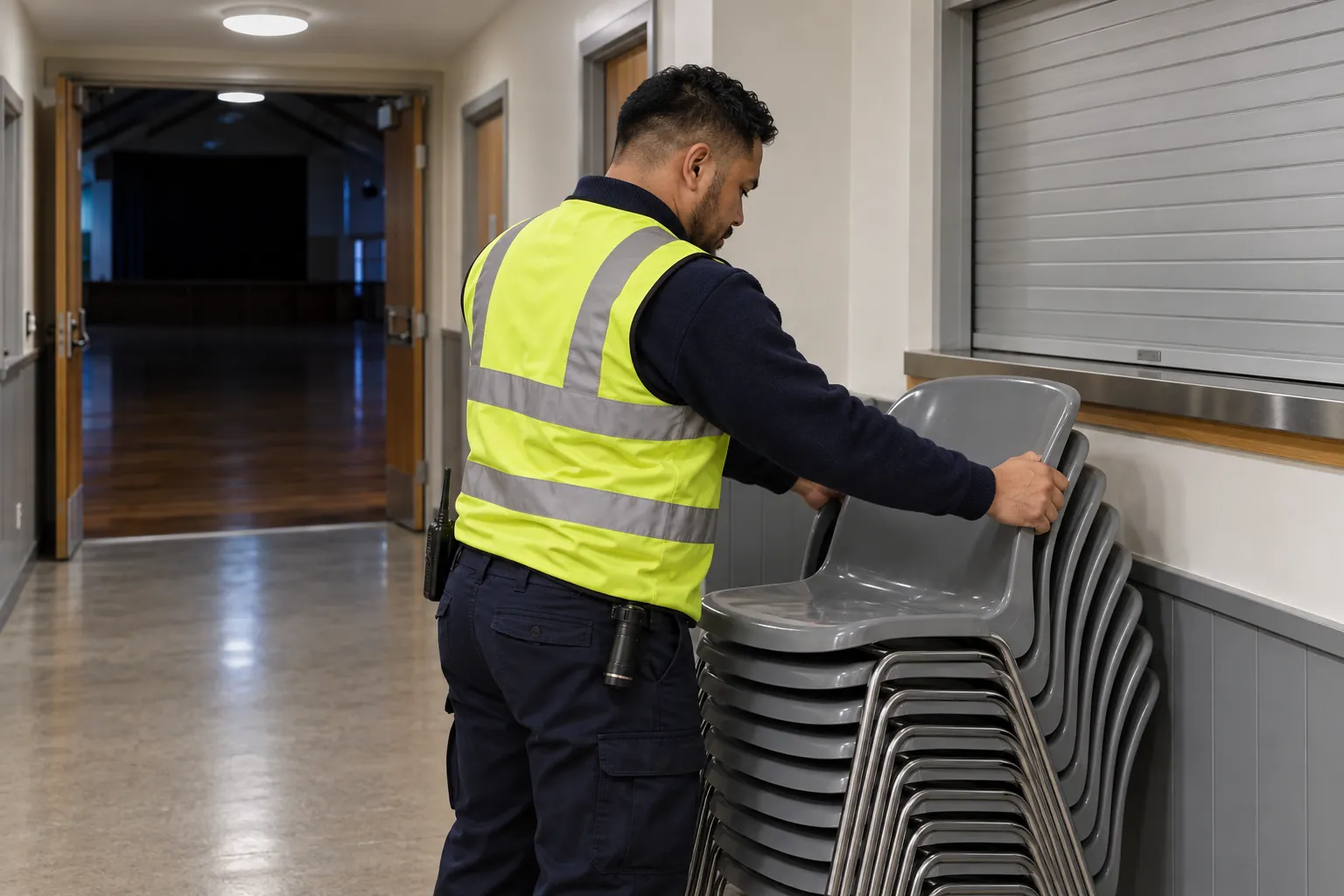
05
What each visit should leave on record, and how the client checks
A lock-up service is bought for something the client never sees, so the record is the only way to know it happened. Agree what it should show before the first visit:
- Arrival and departure times for each building, recorded as they happen.
- The named officer, not only the patrol vehicle or the company.
- Each point checked: the doors, gates and areas the instructions list, not a single "all secure".
- Exceptions: people found, doors that would not lock, zones isolated, faults, and who was told and when.
- Photos where they help, such as a damaged door, a blocked exit, or a gate left chained.
- Missed visits, with the reason: a patrol diverted to an alarm, a road closed, a building still occupied.
The client, or the facilities manager acting for them, should be able to check the service in several ways:
- Licences and certificates. The PSPLA's public register of licence and certificate holders shows the class of security work each holder covers, when it expires, any conditions, and whether it has ever been suspended or cancelled.
- Identity on site. The PSPLA's page on the duties of licence and certificate holders says "Your ID badge must always be visible when you are working", with limited exceptions, and that licence holders must keep staff records and training records.
- The alarm's own record. Where the alarm is monitored, the time it was set each night can be compared with the patrol's recorded lock-up time.
- Morning checks. The first person in, or the unlock patrol, reports a door found unlocked or a window open, so a missed step shows up quickly.
- Review meetings. Visits scheduled against visits made, exceptions and how quickly they were dealt with, and changes to the building such as a new tenant or an evening hire.
Keys and codes need their own control: a key register showing which keys the patrol holds, personal rather than shared alarm codes, and codes changed when an officer leaves the contract.
06
Where the lock-up record fails, and where SiteClara fits
The typical lock-up record is a line on a run sheet: a site, a time and "secure", often written in the vehicle at the end of the run. It cannot show which doors were tried, whether the building was swept, or what was found. When a door is found open in the morning, nobody can tell whether the lock-up missed it or someone opened it later.
SiteClara records the checks where they happen. A printed QR poster, with an optional NFC tag behind it, sits at each point the lock-up covers: the main entrance, the fire exits, the loading dock, the alarm panel, the gate. The officer scans the code or taps the tag with their own phone, with no app to install, sees the checks due there, and marks each one done or explains what stopped them. The time and the named officer are recorded as it happens, with a photo when the check asks for one. A fault found on the round, such as a door closer that has failed or a blocked exit, is reported there and goes onto the team's list of jobs until someone closes it.
The security supervisor sees what is due, done and missed across the sites, and records the reason a check was missed. At the end of the day the supervisor reviews the totals and photos, adds a note and approves a report that goes to the client's nominated contacts at 8am the next morning, showing what was reported, what is still open and how the scheduled checks went, for example 9 of 9 completed.
07
Further reading, and a list to take away
The Private Security Personnel Licensing Authority, on the Ministry of Justice website, publishes the classes of work, the duties of holders and the public register. Fire and Emergency New Zealand publishes the fire safety duties of building owners and occupants. New Zealand Police publishes guidance on trespass notices and reporting burglary, and WorkSafe New Zealand on PCBUs working together and lone working.
Before a lock-up service starts on a building, check that:
- the company holds a current company licence and each officer a certificate of approval with the property guard class, shown on the public register;
- the site instructions list every door, gate, window and area to check, in order, and the time of the lock-up and any unlock;
- the sweep comes before the exits are secured, and the instructions say what happens when someone is still inside;
- the instructions say whether the patrol may give trespass notices on the client's behalf;
- there is an after-hours contact for faults, and a rule for a door or alarm zone that will not secure;
- officers know not to enter where an intruder may be, and to call 111 first;
- keys are on a register and alarm codes are personal;
- each visit records the time, the named officer, each point checked and any exception;
- missed visits are recorded with a reason, not left blank;
- someone on the client's side reads the record and compares it with the alarm and the morning.
Sources
Every document this guide quotes or links to, in the order it first cites them.
- Work you need a licence or certificate for justice.govt.nz
- Licence or certificate? justice.govt.nz
- Who doesn't need a licence or certificate justice.govt.nz
- Regulations for building owners fireandemergency.nz
- Regulations for building tenants and occupants fireandemergency.nz
- Trespass notices police.govt.nz
- Personal safety advice for new arrivals police.govt.nz
- How to report theft, burglary or robbery police.govt.nz
- PCBUs working together worksafe.govt.nz
- Lone working worksafe.govt.nz
- Public register of licence and certificate holders justice.govt.nz
- The duties of licence and certificate holders justice.govt.nz
Related guides
 Security patrolsSecurity guard duties: what the role involves in New Zealand, and how it is checkedSecurity guard duties in New Zealand: the PSPLA certificate of approval, patrols, access, trespass, citizen's arrest, and how the work is set and checked.
 Security patrolsSite security checklist: what to check, how often, and how to show it was doneA site security checklist for New Zealand: perimeter, access, lighting, CCTV, alarms, keys and escape routes, how often each check is due, and how to record it.
 Security patrolsSecurity occurrence book: what to record, and how to keep one that stands upThe security occurrence book in New Zealand: what guards should record, how to write entries that stand up, and how it links to incidents, trespass and privacy.
 Security patrolsSecurity incident report: what to record, and how to write one that holds upWhat a New Zealand security incident report should record, how to write one, the PSPLA and NZQA expectations, HSWA notifiable events and Privacy Act care.