Security patrols
Security occurrence book: what to record, and how to keep one that stands up
A security occurrence book, often called the daily occurrence book, is the running record security guards keep on a site, in time order, of each shift: who came on duty, what was checked on patrol, what happened and what was done about it.

When something goes wrong at a site, it is usually the first thing the client, the property manager, the insurer or the Police ask to see. This guide covers what a security occurrence book should hold in New Zealand, how to write entries that can be relied on, how it sits beside incident reports, trespass notices and the PCBU's record of notifiable events, and how to keep it under the Privacy Act 2020.
01
What a security occurrence book is
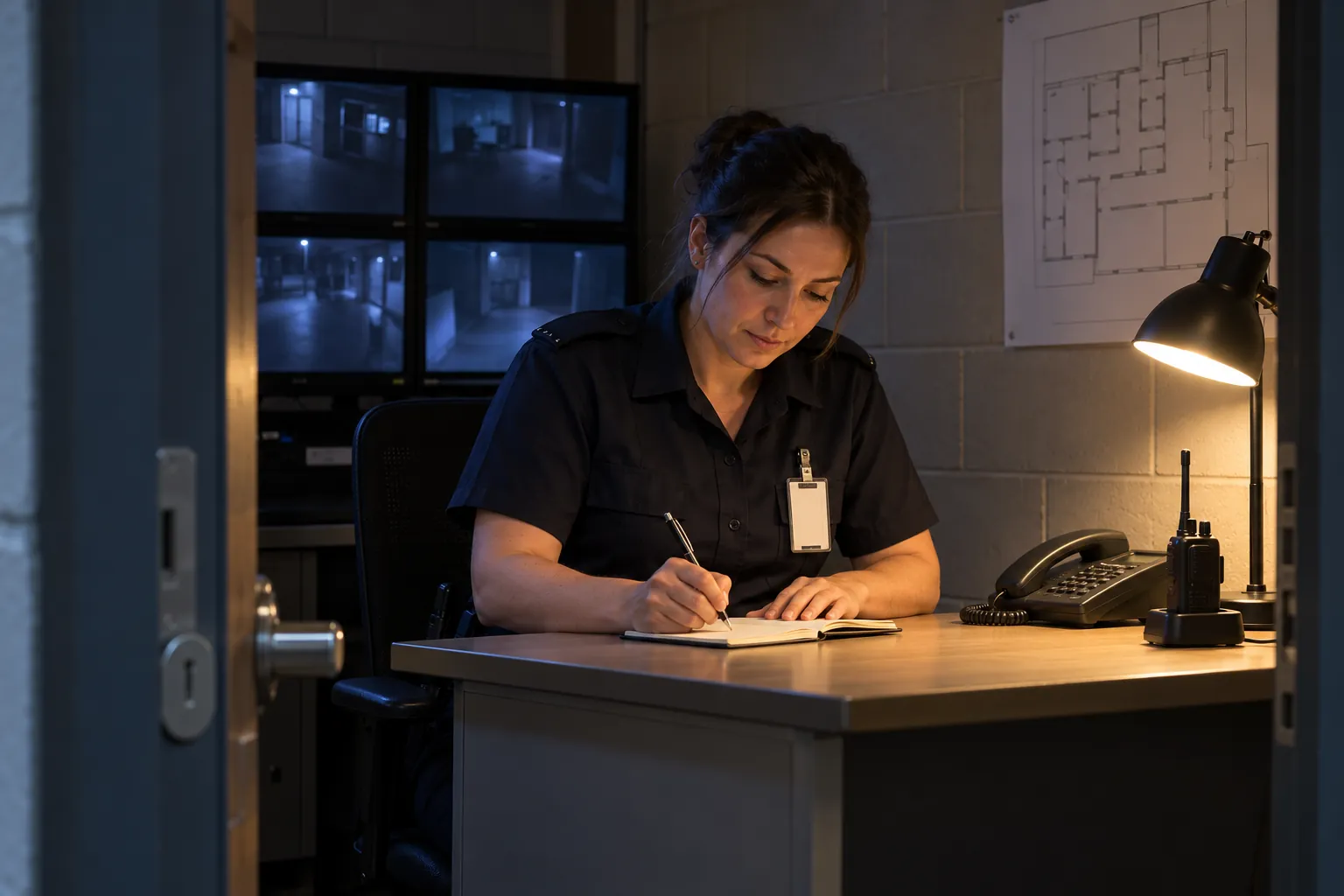
A security occurrence book is a chronological record of everything significant that happens on a guarded site during each shift. It lives on site, at the gatehouse, the concierge desk, the security office or the control room, and every guard on duty writes in it. On different contracts the same record is called the site book, the site log, the daily occurrence book, the logbook or, once it moves onto a phone or tablet, the electronic log. The name matters less than the habit: a record made at the time, in order, by a named person.
No Act requires an occurrence book as such. What the law does regulate is who may do security work. Under the Private Security Personnel and Private Investigators Act 2010, the Private Security Personnel Licensing Authority (PSPLA) issues licences and certificates of approval, holds a register of all holders and can discipline them. Guarding property and answering alarm callouts on site is property guard work, one of the classes on the Ministry of Justice's list of work you need a licence or certificate for, and its page on whether you need a licence or a certificate explains the split: a company or sole trader providing the service needs a licence, and every employee or contractor working for a licensed company needs a current certificate of approval (CoA).
The occurrence book comes from practice, training and contracts rather than statute. The core unit standards for a CoA expect it. NZQA unit standard 27364, Demonstrate knowledge of the security industry in the pre-employment context, asks a candidate to identify the information security reporting needs (who, what, why, when, how, where) and to complete a security report, with a notebook, a log book and an incident report among the examples. Unit standard 27361, Manage conflict situations in a security context, lists a notebook or logbook entry among the reporting requirements after an incident. Both are now expiring: NZQA says 27364 was replaced by skill standard 40146 and 27361 by skill standard 40147, with 31 December 2027 the last date for assessment against them. The PSPLA's training and skills page accepts either the unit standards or the skill standards, and the expectation has not changed. Most site instructions and client contracts then name the occurrence book as the place the shift's record goes.
Contract property guards are the main users, along with mobile patrol and alarm response officers who log each site visit. Concierge staff in buildings run by a body corporate, school caretakers and in-house security teams keep them too. A security provider with guards on several sites usually keeps a separate book at each one, so the record stays with the place it describes.
02
What should go in a security occurrence book
The site instructions should say what goes in the book on each site and what goes in a separate register. A typical list of entries, covering the shift's routine activities as well as the unusual, includes:
- Start and end of each shift: the guard's name, CoA number, and the time they came on and went off duty.
- Handover: what was passed on – open issues, keys out, contractors on site, systems in fault, anyone trespassed recently.
- Patrols: when each patrol started and finished, the route or checkpoints covered, and anything found.
- Lock-up and unlock: doors, gates and roller doors secured or opened, and anything that would not lock.
- Keys and access cards: issued and returned, if there is no separate key register.
- Visitors, contractors and deliveries out of hours, or a reference to the visitor or contractor sign-in.
- Alarms: intruder and fire alarm activations, faults, isolations and tests, the cause where known, who was told and what was done.
- Emergency services: when Police, Fire and Emergency or an ambulance were called and arrived, and any reference or event number given.
- Trespass: any trespass notice given on the occupier's behalf, with the date and time, the reason, and the person's name or description.
- Health and safety: injuries, near misses and hazards found on patrol, with a reference to the incident report or hazard register entry.
- Faults: failed lighting, leaks, broken locks, blocked exits, and who they were reported to.
- Calls and instructions: contact with the control room, the client, the property manager or the supervisor, including any change to instructions.
- Supervisor visits: the time, and the supervisor's signature.
Trespass entries deserve care, because they are often needed months later. New Zealand Police guidance on how to give someone a trespass notice says a notice can be given by whoever owns or legally occupies the premises, or by someone on their behalf, that the person must then not return for two years, and that for a verbal notice you should note the date and time it was given, why, and the person's name or description. For a written notice, Police suggest three copies (one for you, one for the person and one for Police); if the person drops it or refuses it, keep that copy and write on it what happened, and give Police a signed copy when you report the trespass. The occurrence book is where that note usually lives on a guarded site, and the site instructions should say who may give a notice for the occupier.
The test for the whole book is simple: could a guard who was not there read the day's entries and know what happened, in what order, and what is still outstanding? That is its everyday job, long before anyone reads it as evidence.
03
How to write entries that can be relied on
An occurrence book is read by people looking for gaps: a client after a break-in, a lawyer after an assault in the car park, a WorkSafe inspector after an injury. The conventions for a handwritten book exist to keep entries accurate, hard to alter and easy to follow, and the same principles apply to an electronic log:
- Write entries at the time, or as soon as you can. An entry made as it happened carries weight; a shift written up at the end does not.
- Use the 24-hour clock and put the time against every entry. NZQA lists it with the phonetic alphabet among the standard security protocols.
- Answer who, what, why, when, how and where. If an entry leaves one of them open, the reader will fill the gap with a guess.
- Keep it chronological. Never leave a space to fill in later; if something was missed, add it as a late entry with the time it was actually written.
- Use a bound book with numbered pages, and never tear a page out.
- Write in pen, legibly, with no correction fluid. Strike a mistake through with a single line so it can still be read, and initial it.
- Rule off blank space at the end of an entry or shift so nothing can be added.
- Record facts, not opinions. Write what you saw, heard and did, and what people said, as close to their words as you can.
- Sign off each shift with your name and CoA number, and have the supervisor sign and date the book on each visit.
04
Occurrence book, incident report or notifiable event record?
The occurrence book sits among several other records, and mixing them up causes trouble when one is questioned.
- The occurrence book is a running account of the whole shift, in time order. Most entries are routine. Its job is to show what happened and when, across the day.
- A security incident report is a separate, detailed account of one event: an injury, a crime, a disturbance, damage, a serious fault. It records the people involved, witnesses, actions taken and evidence, and goes to the supervisor and the client.
- The PCBU's record of notifiable events is a legal record. WorkSafe's page on what events need to be notified says a notifiable event is a work-related death, notifiable injury or illness, or notifiable incident; that the PCBU must notify WorkSafe as soon as possible after becoming aware of one; that the site must not be disturbed until an inspector allows work to resume; and that records of notifiable events must be kept for at least five years from the date WorkSafe was notified.
- Other registers such as the key register, the visitor sign-in, the hazard register and the fire alarm or evacuation records each have their own purpose, and the book can refer to them rather than repeat them.
When does a line in the book become an incident report? When the event needs more than a line or two; involves injury, crime, damage or the emergency services; might lead to a complaint, a claim, a trespass or a disciplinary matter; or when the site instructions say so. The book then records the time and a short summary, with the incident report's reference, so the running record and the detailed one join up.
If an event on site might be a notifiable event, the guard's job is usually to make the area safe, call for help, tell the supervisor and the client straight away, write it down and leave the scene alone. Only one notification is needed for each event, and WorkSafe suggests the PCBUs nominate one of them to make it, but every PCBU involved remains responsible for making sure it is made. WorkSafe's introduction to the Health and Safety at Work Act 2015 also explains that businesses sharing a duty must consult, co-operate and co-ordinate with each other. The security company, the building owner and the property manager are often all PCBUs on the same site, which is why the site instructions should say who does what. The occurrence book entry is supporting evidence, not the statutory record.

05
Review, retention, privacy, and paper or electronic
A book nobody reads is a diary. Supervisors should read the entries on every site visit, and at least weekly from a distance, checking that patrols happened as the site instructions require, that faults were passed on and fixed, that incidents became reports and that trespass notices reached the Police. Read over a few weeks, it also shows patterns: the same door alarming every night, the same fault reported again, which is as useful to the facilities management team as it is to the security operation.
The book is also full of personal information: names, vehicle plates, descriptions of people, what they said. The information privacy principles of the Privacy Act 2020 apply to it as they do to any other record. Principle 5 asks for security safeguards that are reasonable in the circumstances against loss and unauthorised access, use or disclosure, so the book does not lie open on a reception counter. Principle 6 gives a person the right to ask whether an agency holds personal information about them and to have access to it, so write every entry expecting it may be read by the person named. Principle 9 says an agency must not keep personal information for longer than is required for the purposes for which it may lawfully be used.
There is no statutory retention period for an occurrence book. Set one in the contract or the security company's policy that covers complaints, claims and insurer requirements, and remember that where an entry supports a notifiable event, the PCBU's own record must be kept for at least five years. Store completed occurrence books securely, with the date range on the cover, and dispose of them when the period ends.
Is an electronic log better than paper? It depends on the site. Paper needs no signal or battery; it also stays on site and is rarely read until something goes wrong. An electronic occurrence book on a phone or tablet stamps the time on each entry, can keep a trail of changes and photos, and lets the supervisor and the client read entries the same day. It only works if guards use it the way they would use the book – at the time, in full – and if the system reliably records who wrote what and when.
06
Where the occurrence book fails, and where SiteClara fits
The book is good at recording what the guard chose to write. It is weak at proving the routine: "2200 patrol completed, all secure" reads the same whether every floor was walked or the line was written at the desk. A fault noted at 0300 stays in the book unless someone passes it on. The client sees the book only when they visit, and by then the week's entries are history.
SiteClara records the routine part of the shift where it happens. A printed QR poster, with an optional NFC tag behind it, goes at each checkpoint: a fire exit, a gate, a plant room, a car park level, the last door on a lock-up round. The guard scans the code or taps the tag on their own phone, with no app to install, and marks the scheduled check done or says what stopped them. The time and the named guard are recorded as it happens. A fault or incident found on the round can be reported there with a photo, and goes onto the team's list of open jobs until someone closes it.
The supervisor sees what was due, done and missed, and can record the reason a check was missed. At the end of the day the supervisor reviews the totals and photos, adds a note and approves the daily report, which goes to nominated contacts at the client or the property manager the next morning: what was reported, what was completed, what is still open, and how the scheduled checks went.
07
Questions people ask
What is a security occurrence book?
A running record, in time order, of what happens on a guarded site during each shift, written by the guards on duty. No New Zealand Act requires one by name; the expectation comes from training, site instructions and contracts. NZQA's unit standard 27364, Demonstrate knowledge of the security industry in the pre-employment context (now expiring, replaced by skill standard 40146) asks a candidate to complete a security report in accordance with relevant instructions, naming a note book, a log book and an incident report among the examples, and defines relevant instructions as the oral, written or electronic instructions that govern security tasks, which may relate to a particular site.
What do you write in an occurrence book?
Enough about each event to answer who, what, why, when, how and where: the six items NZQA's unit standard 27364 lists as the information required in security reporting, alongside standard protocols such as the phonetic alphabet and the 24-hour clock. On most sites that means the start and end of each shift, handovers, patrols, alarms, visitors, faults and calls to the emergency services. Where a guard gives a verbal trespass notice, New Zealand Police's Trespass notices page says to note the date and time it was given, why, and the person's name or description.
How do you write a security pocket book?
By the same rules as the occurrence book: at the time, in order, with the time against every entry. NZQA's unit standard 27361, Manage conflict situations in a security context makes a notebook or logbook entry a reporting requirement after an incident, and says the reporting may also include an incident report, a hazard register entry and a request for equipment repairs, with the follow-up including a record of any injuries and the treatment given. When a guard reports the situation to a supervisor or the emergency services, the same standard says the information includes the location, details of the subject and situation, and an assessment of how severe it is.
08
Further reading, and a list to take away
The Ministry of Justice publishes the PSPLA's guidance on licences, training and the duties of licence and certificate holders, including keeping your ID badge visible while you work. WorkSafe, the Office of the Privacy Commissioner and New Zealand Police publish the notifiable event, privacy and trespass guidance cited above.
Before the next book is opened on site, check that:
- the site instructions say what goes in the book and what goes in separate registers;
- every guard knows how to write, correct and sign an entry, with the time in 24-hour form;
- entries are made at the time, in order, with nothing left blank to fill later;
- incidents in the book refer to a separate incident report, and possible notifiable events go to the supervisor and the client at once;
- trespass notices are recorded with the date, time, reason and person, and passed to the Police;
- faults recorded are passed to someone who will fix them;
- a supervisor reads and signs the book regularly;
- completed books are stored securely, and you know how long they are kept and when they are destroyed.
Sources
Every document this guide quotes or links to, in the order it first cites them.
- Private Security Personnel Licensing Authority (PSPLA) justice.govt.nz
- Work you need a licence or certificate for justice.govt.nz
- Whether you need a licence or a certificate justice.govt.nz
- Unit standard 27364, Demonstrate knowledge of the security industry in the pre-employment context nzqa.govt.nz
- Unit standard 27361, Manage conflict situations in a security context nzqa.govt.nz
- Training and skills page justice.govt.nz
- How to give someone a trespass notice police.govt.nz
- What events need to be notified worksafe.govt.nz
- Introduction to the Health and Safety at Work Act 2015 worksafe.govt.nz
- Information privacy principles of the Privacy Act 2020 privacy.org.nz
- Principle 9 privacy.org.nz
- The duties of licence and certificate holders justice.govt.nz
Related guides
 Security patrolsSecurity incident report: what to record, and how to write one that holds upWhat a New Zealand security incident report should record, how to write one, the PSPLA and NZQA expectations, HSWA notifiable events and Privacy Act care.
 Security patrolsSecurity guard duties: what the role involves in New Zealand, and how it is checkedSecurity guard duties in New Zealand: the PSPLA certificate of approval, patrols, access, trespass, citizen's arrest, and how the work is set and checked.
 Security patrolsSite security checklist: what to check, how often, and how to show it was doneA site security checklist for New Zealand: perimeter, access, lighting, CCTV, alarms, keys and escape routes, how often each check is due, and how to record it.
 Security patrolsLock-up patrols: securing a building at close, and showing it was doneWhat a lock-up service covers in New Zealand: the PSPLA licence, the order of a lock-up, fire exits, trespassers, break-ins and what each visit should record.