Security patrols
Security guard duties: what the role involves in New Zealand, and how it is checked
A security guard's duties are to protect a site, its property and its people by patrolling, controlling who comes in, watching the alarms and cameras, answering callouts, dealing with incidents and keeping a record of it all.
The job is simple to state and hard to see. This guide sets out the duties of a security guard in New Zealand, the licensing behind the role under the Private Security Personnel and Private Investigators Act 2010, the limits on what a guard may do, and how a client or supervisor can tell the duties are being done.
01
What a security guard is, and the licence behind the role
A security guard protects premises, property and people against unauthorised entry, theft, damage and disorder, and is the first to respond when an alarm sounds or something goes wrong on site. In New Zealand the same job goes under several names: static guard, patrol officer, mobile patrol officer, concierge security or, in shopping centres, retail security. Most guards work for a security company that supplies guarding to clients under contract; some are employed directly by the organisation whose site they look after.
Private security in New Zealand is regulated under the Private Security Personnel and Private Investigators Act 2010. Under it, the Private Security Personnel Licensing Authority (PSPLA), whose pages are on the Ministry of Justice website, issues licences and certificates of approval, keeps a register of holders and can discipline them. The PSPLA's list of work you need a licence or certificate for puts "guarding property and answering alarm callouts on site" in the class of property guard. Checking who enters premises or events, keeping order and removing people is a separate class, crowd controller; protecting people is personal guard; and watching systems remotely off site without responding to callouts is monitoring officer.
Who needs what depends on how the guard is engaged. As the PSPLA explains in Licence or certificate?:
- a company that provides private security services for money needs a company licence;
- a sole trader providing those services needs an individual licence;
- an employee or contractor of a security company or licence holder needs a certificate of approval (COA) for the classes of work they do.
The penalties are set out on the same page: up to $40,000 for an individual, and up to $60,000 for a company, for running a security business without a licence, and up to $20,000 for a licence holder whose staff work without a current certificate of approval, or for an employee working without one. A new guard can start work on a temporary certificate while completing their training, and in an emergency, such as illness leaving a firm short of certified staff, a firm can make a two-week emergency appointment if it tells the PSPLA first.
Training is set out on the PSPLA's training and skills page: "You must have training to work as a crowd controller, property guard or personal guard." That means three NZQA unit standards covering pre-employment knowledge of the security industry and basic and intermediate conflict situation management (27364, 27360 and 27361), or the equivalent skills standards, or the New Zealand Certificate in Security (Foundation) (Level 3) or (Advanced) (Level 4). The page adds that a guard only needs to train once, not again at each renewal.
02
The core duties of a security guard
The detail varies from site to site, but the everyday duties and responsibilities of security guards are much the same everywhere:
- Being visible. A guard in uniform, with their PSPLA ID badge showing, walking the floors and the car park, is the simplest deterrent a site has.
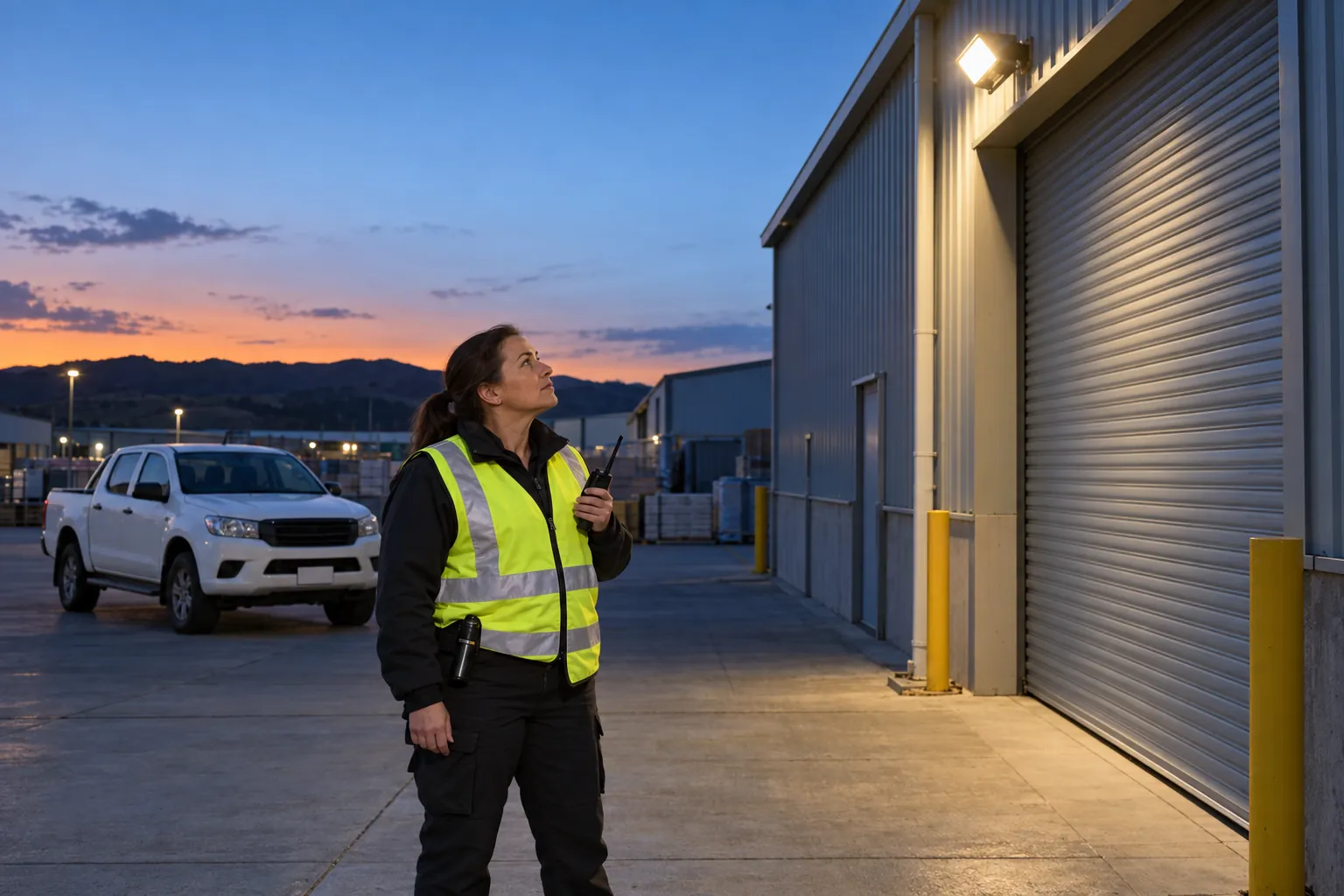
- Patrolling buildings, grounds and car parks on set routes and at set times, and at irregular times too, checking doors, windows, roller doors, gates, fire exits, plant rooms and alarm panels, and watching for anything suspicious.
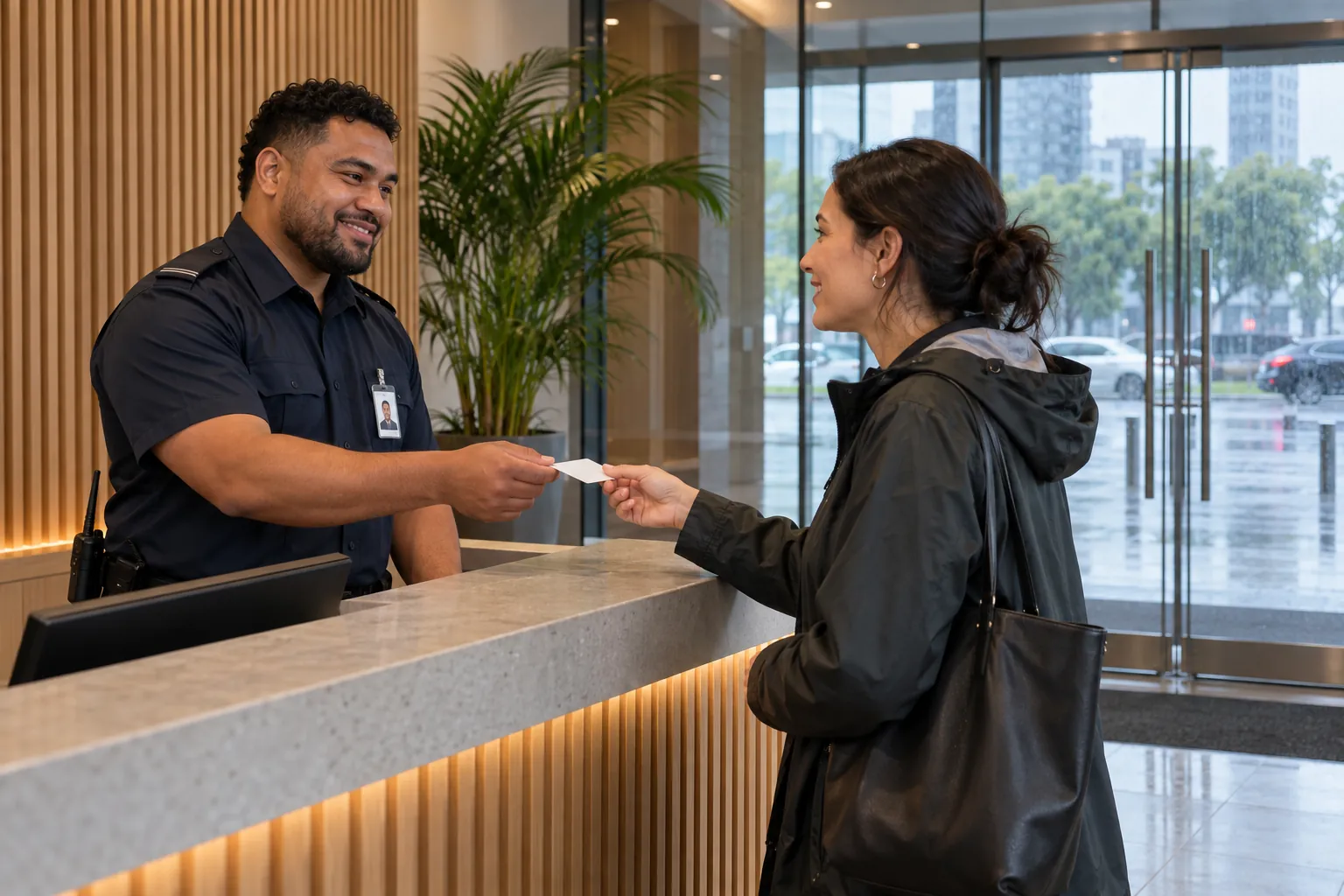
- Access control: checking passes, signing in visitors and contractors, issuing and recovering keys, swipe cards and badges, and refusing entry to people who should not be there.
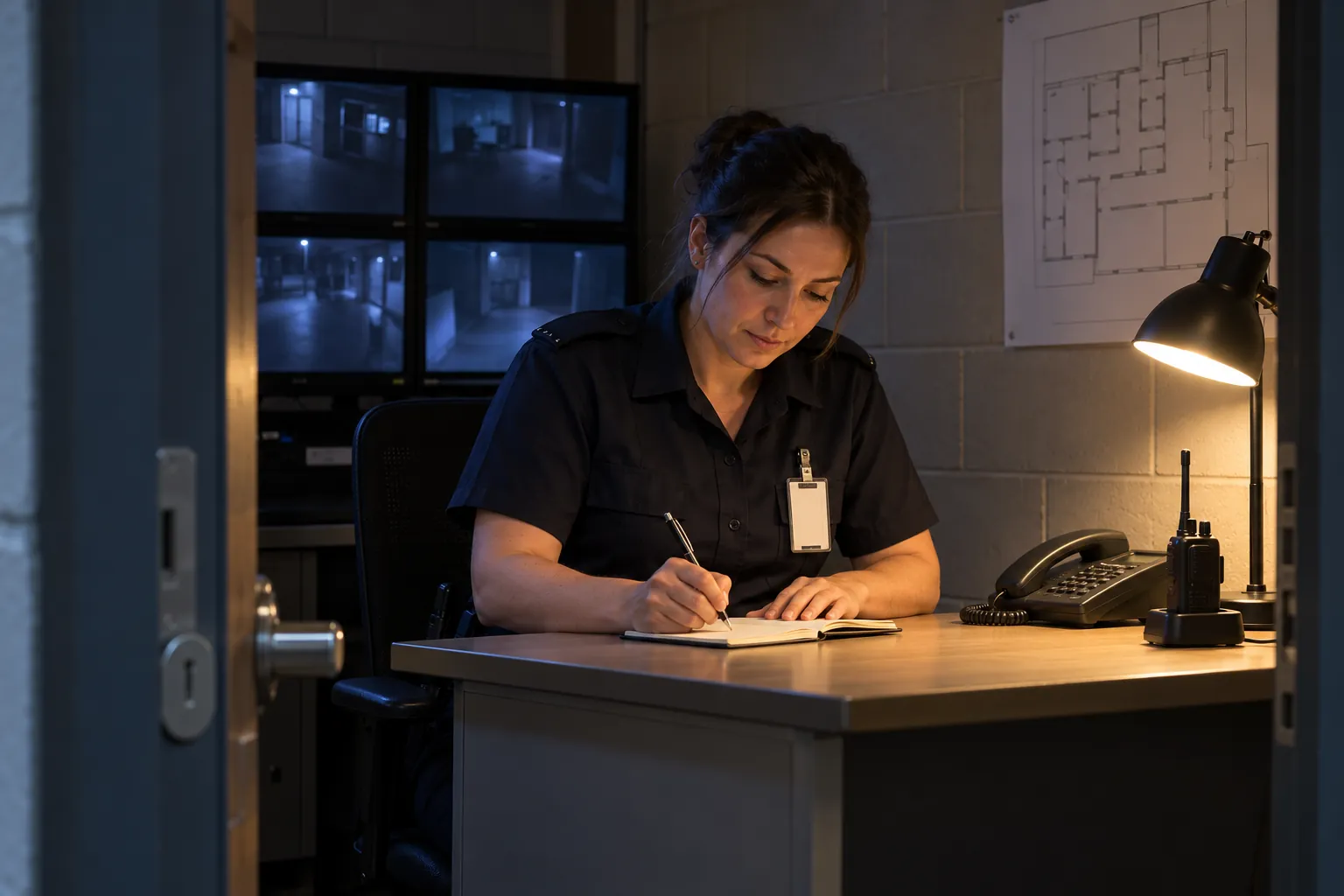
- Monitoring security systems on site: CCTV surveillance, the intruder alarm, access control and, where the guard is asked to watch it, the fire alarm panel.
- Answering alarm callouts: attending activations, checking the building, resetting or escalating, and calling Police on 111 when there is a crime in progress or a risk of harm.
- Responding to emergencies: helping with a fire evacuation under the building's evacuation scheme, first aid where trained and calling an ambulance for a medical emergency, floods, power cuts, earthquakes, and meeting Fire and Emergency or Police on arrival.
- Dealing with people: asking someone to leave, warning a trespasser in line with the site's instructions, calming a dispute, and helping lost, unwell or upset visitors.
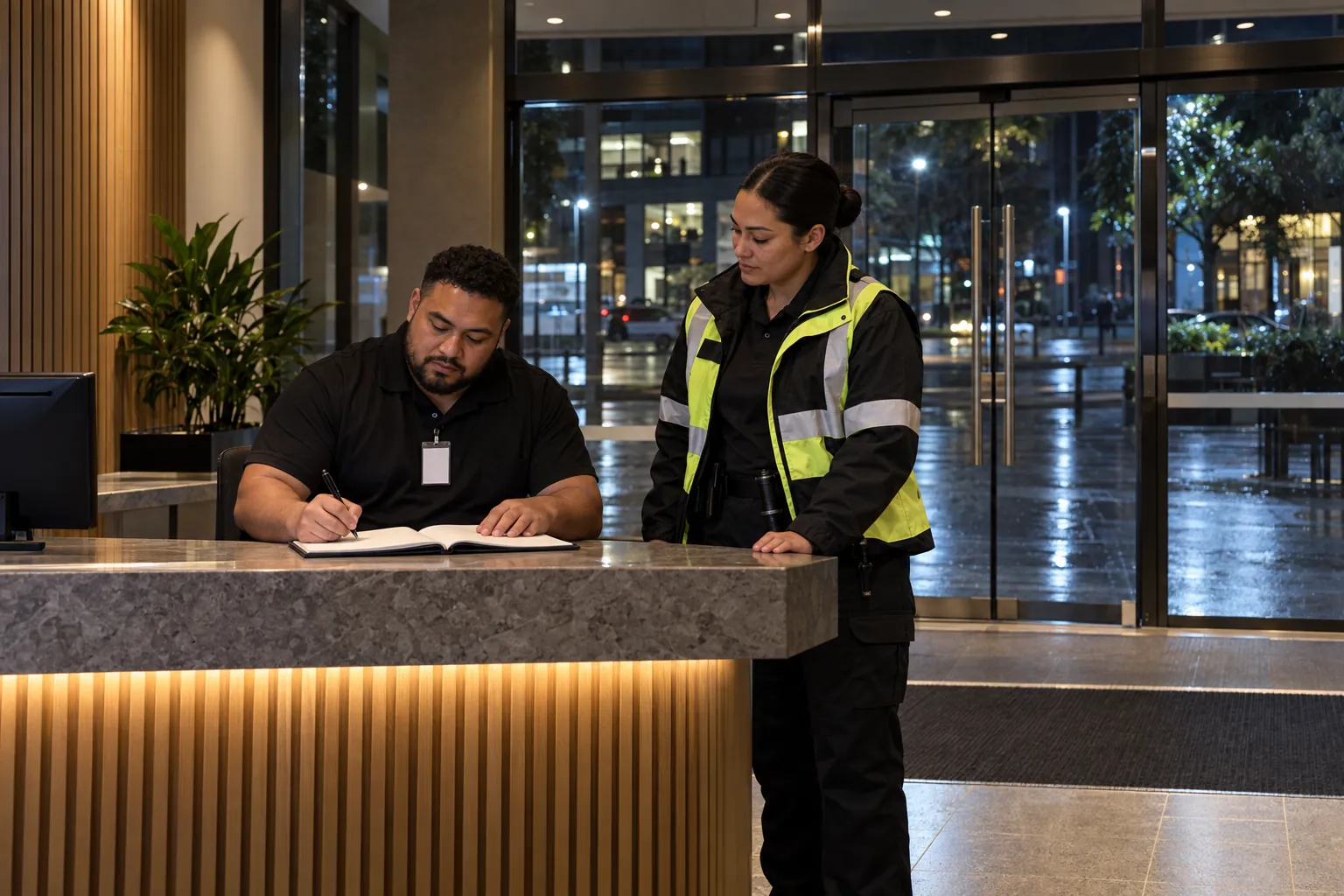
- Keeping records: the occurrence book or daily log, patrol records, incident reports, key registers and visitor logs.
- Reporting faults and hazards: failed lighting, a door that will not latch, a leak, a blocked exit, a broken fence panel, passed to whoever fixes it rather than left in the book.
- Locking up and opening up: the lock-up round at close and the unlock in the morning, including checking that nobody is left inside.
- Handing over to the next shift, with open issues, keys out, alarms isolated and anything that needs watching.
03
How the duties change from one site to another
Security guards do quite different work in different places, and the site instructions (sometimes called post orders or standing orders) are where the differences are written down. Some common settings in New Zealand:
- Office buildings and multi-tenant commercial buildings: often a front-of-house role as much as a guarding one, covering visitor management, swipe cards, deliveries, lifts and the car park, with an evening lock-up patrol and after-hours alarm response.
- Retail and shopping centres: a visible presence on the floor and in the mall, supporting store staff with difficult customers, dealing with shoplifting in line with the retailer's policy, and securing the centre at close.
- Construction sites and vacant buildings: perimeter checks, gate control, checking plant, fuel and materials, and deterring trespass and theft, often overnight and alone.
- Industrial sites, ports and warehouses: gatehouse duties, vehicle and load checks, and patrols of large yards and sheds.
- Hospitals, tertiary campuses and public buildings: open sites with many entrances, where the job leans towards de-escalation, welfare and helping people rather than keeping them out.
- Mobile patrols: a guard in a vehicle visiting several client sites a night, checking locks and perimeters and attending alarms, with a short time at each and a clear record of every visit.
- Events and licensed premises: here the job becomes crowd control, which is a separate PSPLA class with its own certificate.
Additional duties may include watching a building while its fire alarm is out of action, lone worker check-ins, key holding, or covering reception. Whatever they are, they should be in writing and agreed with the client, because a guard who is doing work outside the instructions is also doing it outside anyone's checks.
04
What a security guard may and may not do
A certificate of approval is permission to work in private security. It is not a warrant, and it does not turn a guard into a police officer or give them any powers beyond those of any other member of the public. Knowing the limits is part of the job, and the conflict management training for the certificate covers much of it.
- Trespass. Under the Trespass Act 1980, a person who owns or legally occupies a property can warn someone to leave or to stay off it, and New Zealand Police's guidance on how to give someone a trespass notice explains that the occupier can authorise someone else to give the warning. A trespass notice lasts two years. The trespasser must be given a reasonable time to leave; if they stay, the guidance is to call 111 and ask for Police. A verbal warning should be written down with its date and time, and the notice reported to Police. The site instructions should say whether the guard is authorised to warn people on the occupier's behalf.
- Citizen's arrest. A guard has the same powers of arrest as any other member of the public. The Government's announcement of 6 August 2026 says the Crimes Act Amendment Bill, which passed its final reading that day, widened those powers so that anyone can intervene to stop any Crimes Act offence at any time of day, and requires anyone making an arrest to contact Police and follow Police instructions. Police's guidance on citizen's arrest says to use force only if it is necessary and proportionate, and to use the minimum required, and that in most situations the safest course is to call 111, observe and let Police respond. Whether guards on a site are expected to detain anyone at all is a question for the security company's policy and the client, and it should be answered in writing before it arises.
- Searches. A bag check at an entrance is usually a condition of entry that the person can decline, and refusing entry is the remedy. It is not a power to search someone against their will.
- Fire exits. No exit is locked or blocked while people are in the building, whatever the security reason. Exits and escape routes are part of the building's fire safety, not its security.
- Personal information. CCTV footage, visitor logs and incident reports hold personal information under the Privacy Act 2020. The Privacy Commissioner's guidance on privacy and CCTV says an agency can only collect what is necessary for its purpose, should make clear who operates the cameras, and must be able to respond when a person asks for footage of themselves.
- Work outside the certificate. A guard certified as a property guard who is asked to run the door at a function is doing crowd control, which needs that class on the certificate.
When an incident goes beyond the guard, the duty is to keep people safe, observe, record and call Police. A guard who is unsure should ask the supervisor before acting, not after.
05
How duties are set, and how they are checked
A security guard's duties on any site should come from three documents: the contract, which sets the service and the hours; the site risk assessment, which says what the security is for; and the site instructions, which tell the guard exactly what to do, when and how, and who to call. A guard who is unsure what is expected should be able to find the answer in the site instructions without having to ask.
Health and safety sits alongside all three. Under the Health and Safety at Work Act 2015 (HSWA) the security company and the client are each a PCBU with duties to the guard, and WorkSafe's guidance on PCBUs working together is plain that they "must consult, cooperate and coordinate" and that "You can't contract out of your health and safety duties". Much guarding is done alone and at night, and WorkSafe's page on lone working notes that lone workers on late shifts "may be at increased risk of confrontation or even injury". A lone patrol needs an agreed check-in, a way to call for help and a clear rule on when not to approach.
The security supervisor, or the company's area or operations manager, then checks the work. The usual methods are:
- Supervisory visits, announced and unannounced, including at night, to check the guard is alert, in uniform, wearing the ID badge and following the site instructions. The PSPLA's page on your duties says "Your ID badge must always be visible when you are working", with limited exceptions for safety.
- Certificate checks: the PSPLA's public register of licence and certificate holders shows whether a person or company holds a licence or certificate, its classes, its expiry and any conditions, so a client can check the guards on their site and the company that supplies them.
- Record reviews: reading the occurrence book, incident reports and patrol records for completeness, and for patterns that suggest the site's security needs have changed.
- Patrol evidence: a record showing each checkpoint on the round was visited, when and by whom.
- Client feedback and KPIs: complaints, alarm response times, incidents dealt with, and patrols completed against those scheduled.
- Training and staff records: the same PSPLA page says licence holders must keep training and staff records and give them to Police or the complaints unit if asked.
When something goes badly wrong, anyone can complain to the PSPLA. Its page on complaints about private security operators lists reasons such as working without a licence or certificate for the class of work, not wearing a visible ID badge, not completing training, and misconduct or gross negligence.
06
Where the evidence of the duties fails, and where SiteClara fits
Most of what a good security guard does leaves no trace. A patrol that finds nothing is written up as "all secure", and a client who never sees a problem may start to wonder what the guarding is for. The patrol log filled in at 5am for the whole night, the fault noted in the occurrence book but never passed on, the mobile patrol visit nobody can prove happened: these are where confidence in a security contract wears away.
SiteClara gives the routine duties a record. A printed QR poster, with an optional NFC tag behind it, sits at each checkpoint on the round: a gate, a fire exit, a plant room, a car park level, a loading dock. The guard scans the code or taps the tag with their own phone, with no app to install, and marks the scheduled check done, or explains what stopped them. The time and the named guard are recorded as it happens, with a photo when the check asks for one. A fault or incident found on the round is reported there and goes onto the team's list of jobs until someone closes it.
The security supervisor sees what is due, done and missed, and can record why a check was missed. At the end of the day the supervisor reviews the totals and photos, adds a note and approves the daily report, which goes to nominated managers or client contacts at 8am the next morning, showing what was reported, what is still open and how the scheduled checks went.
07
Questions people ask
What are the main duties of a security guard?
In New Zealand a security guard's work falls in the PSPLA class of property guard, which its page on work you need a licence or certificate for describes as "Guarding property and answering alarm callouts on site". On a given site that means patrolling, controlling access, monitoring the alarms and cameras, responding to incidents and keeping records, as set out in the site instructions.
What are security roles and responsibilities?
The same PSPLA page on work you need a licence or certificate for separates the guarding roles: a crowd controller checks who enters premises or events, keeps order and removes people; a property guard guards property and answers alarm callouts on site; a personal guard protects people; and a monitoring officer monitors systems remotely off site without responding to callouts. Each role is a separate class of work on a certificate of approval.
What are the basic security duties a guard owes under the law?
The PSPLA's page on your duties says a certificate holder must keep their ID badge visible while working, show their certificate when asked, give their employer's name and address when asked, and tell the PSPLA when their details change. Licence holders must also keep training and staff records and make sure every employee doing security work holds a current certificate of approval.
08
Further reading, and a list to take away
The Private Security Personnel Licensing Authority, on the Ministry of Justice website, publishes who needs a licence or certificate, the training requirements, the duties of holders, the public register and how to complain. The Act itself is on the New Zealand Legislation website. New Zealand Police publishes guidance on trespass notices and citizen's arrest. WorkSafe New Zealand publishes guidance on working with other PCBUs and on lone working, and the Privacy Commissioner publishes guidance on CCTV.
Before a guard starts on a new site, check that:
- they hold a current certificate of approval with the right class of work, or a temporary certificate while training, and it shows on the public register;
- they have read the site's instructions and know the patrol routes, the checkpoints and the times;
- they know whether they are authorised to warn trespassers on the occupier's behalf, and how to record and report a warning;
- they know the company's policy on detaining anyone, and that calling 111 comes first;
- they know the emergency procedures, the evacuation scheme and who to call for each kind of incident;
- there is an agreed check-in and a way to call for help if they work alone;
- they know how to record patrols, incidents and faults, and who reads the records;
- their supervisor has a plan for visits and record reviews.
Sources
Every document this guide quotes or links to, in the order it first cites them.
- Private Security Personnel and Private Investigators Act 2010 legislation.govt.nz
- Work you need a licence or certificate for justice.govt.nz
- Licence or certificate? justice.govt.nz
- Training and skills justice.govt.nz
- Trespass Act 1980 legislation.govt.nz
- How to give someone a trespass notice police.govt.nz
- Government's announcement of 6 August 2026 beehive.govt.nz
- Guidance on citizen's arrest police.govt.nz
- Privacy Act 2020 legislation.govt.nz
- Privacy and CCTV privacy.org.nz
- Health and Safety at Work Act 2015 legislation.govt.nz
- PCBUs working together worksafe.govt.nz
- Lone working worksafe.govt.nz
- Your duties justice.govt.nz
- Public register of licence and certificate holders justice.govt.nz
- Complaints about private security operators justice.govt.nz
Related guides
 Security patrolsSecurity occurrence book: what to record, and how to keep one that stands upThe security occurrence book in New Zealand: what guards should record, how to write entries that stand up, and how it links to incidents, trespass and privacy.
 Security patrolsSecurity incident report: what to record, and how to write one that holds upWhat a New Zealand security incident report should record, how to write one, the PSPLA and NZQA expectations, HSWA notifiable events and Privacy Act care.
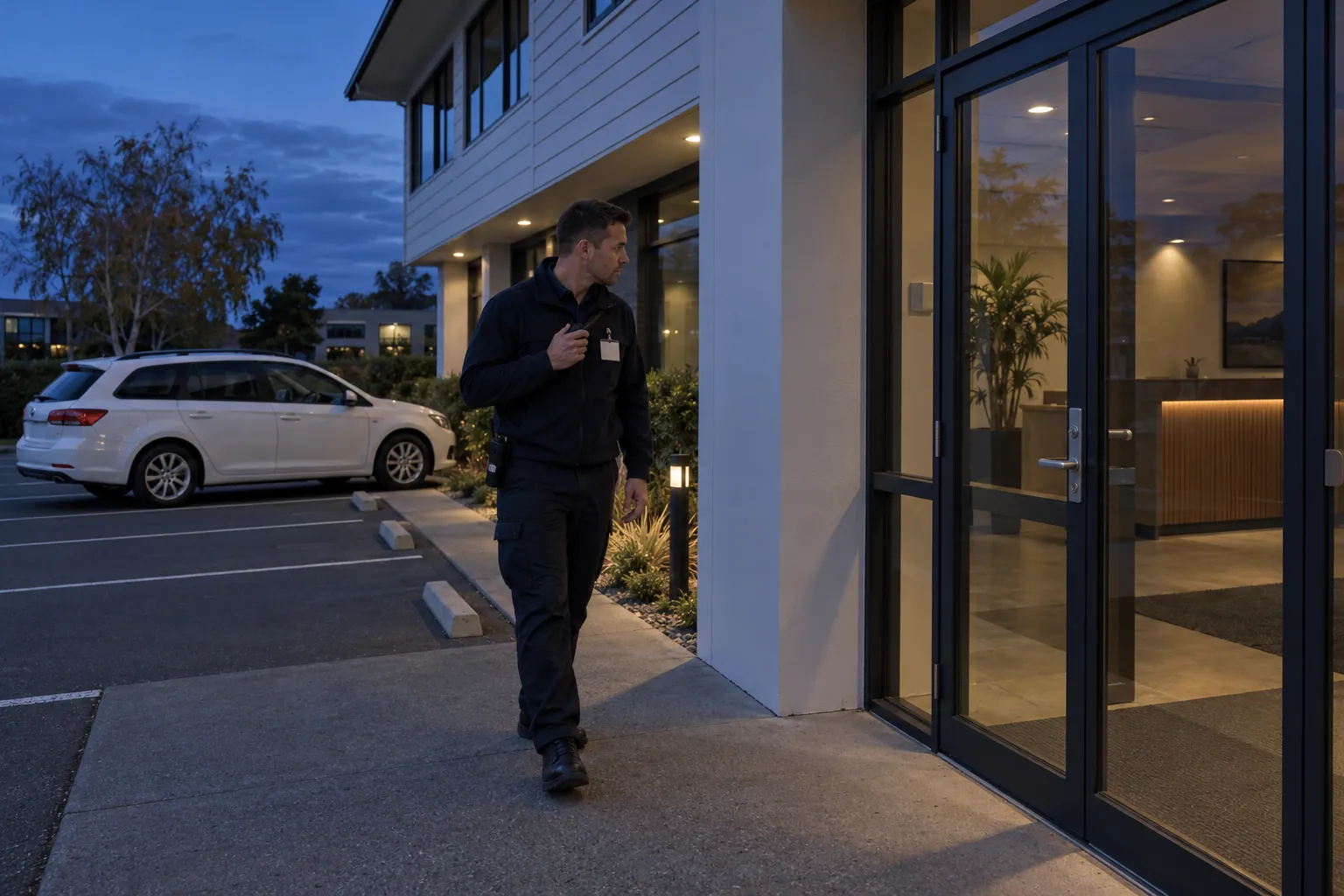 Security patrolsLock-up patrols: securing a building at close, and showing it was doneWhat a lock-up service covers in New Zealand: the PSPLA licence, the order of a lock-up, fire exits, trespassers, break-ins and what each visit should record.
 Security patrolsSite security checklist: what to check, how often, and how to show it was doneA site security checklist for New Zealand: perimeter, access, lighting, CCTV, alarms, keys and escape routes, how often each check is due, and how to record it.