Premises and facilities management
Safe operating procedures: what goes in one, and how to make sure it is followed
A safe operating procedure (SOP) is a written, step-by-step method for doing one task safely, and in New Zealand it is one of the ways a PCBU meets its duty under section 36 of the Health and Safety at Work Act 2015 to provide safe systems of work and the information, training, instruction or supervision its workers need.
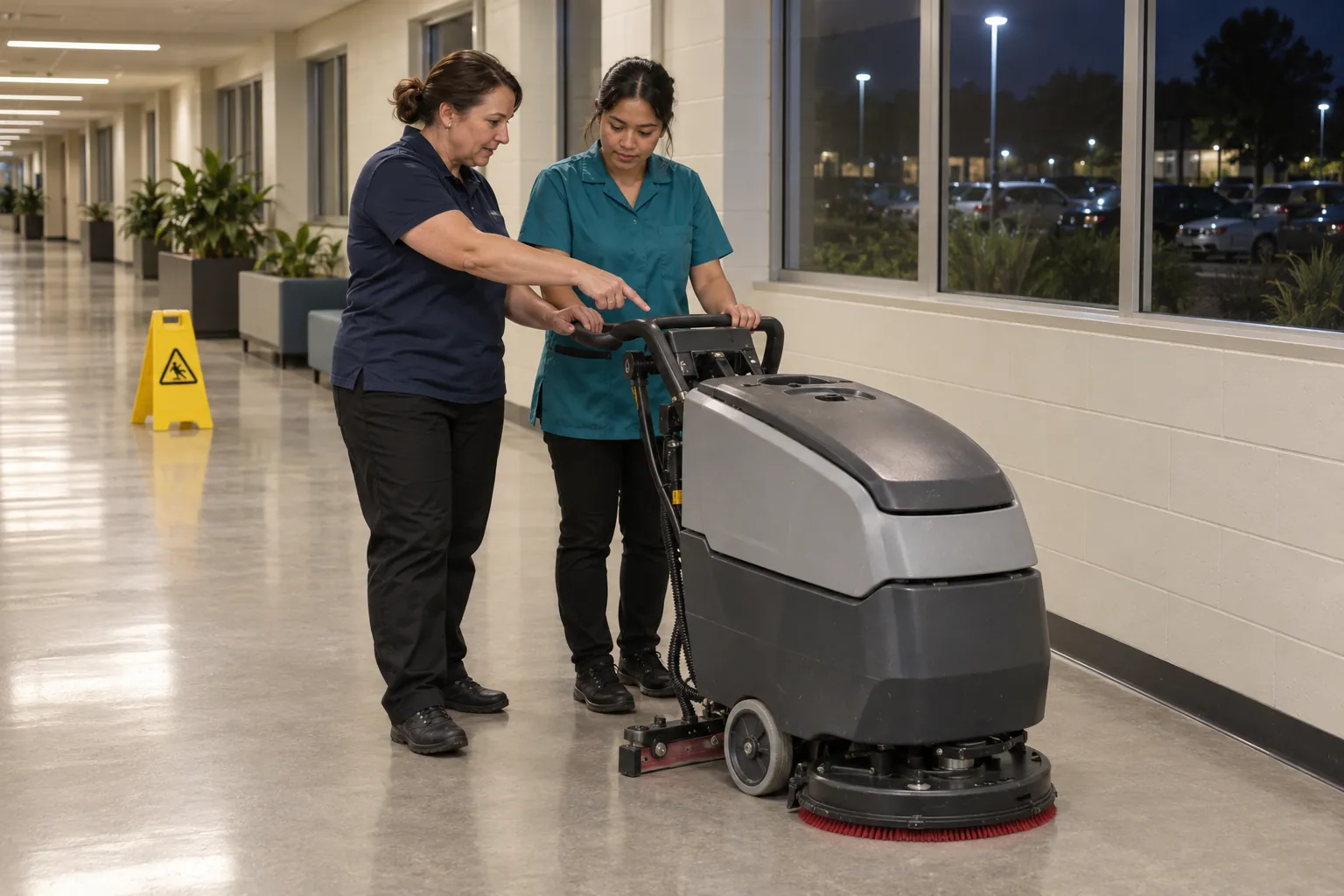
In a building that means the laminated sheet beside the floor scrubber's charging bay, the dilution steps above the chemical dispenser and the lock-up routine a security officer follows alone at night. Section 36 sets a duty rather than a format, but WorkSafe expects a business's operating systems, its procedures among them, to be documented, implemented, communicated and monitored. This guide explains where the duty comes from, which building tasks need a procedure, what goes in one, how to train and supervise people in it, and how to keep it current.
01
What a safe operating procedure is, and where the duty comes from
A safe operating procedure, also called a safety operating procedure, a safe work procedure or a work instruction, sets out how one task is done safely: who may do it, what to check first, the steps in order, the protective equipment, and what to do if something goes wrong. It is written for the person doing the job and kept where the job is done.
WorkSafe's Safe use of machinery guidelines define safe operating procedures as "written instructions that detail the steps that will be performed during a given procedure; including information about hazards and how these hazards will be controlled". A safe operating procedure is not the same as a standard operating procedure, though the two share the abbreviation: a standard operating procedure sets out how a routine operation is done the same way each time and may include safety steps, while a safe operating procedure is built around a task's hazards and their controls.
The legal footing is the primary duty of care in section 36 of the Health and Safety at Work Act 2015 (HSWA). WorkSafe New Zealand's Introduction to the Health and Safety at Work Act 2015 special guide lists what that duty includes, so far as is reasonably practicable. Three items on the list are what an SOP puts into practice:
- "providing and maintaining safe systems of work";
- "ensuring the safe use, handling and storage of plant, structures and substances";
- "providing any information, training, instruction, or supervision that is necessary to protect all persons from risks to their health and safety arising from work carried out as part of the conduct of the business or undertaking".
The Health and Safety at Work (General Risk and Workplace Management) Regulations 2016 place the SOP in the hierarchy of controls. WorkSafe's interpretive guidelines General risk and workplace management – part 2 explain that under regulation 6 a PCBU must first eliminate a risk if that is reasonably practicable, then minimise it by substitution, isolation or engineering controls, and only then use administrative control measures, described as "using safe methods of work, processes or procedures designed to minimise risk". Protective equipment comes last. WorkSafe's good practice guide Safe use of machinery describes administrative controls as "procedures to make sure the work is done safely", listing signage, training, supervision, safe operating procedures and a safe system of work. An SOP handles the risk left after a guard, a safer product or a better layout; it is not written instead of them.
WorkSafe has said what it expects of such procedures. In its 2021 media release Safe systems save lives, on the sentencing of a sawmill after a worker's death, it said "these systems must be documented, implemented, communicated, and monitored to ensure they are effective", and listed among the failings that "there was also no internal monitoring to ensure that employees were aware of the businesses safe operating procedures."
02
Which building tasks need one: examples of safe work procedures
A task needs a written procedure where the risk is real, the safe way is not obvious, or different people would otherwise do it differently. WorkSafe's fact sheet Providing information, training, instruction or supervision for workers names four kinds of work that may need higher levels of training or supervision: confined spaces, working at heights, substances hazardous to health, and remote or isolated work.
For the cleaners, security officers, caretakers and maintenance staff who look after a commercial building, typical examples of safe work procedures are:
- Floor scrubbers and burnishers: the pre-use check, working near the public, emptying the recovery tank, clearing a blockage with the machine isolated, and battery charging.
- Diluting and decanting cleaning chemicals: the dilution ratio, the labelled container, gloves and eye protection, and never mixing products.
- Body fluid spills and sharps found in bins or bathrooms: the kit, the sharps container, and who is told.
- Ladders and high dusting: which ladder, the check before use, and when the job needs a platform or a specialist.
- Lock-up and opening alone: the order of the walk, setting the alarm, the check-in call and what happens if it is missed.
- Night patrols of car parks and service areas: the route, when not to approach, and how to call for help.
- Isolating plant before cleaning or clearing it: the machinery guidelines say employers need to "develop safe operating procedures on how to use machinery safely, including maintenance and cleaning".
The list for any one building comes from its hazard register: every risk whose control is "follow the procedure" needs a procedure that exists, that people have been shown, and that is at hand where the work is done. Higher-risk work often goes further; the special guide notes that "for risky work, safe work methods can be formalised using a permit-to-work system".
03
What goes in a safe operating procedure
A procedure people actually use fits on one or two pages and follows the same shape every time, so workers know where to look:
- Title, purpose and scope: the task, the equipment or substance, and where it applies.
- Who may do it: the training needed, and whether a new worker must be supervised.
- Hazards and controls: the potential hazards and risks from the hazard register or a job safety analysis, and the controls already in place.
- Protective equipment: what to wear, and where to find it.
- Before you start: the checks, such as cables, the emergency stop, the right product and signs out.
- The steps: step-by-step instructions in order, short and in plain words, with pictures where they help.
- Stop and report: when the worker stops and tells someone, such as damage, a leak or an unfamiliar smell.
- Emergency procedures: what to do in a spill, an injury or a fire, and who to call.
- Finishing: cleaning down, storage, charging and leaving the area safe.
- References: the manufacturer's instructions and the safety data sheet.
- Control: version, date, approval and the next review date.
The people who do the work should help write it. WorkSafe's interpretive guidelines General risk and workplace management – part 1 list the decisions on which a PCBU must engage with workers, including "ways to eliminate or minimise health and safety risks" and "procedures for providing information and training for workers". Writing about isolating machinery for cleaning or repair, the machinery guidelines say employers "should develop these safe operating procedures with employees" and that once in place a procedure "should be strictly obeyed".
Write for the reader. The fact sheet on information and training says it must be readily understandable, and asks PCBUs to consider workers' "first language, any cultural differences" and whether some "find it difficult to read", in which case information "may need to be provided orally, or through pictures or demonstrations". It also suggests "daily reminders of safe work practices (eg SOPs, posters or flash cards summarising the key points kept at work stations, toolbox meetings)". A procedure in the office folder is little use to a cleaner at the charging bay at 10pm.
04
Training, supervision and showing people can do it
A procedure only works if people can follow it. Regulation 9 of the General Risk and Workplace Management Regulations is the duty to provide information, supervision, training and instruction. WorkSafe's part 1 guidelines explain that a PCBU must ensure, so far as is reasonably practicable, that every worker either has adequate knowledge and experience of that kind of work, plant or substance, or "is adequately supervised by a person who has adequate knowledge or experience", and is "adequately trained in the safe use of all plant, objects, substances, or equipment" they may use. That covers regular tasks "as well as the ones they may be called on to do (for example, if a co-worker is away)", which is when a relief cleaner meets an unfamiliar machine.
For each procedure:
- Show, then watch. A new worker does the task under supervision and is signed off only when they can do it unaided.
- Check understanding, not attendance. The fact sheet says training "should NOT be a tick in the box exercise", and suggests tests or being "randomly observed by the trainer to confirm competence".
- Refresh. "It's easy for bad habits to slip into work practices", it warns; decide how often people are reminded.
Training records are generally a matter of judgement, but some regulations require them, and hazardous substances work is the one most building teams meet. The fact sheet says "you are not required to keep training records – but they are useful to show what training has taken place and when refresher training is needed". For hazardous substances, WorkSafe's quick guide Information, training and instruction for workers handling hazardous substances (November 2017) says "it is mandatory to keep records of training and instruction for each worker from 1 June 2018". The training must cover "any procedures for safely using, handling, manufacturing, storing and disposing of the hazardous substances", followed by "a suitable period of practical experience in your workplace under direct supervision".
Workers have duties too. As the special guide sets out, under section 45 of HSWA a worker must "cooperate with any reasonable workplace health and safety policy or procedure that has been notified to workers". The word that matters is notified: a procedure nobody was shown is hard to hold anyone to.

05
Keeping procedures current: monitoring and review
An SOP is a control measure, so the duties to keep controls effective apply to it. Under regulation 7, WorkSafe's part 2 guidelines explain, a control must be "installed, set up, and used correctly", and control measures "must be regularly monitored and checked to ensure that they are still managing the risk effectively", not just when first put in place. The machinery guidelines put it bluntly: "Control measures are not 'set and forget'." They suggest checking incident and near-miss reports, inspecting the work, and making sure "all policies, processes and systems have a scheduled date for a review or audit to check that they are being followed and are still fit-for-purpose."
Regulation 8 says when a control must be reviewed and, as necessary, revised: among other times, when it does not control the risk, before a change likely to create a new or different risk, and when a new hazard is identified. The part 2 guidelines count "a change to a system of work, a process, or a procedure" as a change, and give the temporary introduction of a night shift as an example. Triggers worth writing into each SOP are:
- a new machine, chemical or supplier, or new manufacturer's instructions;
- a refit, a new tenant, a new contract or new lock-up times;
- an incident or near miss on that task (see our guide to near-miss reporting);
- workers or their health and safety representative saying it does not work as written.
In a shared building the cleaning company owns the procedure for its scrubber, while the owner or property manager usually owns the lock-up, alarm and evacuation routines contractors follow. Swap the procedures that touch at the start of a contract and agree who updates which; the special guide reminds PCBUs that they "cannot contract out of their duties, but can enter reasonable agreements with other PCBUs to meet their duties." Amendments to HSWA come into force on 1 April 2027, the special guide notes, and WorkSafe will publish guidance beforehand; review the procedures for your most serious risks when it does.
06
Where safe operating procedures fail, and what SiteClara does about it
Most SOPs fail between the binder and the job. The procedure was read out at induction, signed for and filed. Months later the scrubber's pre-use check is skipped on a short shift, the lock-up walk misses the plant room, and the check-in call is made from the car park rather than after the last door. Nothing in the folder shows it. After an incident the question is not whether a procedure existed but whether it was followed that night, by whom, and whether the fault someone noticed reached anyone who could fix it: the monitoring WorkSafe found missing in the 2021 sentencing above.
SiteClara records those checks at the location. A printed QR poster, with an optional NFC tag behind it, sits where a procedure's checks are done, such as a charging bay, a chemical store, a plant room or each point on a lock-up route. Staff scan or tap with their own phone, with no app to install, see the checks due there, and mark each done or say what stopped them. The time and the named person are recorded as it happens, with a photo when one is asked for, and a fault reported there, such as a damaged cable or a leaking dispenser, goes onto the team's list of open jobs until someone closes it.
A supervisor sees what is due, done and missed, records the reason a check was missed, and each day reviews and approves a short report for nominated managers or the client, sent the next morning. When a procedure comes up for review, that is evidence of how the routine was actually carried out.
07
Questions people ask
What is the difference between an SOP and an SSOW?
A safe system of work (SSOW) is the whole arrangement for doing a job safely; a safe operating procedure is one written part of it. WorkSafe's Introduction to the Health and Safety at Work Act 2015 special guide describes developing a safe system of work as examining a task to identify its risks, identifying safe methods and controls, and setting the methods to carry it out, and says it can involve "the physical layout of the workplace and its access and egress, tools, plant, procedures and people (eg instruction, information, training)". The Safe use of machinery guidelines define a safe system of work as "a formal procedure which results from systematic examination of a task in order to identify all the hazards", one that "defines safe methods to ensure that hazards are eliminated or risks minimised". The SOP is the written procedure for one task within it.
Are safe operating procedures a legal requirement in New Zealand?
Section 36 of HSWA requires the safe systems of work and the information, training, instruction or supervision that an SOP helps provide, so far as is reasonably practicable, rather than naming a document. WorkSafe's Safe use of machinery guidelines list safe operating procedures among administrative controls and say employers need to develop them for machinery, including its maintenance and cleaning.
Do workers have to follow a safe operating procedure?
Yes, if it is reasonable and has been notified to them. Under section 45 of HSWA, as WorkSafe's special guide explains, a worker must "cooperate with any reasonable workplace health and safety policy or procedure that has been notified to workers" and comply, so far as reasonably able, with any reasonable instruction given by the PCBU.
08
Further reading, and a list to take away
Start with WorkSafe's Introduction to the Health and Safety at Work Act 2015 special guide for the primary duty and safe systems of work, then General risk and workplace management – part 1 for training and supervision and General risk and workplace management – part 2 for controls, review and remote work. For cleaning machines read Safe use of machinery. Our guide to PCBU duties covers who holds which duty in a building.
Before you issue a safe operating procedure, check that:
- the task is on the hazard register, and the procedure covers the risk left after higher controls;
- the people who do the work helped write it;
- it names who may do the task, the training needed and when supervision is required;
- it has the checks before starting, the steps, the stop-and-report conditions and the emergency actions;
- it can be understood by everyone who will use it, with pictures where needed;
- a copy is kept where the work is done;
- each worker has been shown it and seen doing it, with a record kept for hazardous substances work;
- it has a version, an approval and a review date;
- there is a way to see that its routine checks are actually done, by whom and when.
Sources
Every document this guide quotes or links to, in the order it first cites them.
- Safe use of machinery worksafe.govt.nz
- Introduction to the Health and Safety at Work Act 2015 special guide worksafe.govt.nz
- General risk and workplace management – part 2 worksafe.govt.nz
- Safe systems save lives worksafe.govt.nz
- Providing information, training, instruction or supervision for workers worksafe.govt.nz
- General risk and workplace management – part 1 worksafe.govt.nz
- Information, training and instruction for workers handling hazardous substances worksafe.govt.nz
Related guides
 Premises and facilities managementHazard register: what HSWA expects, and how to keep one that is usedWhat a hazard register is under New Zealand's HSWA, what goes in it, how to assess and control risks, when to review it, and what changes on 1 April 2027.
 Premises and facilities managementLone worker policy: what New Zealand law asks for, and what to put in itA lone worker policy in New Zealand: regulation 21 on remote or isolated work, the risk assessment, check-ins, first aid and an outline to adapt for your building.
 CleaningHazardous substances inventory: what it must hold, and how to keep it trueWhat a hazardous substances inventory must contain in New Zealand, who keeps one in a shared building, when to update it, and how it sits with SDSs and labels.
 Premises and facilities managementHealth and safety representatives: electing an HSR, and engaging workers in a buildingWhat a PCBU must do under Part 3 of HSWA: engaging workers, electing a health and safety representative, the HSR's powers, and health and safety committees.