Premises and facilities management
Defibrillator checks: how to keep a workplace AED ready, and show that it is
Defibrillator checks are the routine look at an automated external defibrillator (AED) that confirms its status indicator shows it is ready, its pads are sealed and in date, its battery is good and its cabinet and signs are in order, at least weekly in the Department for Education's guidance for schools and as the manufacturer's instructions say for every device.
Also written for Ireland · United States · Canada · Australia · New Zealand

No UK law requires a workplace to have a defibrillator, but once one is provided it is work equipment that must be maintained, and a device that has not been checked may not be there when it is needed. This guide covers the law, what each check looks at, how often, who does it, what to do after use or a fault, and how to record it.
01
Is a defibrillator a legal requirement, and what the law says once you have one
No statute requires an ordinary workplace in the UK to have a defibrillator. HSE's first aid at work frequently asked questions say plainly: "Health and safety legislation does not require you to have an automated external defibrillator (AED) in your workplace." Resuscitation Council UK's Public access defibrillators: A guide for communities (version one, October 2025) agrees: "There are no statutory laws in the UK relating to resuscitation or the provision of a defibrillator. The HSE does not mandate that any employer or organisation must provide a defibrillator."
The decision comes through the first aid needs assessment. Regulation 3(1) of the Health and Safety (First-Aid) Regulations 1981 requires an employer to provide equipment and facilities "adequate and appropriate in the circumstances" for first aid to be given to employees who are injured or become ill at work. Resuscitation Council UK's guide suggests that the needs assessment is the place to consider the risk of a cardiac arrest at work, and that a large workforce or many visitors strengthens the case for a defibrillator.
Once you have one, it is work equipment. HSE's guidance on the Regulations, First aid at work (L74, third edition, 2013, reissued with minor amendments in 2018 and 2024), says at paragraph 44 that where an employer provides an AED, the Provision and Use of Work Equipment Regulations 1998 (PUWER) apply. Regulation 5(1) of PUWER requires work equipment to be "maintained in an efficient state, in efficient working order and in good repair". Regulation 6 deals with inspection at suitable intervals, and where an inspection is made under it, the result must be "recorded and kept until the next inspection under this regulation is recorded". The Department for Education points schools to regulation 6 for the purpose of a defibrillator's monthly and annual checks.
The British Standard for workplace first aid kits now covers defibrillators too: BS 8599-1:2019+A1:2026, Workplace first aid kits – Contents of first aid kits and provision of Automated External Defibrillators (AEDs) in the workplace – Specification, published on 30 April 2026, specifies the provision and placement of AEDs in a workplace. Like the rest of BS 8599, it is not a legal requirement.
02
How to check a defibrillator: what each check looks at
Once its pads are attached, an AED analyses the heart rhythm of a person in cardiac arrest and, if required, gives a shock. The Department for Education's Automated external defibrillators (AEDs): a guide for maintained schools and academies notes research showing that the chance of survival after a cardiac arrest falls by 7–10% for every minute of delay in starting treatment, which is why a device that is not ready matters.
Modern AEDs test themselves. The Department for Education's guide explains that they "undertake regular self-tests and, if a problem is detected, will indicate this by means of a warning sign or light on the machine". The routine check is mainly a person going to the device and reading that signal, then looking at everything around it. The British Heart Foundation's page on maintaining your defibrillator and the two official guides give a routine like this:
- The defibrillator is there, in its usual place, and the cabinet or wall bracket is not empty. If it has been moved on purpose, a notice in its place says where it is and who to call.
- The status indicator shows ready. The BHF says it "will usually be lit up green if the defibrillator is ok. Look out for beeping, flashing or an x on the display." Signals differ by model, so read the manual.
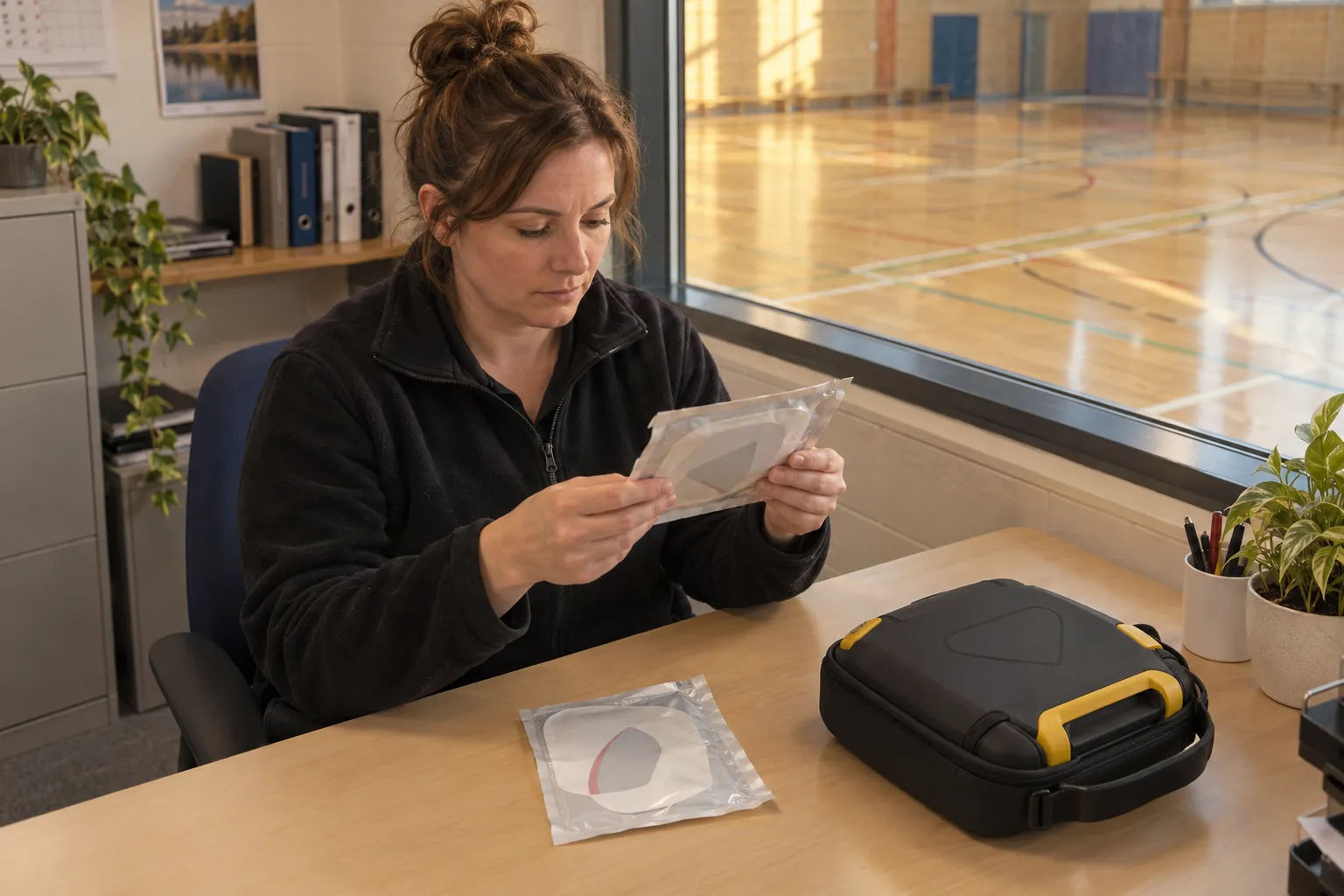
- The pads are in date and sealed. The BHF says to "Check the expiry date on the sticky pads. If they are out of date, replace them." The DfE guide says schools should pre-connect adult pads, since most devices need pads connected to run their self-tests.
- Spare pads are on site, including paediatric pads where the model needs separate ones, so the device is not left unusable while replacements arrive.
- The battery shows no low warning, and is within any date the manufacturer gives.
- The case shows no damage or sign of use, and the BHF suggests a wipe with a damp cloth to stop dirt building up.
- The accessories are with it: typically gloves, a safety razor, scissors that cut through clothing, a towel or dry wipes and a pocket mask or face shield.
- The cabinet closes properly, any lock and keypad work and are lit at night, and an outdoor cabinet's heating has power. The DfE guide asks schools to check "the condition of the cabinet, including the door closure and any lock".
- The signs are in place and visible. Resuscitation Council UK suggests inspecting every sign for the defibrillator at the same time as the device's routine checks.
Resuscitation Council UK advises that only the defibrillator and its equipment are kept in the cabinet.
03
How often to check a defibrillator
No regulation sets an interval. The guidance does:
- Weekly, at least. The DfE guide asks schools to have "a procedure in place for defibrillators to be checked for such a warning on a regular (and no less frequently than weekly) basis". It is written for schools, but it is a sound default for any workplace.
- As the manufacturer says. Resuscitation Council UK's guide says checks "should be carried out as per manufacturer guidance and your risk assessment", and that "In all cases, the manufacturer's instructions should be followed." The BHF notes that all the defibrillators it supplies "offer daily, weekly and monthly checks".
- Monthly and annual checks, where the user manual asks for them. The DfE guide warns that failing to do them "could potentially mean that the defibrillator fails to function properly when needed".
- After every use, before the device goes back into service.
- Before an expiry date: pads and batteries have finite lives and are replaced at the time the manufacturer specifies, usually the expiry date on each item or, for a battery, when its indicator shows low, whichever comes first.
An unrecorded check also has a cost outside the building. Resuscitation Council UK's guide says checks should always be recorded on The Circuit, the national defibrillator network, "as this ensures the ambulance service know your defibrillator is emergency ready", and warns that "Some ambulance services will not deploy a defibrillator that hasn't had a check recorded for over three months."
Servicing is a different matter. The DfE guide says defibrillators "do not normally require regular servicing by a suitably qualified technician", but some models do, so the user manual and the supplier settle it. Software may also need updating when resuscitation guidelines change; the manufacturer arranges that.
04
Who checks it: the guardian, cover and The Circuit
Each defibrillator needs a named person. On The Circuit that person is the guardian: the BHF's page on The Circuit describes a defibrillator guardian as "someone who's responsible for a defibrillator", and says The Circuit will send email reminders to check the defibrillator and tell the guardian when the pads expire. The DfE guide adds that each device needs a primary named guardian, who can nominate support guardians to receive the reminders too.
Resuscitation Council UK's installation checklist asks who will act as guardian "and what system is in place to ensure continuity", and says an agreement or policy should keep the role covered when the guardian is absent. In practice the weekly check is often done by the site manager, caretaker, reception or a first aider, with the guardian making sure it happens.
- Register every device. The Circuit is linked to all UK ambulance services; registration tells them where the defibrillator is, when it can be reached and any cabinet code, so a 999 call handler can send someone to it.
- Keep the details current. If a cabinet code changes, the DfE guide says to update your records and The Circuit at the same time, and not to change codes often.
- Large estates. Organisations with more than ten defibrillators can use an organisation account with reporting, which Resuscitation Council UK says helps an administrator see that all of them are checked regularly and plan the replacement of expiring pads.
- Shared buildings. Where several occupiers share a building, settle in writing whose device it is and who checks it, so it is not assumed to be someone else's.
No special qualification is needed for the check itself. For use, L74 says that under PUWER the employer should provide "information and written instructions, for example from the manufacturer of the AED, on how to use it", and fuller training is part of first aid at work courses. The DfE guide considers a short general awareness briefing sufficient for school staff.
05
After use, after a fault, and what to record
A defibrillator that has been used is not ready until it has been restocked. The DfE guide says pads, safety razors, protective gloves and pocket masks "need to be replaced after every incident", and that some manufacturers advise replacing the battery too, whatever its indicator shows. Most devices store data from the rescue: contact the local ambulance service to arrange for it to be downloaded, and take care not to erase it. Resuscitation Council UK adds that the device should be cleaned and returned to its place, and its status updated on The Circuit so the ambulance service knows it is ready again.
When a check finds a warning, the user manual says what it means and what to do. The DfE guide says a fault during the warranty period that the manual cannot solve should be reported to the manufacturer immediately. Manufacturers may lend a replacement while a device is repaired, which Resuscitation Council UK suggests agreeing when you buy. Until the device is back, tell the people who would go to fetch it, and keep its entry on The Circuit accurate, since that is what the ambulance service reads.
A cardiac arrest at work can also be a reportable incident: the DfE guide notes that where it results from an accident or physical violence arising out of or in connection with work, it may be reportable under RIDDOR.
For each defibrillator, a useful check record shows:
- which device, by building, floor and place, and its serial number;
- when it was checked, and by whom;
- the status indicator, the pad and battery expiry dates, and the state of the cabinet and signs;
- anything wrong, who it was reported to, and when it was put right;
- use, restocking and any loan device.
Record the checks on The Circuit as Resuscitation Council UK asks, because that is the record the ambulance service reads. Your own record is what shows the weekly routine happened between those entries.
06
Where the record fails, and where SiteClara fits
The usual defibrillator record is a card in the cabinet or a sheet in the office, ticked weekly in the same pen, sometimes ahead of time. It cannot show who stood at the cabinet or when, an expired set of pads is often found by the next check rather than reported, and the weekly routine quietly stops when the one person who did it leaves or is off sick.
SiteClara records the check at the device. A printed QR poster, with an optional NFC tag behind it, goes beside each defibrillator cabinet, so each one is its own location with its own scheduled check. The person checking scans the code or taps the tag on their own phone, with no app to install, sees the check due there, and marks it done or explains what stopped them, such as a red light or out-of-date pads, with the time, their name and a photo of the status indicator when one is asked for. Anyone who finds a fault can report it there, and it goes onto the team's list of jobs until someone puts it right and closes it.
Each day a supervisor reviews what was due, done and missed, records the reason a check was missed, and approves a daily report that goes to nominated management or client contacts at 8am the next morning, so a skipped weekly check shows the next day rather than when someone needs the device. SiteClara is the working record of who checked and when; The Circuit stays the record the ambulance service relies on.
07
Questions people ask
How do you test a defibrillator?
You check the result of its own self-tests: the DfE's Automated external defibrillators (AEDs): a guide for maintained schools and academies says modern defibrillators "undertake regular self-tests and, if a problem is detected, will indicate this by means of a warning sign or light on the machine". It asks schools to check for that warning "no less frequently than weekly" and to record each check, and notes that many devices may also need monthly or annual checks set out in the user manual.
How long do defibrillator pads last?
Pads last until the expiry date printed on them, and are replaced after every use. The minimum specification in Resuscitation Council UK's Public access defibrillators: A guide for communities says "The shelf life of the compatible self-adhesive pads must be a minimum of two years from the date of supply."
Does a defibrillator need servicing?
Usually not: the DfE's Automated external defibrillators (AEDs): a guide for maintained schools and academies says defibrillators "do not normally require regular servicing by a suitably qualified technician". Some models do, so it suggests asking suppliers about servicing costs before you buy.
Should a defibrillator cabinet be locked?
No: Resuscitation Council UK's Public access defibrillators: A guide for communities says "RCUK's recommendation is that defibrillator cabinets should not be locked", because a lock may create significant delays in reaching the device quickly. Where a locked cabinet is used, it asks for the unlocking code to be recorded accurately on The Circuit so the 999 call handler can give it to the person sent to fetch the defibrillator.
What should you do first, CPR or AED?
Call 999 and start CPR, then use the AED as soon as it arrives. Resuscitation Council UK's Adult basic life support guidelines (2025) say to start CPR immediately if the person is unresponsive with abnormal breathing and, "As soon as an AED is available, attach it and follow the AED instructions." If you are alone, the DfE's guide says to stay with the person and perform CPR rather than fetch a defibrillator, as the ambulance service will bring one.
08
Further reading, and a list to take away
Resuscitation Council UK's Public access defibrillators: A guide for communities covers choosing, placing, signing, checking and registering a defibrillator, with a needs assessment and an installation checklist in its appendices. The DfE's guide for schools covers installation and registration and sets out defibrillator maintenance in detail. The BHF publishes guidance on maintaining a defibrillator and runs The Circuit. HSE's L74 and first aid FAQs set out how a defibrillator fits within first aid at work, and PUWER is on legislation.gov.uk.
Before the next check, make sure that:
- every defibrillator is registered on The Circuit with its current location, access times and any cabinet code;
- each has a named guardian and cover for when they are away;
- the status indicator is checked at least weekly, and as the user manual asks;
- pads are pre-connected, sealed and in date, with spares on site;
- the cabinet, lock, heating and signs are checked on the same round;
- pads and accessories are replaced and the status updated after every use;
- faults are reported to the manufacturer, and people told, until the device is fixed;
- each check is recorded by device, date and person, and on The Circuit.
Sources
Every document this guide quotes or links to, in the order it first cites them.
- First aid at work frequently asked questions hse.gov.uk
- Public access defibrillators: A guide for communities resus.org.uk
- Regulation 3(1) of the Health and Safety (First-Aid) Regulations 1981 legislation.gov.uk
- First aid at work hse.gov.uk
- Regulation 5(1) of PUWER legislation.gov.uk
- Regulation 6 legislation.gov.uk
- Automated external defibrillators (AEDs): a guide for maintained schools and academies gov.uk
- Supporting pupils at school with medical conditions gov.uk
- BS 8599-1:2019+A1:2026, Workplace first aid kits – Contents of first aid kits and provision of Automated External Defibrillators (AEDs) in the workplace – Specification knowledge.bsigroup.com
- Maintaining your defibrillator defibrillators.bhf.org.uk
- The Circuit bhf.org.uk
- Adult basic life support guidelines resus.org.uk
Related guides
 Premises and facilities managementFirst aid kit checklist: what goes in a workplace first aid box, and how to keep it stockedWhat should be in a first aid box at work in the UK, from HSE's suggested contents to BS 8599-1, and how often to check, restock and record each kit.
 Premises and facilities managementPremises manager: what the job involves, and how to run it wellWhat a premises manager does in a college, charity, housing provider or trust: the compliance calendar, contractors, security, budgets and reporting.
 Premises and facilities managementBuilding compliance checklist: the statutory picture for a UK buildingBuilding compliance checklist for UK non-domestic buildings: fire, electrical, gas, water, asbestos, lifts, access and energy, who is responsible, how often.
 Premises and facilities managementHealth and safety inspection checklist: what to look at, and what to do nextHow to run a workplace health and safety inspection: the legal basis, what to walk and look at, how often, recording findings and actions, and involving staff.