Premises and facilities management
AED checks: keeping a workplace defibrillator ready to use
AED maintenance is a regular visual check that the defibrillator shows ready, that its battery works and its pads are sealed and in date, and the replacement of pads and batteries before they expire, and of the pads after every use, all to the manufacturer's instructions.
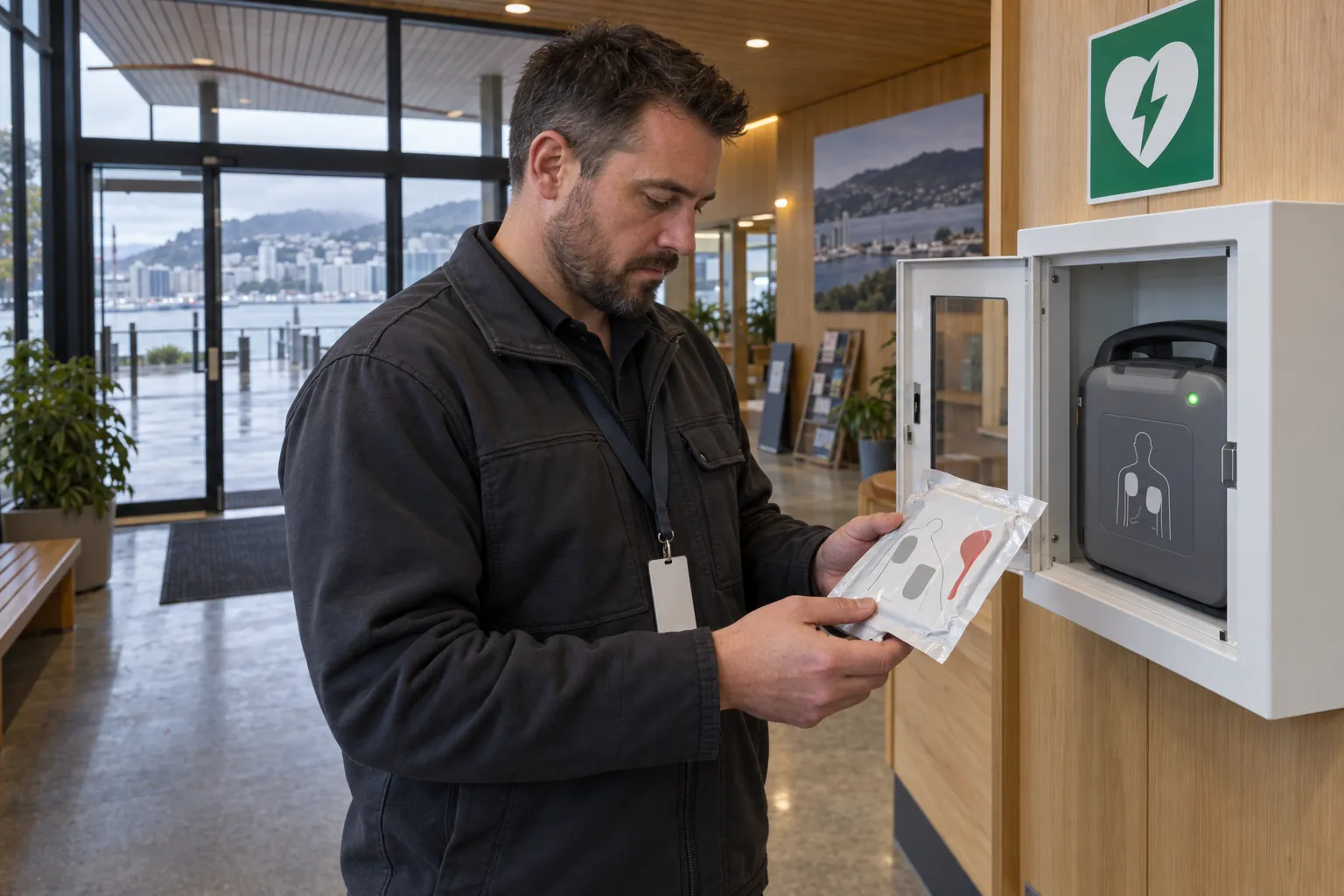
An automated external defibrillator (AED) on the wall is only useful if it works when someone collapses in cardiac arrest, and the people who find out that it does not are usually the ones trying to use it. New Zealand law does not require a workplace to have one, but once a PCBU has decided to provide an AED, WorkSafe expects it to be signed, reachable and maintained to the manufacturer's instructions. This guide covers what an AED check involves, how often to do it, who looks after the pads and battery, and how to keep a record that shows the unit was actually looked at.
01
What the law and guidance say about AEDs at work in New Zealand
No New Zealand statute says a workplace must have an AED. The duty that brings one into the picture is the general first aid duty in regulation 13 of the Health and Safety at Work (General Risk and Workplace Management) Regulations 2016, made under the Health and Safety at Work Act 2015 (HSWA). The PCBU, the person conducting a business or undertaking, must provide adequate first aid equipment, access to facilities for giving first aid, and access to an adequate number of trained first aiders.
WorkSafe's Interpretive guidelines: General risk and workplace management – Part 1 raise the AED directly. Section 7.2 asks whether equipment beyond first aid kits will be needed, "for example, should the workplace have an automatic external defibrillator as there is a risk of electrocution or large numbers of members of the public at the workplace?"
WorkSafe's quick guide First aid at work goes further. Under the heading "Automated external defibrillators" it says that CPR can prolong life "but an automated external defibrillator (AED) is the only way to restore the heart's normal rhythm", and suggests considering an AED if there:
- is a risk to your workers of being electrocuted;
- is likely to be a delay in an ambulance arriving at your workplace, for example because of distance; or
- are large numbers of members of the public at your workplace.
The same guide then sets out the expectation that matters for maintenance: "AEDs can be used by trained or untrained people. They should be located in an area that is clearly visible, accessible and not exposed to extreme temperatures. They should be clearly signed and be maintained according to the manufacturer's instructions."
Whether to have an AED is the PCBU's judgement, made with its workers as part of its first aid assessment. Once it has one, the AED is part of its first aid equipment, and one with a flat battery or expired pads cannot be relied on.
02
What an AED check covers
Most modern AEDs test themselves. Hato Hone St John's Defibrillator FAQs say its units "do a daily diagnostic self-check which ensures it is ready to use", and that the unit "will flash red and bleep multiple times when something needs replacing like the pads and batteries". A self-test cannot see a blocked cabinet, used pads or a missing face shield. St John's own AED Maintenance Checklist (March 2024) puts it plainly: "While most Defibrillators perform routine self-testing, it is critical to visually inspect your unit regularly."
That checklist lists five items to inspect, the first two under condition and the rest under components, with a column for each month's date of inspection:
- Status ready indicator shows the unit is ready.
- Battery is working and not expired.
- The unit is free of cracks, foreign substances, or other signs of damage.
- Pads, the electrodes that go on the patient's chest, are sealed, unused and not expired.
- Supporting materials are sealed and unused within expiration: face shield, scissors, gloves, razor.
At the top of the sheet it asks you to record the AED's location, make and model, serial number, the date the battery was installed and the date the pads expire. Keep those with the unit's record, not in someone's inbox.
A practical check also covers what WorkSafe's guide mentions around the unit, because an AED nobody can find or reach is no better than a broken one:
- the AED is in its listed place, and the sign pointing to it can be seen from the corridor or foyer;
- nothing blocks the cabinet or the route to it, and it opens without a key or code that only one person knows;
- the cabinet is clean, dry and closed, and any cabinet alarm, light or heater works;
- the spot is not exposed to extreme temperatures, such as direct afternoon sun through glass or an unheated outdoor enclosure in a Central Otago winter;
- child pads or a child key are present where the unit has them and the site has children, such as a school, early learning centre or pool;
- the unit's own instructions or quick guide are with it.
Always read the manufacturer's manual for the model on your wall. WorkSafe's guide says to maintain the AED according to the manufacturer's instructions, and St John's checklist says each organisation should check with the manufacturer for additional instructions. Where the manual and a general checklist differ, the manual wins.
03
How often to check an AED, and when to replace pads and batteries
No regulation sets an interval for AED checks in New Zealand. The guidance gives three layers, and sites that keep their units ready tend to use all of them:
- Every time you walk past. St John's checklist recommends "checking the First Aid status ready button every time you walk past the Defibrillator." It takes a second.
- A regular visual inspection. St John's checklist is laid out with a column for each month's date of inspection, and says maintenance "should be regular to ensure it's ready to be used in an emergency." A monthly check against the five components, done by a named person, is a sensible routine for most workplaces.
- Replacement of pads and batteries. St John's page Register your defibrillator / AED says pads and batteries "will need to be replaced every two to four years depending on the model (or immediately, if used in an emergency)." Its FAQs page gives three to four years, so go by the dates on your own unit. Pads and batteries carry an expiry date; the monthly check is where someone reads it.
Plan replacements before they are due. Put the expiry dates in the maintenance plan with enough warning to order, rather than waiting for the unit to warn you. St John offers email reminders to owners who register their unit (see below), which helps, but a reminder is only useful if it reaches someone who still looks after the AED.
After any use, the pads are replaced. St John's FAQs are unambiguous: "If the defibrillator has been used, you will always need to replace the pads." Depending on the model, the battery or a combined pad-and-battery cartridge may need replacing too; its checklist says you will need to replace the pads or the pads and battery cartridge, "dependant on which defibrillator model you have." Replace the face shield, gloves and razor from the kit at the same time, and put the unit back in service only when the status indicator shows ready.
The unit itself has a working life. St John's FAQs say maintenance of the defibrillator "will be required for at least 8 years before it will need to be replaced." Record the purchase date with the serial number so replacement can be budgeted.
04
Who looks after the AED, and how people find it
St John's registration page says: "Someone will need to be responsible for monitoring and maintaining the defibrillator." In practice the AED belongs on the same round as the first aid kit checks, looked after by the same nominated person or a first aider, with a named deputy for leave. That may be a school's caretaker, an office building's facilities manager, or the body corporate's building manager for a unit in an apartment lobby.
Shared buildings need an agreement. WorkSafe's first aid guide says that when the work of two or more PCBUs overlaps, "they must communicate, consult, cooperate and coordinate activities to meet their health and safety responsibilities to workers and others", and gives the example of businesses in a shopping centre sharing first aiders and a first aid room. An AED in a shared foyer is the classic overlap: the owner bought it, the cleaners pass it nightly, security holds the keys after hours, and each tenant assumes someone else checks it. Write down whose AED it is, who checks it, who replaces parts and who is told when it is used. See overlapping duties and building manager duties.
Register it. St John's page explains that registering a defibrillator gives it permission to direct a member of the public to the unit when it is the closest available, and that the information "will only be used when someone nearby calls 111." The same page points to AED Locations, an independent map of defibrillators around New Zealand supported by, among others, Wellington Free Ambulance, the Heart Foundation, St John and the New Zealand Resuscitation Council. AED Locations is candid that a listing does not guarantee the AED is physically there, available 24/7 or in full working order, so keep the registration accurate when the unit moves or the building's hours change.
Sign it. WorkSafe's guide says AEDs should be clearly signed. The Australian and New Zealand Committee on Resuscitation (ANZCOR), whose guidelines the New Zealand Resuscitation Council links to, suggests in Guideline 7: Automated External Defibrillation in Basic Life Support that AED signage is consistent with international recommendations.
Put it on the emergency plan. Regulation 14 requires an emergency plan for every workplace, and WorkSafe's Part 1 guidelines list medical treatment and assistance procedures among what it covers. WorkSafe's first aid guide notes the plan can include a floor plan showing where emergency and first aid equipment is, and the Part 1 guidelines say the plan should be tested at least yearly: a good moment to walk the route to the AED from the far end of each floor.
Tell people. ANZCOR's Guideline 7 says "AED use should not be restricted to trained personnel", but nobody uses an AED they do not know exists. Include its location at induction, including for contractors' night and weekend staff.

05
When the check finds a problem, or the AED has been used
St John's checklist includes a short troubleshooting table:
- Signs of foreign substances on the unit: clean it according to the manual.
- Signs of damage: contact the manufacturer.
- A chirping noise: follow the troubleshooting guidelines, and check the battery and pads.
- The status indicator shows the unit is not ready: follow the troubleshooting guidelines, and contact the manufacturer if that does not resolve it.
- Battery or pads past their date: replace the item.
The person who hears a chirp on a Friday evening is often a cleaner or a security officer, not the nominated person. Decide in advance who they tell, how, and what happens if that person is away.
Whether the AED is usable while a fault is open is for the manual or the supplier to answer. If it is out of service, say so on the cabinet and make sure the next nearest AED is known.
After a real use. Once the ambulance has gone, treat the unit as out of service until it has been restocked and shows ready. Replace the parts as above, clean the unit as the manual says, and record what was used and when it was replaced. The event itself belongs in your incident records, and an injury or illness at work may need to be notified to WorkSafe; see incident reporting and notifiable events.
Review after use. WorkSafe's first aid guide says: "If an incident has occurred requiring first aid, evaluate the effectiveness of the first aid provided and make changes if necessary." For an AED: how long did it take to fetch, did the cabinet open, and was the unit ready?
06
Where the AED check record fails, and what SiteClara does about it
The usual record is a tag on the cabinet or a sheet in a folder at reception: a column of months and initials. It shows that someone wrote a date, not that the status light was green, that the pads were sealed and in date, or that the face shield was there. When the unit starts chirping, the cleaner who hears it at 9 pm has no obvious way to tell the person who looks after it.
A useful AED record shows which unit, when, who looked, what they found against the five components, and what happened to anything that failed, through to the replacement pads being fitted. That is what a body corporate committee, a school board or a health and safety representative will ask for.
SiteClara records the check at the unit. A printed QR poster, with an optional NFC tag behind it, sits beside each AED. The person on the round scans or taps on their own phone, with no app to install, sees the checks due there, and marks each one done or says what stopped them. The time and the named person are recorded as it happens, with a photo when one is asked for, such as the status indicator or the expiry date on the pads. A fault, a chirp or a missing part can be reported from the same scan, and it goes onto the team's list of jobs until someone closes it, so the report does not stop with whoever happened to be at reception.
A supervisor sees which checks were due, done and missed, records why one was missed, and approves a daily report that goes to nominated managers or client contacts the next morning.
07
Questions people ask
What maintenance does an AED require?
A regular visual inspection, and replacement of parts before they expire. Hato Hone St John's AED Maintenance Checklist says that while most defibrillators perform routine self-testing, "it is critical to visually inspect your unit regularly": confirm the status indicator shows ready, the battery is working and not expired, the unit is free of damage, the pads are sealed, unused and not expired, and the face shield, scissors, gloves and razor are sealed and in date. WorkSafe's quick guide First aid at work says AEDs should be maintained according to the manufacturer's instructions.
Do AEDs need servicing?
No New Zealand regulation sets a service interval; WorkSafe's First aid at work says to maintain the device according to the manufacturer's instructions, so any servicing the manual specifies applies. Hato Hone St John's Defibrillator FAQs say its units do a daily diagnostic self-check and that maintenance "will be required for at least 8 years before it will need to be replaced", and its page Register your defibrillator / AED says pads and batteries need replacing every two to four years depending on the model, or immediately after use in an emergency.
What should an AED maintenance checklist include?
Hato Hone St John's one-page AED Maintenance Checklist (March 2024) records the AED's location, make and model, serial number, the date the battery was installed and the date the pads expire, then gives a column for each month's inspection against five items: the status indicator, the battery, the unit's condition, the pads and the supporting materials. It also has a troubleshooting table, and says each organisation should check with the manufacturer for additional instructions.
08
Further reading, and an AED checklist to take away
WorkSafe's quick guide First aid at work is the main workplace reference, and its Interpretive guidelines: General risk and workplace management – Part 1 explain regulations 13 and 14. Hato Hone St John's AED Maintenance Checklist is a one-page form worth keeping with each unit. Above all, read the manual for the model you own.
Before you sign off your AED arrangements, check that:
- each unit's location, make and model, serial number, battery date and pad expiry are written down;
- a named person and a deputy check each unit at least monthly against the manufacturer's instructions;
- anyone passing knows to glance at the status indicator and how to report a fault;
- pad and battery replacements are planned before they expire, and pads are replaced after every use;
- each unit is signed, unobstructed, reachable during the hours people are in the building, and out of extreme heat and cold;
- each unit is registered, and the registration is updated when the unit moves or the building's hours change;
- the AED is on the emergency plan's floor plan and in induction, including for contractors;
- in a shared building, the owner, body corporate and tenants have agreed in writing whose unit is whose and who checks it.
Sources
Every document this guide quotes or links to, in the order it first cites them.
- Interpretive guidelines: General risk and workplace management – Part 1 worksafe.govt.nz
- First aid at work worksafe.govt.nz
- Defibrillator FAQs stjohn.org.nz
- AED Maintenance Checklist stjohn.org.nz
- Register your defibrillator / AED stjohn.org.nz
- AED Locations aedlocations.co.nz
- Guideline 7: Automated External Defibrillation in Basic Life Support anzcor.org
Related guides
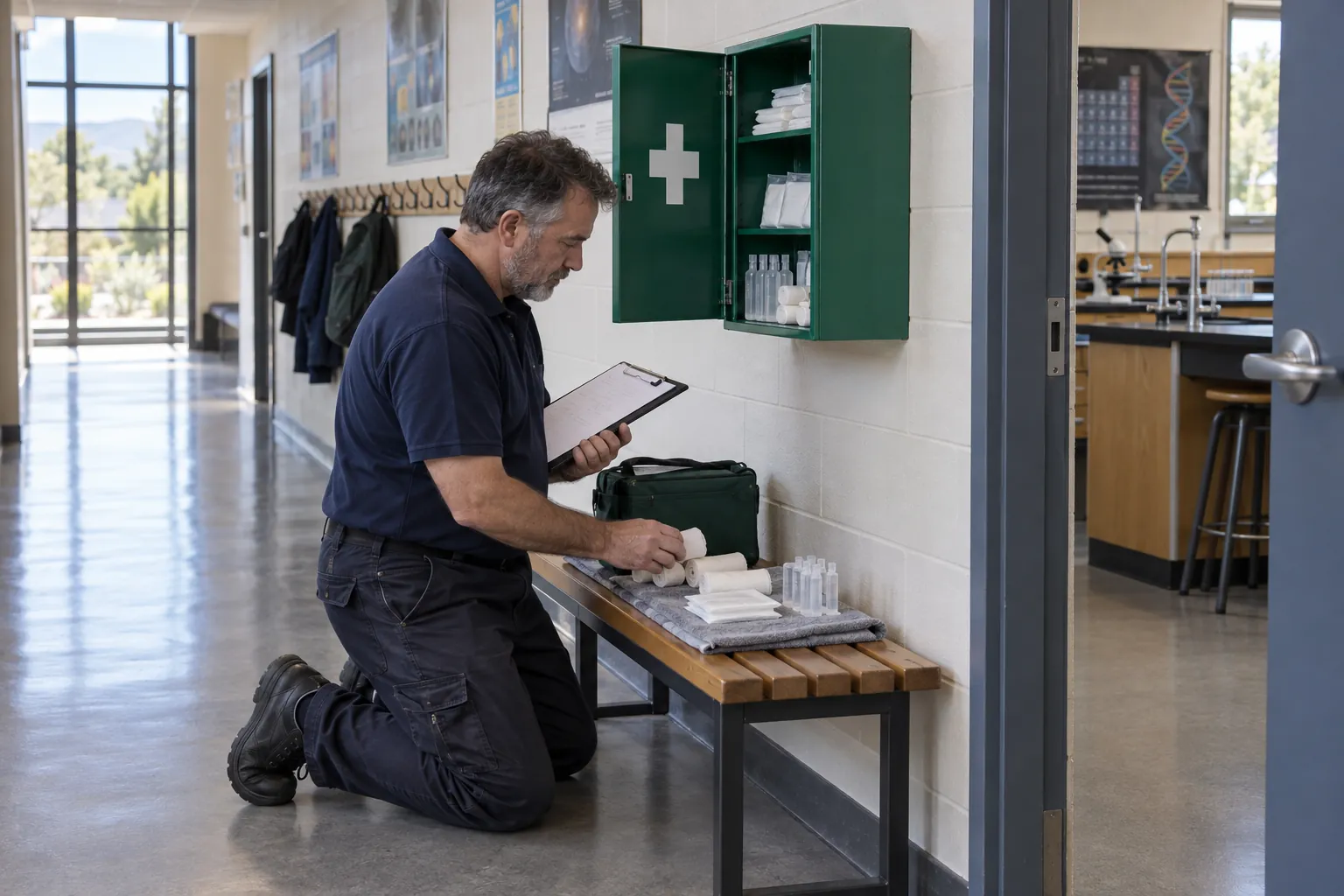 Premises and facilities managementFirst aid kit checklist: what goes in, where it goes, and how to keep it checkedA first aid kit checklist for New Zealand workplaces: what WorkSafe suggests a kit holds, where kits go, how often to check them, and a record that stays honest.
 Premises and facilities managementOverlapping duties: sharing health and safety when several PCBUs work in one buildingOverlapping duties under HSWA 2015: when PCBUs share a building or a contracting chain, how to consult, co-operate and co-ordinate, and how to show it works.
 Premises and facilities managementBuilding manager duties: the law, the daily work and the record, in New ZealandWhat a building manager does in New Zealand: HSWA duties, the compliance schedule and BWoF, unit title buildings, daily work and the records that show it was done.
 Premises and facilities managementHazard register: what HSWA expects, and how to keep one that is usedWhat a hazard register is under New Zealand's HSWA, what goes in it, how to assess and control risks, when to review it, and what changes on 1 April 2027.