Premises and facilities management
AED checks: keeping a workplace defibrillator ready, and proving it
An AED check is a short, regular inspection of an automated external defibrillator (AED) – its status indicator, pads, battery and cabinet – to confirm it is ready to analyse a person's heart rhythm and deliver a shock the moment someone collapses in cardiac arrest.
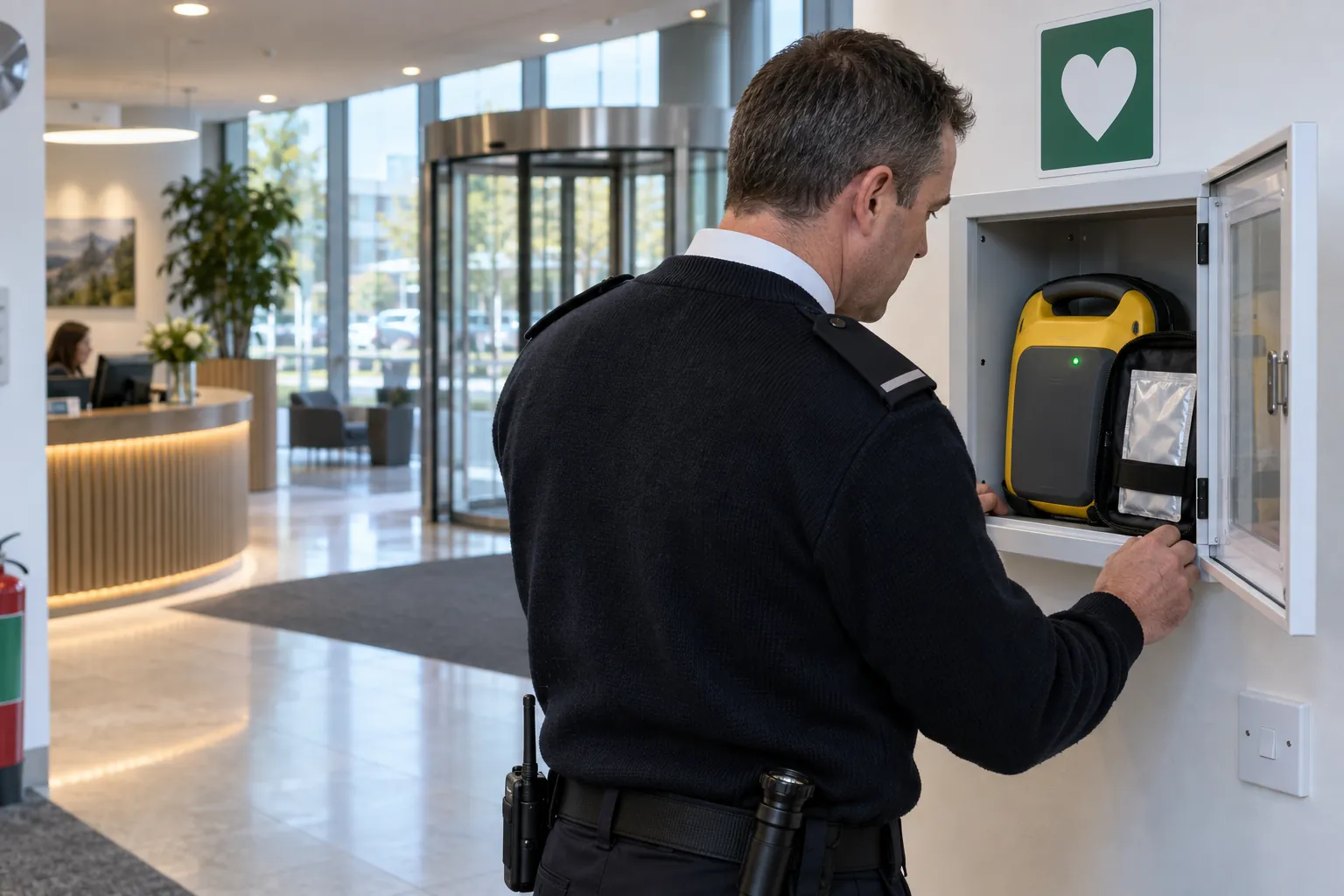
A unit on the wall is only useful if it works on the one day it is needed. In Ireland the Health and Safety Authority calls a regular checklist programme essential for any AED in a workplace, and the Health Products Regulatory Authority expects a maintenance plan and a log of every status check. This guide covers where those expectations come from, what to check, how often, who should do it, and what a record that can be trusted looks like.
01
Where the duty to check an AED comes from
No Irish statute names the defibrillator. Chapter 2 of Part 7 of the Safety, Health and Welfare at Work (General Application) Regulations 2007 (S.I. No. 299 of 2007) deals with first aid in general terms. Regulation 165(1)(a) requires every employer to "provide and maintain suitably marked and easily accessible first-aid equipment, as is adequate and appropriate in the circumstances", and regulation 165(1)(d)(i) requires the details of the first-aid arrangements, "including the names of occupational first-aiders and the location of first-aid rooms equipment and facilities", to be included in the safety statement. Where an employer has decided that an AED is part of its first-aid provision, it is first-aid equipment, and the word maintain applies to it as much as to the green box.
Behind the Regulations sits section 11 of the Safety, Health and Welfare at Work Act 2005, which requires every employer's emergency plans to "provide the necessary measures to be taken appropriate to the place of work for first aid" and to ensure that the people designated to carry them out have adequate training and equipment. The safety statement required by section 20 of the Act is where those arrangements are written down.
The detail comes from guidance. Section 1.10 of the Health and Safety Authority's Guidelines on First-Aid at Places of Work says the provision of AEDs "should be considered and promoted in the workplace", and that "ideally, wherever there is an occupational first-aider(s) in a workplace, an AED should be provided". It accepts that an AED may not be practicable in every workplace, not least because of the cost of maintenance and refresher training. Where there is one, the Guidelines are direct: "It is essential that a regular checklist programme is introduced and maintained to ensure that the AED is always ready for use."
An automated external defibrillator is also a medical device, regulated in Ireland by the Health Products Regulatory Authority (HPRA). Its advice, Buying, storing and maintaining automated external defibrillators, says that a defibrillator "must be used and maintained in accordance with the guidance given by the manufacturer", that "a maintenance plan and schedule should be put in place", and that "a record should be kept of the regular maintenance and checks completed as part of the schedule". The Pre-Hospital Emergency Care Council (PHECC) says on its Responders page that "regular documented AED checks are recommended" and offers a sample AED checklist that responder organisations can adapt.
02
What an AED check covers
The HSA names three things a checklist must confirm: that the "ready for service indicator lights are displaying correctly", that "AED pads are present, in-date", and that "the battery holds sufficient charge to operate". The HPRA adds the accessories, the storage conditions and the manual. Put together, a routine check at the unit covers:
- The status indicator. The HPRA explains that the status indicator "is usually a light on the defibrillator and there may also be a voice prompt", and says the maintenance schedule "should include a log to record when the status of the defibrillator is checked". It also warns that turning a defibrillator on and off repeatedly to confirm it works can run the battery down, so the check is a look at the indicator, not a power-up, unless the manual says otherwise.
- The pads. Present, sealed and within the expiry date printed on the packet. The HPRA asks that all accessories are compatible with the model.
- The battery. Within its date or its indicated life, with no low-battery warning.
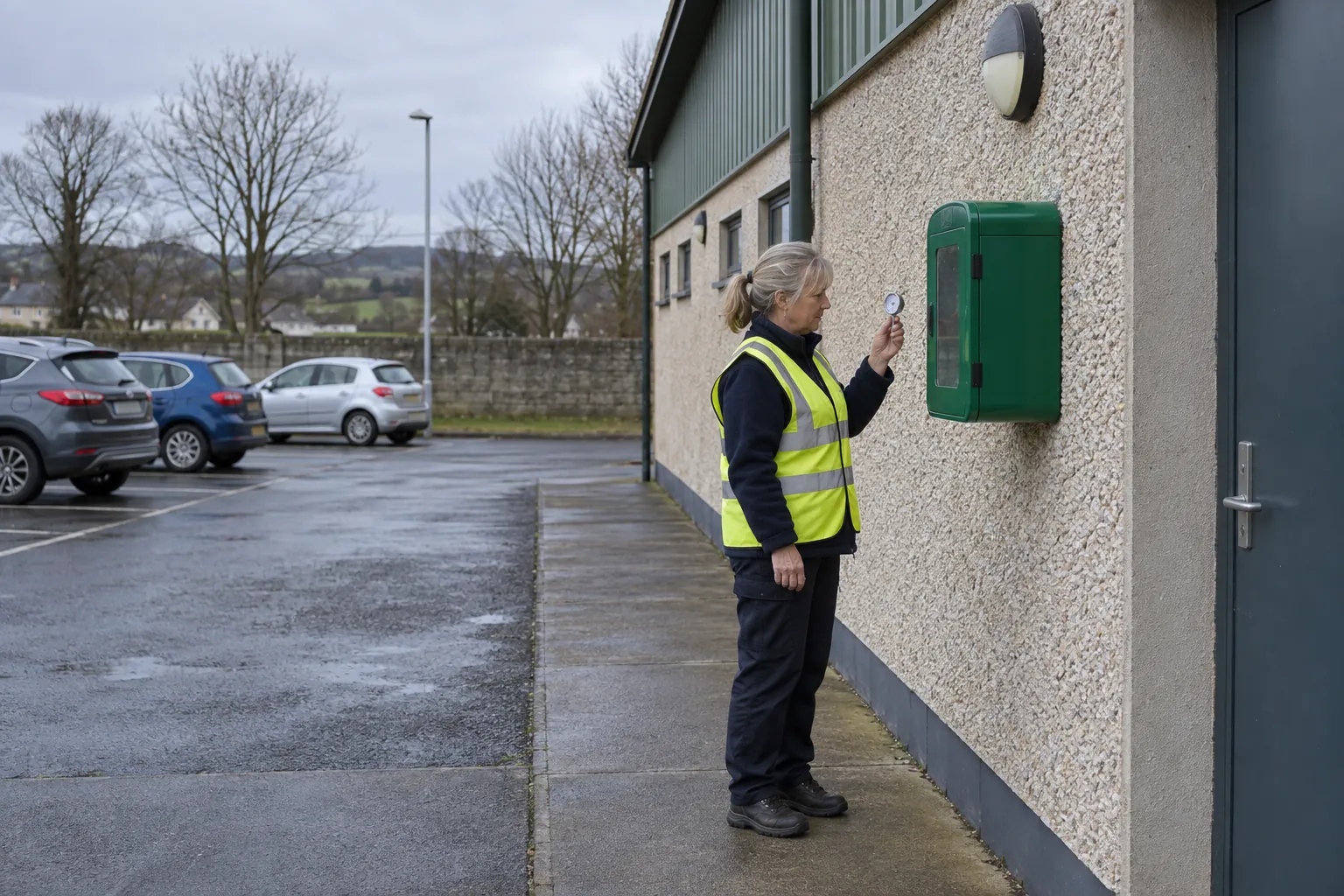
- The cabinet or bracket. Where it should be, unlocked or openable as the HSA expects, clean and undamaged. Outdoors, the HSA says the AED "should be in a heated cabinet", so the check includes the cabinet's heater and power.
- The surroundings. Nothing stacked in front of it, and the sign pointing to it still in place and visible from the corridor or the entrance.
- The kit beside it. Where a small response kit is kept with the unit, such as gloves and scissors, it is complete. The HSA advises that aspirin for suspected cardiac chest pain is stored separately from the first-aid box, or with the AED; if kept there, it is in date.
- The manual and the contacts. The HPRA asks that a copy of the manual is "stored with the defibrillator and be accessible at all times", and that the names and contact details of trained users are displayed near it.
Less often, the check also confirms the environment. The HPRA says to "periodically confirm that the environmental conditions where the AED is located are within the manufacturer's recommendations", and suggests measuring the temperature with a thermometer during colder periods. An unheated porch or loading bay in January may be outside the range the manual allows.
03
How often to check an AED, and what the self-test does
Neither the HSA nor the HPRA sets a frequency: the manual does. In the HPRA's words, "a defibrillator performs self tests at regular intervals to verify it is ready for use": it explains that "some of the tests are automatic and do not require any action from the user, while some tests must be performed by the user", and asks owners to know what is tested, how often, and which steps fall to them. The visual check confirms the unit reports itself fully ready, and notices what a self-test may not catch: a missing or out-of-date pad packet, a blocked cabinet, a fallen sign.
A workable schedule has three layers:
- A routine visual check of the indicator, pads, battery, cabinet and access, on a set day. Where the manual asks for nothing more demanding, weekly is a reasonable starting point for a busy building, and it suits the rhythm of a caretaker's round, a fire warden's walk or a security officer's patrol.
- A fuller monthly check that reads every expiry date, looks over the response kit, confirms the displayed contacts and trained users are current, and, in cold months, reads the thermometer.
- Servicing and replacement as the manufacturer's maintenance schedule requires: pads and batteries replaced before their dates, and any service the manufacturer or supplier specifies. The HPRA says the maintenance plan "must also consider all accessories (pads, battery pack, electrodes etc.)" and identify "their shelf life or whether they are single use only".
Add two checks that are not on a calendar. After every use, the unit is checked and made ready before it goes back on the wall: the manual says which accessories are single use and what must be replaced after a rescue. After any move, the new location is checked for temperature, access and signage, and the details held by the manufacturer or distributor are updated.
Keep a short register for each unit: location, model, serial number, pad and battery expiry, next service. It turns the monthly check into a comparison, and shows when to order replacements, well ahead of their dates.
04
Who is responsible, and who does the check
The employer is responsible, through the safety statement. The HSA says that where there are trained occupational first-aiders, first-aid equipment "including the AED should be kept under their control", and that where no occupational first-aider is required, the first-aid boxes and kits should be the responsibility of a named role in the safety statement. It makes sense to name the same role for the AED. The HPRA asks that "someone familiar with the operation and storage of the defibrillator is given the task of keeping the plan up to date".
The routine visual check often falls to whoever is already on a round:
- The caretaker or site manager in a school, a community centre or an apartment block.
- The security officer on a patrol of a business park, a shopping centre or a campus.
- The fire warden or first-aider in an office, on the walk that checks the first-aid box.
- The facilities team or the managing agent's staff where the unit belongs to the landlord or the owners' management company rather than any one tenant.
Shared buildings need the owner settled in writing. The HSA notes that employers at the same location, such as shopping centres or small business locations, "may find it practical to co-operate on shared equipment, training, and assistance". Where an OMC or a landlord owns the AED in the common area, the contract with the managing agent, the facilities provider or the security company should say who checks it, how often, who orders pads and batteries, and who is told when something is wrong. A tenant who relies on the landlord's AED should record that in its own safety statement.
Training runs alongside. The HSA encourages training for employees who are not occupational first-aiders in the use of AEDs, known as Cardiac First Responder training, and notes that PHECC First Aid Response certification for occupational first-aiders lasts two years. Whoever does the routine check need not be a trained responder, but must know what a correct indicator looks like on that model, and what to do when it is wrong.
05
What a good AED check record shows, and what to do when a check fails
The HPRA asks for "a log to record when the status of the defibrillator is checked" and says to "ensure that each status check of the defibrillator is recorded in the log". PHECC recommends documented checks. A record worth having shows, for each check:
- which unit, identified by its location and serial number, not just "the defib";
- the date and time the check was actually done, and the name of the person who did it;
- what was checked: the indicator, the pads and their expiry, the battery, the cabinet and access;
- anything wrong, what was done about it, and when the unit was back in service;
- services, replacements and uses, with the new pad and battery dates.
The common weakness is a record filled in away from the unit. A sheet kept in the office can be completed without anyone walking to the cabinet, and a column of identical ticks in the same pen, one per Monday, says more about the sheet than the AED. A record made at the unit, at the time, by a named person, is worth more.
A failed check needs an owner and a clock. When the indicator shows a fault, the HPRA says to check the user manual immediately, take the appropriate steps to identify the cause, and "contact your local distributor or the manufacturer as soon as possible". Until the unit is back in service, tell the first-aiders and security, put a notice on the cabinet, and point people to the nearest public-access AED, whose location the HSA suggests considering in any case.
Some problems go further than the site. The HPRA asks users to report to the manufacturer and to the HPRA any unexpected problem or malfunction that may affect a patient, giving as an example a status indicator that fails to show that the device is not operating. It also publishes safety notices; in October 2024, HPRA warns of unauthorised labelling on some AED pads described pads supplied in Ireland with labels showing an incorrect expiry date. That is a reason to register the unit with the manufacturer, as the HPRA advises, so that notices reach the owner, and to keep the owner's contact details current when the unit moves. Where an AED is provided, the HSA also suggests considering registering its location with the National Ambulance Service.
06
Where the record fails, and what SiteClara does about it
AED records fail in familiar ways. The sheet in the cabinet is initialled weeks ahead. The first-aider who owned it left, and the task never moved. The security company thinks the landlord checks the unit in the atrium; the landlord thinks the security company does. Someone mentions the warning light to whoever is at reception, and it is written nowhere. Nobody knows until the cabinet is opened in an emergency.
SiteClara records the routine check at the unit itself. A printed QR poster, with an NFC tag behind it where staff should tap, goes beside each AED: the reception, the sports hall, the car park cabinet, the plant room door. The person on the round scans or taps with their own phone, with no app to install, and sees the check due there. They mark it done, or say what stopped them, with a photo of the indicator or the pad packet when one is asked for, and the time and the named person are recorded as it happens. A fault, a missing pad or a blocked cabinet is reported on the spot and stays on the team's list of open jobs until someone closes it.
The supervisor sees which units are due, done and missed, and gives the reason for a missed check from their company's own list. Each day they review the checks and photos and approve a report that goes to nominated managers or client contacts the next morning, so an OMC director, a facilities manager or a school principal sees what was completed and what is still open without asking.
07
Questions people ask
What is an AED check?
A routine inspection that confirms a defibrillator is ready for use. The HPRA's Buying, storing and maintaining automated external defibrillators describes an AED as a medical device that "analyses a person's heart rhythm and, when needed, delivers a shock" to someone in sudden cardiac arrest, and asks for "a log to record when the status of the defibrillator is checked". Section 1.10 of the HSA's Guidelines on First-Aid at Places of Work says what the check must confirm: that "ready for service indicator lights are displaying correctly, AED pads are present, in-date and the battery holds sufficient charge to operate".
How often should an AED be checked?
No Irish rule sets a frequency. Section 1.10 of the HSA's Guidelines on First-Aid at Places of Work calls for "a regular checklist programme" and says AED equipment and accessories "must be maintained as per manufacturer's instructions". The HPRA's Buying, storing and maintaining automated external defibrillators notes that a defibrillator "performs self tests at regular intervals to verify it is ready for use", and that it "must be used and maintained in accordance with the guidance given by the manufacturer". Follow the manual for your model; where it asks for nothing more, a weekly visual check and a fuller monthly one is a sensible routine.
08
Further reading, and an AED checklist to take away
The law is regulation 165 of the Safety, Health and Welfare at Work (General Application) Regulations 2007, read with section 11 and section 20 of the Safety, Health and Welfare at Work Act 2005. Section 1.10 of the HSA's Guidelines on First-Aid at Places of Work covers AEDs in workplaces. The HPRA's Buying, storing and maintaining automated external defibrillators is the fullest official account of storage, self-tests, maintenance plans and logs. Above all, read the manual for your own model.
For each AED in your building, check that:
- it is in the safety statement, with a named person or role responsible for it and for its maintenance plan;
- it is signposted, unobstructed and not locked away, and outdoors it is in a heated cabinet;
- the status indicator shows ready, without powering the unit on and off to find out;
- the pads are present, sealed, compatible with the model and in date;
- the battery is in date with no warning showing, and the next replacement dates are written down;
- the manual and the names of trained users are with the unit, and the temperature where it is kept is within the manufacturer's range;
- the unit is registered with the manufacturer, and registering its location with the National Ambulance Service has been considered;
- every check is recorded as it is done, by whom and when, and every fault is reported, followed up and closed.
Sources
Every document this guide quotes or links to, in the order it first cites them.
- Safety, Health and Welfare at Work (General Application) Regulations 2007 (S.I. No. 299 of 2007) irishstatutebook.ie
- Section 11 of the Safety, Health and Welfare at Work Act 2005 irishstatutebook.ie
- Section 20 of the Act irishstatutebook.ie
- Guidelines on First-Aid at Places of Work hsa.ie
- Buying, storing and maintaining automated external defibrillators hpra.ie
- Responders page phecc.ie
- HPRA warns of unauthorised labelling on some AED pads hpra.ie
- Guidelines on First-Aid at Places of Work hsa.ie
Related guides
 Premises and facilities managementFirst aid kit checklist: what the HSA recommends, and how to keep the box readyWhat goes in a workplace first aid box in Ireland, from the HSA's recommended contents by headcount, and how to check, restock and record it under the 2007 rules.
 Premises and facilities managementSafety statement: what the 2005 Act requires, and how to show it is followedWhat a safety statement must contain under section 20 of the Safety, Health and Welfare at Work Act 2005, who needs one, when to review it and how to show it works.
 Premises and facilities managementHealth and safety inspection checklist: what to walk, what to record, and what the HSA looks forA workplace health and safety inspection in Ireland: the 2005 Act and 2007 Regulations, what to walk, how often, recording actions, and what an HSA inspector asks.
 Premises and facilities managementCaretaker duties in Ireland: what the job involves, and how to show it was doneCaretaker duties in Irish schools, parish halls, offices and apartment developments: the law behind the job, the daily and weekly checks, lone working and records.