Fire and water checks
Dry riser testing: the inspection, the annual test and the record
Dry riser testing is a visual inspection of a building's dry fire main every six months and a pressurised test every 12 months, the routine set out in government fire safety guidance, which points to the code of practice BS 9990 for the detail.
Also written for Ireland · United States · Australia
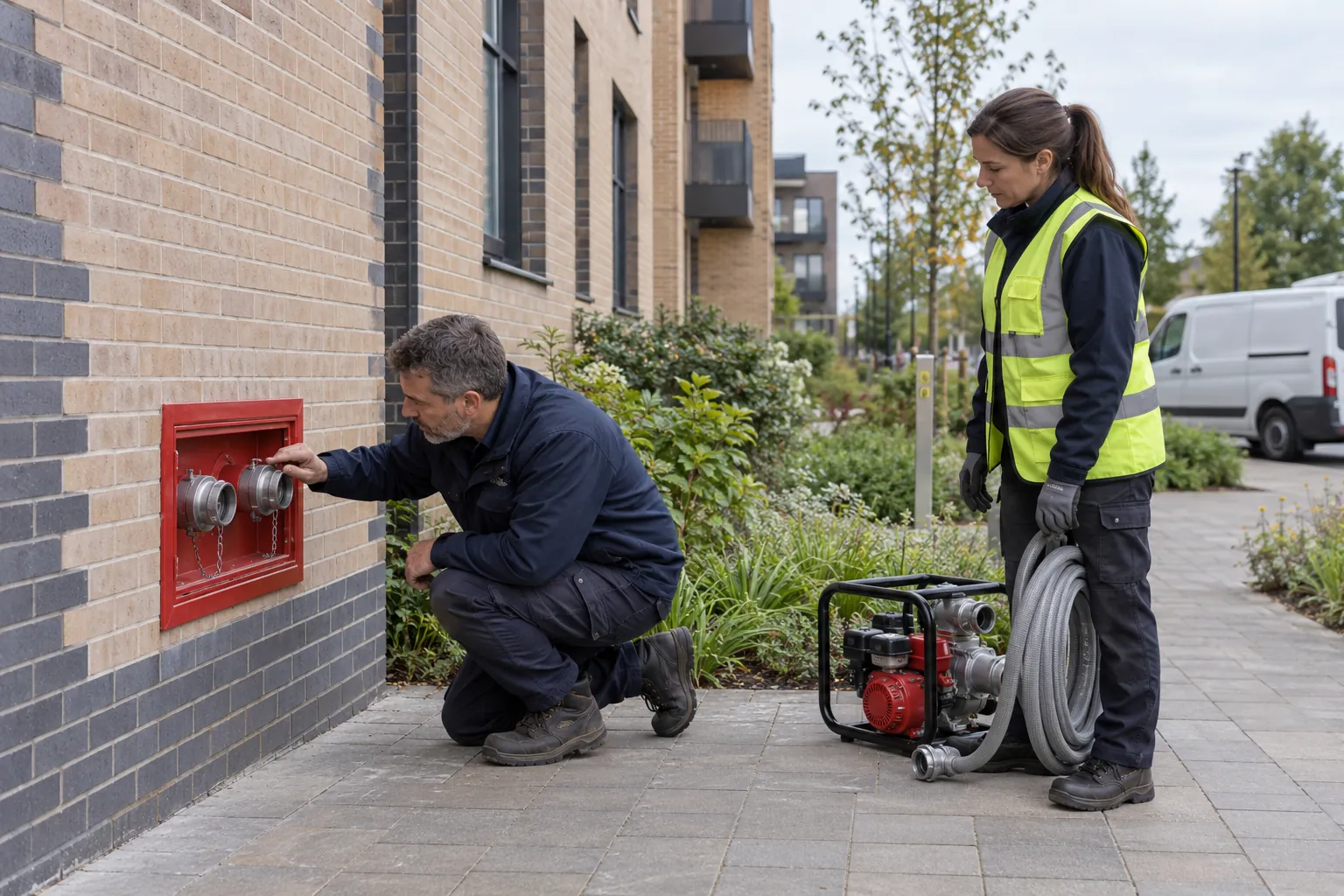
The law does not name those intervals: it requires the responsible person to keep equipment provided for firefighters in efficient working order and good repair. In high-rise residential buildings in England, the inlets and outlets of rising mains must also be checked every month. This guide covers what a dry riser is, what each check looks at, who does it, and what the record should show.
01
What a dry riser is, and the duty to keep it working
A dry riser, which building guidance calls a dry fire main, is a fixed pipe installed so that the fire and rescue service can connect hoses for water on the upper floors of a building. Approved Document B (volume 2, paragraph 16.1) describes two types:
- A dry fire main is normally kept empty and is supplied through a hose from a fire and rescue service pumping appliance, connected to an inlet at ground level.
- A wet fire main, or wet riser, is kept full of water and supplied by pumps from tanks in the building, with a facility to replenish it from a pumping appliance in an emergency.
Approved Document B is the guidance for new building work in England. Under it, a building with a storey more than 18m above the fire and rescue service vehicle access level should have one or more firefighting shafts (paragraph 17.2), and every firefighting shaft should have a fire main with outlet connections and valves at every storey (paragraph 17.10). Above 50m, the mains should be wet (paragraph 16.6). Fire mains are also fitted to lower buildings where a fire engine cannot get close enough (paragraph 16.3). For blocks of flats, volume 1 gives the same guidance in sections 14 and 15.
Once a dry riser is installed, the duty to maintain it is a legal one. In England and Wales, article 38 of the Regulatory Reform (Fire Safety) Order 2005 requires the responsible person, where necessary to safeguard firefighters in the event of a fire, to ensure that facilities, equipment and devices provided for the use by or protection of firefighters are "subject to a suitable system of maintenance and are maintained in an efficient state, in efficient working order and in good repair". Where the premises are part of a larger building, the responsible person may make arrangements with the other occupiers to meet that duty, and they must co-operate.
Scotland has the same duty in regulation 23 of the Fire Safety (Scotland) Regulations 2006, made under the Fire (Scotland) Act 2005, and extends it to the common areas of private dwellings in regulation 24. Northern Ireland has it in regulation 23 of the Fire Safety Regulations (Northern Ireland) 2010. None of these names an inspection interval or a standard.
The interval comes from the British Standard BS 9990:2015, Non-automatic fire-fighting systems in buildings. Code of practice, which covers the design, installation, testing and maintenance of wet and dry fire-fighting mains. It replaced BS 9990:2006, and BSI lists the 2015 edition as current and under review, so ask your contractor which edition they test to.
02
The parts of a dry riser, and what an inspection looks at
A dry riser has three parts that matter to anyone checking it:
- The inlet, on the face of the building at fire service access level. Approved Document B (paragraph 15.4) says a pumping appliance should be able to get within 18m of it and that it should be visible from where the appliance parks.
- The main itself, the pipe running up through the building, in a firefighting shaft or a protected stair.
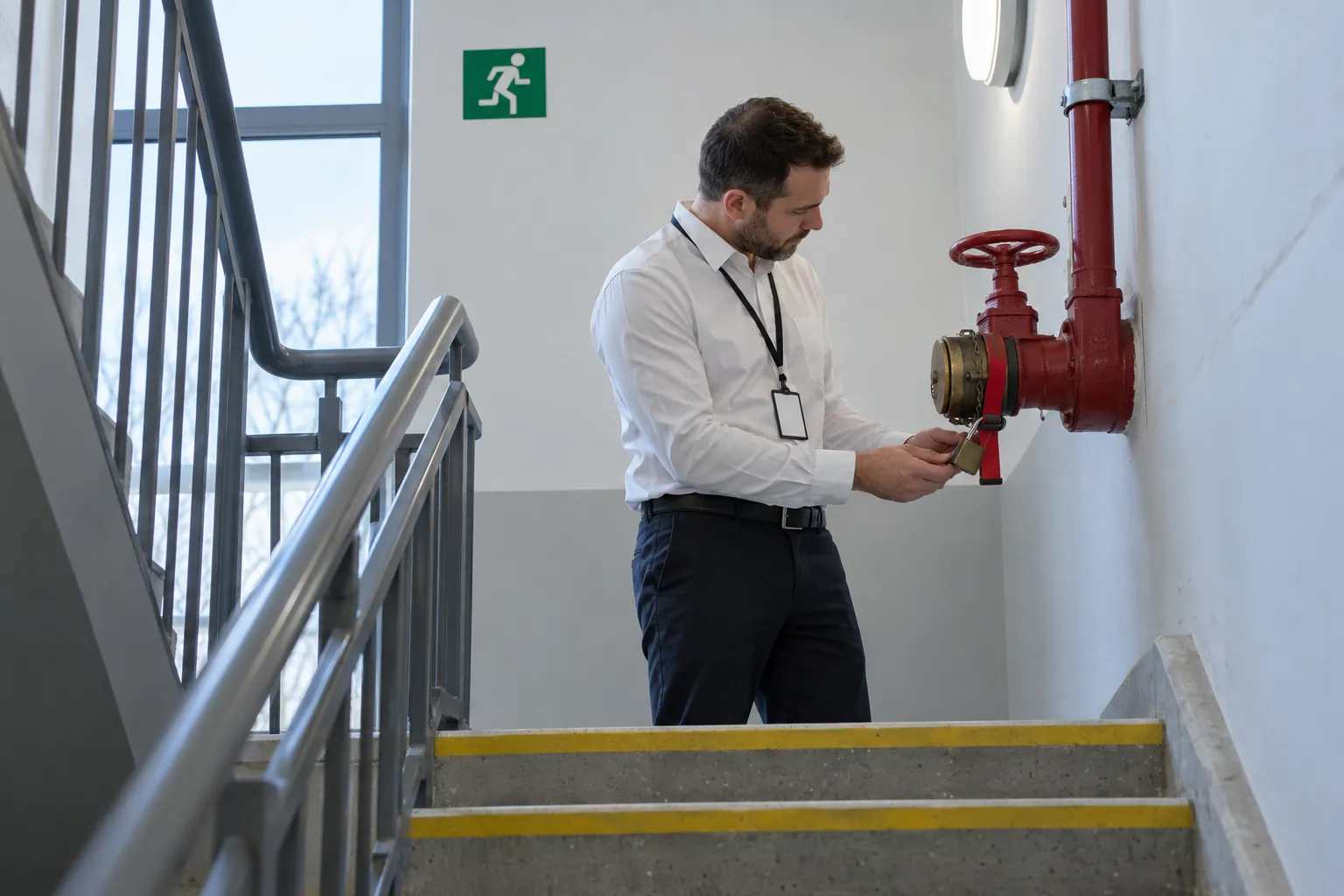
- The outlets, or landing valves, where crews connect their hoses: in a building with a firefighting shaft they are in the protected stairway or protected lobby (paragraph 16.4), at every storey. Landing valves are usually secured with a strap and padlock.
The government's guide Fire safety in purpose-built blocks of flats (paragraph 81.24) describes the inspection as largely simple checks to confirm that the outlets are not damaged and that the padlocks and straps on the landing valves are still in place. The Check your fire safety responsibilities guidance for high-rise flats says that a visual check is normally sufficient for the inlet and the landing valves of rising mains, to make sure they are "undamaged and have not been subject to interference".
Drawing on that guidance, a visual inspection of a dry riser system goes floor by floor and looks at:
- access to the inlet: nothing parked, stored or built in front of it, and the route for a fire engine clear;
- the inlet and its connections: undamaged, and showing no sign of interference;
- each landing valve, floor by floor: present, undamaged, with its strap and padlock in place;
- the space around each outlet: not blocked by stored furniture, bins or building materials;
- anything that looks wrong, such as a missing cap, a damaged valve or a cabinet forced open, recorded and reported the same day.
The same guide for flats lists blocking access to a fire main inlet among the problems that occur during building works, and suggests telling residents to keep fire main inlets and outlets clear and not to block access when parking. Those are the faults a routine inspection is most likely to find.
The annual test is different in kind. The flats guide says testing involves pressurising the main and so will normally need a specialist contractor. The guide points to BS 9990 for further guidance on testing and maintenance, so ask the contractor for a report of what was tested and found, including any leaks and the repairs needed.
03
How often a dry riser is inspected and tested
Every six months, an inspection; every 12 months, a test. That is the routine in paragraphs 81.24 and 81.25 of the government's guide Fire safety in purpose-built blocks of flats, which says that fire mains need to be inspected every six months and tested every 12 months, and refers to BS 9990 for further guidance. GOV.UK notes that the guide was written in 2011 and should be viewed as no longer comprehensive, and it cites the 2006 edition of the standard, so ask your contractor what interval the current edition sets for your system.
Every month, in high-rise residential buildings in England. Since 23 January 2023, regulation 7 of the Fire Safety (England) Regulations 2022 has required the responsible person for a high-rise residential building to carry out monthly routine checks of firefighting lifts, evacuation lifts and essential fire-fighting equipment. A high-rise residential building is one containing two or more sets of domestic premises that is at least 18 metres above ground level or has at least seven storeys (regulation 3). Essential fire-fighting equipment includes the key fire-fighting equipment listed in regulation 6(7), which begins with the inlets and outlets of dry-rising and wet-rising mains.
A routine check, in regulation 7, is "a check that any lift or piece of equipment is in efficient working order and in good repair, carried out in accordance with the relevant industry standard or any recommendations made by the manufacturers". The government's fact sheet on regulation 7 says it is not the intention to require responsible persons to engage specialists for these checks, and that the regulations add to, and do not replace, the existing duties under the Fire Safety Order. So in a high-rise block the monthly visual check sits on top of the six-monthly inspection and the annual test, it does not replace them.
Outside high-rise residential buildings in England, nothing in law sets a monthly riser check. Many site teams still look at the inlet and landing valves on their routine fire safety walk, because a padlock cut off in March is otherwise found at the inspection in June.
04
Who does what, what happens to a fault, and the record
The duty sits with the responsible person, usually the employer or whoever controls the premises. The work divides into three parts:
- The routine visual check, of the inlet and the landing valves, can be done by a site manager, caretaker, concierge or security officer who has been shown what to look for. The flats guide suggests the six-monthly inspection could readily be part of formal fire safety inspections or fire risk assessment reviews.
- The annual pressure test, and any repair to valves, inlets or pipework, is a job for a specialist fire contractor working to BS 9990.
- The fire risk assessment should confirm that the riser is maintained.
A fault is put right, not just noted. In a high-rise residential building in England, regulation 7 requires the responsible person to take steps to rectify a fault found on a monthly check. If it cannot be put right within 24 hours of being found, they must report it to the local fire and rescue authority by electronic means as soon as reasonably practicable, and report again when it has been fixed. Fire and rescue services publish their own way to do this; Royal Berkshire Fire and Rescue Service, for example, explains on its page on lifts and essential fire-fighting equipment that it uses an online fault form and gives a reference number to quote when the repair is done.
Records. Regulation 7 also requires the monthly checks to be recorded and the records made accessible to the residents of the building; the fact sheet gives a notice board or a residents' association as examples. In any building, keep the riser inspections and the contractor's test reports with the other fire safety records, in the fire safety log book or wherever the building keeps them. A good record shows:
- the date, and who carried out the check;
- the inlet and each landing valve, floor by floor, rather than a single tick for the riser;
- what was found, including a missing padlock or a blocked inlet;
- what was done about each fault, by whom and when, and any fire service reference number;
- the date of the last annual test and the contractor's report, with any recommendation and when it was dealt with.
In a high-rise residential building in England, the floor plans kept in the secure information box under regulation 6 must also show the inlets and outlets of the dry-rising and wet-rising mains, and the building plan their inlets; the guide to the Fire Safety (England) Regulations 2022 covers those duties.
05
Where the record fails, and what SiteClara does about it
The annual test leaves a contractor's report; the checks in between often leave very little. A dry riser spends years doing nothing, so the inlet ends up behind the bins, a padlock goes missing on the ninth floor, and the inspection becomes one line saying "riser OK" with no floors named. A fault found is mentioned to whoever was passing rather than reported and followed up.
SiteClara puts a printed QR poster at each place a check is due, such as the riser inlet and each riser landing or stair core, with an optional NFC tag behind it. Staff scan the code or tap the tag on their own phone, with no app to install, see the checks due there, and mark each one done or explain what stopped them. The time and the named person are recorded as it happens, with a photo when one is asked for. A problem, such as a missing padlock, a damaged valve or a blocked inlet, is reported there with a photo and goes onto the team's list of jobs until someone closes it.
The supervisor sees what is due, done and missed, and can record why a check was missed; a job that needs the building manager can be escalated to them to answer. Each day the supervisor reviews and approves a report that goes to nominated management or client contacts at 8am the next morning, showing what was reported, completed and still open, and how the scheduled checks went, for example 14 of 14 completed. That gives the responsible person a working record of every landing, kept as the checks happen.
06
Questions people ask
What is the purpose of a dry riser?
A dry riser lets the fire and rescue service get water to the upper floors of a building: crews pump water from a fire engine into the inlet at ground level and connect their hoses to the outlet on the floor where they are working. Approved Document B, volume 2 (paragraph 16.1) says fire mains are installed for the fire and rescue service to connect hoses for water, and that a dry main is normally kept empty, so it has no water supply of its own until a pumping appliance is connected.
What is the difference between a wet riser and a dry riser?
A dry riser is normally kept empty and is supplied through a hose from a fire and rescue service pumping appliance; a wet riser is kept full of water, supplied by pumps from tanks in the building. Approved Document B, volume 2 (paragraph 16.6) says a building with a storey more than 50m above fire service vehicle access level should have wet fire mains, and that either type is suitable in all other buildings where fire mains are provided.
How to service a dry riser?
Servicing a dry riser has two parts. Every six months it is inspected, which the government's guide Fire safety in purpose-built blocks of flats (paragraph 81.24) says largely involves simple checks that the outlets are not damaged and that the padlocks and straps on the landing valves are still in place. Every 12 months it is tested, which involves pressurising the main and so normally needs a specialist contractor; the guide refers to BS 9990 for further guidance on testing and maintenance.
What are the legal requirements for dry risers in the UK?
By law, where it is needed for firefighters' safety, a dry riser must be subject to a suitable system of maintenance and kept in efficient working order and good repair: in England and Wales under article 38 of the Regulatory Reform (Fire Safety) Order 2005, in Scotland under regulation 23 of the Fire Safety (Scotland) Regulations 2006, and in Northern Ireland under regulation 23 of the Fire Safety Regulations (Northern Ireland) 2010. In a high-rise residential building in England, regulation 7 of the Fire Safety (England) Regulations 2022 adds monthly routine checks of the inlets and outlets. The six-monthly inspection and the annual test come from government guidance and BS 9990 rather than from the law itself.
Should a dry riser be locked?
The landing valves normally are: the government's guide Fire safety in purpose-built blocks of flats (paragraph 81.24) describes the six-monthly inspection as checking that the padlocks and straps on the landing valves are still in place. Ask your fire contractor how the inlet and valves on your system are meant to be secured, so that the fire and rescue service can still get to them and use them.
07
Further reading, and a list to take away
Start with the government's fact sheet on lifts and essential fire-fighting equipment for high-rise blocks in England, and Fire safety in purpose-built blocks of flats for the six-monthly and annual routine. BS 9990 is published by BSI, and your local fire and rescue service can advise on your own building.
Before the next contractor's visit, check that:
- you know where every riser inlet and landing valve in the building is, floor by floor;
- the inlet is inspected every six months and the main tested every 12 months, and the next dates are booked;
- in a high-rise residential building in England, the inlets and outlets are also checked every month and the records are available to residents;
- each inspection names the person and covers every floor, not just the riser as a whole;
- faults are fixed, and any fault not fixed within 24 hours in a high-rise block is reported to the fire and rescue service;
- nothing is parked or stored in front of the inlet or the outlets, including during building works;
- the last test report is filed and its recommendations have been dealt with;
- a wet riser's pumps and tanks are on a schedule of their own.
Sources
Every document this guide quotes or links to, in the order it first cites them.
- Approved Document B gov.uk
- Article 38 of the Regulatory Reform (Fire Safety) Order 2005 legislation.gov.uk
- Regulation 23 of the Fire Safety (Scotland) Regulations 2006 legislation.gov.uk
- Fire (Scotland) Act 2005 legislation.gov.uk
- Regulation 24 legislation.gov.uk
- Regulation 23 of the Fire Safety Regulations (Northern Ireland) 2010 legislation.gov.uk
- BS 9990:2015 knowledge.bsigroup.com
- Fire safety in purpose-built blocks of flats gov.uk
- Check your fire safety responsibilities gov.uk
- Regulation 7 of the Fire Safety (England) Regulations 2022 legislation.gov.uk
- Regulation 3 legislation.gov.uk
- Regulation 6(7) legislation.gov.uk
- Fact sheet on regulation 7 gov.uk
- Page on lifts and essential fire-fighting equipment rbfrs.co.uk
Related guides
 Fire and water checksThe Fire Safety (England) Regulations 2022: what each building must doFire Safety (England) Regulations 2022 explained: what responsible persons must do in blocks of flats of every height, over 11 metres, and 18 metres or more.
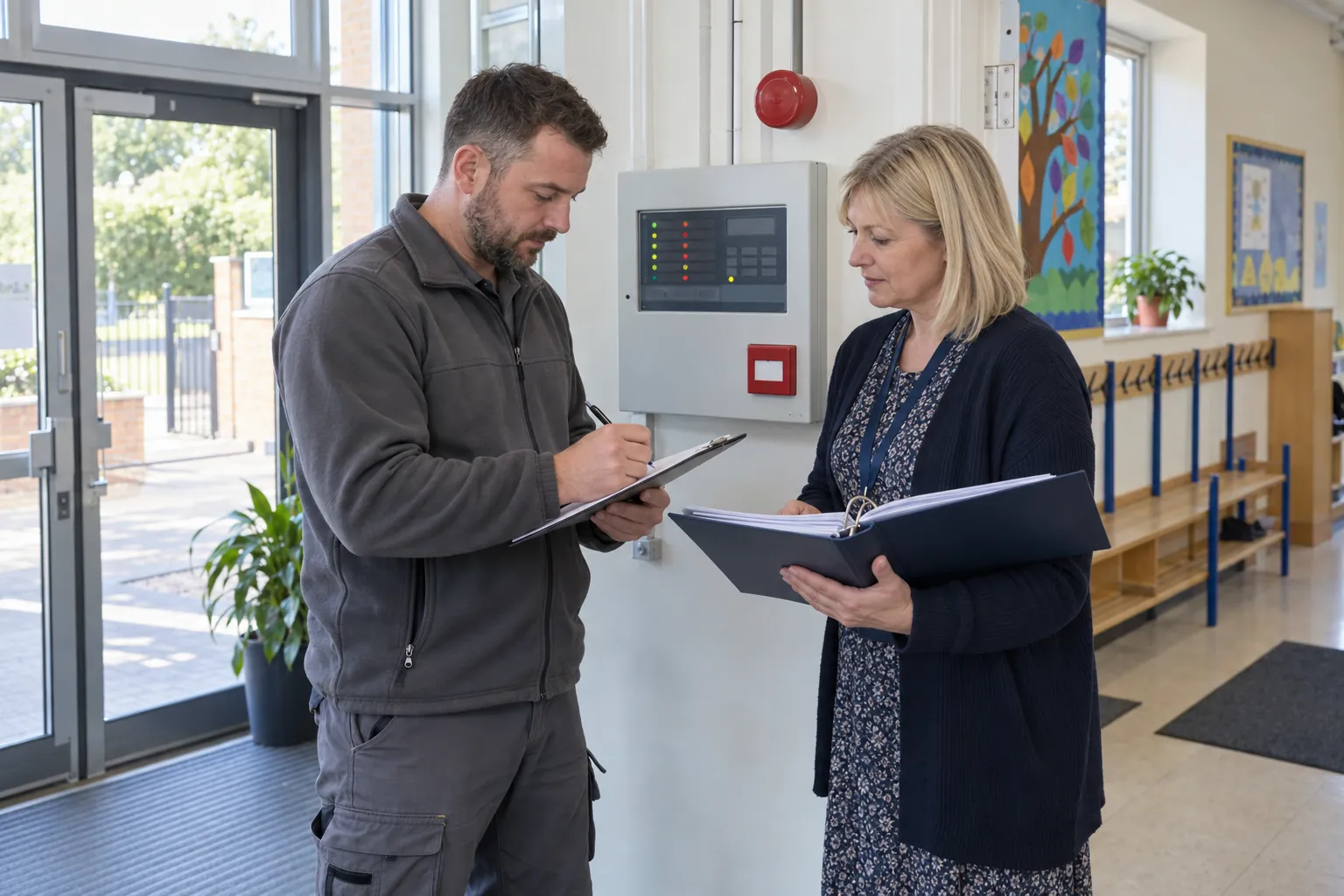 Fire and water checksFire safety log book: what to record, who keeps it and for how longWhat a fire safety log book should contain, from alarm tests to drills and servicing, who keeps it, how long for, and whether paper or digital is better.
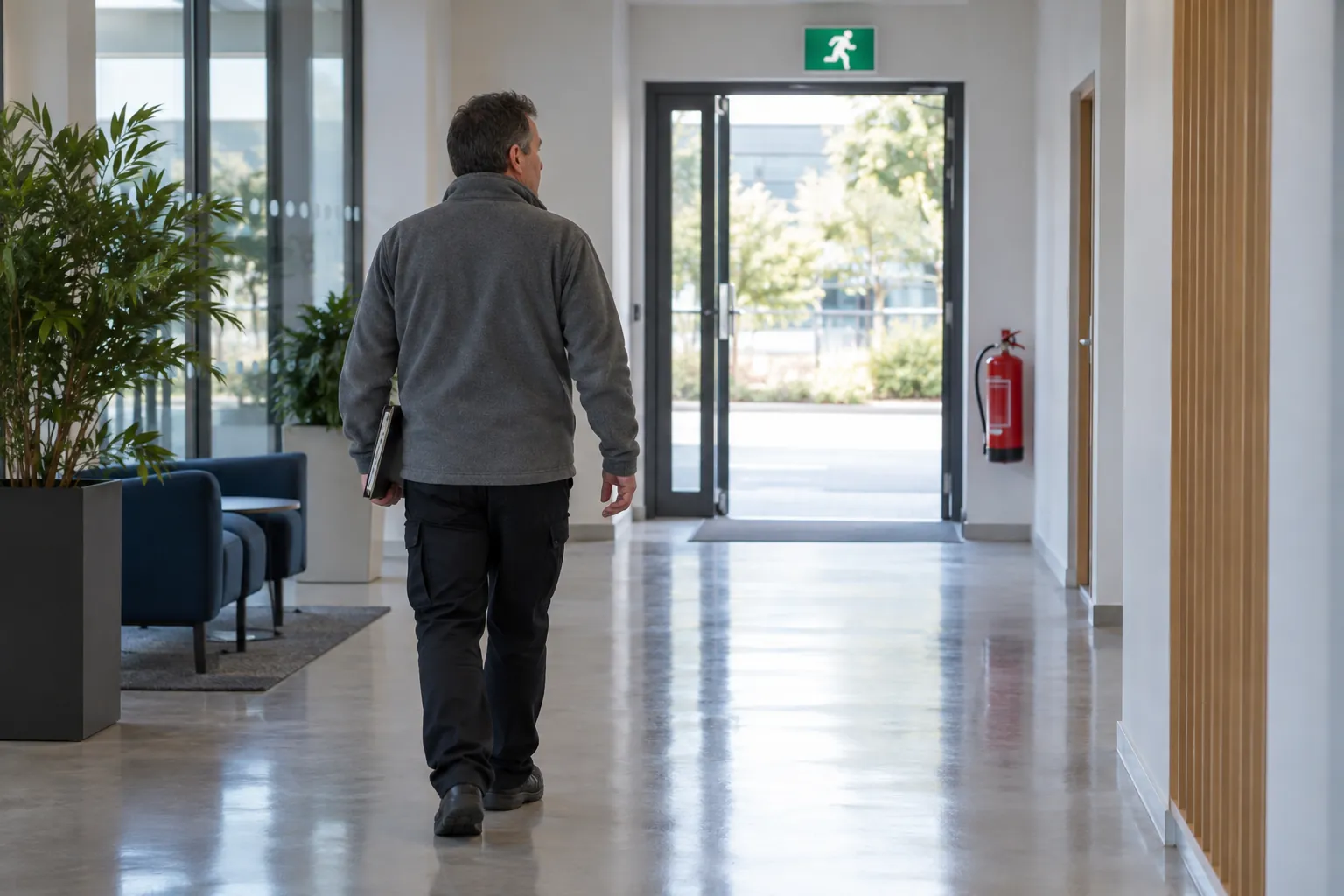 Fire and water checksFire safety checks in the workplace: what to check, how often, and who does itThe routine fire safety checks a UK workplace needs, from daily escape routes to the weekly alarm test, who does each one, and what the record should show.
 Fire and water checksFire extinguisher checks: the monthly check and the annual serviceWhat a monthly fire extinguisher check looks at, what the annual service by a competent person covers under BS 5306-3, and how to keep a record that stands up.