Fire and water checks
Fire hydrant testing: the AS 1851 service, the booster and the record
Fire hydrant testing is the routine service of a building's fire hydrant system to AS 1851-2012, whose section 4 sets monthly, six-monthly, yearly and five-yearly service schedules for a fire services contractor to carry out, while state and territory law makes the owner or occupier responsible for having it done and keeping the records.
Also written for United Kingdom · Ireland · United States
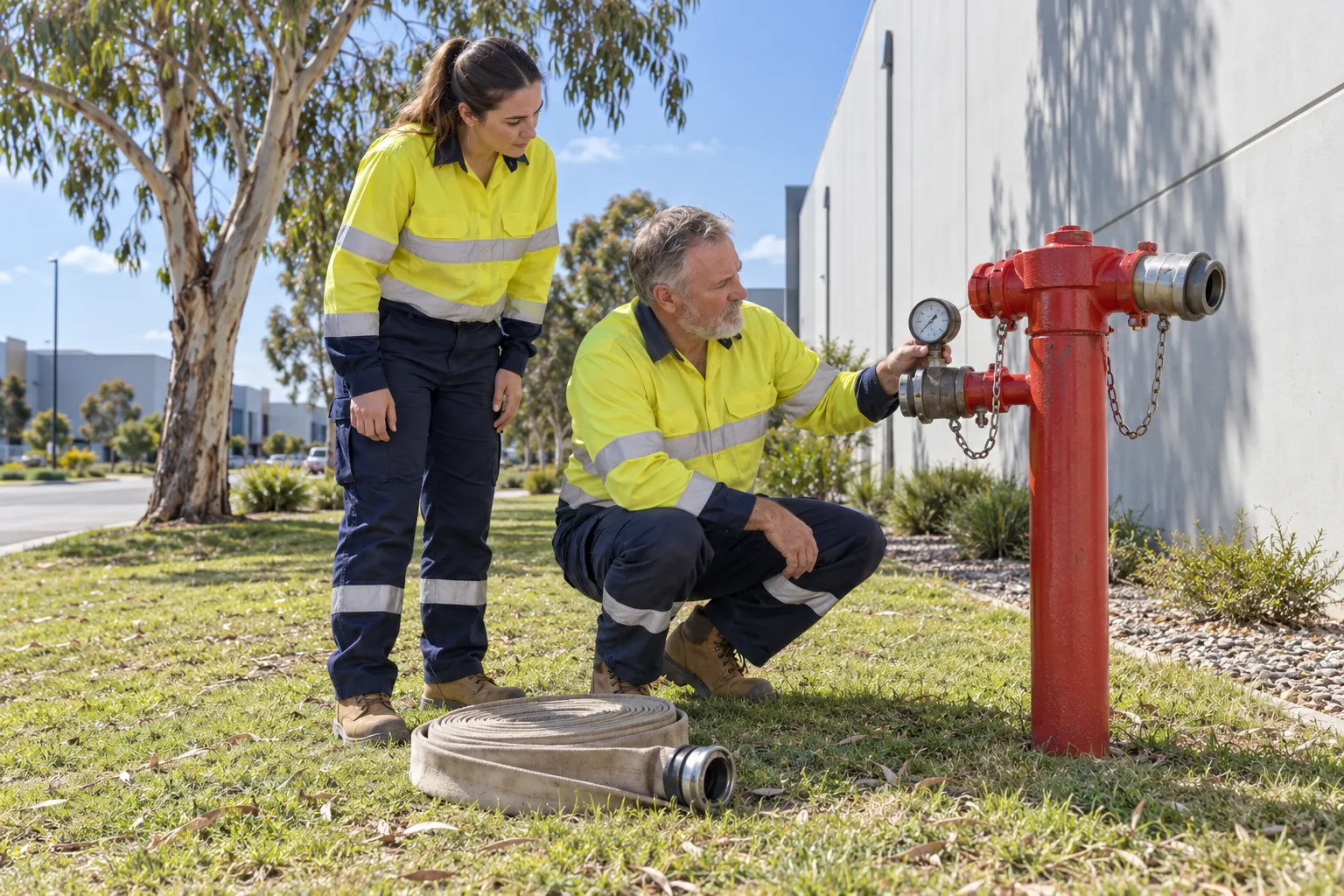
A hydrant system is not for the people in the building: it is the fire brigade's water supply, from the booster where a fire appliance connects to the hydrants around and inside the building. It sits unused for years, and a parked truck, a lost block plan or a valve left shut can stop it working on the one day it matters. This guide covers what a hydrant system is, what each service looks at, how often the work falls due, who carries the duty, and what the building team can check between the contractor's visits.
01
What a fire hydrant system is, and the rules behind it
A fire hydrant system is the fixed pipework, valves and hydrant outlets that give the fire brigade water at a building, with a booster connection where a pumping appliance can add pressure and flow. Whether a building needs one comes from its approval, which for newer buildings means the National Construction Code. In NCC 2025 Volume One, Part E1 Fire fighting equipment, performance requirement E1P3 says a fire hydrant system "must be provided to the degree necessary to facilitate the needs of the fire brigade", and applies only where a fire brigade is available to attend.
The deemed-to-satisfy clause, E1D2, requires a fire hydrant system to serve a building with a total floor area greater than 500 m² where a fire brigade station is no more than 50 km away by road and is equipped to use a fire hydrant. The system must be installed in accordance with AS 2419.1, or AS 2118.6 or FPAA101H where they apply.
Two Australian Standards do most of the work:
- AS 2419.1:2021 Fire hydrant installations, Part 1: System design, installation and commissioning, which Standards Australia describes as specifying "requirements for the design, installation and commissioning and testing of fire hydrant installations". An older system was designed to the edition in force when the building was approved.
- AS 1851-2012 Routine service of fire protection systems and equipment, which "sets out requirements for inspection, testing, preventive maintenance and survey of fire protection systems and equipment". Section 4 is fire hydrant systems; section 3 covers fire pumpsets and section 5 water storage tanks, both often part of a hydrant system. The store lists the 2012 edition, with Amendment 1 of 2016, as pending revision.
A standard binds only when legislation, the building's approval or a contract calls it up. For maintenance that is state and territory law (section 03).
02
The parts of a hydrant system, and what a service looks at
The contents of AS 2419.1:2021, as listed by Standards Australia, show the parts a building is likely to have:
- Fire hydrants, which the standard classifies as feed, attack and attack/feed hydrants, external or internal; the contents also cover street hydrants as feed hydrants.
- The fire brigade booster assembly, the inlets where a fire appliance connects to push water into the system, with requirements for its location, accessibility, clearance and protection, a visual alarm device and the doors of its cabinet.
- Signage and baseline data at the booster: test pressure and boost pressure signs, a pressure schedule, and a block plan of the site.
- Isolating valves, pressure gauges and system monitoring, and on-site pumps and tanks where the town main alone cannot give the flow and pressure needed.
- A test facility, permanent in many systems, with drainage for the test water.
Section 4 of AS 1851-2012 lists the routine service process and procedures, a survey, baseline data, service records, tags or labels, reports, the frequency and the service schedules. A pressure or flow reading only means something against the baseline. ACT Fire & Rescue's guideline FSG-05 Maintenance of fire protection systems and equipment (August 2023) notes that baseline data "is not consistently available for all buildings" and expects owners and maintenance providers "to make concerted efforts to compile this data where required".
The hydrant booster is the part the brigade has to find and reach in seconds, and where the block plan and pressure signs are read. The Country Fire Authority's Fire hydrants page for businesses ends its owner's checklist with exactly that: "If a booster assembly is installed, does it have a block plan of the building and work and test pressures displayed?"
03
How often a fire hydrant is tested, and the flow test
AS 1851-2012 lists four routine service schedules for fire hydrant systems in section 4.4: monthly, six-monthly, yearly and five-yearly. Fire pumpsets in section 3 have their own monthly, six-monthly, yearly and five-yearly schedules, and water storage tanks in section 5 run monthly, six-monthly, yearly and ten-yearly. Clause 1.11 sets the tolerances within which a service still counts as on time. A system with a pump and a tank has three calendars.
The legal frequency depends on the state:
- New South Wales. The NSW Government's page on building fire safety requirements under AS 1851-2012 says that "from 13 February 2026, all class 1b and class 2 to class 9 buildings in NSW must have essential fire safety measures inspected and tested in accordance with AS 1851-2012", under section 81A of the Environmental Planning and Assessment (Development Certification and Fire Safety) Regulation 2021.
- Victoria. Under the Building Regulations 2018 (Vic), the occupancy permit (regulation 194, in Part 13) or a maintenance determination (regulation 215, in Part 15) sets "the frequency and type of inspection, testing and maintenance" for each essential safety measure. Where either names AS 1851-2005 or earlier, regulation 196 (occupancy permit) or regulation 217 (determination) lets the owner comply with AS 1851-2012 instead, and then keep doing so.
- Queensland. Section 54 of the Building Fire Safety Regulation 2008 (Qld) requires the occupier to ensure each prescribed fire safety installation is "inspected and tested at intervals in compliance with QDC, part MP6.1".
- The ACT. FSG-05 explains that section 95 of the Emergencies Act 2004 (ACT) makes it an offence for the occupier not to maintain a fire appliance provided or installed under a direction under section 92 to a "proper maintenance standard", one of which is AS 1851 as in force from time to time. FSG-05 treats every system covered by AS 1851 as a fire appliance.
A fire hydrant flow test discharges water from the hydrants to show that the system still gives the flow and pressure it was designed for. The first is at commissioning: section 12 of AS 2419.1:2021 covers hydrostatic testing and flow and pressure performance testing, including the booster and the pumpsets. After that, the CFA's Fire Hydrants: a guide for business owners expects a hydrant maintained to AS 1851 to have "had tests conducted to ensure there is appropriate water flow and pressure". Ask the contractor which service includes the flow test, and ask for the measured figures against the baseline, not just a pass.
Flow testing puts a lot of water somewhere. A 2021 position statement from Queensland Fire and Emergency Services (now the Queensland Fire Department), Fire hydrant test facilities, says test water may go to the building's or the area's drainage "if it is safe to do so", and recommends a closed-loop arrangement with an on-site tank where practicable. Agree before the test day where the water will go and which areas must be kept clear.
04
Who is responsible, defects, and what the record should show
Who carries the duty depends on the state:
- Victoria: the owner. Schedule 8 lists the "Fire hydrant system (including on-site pump set and fire-service booster connection)" as an essential safety measure, and regulation 226 says the owner must ensure each one "is maintained in a state which enables the essential safety measure to fulfil its purpose", subject to two exceptions. Regulation 225 requires the owner to make available at the building, within 24 hours of a request by the municipal building surveyor or the chief officer, the annual essential safety measures reports of the past ten years, the maintenance schedules and "the records of all inspections, testing and maintenance (including repairs)". Each carries a penalty of 20 penalty units.
- New South Wales: the owner, which the NSW Government's AS 1851 page says includes "strata committees, owners corporations, and developers prior to occupation certificate". The NSW Planning guidance on fire safety certification explains that an annual fire safety statement "must be issued each year and include all the essential fire safety measures that apply to a building", once an accredited practitioner (fire safety) has inspected the building.
- Queensland: the occupier. Section 54 requires maintenance "carried out by an appropriately qualified person" and any repair or corrective action the record shows is needed done no later than one month after the maintenance, unless the occupier has a reasonable excuse. Section 55 sets out the record of maintenance, including the qualified person's name and licence number, the date, the work and the results. Section 55A requires an occupier statement at the intervals QDC MP6.1 sets, which the Queensland Government's page on fire safety installations in buildings describes as yearly, and section 72 requires each record of maintenance to be kept for at least two years.
- The ACT: the occupier, with the owner or their representative keeping the records, which FSG-05 says must be available to ACT Fire & Rescue within 48 hours of a request.
A lease can move the work but not the need to show it. The CFA's page on essential safety measures for businesses notes that "it is sometimes specified within a lease agreement that ESMs are the responsibility of the tenant or building occupant".
Defects. FSG-05 summarises the AS 1851 procedure: a critical defect is reported to the owner before the service provider leaves site, or as soon as possible, and confirmed in writing within 24 hours; non-critical defects and non-conformances are reported in writing within one week. In Queensland, section 53 requires a critical defect notice to the occupier within 24 hours, and section 49's example of a critical defect is "a defect in a pump making the fire hydrants for a building inoperable".
A hydrant record that holds up shows, for each service: the date and schedule; the technician and their licence where one is required; each hydrant, the booster, the pump and the tank rather than one line for the system; measured pressures and flows against the baseline; every defect and when it was fixed; and anything not done, and why.
05
What the building team can check between services
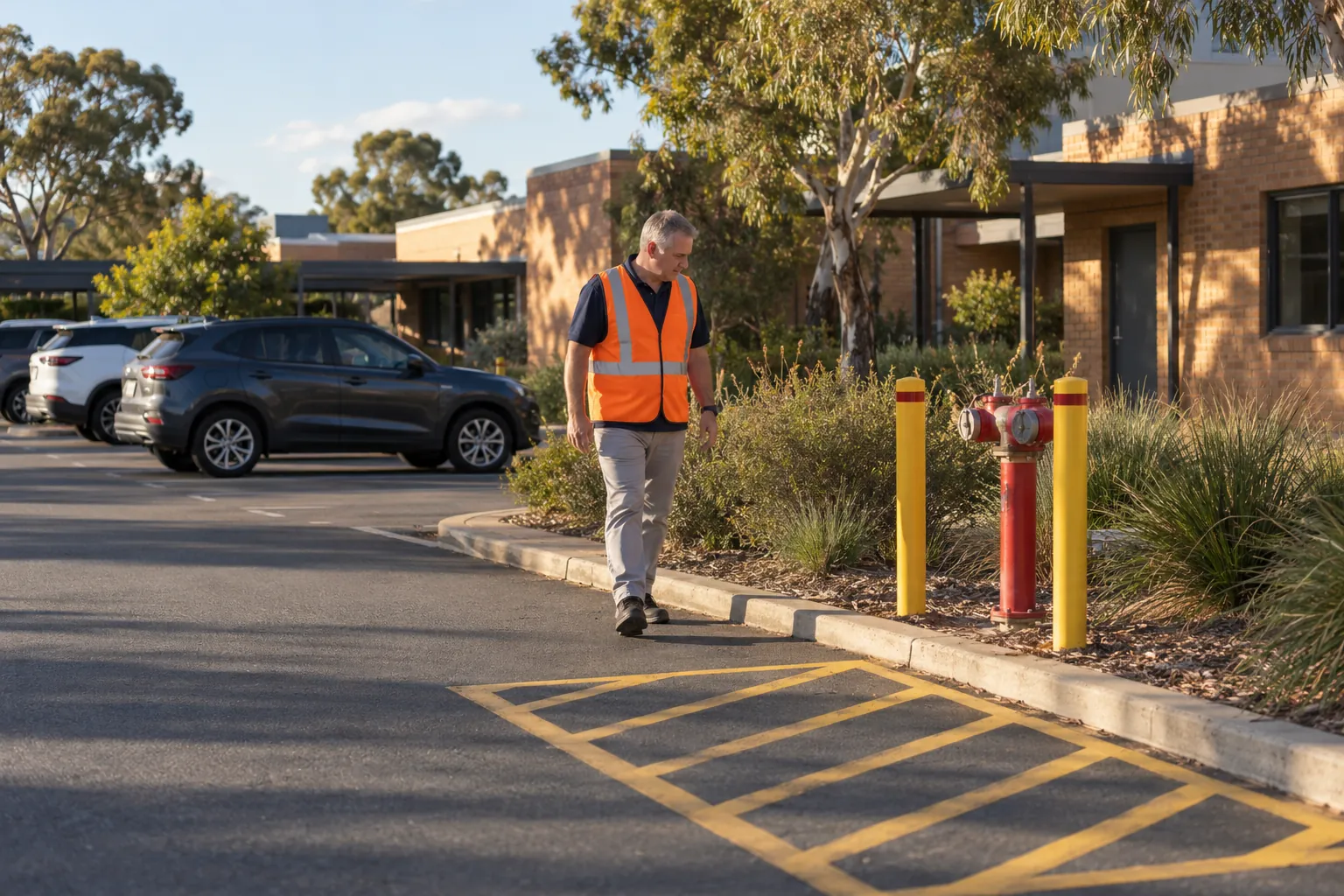
The CFA's factsheet lists why firefighters often struggle to find a hydrant: vegetation hiding it, hydrant marker posts and blue road reflective markers removed or knocked over, hydrants "obstructed by fences, stock, pallets, parked cars etc.", and paintwork fading or peeling. All of these can develop between services.
A short walk by the building manager, caretaker, security officer or cleaning supervisor catches most of this. It is an observation, not an AS 1851 service, and should be recorded as one. For each hydrant and the booster on the building's list:
- the booster can be seen and reached, with nothing parked, stacked or built in front of it;
- the block plan and the test and boost pressure signs are in place and readable;
- each external hydrant can be found, with its marker in place and nothing obstructing or hiding it;
- nothing shows vehicle damage, and any bollards protecting a hydrant or the booster are intact;
- each internal hydrant is clear, and the space around it is not being used for storage;
- there is no sign of leaking at a valve, outlet or the booster;
- the pump room and tank, where there are any, are not being used as a storeroom;
- the service tag or label is present, and the last service date looks within its interval.
Do not open valves or operate the booster on this walk; that is the contractor's work. Each finding goes to one named person, usually whoever holds the fire services contract, and stays open until it is fixed. In Victoria, regulation 228 separately requires the occupier of most buildings to keep exits and paths of travel "readily accessible, functional and clear of obstructions", and the same walk can take in the exits too.
06
Where the record fails, and what SiteClara does about it
The contractor's reports are usually sound; the gap is between them. A hydrant checklist ticked for the month in one sitting in the site office; a truck across the booster mentioned to whoever was at the gatehouse; a block plan that went missing during a repaint and was not noticed until the yearly service. When a surveyor asks for the records, nothing shows whether anyone walked the hydrants or what became of what they found.
SiteClara records those checks at the location. A printed QR poster, with an optional NFC tag behind it, is placed where a check is scheduled, such as inside the booster cabinet, at the pump room or beside each internal hydrant. Staff scan the code or tap the tag on their own phone, with no app to install, see the checks due there, and mark each one done or say what stopped them. The time and the named person are recorded as it happens, with a photo when one is asked for. A problem, such as a blocked hydrant or a damaged booster door, is reported there with a photo and goes onto the team's list of jobs until someone closes it.
The supervisor sees what is due, done and missed, and records the reason a check was missed. Each day they review the checks and photos, add a note and approve a report that goes to nominated contacts, such as the owner's facility manager, at 8am the next morning, showing what was reported, completed and still open.
07
Questions people ask
How often should a fire hydrant be tested?
Under AS 1851-2012, a fire hydrant system has monthly, six-monthly, yearly and five-yearly routine service schedules, with separate schedules for its pumps and tanks, as the contents on the Standards Australia store page for AS 1851-2012 show. The legal frequency is set by your state or territory: in NSW, AS 1851-2012 itself since 13 February 2026, as the NSW Government's page on building fire safety requirements under AS 1851-2012 explains; in Victoria, the occupancy permit or maintenance determination; in Queensland, QDC MP6.1.
Who is responsible for fire hydrant testing?
The building owner in Victoria and New South Wales, and the occupier in Queensland and the ACT, though a lease can pass the work to a tenant. The testing itself is done by a qualified fire services contractor, and whoever holds the duty must be able to produce the records: within 24 hours of a request in Victoria under regulation 225 of the Building Regulations 2018 (Vic).
Are fire hydrant flow tests required?
Yes. A new system is flow and pressure tested at commissioning under section 12 of AS 2419.1:2021 Fire hydrant installations, Part 1, and the CFA's Fire Hydrants: a guide for business owners expects a hydrant maintained to AS 1851 to have "had tests conducted to ensure there is appropriate water flow and pressure". Your contractor can tell you which routine service includes it.
What is a hydrant booster?
A hydrant booster, or fire brigade booster assembly, is the set of inlets where a fire appliance connects to pump water into a building's hydrant system. AS 2419.1:2021 sets its location, access, protection and signage, including test and boost pressure signs and a block plan of the site.
08
Further reading, and a list to take away
For where a hydrant system is required, read clauses E1P3 and E1D2 of NCC 2025 Volume One, Part E1; an older building was approved under an earlier edition. For the duties, read the NSW Government's AS 1851-2012 page, Parts 13 and 15 of the Building Regulations 2018 (Vic), Part 5 of the Building Fire Safety Regulation 2008 (Qld) or ACT Fire & Rescue's FSG-05.
To take away:
- keep a list of every hydrant, the booster, the pumps and the tanks, and check it against the contractor's records after building work;
- know which regime applies in your state and which edition the contract assumes;
- hold the hydrant, pump and tank service calendars at the building, and treat a late service as late;
- keep the baseline data and commissioning results on file, and ask for measured figures at each flow test;
- agree where test water goes before a flow test;
- give every defect a named person and a closure date;
- walk the hydrants and the booster between services, and report what you find to one named person;
- keep the records where they can be produced quickly when asked.
Sources
Every document this guide quotes or links to, in the order it first cites them.
- NCC 2025 Volume One, Part E1 Fire fighting equipment ncc.abcb.gov.au
- AS 2419.1:2021 Fire hydrant installations, Part 1: System design, installation and commissioning store.standards.org.au
- AS 1851-2012 Routine service of fire protection systems and equipment store.standards.org.au
- FSG-05 Maintenance of fire protection systems and equipment data.esa.act.gov.au
- Fire hydrants page for businesses cfa.vic.gov.au
- Building fire safety requirements under AS 1851-2012 nsw.gov.au
- Building Regulations 2018 (Vic) legislation.vic.gov.au
- Building Fire Safety Regulation 2008 (Qld) legislation.qld.gov.au
- Fire Hydrants: a guide for business owners cfa.vic.gov.au
- Fire hydrant test facilities fire.qld.gov.au
- NSW Planning guidance on fire safety certification planning.nsw.gov.au
- Fire safety installations in buildings business.qld.gov.au
- Essential safety measures for businesses cfa.vic.gov.au
Related guides
 Fire and water checksAS 1851 routine service: what it asks of owners, fire contractors and building teamsWhat AS 1851-2012 routine service covers, how intervals and competent persons work, what the records must show, and how Victoria's regulations call it up.
 Fire and water checksFire hose reel inspection: the six-monthly service, the records and the checks in betweenHow fire hose reels are inspected in Australia: AS 2441 and the NCC, the six-monthly and yearly AS 1851 service, state records rules, and the checks between visits.
 Fire and water checksSprinkler system inspection: what the standard asks, what the law asks, and what the site team can seeHow sprinkler systems are inspected and serviced in Australia: AS 1851 schedules, the rules in Victoria, NSW and Queensland, the records, and what site teams check.
 Fire and water checksThe annual fire safety statement: what a NSW building owner declares, and how to make it trueWhat a NSW annual fire safety statement declares, which buildings need one, the 3-month assessment window, lodging and display, and the checks that make it true.