Fire and water checks
Fire extinguisher checks: the monthly check and the annual service
Fire extinguisher checks are a visual check of every portable extinguisher each month by someone on site, and an inspection and service by a competent contractor once a year.
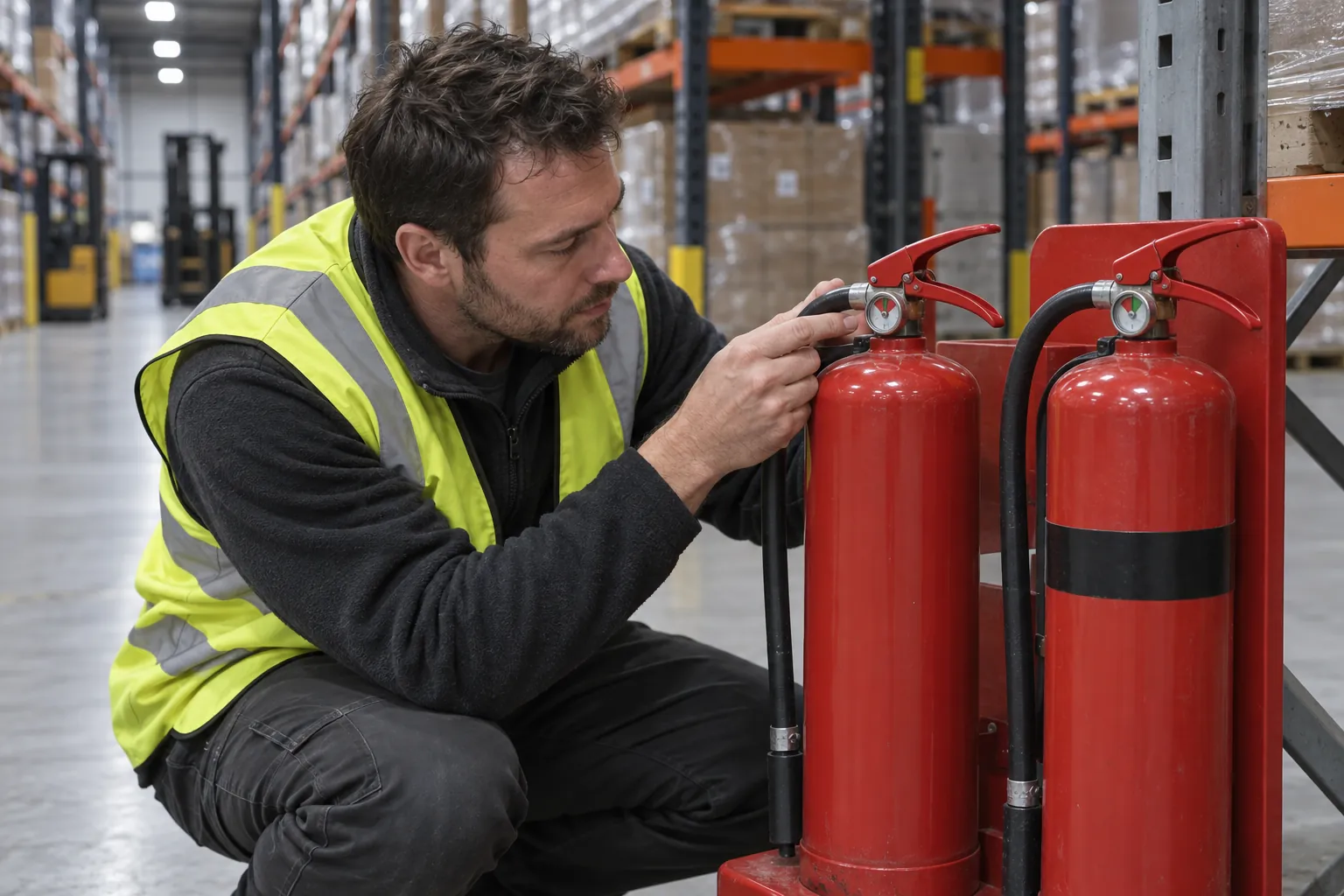
That is the routine the Home Office sets out for small non-domestic premises in England. Fire safety law requires extinguishers to be maintained but sets no schedule, so the monthly check and the annual service come from guidance and the British Standard, not from the law itself. This guide covers what each involves, who does it, and what the record should show.
01
The duty, and the standard behind the checks
In England and Wales, article 13 of the Regulatory Reform (Fire Safety) Order 2005 requires the responsible person, where necessary to keep people safe, to equip the premises with appropriate fire-fighting equipment, with any non-automatic equipment, such as a portable extinguisher, easily accessible, simple to use and indicated by signs. Article 17 then requires that equipment to be subject to a suitable system of maintenance and maintained in an efficient state, in efficient working order and in good repair. That is the legal requirement behind every fire extinguisher check. The Order does not name a checking frequency or a standard. Scotland has equivalent duties under the Fire (Scotland) Act 2005, and Northern Ireland under the Fire Safety Regulations (Northern Ireland) 2010.
In practice, the recognised way to meet the maintenance duty for portable fire extinguishers is the British Standard BS 5306-3, the code of practice for the commissioning and maintenance of portable fire extinguishers. It sets out two layers:
- Regular visual inspection by the user, meaning the responsible person or someone they nominate, usually at least once a month.
- Commissioning and maintenance by a competent person: a check when the extinguisher is installed, a basic service at least once a year, and an extended service or overhaul at longer intervals.
Two related standards are worth knowing. BS 5306-8 covers the selection and positioning of portable extinguishers: which types a building needs and where they go. BS EN 3 is the product standard that extinguishers themselves are made to. Fire risk assessors and insurers may look for them to be followed, and a fire safety inspector can ask to see the service records.
02
Types of fire extinguisher, and what each is for
Different types of fire need different extinguishers. Anyone checking should know which type of fire extinguisher is meant to be where, because the wrong type in the wrong place is a finding in its own right. Under BS EN 3 extinguishers have a red body, and BS 5306-10 recommends the coloured band or label that shows the type:
- Water (red): for fires involving solids such as paper, wood and textiles, known as class A.
- Foam (cream band): class A, and flammable liquids, class B.
- Carbon dioxide, CO2 (black band): flammable liquids and fires involving electrical equipment; often placed near server rooms and switchgear.
- Dry powder (blue band): a wide range of fires, including flammable gases, class C; generally not recommended for use in small enclosed spaces indoors.
- Wet chemical (yellow band): cooking oil and fat fires, class F, in commercial kitchens.
Specialist powders for metal fires, class D, are found in some industrial premises. Fire blankets are separate equipment, and should be on the same checks where they are fitted.
Which types go where is decided by the fire risk assessment and BS 5306-8, not by the person doing the monthly check. Their job is to notice when something has changed: an extinguisher moved, swapped for the wrong type, or missing altogether.
03
The monthly fire extinguisher check
The monthly fire extinguisher inspection is visual. It takes a few seconds per fire extinguisher and needs no tools or specialist training beyond being shown what to look for, usually by the service company or the person responsible for fire safety. BS 5306-3 recommends checking that each extinguisher:
- is in its designated place, on its bracket or stand, and has not been moved, removed or hidden;
- is visible and accessible, not blocked by furniture, stock, bins or deliveries, with its sign in place;
- has its operating instructions clean, legible and facing outwards;
- shows a pressure reading in the operable range: check the pressure gauge, where there is one, and that the needle is in the green;
- has its safety pin and tamper seal intact, which shows it has not been used or tampered with;
- has no obvious damage: no dents, corrosion, leaks, or a cracked or blocked hose or nozzle;
- carries a service label showing a service within the last year.
Anything that fails the check should be reported straight away to whoever arranges servicing, and a missing or discharged extinguisher treated as urgent: until it is replaced or recharged, that area has no extinguisher. An extinguisher that has been used, even briefly, needs to be recharged or replaced by a competent person, not put back on its bracket.
Who does the monthly check depends on the building. It is often the premises or site manager, a caretaker, a security officer on patrol, or a fire warden for their floor. Whoever it is, name them and a deputy, and make the check part of a routine rather than something done when someone remembers.
04
Annual servicing and extended servicing
A fire extinguisher service is the competent person's job, not the user's, and is usually done by an extinguisher technician from a fire protection company. Under BS 5306-3, servicing and maintenance includes:
- Commissioning when an extinguisher is first installed, so that it starts in a known condition and in the right place.
- A basic service at least once a year: a thorough examination of each extinguisher, including its weight or pressure, its condition, the seals and the hose, with any faults put right and a new service label fitted.
- An extended service at longer intervals, usually every five years for water, foam and powder extinguishers, in which the extinguisher is discharged and refilled or replaced.
- An overhaul of CO2 extinguishers, usually every ten years, including a pressure test of the cylinder, or replacement.
Extinguishers that are too old, corroded or uneconomic to service are condemned and replaced. The service company should leave a certificate or report listing every extinguisher by location, what was done, and anything recommended, such as a missing extinguisher, the wrong type for a room, or an extinguisher that should be added.
A competent person is someone with the training, experience and equipment to service extinguishers to the standard. Third-party certification, such as the BAFE SP101 scheme for portable fire extinguisher organisations and their technicians, is one way to show a company's competence, and BAFE strongly recommends using a third-party certificated provider.

05
Records, training and what goes wrong
Keep the monthly checks and the service reports together, with the records for the building's other fire safety equipment, in the fire log book or wherever the building keeps its fire safety records. A good monthly record shows the date, who checked, which extinguishers were checked by location, what was found, and what happened about each fault. A good service record is the competent person's report and certificate, with a note of when each recommendation was dealt with.
Common findings on fire risk assessments and fire safety inspections include:
- extinguishers used as door stops, which also means a fire door wedged open;
- extinguishers removed from brackets and left on the floor, or moved to another room during a refit;
- a CO2 extinguisher by a kitchen fryer, or a water extinguisher next to electrical switchgear;
- service labels more than a year old, or a monthly check record that stops in the spring;
- a discharged extinguisher put back on its bracket after a small incident.
Extinguishers are only useful in the hands of someone who knows when and how to use them, and when not to. Fire safety training for staff should cover the types in the building, what each is for, and that the priority is to raise the alarm and get out; an extinguisher is for tackling a small fire only when it is safe to do so. Fire wardens or fire marshals usually receive more practical training.
06
Where the record fails, and what SiteClara does about it
Monthly extinguisher checks are the kind of routine that fades. They start well after the service visit, get skipped in a busy month, and become a single tick for the whole building. Nobody can then say whether the extinguisher on the third floor was on its bracket in July, and a missing one is found at the next annual service, or not at all.
SiteClara puts a printed QR poster at each extinguisher point or group of points, with an optional NFC tag behind it. Staff scan the code or tap the tag on their own phone, with no app to install; they are enrolled by text and sign in with a link. They see the checks due at that location, such as the monthly extinguisher check, and mark each one done, or explain what stopped them. A problem, such as a missing extinguisher, a broken seal or a gauge out of range, is reported there with a photo and goes onto the team's list of jobs until someone closes it.
The supervisor sees what is due, done and missed and can record why a check was missed; a job that needs the building manager can be escalated to them to answer. Each day the supervisor reviews and approves a report that goes to nominated management or client contacts at 8am the next morning, showing what was reported, completed and still open, and how the scheduled checks went, for example 12 of 12 completed. It is priced per building, with no per-person fees.
07
Questions people ask
Is fire extinguisher testing a legal requirement?
Yes, fire extinguishers must by law be maintained, though the law sets no testing schedule: in England and Wales, article 17 of the Fire Safety Order requires fire safety equipment to be subject to a suitable system of maintenance and kept in efficient working order and good repair, and names no frequency or standard. BAFE quotes the code of practice BS 5306-3 as saying it is the duty of the responsible person to ensure that extinguishers are maintained regularly by a competent person. The monthly check and the annual service are the recommended routine, from guidance and that standard, not a schedule set in law.
How often should fire extinguishers be checked?
Fire extinguishers should have a visual check every month and an inspection and test by a competent contractor every year, the routine in the Home Office's guide to making small non-domestic premises safe from fire in England. The extended service and the CO2 overhaul described above come at longer intervals.
How do I get fire extinguishers checked?
Give the monthly visual check to a named person on site, and book the annual service with a competent company, such as one certificated to the BAFE SP101 scheme, which you can find on the BAFE Fire Safety Register by choosing fire extinguisher maintenance or service. BAFE advises checking that a company's registration covers fire extinguisher service and maintenance before you award the contract.
08
Further reading, and a list to take away
BS 5306-3 (maintenance of portable fire extinguishers) and BS 5306-8 (selection and positioning) are published by BSI. BAFE publishes information on its SP101 scheme and a register of certificated companies, and the Fire Industry Association publishes guidance on extinguisher maintenance. GOV.UK publishes the Fire safety risk assessment guides for different types of premises, which cover firefighting equipment, and your local fire and rescue service can advise on your own building.
Before the next service visit, check that:
- there is a list of every extinguisher, by location and type;
- each one is checked monthly, by a named person, and the check is recorded;
- faults and missing extinguishers are reported and dealt with, not just noted;
- the annual service is booked with a competent company, and the report is filed;
- extended services and CO2 overhauls are tracked, so they are not missed;
- recommendations from the last service have been acted on;
- staff know which extinguisher is for what, and that getting out comes first.
Sources
Every document this guide quotes or links to, in the order it first cites them.
- Article 13 of the Regulatory Reform (Fire Safety) Order 2005 legislation.gov.uk
- Article 17 legislation.gov.uk
- BS 5306-3 knowledge.bsigroup.com
- BS 5306-8 knowledge.bsigroup.com
- BAFE SP101 scheme bafe.org.uk
- Guide to making small non-domestic premises safe from fire gov.uk
- Fire safety risk assessment gov.uk
Related guides
 Fire and water checksFire safety checks in the workplace: what to check, how often, and who does itThe routine fire safety checks a UK workplace needs, from daily escape routes to the weekly alarm test, who does each one, and what the record should show.
 Fire and water checksFire marshal checklist: the daily and weekly checks, and the job in an evacuationWhat a fire marshal or fire warden checks each day and week, their role in an evacuation, the law behind the role, and how to keep a record that stands up.
 Fire and water checksWeekly fire alarm test: how to do it, and what to recordWeekly fire alarm test: how to carry out the test BS 5839-1 recommends, rotating call points, what to record, and what only a competent person can do.
 Fire and water checksEmergency lighting log book: what to record, and how oftenWhat an emergency lighting log book should record, the monthly and annual tests BS 5266-1 recommends, who does each, and how to keep the record credible.