Fire and water checks
Legionella control: the routine checks in a building's water system, and the record that shows them
Legionella is a group of bacteria, found naturally in water and moist soil, that can grow in a building's hot and cold water systems and cause Legionnaires' disease, a severe pneumonia, in people who breathe in contaminated spray.
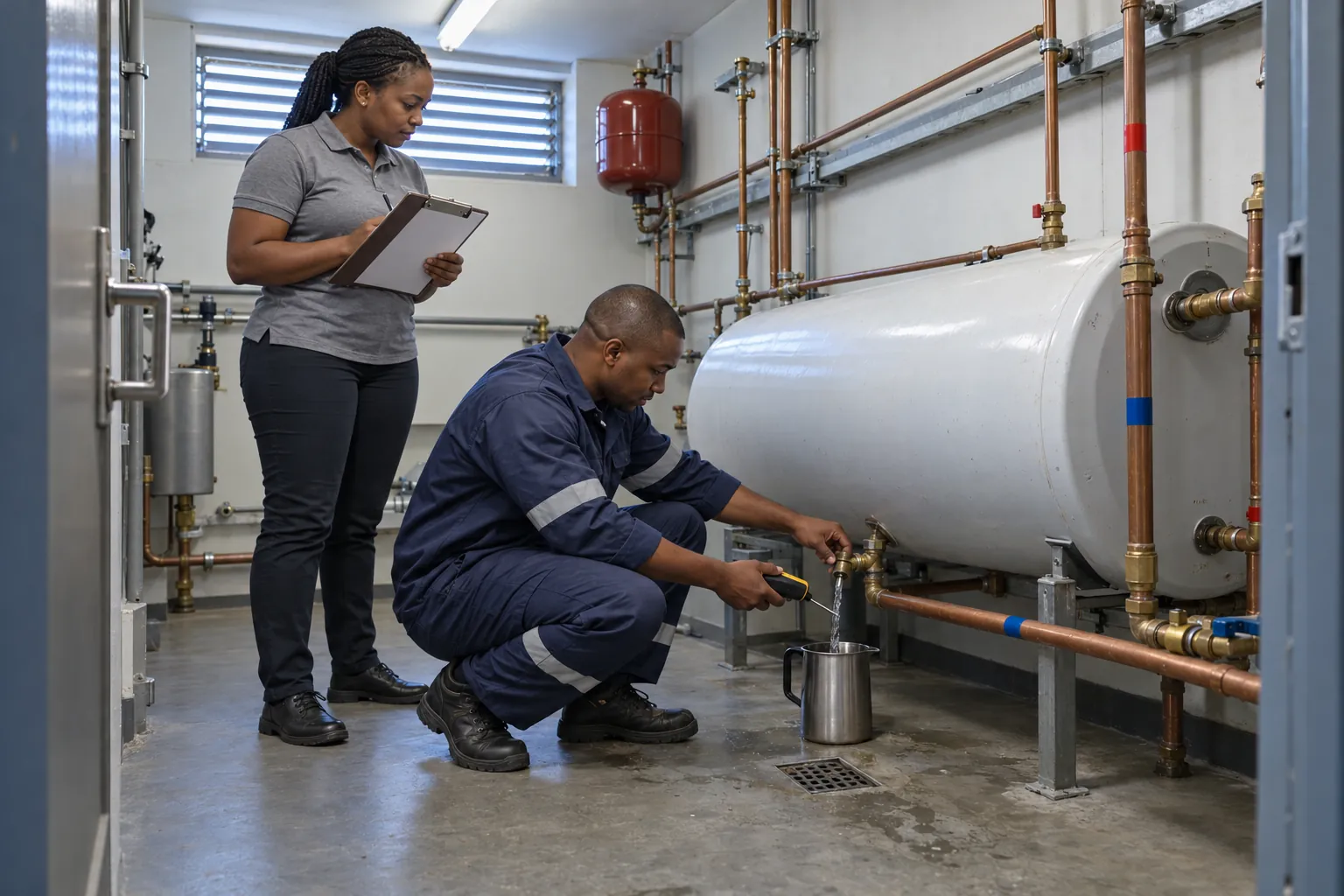
Legionella control is the work of stopping the bacteria from multiplying in those systems to prevent that illness, and in South Africa it rests on the employer's duties under the Occupational Health and Safety Act 85 of 1993 and the Regulations for Hazardous Biological Agents, 2022, with SANS 893-1 and SANS 893-2 as the national standards for managing the risk. The National Institute for Communicable Diseases puts the prevention simply: store hot water above 60°C, deliver it to taps above 50°C, keep cold water below 20°C, and get rid of dead legs and water that stands still. Most of the work is not the risk assessment. It is the routine that follows it: flushing the shower nobody uses, running the tap furthest from the geyser with a thermometer in the stream, and writing the reading down. This guide covers the duty, the systems at risk, the routine checks, who does them, and what makes the record worth keeping.
01
Where the duty to control Legionella comes from
Legionella bacteria live naturally in rivers, lakes, natural pools and moist soil, as the NICD's Legionnaires' disease frequently asked questions explain. They become a problem in man-made water systems, which can give them the three conditions the NICD's Legionnaires' disease: NICD recommendations for diagnosis, management and public health response (version 1.2, March 2016) names: heat between 20°C and 45°C, water standing still, and a way of turning it into spray. People are infected by breathing in the droplets, and the illness, Legionnaires' disease, is a serious pneumonia and a notifiable condition in South Africa.
No single law covers Legionella. The duty comes from general occupational health and safety law, read with a set of regulations and two national standards:
- The Occupational Health and Safety Act 85 of 1993. Section 8(1) requires every employer to provide and maintain, as far as is reasonably practicable, a working environment that is safe and without risk to the health of employees. Section 9(1) extends the duty to people who are not employees, such as tenants, visitors, learners and patients.
- The Regulations for Hazardous Biological Agents, 2022 (GN R.1887), made under section 43 of the Act and published on 16 March 2022. A hazardous biological agent (HBA) is defined as one "which may cause an infection, allergy or toxicity or otherwise create a risk to human health", and Annexure A, which sorts biological agents by risk group, lists Legionella species in risk group 2. The regulations are not limited to laboratories: regulation 2(1)(b) applies them to every employer at a workplace where "exposure to an HBA may occur".
- SANS 893-1:2018, Legionella – Part 1: Risk management, which the SABS describes as guidelines for managing the risk wherever water is used or stored at a place of work or business and "there is a means of creating and transmitting water droplets which may be inhaled".
- SANS 893-2:2018, Legionella – Part 2: The control of Legionella in water systems, which sets requirements for the design and management of cooling towers, evaporative condensers, and hot and cold water systems.
Both parts of SANS 893 are edition 2, approved on 19 February 2018 and replacing the 2013 first editions, and both are listed as issued in Government Notice 83 of 2018 (Standards Act, 2008: Standards matters). Like any SANS, they are voluntary until a regulation, a by-law or a contract calls them up, and they are paid documents, so this guide cites them and does not quote them.
Under the HBA Regulations, the employer must conduct and document a risk assessment, carried out by a competent person (regulation 6(2)), after telling the health and safety representative or committee that it intends to do so (regulation 4(1)). The employer reviews it at intervals not exceeding 24 months, and at once if it is no longer valid or after an incident or a change in the work (regulation 6(6)). This guide is about what follows: the routine checks that show the control measures work. The assessment, and how the regulations apply to a particular building, belong to the employer and a competent person.
02
Which water systems Legionella control covers
The NICD's sampling guidance for hotels and large buildings runs through what an ordinary building contains. In an office block, school, hospital, hotel, shopping centre or sectional title scheme, Legionella control covers:
- Geysers and calorifiers: the central hot water tanks, and the individual geysers in ablutions, kitchens and flats.
- Cold water storage: roof tanks, and the plastic storage tanks (JoJo tanks) and borehole systems many buildings added as a backup supply.
- Outlets: taps, showers and hoses, especially seldom-used ones in ablutions and change rooms.
- Air conditioning: cooling towers, evaporative condensers and air conditioning sumps.
- Anything else that makes spray: fountains, misting devices, humidifiers, spa baths and ice machines.
The risk lies wherever warm water stands still. Some South African conditions make that more likely than they look on a plumbing drawing:
- A geyser that goes cold. A geyser turned off by a timer, by load shedding or by an outage cools into the range Legionella likes.
- Tanks in the sun. A roof tank or JoJo tank in full sun can warm cold water well above 20°C in summer.
- Buildings that close. A school over the holidays, an office block over December, a floor not yet let: the NICD's sampling guidance singles out "any rooms or floors that have not been in use" and "new areas of the building not utilized yet".
- Dead legs: pipes left behind when a basin or shower was removed, where water never moves at all.
Cooling towers and evaporative condensers need continuous water treatment and sampling by a specialist; this guide deals with the routine checks on hot and cold water systems.
03
The routine checks, and how often
Regulation 12 of the HBA Regulations requires documented, risk-based protocols for every control measure, maintained by a competent person and setting out acceptance criteria, the verification method and intervals, routine maintenance, the standards that apply and the competence needed, and regulation 12(d) requires the outcomes of tests of control measures to be documented and available for inspection. Those protocols, often called the written scheme or Legionella management plan, set the checks for your building, drawing on SANS 893-2. The routine for a hot and cold water system usually includes:
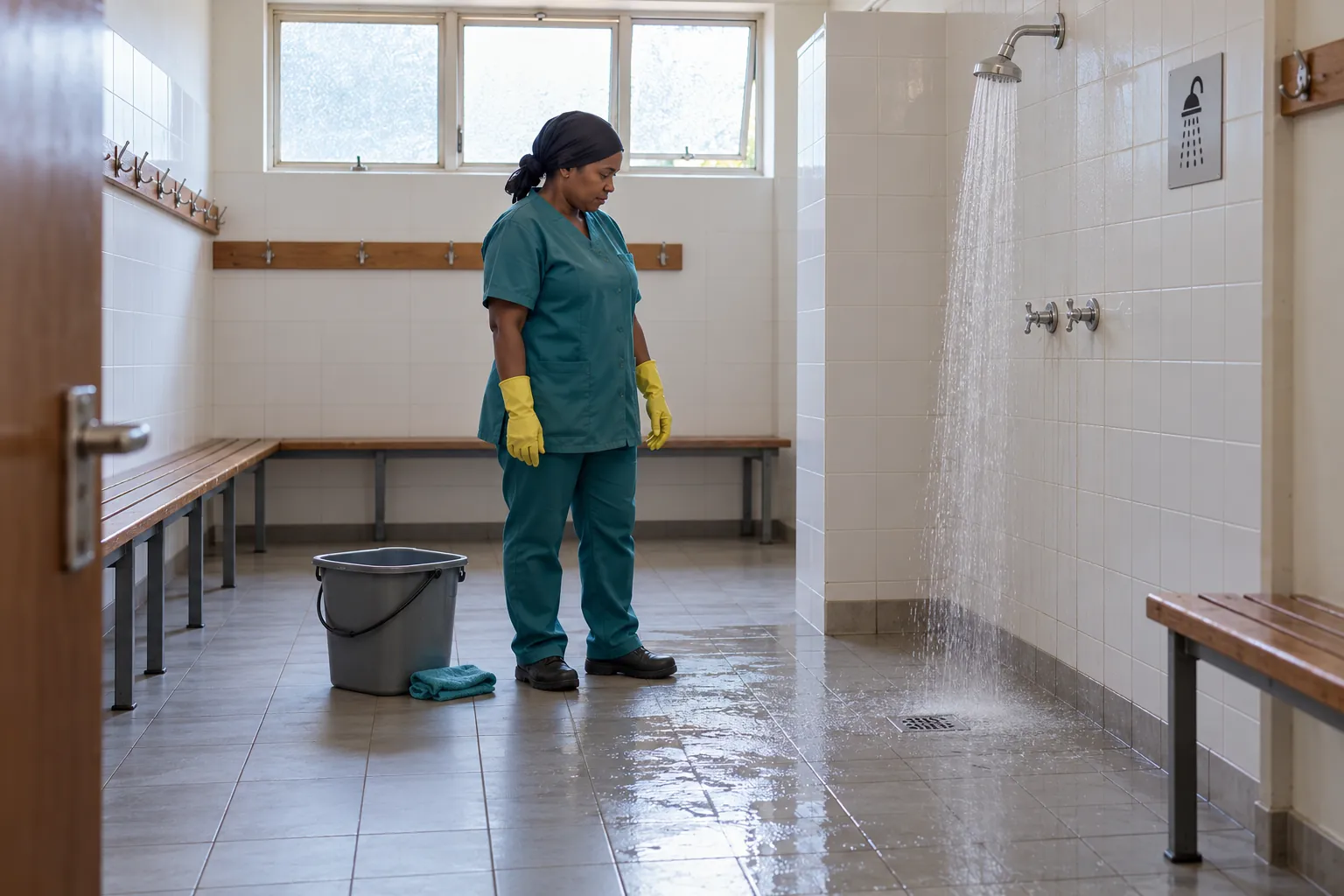
- Flushing seldom-used outlets. The NICD's guidance says showers and taps that are seldom used "ideally ... should be flushed on a regular basis (weekly)". Run them to drain without making spray. An outlet that is never needed can be removed with the pipe that feeds it.
- Temperatures at the sentinel outlets. The outlets nearest to and furthest from each geyser or calorifier are checked with a calibrated thermometer, to show the whole system reaches temperature. The NICD treats a hot tap that "does not reach 50°C within 30 seconds" and a cold tap that runs lukewarm as warning signs worth sampling.
- Geyser and calorifier temperatures: water stored above 60°C, as the NICD recommends. Where there is a circulation loop, the protocol usually adds the return temperature.
- Cold water tanks: the water temperature, and a look for a secure lid, debris and sediment.
- Showerheads and hoses: cleaned and descaled, because scale and sludge give bacteria somewhere to live.
- Representative outlets: a rotation through other taps and showers, floor by floor, so the whole system is checked over time.
The protocol sets each interval, and regulation 12(c) adds a thorough examination and test of the control measures at intervals not exceeding 24 months. Take a reading after a shutdown too, such as a geyser back on after an outage.
A reading outside the limits is not a pass with a note beside it. It means control has failed at that point: a thermostat set too low, a failed geyser element, a dead leg, a tank in the sun. The protocol should say who is told and what happens next.
04
Who does what
The duty sits with the employer, and in a company that means the chief executive officer under section 16(1) of the Act, who usually delegates day-to-day responsibility to a section 16(2) appointee, often the facilities manager or the building manager. They do not take every reading, but they make sure the protocol is followed and the records are kept. The routine is usually shared:
- The maintenance team or handyman takes the sentinel temperatures on a set route, checks the geysers and tanks, and deals with a failed reading.
- Cleaners often flush the seldom-used showers and taps in ablutions and change rooms, because they are in those rooms anyway. They need to know which outlets, for how long, and how to avoid making spray.
- A water treatment specialist usually writes or reviews the risk assessment and protocols, looks after cooling towers, disinfects the system when control is lost, and arranges sampling. Samples go to a laboratory; the NICD notes that a number of private laboratories test for Legionella.
Regulation 4 requires any employee at risk of being exposed, or of exposing others, to be informed, instructed and trained before they could be exposed, with refresher training every year or at the intervals the health and safety committee or representative recommends. Someone flushing a shower does not need the specialist's knowledge, but they do need to know why the check matters and what to report: brown water, a hot tap that never gets hot, a shower that has clearly not run in months.
Where more than one party is involved, write the division down. In a multi-tenant block or a sectional title scheme, the landlord or the body corporate usually controls the geysers and tanks while tenants' staff and residents use the outlets. Where a contractor does the work, a section 37(2) agreement records who is responsible for what.
05
What the record should show
The HBA Regulations are specific about records. Regulation 9 requires the employer to keep records of training, exposure assessments and exposure monitoring reports, and to make them available to an inspector and to the health and safety representative or committee. Risk assessments and exposure monitoring reports are kept for at least 40 years; records of the examinations and tests of control measures under regulation 12(c), and of any repairs, for at least five years; training records for as long as the employee works there.
A useful record of the routine checks carries:
- The outlet or plant item, named the same way as in the protocol, so that "sentinel hot, third floor, east ablutions" means one tap.
- The date and time of the check, written when it was done.
- The name of the person who did it.
- The reading in degrees, not a tick. A column of ticks beside "above 50°C" hides a system drifting from 58°C to 51°C over a winter.
- For flushing, which outlets were run, and for how long where the protocol sets a time.
- What happened when a check failed: who was told, what was done, and the reading after the fix.
- Missed checks, with the reason: a locked plant room, a closed floor, a tenant who would not give access.
When two or more cases of Legionnaires' disease are linked to one location within 12 months, the NICD's guidance calls for a full environmental assessment, and its sampling starts by mapping the water systems "with the maintenance manager or a person with a working knowledge of the plumbing". A year of readings, flushes and fixes answers that far better than a folder of ticks.
The flushing record is usually the weakest: a weekly job in rooms nobody else visits, and a sheet showing every shower flushed every Monday for a year, in the same pen, is not easily believed. It needs to agree with the temperature log and the specialist's reports.
06
Where the record fails, and what SiteClara does about it
Most failures in Legionella control are not failures of knowledge. They are a weekly flush that stopped when the cleaner who did it moved site, a sentinel check missed in December because the building was closed, a reading of 42°C written down and never passed on. On paper nobody sees the gap until someone reads the file, often the specialist on the next visit.
SiteClara records routine checks where they happen. A printed QR poster, with an optional NFC tag behind it, is put up at each location in the protocol: the change room shower nobody uses, the sentinel taps, the plant room door beside the calorifier. Whoever does the check scans the code or taps the tag on their own phone, with no app to install, sees the checks due there, and marks each one done or says what stopped them, with a photo when one is asked for, such as the thermometer in the stream. The time and the named person are recorded as it happens. A problem found there, such as a hot tap that will not get hot, goes onto the team's list of open jobs until someone closes it, and a supervisor can escalate it to the building manager.
The supervisor sees what is due, done and missed, gives the reason a check was missed, and approves a daily report that goes to the client's facilities manager and other nominated contacts the next morning, showing what was reported, completed and still open, and how the scheduled checks went.
07
Questions people ask
What is Legionella and how do you get it?
Legionella is a group of bacteria that live naturally in rivers, lakes, natural pools and moist soil, and Legionella pneumophila, above all its serogroup 1, is the species that most often causes disease in people. The NICD's Legionnaires' disease frequently asked questions explain that people are infected by breathing in water droplets containing the bacteria, from sources such as showers and taps, cooling towers, spa baths and fountains, and that person-to-person spread has never been documented.
How do you know if you have Legionella?
Only a laboratory test can tell. The NICD's Legionnaires' disease: NICD recommendations for diagnosis, management and public health response describe Legionnaires' disease as a flu-like illness with high fever, muscle aches and headaches, followed by a dry cough and pneumonia, usually 2 to 10 days after exposure; Pontiac fever, the milder form, is a flu-like illness that passes on its own within a few days. Because the pneumonia looks like any other, diagnosis rests on testing, such as the urinary antigen test and culture of a sputum sample, and anyone worried should see a doctor.
What kills Legionella in water?
Heat and disinfection. The NICD's Legionnaires' disease: NICD recommendations for diagnosis, management and public health response say emergency remediation after a cluster may include heat disinfection or chemical disinfection (hyperchlorination), carried out with an accredited water treatment company once samples have been taken. They also warn there are no permanent solutions: continuous, thorough and routine maintenance and treatment of the water system is needed to prevent regrowth, not least because the bacteria can multiply inside amoebae, which protect them from chlorination.
Is Legionnaires' disease notifiable in South Africa?
Yes. The NICD's recommendations for Legionnaires' disease say legionellosis is a notifiable condition, and a clinician who diagnoses a confirmed or probable case must notify the District Communicable Diseases Co-ordinator. A cluster linked to one building calls for a full environmental assessment there.
What temperature should hot water be to control Legionella?
The NICD's Legionnaires' disease: NICD recommendations for diagnosis, management and public health response say hot water should be stored above 60°C and delivered to taps above 50°C, and cold water kept below 20°C, because Legionella grows in warm water between about 20°C and 45°C. Where water that hot could scald the people using an outlet, a thermostatic mixing valve close to the tap brings it down at the point of use.
How often should a building be tested for Legionella?
No South African law sets one sampling frequency for every building. Regulation 12 of the HBA Regulations requires the verification method and intervals for each control measure to be set in documented protocols, maintained by a competent person, and the outcomes of tests to be documented, so the risk assessment and protocols, drawing on SANS 893-2, decide when water is sampled; temperature checks and flushing carry on between samples.
08
Further reading, and a list to take away
The NICD publishes its recommendations, including where to sample in a hotel, hospital or large building, and a short set of frequently asked questions. The HBA Regulations are Government Notice R.1887 of 2022, the Act is on the South African Government website, and SANS 893-1 and 893-2 are sold by the SABS.
For the routine checks in your building, make sure that:
- there is a current risk assessment, reviewed within the last 24 months, and written protocols for each control measure;
- someone is named as responsible, and everyone who does checks knows who that is;
- every seldom-used outlet is listed, and someone owns the weekly flush for each one;
- sentinel outlets are identified and their temperatures are recorded as readings, not ticks;
- a failed reading has a written next step and a named person to tell;
- geysers and outlets are checked after load shedding, an outage or a building closure;
- missed checks are recorded with a reason, not left blank;
- thermometers are calibrated, and risk assessments and monitoring results are kept for 40 years;
- the health and safety representative can see the risk assessment and the monitoring results.
Sources
Every document this guide quotes or links to, in the order it first cites them.
- Legionnaires' disease frequently asked questions nicd.ac.za
- Legionnaires' disease: NICD recommendations for diagnosis, management and public health response nicd.ac.za
- Occupational Health and Safety Act 85 of 1993 gov.za
- Regulations for Hazardous Biological Agents, 2022 (GN R.1887) source.acts.co.za
- SANS 893-1:2018, Legionella – Part 1: Risk management store.sabs.co.za
- SANS 893-2:2018, Legionella – Part 2: The control of Legionella in water systems store.sabs.co.za
- Government Notice 83 of 2018 (Standards Act, 2008: Standards matters) gov.za
Related guides
 Premises and facilities managementHazard identification and risk assessment: how a HIRA is done, and how it stays trueWhat a HIRA is under the OHS Act and its regulations, how to identify hazards and rate risks, who takes part, when to review it, and how rounds keep it honest.
 Premises and facilities managementPreventative maintenance for buildings: how to plan it and show it was donePreventative maintenance for South African buildings: the OHS Act duty, the asset register and schedule, lift, electrical and fire tasks, and records that hold up.
 Premises and facilities managementFacilities manager duties: what the job covers under South African law, and how to show it is doneA facilities manager's duties in South Africa: the OHS Act duties they carry, contractors, lifts, electrics, fire and ablutions, and the records that show it.
 Premises and facilities managementCaretaker duties: what the job involves in South Africa, and how to show it was doneCaretaker duties in South African sectional title schemes, estates, schools, offices and churches: the law behind the job, daily checks, repairs and the record.