Cleaning
Student accommodation cleaning: halls, flats and the summer turnaround
Student accommodation cleaning is the cleaning of halls of residence and purpose-built student blocks: the communal areas, and often the shared kitchens and bathrooms, during term, and every room between lets, to the standard the tenancy agreement and the accommodation code set.
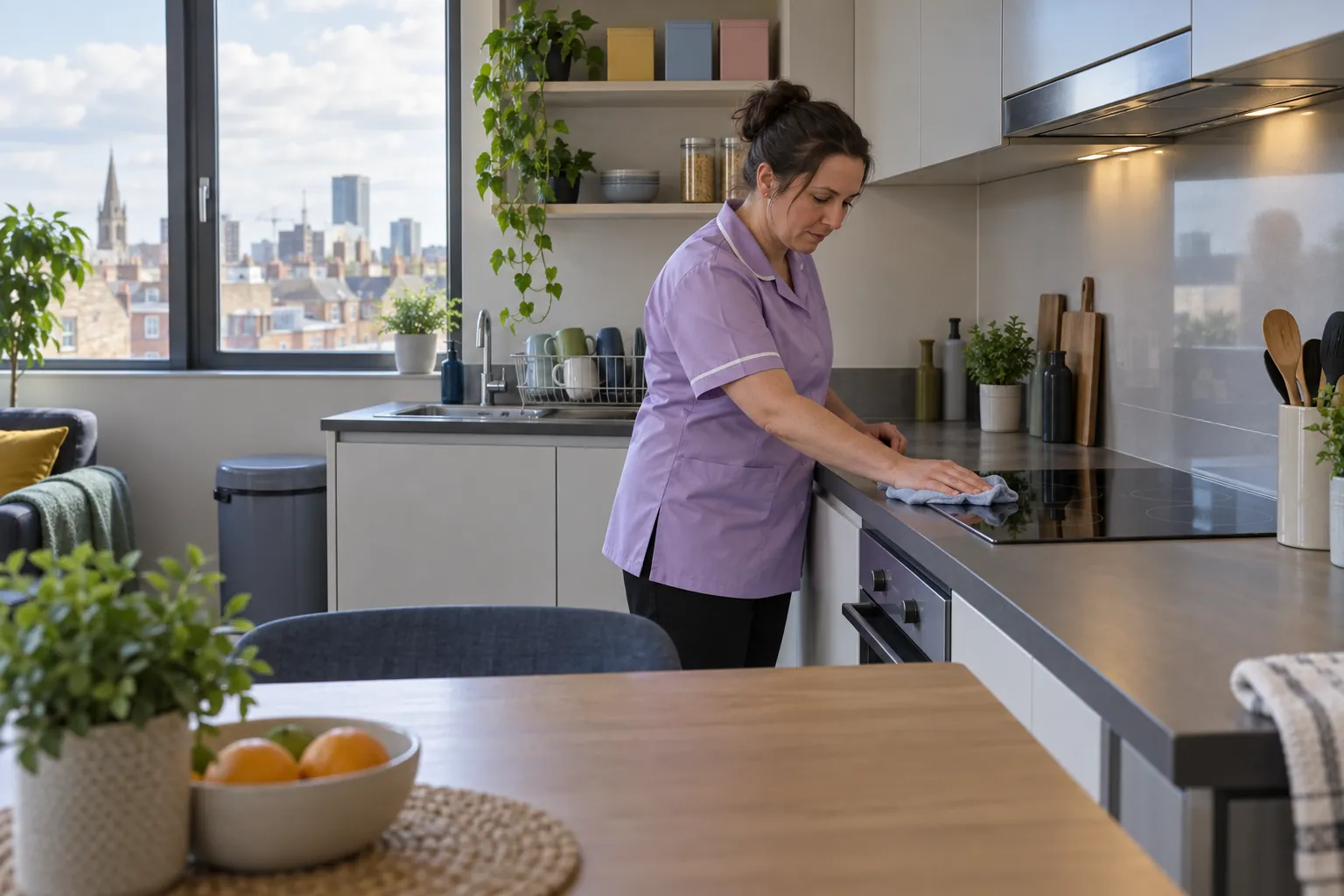
It is done around hundreds of people living at close quarters, most of them away from home for the first time, in buildings that must be emptied, cleaned and made ready again in a few weeks each summer. This guide is for the universities, operators and cleaning providers who run halls of residence and purpose-built student accommodation.
01
The standards that apply to student accommodation
Student accommodation comes in two main types: university accommodation in halls of residence, owned or managed by the university, and private student accommodation in purpose-built blocks (PBSA), run by specialist operators and property managers. Smaller shared student housing, a student house let by a private landlord, is closer to an ordinary house in multiple occupation and is not the subject of this guide. Both are residential buildings and workplaces at once, and several sets of rules touch the cleaning.
- Codes of practice. In England and Wales, most university halls follow the Universities UK / GuildHE Accommodation Code of Practice for Student Housing, and many private operators belong to the ANUK/Unipol National Codes. Both are approved under section 233 of the Housing Act 2004, which provides for codes of practice laying down standards for the management of houses in multiple occupation or of excepted accommodation, which includes student halls, and they set management standards that include the condition of rooms and shared areas, repairs and how residents are kept informed.
- HMO management rules. Where a shared building is a house in multiple occupation and not covered by an approved code, the HMO management regulations in England and in Wales require the manager to keep common parts clean, in good repair and reasonably clear of obstruction. In England, regulation 7 of the Management of Houses in Multiple Occupation (England) Regulations 2006 requires the manager to ensure that all common parts are maintained in good and clean decorative repair, maintained in a safe and working condition, and kept reasonably clear from obstruction. Scotland and Northern Ireland have their own HMO regimes.
- Housing standards. In England and Wales, the Housing Health and Safety Rating System under the Housing Act 2004 treats damp and mould growth, food safety, and personal hygiene, sanitation and drainage among the hazards assessed in residential buildings, which a landlord is expected to keep under control.
- Fire safety. The Regulatory Reform (Fire Safety) Order 2005 applies to the common parts in England and Wales, and in England the Fire Safety (England) Regulations 2022 add checks for multi-occupied residential buildings, including regular checks of fire doors in the common parts of buildings over 11 metres.
- The workplace. For the staff who clean, the Workplace (Health, Safety and Welfare) Regulations 1992 and the Control of Substances Hazardous to Health Regulations 2002 apply as in any building.
The tenancy or licence agreement sets out what the operator cleans and what each tenant must keep clean themselves. The cleaning specification should match it exactly, or the cleaning team will be asked to do work nobody is paying for.
02
What student accommodation cleaning covers
Across the types of student accommodation, the split between what the operator cleans and what students clean varies, but a typical building of student flats has these areas:
- Shared kitchens in cluster flats or on corridors: worktops, hobs, ovens, extractor hoods, sinks, fridges and freezers, cupboard fronts, bins and floors.
- Shared bathrooms and toilets, in older halls, and en-suite bathrooms in newer blocks, where residents usually clean their own.
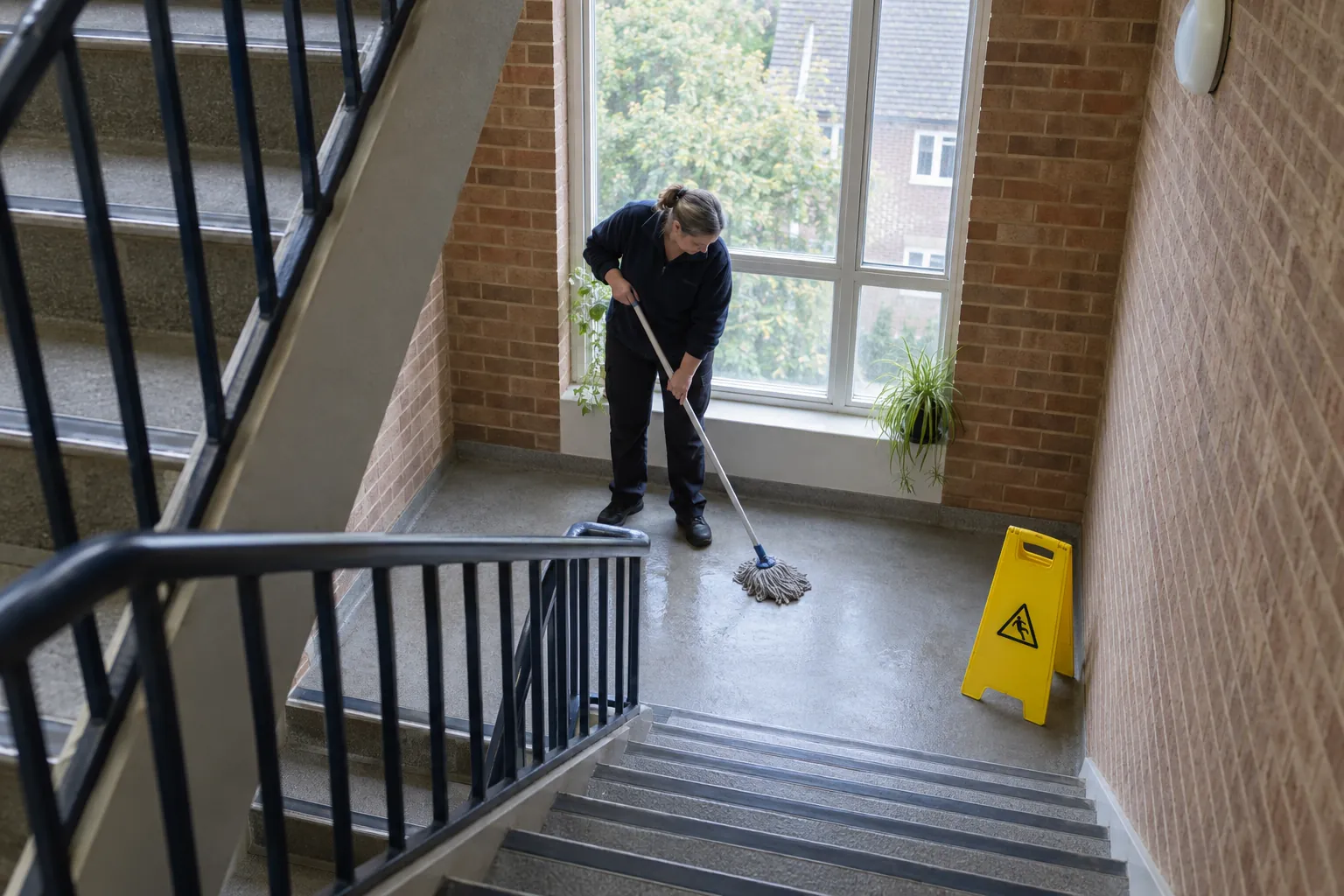
- Corridors, stairs and lifts: floors, handrails, door handles, lift buttons, and fire doors kept clear.
- Entrances and reception: matting, glass, the post room and parcel lockers.
- Common rooms and study spaces: furniture, tables, screens and floors.
- Laundry rooms: machines, floors, lint and litter.
- Gyms, cinema rooms and other amenities in many PBSA buildings.
- Bin stores and recycling areas: a frequent source of pests and complaints.
- Outside: courtyards, bike stores, paths and car parks.
Individual bedrooms are usually the resident's own living space during the tenancy, and are cleaned by the operator between lets, with an end-of-tenancy clean that gets each room ready for the next resident. Many operators include a clean of shared kitchens and bathrooms in the rent; others clean only the common areas and leave the flats to the students. Whichever applies, say so plainly in the welcome information, because most complaints about cleaning in halls start with a different assumption about who does what.
03
Cleaning during term
Term-time cleaning is about keeping shared spaces hygienic and safe, and a decent living environment for student living, not tidying up after residents. The work sits between domestic cleaning and commercial cleaning: residential rooms, at the scale of a commercial building. Whether it is done by an in-house team or bought as a cleaning service from a cleaning company, the cleaning schedule should look something like this for a large block:
- Daily: entrances, reception, lifts and high-touch points; common rooms and study spaces; bin stores checked and cleared; corridor floors in busy blocks.
- Several times a week: shared bathrooms and toilets in non-en-suite halls, and laundry rooms.
- Weekly or fortnightly: shared kitchens in cluster flats, where the rent includes it, covering hard surfaces, hobs, sinks, floors and the outside of appliances: a kitchen clean that removes grease and grime, not a tidy-up.
- Periodic: carpet cleaning in corridors, high-level dusting, extractor filters, windows and a deep clean of kitchens and bathrooms at the end of each term.
Set clear rules for shared kitchens. Cleaners clean surfaces that are clear; they do not wash residents' dishes or throw away their food, and housemates remain responsible for their own washing up. When a kitchen is too cluttered to clean, the cleaner should record it, with a photo, and the residence team should follow it up with the flat. A written notice after two missed cleans works better than an argument on the day.
Watch for the problems that are cheaper to catch early:
- Mould on bathroom ceilings, window reveals and behind furniture, often from drying laundry indoors and blocked vents. Clean it, report the cause, and give residents simple advice on ventilation.
- Pests: food waste in kitchens and bin stores attracts mice and flies. Report sightings straight away rather than cleaning round them.
- Fire safety: fire doors wedged open, bikes and rubbish in corridors, extractor hoods thick with grease, and overloaded sockets. Cleaners see these first and should have a route to report them the same day.
- Welfare: cleaners are sometimes the first to notice a resident who has not been seen, or a room in a very poor state. They should know who to tell in the residence life or welfare team, and should not be expected to deal with it themselves.
04
Room and flat inspections
Most operators inspect rooms and flats during the year, for maintenance, fire safety and hygiene. An inspection is a record that may later be relied on, so run it consistently.
- Give notice. The tenancy or licence agreement will say how much notice is needed; 24 hours in writing is the usual minimum, except in an emergency. Tell residents what the inspection is for.
- Use the same form everywhere. Room by room: cleanliness, damage, damp and mould, smoke detector present and not covered, fire door closing, windows and vents, prohibited items such as candles or extension leads where the rules forbid them.
- Take dated photographs of anything recorded as a problem, and of each room's general condition.
- Go in pairs where practical, and respect privacy: inspect the room, not the resident's belongings.
- Follow up. Maintenance faults raised as jobs, hygiene problems in writing to the flat with a date for a re-inspection, and fire safety issues dealt with straight away.
Inspection records matter most at the end of the year. Where a deposit is protected in a tenancy deposit scheme, a disputed deduction for cleaning or damage is decided on evidence, and a check-in record, mid-year inspections and a check-out record with dated photographs are what that evidence is.
05
End of term and the summer turnaround
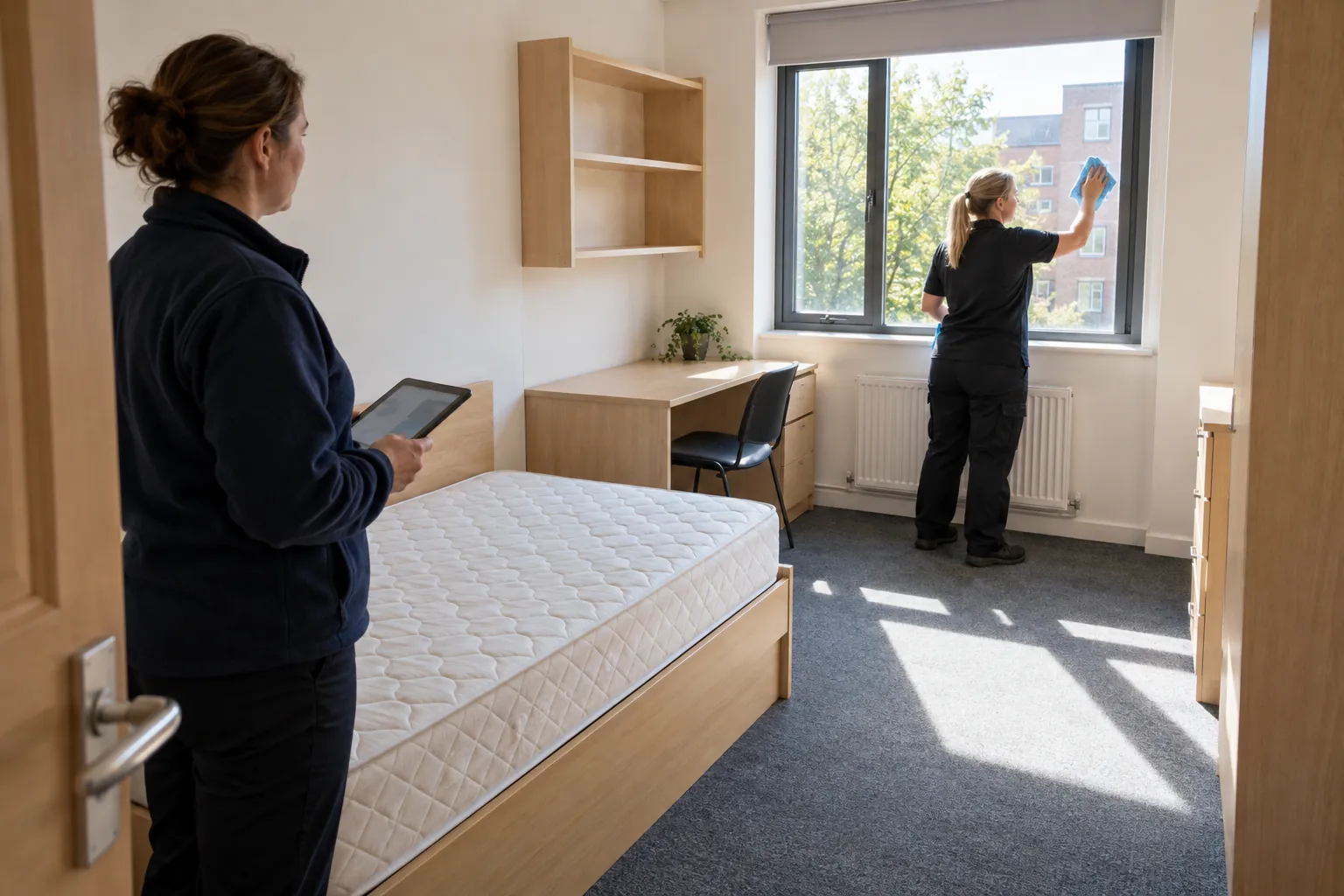
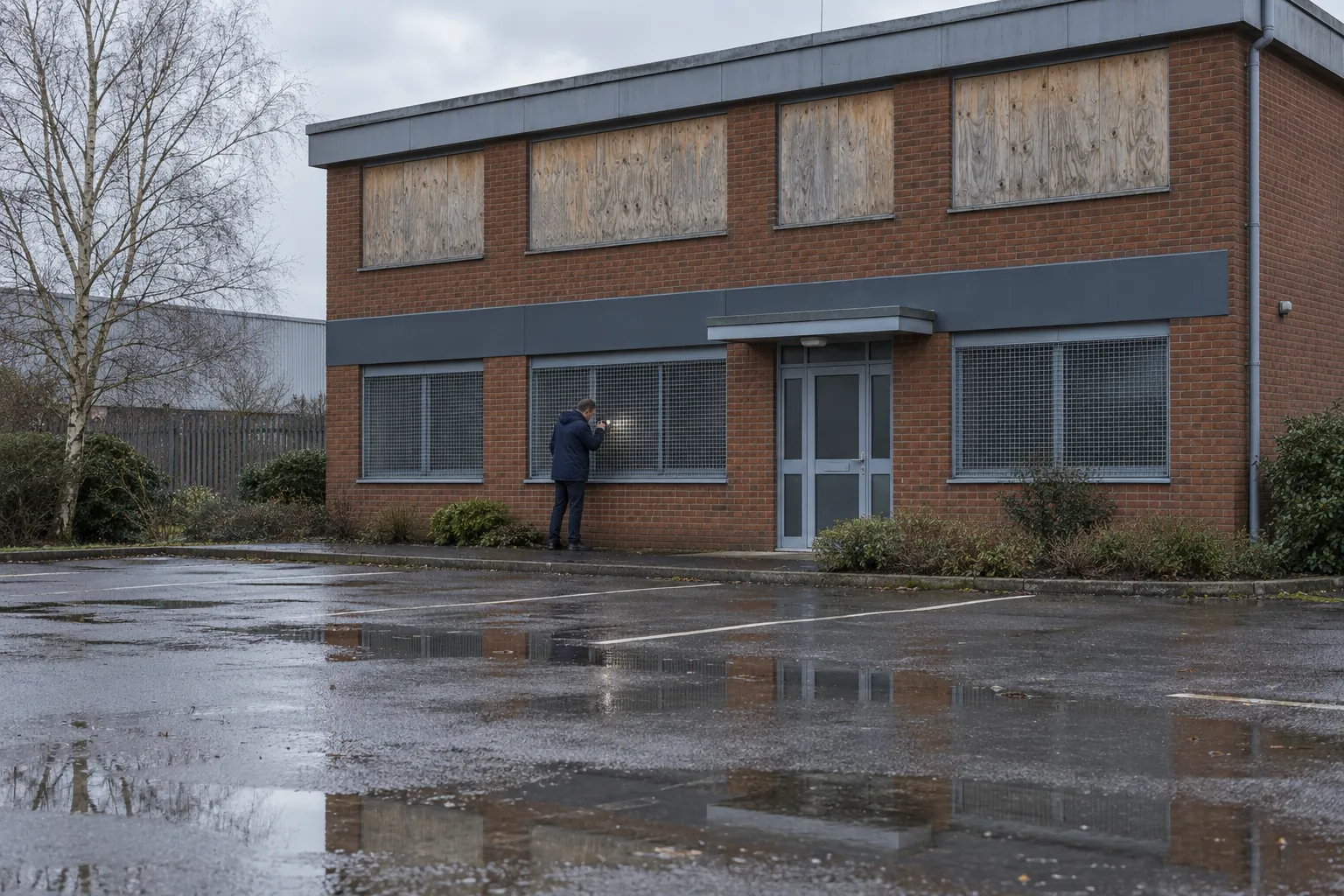
The summer turnaround is the hardest cleaning job in the student year. The end-of-term turnover empties hundreds of rooms over a few weeks, many are let for conferences, language schools or summer stays, and everything has to be cleaned to a high standard, repaired and inspected before the new intake arrives in September. It is closer to a building-wide void programme than to routine cleaning: end-of-tenancy cleaning across a whole student property at once, which is why many operators bring in extra professional cleaning teams for the summer peak. The void property inspection guide covers the inspection side.
A turnaround that runs to time usually has:
- A plan by block and floor, with the order of work, the dates rooms become available and the date each must be ready, including any summer lets in between.
- A check-out inspection of every room as residents leave, recording condition, damage and anything left behind.
- A clear sequence: clearance of rubbish and abandoned belongings first, then maintenance and redecoration, then the deep clean, so the cleaning team is not cleaning rooms that trades will return to.
- A deep clean specification for each room type, setting the level of cleanliness, the cleaning products and the cleaning process for a thorough cleaning: mattresses and bed bases checked, carpets cleaned, fridges and freezers defrosted and cleaned, ovens, hobs and extractors degreased, bathrooms descaled, windows, blinds and high-level surfaces done.
- A room-ready sign-off, by a supervisor who did not do the clean, before the room is released for letting; see the cleaning sign-off sheet guide.
- A final walk-round of the common areas, bin stores and outside before the move-in weekend.
The common failure is a backlog that is not visible until late August: rooms recorded as cleaned that were never inspected, and a list of repairs sitting in someone's inbox. Track progress by room, every day, against the plan.
06
Where the student accommodation record fails, and what SiteClara does about it
Operators with several blocks often run cleaning from spreadsheets and paper sheets pinned in kitchens. A resident complains that their kitchen has not been cleaned for three weeks; the cleaning contractor says it was cleaned on Tuesday; nobody can show which is right. In the summer, the room list shows every room ready while the supervisor knows the true figure is lower.
SiteClara puts a printed QR poster at each location – each kitchen, corridor, laundry and bin store, or each room during the turnaround – with an optional NFC tag behind it. Staff are enrolled by text and sign in with a link. They scan or tap on their own phone, with no app to install, see the scheduled checks due at that location and mark them done, or explain what stopped them, such as a kitchen too cluttered to clean, with a photo. A problem found, such as mould, a broken extractor or a wedged fire door, is reported there and goes onto the team's list of jobs until someone closes it.
The supervisor sees what is due, done and missed, and the queue of open jobs grouped by building and floor. A job can be escalated to the building manager, who can answer it. The operator and its cleaning contractor can share the same site. Each morning at 8am the approved report for the day before goes to nominated management or client contacts, showing what was reported, completed and still open, and how scheduled checks went.
07
Further reading, and a list to take away
Universities UK publishes the Accommodation Code of Practice for Student Housing with GuildHE, and Unipol publishes the ANUK/Unipol National Codes for student accommodation. The Government publishes guidance on the Housing Health and Safety Rating System and on HMO management, and on the Fire Safety (England) Regulations 2022. The Health and Safety Executive publishes guidance on COSHH. The British Institute of Cleaning Science (BICSc) publishes training and cleaning standards for cleaning operatives, and is a useful reference when setting the standard for student accommodation cleaners or comparing student accommodation cleaning services.
Before the next academic year, check that:
- the cleaning specification matches exactly what the tenancy or licence agreement says the operator cleans;
- residents are told plainly what is cleaned for them and what is their job;
- shared kitchens have a rule for clutter, with a record and a follow-up;
- cleaners know how to report mould, pests, fire safety problems and welfare concerns the same day;
- room inspections use one form, with notice given and dated photographs;
- the summer turnaround has a plan by block, a clear sequence and a room-ready sign-off;
- progress is tracked by room every day, not reported at the end.
Sources
Every document this guide quotes or links to, in the order it first cites them.
- Section 233 of the Housing Act 2004 legislation.gov.uk
- Regulation 7 of the Management of Houses in Multiple Occupation (England) Regulations 2006 legislation.gov.uk
- Regulatory Reform (Fire Safety) Order 2005 legislation.gov.uk
- Fire Safety (England) Regulations 2022 legislation.gov.uk
- Control of Substances Hazardous to Health Regulations 2002 legislation.gov.uk
Related guides
 CleaningCommunal area cleaning: what it covers, how often, and how to show it was doneWhat communal area cleaning should cover in blocks of flats and shared buildings, how often, who pays through the service charge, and how to show it was done.
 Premises and facilities managementVoid property inspection: what to check, how often, and what to recordHow to inspect an empty commercial or residential property: security, weather, water, fire and the insurer's conditions, and the record that shows it was done.
 CleaningCleaning sign-off sheet: who signs it, and what a signature meansWhat a cleaning sign-off sheet should record in kitchens, food areas, rooms and end-of-clean handovers, who should sign it, and what each signature proves.
 Fire and water checksCommunal fire door checks in blocks of flatsWhat the Fire Safety (England) Regulations 2022 require of communal fire doors and flat entrance doors, who carries out the checks, and how to record them.