Cleaning
Student accommodation cleaning: halls, colleges and the summer changeover
In Australian student accommodation, the operator's own team or a professional cleaning contractor usually cleans the communal areas, such as shared kitchens, bathrooms, corridors and common rooms, while each student keeps their own bedroom and ensuite clean during the agreement.
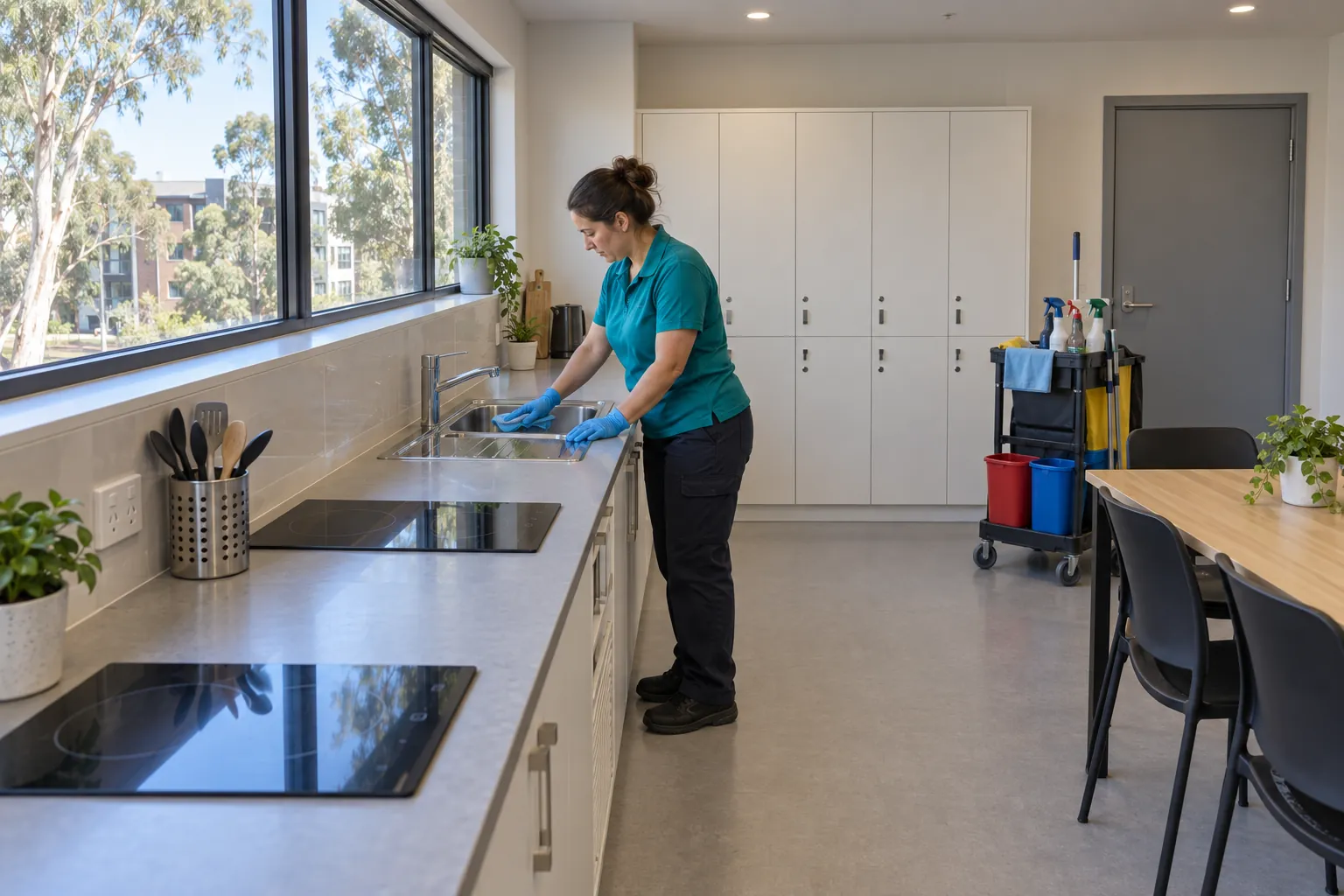
The work is done around hundreds of young people living at close quarters, many of them international students a long way from home, in buildings that are largely emptied, cleaned and made ready again over the summer break. This guide is for the universities, residential colleges, purpose-built student accommodation operators and cleaning contractors who look after them.
01
The rules that apply to student accommodation in Australia
Student accommodation in Australia comes in three broad forms: halls of residence and residential colleges on or near campus, run by a university or an affiliated college; purpose-built student accommodation (PBSA), privately owned blocks of studios and shared apartments run by specialist operators; and smaller shared houses and rooming houses let to students by private landlords. There is no national code for cleaning any of them. Instead, several sets of state and territory law touch the work, and which ones apply depends on where the building is and how the rooms are let.
- Work health and safety. Every state and territory except Victoria has adopted the model WHS laws. In Queensland, for example, section 41 of the Work Health and Safety Regulation 2011 (Qld) requires a person conducting a business or undertaking (PCBU) to provide adequate facilities for workers and to maintain them so they are "in good working order" and "clean, safe and accessible". The model Code of Practice: Managing the work environment and facilities (the NSW edition, August 2019) adds that "the work environment must be maintained so that it remains in a clean and safe condition". Those duties protect the cleaners and the residence staff; the building is their workplace.
- Victoria. A residence in Melbourne or anywhere else in Victoria is different, because Victoria still has its own Occupational Health and Safety Act 2004 and the OHS Regulations 2017, with WorkSafe Victoria's Compliance code: Workplace facilities and the working environment (December 2023) as the practical guidance.
- Tenancy law. Each state has its own residential tenancies or rooming accommodation law, and student rooms fall in and out of it. In Queensland, section 33 of the Residential Tenancies and Rooming Accommodation Act 2008 (Qld) takes most accommodation within a university campus's boundary, provided by the university or on a not-for-profit basis, out of the Act, although the rental bond provisions still apply where a bond is paid. Off-campus PBSA with shared kitchens is often rooming accommodation under the same Act, and section 247 then requires the provider to take reasonable steps to keep each resident's room, the common areas and their facilities safe, in good repair and, subject to any agreement about cleaning, clean.
- Fire safety. Fire safety maintenance is state law too: essential safety measures in Victoria, the annual fire safety statement in NSW, and in Queensland the Building Fire Safety Regulation 2008 (Qld), which says a person must not place a thing within 2 metres of a final exit outside a building, or on an evacuation route where it would unduly hinder people leaving in an emergency.
- Cleaning chemicals. The model Code of Practice: Managing risks of hazardous chemicals in the workplace warns that supermarket cleaning products used "in a way or quantity which is not consistent with home use" can carry greater risks, and tells a PCBU to obtain the safety data sheet in that case.
The rest is contract. The residential agreement, licence or lease sets out what the operator cleans and what each resident must keep clean. The cleaning contract or in-house specification should match it exactly, or the cleaning team will be asked to do work nobody has agreed to pay for.
02
What student accommodation cleaning covers
The split between what the operator cleans and what residents clean varies from one building to the next, but a typical PBSA block or residential college has these areas:
- Shared kitchens in cluster apartments, pods or on each floor: benchtops, cooktops, ovens, rangehoods, sinks, fridges, cupboard fronts, bins and floors.
- Shared bathrooms and toilets in older halls and colleges, and ensuites in newer blocks, which residents usually clean themselves during semester; the toilet cleaning checklist covers the shared ones.
- Corridors, stairs and lifts: floors, handrails, door handles, lift buttons, and fire doors and exits kept clear.
- Foyer and reception: entry matting, glass, the parcel room and lockers.
- Common rooms, study rooms and music rooms: furniture, tables, screens and floors.
- Laundries: machines, lint filters where the contract includes them, benches and floors.
- Gyms, games rooms, cinema rooms and rooftop terraces in many PBSA buildings.
- Bin rooms and recycling areas, including the mixed recycling and general waste bins that residents often muddle, and the most common source of pests and complaints.
- Outside: courtyards, barbecue areas, bike storage, paths and the car park.
Bedrooms and studios are the resident's own living space during the agreement, cleaned by the operator between residents with an end-of-lease clean that gets each room ready for the next one. Some operators and many catered colleges include a regular clean of shared kitchens and bathrooms in the fee; others clean only the common areas and leave the apartments to the students. Queensland's rooming accommodation rules show why the line matters: under section 247 of the Act a provider can agree with residents that they clean a common area only where it is used by that resident and a minority of the other residents, such as a kitchen shared by four rooms. Whatever applies, say so plainly in the welcome pack and on move-in day, because most complaints about cleaning in student accommodation start with a different assumption about who does what.
03
Cleaning during semester
Semester cleaning is about maintaining a hygienic and safe living environment in the shared spaces, not tidying up after residents. The work sits between domestic and commercial cleaning: residential rooms at the scale of a commercial building. Whether it is done by an in-house team or a cleaning contractor, the schedule for a large block usually looks something like this:
- Daily: foyer, reception, lifts and high-touch points; common rooms and study rooms; bin rooms checked and cleared; corridor floors vacuumed or mopped in busy blocks.
- Several times a week: shared bathrooms and toilets in halls without ensuites, and laundries.
- Weekly or fortnightly: shared apartment kitchens where the fee includes it, covering clear benchtops, cooktops, sinks, floors and the outside of appliances, a proper degrease rather than a wipe over.
- Periodic: carpet cleaning in corridors, high dusting, rangehood filters, windows, and a deep clean of kitchens and bathrooms at the end of each semester.
Set clear rules for shared kitchens. Cleaners clean surfaces that are clear; they do not wash residents' dishes or throw out their food. When a kitchen is too cluttered to clean, the cleaner should record it with a photo, and the residential life team should follow it up with the apartment. A written notice after two missed cleans works better than an argument in the kitchen.
Watch for the problems that are cheaper to catch early:
- Gastro. Viral gastroenteritis spreads quickly through shared kitchens and bathrooms. NSW Health's viral gastroenteritis fact sheet tells anyone cleaning up vomit or faeces to wear gloves and a mask, remove solid material with disposable paper towels or rags sealed in a plastic bag, clean the soiled surface with hot water and detergent and let it dry, and wash their hands after taking the gloves off. It also says people with gastro should not prepare food for others until 48 hours after symptoms stop, which matters in a shared kitchen. Keep a spill kit on each floor and log each clean-up.
- Mould on bathroom ceilings, window frames and behind furniture, often from drying washing indoors and closed windows in winter. Clean it, report the cause, and give residents simple advice on ventilation.
- Pests: food waste in kitchens and bin rooms brings cockroaches, ants and rodents. Report sightings straight away rather than cleaning round them.
- Fire safety: fire doors propped open, bikes and boxes in corridors, rubbish left by a final exit, rangehoods thick with grease. Cleaners see these first and need a route to report them the same day, because in Queensland, for example, the occupier must not let an evacuation route be obstructed.
- Welfare: cleaners are sometimes the first to notice a resident who has not been seen, or a room in a very poor state. They should know who to tell in the residential life or wellbeing team, often a residential adviser (RA), and should not be expected to deal with it themselves.
Early-morning and late cleaning in a quiet residential block is close to the model code's own example of isolated work: a cleaner working by themselves at night in a city office building, who may be isolated even if other people are close by. Plan how a lone cleaner calls for help, and check in on them.
04
Room and apartment inspections
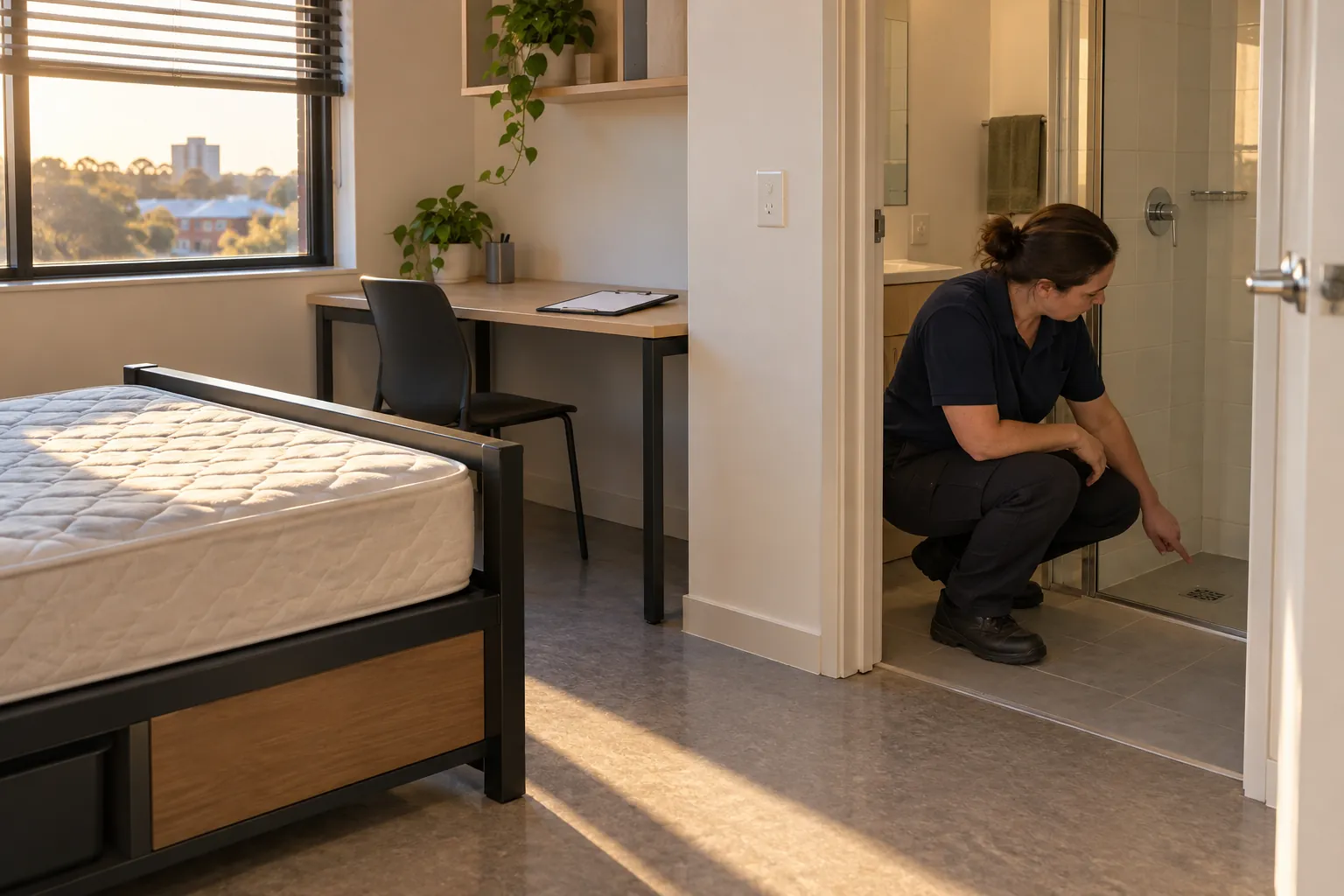
Most operators inspect rooms and apartments during the year, for maintenance, fire safety and hygiene. An inspection is a record that may later be relied on in a bond dispute, so run it consistently and within the notice rules of the state's law and the residential agreement.
Queensland's rooming accommodation rules are a clear worked example of how tightly entry can be regulated. Under the Residential Tenancies and Rooming Accommodation Act 2008, a provider may enter a resident's room to inspect it at a reasonable time with at least 48 hours' written notice, and not more than once each month (section 258); may enter to clean the room with at least 24 hours' written notice (section 259), and a notice covering several rooms can be posted on a notice board at least 48 hours before the first entry; and may agree regular cleaning times with the resident in the agreement itself (section 257). Other states and territories set their own rules, and on-campus accommodation outside the tenancy law follows the university's own residential agreement.
- Give notice in writing, in the form and time the law or the agreement requires, and tell residents what the inspection is for.
- Use the same form everywhere. Room by room: cleanliness, damage, damp and mould, smoke alarm present and uncovered, fire door closing, windows and vents, and prohibited items such as candles or extra heaters where the house rules forbid them.
- Take dated photos of anything recorded as a problem, and of each room's general condition.
- Go in pairs where practical, and respect privacy: inspect the room, not the resident's belongings.
- Follow up. Maintenance faults raised as jobs, hygiene problems in writing to the apartment with a date for a re-inspection, and fire safety problems dealt with straight away.
Inspection records matter most at the end of the year. A claim on a bond for cleaning or damage is decided on evidence, and an entry condition report, mid-year inspections and a final inspection with dated photos are what that evidence is.
05
The end of semester and the summer changeover
The summer changeover is the hardest cleaning job in the student year. After exams finish in November, hundreds of rooms empty over a few weeks. Some are relet for summer school, short stays or conference guests, and every room has to be cleaned, repaired and inspected before residents arrive for Orientation Week and semester one in February. The mid-year break in June and July is a smaller version of the same job, with semester two arrivals, many of them international students, landing within days of each other. It is closer to a building-wide vacancy program than to routine cleaning; the vacant property inspection guide covers the inspection side.
A changeover that runs to time usually has:
- A plan by building and floor, with the order of work, the date each room becomes free, the date it must be ready, and any summer lets in between.
- A final inspection of every room as residents leave, recording condition, damage and anything left behind.
- A clear sequence: rubbish and abandoned belongings cleared first, then maintenance and painting, then the deep clean, so cleaners are not cleaning rooms that trades will come back to.
- A deep clean specification for each room type: mattresses and bed bases checked, carpets cleaned, fridges and freezers defrosted and cleaned, ovens, cooktops and rangehoods degreased, bathrooms descaled, windows, blinds, air-conditioner filters and high surfaces dusted, and every floor vacuumed or mopped last.
- A room-ready sign-off by a supervisor who did not do the clean, before the room is released for letting; see cleaning supervisor duties.
- A final walk-through of the common areas, bin rooms and outside areas before move-in weekend.
Summer heat changes the job too. Bin rooms and empty fridges left closed for weeks turn quickly, and cleaners working through an Australian summer in rooms with the air-conditioning off need water, breaks and a plan for hot days. The common failure is a backlog nobody sees until late January: rooms recorded as cleaned that were never inspected, and a list of repairs sitting in someone's inbox. Track progress by room, every day, against the plan.
06
Where the student accommodation record fails, and what SiteClara does about it
Operators with several buildings often run cleaning from spreadsheets and a cleaning log sheet taped inside the kitchen cupboard. A resident complains that their kitchen has not been cleaned for three weeks; the contractor says it was done on Tuesday; nobody can show which is right. In January the room list shows every room ready, while the supervisor knows the true figure is lower.
SiteClara puts a printed QR poster at each location, such as each kitchen, corridor, laundry and bin room, or each room during the changeover, with an optional NFC tag behind it. Cleaners and residence staff sign in with a link and scan or tap on their own phone, with no app to install. They see the scheduled checks due at that location and mark each one done, or explain what stopped them, such as a kitchen too cluttered to clean, with a photo when one is asked for. A problem found there, such as mould, a broken rangehood or a propped-open fire door, is reported on the spot and goes onto the team's list of open jobs until someone closes it.
The supervisor sees what is due, done and missed, and the open jobs grouped by building and floor. A job can be escalated to the building manager, who can answer it. The operator and its cleaning contractor can share the same site. Each morning the approved report for the day before goes to nominated management or client contacts, showing what was reported, completed and still open, and how the scheduled checks went.
07
Questions people ask
Who cleans what in student accommodation?
It depends on the residential agreement, but in Queensland rooming accommodation the law sets the default. Under section 247 of the Residential Tenancies and Rooming Accommodation Act 2008 (Qld), the provider must take reasonable steps to keep each resident's room, the common areas and their facilities clean, subject to any agreement with the resident about cleaning. Under section 253, the resident must keep their own room and inclusions clean, having regard to their condition at the start of the agreement, and leave them, as far as possible, in the same condition at the end, fair wear and tear excepted. On-campus accommodation outside the Act follows the university's own residential agreement.
Can a resident have a partner or friend to stay in student accommodation?
Usually, within the house rules. In Queensland rooming accommodation, section 247 of the Residential Tenancies and Rooming Accommodation Act 2008 (Qld) says the provider must not unreasonably restrict a resident's guests in visiting them, and section 268 lets the provider make house rules about guests. The resident must make sure their guests do not interfere with other residents' peace, comfort or privacy (section 253). On-campus halls and colleges set their own guest rules in the residential agreement.
What are residents not allowed to do in student accommodation?
The residential agreement and house rules list the details, but in Queensland rooming accommodation the Residential Tenancies and Rooming Accommodation Act 2008 (Qld) sets the baseline. Section 253 says a resident must not keep an animal without authorisation, must not intentionally or recklessly damage the premises or let guests do so, and must not keep their room in a condition that gives rise to a fire or health hazard; the Act's examples of a fire hazard are letting newspapers build up and blocking access to the room. Section 268 lets the provider make house rules about shared facilities, parking, alcohol and drugs, smoking, noise, pets and guests.
How much do cleaners get paid in Australia?
Cleaners employed by a cleaning contractor are covered by the Cleaning Services Award 2020 (MA000022), which applies to the business of providing cleaning services under a contract. Clause 15 of the award sets the minimum weekly and hourly rates for each classification level, and those rates change over time, so read the current version of the award. A cleaner employed directly by a school, university or residence operator is paid under whatever award or enterprise agreement covers that employer instead.
08
Further reading, and a list to take away
Start with the WHS regulations for your state or territory (the Work Health and Safety Regulation 2011 (Qld) is one example) and the model codes of practice on managing the work environment and facilities and managing risks of hazardous chemicals, or in Victoria WorkSafe Victoria's Compliance code: Workplace facilities and the working environment. For tenancy rules, read your state's residential tenancies or rooming accommodation law and the fair trading or consumer affairs guidance that goes with it; in Queensland that is the Residential Tenancies and Rooming Accommodation Act 2008. For gastro, your state health department's fact sheets, such as NSW Health's viral gastroenteritis fact sheet, are the reference.
Before the next academic year, check that:
- you know which tenancy law, if any, covers each building, and what it says about cleaning and entry;
- the cleaning specification matches exactly what the residential agreement says the operator cleans;
- residents are told plainly what is cleaned for them and what is their job;
- shared kitchens have a rule for clutter, with a record and a follow-up;
- each floor has a spill kit, and cleaners know the gastro clean-up routine;
- cleaners know how to report mould, pests, fire safety problems and welfare concerns the same day;
- exits and corridors are checked for obstructions on every round;
- room inspections use one form, with the right notice and dated photos;
- the summer changeover has a plan by building, a clear sequence and a room-ready sign-off;
- progress is tracked by room every day, not reported at the end.
Sources
Every document this guide quotes or links to, in the order it first cites them.
- Work Health and Safety Regulation 2011 (Qld) legislation.qld.gov.au
- Code of Practice: Managing the work environment and facilities safework.nsw.gov.au
- Occupational Health and Safety Act 2004 legislation.vic.gov.au
- Compliance code: Workplace facilities and the working environment worksafe.vic.gov.au
- Residential Tenancies and Rooming Accommodation Act 2008 (Qld) legislation.qld.gov.au
- Building Fire Safety Regulation 2008 (Qld) legislation.qld.gov.au
- Code of Practice: Managing risks of hazardous chemicals in the workplace safework.nsw.gov.au
- Viral gastroenteritis fact sheet health.nsw.gov.au
- Cleaning Services Award 2020 (MA000022) library.fairwork.gov.au
Related guides
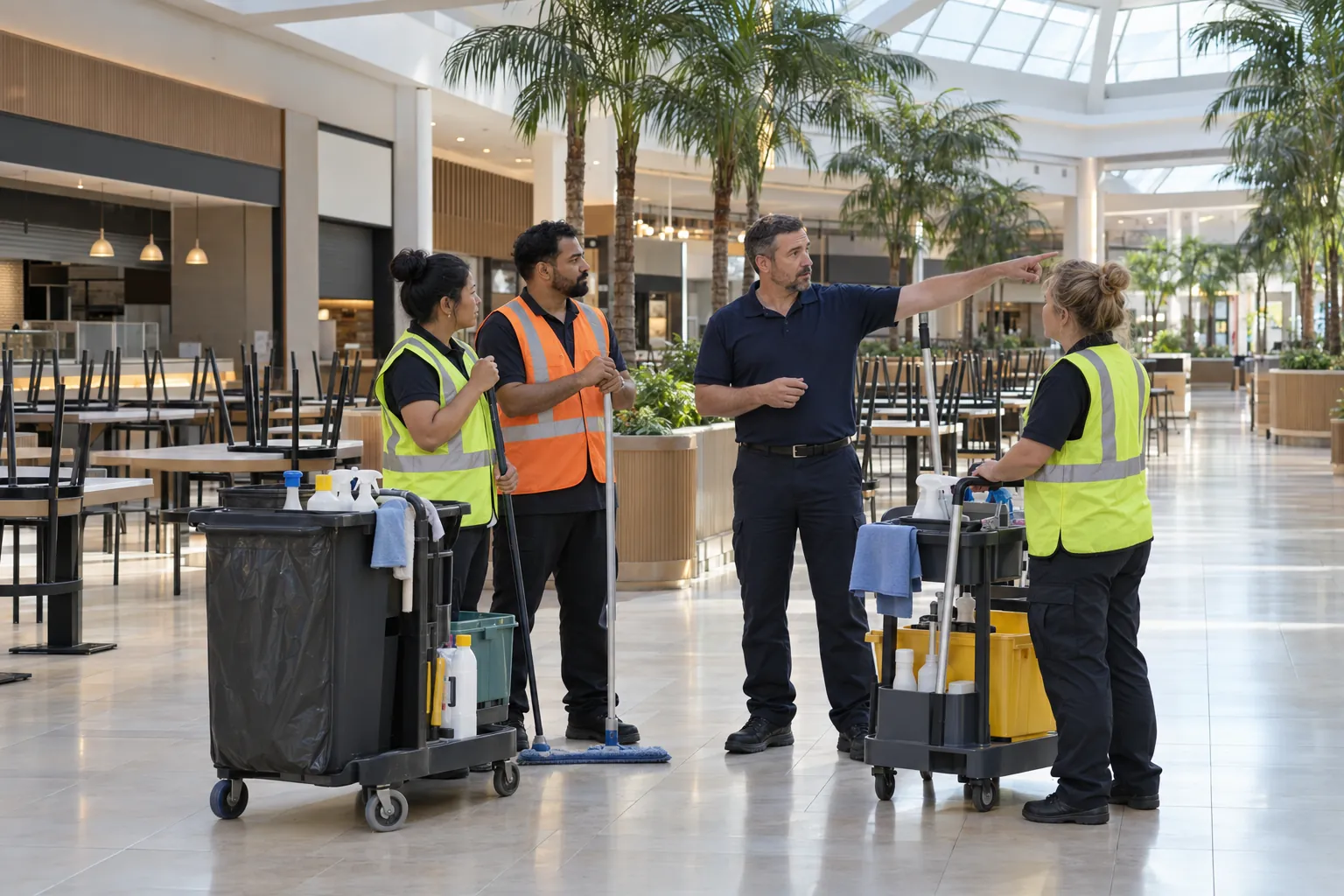 CleaningCleaning supervisor duties: what the role involves in Australia, and what good looks likeWhat a cleaning supervisor does in Australia: the Cleaning Services Award, WHS duties, a typical shift, managing the team, checking the work and reporting.
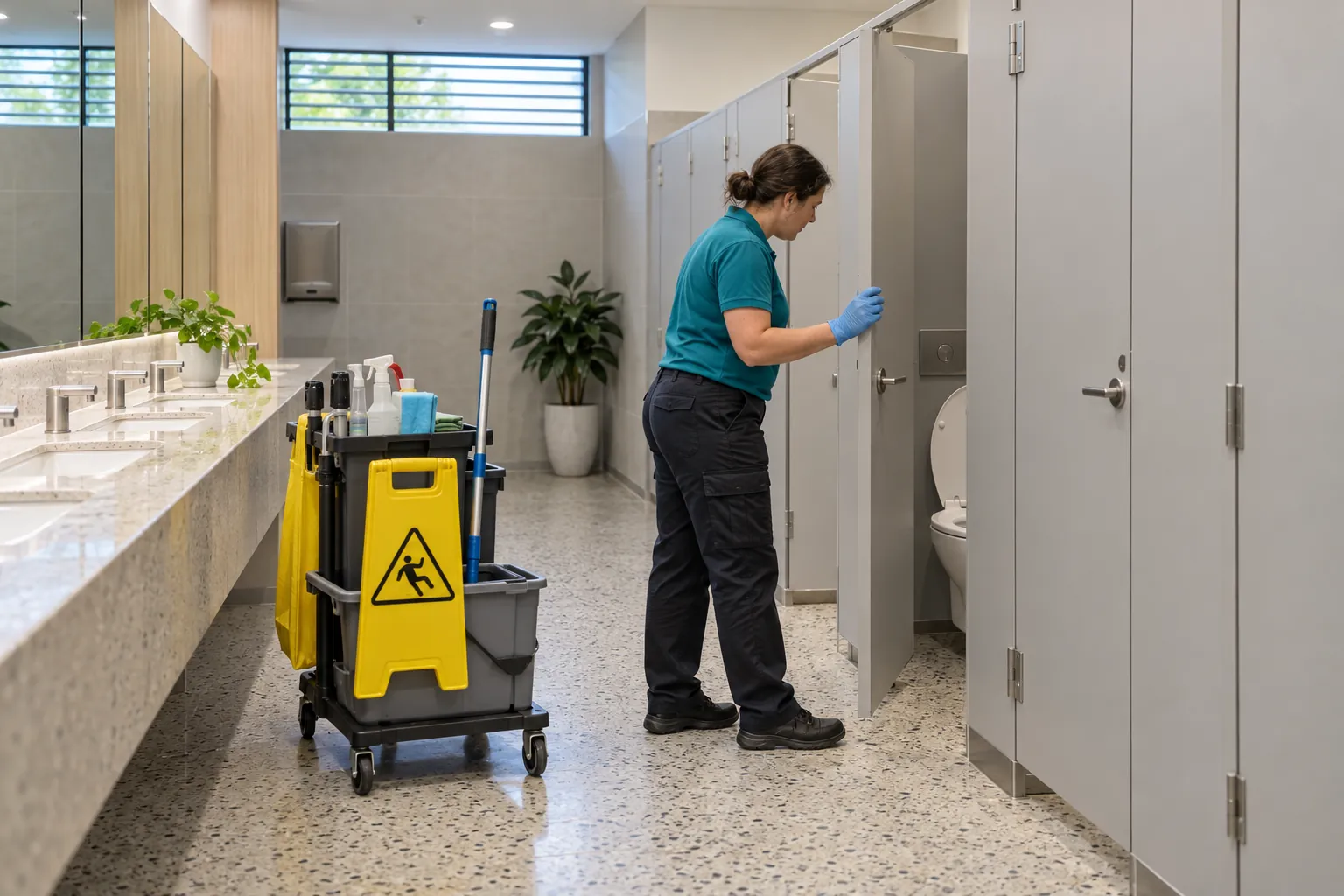 CleaningToilet cleaning checklist: what to check, how often, and how to make the record believableWhat a toilet cleaning checklist should cover in Australian workplaces, how often to check, the WHS and OHS duties behind it, and how to make the record believable.
 CleaningCleaning log sheet: what to record, who signs it, and what a signature provesWhat a cleaning log sheet should record in Australian workplaces and food businesses, the WHS and food safety rules behind it, and what a signature proves.
 Premises and facilities managementVacant property inspection: what to check, how often, and what to recordHow to inspect a vacant commercial building in Australia: security, water, fire safety, asbestos, the insurer's unoccupancy conditions and the record of each visit.