Cleaning
Office cleaning checklist: what to clean, how often, and how to show it was done
An office cleaning checklist lists the cleaning tasks for each area of an office, from the lobby and restrooms to workstations and the breakroom, with how often each one is done and who does it.
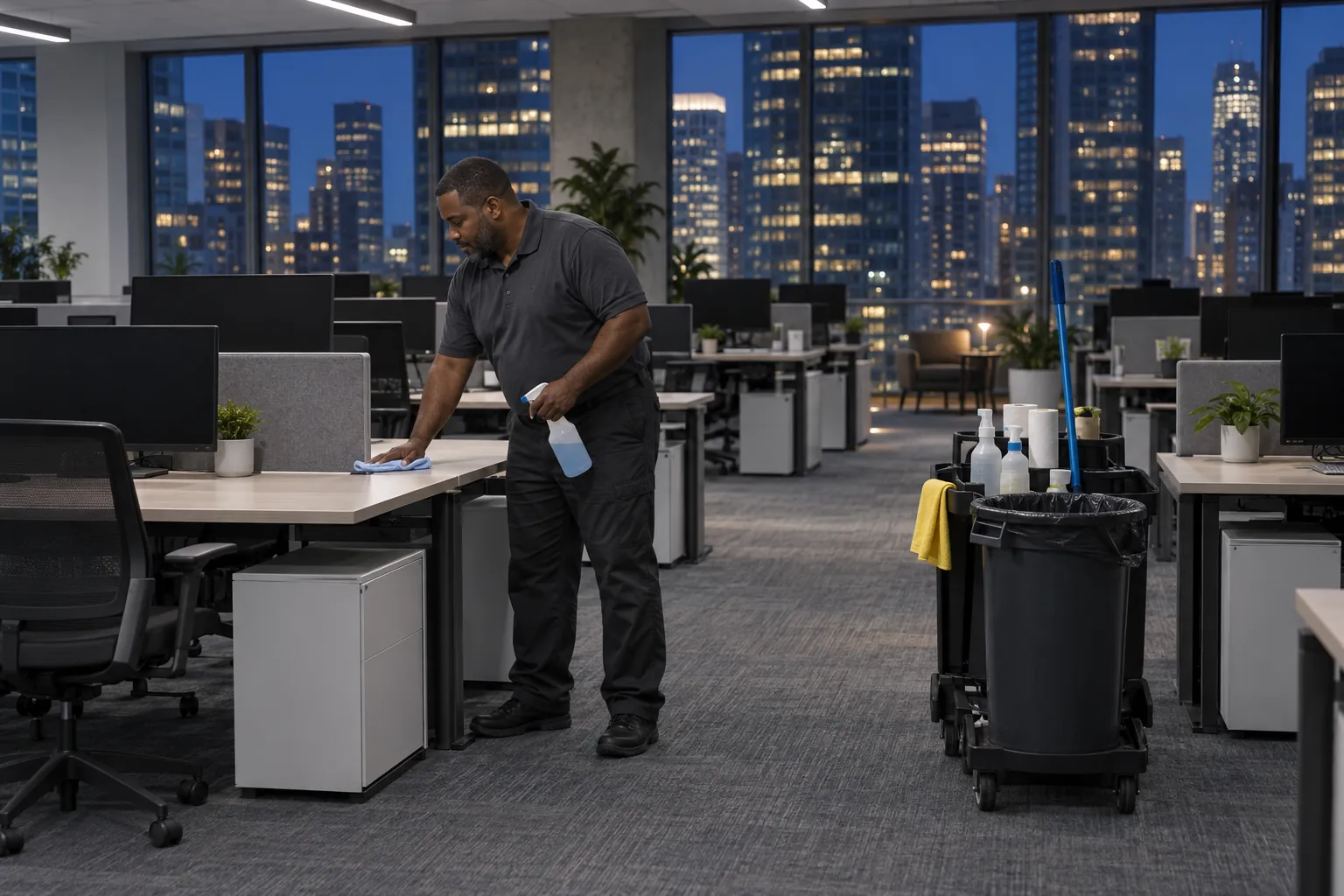
It turns "keep the office clean" into work a janitor can do and a supervisor can check. This guide covers the federal rules behind it, a checklist by area, what belongs daily, weekly, monthly and on the periodic calendar, and how to keep a record a facility manager or tenant will believe.
01
The rules behind an office cleaning checklist
No federal regulation requires an office to post a written cleaning checklist. The rules set the standard of cleanliness and sanitation, and a checklist is a common way for employers, property managers and janitorial contractors to show they are meeting it. For an office, that standard comes mainly from two OSHA general industry regulations.
- 29 CFR 1910.22, Walking-Working Surfaces: general requirements. Paragraph (a)(1) requires that "all places of employment, passageways, storerooms, service rooms, and walking-working surfaces are kept in a clean, orderly, and sanitary condition." Paragraph (a)(3) requires surfaces to be kept free of hazards such as "leaks, spills, snow, and ice," and (d)(2) says a hazardous condition must be corrected or repaired before an employee uses the surface again, or guarded until it is.
- 29 CFR 1910.141, Sanitation. "All places of employment shall be kept clean to the extent that the nature of the work allows" (a)(3)(i); waste receptacles must not leak and must be kept sanitary, and refuse must be removed "in such a manner as to avoid creating a menace to health" (a)(4); an enclosed workplace must be maintained to prevent the entrance or harborage of rodents, insects and other vermin (a)(5); and washing facilities "shall be maintained in a sanitary condition" (d)(1), with running water, hand soap and individual towels or air dryers (d)(2). The same standard says no employee may be allowed to eat or drink in a toilet room or any area exposed to a toxic material (g)(2), so wherever staff do eat, usually a breakroom, it needs a place on the checklist.
Cleaning has to be done safely too. The chemicals a night crew carries fall under OSHA's Hazard Communication standard (29 CFR 1910.1200): every employer with hazardous chemicals in the workplace must have labels and safety data sheets for exposed workers and train them to handle the chemicals appropriately. And a janitor's cart parked in a corridor is covered by the exit routes standard, 29 CFR 1910.37, which says "exit routes must be free and unobstructed" and that no materials or equipment may be placed in one, even temporarily.
In a leased office the property manager usually runs janitorial for the common areas, and often for tenant spaces under the lease. When a janitorial contractor or other commercial cleaning company does the work, the checklist is normally part of the janitorial scope of work, and it becomes the list the service is judged against.
02
The office cleaning checklist, area by area
A good checklist is organized the way the crew walks the building, not the way the contract was typed. Most office space divides into the same areas, whatever its size. For each, write tasks a person can do and a supervisor can check: "vacuum carpeted walkways and under chair mats" rather than "floors".
- Lobby and reception: entrance matting vacuumed or shaken out, hard floors dust-mopped and damp-mopped, glass entry doors and sidelights spot-cleaned, reception desk and visitor seating wiped, trash emptied. This is where dirt enters the building, so it sets the standard for every floor above.
- Open office and workstations: trash and recycling emptied and liners replaced, cleared desk surfaces wiped, carpet vacuumed in traffic lanes, chair mats cleaned, partitions and cubicle tops dusted.
- Private offices: the same as open areas, with a decision written down about locked doors and desks covered in papers.
- Conference rooms: tables and chairs wiped, whiteboards cleaned and markers left, remotes, phones and touch panels wiped, trash removed, chairs set back.
- Restrooms: toilets, urinals, sinks, counters, mirrors and partitions cleaned; soap, paper towels and toilet tissue restocked, since handwashing depends on soap and a clean towel or air dryer; floors mopped; odors and leaks reported. Many offices keep a restroom cleaning log for the checks between cleanings.
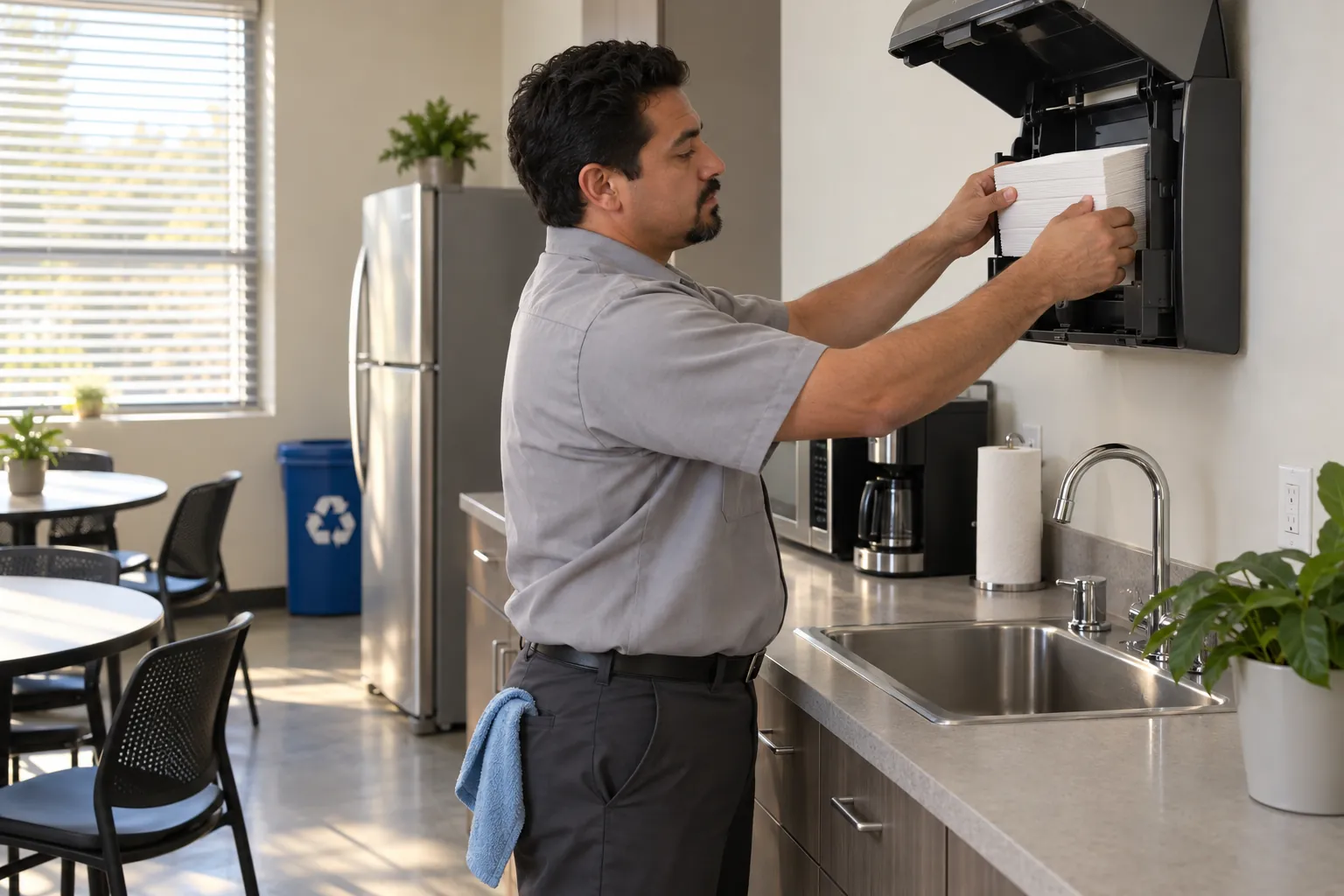
- Breakrooms and kitchenettes: counters, sinks and faucets, microwaves, coffee makers, refrigerator handles and tables cleaned, floors mopped, trash and recycling removed. The breakroom cleaning checklist goes into more detail.
- Corridors, stairwells and elevators: floors, handrails, elevator buttons and cab interiors, door push plates and kick plates, drinking fountains.
- Copy and mail rooms: counters and the outside of shared equipment wiped with a suitable product, paper waste and packaging removed.
- Waste and recycling: bins emptied, liners replaced, recycling kept separate as the building's program requires, and everything taken to the dock or trash room.
- Low-use spaces: storerooms, wellness and lactation rooms, and training rooms on a slower cycle; server and telecom closets only as the owner allows, since many are off limits to janitorial.
High-touch surfaces deserve their own line rather than being folded into "wipe surfaces". The CDC's guidance, When and How to Clean and Disinfect a Facility, says to "clean high-touch surfaces regularly" and names examples such as door handles, stair rails, elevator buttons, touchpads, restroom fixtures and desks. In an office that list usually adds light switches, faucet handles, refrigerator and microwave handles, and shared keyboards.
03
Daily, weekly, monthly and periodic tasks
Frequency follows foot traffic and risk, not habit. An office of 300 people and one of 15 need the same list of areas and very different frequencies. As a starting point for a typical office cleaned five nights a week:
- Daily: empty trash and recycling; clean and restock restrooms; clean breakroom counters, sinks and appliance exteriors; wipe high-touch surfaces; vacuum lobby, traffic lanes and visible debris; dust-mop and spot-mop hard floors; spot-clean entry glass; reset and wipe conference rooms.
- Through the day: restrooms and breakrooms fail first. In a busy building a day porter checks and restocks them after the morning rush and again after lunch, deals with spills as they happen, and keeps the lobby presentable.
- Weekly: vacuum all carpet wall to wall, including under desks where it can be reached; damp-mop all hard floors; dust horizontal surfaces such as window sills, partitions, file cabinets and picture frames; clean interior glass; wipe the inside of microwaves; clean the outside of refrigerators and dispose of expired food on the day the office agrees.
- Monthly: high dusting of air vents, light fixtures, door frames and the tops of cabinets; baseboards; descale faucets; spot-clean upholstered chairs and carpet stains; wipe out refrigerators.
- Periodic: carpet extraction, often once or twice a year and more often in traffic lanes and entrances; stripping and refinishing or burnishing hard floors; exterior window washing; upholstery cleaning; deep cleaning of restrooms. These belong on a calendar with dates, because they are never urgent on any given night.
Hybrid work changes the arithmetic. A checklist written for a full office five days a week spends hours on rooms nobody used on Friday and falls short on Tuesday and Wednesday, when every desk and conference room is taken. One answer is to set daily tasks by occupancy, with a lighter clean on quiet days.
Desks cause more arguments than any other line. Some janitorial contracts clean only cleared desk surfaces, so a checklist that says "wipe desks" should say whether that means every desk or only the clear ones. The same goes for refrigerator shelves and dishes in the sink: decide who does what and tell staff.
04
Who does what, and doing it safely
A checklist works only when every line has an owner. In most offices there are five:
- The janitorial crew, in-house custodians or a contractor's team, does the scheduled work, usually on a night shift when the office is empty.
- The day porter, where there is one, covers the restroom and breakroom checks, spills and the lobby during business hours.
- The janitorial supervisor sets the routes, inspects the work, covers absences and reports to the client.
- The facility manager or property manager owns the checklist, agrees on changes with the contractor and takes requests and complaints from tenants and staff.
- Employees keep their own workspace clear enough to be cleaned, clear their own dishes and food, and report spills and leaks rather than walking past them.
Hiring professional cleaning services moves the work, not the responsibility, which is why good contracts include inspections and reporting instead of leaving them to trust.
The checklist should also say how the work is done safely. OSHA's Cleaning Industry page notes that cleaning workers "may be exposed to potentially hazardous chemicals" and may work with equipment that can present a danger. In practice that means:
- an approved list of products, with safety data sheets kept where the crew can reach them, and training before anyone uses a new chemical;
- dilution by dispenser or measured dose, and never mixing products;
- disinfectants used as the label says, since the CDC notes that "the surface should stay wet during the entire contact time" for germs to be killed;
- color-coded cloths and mops, one set for restrooms and another for breakrooms and desks, so cleaning does not carry germs from one to the other;
- wet floor signs put out while floors are mopped and taken in when they are dry, and carts and cords kept out of exit routes and stairwells.
The CDC's guidance is a useful brake on overuse: "In most situations, cleaning regularly is enough to prevent the spread of germs." It advises disinfecting areas where people have obviously been ill. A checklist that says which surfaces are disinfected, and with what, is cheaper and safer than one that says "disinfect everything".
05
How to check the checklist is being worked
A checklist is a promise. Whether it is being kept is a separate question, and it needs its own answer. The usual ways to keep an office cleaning program honest are:
- Supervisor inspections: the janitorial supervisor inspects a sample of areas against the checklist every night or every week, at varied times and without warning. Janitorial quality control covers how to score them.
- Joint walkthroughs: the facility manager and the contractor walk the building together monthly or quarterly and score it, which settles disagreements before they turn into a rebid.
- A record of work done: a sheet, log or system showing each task or check was done, by whom and when.
- Requests and complaints: logged with the time they came in and the time they were resolved, so repeat problems show up.
- The periodic calendar: carpet extraction, floor care and window washing signed off against their dates, with the next ones booked.
The record is only useful if it is specific. A line that says "2nd floor done" with a set of initials cannot tell anyone whether the breakroom refrigerator was wiped or the carpet under the east windows was vacuumed. A good record names the area, the task or check, the person and the actual time, and it records the problems found: the leaking faucet, the broken paper towel dispenser, the stain that would not lift. Under 1910.22(d)(2) a hazard such as a leak or loose floor tile has to be corrected or guarded before anyone walks on it again, so a checklist that finds one should also say who was told.
Review the checklist when the office changes: a new floor, a new occupancy pattern, a breakroom remodel or a complaint that keeps coming back.
06
Where the checklist record fails, and what SiteClara does about it
Most offices can show a checklist. Far fewer can show it was worked. The daily tasks happen at night, when nobody from the client is in the building, and the record is usually a sheet in the janitor's closet, initials on a clipboard, or a line in the contractor's monthly report. A missed breakroom clean comes to light when someone complains about the refrigerator on Thursday, not on the Monday night it was missed, and the leak a custodian noticed at 11 p.m. is still dripping at 9 a.m. because nobody in maintenance saw the note.
SiteClara puts a printed QR code poster at each location on the checklist, such as the lobby, each restroom and each breakroom, with an optional NFC tag behind it. The custodian scans the code or taps the tag on their own phone, with no app to install, and sees the scheduled checks due there. They mark each one done, or explain what stopped them, and can add a photo. If something needs fixing, such as a leaking faucet, a broken dispenser or a stained carpet, they report it there and it goes onto the team's list of jobs until someone closes it.
The janitorial supervisor sees what is due, done and missed, and can record the reason a check was missed. At the end of the day they review the totals and photos, add a note and approve the report, which goes to the facility manager or the client at 8 a.m. the next morning, showing what was completed, what is still open and how the scheduled checks went, for example 14 of 14 completed.
07
Further reading, and a list to take away
OSHA publishes the walking-working surfaces and sanitation standards free on its site, and its Cleaning Industry page collects the hazards janitorial workers face, including cleaning chemicals. The CDC's facility guidance explains when cleaning is enough and when to disinfect. If your state runs its own OSHA program, read its version alongside the federal text.
Before you finalize the next version of your office cleaning checklist, check that:
- every area of the office is listed, including low-use rooms and the spaces janitorial must not enter;
- each task is specific enough for a supervisor to inspect;
- each task has a frequency: daily, through the day, weekly, monthly or periodic;
- periodic work such as carpet extraction and floor refinishing has dates on a calendar;
- high-touch surfaces are named, not left to judgment;
- the checklist says who cleans desks, refrigerators and personal areas, and when expired food goes;
- approved products, safety data sheets, dilution and color coding are covered;
- hazards found at night, such as leaks and loose tiles, have someone to report them to;
- you know how completed work will be recorded, who will see the record and how soon;
- there is a date to review the checklist against how the office is actually used now.
Sources
Every document this guide quotes or links to, in the order it first cites them.
- 29 CFR 1910.22, Walking-Working Surfaces: general requirements osha.gov
- 29 CFR 1910.141, Sanitation osha.gov
- Hazard Communication standard osha.gov
- 29 CFR 1910.37 osha.gov
- OSHA-approved State Plans osha.gov
- When and How to Clean and Disinfect a Facility cdc.gov
- Cleaning Industry osha.gov
Related guides
 CleaningCommercial cleaning checklist: area by area, and how to use itA commercial cleaning checklist for offices, lobbies, restrooms and shared areas, area by area, with the OSHA rules behind it and how a supervisor checks the work.
 CleaningBreakroom cleaning checklist: what to clean, how often, and who owns the refrigeratorA breakroom cleaning checklist by surface and frequency, the OSHA sanitation rules behind it, who cleans the refrigerator, and how to show the work was done.
 CleaningJanitorial scope of work: what it should say, and how to show it is metWhat a janitorial scope of work should cover, how to set cleaning frequencies by room type, output versus input standards, and how to show the work is being done.
 CleaningJanitorial quality control: how to inspect, score and fix the cleaningHow janitorial quality control works: QA versus QC, building a cleaning inspection checklist, APPA appearance levels, sampling, scoring and corrective action.