Cleaning
Dental office cleaning: who cleans what, and how to show it was done
Dental office cleaning is the routine cleaning and disinfection of a dental practice, shared between the dental assistants, who disinfect or re-barrier each operatory's clinical contact surfaces between patients, and a janitorial crew, who clean the floors, restrooms, trash and non-clinical rooms after the last patient has gone.
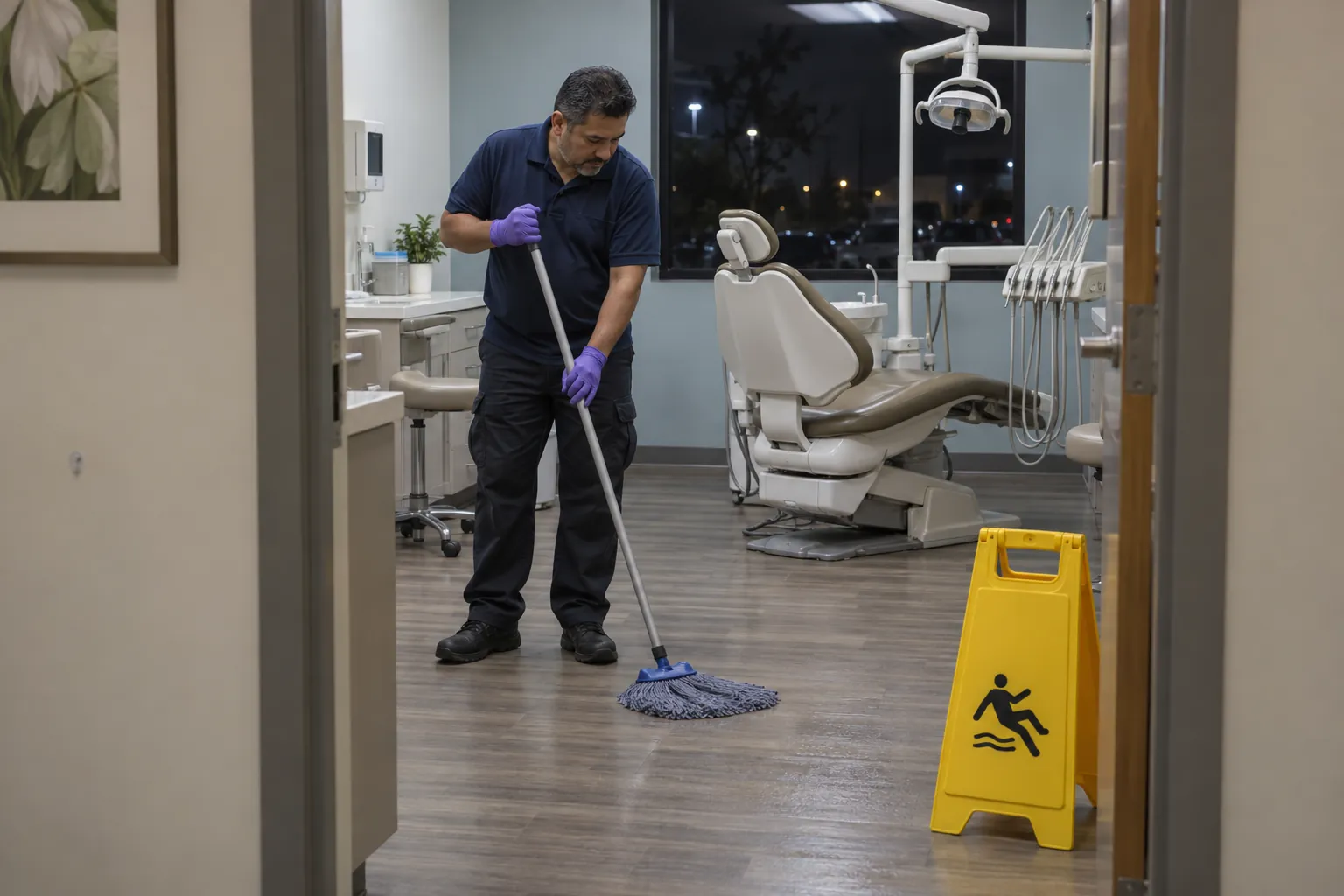
The two teams rarely meet. The CDC and OSHA set the rules both work to, and most of the trouble comes from the line between them. This guide covers what the federal guidance and the Bloodborne Pathogens standard say, which surfaces belong to whom, a nightly janitorial scope room by room, products, spills and waste, and how an office checks the work was done.
01
The rules behind dental office cleaning
No federal regulation sets out a cleaning checklist for a dental office. The duties come from the CDC's guidance for dental settings, the standard of practice, and OSHA's general industry standards, which are law. OSHA's own Dentistry overview says there are no dentistry-specific OSHA standards; the hazards of a dental office are covered by the standards for general industry.
The CDC's Guidelines for Infection Control in Dental Health-Care Settings – 2003 (MMWR, Vol. 52, No. RR-17) is the full document. The CDC now pairs it with a shorter Summary of Infection Prevention Practices in Dental Settings: Basic Expectations for Safe Care (October 2016); the CDC's page for the summary says the 2003 guidelines, though archived, continue to serve as the standard of practice for clinical dentistry. On environmental surfaces the summary's first key recommendation is plain: "Establish policies and procedures for routine cleaning and disinfection of environmental surfaces in dental health care settings."
The law for the employer is OSHA's Bloodborne Pathogens standard, 29 CFR 1910.1030. Its housekeeping paragraph, (d)(4)(i), reads:
Paragraph (d)(4)(ii)(A) adds when contaminated work surfaces must be decontaminated "with an appropriate disinfectant": "after completion of procedures; immediately or as soon as feasible when surfaces are overtly contaminated or after any spill of blood or other potentially infectious materials; and at the end of the work shift if the surface may have become contaminated since the last cleaning." The written schedule covers every area, not just the operatories.
Check the state too. OSHA lists 22 State Plans covering private employers; in those states the state's equivalent standard applies. And some state dental boards write their own infection control rules, California's Minimum Standards for Infection Control (16 CCR 1005) among them, which can be more specific than the CDC.
02
Clinical contact surfaces and housekeeping surfaces: who cleans what
The CDC divides environmental surfaces into two kinds, and the split is the most useful thing a dental office cleaning plan can get right, because it usually decides who does the work.
- Clinical contact surfaces. The CDC's Best Practices for Environmental Infection Prevention and Control describes them as surfaces "such as light handles, bracket trays, switches on dental units, and computer equipment" that "are likely be contaminated by direct spray or spatter generated during dental procedures." The 2003 guidelines add drawer handles, faucet handles, countertops, pens, telephones and doorknobs.
- Housekeeping surfaces. The same page: "Housekeeping surfaces, such as floors, walls, and sinks, do not come into contact with patients or devices used in dental procedures." They "can be cleaned with soap and water or cleaned and disinfected if visibly contaminated with blood."
Clinical contact surfaces in the operatory are turned over by the clinical team between patients. The CDC recommends barriers on those that are hard to clean, such as the switches on dental chairs and computer equipment, changed between patients; surfaces without a barrier are cleaned and disinfected "with an EPA-registered hospital disinfectant after each patient," with an intermediate-level (tuberculocidal) product if visibly contaminated with blood. That is chairside work, and a janitor coming in at 7 p.m. cannot do it.
The 2003 guidelines also recommend "general cleaning and disinfection" of clinical contact surfaces, dental unit surfaces and countertops "at the end of daily work activities," and say it is "required if surfaces have become contaminated since their last cleaning." Many offices keep everything on and around the dental unit with the assistants, and give the janitorial crew the floors, walls, sinks, trash and non-clinical rooms. What matters is that the split is written down, room by room.
A few things normally stay off the janitorial scope altogether:
- The dental unit, its hoses, handpieces and waterlines, whose water the CDC's summary says should meet drinking water standards (at most 500 CFU/mL of heterotrophic water bacteria).
- Instruments and sterilizers. A janitor may clean the sterilization area's floor and sink, not its instruments.
- Sharps containers and red bags, which go out as regulated medical waste.
03
A nightly janitorial scope for a dental office, room by room
A janitorial contract for a dental office, whether the work goes to the office's own cleaner or to a professional cleaning services company, is mostly ordinary commercial cleaning, done with more care about products and a firmer rule about what not to touch. A typical after-hours scope, to adapt to your own office and written into the scope of work, looks like this:
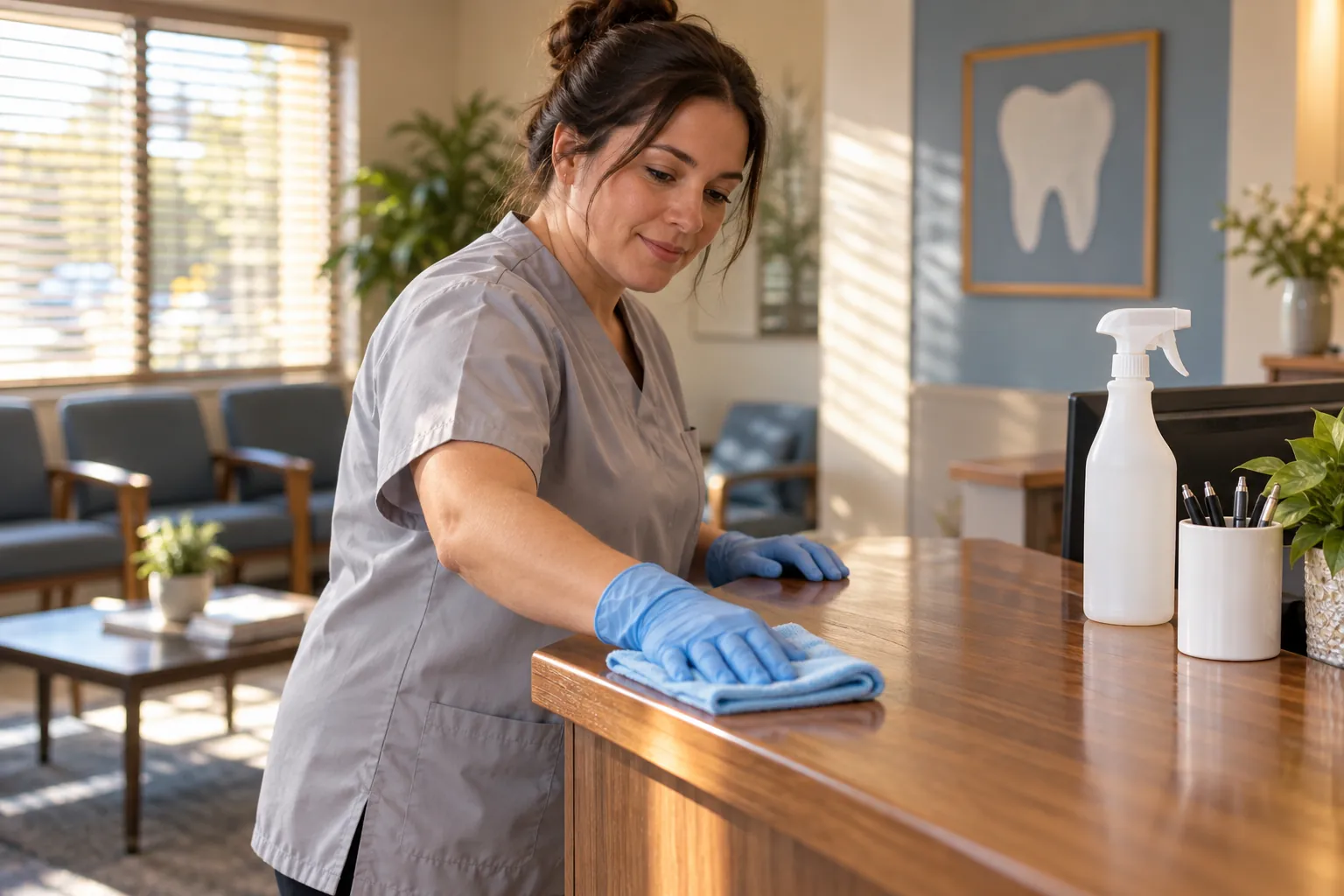
- Reception and waiting room: trash; the check-in counter, pens, clipboards and door handles; chair arms; vacuum or mop; entrance glass.
- Restrooms: clean and disinfect toilets, urinals, sinks, fixtures and grab bars; refill soap, paper towels and toilet tissue; empty trash and sanitary bins; mop the floor with a disinfectant. See the restroom cleaning log for how to record it.
- Operatories (after the clinical team has finished): general trash only; the hand sink if the split gives it to you; walls and doors where marked; damp mop the hard floor, leaving the dental unit alone. Report anything left out that should not be.
- Sterilization and lab areas: floor and sink as agreed, general trash only, nothing on the instrument side of the room.
- Staff room and offices: counters, sink, appliance handles, tables; trash; floors.
- Corridors: door handles, push plates, light switches; floors.
A periodic deep clean adds vents, baseboards, high dusting, blinds and interior glass. The 2003 guidelines recommend cleaning "walls, blinds, and window curtains in patient-care areas when they are visibly dusty or soiled," so the list should say who looks, not only who cleans.
Flooring matters. The 2003 guidelines recommend avoiding "carpeting and cloth-upholstered furnishings in dental operatories, laboratories, and instrument processing areas," because carpet "cannot be reliably disinfected, especially after spills of blood and body substances." A carpeted waiting room is normal; a carpeted operatory is a problem to raise with the office.
Keep the tools clean as well. The CDC's recommendations are to "Clean mops and cloths after use and allow to dry before reuse; or use single-use, disposable mop heads or cloths," and to "Prepare fresh cleaning or EPA-registered disinfecting solutions daily and as instructed by the manufacturer." A spray bottle topped up for a month is a reservoir for the organisms the clean is meant to remove. Color-coded cloths keep the restroom cloth off the reception counter.
04
Products, PPE, spills and waste
Disinfectants. Environmental surface disinfectants are registered by the EPA. For housekeeping surfaces the CDC allows detergent and water or an EPA-registered hospital disinfectant/detergent. For clinical contact surfaces it calls for an EPA-registered hospital disinfectant with a low-level (HIV and HBV label claims) to intermediate-level (tuberculocidal claim) activity, intermediate where there is visible blood. The EPA's Selected EPA-Registered Disinfectants lists help you check a product: List B names products effective against Mycobacterium tuberculosis, and List S products effective against bloodborne pathogens. The EPA says "the only way to accurately identify a product is by the EPA registration number," and that "the surface should be visibly wet for the entire contact time."
Two rules from the CDC are worth writing on the closet door. Follow the manufacturer's instructions for amount, dilution, contact time, safe use and disposal. And never use high-level disinfectants on the building: "High-level disinfectants, such as glutaraldehyde, are used as chemical sterilants. Because of their toxic nature, high level disinfectants should never be used on environmental surfaces."
Hazard communication. OSHA's Hazard Communication standard, 29 CFR 1910.1200 requires a written program, safety data sheets "readily accessible during each work shift," and training on the chemicals in use. A contract crew bringing its own products keeps its own sheets on site.
PPE. The CDC recommends gloves, and as needed protective clothing, masks and eye protection, for anyone cleaning environmental surfaces. If a cleaner's duties include anything that may carry blood or saliva, such as operatory trash or a spill, they may have occupational exposure under 29 CFR 1910.1030, and their employer then owes them an exposure control plan, training and PPE at no cost, as the standard requires.
Spills of blood. The 2003 guidelines say: contain the spill quickly, wear gloves and other PPE, remove visible material with disposable absorbent towels into a leak-proof, labeled container, then clean and decontaminate the surface with an EPA-registered hospital disinfectant effective against HBV and HIV or with a tuberculocidal claim. OSHA adds that contaminated broken glass "shall not be picked up directly with the hands." See blood spill cleanup.
Waste. Most dental office waste is ordinary trash. The CDC's guidelines put regulated medical waste at about 1% to 2% of total waste in dental offices, giving as examples gauze saturated with blood or saliva, extracted teeth, removed tissue and contaminated sharps. That waste goes into labeled or color-coded leakproof bags and puncture-resistant sharps containers, and its disposal "must follow federal, state, and local regulations." The janitorial crew takes the general trash and recycling, and leaves red bags and sharps containers alone unless the office's waste plan and its own training say otherwise.
05
How often, who checks, and what good records look like
The CDC summary asks each dental setting to name an infection prevention coordinator, "at least one individual with training in infection prevention," who writes the policies and reassesses them "on a regular basis (e.g., annually) or according to state or federal requirements." In a small practice that is usually the office manager or a senior assistant, and it is the person the janitorial contract should report to.
The summary's companion, the Infection Prevention Checklist for Dental Settings (Appendix A of the summary), gives the office a ready-made audit. Its environmental section asks whether:
- written policies and procedures exist for routine cleaning and disinfection of clinical contact and housekeeping surfaces;
- staff doing environmental infection prevention receive job-specific training "upon hire," "when procedures/policies change" and "at least annually";
- training and equipment are available so staff wear appropriate PPE;
- "Cleaning, disinfection, and use of surface barriers are periodically monitored and evaluated to ensure that they are consistently and correctly performed";
- procedures are in place for decontamination of spills of blood or other body fluids.
The fourth line is the hard one. For the janitorial crew it means someone looking at what the night left behind. A practical rhythm:
- Each night, the crew completes the scope and records any room it could not enter, with the reason.
- Each morning, the first person in walks reception, the restrooms and one operatory. Problems go to the contractor the same day.
- Each month, the contractor's supervisor and the office walk the whole office against the scope (see janitorial quality control).
- Each year, the coordinator reviews the written cleaning schedule, alongside the exposure control plan OSHA requires to be reviewed at least annually.
Good evidence is specific: which room, which task, who did it and when, and what was not done and why. "Cleaned – M.R." for the whole office tells nobody whether the second restroom was locked.
06
Where the dental office cleaning record fails, and what SiteClara does about it
The janitorial crew works when the office is empty, so the office usually learns what happened overnight from what it finds at 7:30 a.m. The record, if there is one, is a sheet on the janitor's closet door, initialed for the week in one pen. When a patient mentions a dirty restroom, nobody can say whether it was cleaned and used since, or missed. When a cleaner notices a dripping faucet or a full sharps container on the counter, there is nobody to tell.
SiteClara records checks at the place they happen. A printed QR code poster, with an optional NFC tag behind it, goes in each room or area where a check is scheduled: reception, each restroom, the operatory corridor, the staff room. The cleaner scans the code or taps the tag on their own phone, with no app to install, sees the checks set for that place, and marks each one done, or says what stopped them, such as an operatory left locked. The office decides what each check asks, so the restroom check can ask for a photo of the room as it was left. The time and the named person are recorded as it happens. A problem found on the way, such as the dripping faucet or the full sharps container the cleaner must not touch, goes onto the team's list of jobs until someone closes it.
The contractor's supervisor sees what is due, done and missed, and records the reason when a check was missed. Each day they review the totals and photos and approve a report that goes the next morning to nominated managers, such as the office manager, showing what was reported, completed and still open, and the reasons for any check not done.
07
Questions people ask
Is there a dental office cleaning checklist PDF?
The nearest official one is the CDC's Infection Prevention Checklist for Dental Settings, a fillable PDF that accompanies the Summary of Infection Prevention Practices in Dental Settings. It is an audit rather than a nightly cleaning list: each element is answered yes or no, with space for notes and areas for improvement. Its environmental sections ask whether written procedures exist for cleaning clinical contact and housekeeping surfaces, whether cleaners and disinfectants are used according to the manufacturer's instructions for dilution, storage, shelf-life, contact time and PPE, and whether cleaning, disinfection and surface barriers are periodically monitored. The CDC says compliance should be assessed by directly observing staff as they work. A room-by-room nightly list, like the scope above, is something each office writes for itself.
What goes on a dental office daily cleaning checklist?
OSHA's Bloodborne Pathogens standard, 29 CFR 1910.1030 sets the daily minimum for any surface that may carry blood or saliva: contaminated work surfaces are decontaminated with an appropriate disinfectant after procedures, as soon as feasible after a spill, and "at the end of the work shift if the surface may have become contaminated since the last cleaning," and protective coverings such as plastic wrap are replaced as soon as feasible when overtly contaminated, or at the end of the shift if they may have become contaminated during it. The CDC's Infection Prevention Checklist for Dental Settings adds that clinical contact surfaces are either barrier-protected or cleaned and disinfected with an EPA-registered hospital disinfectant after each patient. The rest of a daily list is the housekeeping work: trash, restrooms, sinks, counters, door handles and floors in each room, with who did each one and when.
08
Where to read more, and a dental office cleaning checklist to take away
Start with the CDC's Summary of Infection Prevention Practices in Dental Settings and its checklist, then the environmental chapter of the Guidelines for Infection Control in Dental Health-Care Settings – 2003. For the law, read 29 CFR 1910.1030 and your state dental board's rules.
Before your next contract review, check that:
- the office has a written cleaning schedule and method for every area, as 29 CFR 1910.1030(d)(4)(i) requires, not just for the operatories;
- the split between the clinical team and the janitorial crew is written down room by room, including who does the end-of-day clean of countertops and dental unit surfaces;
- the dental unit, waterlines, instruments, sharps containers and red bags are named as outside the janitorial scope, unless the waste plan and training say otherwise;
- every product in use has an EPA registration number, the right claim for the surface, and a contact time the crew actually keeps wet;
- mop heads and cloths are laundered and dried or single-use, and solutions are made fresh each day;
- a blood spill procedure and kit are in place, and the crew knows when to call the clinical team instead;
- each night leaves a record of which rooms were done, by whom and when, and which were not and why, and someone looks at it before the first patient.
Sources
Every document this guide quotes or links to, in the order it first cites them.
- Dentistry overview osha.gov
- Guidelines for Infection Control in Dental Health-Care Settings – 2003 cdc.gov
- Summary of Infection Prevention Practices in Dental Settings: Basic Expectations for Safe Care cdc.gov
- Bloodborne Pathogens standard, 29 CFR 1910.1030 osha.gov
- State Plans osha.gov
- Best Practices for Environmental Infection Prevention and Control cdc.gov
- Selected EPA-Registered Disinfectants epa.gov
- Hazard Communication standard, 29 CFR 1910.1200 osha.gov
- Infection Prevention Checklist for Dental Settings cdc.gov
- Infection Prevention Checklist for Dental Settings cdc.gov
Related guides
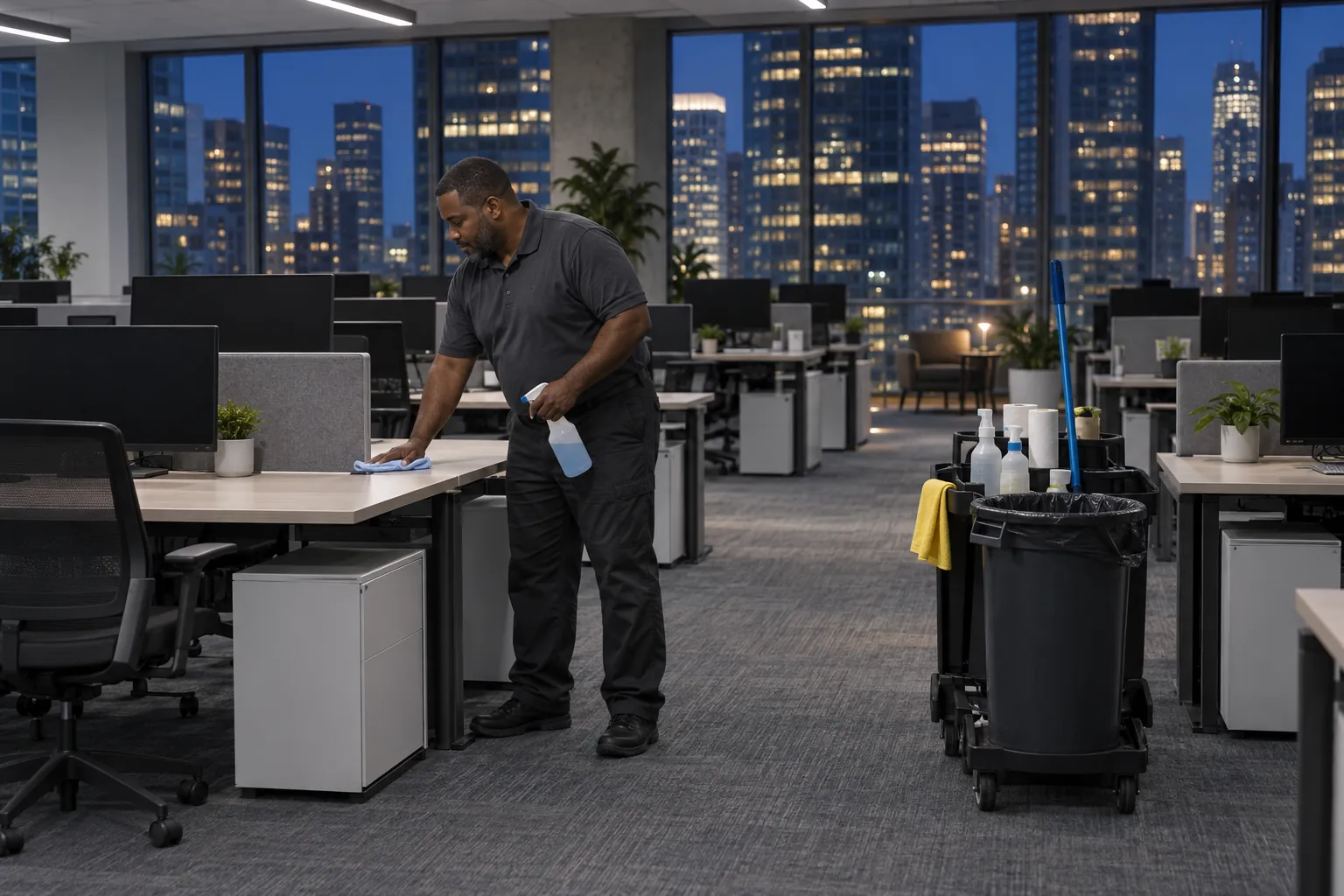 CleaningOffice cleaning checklist: what to clean, how often, and how to show it was doneAn office cleaning checklist by area and frequency, the OSHA rules behind it, who does each task, and how to show the night crew's checklist was really worked.
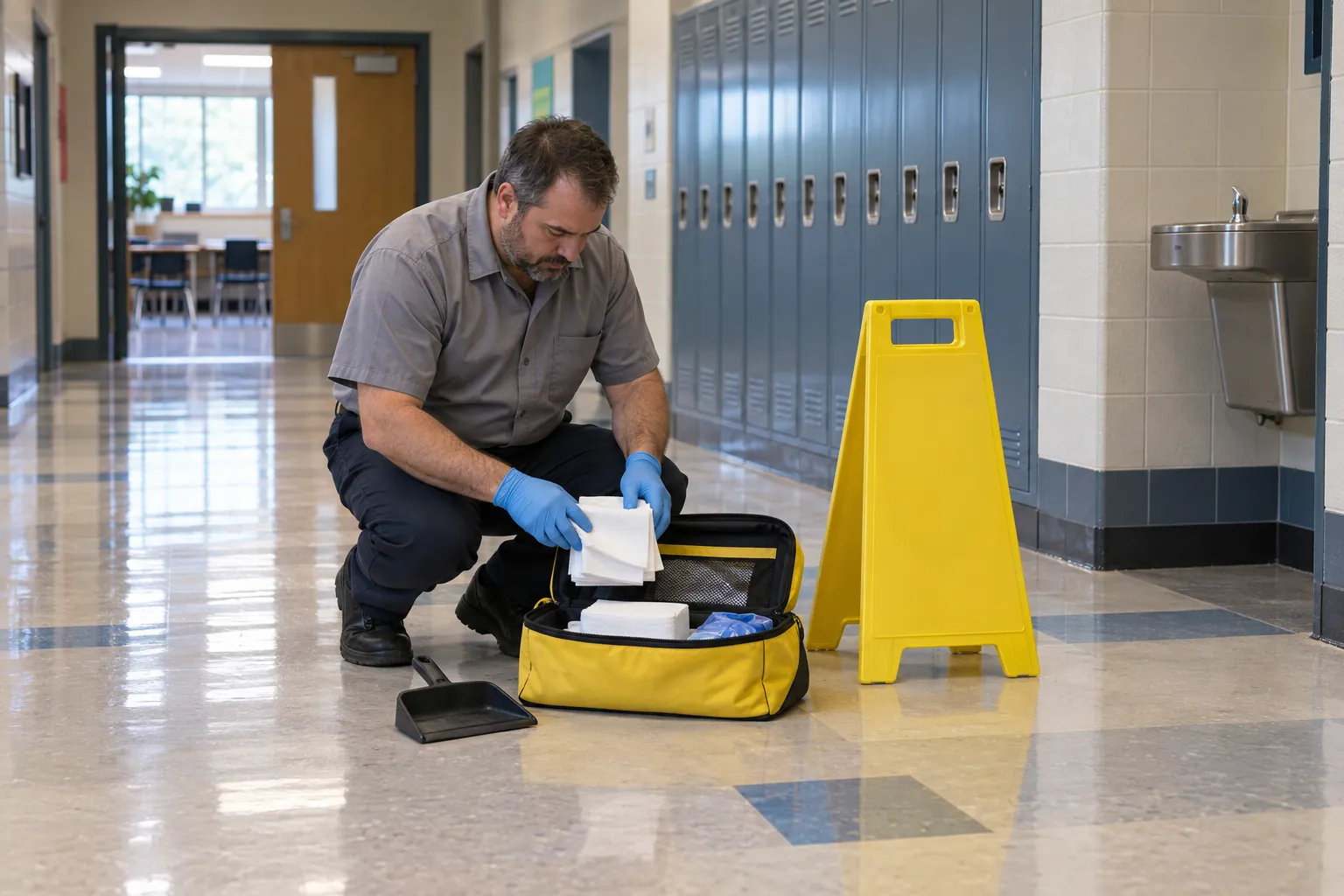 CleaningBlood spill cleanup: doing it safely, and showing it was doneHow to clean up a blood spill at work under OSHA's bloodborne pathogens standard: PPE, sharps, disinfectants, waste, training and the record to keep.
 CleaningCleaning, sanitizing and disinfecting: what each one does, and when a building needs itCleaning, sanitizing and disinfecting defined by the CDC, EPA and FDA Food Code: when each is needed, how to do it right, and what the record should show.
 CleaningHigh-touch surfaces: a cleaning routine you can show was doneHigh-touch surfaces as the CDC describes them: which ones to list area by area, how often to clean and disinfect them, the right method, and a record that holds up.