Cleaning
Parking garage cleaning: the schedule, the hazards and the record
Parking garage cleaning is the regular sweeping, litter pickup, degreasing and washing of a garage's decks, ramps, stair towers and elevator lobbies, done so every surface stays safe to walk and drive on and the dirty water stays out of the storm drain.
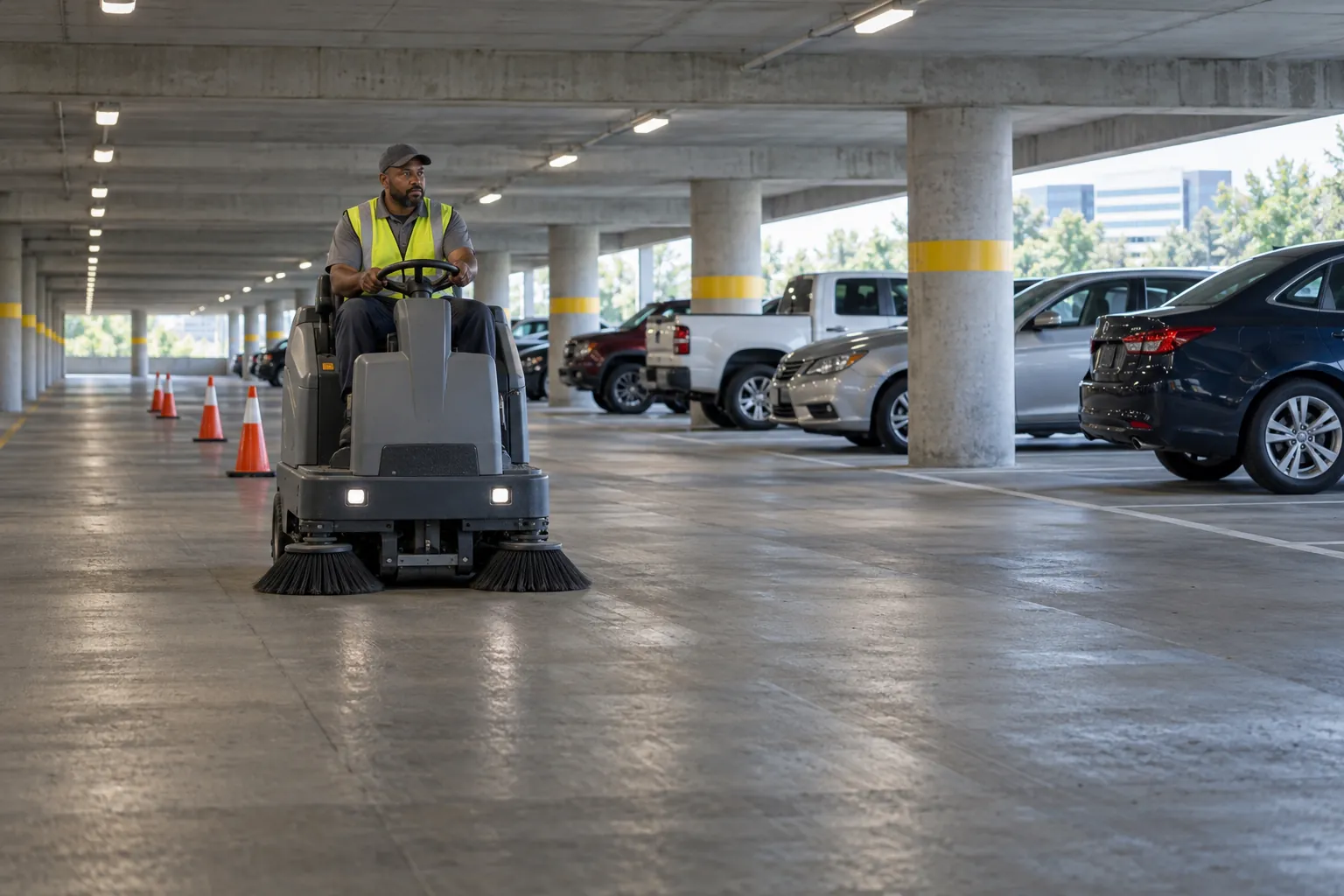
For facility managers, a parking garage is the first and last part of the building many tenants and visitors see, and one of the hardest to keep clean: oil on the deck, litter in the stair towers, salt and grit after every storm, pigeons on the pipes and an elevator lobby that smells by Friday. It is also a workplace with moving cars, engine exhaust and floor drains that may run straight to a creek. This guide covers the rules behind garage cleaning, what the work includes, how often to do it, how to do it safely, what to do with the wash water, and how to keep a record that shows it was done.
01
The rules behind a clean parking garage
No federal rule is written about parking garage cleaning as such. The duty comes from two directions: the owner's and employer's duty to keep a workplace safe for the people who work in it, and the duty not to let anything but rain run into the storm sewer. Local property maintenance and fire codes add their own.
For the workplace, the federal floor is OSHA's walking-working surfaces standard, 29 CFR 1910.22. A garage is a place of employment for the parking attendants, security officers, porters and engineers who work there, and the standard says:
- 1910.22(a)(1): "All places of employment, passageways, storerooms, service rooms, and walking-working surfaces are kept in a clean, orderly, and sanitary condition."
- 1910.22(a)(3): "Walking-working surfaces are maintained free of hazards such as sharp or protruding objects, loose boards, corrosion, leaks, spills, snow, and ice."
- 1910.22(d)(1): "Walking-working surfaces are inspected, regularly and as necessary, and maintained in a safe condition."
- 1910.22(d)(2): hazardous conditions are to be "corrected or repaired before an employee uses the walking-working surface again", and if that cannot be done immediately, the hazard must be guarded until it is.
For water, the rules come from the Clean Water Act through the EPA's NPDES stormwater program. The EPA describes stormwater runoff as water from rain and snowmelt that flows over "impervious surfaces, such as paved streets, parking lots, and building rooftops" and "picks up pollutants like trash, chemicals, oils, and dirt/sediment that can harm our rivers, streams, lakes, and coastal waters." Cities and counties that operate a municipal separate storm sewer system (MS4) must run a program to find and stop illicit discharges, which the EPA's Illicit Discharge Detection and Elimination guidance says, in general, include "any discharge into a storm drain system that is not entirely composed of stormwater." Garage wash water, degreaser and a hosed-down oil spill are not stormwater, and your city's stormwater ordinance is the rule an inspector enforces.
02
What parking garage cleaning covers
Write each part of the garage into the janitorial scope of work with its own frequency, rather than leaving "the garage" as a single line:
- Drive aisles, ramps and parking stalls: litter, grit, leaves, broken glass, oil drips and tire marks. In cold climates, sand and salt tracked in by cars all winter.
- Entry and exit lanes and pay stations: the ticket and payment machines, gate arms, intercom panels, curbs and the booth if there is one.
- Elevator lobbies and cabs: floors, doors, call buttons, glass and trash cans.
- Stair towers: treads, landings, handrails and corners. Stairwells collect litter, spills and worse, and they are exit routes, so nothing is stored in them.
- Trash and recycling cans: emptied, relined, wiped and checked for leaks, with the area around them swept.
- Drains: floor drains, trench drains and grates cleared of leaves, trash and sediment so water does not pond on the deck.
- Walls, columns, ceilings and overheads: dust and cobwebs on pipes, conduit and light fixtures, handprints and scuffs, graffiti, and the travel directions and level markings that need to stay readable.
- Bird droppings and nesting: pigeons roost on beams, sprinkler pipes and ledges, especially on open decks.
- The roof level: leaves, standing water and, in winter, snow and ice.
In a commercial garage, cleaning is usually split between a day porter who walks the levels and keeps the public areas right, and a periodic crew or specialist contractor who sweeps, scrubs and washes the decks with ride-on equipment and pressure washers. The day porter's duties and the periodic work need to be written down separately, or the periodic work quietly never happens.
A porter walking every level is also the person most likely to see a light out, spalled concrete, a leaking pipe, a propped stair door or something hung from a sprinkler head. Build reporting those into the round, and hand them to whoever owns the parking area inspection.
03
How often to clean a parking garage
No code sets a frequency for garage cleaning; a hospital garage that turns over all day needs far more than an office garage that empties at 6 p.m. A pattern to start from, then adjust:
- Every day: walk every level; pick up litter; empty and wipe trash cans; clean elevator lobbies, call buttons and pay stations; sweep and spot mop stair towers; deal with spills, broken glass and anything biological; report faults.
- Every week: sweep entry and exit lanes and the busiest aisles; mop stair treads and landings; wipe handrails; spot treat fresh oil stains; clear drain grates.
- Every month: sweep all levels with a ride-on or walk-behind sweeper; clean stair tower walls and doors; remove graffiti; degrease the worst stall areas.
- Every quarter or season: high dust pipes, conduit, signs and light fixtures; clean out trench drains and catch basins or have them vacuumed; treat and clean pigeon roosting areas.
- Once or twice a year: a full deck wash-down, often in spring to remove winter salt and grit, with the wash water collected and disposed of as the next sections describe.
In snow country, sweep as soon as practical after the snow melts. The EPA's fact sheet on Parking Lot and Street Sweeping (December 2021) makes the point for streets: removing the accumulated sand, grit and debris after the snow melts "reduces the amount of pollutants that subsequent storms can mobilize."
Choose the sweeper for the job. The same EPA fact sheet describes three types, mechanical, regenerative air and vacuum. Mechanical broom sweepers are the cheapest and good for large debris and wet surfaces but "tend to create more dust", while regenerative air and vacuum sweepers are much better at fine particles.
04
Doing it safely: exhaust, traffic, sharps and droppings
A garage has hazards an office floor does not. The cleaning plan and the crew's training should cover each of these.
Carbon monoxide. OSHA's Carbon Monoxide Poisoning fact sheet calls CO "a poisonous, colorless, odorless and tasteless gas" and names the internal combustion engine as "one of the most common sources of exposure in the workplace." In a garage that means the tenants' cars and, too often, the cleaning equipment itself. The fact sheet tells workers to avoid gas-powered engines, "such as those in powered washers as well as heaters and forklifts, while working in enclosed spaces", and tells employers to consider switching to equipment powered by electricity, batteries or compressed air, to prohibit gasoline-powered engines in poorly ventilated areas, and to provide personal CO monitors with audible alarms where exposure is possible. The OSHA permissible exposure limit is 50 parts per million averaged over an eight-hour period. Keep the ventilation running while the crew works, and anyone with a headache, dizziness or nausea gets to fresh air and reports it.
Traffic. Drivers are looking for a space, not for a porter bending down behind a pillar. Crews wear high-visibility clothing and put out cones before starting anything that keeps them in one place.
Wet decks. A washed or scrubbed deck is a slip hazard for the people walking to their cars. Under 1910.22(d)(2), a hazard that cannot be fixed immediately must be guarded, so keep wet areas coned off until they are dry and put out wet floor signs in lobbies and stairs.
Needles, blood and bodily fluids. Garages and their stair towers are where discarded needles, vomit and worse turn up. Where cleaning staff can reasonably be expected to come into contact with blood or other potentially infectious materials, OSHA's bloodborne pathogens standard, 29 CFR 1910.1030 requires the employer to have a written exposure control plan. The standard says broken glassware which may be contaminated "shall not be picked up directly with the hands" but with mechanical means such as a brush and dust pan, tongs or forceps, and sharps go in containers that are closable, puncture resistant, leakproof on the sides and bottom, and labeled or color-coded. The blood spill cleanup guide covers the rest.
Bird droppings. Accumulated pigeon droppings can carry the fungus that causes histoplasmosis, which is caught by breathing in spores. The CDC's NIOSH page on Preventing Histoplasma Exposures at Work lists controlling dust, removing birds from the building and disposing of waste, with respiratory and eye protection, gloves and disposable protective clothing, and says large amounts of droppings should be cleaned up by a professional company that specializes in handling hazardous waste.
05
Oil, spills and wash water: keeping it out of the storm drain
The part of garage cleaning most likely to get an owner a notice of violation is where the dirty water goes. Before anyone pressure washes a deck, find out where each floor drain and trench drain leads. In some garages the drains connect through a sand and oil separator to the sanitary sewer; in others, especially on open roof levels, they run to the storm sewer and out to a stream. The building engineer or the plumbing drawings will know.
Work dry first:
- Sweep before you wash. Dry grit taken up never becomes muddy water.
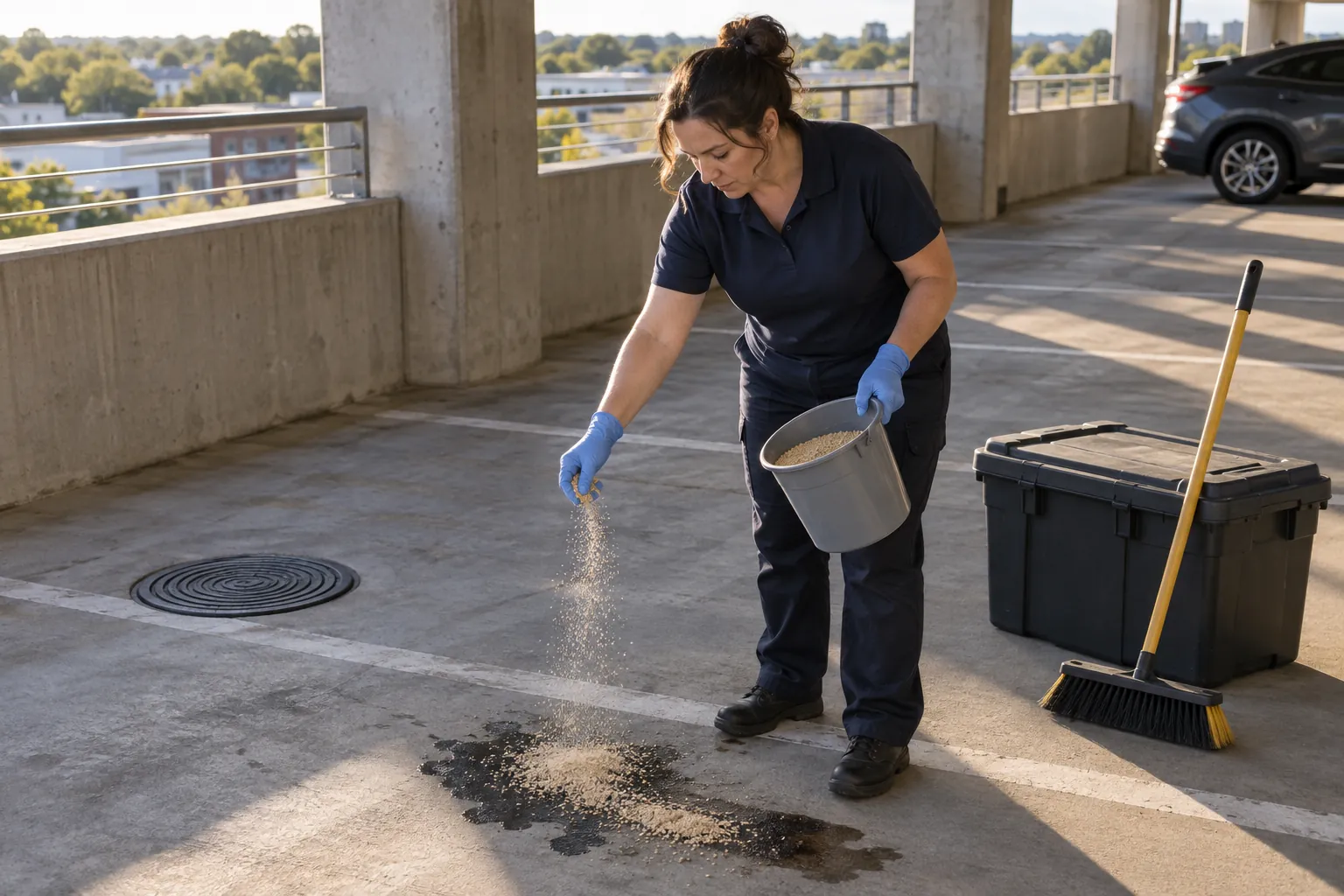
- Absorb oil and fluids. Put absorbent on fresh drips and spills, work it in, sweep it up and bag it. Never hose a spill toward a drain.
- Protect the drains. Cover or block storm drain inlets in the work area before washing, with drain covers or berms.
- Collect the wash water. Use a pressure washer with a vacuum recovery system, or berm and vacuum the water, then dispose of it the way your sewer authority allows, which may mean the sanitary sewer with permission or hauling it away.
- Handle the sweepings. The EPA sweeping fact sheet notes that sweepings can contain pollutants such as heavy metals and petroleum hydrocarbons and that disposal should follow all federal and state regulations; bag and dispose of them as your hauler and state require.
Treat a bigger spill as a spill, not a cleaning task. The EPA's Spill Response and Prevention fact sheet (December 2021) lists parking lots among the places its practices apply to and says a spill response plan should set out "step-by-step instructions for spill containment, material cleanup and disposal, documentation, reporting, and follow-up procedures." It also recommends storing spill response supplies in easily accessible locations and identifying a contractor for larger spills. For a garage, that means a stocked spill kit on each level, a porter who knows when to call for help, and a note of what happened.
06
Where the garage cleaning record fails, and what SiteClara does about it
Garage cleaning records are thin because nobody from management goes down to read them. The sheet taped inside the stair tower door gets wet, torn or taken; initials filled in at the end of the week look the same as initials written at the time; and the missed round on level P3 is found when a tenant emails a photo of the stairwell. The porter who sees an oil slick at the ramp tells whoever is passing. When a slip-and-fall claim or a stormwater complaint arrives, the record cannot show when the area was last checked or by whom.
SiteClara replaces the sheet with a tag at each place a check is due: a printed QR code poster, with an NFC tag behind it if staff would rather tap than scan, at each elevator lobby, stair tower or level. A porter scans the code or taps the tag on their own phone, with no app to install, sees the checks due there and completes them. The time and the named person are recorded as it happens. If something is wrong, such as a spill, a light out, a blocked drain, broken glass or a needle that needs the sharps kit, they record it there with a photo, and it goes onto the team's list of open jobs until someone closes it.
Scheduled checks are set per location, so each level's lobby can have a daily round and each stair tower its own. The porter sees what is due and marks it done, or says what stopped them, such as a level closed for a wash-down. The supervisor sees what was done and what was missed, and can record why. At the end of the day the supervisor reviews it, adds a note, and the approved report goes to the property manager at 8 a.m. the next morning.
07
Questions people ask
What is the best way to clean a parking garage?
Dry first, then wet, and never toward a storm drain. Sweep the grit and litter up, put absorbent on oil drips and sweep that up too, then wash only with the drains protected and the wash water collected. For the sweeping itself, the EPA's Parking Lot and Street Sweeping fact sheet says "using a mechanical sweeper for large particles followed by a regenerative air cleaner can be an effective strategy."
What machine is used to clean a parking lot or garage?
A sweeper, of one of three common types: mechanical broom, regenerative air or vacuum. The EPA's Parking Lot and Street Sweeping fact sheet says each targets large debris, but regenerative air and vacuum machines "are much more effective at removing particles down to 10 microns in diameter." Under a roof, the engine matters as much as the brush: OSHA's Carbon Monoxide Poisoning fact sheet tells employers to consider switching from gasoline-powered equipment to equipment powered by electricity, batteries or compressed air, and to prohibit gasoline-powered engines in poorly ventilated areas.
Who sweeps a privately owned parking lot?
The owner arranges it. The EPA's Parking Lot and Street Sweeping fact sheet says property owners and municipal staff should coordinate to limit pollutant discharge to public storm drains, and that in many cases property owners can contact their municipal public works departments or private street sweeping companies to coordinate regular cleanings.
08
Further reading, and a list to take away
For the workplace, read OSHA's walking-working surfaces standard and the Carbon Monoxide Poisoning fact sheet, alongside your State Plan if you have one. For water, the EPA's NPDES stormwater program pages and its fact sheets on Parking Lot and Street Sweeping and Spill Response and Prevention are written for municipalities but apply as well to a private garage. For bird droppings, see NIOSH's Preventing Histoplasma Exposures at Work.
Before you rewrite the garage cleaning routine, check that:
- each level, lobby, stair tower and pay station is in the scope of work with its own frequency;
- daily porter rounds and periodic sweeping and washing are written down separately;
- you know where every floor drain and trench drain goes, and what your city allows into it;
- wash-downs are swept first, drains are protected and the wash water is collected;
- a stocked spill kit is on every level, and staff know when to call for help;
- sweepers and scrubbers on enclosed levels are battery powered, or CO is monitored and ventilation is running;
- the crew wear high-visibility clothing and cone off their work area;
- tongs, a sharps container and an exposure control plan are in place;
- heavy pigeon fouling goes to a specialist, not the porter;
- every check records the actual time, one named person and what was found, and faults reach whoever fixes them.
Sources
Every document this guide quotes or links to, in the order it first cites them.
- Walking-working surfaces standard, 29 CFR 1910.22 osha.gov
- OSHA-approved State Plans osha.gov
- NPDES stormwater program epa.gov
- Illicit Discharge Detection and Elimination guidance epa.gov
- Parking Lot and Street Sweeping epa.gov
- Carbon Monoxide Poisoning fact sheet osha.gov
- Bloodborne pathogens standard, 29 CFR 1910.1030 osha.gov
- Preventing Histoplasma Exposures at Work cdc.gov
- Spill Response and Prevention epa.gov
Related guides
 Premises and facilities managementParking lot inspection checklist: what to check, how often, and what to recordA parking lot inspection checklist for commercial property: pavement, striping, ADA spaces, lighting and drainage, how often to check, and a record that holds up.
 CleaningDay porter duties: what the job covers, and how to prove the roundsWhat a day porter does in an occupied building, a sample daily route, the OSHA rules behind the work, and how to show a client the rounds really happened.
 CleaningTrash room cleaning: the codes, the schedule and the recordHow to keep a trash room clean, safe and pest-free: the property maintenance, fire and OSHA rules behind it, a cleaning schedule, and what to record.
 CleaningCommon area cleaning: what it covers, how often, and how to show it was doneWhat common area cleaning covers in apartment, condo and commercial buildings, how often, the OSHA and code rules behind it, and how to show each visit happened.