Cleaning
Cleaning KPIs: what to measure, and how to know the figures are true
Cleaning KPIs (key performance indicators) are the measurable targets in a cleaning contract, such as audit scores, scheduled tasks completed, response and rectification times and complaints, that a client and a cleaning contractor use to agree whether the service is being delivered to the standard paid for.
Also written for United Kingdom · Ireland · United States · Canada

In Australia no law sets them for an ordinary workplace: they are written into the contract or its service level agreement, while the work health and safety laws set the outcome underneath, a workplace and its amenities kept clean. This guide covers which KPIs to use, how to define and target them, how to report them, and how to tell whether the figures are true.
01
What cleaning KPIs are, and where they come from
A key performance indicator is a measurable figure that shows whether a service is meeting an agreed standard. It turns a judgement such as "the cleaning is fine" into data both sides can measure, compare month to month and act on. In a commercial cleaning contract the KPIs usually sit in a schedule to the cleaning contract or in a service level agreement, each with a definition, a target, a measurement period and a source of evidence, and they are reviewed at a regular contract meeting between the facility manager or building manager and the contractor's account manager.
No Australian law sets cleaning KPIs for an office, shopping centre, school or strata building. The law sets the outcome. Under regulation 41 of the model Work Health and Safety Regulations, a person conducting a business or undertaking (PCBU) must ensure, so far as is reasonably practicable, that adequate facilities are provided for workers and "maintained so as to be (a) in good working order; and (b) clean, safe and accessible". The model Code of Practice: Managing the work environment and facilities, published in New South Wales by SafeWork NSW, adds that workplaces and facilities should be cleaned regularly, taking into account the type of work, the likelihood of contamination and the number of workers using them. Every state and territory except Victoria has adopted the model laws; in Victoria, WorkSafe Victoria's Compliance code: Workplace facilities and the working environment covers how to maintain, clean and monitor workplaces under the Occupational Health and Safety Act 2004. KPIs are how a client shows it is managing that duty when the cleaning is outsourced, and how a contractor shows it delivered what it was paid for.
Public health care is the exception, and it shows the method most clearly. NSW Health's Cleaning of the Healthcare Environment policy directive (PD2023_018), issued in August 2023, requires every NSW public health organisation to have "a cleaning audit system that measures and records cleaning outcomes", with a minimum acceptable quality level for each of four risk categories, from 90% in extreme risk areas such as operating theatres to 80% in low risk areas such as offices. Outside health care, good KPI frameworks follow the same logic on a smaller scale: set the target by risk, audit to a written method, and fix what fails within a set time.
02
Cleaning KPI examples worth measuring
Most cleaning contracts need between five and ten KPIs. Fewer and something important goes unmeasured; more and nobody reads them. These are the cleaning performance indicators that work on almost any commercial site, covering quality, delivery and the operational side of the contract:
- Cleaning quality (audit score): the percentage of inspected elements that meet the standard in a structured cleaning audit, by area type. The KPI most clients start with, and the one most open to argument unless the audit method and sample are agreed.
- Scheduled tasks completed: daily and weekly tasks and checks done against those planned, for example amenities checks completed as a share of those scheduled. Some contracts call this SLA adherence. It measures whether the service happened at all.
- Response and rectification time: how quickly a reported problem, such as a spill, an empty dispenser or a blocked toilet, is attended to and put right, by priority.
- Rework and repeat failures: how many audit failures or complaints concern something already raised. A non-conformity that returns every month says more than the total, and tracking repeats as a rate, as a share of all failures, shows whether fixes hold.
- Complaints and feedback: the number per period, by area, read against the building's occupancy.
- Periodic work completed: carpet extraction, hard floor strip and seal, high-level dusting, windows and pressure washing, against the periodic schedule.
- Labour delivered and cover: contracted hours worked, and absences covered. A contract short of hours fails every other KPI in the end.
- WHS and training: site inductions and chemical and equipment training current, safety data sheets on site, and incidents and near misses followed up.
- Labour compliance: evidence that cleaners are paid correctly and subcontracting is controlled, for buildings that buy against a labour standard.
- Occupant or client satisfaction: a short periodic survey, used beside the other measures, never instead of them.
Cost per square metre and square metres cleaned per hour help in comparing tenders and planning labour, but they are cost and efficiency metrics, not measures of cleaning performance. Judge the contract on the result.
03
Defining each KPI and setting the target
Every KPI needs a written definition both sides agree before the contract starts, or at the first review after it does. A simple cleaning KPI template has one row per indicator with these columns:
- What is measured, precisely. "Amenities checks completed" needs to say whether a check done 40 minutes late counts, and whether a check skipped because the room was locked counts as missed.
- The source of the data: audit sheets, check records, the help desk log, the roster, the client's complaints register.
- Who measures it, and whether the client verifies it. A contractor marking its own work needs an independent check, such as joint audits or a sample audited by the client.
- The period: weekly, monthly or quarterly.
- The target, and the level below which it counts as a failure.
- What happens on a failure: a corrective action with a due date, a performance improvement plan, an abatement or service credit if the contract has them, and when repeated failure escalates.
Set targets from a baseline, not from ambition. The first month of a new contract, or the last three months of an existing one, shows what the building actually achieves; that is the benchmark to improve from. A target of 100% on anything measured by human inspection will be missed, and a contract that fails a KPI every month soon stops taking it seriously. A target nobody ever misses is not measuring anything.
Weight the targets to the building and its risk. The NSW directive is a worked example of a risk-weighted set. Each functional area has a minimum acceptable quality level, a minimum audit frequency and a time to put failed elements right:
- Extreme risk: 90%; at least 50% of rooms audited each month and all rooms every two months; failed elements rectified within 24 hours, and risks to patient safety immediately.
- High risk: 88%; at least 50% of rooms audited every two months and all rooms every four months; rectified within 48 hours.
- Medium risk: 85%; at least 50% of rooms audited every three months and all rooms every six months; rectified within 72 hours.
- Low risk: 80%; all rooms audited at least once a year; rectified within seven days.
It also sets what repeated failure triggers: in an extreme risk area, two consecutive audit failures bring targeted cleaning and a weekly inspection of every room until the benchmark is met (three in a high risk area), and six failures in a year bring an external or independent audit and an entry on the local risk register. An office or shopping centre does not need hospital figures, but the shape is worth copying: higher targets in the critical areas where failure matters most, a clock on rectification, and a defined step when the same area keeps failing.
What is a good cleaning audit score?
Outside health care the contract sets it. NSW Health's policy directive sets the minimum acceptable quality level for public health facilities at 90% in extreme risk areas, 88% in high, 85% in medium and 80% in low risk areas, a useful reference for a commercial contract weighting its own areas by risk.
Involve the cleaners and supervisors. They know which tasks will not fit the hours, and KPIs they can see each day improve the service more than targets in a monthly email. Their training should cover what the standards look like in practice, so that each cleaner knows what a pass is.
04
How cleaning KPIs are reported
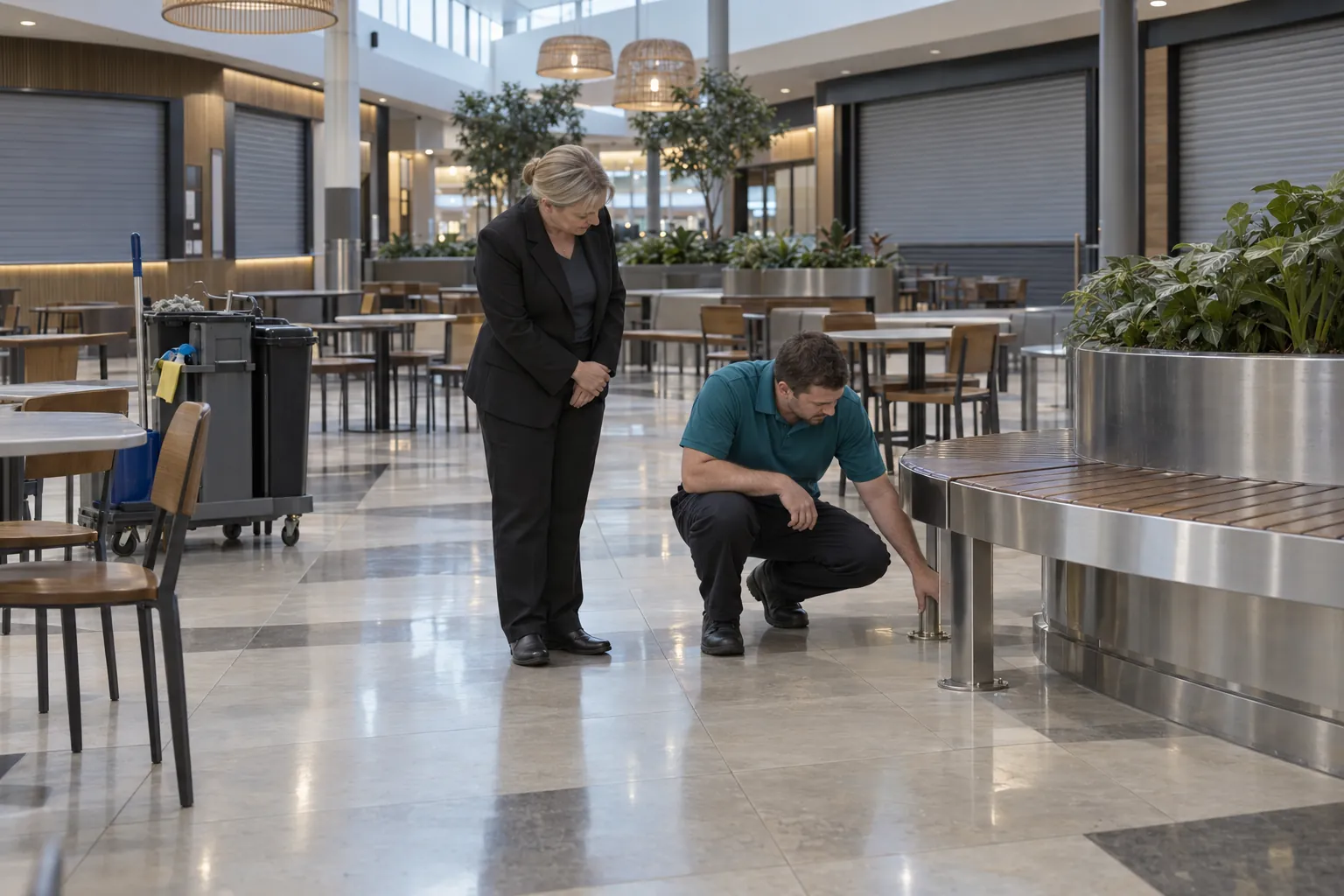
Cleaning KPI reporting is usually monthly: a short report or dashboard taken through at a meeting between the client's facility manager and the contractor's operations team. The figures should be gathered as the month goes, not assembled the day before the meeting. A useful monthly report shows:
- each KPI against its target, with a simple red, amber or green status;
- the trend over several months, because quality over time matters more than any single figure;
- the reason behind each failure, and the corrective action taken;
- open actions and decisions from the last meeting, who owns them and which are overdue;
- anything that keeps recurring, and what is being done about it.
Monthly reports are often too slow on their own. A missed amenities clean on the 3rd reported on the 30th has already become a complaint. Many clients also want a short daily or weekly view of delivery, showing what was done, what was missed and what is still open, so that problems surface while they can be fixed and the monthly figures hold no surprises. The facilities management report then carries the cleaning figures alongside maintenance and compliance.
Health care shows who should see the results. Under the NSW directive, audit results and improvement plans go to the quality and risk and infection prevention and control committees, and the external audits of extreme and high risk areas "may not be undertaken by staff from the organisation's external cleaning provider". A commercial contract can borrow the principle: the party being measured should not be the only one measuring.
05
When KPIs look green and the building is not clean
Most facility managers have seen a contract with good KPIs and unhappy occupants. The usual causes are these:
- Measuring only inputs. Tasks ticked off, with no check on the result, reward visiting a room rather than cleaning it.
- Measuring only outputs. An audit of a small, predictable sample says little about the rooms nobody inspected, or the amenities at 2 pm rather than 9 am.
- Closing actions without fixing them. An audit flags an issue, an action is raised and marked complete, and the same issue is back next month. Track repeat failures, not only closed actions.
- Self-reported data nobody checks. A contractor's own figures, never verified, drift upwards.
- Stale targets. KPIs written for how a building was used three years ago measure a building that no longer exists. Review them at least once a year, and whenever occupancy or use changes.
- Targets the hours cannot meet. A KPI set that assumes more work than the contracted hours allow is met on paper, by cutting corners, or not at all.
That last point has a legal edge in Australia. The Cleaning Services Award 2020, the cleaning industry's modern award, sets minimum rates, penalties and allowances for contract cleaners, and clause 13.5(c) sets minimum shifts for part-time and casual cleaners by cleaning area: 2 consecutive hours at a location of up to 2000 square metres, 3 hours up to 5000, and 4 hours at 5000 square metres or more, with a one-hour minimum only for a lone cleaner at a small stand-alone site of up to 300 square metres. Productivity and cost targets have to sit inside that floor. The Cleaning Accountability Framework's certification assesses a building's cleaning supply chain against standards including labour and responsible contracting ("ethical pricing, responsible subcontracting and transparency of contracts"), with payroll checks and meetings with the cleaners. A client that adds labour compliance to its KPIs is measuring the risk most likely to end a contract badly.
The answer is balance: quality and delivery, contractor-measured and client-verified, the monthly trend and the daily detail.
06
Where the delivery data fails, and what SiteClara does about it
Of all cleaning KPIs, scheduled tasks completed is the one most often built on the weakest evidence. The figure in the monthly report is usually totted up from the amenities sheet on the back of the door and the supervisor's notes, filled in after the fact. The sheet cannot show when a check was done or by whom, it is sometimes initialled for the whole week on Monday, and a missed check is rarely written down as missed. A fault mentioned to whichever cleaner was passing never reaches the complaints count at all.
SiteClara records the checks at the location. A printed QR poster, with an optional NFC tag behind it, sits at each place a check is scheduled, such as an amenities block, a lift lobby, an end of trip facility or a car park level. The cleaner scans or taps on their own phone, with no app to install, sees the checks due there, and marks each one done or says what stopped it. The time and the named person are recorded as it happens, with a photo when the check asks for one, and a reported problem goes onto the team's list of open jobs until someone closes it.
The supervisor sees what is due, done and missed, and gives the reason a check was missed or held up. Each day they review the checks and photos, add a note and approve a report that goes to nominated client or management contacts at 8 am the next morning, showing what was reported, what was completed, what is still open and how the scheduled checks went, for example 12 of 12 completed. That gives the tasks-completed and open-jobs figures a daily source recorded at the time, and both sides bring the same record to the monthly meeting.
07
Questions people ask
What are the four main KPIs?
There is no fixed set, but a government framework gives a useful four. Victoria's Resource Management Framework, issued by the Department of Treasury and Finance, requires "a meaningful mix of quality, quantity, timeliness and cost performance measures" for each output, each with a one-year target. In a cleaning contract that maps to the audit score (quality), scheduled tasks completed (quantity), response and rectification time (timeliness) and the contract price, with cost kept beside the others rather than standing in for them.
How do you write a good KPI?
Victoria's Resource Management Framework says good objective indicators "measure the results of Government action, rather than external factors", "are free of perverse incentives and balanced with other departmental objective indicators", and "ideally rely on existing, regularly updated data streams". It also asks for a written record of how each figure is calculated, an annual review of whether each measure is still relevant, and targets revised for historical overachievement or productivity gains. The same tests suit a cleaning KPI: measure what the contractor controls, pair measures so one cannot be met by sacrificing another, and write down the data source and calculation.
What are some good KPI examples for cleaning?
NSW Health's Cleaning of the Healthcare Environment policy directive (PD2023_018) builds its cleaning measures around audits: each functional area has a minimum acceptable quality level, from 90% in extreme risk areas to 80% in low risk areas, a minimum audit frequency and a time to rectify failed elements, with defined steps when an area fails repeatedly. Outside health care, the same pattern gives an audit score by area, audits completed against schedule, and failed elements rectified on time.
08
Further reading, and a list to take away
For the workplace duty, read the Code of Practice: Managing the work environment and facilities as adopted in your state or territory, or WorkSafe Victoria's Compliance code: Workplace facilities and the working environment. For risk-based cleaning targets and audits, read Section 4 and Appendix 1 of NSW Health's Cleaning of the Healthcare Environment policy directive (PD2023_018). For labour, read the current Cleaning Services Award 2020 and the Cleaning Accountability Framework guide.
Before you agree or review a set of cleaning KPIs, check that:
- there are between five and ten, and each one matters to this building;
- they measure delivery as well as quality;
- each has a written definition, data source, owner, period and target;
- targets come from a baseline, and are higher where failure matters most;
- every failure has a rectification time and repeated failure has a defined next step;
- some of the data is verified by the client, for example through joint audits;
- the targets can be met within the contracted hours at award rates;
- there is a daily or weekly view of delivery as well as the monthly report;
- they are reviewed at least once a year, and when the building's use changes.
Sources
Every document this guide quotes or links to, in the order it first cites them.
- Code of Practice: Managing the work environment and facilities safework.nsw.gov.au
- Compliance code: Workplace facilities and the working environment worksafe.vic.gov.au
- Cleaning of the Healthcare Environment policy directive (PD2023_018) www1.health.nsw.gov.au
- Cleaning Services Award 2020 awards.fairwork.gov.au
- Cleaning Accountability Framework's certification cleaningaccountability.org.au
- Resource Management Framework dtf.vic.gov.au
Related guides
 CleaningCleaning contracts in Australia: what to put in them, and how to know they are workingWhat an Australian commercial cleaning contract should cover, how the Cleaning Services Award and Fair Work Act shape it, and how to show the work was done.
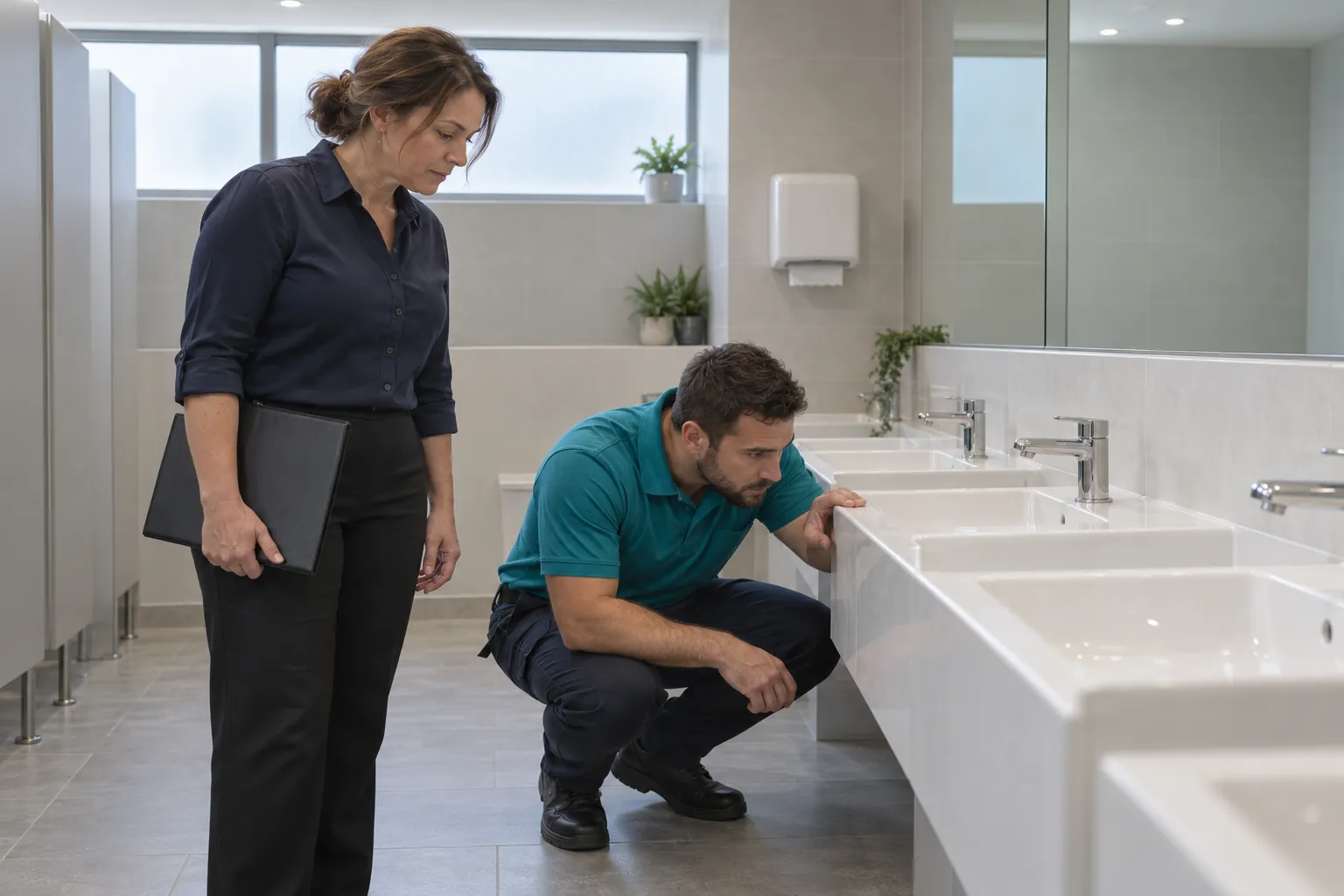 CleaningCleaning audit: what to inspect, how to score it and what happens nextHow to run a cleaning audit in Australia: what to inspect, sampling and frequency, scoring against an acceptable quality level, corrective action and the record.
 Premises and facilities managementFacilities management report: what to include, and what makes it believableWhat an Australian facilities management report should contain: WHS, fire safety compliance by state, maintenance, KPIs, costs and the evidence behind them.
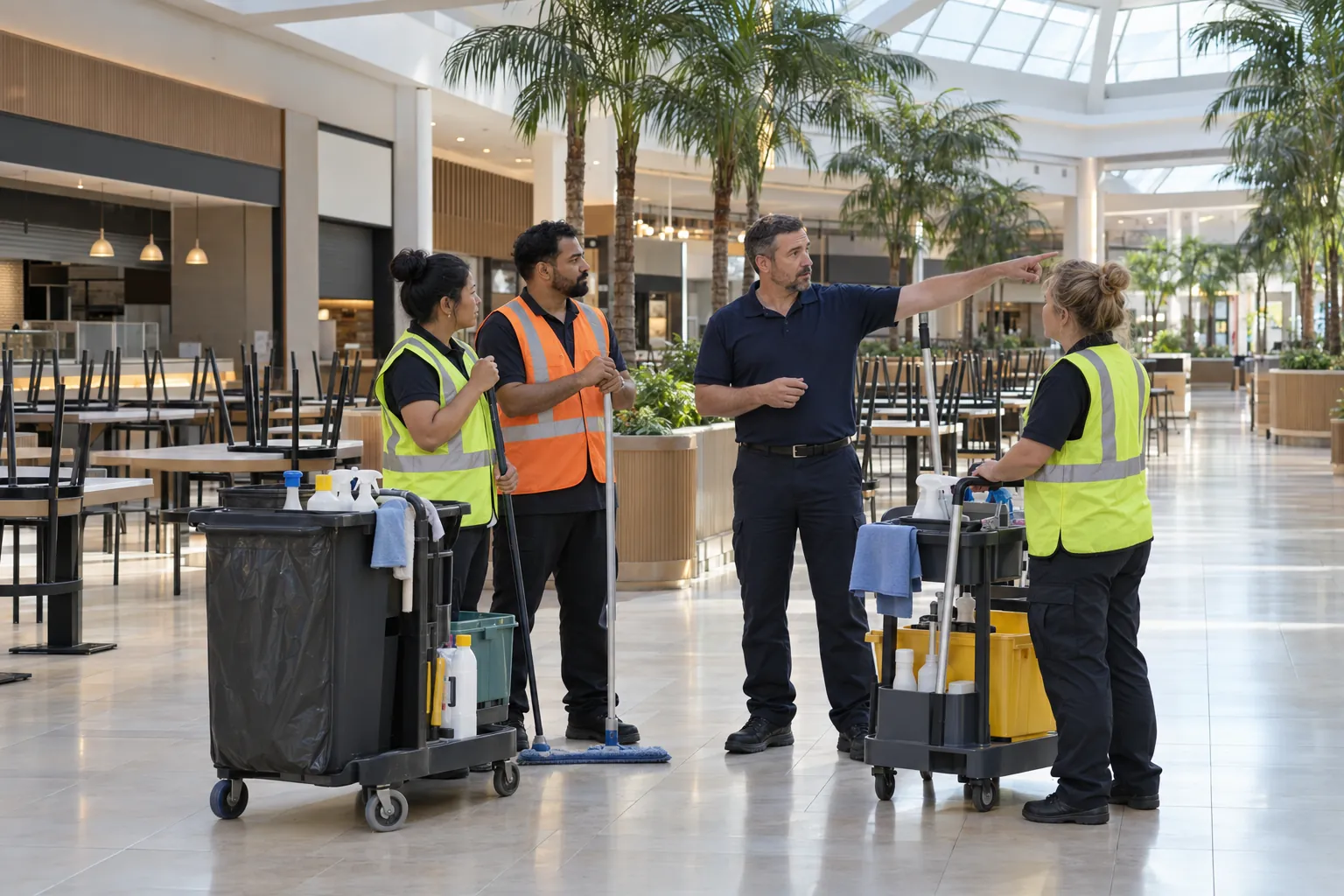 CleaningCleaning supervisor duties: what the role involves in Australia, and what good looks likeWhat a cleaning supervisor does in Australia: the Cleaning Services Award, WHS duties, a typical shift, managing the team, checking the work and reporting.