Cleaning
Commercial cleaning checklist: area by area, for Canadian buildings
A commercial cleaning checklist is the list of cleaning tasks a janitorial crew works from in an office or other commercial building, set out area by area and by frequency (daily, weekly and monthly), with room to record what was done.
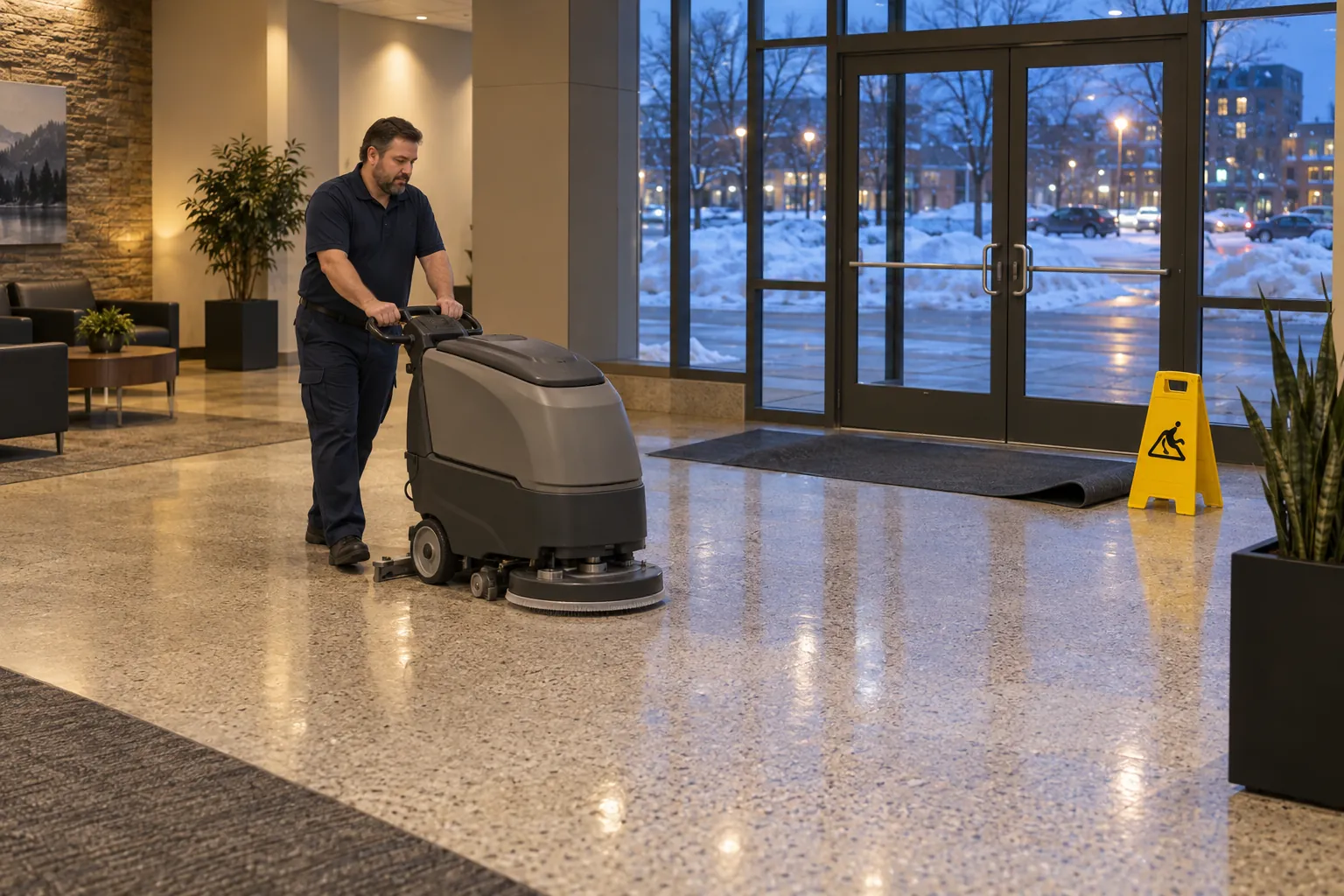
This guide sets one out area by area for offices and other commercial buildings in Canada, explains the provincial and federal rules that sit behind it, including Ontario's washroom cleaning records, and covers how to use the list on shift and how to tell whether it is being followed.
01
The rules behind a commercial cleaning checklist in Canada
No Canadian law requires a commercial cleaning checklist by name. What the law requires is a workplace kept clean and safe, and the checklist is how a janitorial crew, and the building owner or tenant paying for it, shows that the daily cleaning behind that duty is being done, whether the cleaners are in-house staff or come from a company selling commercial cleaning services.
The first thing to settle is which rules apply, because workplace health and safety in Canada is mostly provincial. Each province and territory has its own act and regulations. Federal rules apply only to federally regulated work, such as banks, airports, telecommunications and interprovincial transport.
Ontario. The Occupational Health and Safety Act defines an industrial establishment as "an office building, factory, arena, shop or office, other than an office located in a private residence", so almost every commercial building is one. Regulation 851 (Industrial Establishments) "applies to all industrial establishments" (section 3). Section 11 requires that a floor or other surface used by any worker be "kept free of" obstructions, hazards and "accumulations of refuse, snow or ice", and not have "any finish or protective material used on it that is likely to make the surface slippery". Section 123 applies the Fire Code's rules on keeping egress doorways, public corridors and exits free from obstruction.
Ontario has also made washroom cleaning a matter of record. Since 1 July 2025, section 25.3 of the Act has required an employer to ensure that washroom facilities provided for workers "are maintained in a clean and sanitary condition", and to "keep, maintain and make available records of the cleaning of washroom facilities as prescribed". O. Reg. 480/24, in force since 1 January 2026, says the record must include "the date and time of the two most recent cleanings", posted in a conspicuous place in or near the washroom, or posted electronically where workers can access it with direction on where and how. The province's page on maintaining clean washroom facilities for workers explains how inspectors judge "clean and sanitary", which the regulation does not define.
British Columbia. Part 4 of the WorkSafeBC Occupational Health and Safety Regulation requires floors, platforms, ramps, stairs and walkways to be "maintained in a state of good repair and kept free of slipping and tripping hazards" (section 4.39), and says "refuse, spills and waste material must not be allowed to accumulate so as to constitute a hazard" (section 4.41). Other provinces have their own versions; check yours.
Federally regulated workplaces. Part IX of the Canada Occupational Health and Safety Regulations is more specific. Every personal service room (a change room, toilet room, shower room, lunch room, living space or sleeping quarters) and food preparation area must be kept "in a clean and sanitary condition"; "all janitorial work that may cause dusty or unsanitary conditions" must be done so as to prevent contaminating the air; each personal service room "shall be cleaned at least once every day that it is used"; and waste containers must be emptied "at least once every day that it is used".
The checklist is not the contract. The janitorial scope of work says what is cleaned, to what standard and how often; the checklist is the working list for a shift or an area, in the order the work is done, with room to record what was done and what was found. Keep it short and specific to the building.
02
What a commercial cleaning checklist covers
Commercial buildings vary, from a single floor of office space in a strip plaza to a downtown tower with a food court, but the same area types turn up in almost all of them. A checklist should be divided by area, not written as one long list for the building, so that each part can be completed and checked on its own:
- Entrances, vestibules and lobbies: where visitors form their first impression and where, for much of the winter in most of Canada, snow, slush and road salt come in.
- Open-plan offices and workstations: garbage and recycling, touch points, clear desk surfaces and floors.
- Boardrooms, meeting rooms and conference rooms: tables, chairs, screens and whiteboards, reset for the next day.
- Kitchenettes, lunchrooms and break rooms: sinks, counters, appliances, fridges and organics.
- Washrooms, which American cleaning companies call restrooms: toilets, urinals, sinks, dispensers, floors and supplies, and in Ontario the posted cleaning record. See the washroom cleaning checklist.
- Corridors, stairwells and elevators: handrails, door hardware, elevator buttons and floors in high-traffic areas.
- High-touch surfaces across the building: door handles, light switches, push plates, elevator buttons, shared phones and equipment such as printers.
- Garbage, recycling and organics: internal bins, central collection points and the garbage room.
- Anything specialized: a fitness room, a clinic, a retail floor, a commercial kitchen or a server room, each with its own list.
Schools, with their own calendar and custodial staff, need a list of their own; see the school cleaning checklist. Leave out anything the contract does not cover. A checklist that lists window washing when a separate contractor does the windows each spring and fall invites a checkmark against work the crew never does.
03
The checklist, area by area
The tasks below are a starting point for a typical office or mixed commercial building. Adjust them to the building, depending on its use and traffic, and take the frequencies from the schedule. Daily tasks come first, area by area; weekly, monthly and periodic tasks follow.
Entrances, vestibules and lobby
- Vacuum or extract entrance matting and shake out or swap removable mats; in winter, check mats are lying flat and not saturated.
- Sweep and damp mop hard floors, or run the auto scrubber; clean again during storms, when meltwater and salt residue build up quickly.
- Place wet floor signs wherever a floor is wet, and remove them once it is dry.
- Clean the glass of entrance doors and sidelights at hand height.
- Wipe the reception desk, visitor seating, sign-in screen and door push plates.
- Empty garbage and recycling and check the area is clear of trip hazards.
Offices and workstations
- Empty garbage, recycling and, where the building collects it, organics; replace liners.
- Wipe desks that have been left clear; do not move papers or equipment unless the scope of work says so.
- Wipe shared keyboards, phones and printer controls where agreed.
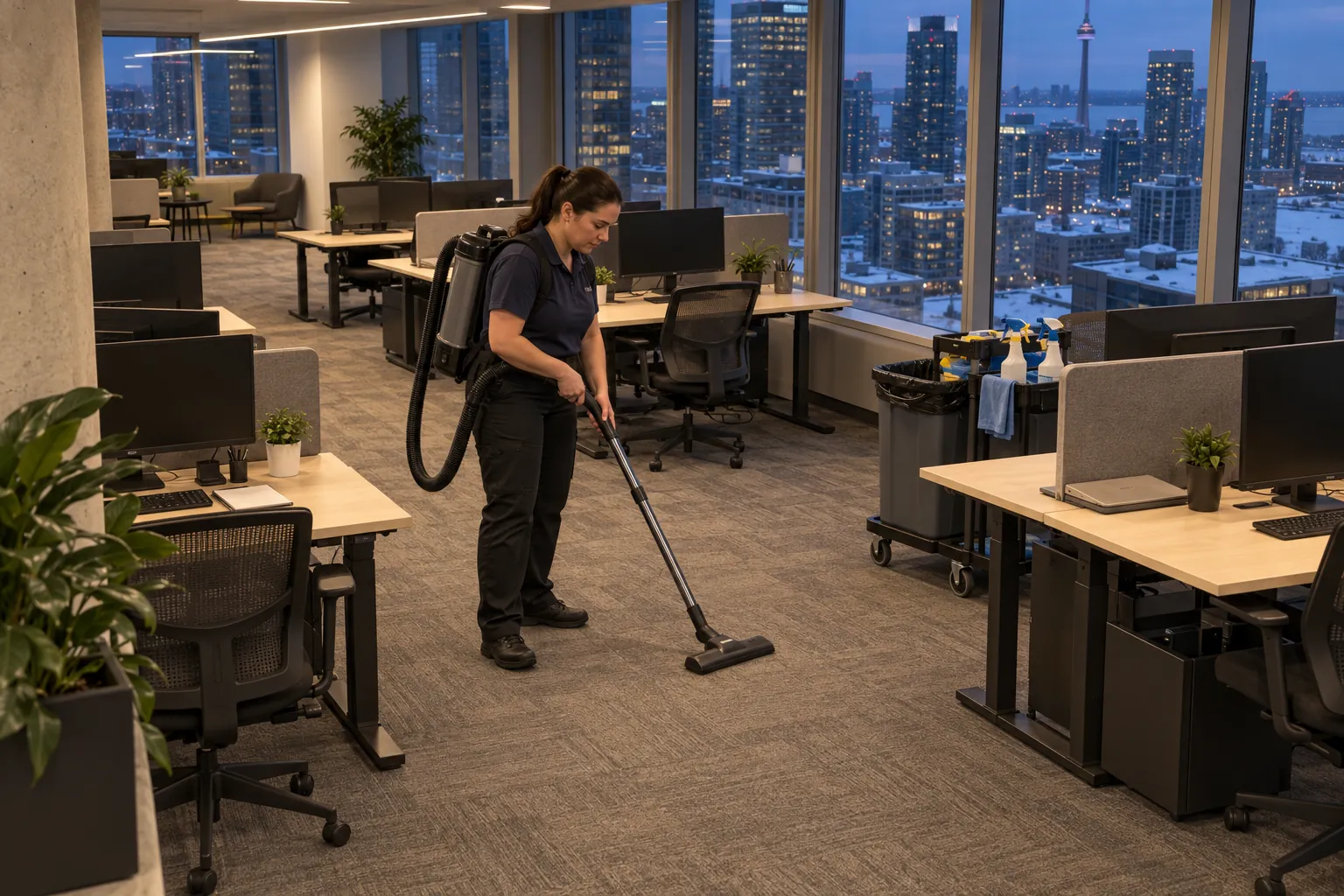
- Vacuum carpets and walkways, with the busiest routes done every day; spot-clean spills.
- Dust windowsills, ledges and partition tops within reach.
Boardrooms, meeting rooms and conference rooms
- Clear cups and litter, wipe tables and chairs.
- Clean whiteboards if left clean-ready, and wipe control panels.
- Vacuum or mop and reset furniture to the standard layout.
Kitchenettes, lunchrooms and break rooms
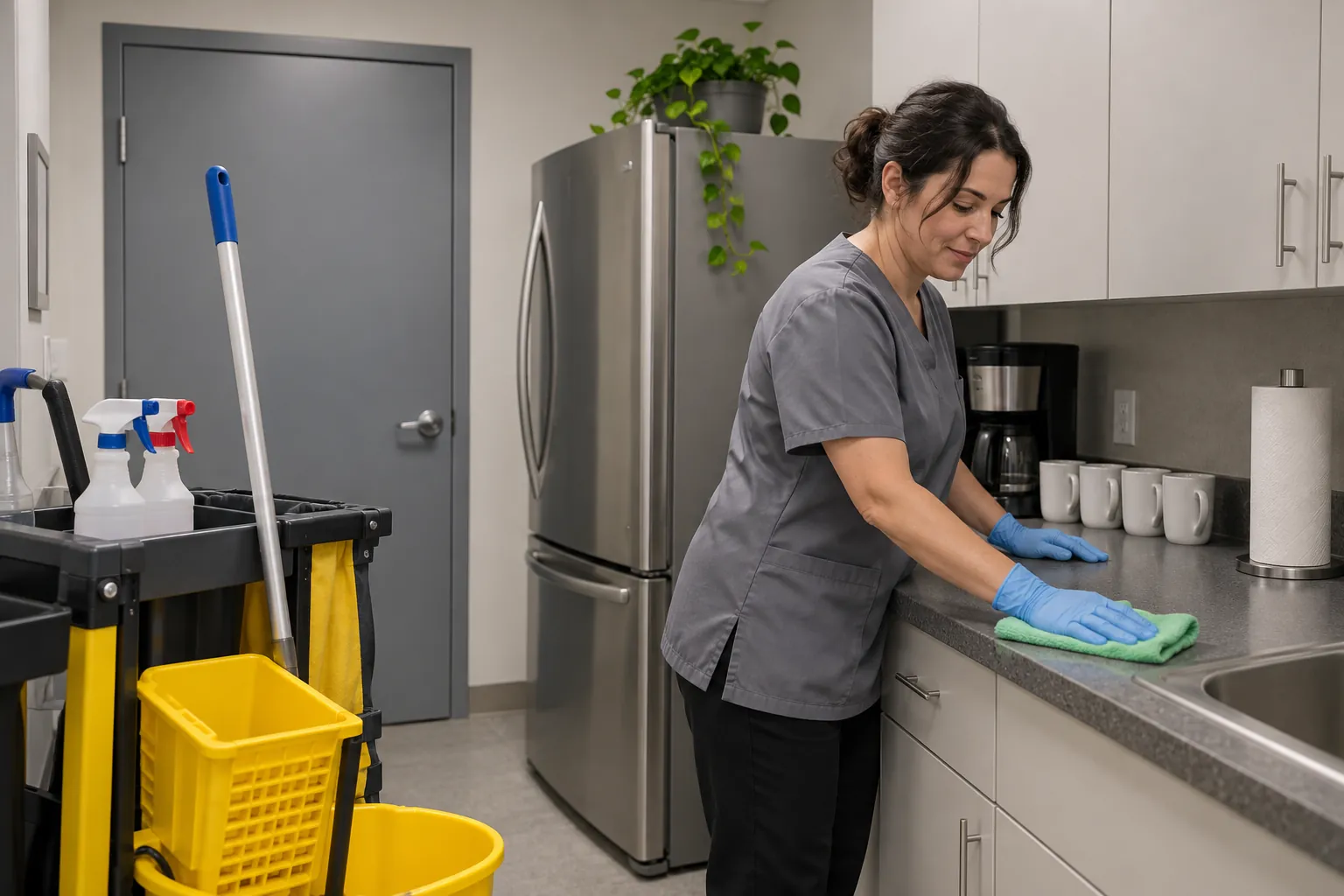
- Clean and disinfect counters, sinks and faucets.
- Wipe appliance fronts, handles and controls: fridge, microwave, kettle, coffee machine, dishwasher.
- Empty organics, garbage and recycling into the building's streams.
- Mop the floor and restock hand soap and paper towels.
- Where food is prepared for sale, follow the food premises cleaning program the local public health authority expects; it takes precedence over this list.
Washrooms
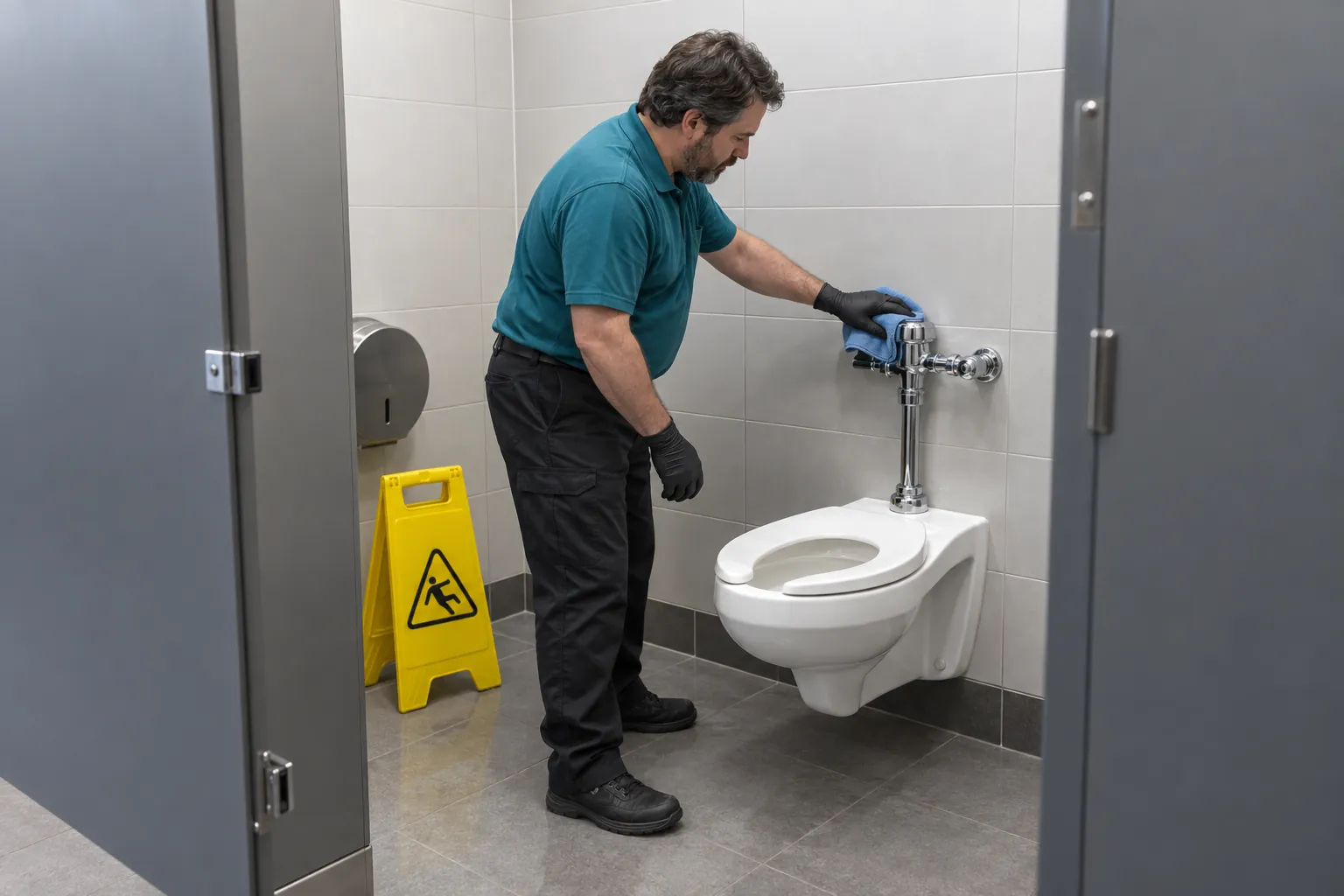
- Clean and disinfect toilets, urinals, seats and flush handles.
- Clean sinks, faucets, mirrors and stall doors, locks and partitions.
- Restock toilet paper, soap, paper towels and hand sanitizer; check hand dryers work.
- Empty garbage and check sanitary disposal units are within capacity.
- Mop the floor, working toward the door, and report any leak, clog or broken fixture.
- In Ontario, where the washroom is provided for workers, update the posted or electronic record with the date and time of the cleaning.
Corridors, stairwells and elevators
- Vacuum or mop floors and stair treads.
- Wipe handrails, door handles, push plates and elevator buttons.
- Check that exits, stairwells and corridors are clear of janitorial carts, equipment and garbage.
Weekly, monthly and periodic
- Weekly: high dusting of ledges and baseboards, detailed cleaning of doors and frames, inside microwaves and fridges, interior glass, chair bases and bin exteriors.
- Monthly: dust air diffusers and return grilles, clean light switches and receptacle plates thoroughly, wash internal bins.
- Periodic, often quarterly or twice a year: carpet extraction, stripping and refinishing resilient floors, deep cleaning of washrooms and kitchenettes, cleaning behind and under fixed equipment, and exterior window washing by a specialist. In winter, add salt-residue removal from entrance floors and carpets as often as the weather demands.
04
How to use the checklist on shift
A checklist only improves cleaning if it matches how the work is really done. A few habits make the difference between a list that guides the shift and a list that is checked off at the end of it.
- Write it in route order. The list should follow the path the cleaner walks, so that it is read as the work progresses rather than looked at afterward.
- Clean from top to bottom and from clean to dirty. High surfaces before low ones, dry dusting before wet cleaning, and washrooms last or with separate equipment, so that dirt and germs are not carried from one area to the next.
- Use a colour-coded system. Many janitorial crews use separate colours of cloth, mop and bucket for washrooms, general areas and food areas, so that equipment used on a toilet is never used on a kitchen counter. Put the colour for each area on the checklist.
- Name the products, and check they are the right ones. Many cleaning chemicals are hazardous products under WHMIS, the Workplace Hazardous Materials Information System, whose main components, as the CCOHS guide WHMIS – General sets them out, are hazard identification and product classification, labelling, safety data sheets, and worker education and training. A disinfectant sold in Canada needs, in Health Canada's words from its guidance on disinfectants, "a pre-market assessment and a drug identification number (DIN)" before it can be sold. The checklist can refer to the label and safety data sheet for dilution and contact time rather than repeat them, and should start with a check that supplies and consumables are stocked.
- Record exceptions, not only checkmarks. A task that could not be done, because a room was locked or a meeting ran late, should say so. So should a problem found: a dripping faucet, a burnt-out light, a stain that will not come out, a lifted mat.
- Make time for it. If the list takes longer than the hours on site, it will be completed on paper and not in the building. Time each area once and set the list, or the hours, accordingly.
Keep separate checklists for each area or route, not one for the whole building. When something is missed, a list per area shows where; a single sheet for the building shows only that the shift ended.
05
How to check the checklist is being followed
Whether cleaning is done in-house or bought from a janitorial contractor, the question is the same. A completed checklist shows that the work was recorded. Whether it was done, and done well, needs someone else to look. The usual layers are:
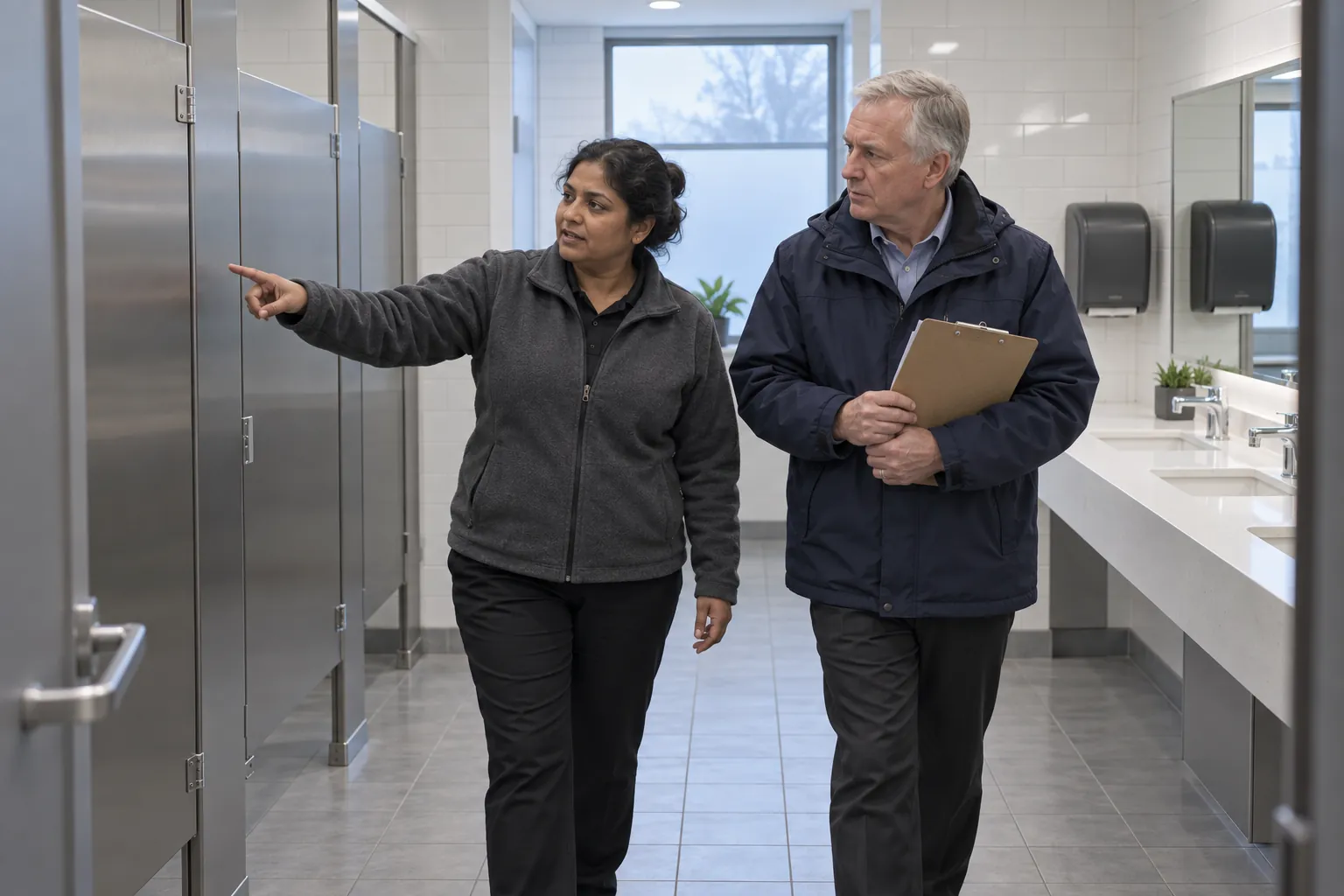
- The janitorial supervisor's walk-through. A short, regular inspection of a sample of areas against the checklist, at varied times, including first thing in the morning when the night crew's work is fresh.
- A quality inspection. A scored inspection against the standards in the scope of work, often monthly and sometimes jointly with the property manager. The janitorial quality control guide covers how.
- Complaints and work orders. Every complaint is a data point: where it was, what time, and whether the checklist for that area showed the task as done.
- The joint health and safety committee or representative. Under Ontario's Act, a designated worker member of the committee, or the health and safety representative, inspects the physical condition of the workplace at least once a month; where that is not practical, the whole workplace at least once a year, with part of it inspected each month (sections 8 and 9); see the JHSC workplace inspection guide. Slippery entrances, blocked exits and overflowing garbage rooms are what the checklist should already have caught.
Review the checklist whenever the building's use changes: a new tenant, a new floor, different hours, a lunchroom that opens or closes. A checklist written for five busy days wastes effort in an office that is full only two or three days a week.
06
Where the checklist record fails, and what SiteClara does about it
The paper checklist has the same weakness everywhere. It is filled in by the person whose work it records, often at the end of the shift, and it lives on a clipboard in the janitor's closet. A property manager who wants to know whether the lunchroom was cleaned last night has to take someone's word for it, and a contractor with twenty buildings finds out about a missed area when the complaint arrives.
SiteClara puts a printed QR poster at each area on the checklist, with an optional NFC tag behind it. A member of the crew scans the code or taps the tag on their own phone, with no app to install, and sees the scheduled checks due at that location. They mark each one done, or explain what stopped them, and can add a photo. The time and the person are recorded as it happens. A problem found on the round, such as a dripping faucet or a broken dispenser, can be reported there and goes onto the team's list of jobs until someone closes it.
The supervisor sees what is due, done and missed across the building, can record the reason a check was missed, and sees open jobs grouped by building and floor. At the end of the day they review the totals and photos, add a note and approve the report, which goes to nominated management or client contacts at 8 a.m. the next morning, showing what was completed, what is still open and how scheduled checks went, for example 12 of 12 completed.
07
Questions people ask
What is included in commercial cleaning?
The federal government’s National Occupational Classification profile for light duty cleaners (NOC 65310) says they “clean lobbies, hallways, offices and rooms” of buildings including office buildings, and lists duties such as “Sweep, mop, wash, wax and polish floors”, “Clean, disinfect and polish kitchen and bathroom fixtures and appliances”, “Pick up debris and empty trash containers” and “Wash windows, walls and ceilings”. The CCOHS Workplace Housekeeping – Basic Guide adds the safety side: keeping work areas neat and orderly, halls and floors free of slip and trip hazards, and waste removed, with dust and dirt removal, spill control and waste disposal among the elements of an effective program. What a particular contract includes is set by its scope of work.
What are the 7 stages of cleaning?
No Canadian regulator sets out seven stages of cleaning, and lists that use the number differ. Public Health Ontario’s Best Practices for Environmental Cleaning for Prevention and Control of Infections in All Health Care Settings, written for health care but useful in any building, gives the order in three parts. Before cleaning: gather the materials, follow the manufacturer’s instructions for dilution and contact time, and remove clutter. During cleaning: “Progress from the least soiled areas to the most soiled areas”, “Progress from high surfaces to low surfaces” and “Remove gross soil prior to cleaning and disinfection”, with dry mopping before wet or damp mopping. After cleaning: clean and dry the tools between uses and launder mop heads daily. It explains why cleaning comes first: “Surfaces must be cleaned of visible soil before being disinfected, as organic material may inactivate a disinfectant.”
08
Further reading, and a list to take away
Start with your own province's regulation and its guidance, the federal Part IX if the workplace is federally regulated, and the CCOHS guides Workplace Housekeeping – Basic Guide and WHMIS – General. In Ontario, the province's page on maintaining clean washroom facilities for workers is the quickest way into the washroom record.
Before you issue a commercial cleaning checklist to the crew, check that it:
- is divided by area and written in the order the work is done;
- matches the scope of work, with nothing on it the contract does not cover;
- takes its frequencies from the cleaning schedule, not a separate list;
- names the colour code and the product for each area, with a DIN on every disinfectant;
- covers winter entrances, mats and salt, with checks through the day;
- keeps exits and stairwells clear of carts and garbage;
- has room to record tasks not done, and why, and problems found;
- in Ontario, keeps the washroom cleaning record the regulation requires;
- fits the hours on site when done properly;
- is checked by someone other than the person who filled it in.
Sources
Every document this guide quotes or links to, in the order it first cites them.
- Occupational Health and Safety Act ontario.ca
- Regulation 851 (Industrial Establishments) ontario.ca
- O. Reg. 480/24 ontario.ca
- Maintaining clean washroom facilities for workers ontario.ca
- WorkSafeBC Occupational Health and Safety Regulation worksafebc.com
- Canada Occupational Health and Safety Regulations laws-lois.justice.gc.ca
- WHMIS – General ccohs.ca
- Guidance on disinfectants canada.ca
- CCOHS guide to workplace housekeeping ccohs.ca
- National Occupational Classification profile for light duty cleaners (NOC 65310) noc.esdc.gc.ca
- Best Practices for Environmental Cleaning for Prevention and Control of Infections in All Health Care Settings publichealthontario.ca
Related guides
 CleaningOffice cleaning checklist: what to clean, how often, and how to show it was doneAn office cleaning checklist for Canada: the federal and provincial rules behind it, daily to periodic tasks, who does what, and how to show it was done.
 CleaningWashroom cleaning checklist: what to check, how often, and Ontario's new cleaning recordsWhat a workplace washroom cleaning checklist should cover, how often to clean, and Ontario's posted cleaning records required since January 1, 2026.
 CleaningJanitorial scope of work: what it should say, and how to show it is metWhat a janitorial scope of work should contain in Canada: areas, tasks, frequencies, standards, winter care, WHMIS and products, and how to show the work was done.
 CleaningJanitorial quality control: how to inspect, correct and show the standard heldHow janitorial quality control works in Canada: QA versus QC, inspections, sampling, corrective action, CIMS, the PIDAC audit model and records that hold up.