Cleaning
Floor care program: what to do, how often, and how to show it was done
Floor care is the cleaning and maintenance that keeps a building's hard floors and carpet clean, safe to walk on and lasting as long as they should: floor cleaning every day, interim work every few weeks or months, and restorative work once or twice a year in the busiest areas.
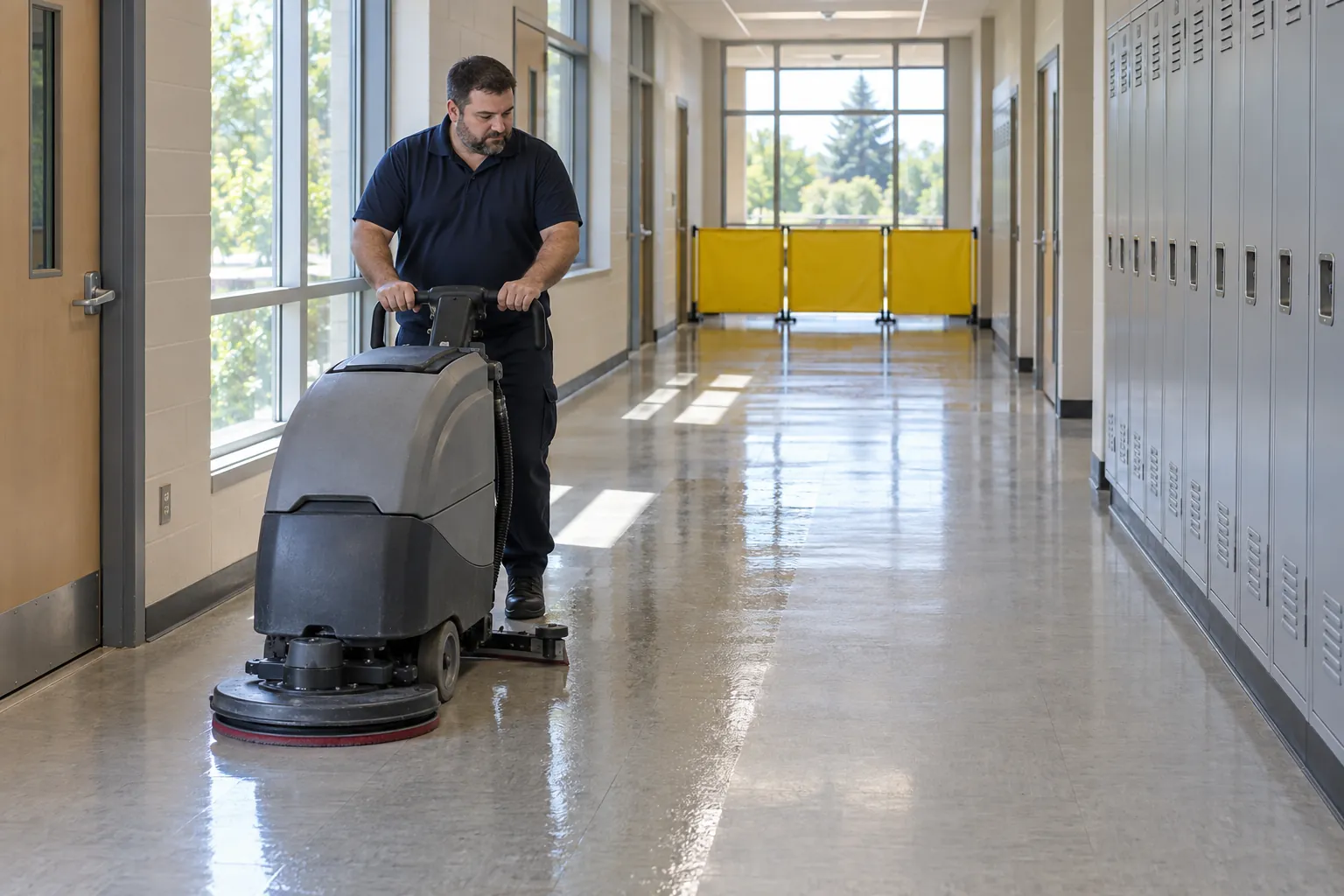
A floor care program is the plan that sets out that work floor by floor and area by area, with who does it and how often. This guide covers what Canadian workplace law says about floors, what a program should include, how often each kind of work is done, how to do it safely, and how to keep a record of it that a client or a joint health and safety committee will believe.
01
What a floor care program is, and what the law in Canada asks for
Floor care is the part of janitorial work that deals with hard floors and carpet: removing soil every day, keeping the finish up between visits, and restoring the floor when routine work no longer brings it back. A floor care program writes that down: which floors the building has, what each needs, how often, by whom, and how anyone can tell it was done. Whether the work is done by in-house custodians or bought in from commercial cleaning services, the program is the same document; in a contract it usually sits inside the janitorial scope of work.
No Canadian law says how often to mop or when to strip and refinish. The law sets the outcome, mostly about slipping, and because most workplace health and safety law is provincial or territorial, the rules depend on where the building is:
- Ontario. Section 11 of R.R.O. 1990, Reg. 851: Industrial Establishments says that a floor or other surface used by any worker shall be kept free of obstructions, hazards and accumulations of refuse, snow or ice, and shall not have any finish or protective material used on it that is likely to make the surface slippery. The Occupational Health and Safety Act defines an industrial establishment as an office building, factory, arena, shop or office, so the rule reaches most commercial buildings. The second limb is a floor care rule in plain words.
- British Columbia. Section 4.39 of the OHS Regulation Part 4: General Conditions requires floors, platforms, ramps, stairs and walkways available for use by workers to be maintained in a state of good repair and kept free of slipping and tripping hazards, and, if such areas are taken out of service, the employer must take reasonable means for preventing entry or use. Section 4.41 says refuse, spills and waste material must not be allowed to accumulate so as to constitute a hazard.
- Federally regulated workplaces (banks, airports, telecoms, interprovincial transport) follow the Canada Occupational Health and Safety Regulations (SOR/86-304) under Part II of the Canada Labour Code. Section 2.14 requires dust, dirt, waste and scrap to be removed as often as is necessary to protect the health and safety of employees, and every travelled surface to be slip resistant and kept free of splinters, holes, loose boards and tiles and similar defects. Section 9.3 is written for janitors: all janitorial work that may cause dusty or unsanitary conditions shall be carried out in a manner that will prevent the contamination of the air by dust or other substances injurious to health.
Behind all of these sits the general duty. In Ontario, section 25(2)(h) of the OHSA requires an employer to take every precaution reasonable in the circumstances for the protection of a worker, and section 27(2)(c) puts the same duty on a supervisor. A floor care program is how an owner and a janitorial contractor show they have taken those precautions for the floors.
02
What a floor care program covers
A useful program starts with an inventory, not a schedule. Walk the building with a floor plan and record every floor surface, its type of flooring, its location and roughly its area. Different flooring types need different products, pads and methods, so the inventory decides everything that follows. Most Canadian commercial buildings have several of these:
- Vinyl composition tile (VCT) in corridors and classrooms, with sealer and coats of finish that take the wear instead of the tile.
- Sheet vinyl flooring, luxury vinyl tile and linoleum, often factory-coated; the care guide may say not to strip or finish them.
- Laminate flooring in some offices and retail units, which is durable on the surface but can be damaged by moisture at the joints, so it is damp mopped, never flooded.
- Rubber flooring in gyms and stairwells.
- Ceramic, porcelain and quarry tile in washrooms and kitchens, where grout shows neglect first.
- Terrazzo, stone and sealed concrete in entrances and atriums.
- Hardwood in school and community centre gyms, with its own contractor and schedule.
- Carpet and carpet tile in offices and libraries.
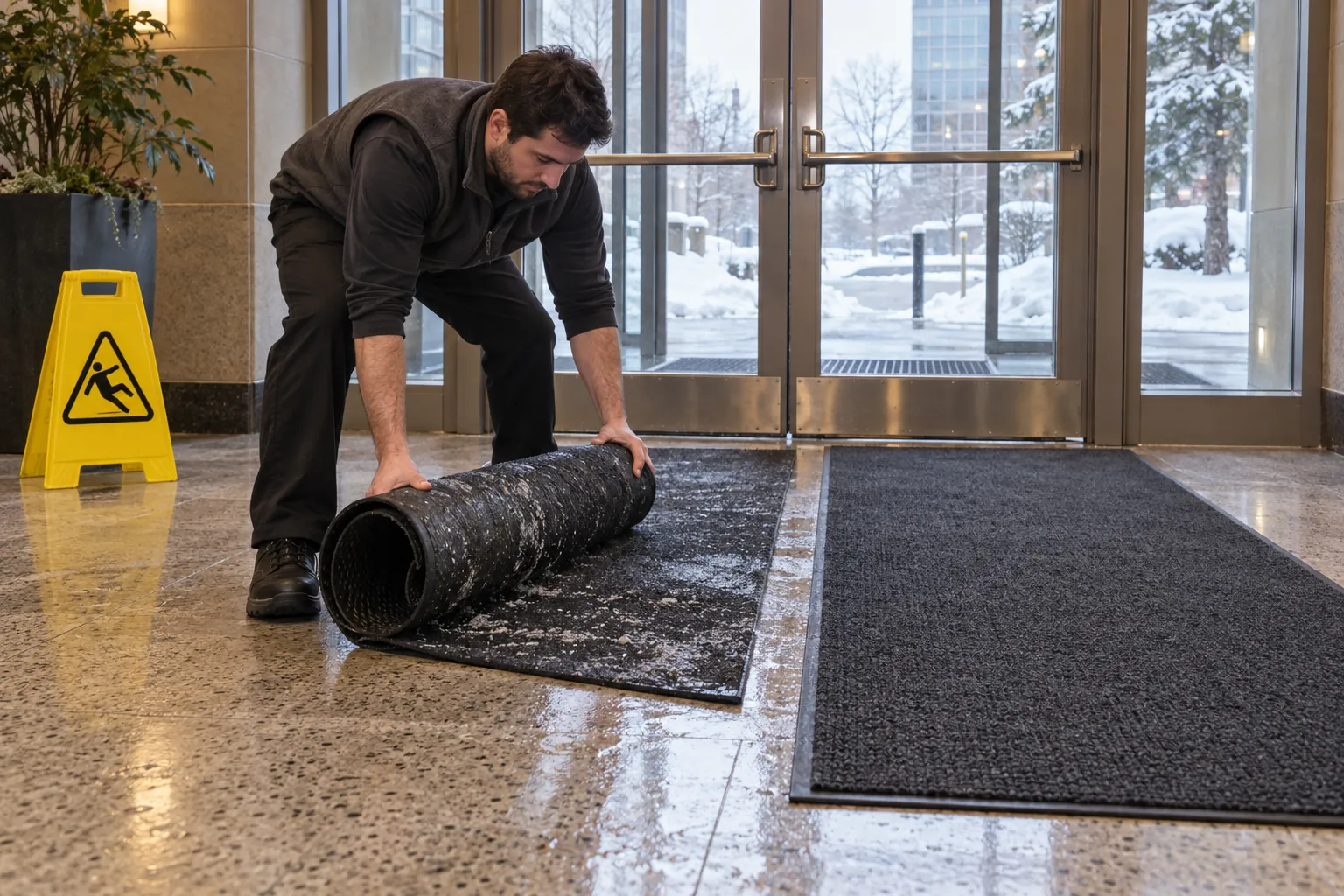
- Entrance matting, the first line of defence against the dirt and salt that wear everything else.
For each floor, the program then sets out three levels of work. The words vary between companies, but the structure is almost universal in janitorial work:
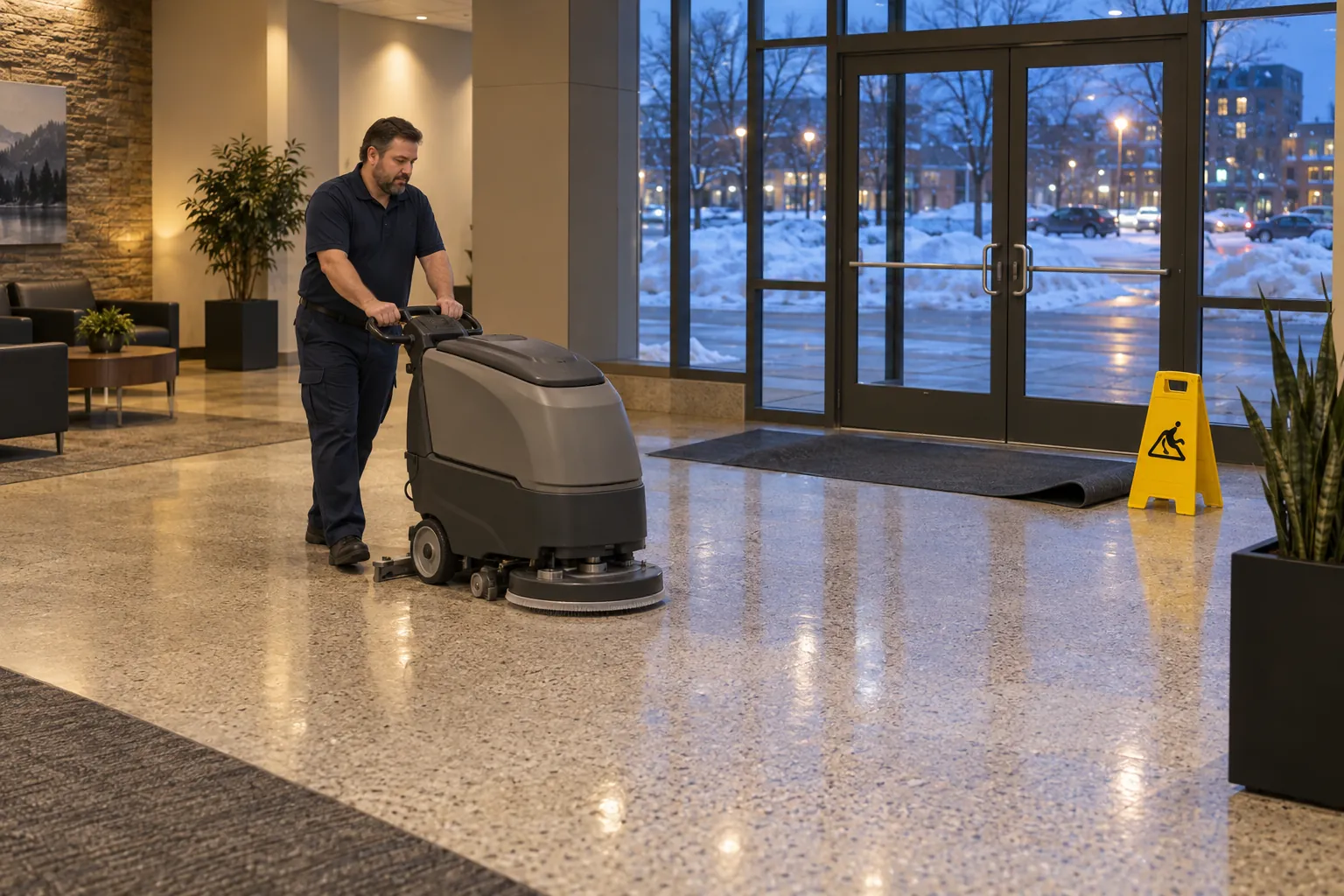
- Daily (routine) care: dust mopping or sweeping, damp mopping or auto-scrubbing, spot cleaning spills, vacuuming carpet, cleaning and shaking out matting. This regular cleaning is what keeps soil from grinding into the surface.
- Interim care: machine scrubbing, a top scrub and recoat, burnishing or spray buffing, low-moisture cleaning of carpet traffic lanes, and cleaning grout.
- Restorative care: stripping and refinishing, hot-water extraction of carpet, honing stone and terrazzo, and screening and recoating a gym floor. This is the disruptive work, usually booked for summer or the winter holidays, when furniture can be moved out and the area closed until the floor is dry.
Alongside the levels, the program records for each area the products and dilutions, the equipment and pads, who does the work and what counts as done. It also names the areas that cannot be closed easily, such as the only entrance, because those decide how restorative work is scheduled.
03
How often: setting the frequencies, and planning for winter
Frequencies follow traffic, not the calendar. A main entrance in January needs more than a third-floor meeting room in July. A sensible start is to sort each area into heavy, medium and light traffic, then set the work for each band:
- Heavy traffic (entrances, lobbies, main corridors, cafeterias, washrooms): daily care every day the building is open, more than once a day at entrances in wet or snowy weather; interim work weekly to monthly; restorative work once or twice a year.
- Medium traffic (secondary corridors, classrooms, open offices, break rooms): daily care each day or each cleaning visit; interim work monthly to quarterly; restorative work every year or two.
- Light traffic (private offices, storage, rarely used rooms): routine care on a set schedule; interim and restorative work only when inspection shows it is needed.
These bands are a starting point to agree, not a standard. The best evidence is the floor itself: a corridor that needs restoring every six months needs more interim work or better matting.
Book restorative work a year ahead. Strip and refinish in a school usually happens in July and August, when rooms can be emptied; in an office it may be a series of weekends. Put the dates in the program so that a missed summer is noticed in September, not the following spring.
The program should also say what happens outside the schedule. A spill or a leak is floor care too, and CCOHS's guidance on prevention of slips, trips and falls puts cleaning all spills immediately and marking spills and wet areas among its first measures. Say who responds, how fast, and how a spill found by someone else reaches them.
04
Who does what, and doing it safely
Floor care is often split between people who rarely meet: a day porter at the entrances, the evening crew, a floor care technician or subcontractor for the machine work, and the building operator who books closures. The program should name each role against each task, and name the janitorial supervisor who checks the result.
Four safety questions come up in almost every program:
- Closing the area. A floor being stripped or refinished is often more slippery than any spill. British Columbia's section 4.39(2) requires reasonable means for preventing entry or use when an area is taken out of service. Use barriers, not only a wet floor sign, work in sections so a route stays open, and reopen only once the finish is dry.
- The chemicals. Floor strippers, finishes, degreasers and some neutral cleaners are hazardous products under WHMIS. CCOHS's WHMIS – General page sets out the employer's part: educate and train workers on the hazards and safe use of products, provide access to current safety data sheets, ensure proper labelling and put control measures in place. CCOHS's Cleaning Products – Working Safely adds the habits that matter: read the label or safety data sheet, never mix different products, add the concentrate to the water, and work in a well-ventilated space.
- The finish. In Ontario, Reg. 851 forbids a finish likely to make the surface slippery. Use the manufacturer's slip resistance information, coat count and drying times, and never finish a floor whose manufacturer says not to.
- Older floors. Health Canada's Asbestos and your health lists floor and ceiling tiles among the older building materials that may contain asbestos, and sanding and scraping among the activities that can release its fibres. In Ontario, O. Reg. 278/05, Designated Substance – Asbestos on Construction Projects and in Buildings and Repair Operations classifies breaking, cutting, drilling, abrading, grinding, sanding or vibrating non-friable asbestos-containing material as a Type 1, 2 or 3 operation, with measures that depend on how the work is done; section 8 requires an owner who knows, or ought reasonably to know, that asbestos-containing material has been used in a building to prepare and keep on the premises a record of it, and to give written notice to an employer contracted for work that may involve or disturb that material. Before aggressive stripping or grinding of an older floor, ask the owner for that record, and if a floor is on it, stop and follow the owner's asbestos procedure.
Record who is trained on each machine, keep the manufacturer's instructions with it, and remember the federal rule on dust when dry buffing or sweeping: choose the method that keeps dust out of the air.
05
What good evidence looks like, and how the program is checked
A floor care program is only as good as the proof that it happened. Arguments about floors are rarely about technique; they are about whether the interim work was done at all. Good evidence says what was done, where, when and by whom.
- Daily care recorded area by area as it is done, not as one tick for the whole floor at the end of the shift.
- Interim and restorative work with the date, area, method, number of coats and who did it; a photo before and after is worth more than a sentence.
- Closures, with when the area was closed and reopened.
- Spills, with who was told and when it was cleaned.
- Deficiencies found on inspection, such as salt film or worn traffic lanes, with the date they were put right.
Checking comes in three forms. The supervisor's inspection, walking a sample of areas on unannounced visits and scoring the floors against the program, is the backbone of janitorial quality control. A joint inspection with the client or property manager settles disagreements before they become complaints. And the workplace inspection by the joint health and safety committee or representative looks at floors from the safety side: slippery finishes, damaged tiles, curled mats. The JHSC workplace inspection does not replace the floor care program, and the program does not replace it.
For contractors, the ISSA Cleaning Industry Management Standard (CIMS) is the industry's management framework. ISSA Canada describes it as providing a framework for cleaning organizations to establish effective management systems that ensure quality, efficiency and customer satisfaction, and under “Who can be certified?” the page says its Green Building version, CIMS-GB, applies, whatever the size of the organization, both to cleaning organizations that self-perform cleaning and to commercial cleaning contractors. A written program with records is the kind of documented procedure it looks for.
06
Where the floor care record fails, and what SiteClara does about it
Floor care records fail in familiar ways. The daily work is signed for once, for the whole building, at the end of the night shift. The interim scrub and recoat is written on a calendar in the janitor's closet that the client never sees. Nobody can say whether the lobby was mopped after the afternoon snowfall, and a spill reported to whoever was passing reaches the crew hours later, or not at all.
SiteClara records the work at the place where it is done. A printed QR code at each area, with an NFC tag behind it if staff would rather tap than scan, lets the custodian, porter or floor care technician mark the scheduled work for that location done on their own phone, with no app to install, or say what stopped them, such as an area that could not be closed. Their name and the time are recorded as it happens, and they can add a photo when one is asked for, such as a before and after of a recoat. A problem found, such as a worn traffic lane, lifted tile or curled mat, goes onto the team's list of open jobs until someone closes it.
The supervisor sees what is due, done and missed at each location, and can record the reason a scheduled task was missed from their company's own list, with a few words. At the end of the day they review it, add a note and approve the report, which goes to nominated client or management contacts at 8 a.m. the next morning, showing what was completed, what is still open and how the scheduled work went.
07
Questions people ask
How often do floors need to be cleaned?
As often as it takes to keep them safe, which in a workplace is set by traffic and weather, not by a fixed number. Section 2.14 of the Canada Occupational Health and Safety Regulations requires dust, dirt, waste and scrap to be removed "as often as is necessary to protect the health and safety of employees", and CCOHS's Workplace Housekeeping – Basic Guide says cleaning "must be done regularly, not just at the end of the shift". In practice that means daily care in every area in use, and more than once a day at entrances in wet or snowy weather.
Should you mop your floors once a week?
In a commercial building, once a week is rarely enough for floors people walk on every day, and spills cannot wait for the weekly visit. CCOHS's Prevention of Slips, Trips and Falls lists "cleaning all spills immediately" and "mopping or sweeping debris from floors" among the good housekeeping that is the first level of preventing falls. A weekly schedule can suit light-traffic rooms such as storage or rarely used offices, if inspection shows the floor stays clean.
What is the best thing to clean floors with?
The product the floor or finish manufacturer's care guide names for that type of flooring, diluted as the label says. CCOHS's Cleaning Products – Working Safely says to "always use the appropriate product for the task, and one that is the least hazardous", to "always add the concentrate to the water", and to use mops or scrubbers that keep hands out of the solution.
Is vinegar and Dawn good to mop floors?
Mixing your own cleaner is not the safe default at work. CCOHS's Cleaning Products – Working Safely says "never mix different cleaning products together" and "do not mix vinegar (which is an acid), bleach, or ammonia when making homemade cleaners". On a commercial floor, use the cleaner the manufacturer's care guide names, so that the finish and its slip resistance are not harmed.
08
Further reading, and a list to take away
In Ontario, read section 11 of Reg. 851 and sections 25 and 27 of the OHSA, and O. Reg. 278/05 if the building is older. In British Columbia, read sections 4.39 to 4.41 of WorkSafeBC's Part 4. Federally regulated workplaces should read sections 2.14, 2.15 and 9.3 of the Canada Occupational Health and Safety Regulations. Elsewhere, start with your own province's general conditions regulation. CCOHS's Workplace Housekeeping – Basic Guide is short and practical, and notes that areas that cannot be cleaned continuously, such as entrance ways, should have anti-slip flooring.
Before the next season's floor work, check that:
- every floor surface is listed by area, with its type and the manufacturer's care guide;
- each area has a traffic band and agreed daily, interim and restorative frequencies;
- the restorative work has dates booked for the coming year;
- there is a winter plan: matting, extra entrance cleaning, ice melt residue and signs;
- each task names who does it and who checks it;
- workers using strippers, finishes and machines have WHMIS and equipment training, with current safety data sheets on hand;
- closures use barriers, and areas are not reopened until dry;
- in older buildings, the owner's asbestos record has been checked before stripping or grinding;
- spills have a named responder and a way of reaching them;
- the work is recorded by area, with times, names and photos for interim and restorative work;
- someone reviews the records each month and acts on the trends.
Sources
Every document this guide quotes or links to, in the order it first cites them.
- R.R.O. 1990, Reg. 851: Industrial Establishments ontario.ca
- Occupational Health and Safety Act ontario.ca
- OHS Regulation Part 4: General Conditions worksafebc.com
- Canada Occupational Health and Safety Regulations laws-lois.justice.gc.ca
- Prevention of slips, trips and falls ccohs.ca
- WHMIS – General ccohs.ca
- Cleaning Products – Working Safely ccohs.ca
- Asbestos and your health canada.ca
- O. Reg. 278/05, Designated Substance – Asbestos on Construction Projects and in Buildings and Repair Operations ontario.ca
- Cleaning Industry Management Standard (CIMS) issa-canada.com
- Workplace Housekeeping – Basic Guide ccohs.ca
Related guides
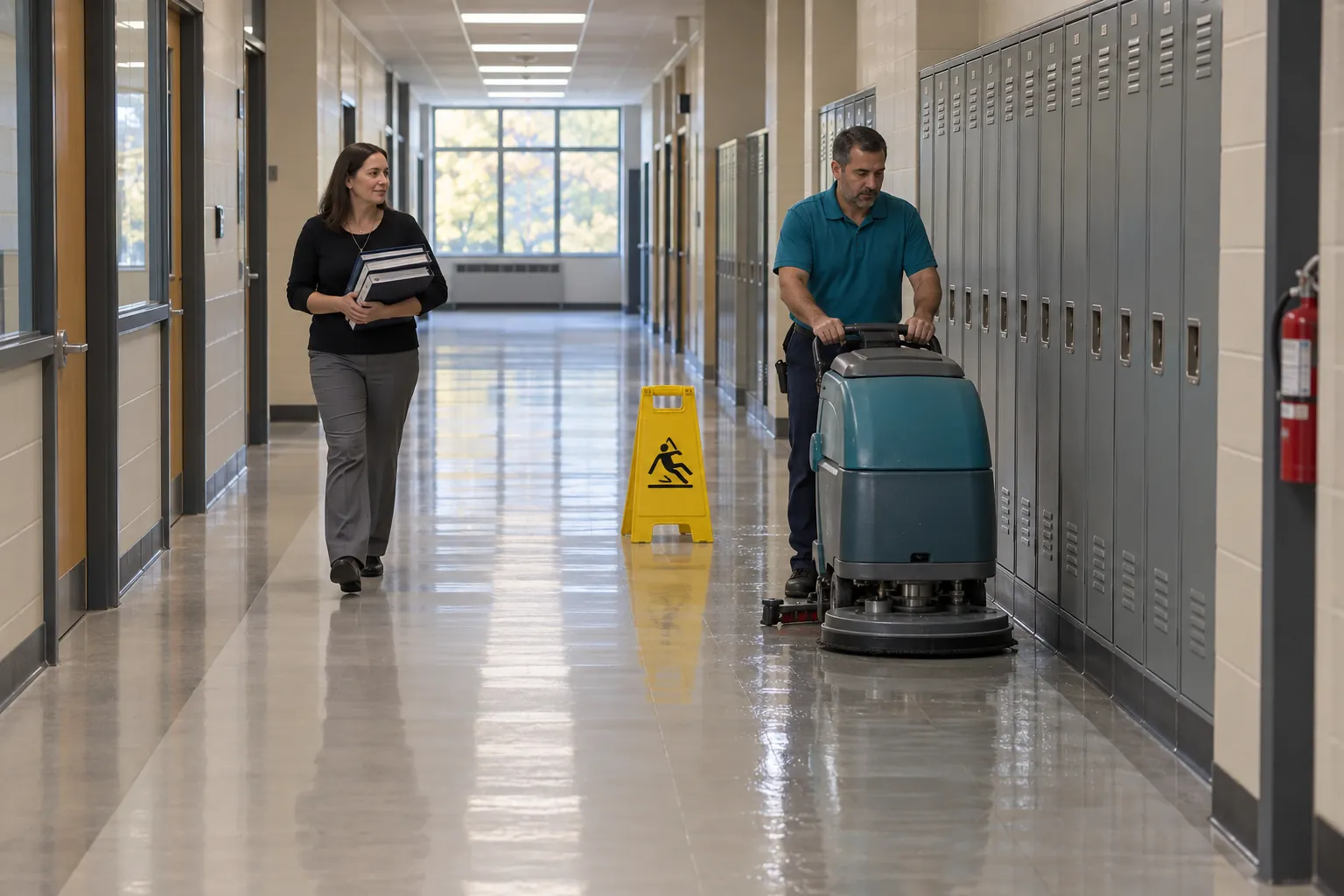 Premises and facilities managementSlips, trips and falls: how to prevent them in the buildings you look afterPreventing slips, trips and falls in Canadian buildings: Ontario, BC, Alberta and federal rules, wet floors, winter entrances, stairs and the records to keep.
 CleaningJanitorial scope of work: what it should say, and how to show it is metWhat a janitorial scope of work should contain in Canada: areas, tasks, frequencies, standards, winter care, WHMIS and products, and how to show the work was done.
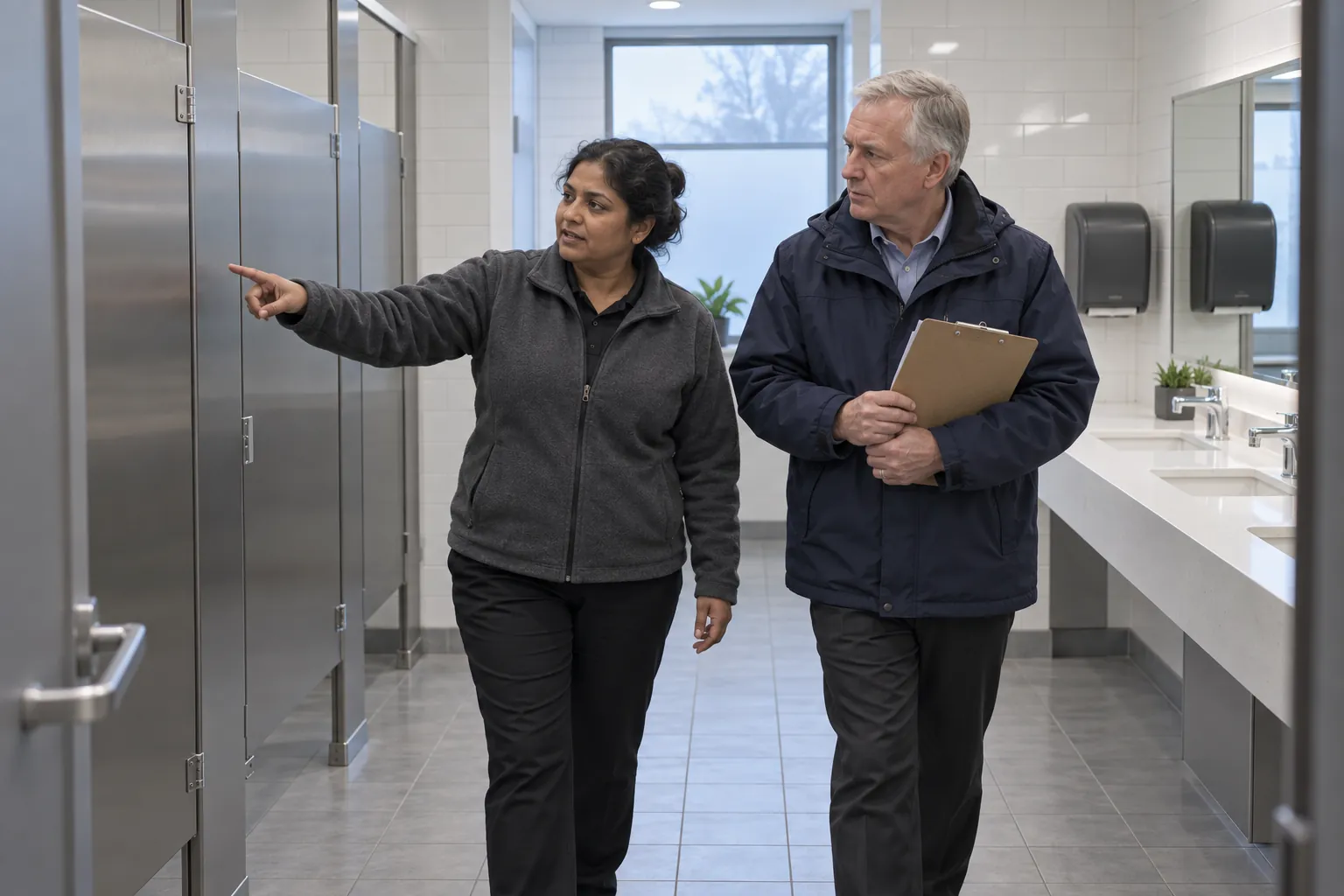 CleaningJanitorial quality control: how to inspect, correct and show the standard heldHow janitorial quality control works in Canada: QA versus QC, inspections, sampling, corrective action, CIMS, the PIDAC audit model and records that hold up.
 CleaningCommercial cleaning checklist: area by area, for Canadian buildingsA commercial cleaning checklist for Canadian offices and shared buildings, area by area, with the provincial rules behind it, what to record and how to check it.