Cleaning
Janitorial supervisor duties: what the role involves in Canada, and what good looks like
A janitorial or cleaning supervisor supervises and coordinates the work of cleaners and janitors, inspects the building to make sure safety and cleanliness standards are met, and hires, trains and schedules the team.
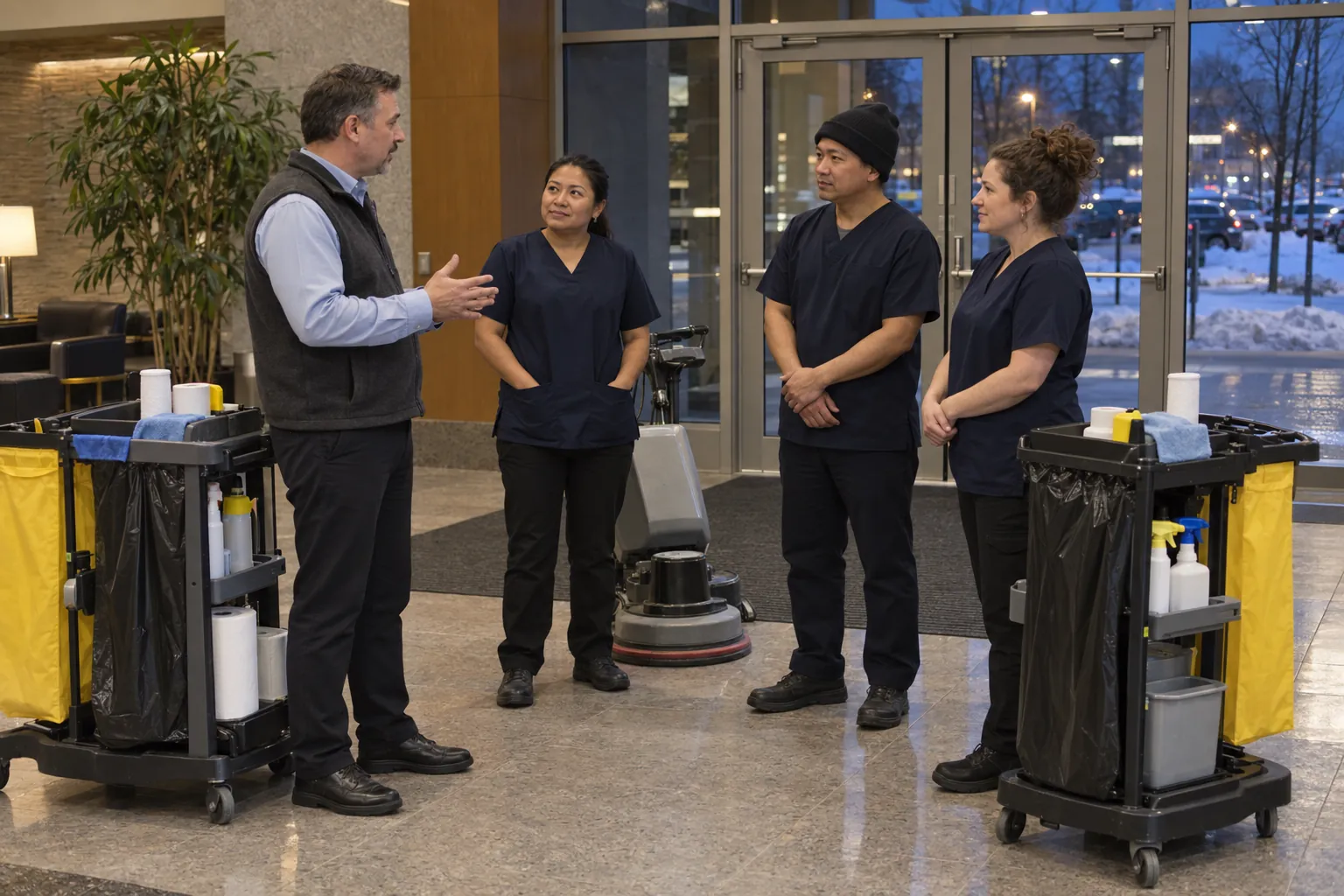
The job turns a scope of work into a clean building, night after night, and combines running a crew, checking the work, keeping people safe and being the client's first point of contact, and in Canada it also carries legal duties of its own. This guide covers the cleaning supervisor's main duties and responsibilities, what a typical shift looks like, what provincial law expects of a supervisor, and the records a good one keeps.
01
What a janitorial supervisor is, and what the law says a supervisor must do
A janitorial supervisor is responsible for a crew of cleaners on one or more buildings: they organize and oversee the work, check the standard, and make sure the cleaning is done to the scope of work, safely and on time. Contract cleaning companies say janitorial supervisor or lead hand; school boards say head custodian or head caretaker; hospitals say environmental services supervisor. The duties are much the same. On a large building, or a route of several, supervising is the whole job, and the supervisor is usually the person the property manager sees most.
Most workplace health and safety law in Canada is provincial, so the rules depend on where the building is; federally regulated workplaces, such as banks and airports, follow federal law instead. Ontario is the most detailed example, and its Occupational Health and Safety Act (OHSA) gives the supervisor a legal status of their own:
- Who is a supervisor. Section 1 defines a supervisor as "a person who has charge of a workplace or authority over a worker". A lead hand who directs the crew can meet that definition whatever the job title says.
- Appointed as competent. Section 25(2)(c) requires the employer, when appointing a supervisor, to appoint a competent person: someone qualified because of knowledge, training and experience to organize the work and its performance, familiar with the Act and the regulations that apply to the work, and with knowledge of any potential or actual danger to health or safety in the workplace.
- The supervisor's own duties. Section 27 requires a supervisor to ensure that a worker works in the manner and with the protective devices, measures and procedures required by the Act and the regulations, and uses or wears the equipment, protective devices or clothing the employer requires. A supervisor must also advise a worker of any danger to their health or safety the supervisor is aware of, and "take every precaution reasonable in the circumstances for the protection of a worker".
Ontario also requires every new supervisor to be trained. Under O. Reg. 297/13 (Occupational Health and Safety Awareness and Training), the employer must ensure a supervisor completes a basic health and safety awareness training program within one week of performing work as a supervisor, including how to recognize, assess and control workplace hazards, and must keep a record of it.
02
The main duties and responsibilities
Job descriptions for cleaning supervisors vary by employer, sector and work environment, but the main responsibilities of a janitorial or cleaning supervisor usually include:
- Organizing the work: assigning areas to each cleaner so that everything in the scope of work is covered in the hours available.
- Running the crew: briefing staff, covering absences, dealing with lateness and performance, and helping hire and orient new cleaners.
- Training: showing new cleaners the methods, the equipment, the products and the building.
- Inspecting the work: walking the building to check work against the standard, and making sure anything missed is put right.
- Periodic work: planning floor care (strip and wax, burnishing, carpet extraction), high dusting and deep cleans around the building's use.
- Health and safety: making sure procedures are followed, WHMIS labels and safety data sheets are in place, protective equipment is worn, wet floors are signed, and injuries and hazards are reported.
- Winter: keeping entrance matting, vestibules and lobbies dry and safe through the snow and salt season, and reporting ice at doors to whoever looks after the grounds.
- Equipment and supplies: keeping machines safe, ordering chemicals, liners and paper, and keeping the janitor's closet secure.
- Client liaison: being the first point of contact for the property manager or building operator, taking requests and complaints, and reporting back.
- Records: cleaning logs, inspection records, training records and incident records, and in Ontario the washroom cleaning records the law now requires.
- Security and access: keys, access cards, alarm codes and locking up.
The building shapes the job. In a hospital or long-term care home, the role is built around infection prevention. In a school, the head custodian works around the school day; in an office tower the evening crew works around tenants who stay late.
03
What a typical shift looks like
Every building is different, but a supervisor's shift on a contract janitorial account often follows a pattern like this:
- Before the shift: check who has called in sick, decide how the gap will be covered, and read any requests from the property manager.
- Briefing: a few minutes with the crew on changes, events in the building and the areas that need extra attention tonight.
- During the shift: walk the building, check work in progress, help where the crew is stretched, and deal with spills and urgent requests.
- Checks: carry out planned inspections and confirm that scheduled tasks, such as washroom cleaning and restocking on the washroom cleaning checklist, actually happened.
- Problems: report faults such as leaks, broken fixtures, blocked toilets or burnt-out lights to whoever fixes them, usually the building operator or through the property manager's work order system, and follow up the ones still open.
- End of shift: confirm everything scheduled was done or record why not, lock up, secure equipment and chemicals, and leave a note for the day porter, the next shift or the client about anything outstanding.
Evening and overnight shifts are common, because offices and schools are easiest to clean when empty; day supervisors in hospitals, malls and arenas spend more time on reactive cleaning and washroom rounds.
04
Keeping the crew safe, and knowing the limits of the role
Most of what makes a good janitorial supervisor is people management: crews are often part-time, on nights, and sometimes working in a second language, so clear instructions, fair allocation and being visible matter more than paperwork. The health and safety side is where the supervisor carries the most responsibility:
- WHMIS: in Ontario, R.R.O. 1990, Reg. 860 (Workplace Hazardous Materials Information System) requires every worker who works with or may be exposed to a hazardous product to be instructed in the contents of labels and safety data sheets, and in procedures for safe use, storage, handling and disposal, and for emergencies. The supervisor makes sure cleaners use only the approved products, at the right dilution, with the protective equipment the label and the safety data sheet call for.
- Mixing and diluting: CCOHS's Cleaning Products – Working Safely says never to mix different cleaning products, that bleach and ammonia products must never be mixed, and to always add the concentrate to the water.
- Blood, body fluids and sharps: CCOHS's Sanitation and Infection Control for Cleaning Staff covers gloves, puncture-resistant containers for sharps, never compacting infectious waste, and cleaning surfaces before disinfecting them.
- Slips and falls: Ontario's R.R.O. 1990, Reg. 851 (Industrial Establishments) requires a floor used by any worker to be kept free of obstructions, hazards and accumulations of refuse, snow or ice, with no finish likely to make it slippery. That is a floor care duty as much as a safety one.
- Hazards reported: section 28 of the OHSA requires workers to report missing or defective protective equipment and any hazard they know of to their employer or supervisor. The supervisor has to act on those reports.
- Injuries: every injury and incident is recorded and passed to the employer at once. In Ontario the employer has notice duties under sections 51 and 52 of the OHSA, and the WSIB's report an injury or illness page says the WSIB must receive the employer's Form 7 within three business days after the reporting obligation begins.
- Police record checks in schools: in Ontario, O. Reg. 521/01 (Collection of Personal Information) under the Education Act requires school boards to collect a police record check from service providers at their school sites, which can include a contractor's cleaners. The supervisor makes sure nobody starts at a school before the board's requirements are met.
Where a workplace has a joint health and safety committee (JHSC) or a health and safety representative, the supervisor works with them; see JHSC workplace inspection. In Ontario, a committee is required where 20 or more workers are regularly employed, and a representative where the number regularly exceeds five; a designated member or the representative inspects the physical condition of the workplace at least once a month where practical.
Supervisors also need to know the limits of the role. Pay, discipline, hiring and WSIB claims usually sit with the operations manager or human resources, and a good supervisor knows when to pass something up.
05
Checking the work and reporting to the client
Keeping the building clean is the purpose of the job, so a janitorial supervisor needs to know, at any point, whether the building is clean and whether the scheduled work was done. Those are two different kinds of checking:
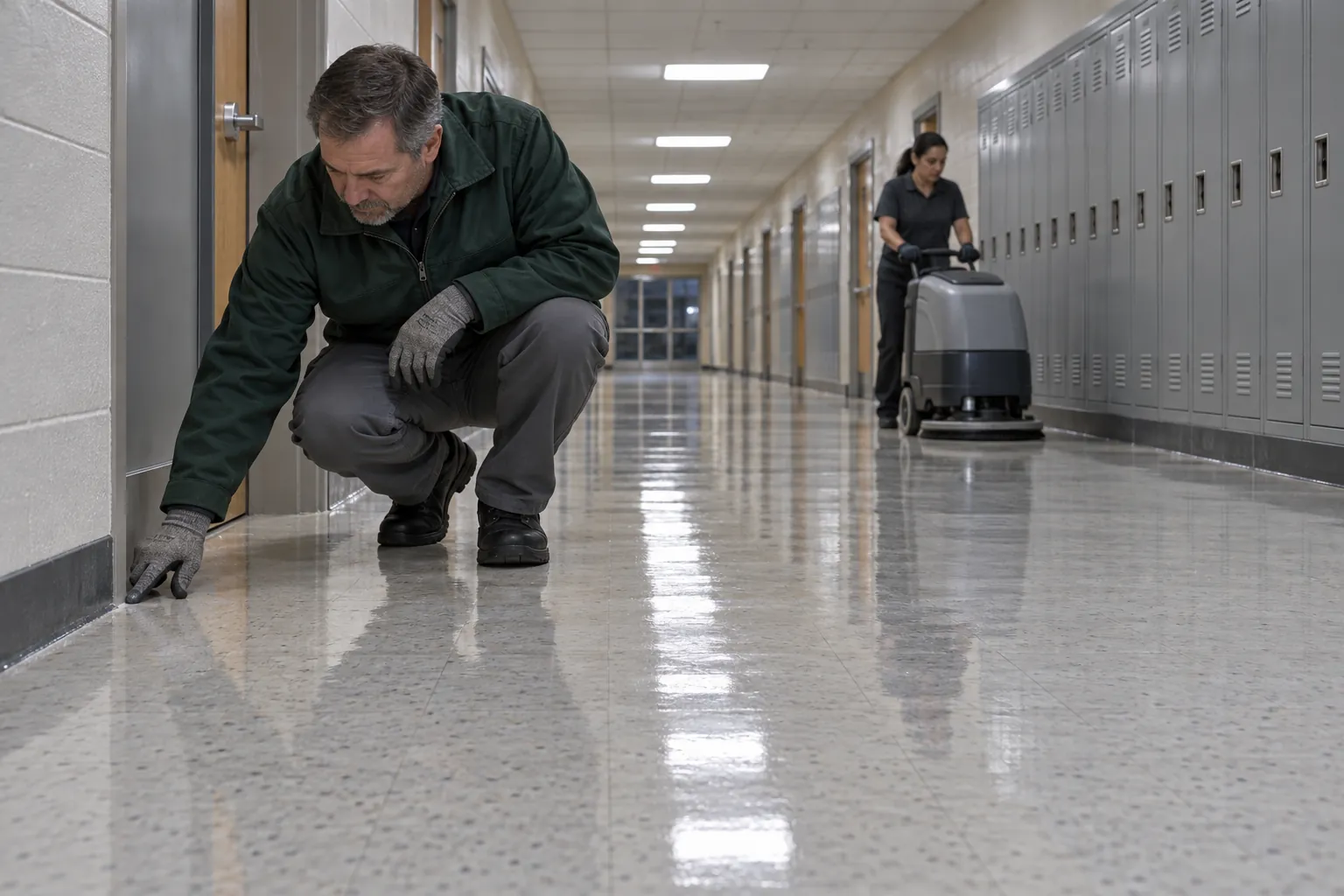
- Inspecting quality: regular inspections against the standard in the scope of work, sampling different floors, rooms and times, with deficiencies corrected and recorded. Many accounts also run formal inspections with the client, often scored, as described in janitorial quality control.
- Confirming delivery: that each scheduled cleaning and check actually happened, when and by whom, and that missed tasks are known and explained rather than discovered by the client.
In Ontario, one part of confirming delivery is now a legal record. Since 1 January 2026, O. Reg. 480/24 (Washroom Facilities – Records of Cleaning) lets an employer meet the OHSA's washroom records duty by posting the record in a conspicuous place in or near the washroom, or electronically where workers can reach it with directions on where and how, and requires it to include the date and time of the two most recent cleanings. On a contract account, agree with the client who owns it.
Reporting to the client is where a supervisor earns trust. A short, honest report of what was done, what was missed and why, and what is still open is worth more than a long one that says everything went well. Property managers rarely mind an explained gap; they mind finding it themselves. If the contract carries cleaning KPIs, the supervisor's records are usually where the numbers come from.
06
Where the supervisor's record fails, and what SiteClara does about it
Much of a supervisor's shift is spent finding out what has happened: whether the washroom rounds were done, whether a leak was reported, whether the evening cleaner reached the fourteenth floor. On paper that means walking the building reading sheets on doors, then writing a report from memory. When a property manager asks what happened last Tuesday, the answer depends on who remembers.
SiteClara gives the supervisor that picture without the walk. Each location has a printed QR poster, with an optional NFC tag behind it. Staff scan or tap it on their own phone, with no app to install, see the checks due there and mark each one done or explain what stopped them, with a photo when one helps. Issues are reported on the spot and go onto the team's list of open jobs until someone closes them.
The supervisor sees what is due, done and missed, can record the reason a check was missed, and works from a queue of open jobs grouped by building and floor, escalating a job to the building manager when it needs them. At the end of the day they review the totals and photos, add a note, record who was notified and approve the daily report, which goes to nominated management or client contacts at 8 a.m. the next morning, showing what was completed, what is still open and how scheduled checks went, for example 12 of 12 completed.
07
Questions people ask
What are the responsibilities of a janitorial supervisor?
The federal profile of NOC 62024 – Cleaning supervisors lists the main duties: to "supervise and coordinate the work of light duty, industrial or specialized cleaners and janitors", "inspect sites or facilities to ensure established safety and cleanliness standards are met", recommend or arrange repairs and replacements, "hire and train cleaning staff", "prepare work schedule and coordinate activities with those of other departments", and prepare budgets and keep financial records. It adds that a cleaning supervisor "may perform certain cleaning duties". The same profile says cleaning supervisors are employed by hospitals and other health care institutions, hotels, motels, schools and other educational institutions, commercial and industrial establishments, home and office cleaning establishments and specialized cleaning companies.
What are the 5 duties and responsibilities of a supervisor?
In Ontario, section 27 of the Occupational Health and Safety Act sets them out, and Ontario's A Guide to the Occupational Health and Safety Act, Part III lists five: ensure a worker works in the manner and with the protective devices, measures and procedures the Act and regulations require; ensure any equipment, protective device or clothing the employer requires is used or worn; "advise a worker of any potential or actual health or safety dangers known by the supervisor"; where prescribed, give a worker written instructions on the measures and procedures for their protection; and "take every precaution reasonable in the circumstances for the protection of workers". Other provinces word a supervisor's duties differently.
What is the NOC code and skill level for a cleaning supervisor?
Cleaning supervisors are NOC 62024 – Cleaning supervisors in the 2021 National Occupational Classification, in TEER 2, which covers supervisory occupations as well as those that usually need a college diploma or two or more years of apprenticeship training. Head custodian and housekeeping supervisor are among its example job titles. The profile says completion of secondary school is usually required, previous experience in a particular area of cleaning is usually required, and previous supervisory experience may be required.
08
Skills, training and further reading
Most janitorial supervisors come up from cleaner or custodian, so experience in the cleaning industry counts for a lot. The skills employers look for are practical: floor care and equipment, organizing a crew, leadership, clear communication and reliability. Pay varies widely by province, sector, shift and the size of the account, so current postings in your area are the best guide to it.
The training that matters most is what the law requires: supervisor awareness training in Ontario under O. Reg. 297/13, WHMIS instruction on the products the crew actually uses, and first aid where the employer designates the supervisor as a first aider. For the law, read the Ontario OHSA (sections 1, 25, 27 and 28), O. Reg. 297/13, Reg. 851 and Reg. 860; in British Columbia, Part 2 of the Workers Compensation Act; elsewhere, your own province's act. CCOHS's fact sheets on cleaning products, sanitation for cleaning staff and working alone are short, practical and free.
A good janitorial supervisor, at the end of each shift, can say:
- who was on shift, and how any absence was covered;
- that every area in the scope of work was assigned to someone;
- which scheduled cleanings and checks were done, and why any were not;
- what was inspected, what failed and what was corrected;
- that washroom cleaning records are current where the law requires them;
- which faults were reported, to whom, and which are still open;
- that any injury, incident or hazard was recorded and passed on;
- that everyone working alone was accounted for;
- what the client has been told.
Sources
Every document this guide quotes or links to, in the order it first cites them.
- Occupational Health and Safety Act ontario.ca
- O. Reg. 297/13 (Occupational Health and Safety Awareness and Training) ontario.ca
- Workers Compensation Act, Part 2 (Occupational Health and Safety) worksafebc.com
- Working Alone – General ccohs.ca
- R.R.O. 1990, Reg. 860 (Workplace Hazardous Materials Information System) ontario.ca
- Cleaning Products – Working Safely ccohs.ca
- Sanitation and Infection Control for Cleaning Staff ccohs.ca
- R.R.O. 1990, Reg. 851 (Industrial Establishments) ontario.ca
- WSIB's report an injury or illness wsib.ca
- O. Reg. 521/01 (Collection of Personal Information) ontario.ca
- O. Reg. 480/24 (Washroom Facilities – Records of Cleaning) ontario.ca
- NOC 62024 – Cleaning supervisors noc.esdc.gc.ca
- A Guide to the Occupational Health and Safety Act, Part III ontario.ca
Related guides
 CleaningJanitorial quality control: how to inspect, correct and show the standard heldHow janitorial quality control works in Canada: QA versus QC, inspections, sampling, corrective action, CIMS, the PIDAC audit model and records that hold up.
 CleaningCleaning KPIs: what to measure in a janitorial contract, and how to know the figures are trueThe cleaning KPIs worth measuring in a Canadian janitorial contract, how to define and target them, how to report them, and how a green dashboard can mislead.
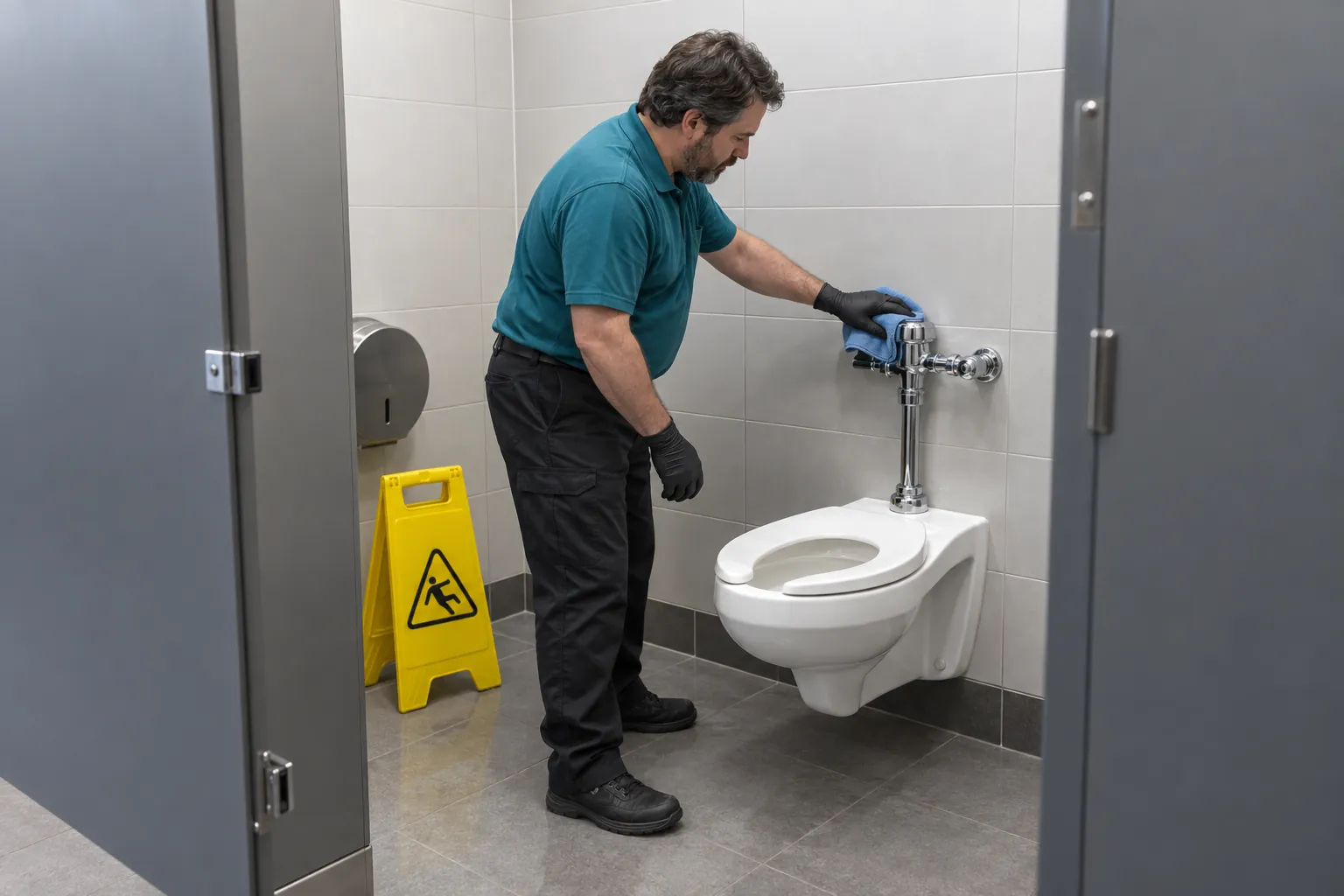 CleaningWashroom cleaning checklist: what to check, how often, and Ontario's new cleaning recordsWhat a workplace washroom cleaning checklist should cover, how often to clean, and Ontario's posted cleaning records required since January 1, 2026.
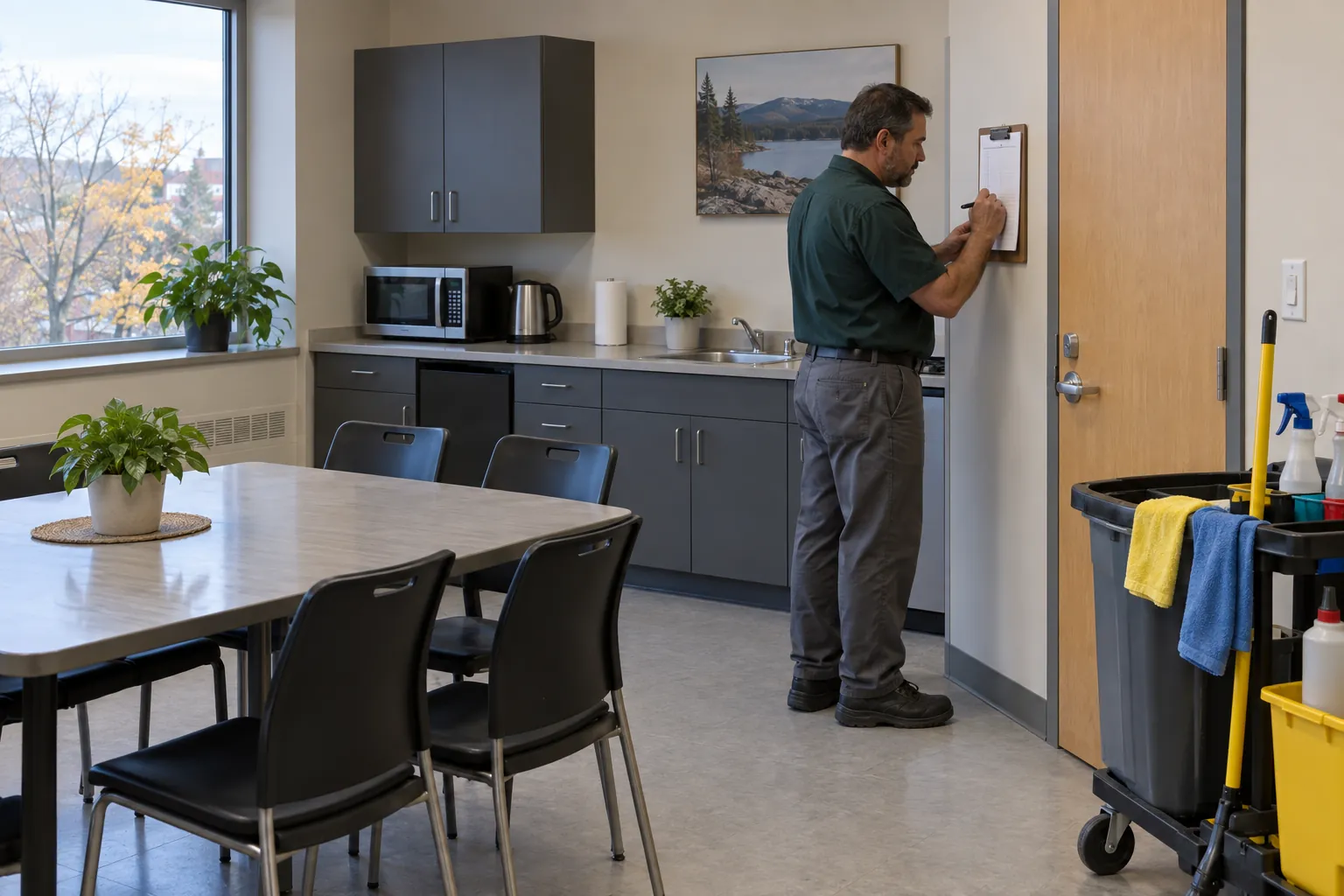 CleaningCleaning log sheet: what to record, who fills it in, and what the law in Canada asks forWhat a cleaning log sheet should record, where Canadian workplaces use one, what Ontario and federal rules require, and how to keep a log people believe.