Cleaning
Commercial cleaning checklist: area by area, and how to use it
A commercial cleaning checklist lists the cleaning tasks for each area of an office or other commercial premises, from the entrance and desks to meeting rooms, kitchens, washrooms and corridors, split into daily, weekly and monthly tasks, with space to record that each was done.
It is the list the cleaning team actually works from, and this guide sets one out area by area, then covers how to use it on shift and how to tell whether it is being followed.
01
The duty behind a commercial cleaning checklist
No law requires a commercial cleaning checklist by name: the main legal duty behind one, in Great Britain, is regulation 9 of the Workplace (Health, Safety and Welfare) Regulations 1992, which requires every workplace and its furniture, furnishings and fittings to be kept sufficiently clean. The checklist is how a cleaning team, and the business paying for it, shows that the daily cleaning behind a safe work environment is being done, whether the team is in-house or comes from a cleaning company selling commercial cleaning services.
The same Regulations set the baseline for almost every workplace in Great Britain. As well as that duty to keep it sufficiently clean, they require waste, so far as is reasonably practicable, not to be left to accumulate except in suitable receptacles; floors and traffic routes to be kept free, so far as is reasonably practicable, of anything that could cause a slip, trip or fall; and toilets and washing facilities to be kept clean and orderly. Northern Ireland has equivalent regulations made in 1993.
Around them sit the duties about how cleaning is done. The Health and Safety at Work etc. Act 1974 covers the safety of cleaning staff and of anyone else in the building. The Management of Health and Safety at Work Regulations 1999 require a risk assessment, which for cleaning means wet floors, lifting, ladders and lone working. The Control of Substances Hazardous to Health Regulations 2002 (COSHH) cover the cleaning products themselves. Where food is prepared or served, food hygiene law adds its own cleaning requirements.
Three documents are often confused, and each has a different job:
- The cleaning specification is the contract: what is cleaned, to what standard and how often. See the cleaning specification guide.
- The cleaning schedule sets the daily, weekly and monthly frequencies. See the office cleaning schedule guide.
- The checklist is the working list for a shift or an area: the cleaning tasks, in order, with space to record that each was done and what was found.
This guide is about the third. A good checklist is short, specific to the premises and written in the order the work is done.
02
What a commercial cleaning checklist covers
Commercial premises vary, from a single floor of office space to a multi-tenant block, but the same area types turn up in almost all of them. A checklist should be divided by area, not written as one long list for the building, so that each part can be completed and checked on its own:
- Entrance and reception area: the first thing visitors see and where most dirt comes in.
- Open-plan offices and desks: bins, touch points, desk surfaces where they are clear, and floors.
- Meeting rooms: tables, chairs, screens and whiteboards, reset for the next day.
- Kitchens and tea points: sinks, worktops, appliances, fridges and waste.
- Washrooms: toilets, urinals, basins, dispensers, floors and supplies.
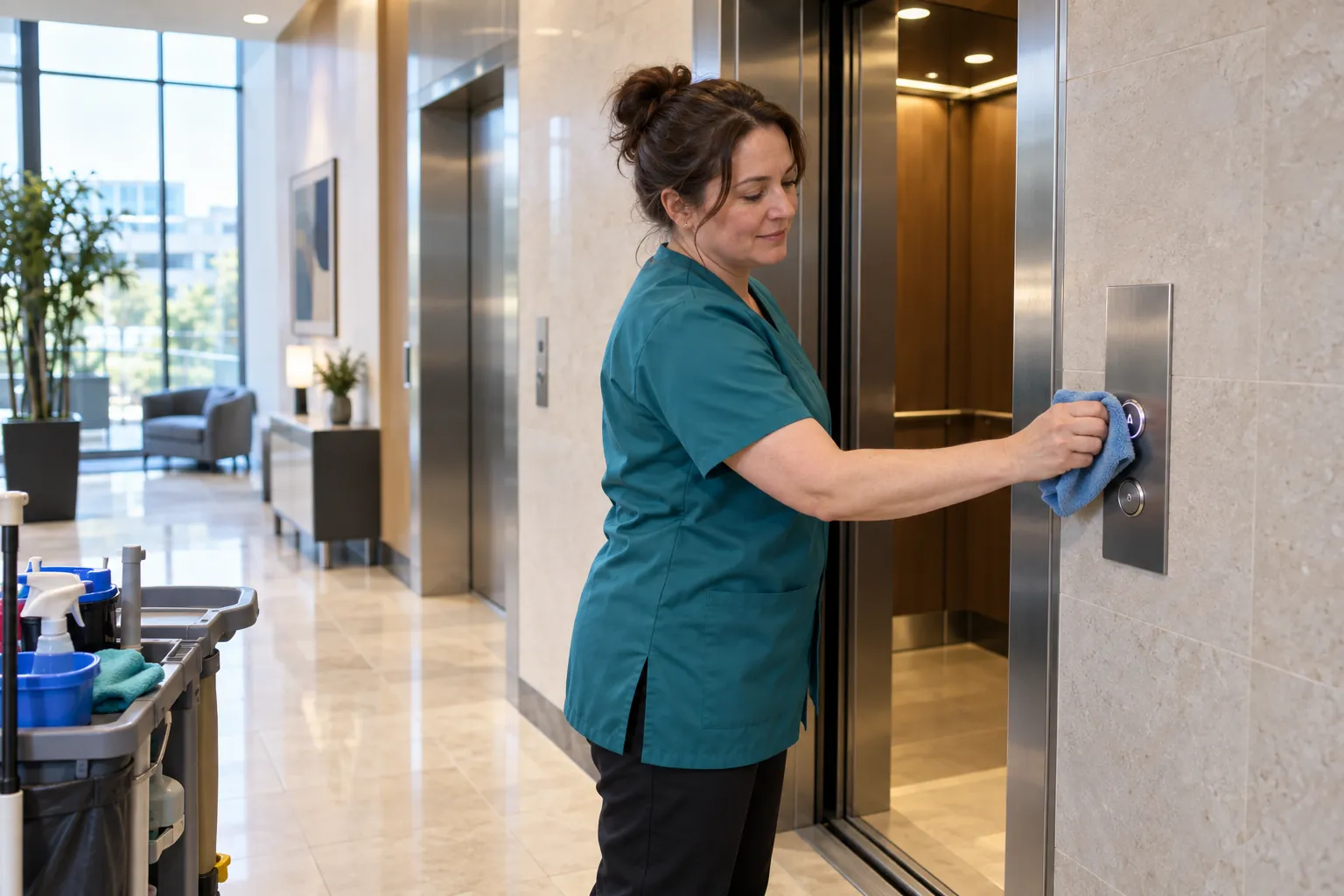
- Corridors, stairs and lifts: handrails, door plates, lift buttons and floors in high-traffic areas.
- High-touch surfaces across the building: door handles, light switches, push plates, lift buttons, shared phones and office equipment such as printers.
- Waste and recycling: internal bins, central collection points and bin stores.
- Anything specialist: a staff gym, a clinic room, a shop floor, a commercial kitchen or a server room, each with its own list.
Schools, with terms and holidays, need a list of their own; see the school cleaning checklist. Leave out anything the contract does not cover. A checklist that lists window cleaning when a separate contractor does it every quarter invites a tick against work the team never does.
03
The checklist, area by area
The tasks below are a starting point for a typical office or mixed commercial building. Adjust them to the building, and take the frequencies from the schedule rather than writing them twice. An office cleaning checklist is mostly daily cleaning tasks, so the daily office cleaning checklist comes first, area by area; the weekly tasks and monthly tasks follow at the end.
Entrance and reception
- Vacuum or clean entrance matting and shake out removable mats.
- Clean hard floors by vacuuming or mopping, or with a scrubber-dryer; clean again in wet weather.
- Clean the glass of entrance doors and screens at hand height.
- Wipe the reception desk, visitor seating, signing-in screen and door push plates.
- Empty bins and check the area is clear of trip hazards.
Offices and desks
- Empty waste and recycling bins and replace liners.
- Wipe each clear office desk; do not move papers or equipment unless the specification says so.
- Wipe shared keyboards, phones and printer controls where agreed.
- Vacuum carpets and walkways, with daily vacuuming of the routes that carry most foot traffic; spot-clean spills.
- Dust window sills, ledges and partition tops within reach.
Meeting rooms
- Clear cups and litter, wipe tables and chairs.
- Clean whiteboards if left clean-ready, and wipe control panels.
- Vacuum or mop and reset furniture to the standard layout.
Kitchens and tea points
- Clean and disinfect worktops, sinks and taps.
- Wipe appliance fronts, handles and controls: fridge, microwave, kettle, coffee machine, water boiler, dishwasher.
- Load or empty the dishwasher if the contract includes it.
- Empty food waste, general waste and recycling.
- Mop the floor and restock hand soap and paper towels.
- Where food is prepared, follow the cleaning and disinfecting schedule in the food safety management system: in commercial kitchens it takes precedence over this list.
Washrooms
- Clean and disinfect toilets, urinals, seats and flush handles.
- Clean basins, taps, mirrors and cubicle doors, locks and partitions.
- Restock toilet paper, soap, paper towels and sanitiser; check hand dryers work.
- Empty waste bins and check sanitary bins are within capacity.
- Mop the floor, working towards the door, and report any leak, blockage or broken fitting.
Corridors, stairs and lifts
- Vacuum or mop floors and stair treads.
- Wipe handrails, door handles, push plates and lift buttons.
- Check fire exits and escape routes are clear of cleaning equipment and waste.
Weekly, monthly and periodic
- Weekly cleaning: dust high-level ledges and skirting boards, detailed surface cleaning of doors and frames, clean inside microwaves and fridges, polish internal glass, clean chair bases and bin exteriors.
- Monthly: dust air vents and grilles, which helps air quality, clean light switches and sockets thoroughly, wash internal bins.
- Periodic deep cleaning, often quarterly or annually: deep clean carpets, strip and reseal hard floors, deep clean washrooms and kitchens, clean behind and under fixed equipment, and external window cleaning by a specialist.
04
How to use the checklist on shift
A structured cleaning checklist only improves cleaning if it matches how the work is really done and becomes the cleaning routine rather than a form. A few habits make the difference between a list that guides the shift and a list that is ticked at the end of it.
- Write it in route order. The list should follow the path the cleaner walks, so that it is read as the work progresses rather than looked at afterwards.
- Clean from top to bottom and from clean to dirty. High surfaces before low ones, dry dusting before wet cleaning, and washrooms last or with separate equipment, so that dirt and germs are not carried from one area to the next. It is the simplest way to maintain hygiene across a building.
- Use a colour-coded cleaning system. Most UK cleaning teams use separate colours of cloth, mop and bucket for washrooms, general areas and food areas, so that equipment used on a toilet is never used on a kitchen worktop. Put the colour for each area on the checklist.
- Name the cleaning products. The right product for each task, the dilution and the contact time for a disinfectant should come from the COSHH assessment and the product data sheet. The checklist can refer to them rather than repeat them, and should start with a check that cleaning supplies and consumables are stocked.
- Record exceptions, not only ticks. A task that could not be done, because a room was locked or a meeting overran, should say so. So should a fault found: a leaking tap, a broken light, a spillage that will not come out.
- Make time for it. If the list takes longer than the hours on site, it will be completed on paper and not in the building. Time each area once and set the list, or the hours, accordingly.
Keep one checklist per area or per route, not one for the whole building. When something is missed, a list per area shows where; a single sheet for the building shows only that the shift ended.
05
How to check the checklist is being followed
Whether cleaning is done in-house or bought as office cleaning services from a professional cleaning provider, the question is the same. A completed checklist shows that the work was recorded. Whether it was done, and done well, needs someone else to look. The usual layers are:
- The supervisor's walk-round. A short, regular inspection of a sample of areas against the checklist, at varied times, including early in the morning when the night's work is fresh.
- A quality audit. A scored inspection against the cleaning standards in the specification, often monthly and sometimes jointly with the client. The cleaning quality control guide covers how.
- Complaints and requests. Every complaint is a data point: where it was, what time, and whether the checklist for that area showed the task as done.
- Completion against schedule. How many of the scheduled tasks or checks were completed, and why the rest were not. A figure of 100% every day with no exceptions is usually a sign that nobody is looking.
Review the checklist itself at least when the building's use changes: new tenants, a new floor, different working hours, a canteen that opens or closes. Hybrid working has left many offices with desks used two or three days a week and full kitchens on the same days, and a checklist written for five busy days, with the same foot traffic each day, wastes effort on the quiet ones.
Supervisors often ask how long a daily office checklist should take. There is no fixed answer; it depends on floor area, fit-out and occupancy. The practical test is to time a competent cleaner doing the list properly, add a margin for the unexpected, and compare the result with the hours in the contract.
06
Where the checklist record fails, and what SiteClara does about it
The paper checklist has the same weakness everywhere. It is completed by the person whose work it records, often at the end of the shift, and it lives in a folder in the cleaners' cupboard. A client who wants to know whether the kitchen was cleaned last night has to take someone's word for it, and a provider with twenty sites finds out about a missed area when the complaint arrives.
SiteClara puts a printed QR poster at each area on the checklist, with an optional NFC tag behind it. A member of the team scans the code or taps the tag on their own phone, with no app to install, and sees the scheduled checks due at that location. They mark each one done, or explain what stopped them, and can add a photo. The time and the person are recorded as it happens. A fault found on the round, such as a leaking tap or a broken dispenser, can be reported there and goes onto the team's list of jobs until someone closes it.
The supervisor sees what is due, done and missed across the building, can record the reason a check was missed, and sees open jobs grouped by building and floor. At the end of the day they review the totals and photos, add a note and approve the report, which goes to nominated management or client contacts at 8am the next morning, showing what was completed, what is still open and how scheduled checks went, for example 12 of 12 completed.
07
Further reading, and a list to take away
The Health and Safety Executive publishes the Approved Code of Practice Workplace health, safety and welfare (L24), which explains the cleanliness and floor duties, and guidance on COSHH and on preventing slips and trips at work. The British Institute of Cleaning Science (BICSc) publishes training and standards for cleaning operatives, including colour coding and safe methods. Where there is a commercial kitchen, the Food Standards Agency, and Food Standards Scotland in Scotland, publish guidance on cleaning in food businesses.
Before you issue a commercial cleaning checklist to the team, check that it:
- is divided by area and written in the order the work is done;
- matches the specification, with nothing on it the contract does not cover;
- takes its frequencies from the cleaning schedule, not a separate list;
- names the colour code and the product for each area;
- has room to record tasks not done, and why, and faults found;
- fits the hours on site when done properly;
- is checked by someone other than the person who completed it;
- has a date for review when the building's use changes.
Sources
Every document this guide quotes or links to, in the order it first cites them.
- Workplace (Health, Safety and Welfare) Regulations 1992 legislation.gov.uk
- Control of Substances Hazardous to Health Regulations 2002 legislation.gov.uk
- Workplace health, safety and welfare hse.gov.uk
- Preventing slips and trips at work hse.gov.uk
Related guides
 CleaningOffice cleaning schedule: what to clean, how often, and how to show it was doneWhat an office cleaning schedule should cover, which tasks are daily, weekly, monthly or periodic, who does what, and how to show the schedule is being kept.
 CleaningCleaning specification: what it should say, and how to show it is metWhat a cleaning specification should contain, input and output standards, setting frequencies by area, and how to show the specification is being delivered.
 CleaningCleaning quality control: how to inspect, correct and prove the standardHow quality control works in commercial cleaning: QA versus QC, setting standards, running inspections, corrective action and a record that holds up.
 CleaningCleaning sign-off sheet: who signs it, and what a signature meansWhat a cleaning sign-off sheet should record in kitchens, food areas, rooms and end-of-clean handovers, who should sign it, and what each signature proves.