Fire and water checks
Emergency lighting testing in New Zealand: what the compliance schedule asks, and what the building team can do
Emergency lighting is the lighting that comes on automatically when the main lighting fails, so that people can see their way along escape routes and out of a building, and in New Zealand it is governed by Building Code clause F6 and listed on the compliance schedule as specified system SS 4.
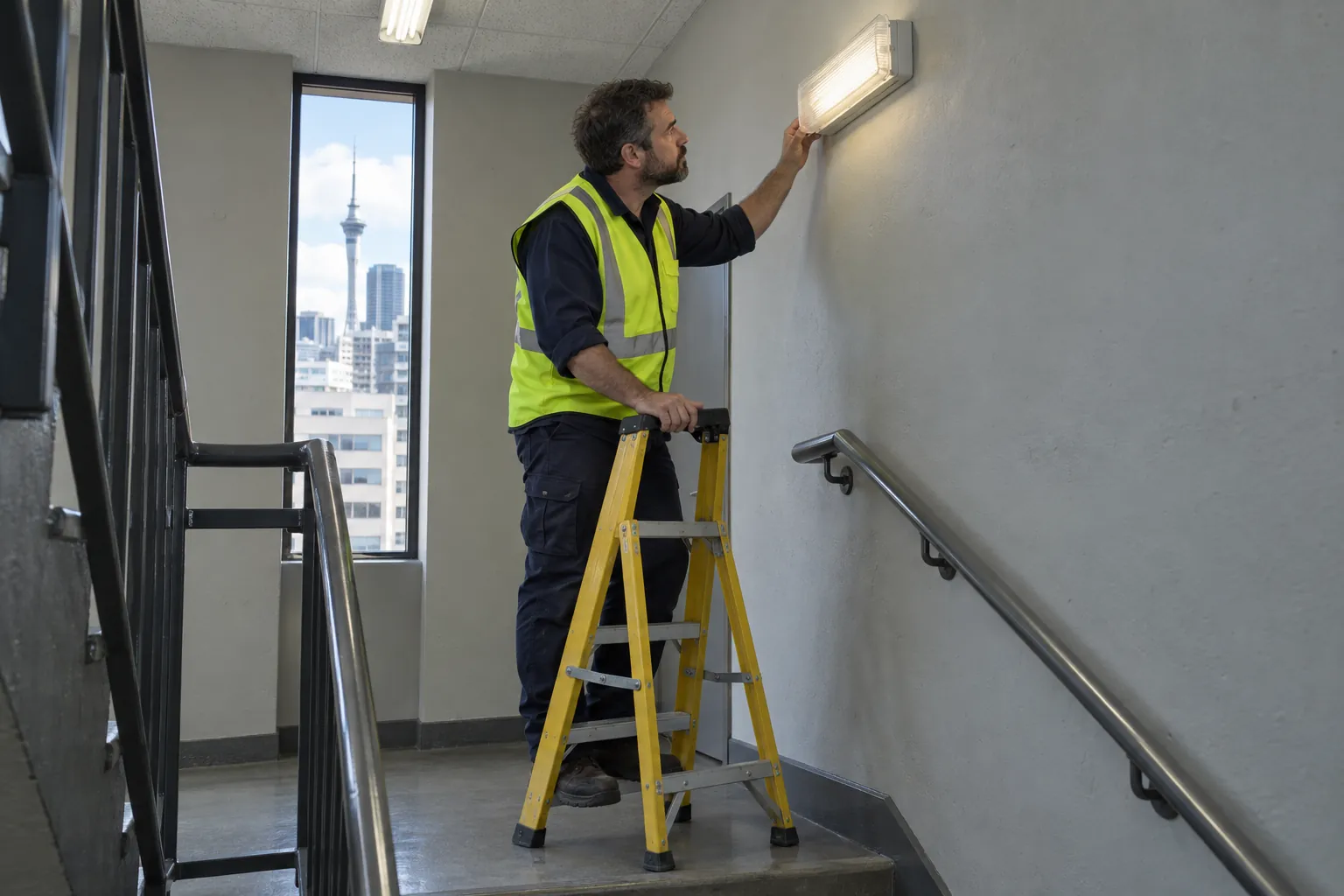
Because it is a specified system, it is inspected under the compliance schedule, usually by an independent qualified person, and covered by the owner's building warrant of fitness each year. This guide explains where the duty comes from, what the testing covers, who does which part and how often, what records should sit behind the Form 12A, and what the building team can usefully do between the IQP's visits.
01
Where the duty comes from
Two sets of rules meet at every emergency light in a New Zealand building: the Building Code, which says what the lighting must achieve, and the Building Act 2004's compliance schedule regime, which keeps it working.
The Building Code clause is clause F6, Visibility in escape routes. As reproduced in MBIE's Acceptable Solutions and Verification Methods for clause F6 (F6/AS1, third edition, amendment 4, effective 1 January 2017), its objective is "to help safeguard people from injury in escape routes during failure of the main lighting", and its functional requirement is that "specified features in escape routes must be made reasonably visible by lighting systems, other systems, or both, during failure of the main lighting." The performance clauses then set how quickly the lighting must come up after a failure and how long it must last: until the main lighting is restored in risk group A, 90 minutes in risk group B and 30 minutes in risk group C.
Emergency lighting that meets F6 is then a specified system. MBIE's Specified systems and compliance schedules page lists "emergency lighting systems" as the fourth of the fifteen categories, which is why the trade calls it SS 4, and a building containing any specified system needs a compliance schedule issued by the council. MBIE's Compliance Schedule Handbook (amendment 3, 14 February 2014) is blunt about it: "An emergency lighting system is required to be listed on a compliance schedule in all cases."
From there the owner's duties follow the schedule:
- carry out, or have carried out, the inspection, maintenance and reporting procedures the compliance schedule sets for SS 4;
- obtain the annual written reports that section 110 of the Building Act requires, signed by the IQP, keep them for two years and produce them when the council asks;
- obtain a Form 12A from the IQP certifying that the procedures were carried out for the previous twelve months;
- supply the council with the building warrant of fitness on each anniversary of the compliance schedule, and display it where the building's users can see it.
MBIE's Managing your BWoF pages put the last step simply: "A building owner needs to renew a building's warrant of fitness (BWoF) every 12 months, signing, issuing and publicly displaying it." Emergency lighting testing is one of the things that warrant is quietly vouching for.
02
What emergency lighting testing covers
The Compliance Schedule Handbook gives two examples of what SS 4 includes: an emergency lighting system within the safe or open path of the building to help people evacuate, and an emergency lighting installation that identifies the exitways. In most buildings that means some mix of the following:
- Self-contained (single point) luminaires, each with its own battery and charger, over stairs, along corridors, in plant rooms and at final exits.
- Illuminated exit signs, the green running-man signs over exits and along the route to them; F6/AS1 leaves their colours and images to Building Code clause F8, Signs.
- Central battery systems, where a battery room or cabinet feeds emergency fittings across the building.
- Generator-backed systems, where a standby generator is part of the emergency supply.
- Photoluminescent (self-illuminated) stair nosings and strips, which Westland District Council's specified systems guidance, for example, lists as a separate kind of SS 4 system.
Which standard applies depends on how the system was designed and installed, and the compliance schedule names it. The handbook lists the options for inspection: NZS 6742 for existing systems installed to it, AS/NZS 2293 for systems installed to that series, NZS 6104 for a generator that forms part of the system, and, where none of those fit, "a specifically-designed solution prepared by a person who, on the basis of experience and qualifications, is competent to do so." Paragraph 1.8.3 of F6/AS1 says that "inspection, maintenance and reporting procedures for central battery and single point systems shall be performed in accordance with AS/NZS 2293: Part 2", and the edition it cites is the 1995 one.
A newer joint edition exists: AS/NZS 2293.2:2019 Emergency lighting and exit signs for buildings, Part 2: Routine service and maintenance, listed on MBIE's Building CodeHub as valid from 9 April 2019. The handbook says the edition matters: "it is essential that these be included on a building's compliance schedule." So read your own schedule and see which document, and which edition, your IQP is working to.
03
How often, and who does which test
There is no single national frequency written into the Act. The compliance schedule sets it, system by system, and MBIE's page on inspection and maintenance of specified systems explains the usual pattern: "Most specified systems require at least an annual inspection by an IQP but in some cases they may inspect more frequently such as 6 monthly or quarterly." An IQP is "a person (or firm) approved by the territorial authority as qualified to inspect certain specified systems", and councils keep a register of them.
For emergency lighting, the six-monthly and annual pattern is common. Westland District Council's Specified Systems Guidance (WBCA 003, 16 September 2025), the template its applicants use to describe SS 4 on a building consent, gives the frequency for both central and self-contained systems as "6 monthly and annual by Independent qualified person (as required by AS/NZS 2293.2:1995)", and names the performance standards as AS 2293.1:2005 and AS 2293.3:2005 as modified by Appendix B of F6/AS1. Other councils publish similar sheets; your own schedule is the one that binds you.
The routine visits usually cover:
- A discharge test, running the fittings on battery to prove they last the duration the design requires;
- A visual inspection of each luminaire and exit sign: damage, missing diffusers, lamps out, fittings that have been moved or covered;
- Cleaning of the fittings and reflective surfaces where the procedure calls for it;
- Central equipment: the battery room or cabinet, chargers, and the generator where there is one;
- The interface with the emergency warning system, where the two are connected, at least annually;
- Repairs and replacements, with the failed fittings retested.
The duration the discharge test has to prove comes from the design. Under paragraph 1.6.1 of F6/AS1, emergency lighting must be maintained continuously where occupants must stay until the main lighting is restored or the evacuation time exceeds 90 minutes; for 90 minutes where the escape height is over 150 metres, the evacuation time is between 30 and 90 minutes, or the occupant load exceeds 1,000; and for 30 minutes in all other buildings. Ask the IQP which applies to your building, and make sure the test report says it.
MBIE also notes that "a building owner may be responsible for undertaking some less complex and more frequent inspection tasks." If your compliance schedule gives the owner a check between IQP visits, it is part of the procedures the Form 12A certifies, and it needs to be done and recorded like any other. If it gives the owner nothing, the building team's walk-rounds in the next section are good practice, not a substitute for the schedule.
Batteries need time to recharge after a discharge test, so book it for a quiet time or ask the IQP to stage it across areas. And a fit-out that adds to or alters the system brings fresh commissioning tests: F6/AS1 requires them to be "repeated on the completion of any addition to, or alteration of, the installed system."
04
What the building team can do between IQP visits
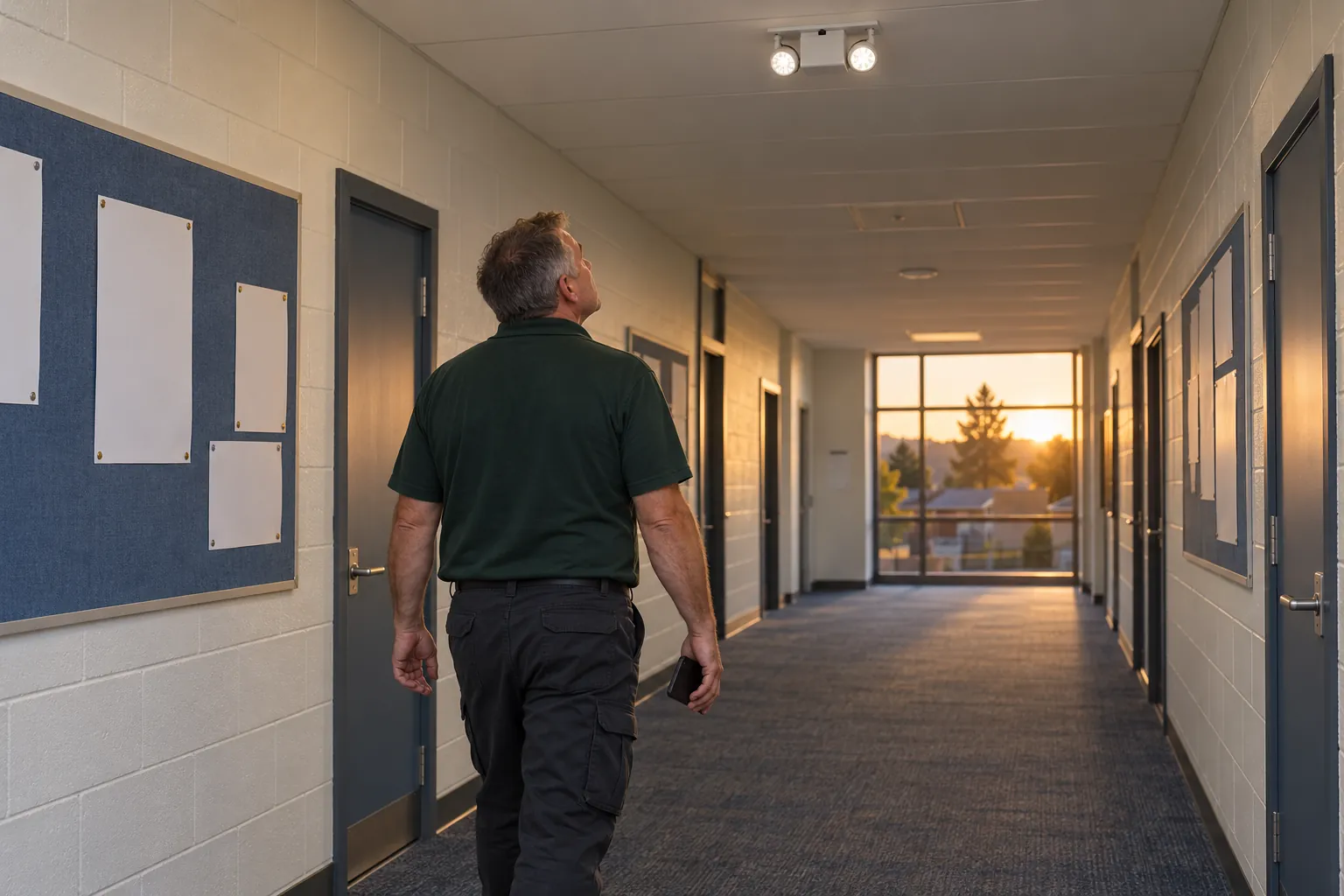
Emergency lighting fails quietly: a fitting stops charging, an exit sign lamp goes, a new partition hides a luminaire, carpet covers a glow-in-the-dark stair nosing. The people most likely to notice are already walking the building: the caretaker, the evening cleaning crew, the security officer on lock-up. A short, regular walk-round by the building team, separate from the IQP's procedures, catches most of it. On each floor or route, look for:
- Exit signs lit: every illuminated exit sign on, legible and pointing the right way.
- Charge indicators: on fittings that have one, the indicator showing the battery is charging.
- Damage: cracked or missing diffusers, fittings hanging loose, signs knocked by trolleys or ladders.
- Obstruction: shelving, signage, decorations or new partitions blocking a fitting or an exit sign.
- Changes: fittings removed, moved or added during a fit-out that the IQP may not know about.
- Photoluminescent markings: still in place, clean, and not covered by carpet or other material, which is the check Westland's guidance lists for these products.
The handbook's description of responsive maintenance is the reason this matters. It is needed "where the system or a component of the system has failed, resulting in the performance standard not being satisfied", and the failure "may be identified during inspection, testing, planned preventative maintenance or reported by building users." A fault found on a walk-round and passed to the contractor the same day is responsive maintenance working as intended; found by the IQP five months later, it is a gap in the year the Form 12A covers.
The walk-round is a look, not a test: nobody should switch circuits or run fittings on battery unless the compliance schedule gives them that task and they have been shown how.
In a body corporate building, the body corporate manager often arranges the IQP while the caretaker or cleaning contractor sees the common areas every day; in a school, the property manager and the caretaker. Agree in writing who walks the routes, how often, and who a fault goes to.
05
The records behind the Form 12A
The Building Act makes the records the owner's responsibility, although the handbook accepts that "for practical reasons, it may be appropriate for the IQP to keep the records on the owner's behalf." It also suggests that "it may be appropriate to keep records in a log book at the installation, with a summary report held in the designated location with the compliance schedule." For emergency lighting, that often means a log book beside the central battery equipment or the main switchboard, and the IQP's reports in the BWoF folder.
The handbook's example reporting statement is a good template for what a compliance schedule will ask:
Records an IQP, a council officer or an insurer will believe share a few features:
- Each test is dated and signed by the person who did it, with the duration run.
- Fittings are identified by a reference and location, so a failure can be traced to one luminaire, not "level 3 – some out".
- Every fault has an outcome: reported to whom, repaired when, retested with what result.
- Changes are written in: fittings added or removed in a fit-out, with the commissioning tests that followed.
- Gaps are explained: a test postponed because of a function in the building, with the date it was done instead.
- The owner-side checks match the schedule: if the schedule gives the owner a task, the record shows it done at the interval it sets.
At the anniversary, the IQP issues a Form 12A only if the procedures were fully carried out for the previous twelve months, and the handbook is clear that a Form 12A "cannot be amended or altered to create exceptions". A tidy year of emergency lighting records is what lets that happen without a scramble.
06
Where the record fails
The IQP's visits are usually well recorded, because the contractor's report is the product. The weak part is the months in between. The walk-round sheet on the plant room door is filled in for the month in one sitting. A cleaner sees a dark exit sign on the stairs and mentions it to whoever is passing, and nobody knows whether it reached the contractor. When the IQP arrives, the owner cannot show what happened to the faults.
SiteClara is built for that everyday part. A tag at each point on the route, such as a stairwell, a corridor, a final exit or the central battery room, lets the person doing the walk-round scan it with their own phone and confirm what they checked, with a photograph when one is asked for, so the record shows which point was looked at, by whom and when. A walk-round that was due and not done shows as not done, and the supervisor records why. A failed fitting or a dark exit sign reported at the tag goes to the team responsible for fixing it and stays on the list until it is closed, and a daily report tells the building manager what was checked and what is still open.
It is just as important to say what SiteClara does not do. It does not test, switch or monitor emergency lighting, and it does not run a discharge test. It is not an IQP and does not inspect, maintain or certify SS 4 or any other specified system. It is not a Form 12A or a building warrant of fitness and sends nothing to the council. It does not replace the compliance schedule, the IQP's reports or the emergency lighting log book the schedule may require: where the Building Act or the compliance schedule requires a particular record, SiteClara is the working record of the building team's checks between IQP visits, not the statutory one. It is not a CAFM system and does not manage assets, planned maintenance, rostering or time and attendance.
07
Questions people ask
What is the standard for emergency lighting in New Zealand?
F6/AS1 points to one series, AS 2293, for two jobs: installation and upkeep. Paragraph 1.8.1 of F6/AS1 says an emergency lighting system must be installed in accordance with AS 2293 Parts 1 and 3, as amended by its Appendix B, and Building Code clause G9, Electricity; paragraph 1.8.3 says inspection, maintenance and reporting for central battery and single point systems follow AS/NZS 2293 Part 2, and the edition it cites is the 1995 one. A newer edition is AS/NZS 2293.2:2019 Routine service and maintenance, listed on MBIE's Building CodeHub as valid from 9 April 2019. Your compliance schedule names the standard and edition your building is inspected to.
What are the three types of emergency lighting?
The New Zealand documents sort emergency lighting by where its power comes from rather than into three named types. F6/AS1 refers to single point systems, where each fitting carries its own battery, and central battery systems, which feed fittings from one supply, and paragraph 1.8.2 accepts a generator installed and maintained to NZS 6104 as an emergency power supply, provided the emergency lighting has priority as the initial load. A comment to that paragraph warns that a generator's starting characteristics make it unsuitable as the initial power source where the Building Code performance requirements F6.3.2(a) and (b) must be satisfied.
Do emergency exit lights need to be hardwired?
F6/AS1 does not use the word, but it treats emergency lighting as part of the building's electrical installation: paragraph 1.8.1 requires installation to AS 2293 Parts 1 and 3 and Building Code clause G9, Electricity, and commissioning after tests that confirm automatic operation when the power supply to the normal lighting circuits trips or fails. Those tests must be repeated after any addition to, or alteration of, the installed system. Ask a registered electrician or your IQP how your building's fittings and exit signs should be connected.
08
Where to read more, and a list to take away
MBIE's Specified systems and compliance schedules and Inspection and maintenance of specified systems pages are the owner's starting point. The Compliance Schedule Handbook sets out the SS 4 content guideline, the options for inspection standards, and the example reporting statement. For design and duration, read F6/AS1. Standards New Zealand publishes the standards, and MBIE funds free downloads of many of those used for Building Code compliance, so check there before buying. Your council's building team administers the compliance schedule, the BWoF and the IQP register. See also our guides to specified systems and IQPs, the compliance schedule and the building warrant of fitness.
Before the IQP's next visit, check that:
- you have read the SS 4 lines of your compliance schedule and know which standard and edition they name;
- you know the interval of the IQP's visits and the duration your system is designed to hold;
- any owner-side check the schedule sets has a named person and a record made at the time;
- the building team walks the routes between visits and knows who a fault goes to;
- every fault reported has a repair date and a retest against it;
- fittings added, moved or removed in a fit-out are recorded and the IQP knows;
- the IQP's reports and the log book for the last two years are with the compliance schedule, where the warrant says they are.
Sources
Every document this guide quotes or links to, in the order it first cites them.
- Clause F6, Visibility in escape routes building.govt.nz
- Acceptable Solutions and Verification Methods for clause F6 building.govt.nz
- Specified systems and compliance schedules building.govt.nz
- Compliance Schedule Handbook building.govt.nz
- Managing your BWoF building.govt.nz
- AS/NZS 2293.2:2019 Emergency lighting and exit signs for buildings, Part 2: Routine service and maintenance codehub.building.govt.nz
- Inspection and maintenance of specified systems building.govt.nz
- Specified Systems Guidance (WBCA 003, 16 September 2025) westlanddc.govt.nz
Related guides
 Fire and water checksIQPs and specified systems: who inspects what, and what the owner must keepWhat an IQP is, the specified systems SS 1 to SS 16, how to engage IQPs, what they inspect and what is left to the owner, and how the Form 12A works in New Zealand.
 Fire and water checksThe compliance schedule: what it lists, and how to keep a building to itWhat a New Zealand compliance schedule lists, which buildings need one, how it is issued and amended, who does the checks and the records behind every BWoF.
 Fire and water checksThe building warrant of fitness: what a New Zealand owner signs each year, and how to make it trueWhat a New Zealand building warrant of fitness declares, who signs it, the Form 12 and Form 12A cycle, the records behind it, and the checks that keep it true.
 Fire and water checksFire alarm testing in New Zealand: what the compliance schedule asks, and what the building team can doFire alarm testing in New Zealand: SS 2 on the compliance schedule, NZS 4512:2021, the IQP's monthly and annual visits, and what the building team records.