Premises and facilities management
Preventative maintenance: how to plan it and show it was done
Preventative maintenance is planned, regular work on a building, its plant and its equipment, done before anything fails, to prevent unexpected breakdowns.

In New Zealand it sits between two sets of duties: the Health and Safety at Work Act 2015, which applies to whoever manages or controls a workplace and its plant, and the Building Act 2004, which makes the owner keep every specified system to its compliance schedule. This guide explains what a preventative maintenance programme covers, how to build one, which tasks are set by the schedule and which are a choice, and what a good record of the work looks like.
01
What preventative maintenance is, and where the duty comes from
Preventative maintenance, often called planned preventative maintenance or PPM, is maintenance done on a schedule so that a building and its equipment keep working safely, rather than being repaired after they break. It is a proactive approach, and its opposite is responsive (or reactive) maintenance, also called corrective or breakdown maintenance. MBIE's Compliance Schedule Handbook (amendment 3, February 2014) draws the line clearly. Planned preventative maintenance is aimed at avoiding breakdown or malfunction, through regular service, cleansing, adjustment, lubrication, or periodic replacement, and it will generally be based on published Standards or recommendations made by the designer, manufacturer or supplier. Responsive maintenance is needed where a system or component has failed, and the handbook notes that a failure may be found during inspection, testing or planned maintenance, or reported by building users.
No New Zealand statute requires a document called a preventative maintenance plan. The duty to maintain comes from three places:
- The Health and Safety at Work Act 2015 (HSWA). WorkSafe's Introduction to the Health and Safety at Work Act 2015 – special guide explains that a PCBU who manages or controls a workplace (section 37) must ensure, so far as is reasonably practicable, that the workplace and the means of entering and leaving it are without health and safety risks to any person, and that a PCBU who manages or controls fixtures, fittings or plant at a workplace (section 38) must ensure they are without risks to the health and safety of any person.
- The Health and Safety at Work (General Risk and Workplace Management) Regulations 2016. WorkSafe's summary, General risk and workplace management – part 1, says PCBUs must ensure, so far as is reasonably practicable, that workplace facilities are sufficient in number and maintained to be in good working order, and are clean, safe, and accessible.
- The Building Act 2004. A building other than a single household unit that contains a specified system, such as sprinklers, a fire alarm, emergency lighting or a lift, must have a compliance schedule. MBIE's page on specified systems and compliance schedules describes it as the document that lists the building's specified systems, the performance standards and the inspection, maintenance and reporting procedures needed to keep them in good order. The owner confirms each year, in the building warrant of fitness (BWoF), that those procedures were followed.
Behind this sits the Building Code: clause B2 Durability sets minimum durability periods of 50, 15 or 5 years that building elements must meet with only normal maintenance.
Reasonably practicable, in WorkSafe's words, is what is reasonably able to be done to ensure health and safety, having weighed up and considered all relevant matters, including the likelihood and severity of harm and whether the cost is grossly disproportionate to the risk. For most buildings, a scheduled, recorded maintenance programme is how that is shown.
02
What a preventative maintenance programme covers
The contents come from what is in the building. In a typical New Zealand office, school, retail centre or apartment block, a programme will usually include:
- Specified systems on the compliance schedule: automatic sprinklers, fire alarms and emergency warning systems, emergency lighting, automatic and access-controlled doors, riser mains, backflow preventers, lifts and escalators, mechanical ventilation and air conditioning, smoke control, audio loops, and the means of escape itself, including final exits, fire separations and exit signs.
- Heating, ventilation and air conditioning beyond what the schedule lists: filter changes, belts, coils, grilles, controls and heat pumps.
- Water systems: cooling towers and evaporative condensers where there are any, hot water cylinders, tempering valves, drinking fountains and little-used outlets.
- Building fabric: roofs, gutters and downpipes, cladding, joinery, sealants and balustrades, which the Building Code expects to last with normal maintenance.
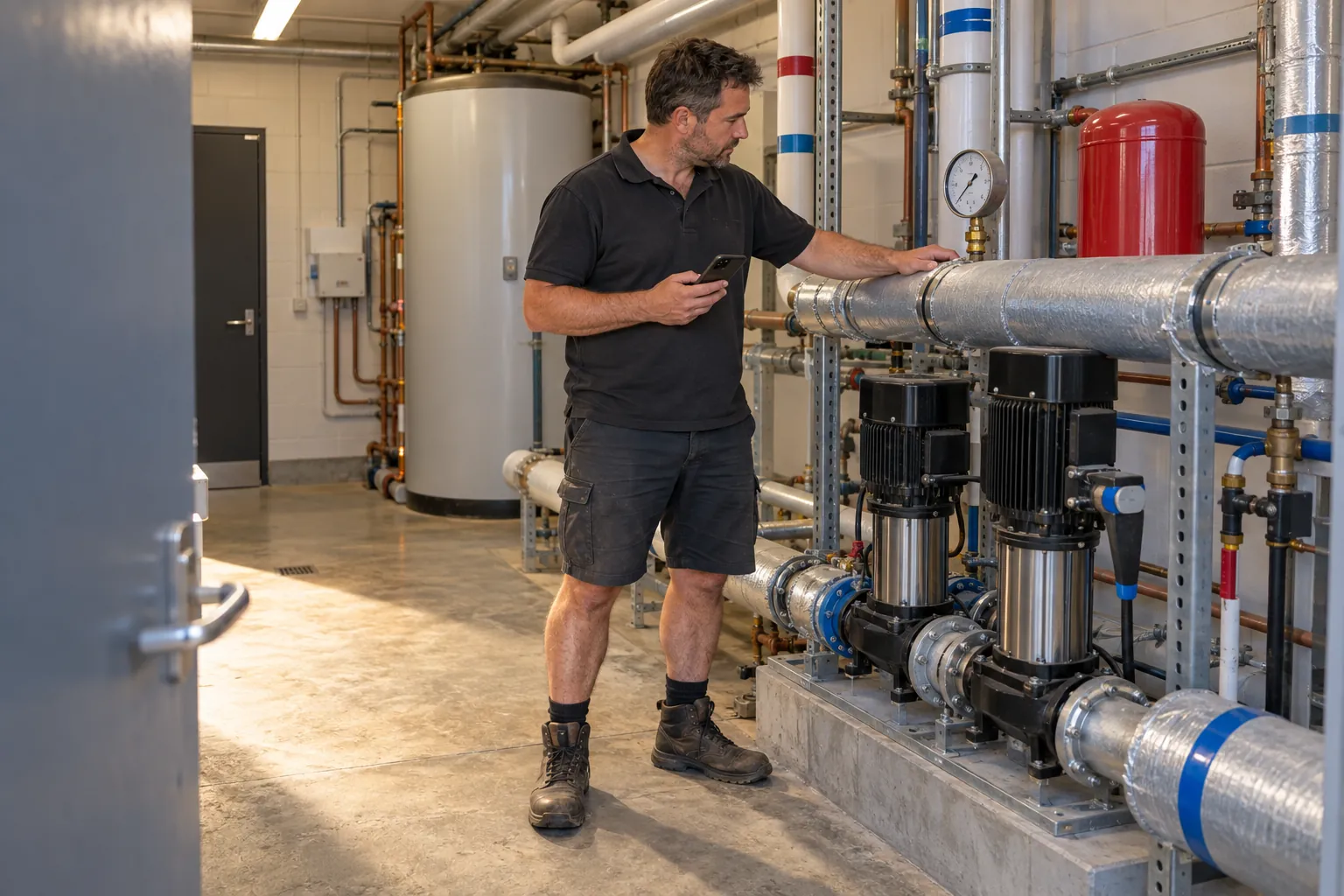
- Plant and machinery: pumps, generators, compressors, roller doors, gates, kitchen equipment, and workshop machinery in schools and industrial buildings.
- Workplace facilities: toilets, showers, kitchens and break rooms, drinking water and first aid facilities, kept in good working order, clean, safe and accessible.
Some of these carry a statutory frequency set by the compliance schedule; most do not. A building can have a current BWoF and still have blocked gutters and a staff toilet that has not flushed properly for a week.
03
Building the asset list and the maintenance schedule
A preventative maintenance schedule answers four questions for every asset: what it is, where it is, what it needs and how often. Building one is careful, methodical work:
- Walk the building and list the assets. Every floor, plant room, roof and riser: type, model, location, age and condition. A list inherited from the last contractor is a starting point, not a register.
- Start from the compliance schedule. Get the current schedule from the council, with every amendment, and copy each specified system's inspection, maintenance and reporting procedures into the programme, noting which tasks fall to an independent qualified person (IQP) and which to the owner.
- Read the operation and maintenance manuals. The handbook's own example of a planned maintenance procedure simply points to the building's operating and maintenance manual for its HVAC services. Service intervals, consumables and warranty conditions come from the designer, manufacturer or supplier.
- Add the discretionary tasks. Decide which non-statutory maintenance you will do and how often, based on how critical the asset is to the building's use and what failure would cost in disruption or risk.
- Name who does each task. The IQP, the maintenance contractor, the in-house caretaker or the cleaning team. Check each is competent for what they are asked to do.
- Put it in a calendar. Group tasks by building, trade and season, and time disruptive work for when the building is quiet, away from peak hours.
Who owns the programme depends on the building. The compliance schedule and the BWoF are always the building owner's responsibility, although many owners appoint an agent, often a property manager or facilities manager, to run them. In a multi-tenancy building the lease decides what each tenant looks after inside its own premises.
Two common New Zealand settings have their own framework:
- Unit title developments. The Unit Titles Services page on unit title maintenance explains that the body corporate maintains the common property, assets used with it, and parts of the building that serve more than one unit. For 10 or more units, the long-term maintenance plan must cover 30 years and be reviewed every three years. That plan sets the budget; the preventative maintenance schedule is how the body corporate manager and building manager carry it out week to week.
- State schools. The Ministry of Education's page on planning property maintenance says school boards are responsible for maintenance of school property, that some regular maintenance can be done by the caretaker while specialist work may need a qualified tradesperson, and that cyclical maintenance is shown in the 10 Year Property Plan. It links a BRANZ maintenance guide for schools and kura, with templates.
Larger organisations often hold the schedule in CAFM or CMMS software; a small site can manage with a spreadsheet, provided one person owns it and keeps it current.
04
Compliance schedule tasks, and the rest
The most useful distinction is between tasks the compliance schedule or the law sets, and tasks you choose to do. The first are not negotiable when budgets are tight; the second are where judgement comes in.
According to MBIE's page on inspection and maintenance of specified systems, a compliance schedule will usually require the more complex inspection and maintenance procedures to be carried out by an IQP, while a building owner may be responsible for some less complex and more frequent inspection tasks, also set out in the schedule. Most specified systems need at least an annual IQP inspection, and some are inspected six-monthly or quarterly. Each year the owner must obtain a Form 12A from each IQP, certifying that the schedule's procedures were carried out for the previous 12 months, before the BWoF can be supplied.
The frequent checks, many of them the owner's own, are where a programme most often slips. The Compliance Schedule Handbook gives minimum frequencies where the nominated standard does not set one. For example:
- Final exits: daily when the building is in use for crowd occupancies, or where building work may affect a final exit, and monthly for all others, to ensure they can be opened and are not locked, barred or blocked.
- Access-controlled doors on escape routes: daily or monthly as above, with six-monthly checks of fail-safe operation and alarm connection.
- Fire separations bounding exitways: visually inspected for damage or deterioration and for new penetrations without suitable fire-stopping.
- Cooling towers: monthly Legionella and heterotrophic microorganism tests, which must be done by an IANZ-accredited laboratory, plus weekly dipslide tests where there is no automatic chemical dosing.
The schedule for your building is the authority, not the handbook. Where the two differ, follow the schedule and raise the difference with your IQP.
Outside the schedule, HSWA still applies. WorkSafe's guidance on safe work with lifts, escalators and moving walkways says a PCBU must, so far as is reasonably practicable, provide and maintain safe plant and structures, and that it is good practice to have an inspection and maintenance programme in place and arrange for a competent person to regularly inspect, test and maintain machinery. Its safe use of machinery guidance adds a regular inspection regime for machinery and guards, and isolation procedures whenever people need to enter the danger area for maintenance or repair.
Discretionary tasks, such as changing filters, lubricating, clearing gutters before autumn and repainting before timber is exposed, are required by no one by name, but skipping them is how minor wear becomes leaks, breakdowns, costly repairs and downtime.
05
How completion is recorded and checked
A preventative maintenance programme is only as credible as its records. When a council officer, an IQP, an insurer, WorkSafe or a client asks whether a task was done, the answer needs to be more than a tick on a planner.
For specified systems, the Building Act makes the records the owner's responsibility. MBIE says the owner must obtain and keep reports detailing inspections, maintenance and repairs from the people who carried out the work, and keep them with the compliance schedule for at least two years after they were issued. The handbook's example reporting statement shows what those records should contain as a minimum:
- details of each inspection, test or preventative maintenance task, with the date, the work done, any faults found, the remedies applied and the person who did it;
- details of any other faults found, and of maintenance and repair work done to keep the system in working order, recorded the same way.
The handbook adds that it may be appropriate to keep a log book at the installation, with a summary report held with the compliance schedule, and that for practical reasons the IQP may keep records on the owner's behalf. Those records are what the IQP reviews before signing a Form 12A.
Other plant has its own record expectations. WorkSafe's page on preventing Legionnaires' disease from cooling towers and evaporative condensers asks operators to keep written records to demonstrate ongoing compliance, including the action taken when results show increased microbial growth. The machinery guidance asks for records of maintenance, inspection, commissioning and alteration of presence-sensing systems, with test results.
Across the whole programme, add two things to the task records: each defect found on a visit with the date its repair was closed, since a report of defects that were never fixed is worse evidence than none, and a view of tasks due, done and overdue by building, with any overdue compliance schedule task named rather than hidden in a percentage.
Review the programme at least once a year, ideally before the BWoF anniversary, and whenever the compliance schedule is amended because a specified system is added, altered or removed.
06
Where the record fails
Preventative maintenance records are usually strongest for the contractor's visit and weakest for the small, frequent checks in between: the monthly walk of the final exits, the caretaker's look at the roof after a southerly, the fire doors that are meant to close and latch. Those end up on a sheet inside a riser cupboard, filled in for the month at once, and a fault found on one is mentioned to whoever is at reception.
SiteClara is built for that everyday part of the work. A printed QR poster at each check point, with an NFC tag behind it if staff would rather tap, lets the caretaker, cleaner or security officer doing the round scan with their own phone, with no app to install, and mark a scheduled check done or say what stopped them, with a photograph when one is asked for. The record shows which point was checked, by whom and when, as it happened, and a check that was due and not done shows as not done rather than disappearing. A fault reported at the tag goes onto the list of jobs for the team responsible until someone closes it. Each day a supervisor reviews the day and approves a report that goes to the building or facilities manager the next morning, showing what was checked, what was missed and why, and what is still open.
07
Questions people ask
What is preventative maintenance?
Maintenance done on a schedule so that things do not fail. MBIE's Compliance Schedule Handbook says planned preventative maintenance "is aimed at avoiding breakdown or malfunction, through regular service, cleansing, adjustment, lubrication, or periodic replacement", and that it will generally be based on published Standards or recommendations made by the designer, manufacturer or supplier.
What are five examples of preventative maintenance?
The five activities named in MBIE's Compliance Schedule Handbook: regular servicing, cleansing, adjustment, lubrication and periodic replacement. In a building that means, for example, servicing a heat pump, cleaning filters and gutters, adjusting controls, lubricating moving parts and replacing worn belts before they fail. The handbook also gives minimum frequencies for the frequent checks of specified systems, such as confirming daily or monthly that final exits can be opened and are not locked, barred or blocked.
What is the difference between preventative and corrective maintenance?
Preventative maintenance is planned before anything fails; corrective maintenance fixes a failure. MBIE's Compliance Schedule Handbook calls the second responsive maintenance: it is required where a system or a component has failed, so that its performance standard is not being met, and the failure may be found during inspection, testing or planned preventative maintenance, or reported by building users.
How often should preventative maintenance be done?
As often as the compliance schedule, the manufacturer's instructions and the risk require. For specified systems, MBIE's page on inspection and maintenance of specified systems says most require at least an annual inspection by an IQP, some are inspected six-monthly or quarterly, and the building owner may be responsible for some less complex and more frequent inspection tasks. Where the nominated standard sets no frequency, the Compliance Schedule Handbook gives minimums, such as final exit checks daily when a crowd occupancy is in use or building work may affect a final exit, and monthly for other buildings.
What is a preventative maintenance checklist?
A list used to check a building regularly, find what needs maintenance, and plan the work. The Ministry of Education's page on planning property maintenance links the Maintenance Guide for Schools | Kura, developed by BRANZ in consultation with the Ministry, which describes preventive maintenance as "a checklist to identify maintenance needed" and includes templates for both routine and preventive maintenance. For a specified system, the checklist is the inspection and maintenance procedures in the building's compliance schedule.
08
Where to read more, and a list to take away
MBIE's Managing your BWoF is the starting point for owners of buildings with specified systems, and the Compliance Schedule Handbook sets out typical procedures for each system. WorkSafe's HSWA special guide explains the PCBU duties for workplaces and plant. Standards named in a compliance schedule, such as NZS 4541 for sprinklers or AS/NZS 3666 for air-handling and water systems, are published by Standards New Zealand.
To check your preventative maintenance is in order:
- every asset is on a list, checked on site, with its location;
- the current compliance schedule, with every amendment, is in the programme task by task;
- each task shows whether it belongs to an IQP, a contractor or the owner's own staff, and names who;
- the owner's frequent checks, such as final exits and fire doors, are scheduled, not left to memory;
- discretionary tasks are chosen deliberately, not inherited;
- reports and certificates are filed against the asset and kept for at least two years;
- faults found between visits reach someone who will fix them, and the fix is recorded;
- overdue compliance schedule tasks are reported by name;
- the programme is reviewed at least once a year, before the BWoF falls due.
Sources
Every document this guide quotes or links to, in the order it first cites them.
- Compliance Schedule Handbook building.govt.nz
- Introduction to the Health and Safety at Work Act 2015 – special guide worksafe.govt.nz
- General risk and workplace management – part 1 worksafe.govt.nz
- Specified systems and compliance schedules building.govt.nz
- B2 Durability building.govt.nz
- Unit title maintenance unittitles.govt.nz
- Planning property maintenance education.govt.nz
- Inspection and maintenance of specified systems building.govt.nz
- Safe work with lifts, escalators and moving walkways worksafe.govt.nz
- Safe use of machinery worksafe.govt.nz
- Preventing Legionnaires' disease from cooling towers and evaporative condensers worksafe.govt.nz
- Maintenance Guide for Schools | Kura web-assets.education.govt.nz
- Managing your BWoF building.govt.nz
Related guides
 Premises and facilities managementBuilding compliance checklist: what a New Zealand building owner and PCBU must keep in orderA building compliance checklist for New Zealand non-residential buildings: the compliance schedule and BWoF, evacuation schemes, HSWA duties, asbestos and records.
 Fire and water checksThe compliance schedule: what it lists, and how to keep a building to itWhat a New Zealand compliance schedule lists, which buildings need one, how it is issued and amended, who does the checks and the records behind every BWoF.
 Fire and water checksIQPs and specified systems: who inspects what, and what the owner must keepWhat an IQP is, the specified systems SS 1 to SS 16, how to engage IQPs, what they inspect and what is left to the owner, and how the Form 12A works in New Zealand.
 Premises and facilities managementBuilding manager duties: the law, the daily work and the record, in New ZealandWhat a building manager does in New Zealand: HSWA duties, the compliance schedule and BWoF, unit title buildings, daily work and the records that show it was done.