Cleaning
Cleaner duties and responsibilities: what the job involves, and what good looks like
A cleaner's duties and responsibilities are to keep the floors, surfaces, ablutions, kitchens and waste areas of a building clean and hygienic to an agreed schedule, to restock toilet paper, soap and paper towels, to use cleaning chemicals and equipment safely, and to report faults, spills and anything unsafe to a supervisor.
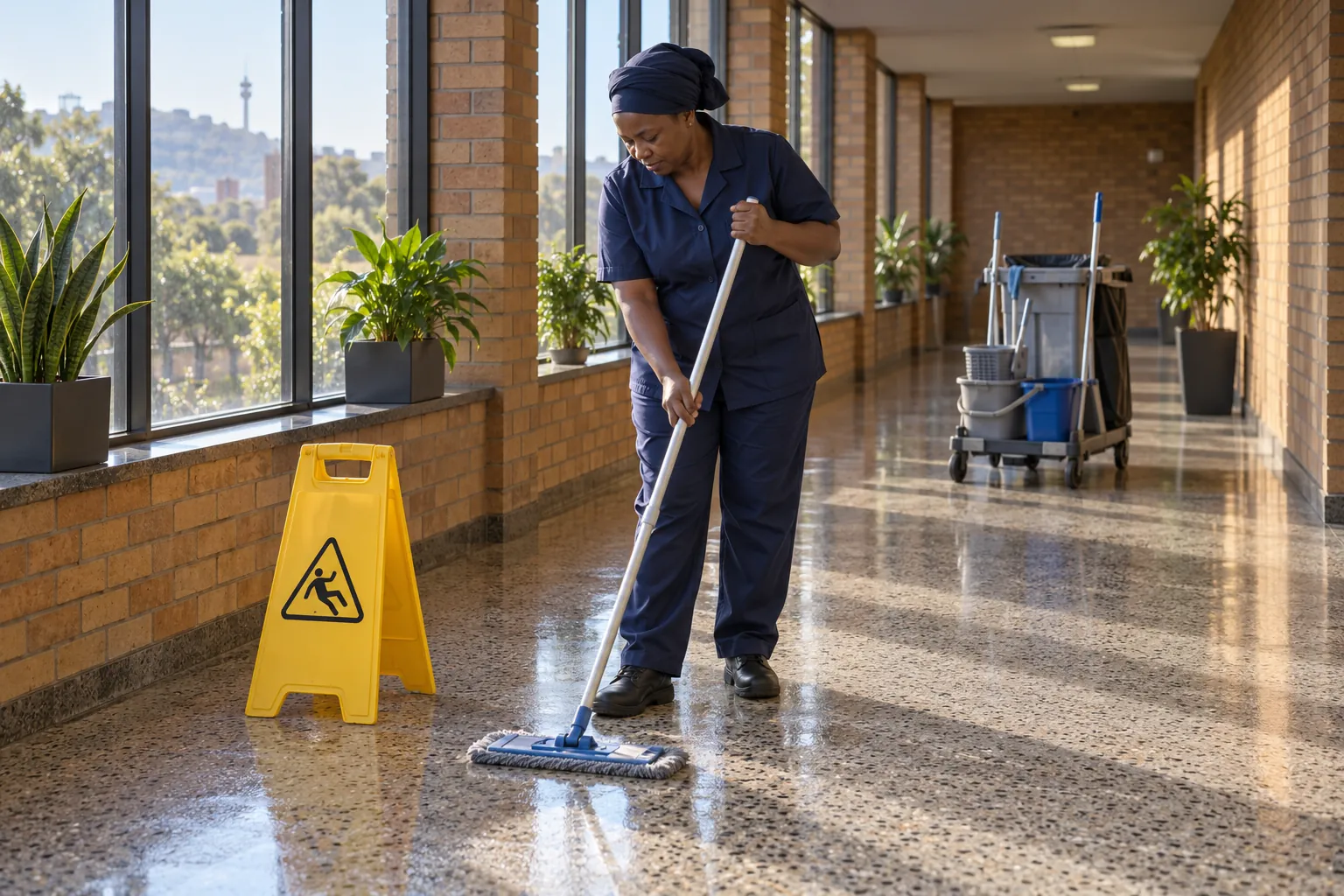
In South Africa the cleaner also carries the duties every employee has under section 14 of the Occupational Health and Safety Act 85 of 1993: to take reasonable care, to follow the employer's health and safety rules, and to report an unsafe situation or an incident without delay. Whether the job is called general cleaner, office cleaner or contract cleaner, the work is the same at heart: the right task, in the right place, at the right time, done safely and recorded honestly. This guide covers the main duties, a typical shift, the health and safety side, the hours and pay rules for contract cleaning, and the records that show the work was done.
01
What a cleaner is, and the duties the law gives one
The cleaner this guide is about keeps a non-domestic building clean, hygienic and safe to use: an office block, a school, a shopping centre, a hospital, the public areas of a hotel, a factory canteen or the common areas of an estate. Some are employed directly by the owner or occupier, often as a general worker who also does other tasks; many more work for a contract cleaning company and are placed on a client's site under a site supervisor.
No South African law lists a cleaner's tasks; those come from the job description, the cleaning schedule and the client's specification. What the law gives a cleaner is the duties every employee has under section 14 of the Occupational Health and Safety Act 85 of 1993 (the OHS Act). Every employee at work must:
- Section 14(a): take reasonable care for their own health and safety and that of others who may be affected by their acts or omissions.
- Section 14(b): co-operate with the employer so that its duties under the Act can be met.
- Section 14(c): carry out any lawful order, and obey the health and safety rules and procedures laid down by the employer.
- Section 14(d): report any unsafe or unhealthy situation, as soon as practicable, to the employer or the health and safety representative.
- Section 14(e): report any incident that has injured them or may affect their health as soon as practicable, and no later than the end of the shift in which it happened, unless the circumstances made that impossible.
Section 15 adds that no person may intentionally or recklessly interfere with or misuse anything provided in the interest of health or safety, such as a wet-floor sign moved out of the way.
The heavier duties sit with the employer. Section 8(1) requires every employer to provide and maintain, as far as is reasonably practicable, a working environment that is safe and without risk to health, and section 8(2)(e) requires the information, instructions, training and supervision needed to make that so. The Department of Employment and Labour's leaflet Health and Safety in the Workplace: what every worker and employer should know about health and safety in the workplace puts it plainly: the workers and the employer must share the responsibility for health and safety in the workplace.
The job should also be written down. Section 29(1) of the Basic Conditions of Employment Act 75 of 1997 (the BCEA) requires an employer to give a new employee written particulars that include their occupation or a brief description of the work, and the place of work or an indication that they will work at various places, which matters for a contract cleaner moved between sites.
02
The main duties and responsibilities of a cleaner
Duties depend on the building and the contract, but the general cleaner duties on most commercial sites include:
- Floors: sweeping, mopping and vacuuming floors, carpets and mats in offices, passages, stairs and foyers, with a wet-floor sign out while a floor dries.
- Surfaces: dusting and wiping desks, counters, shelves and sills, and cleaning glass, mirrors and entrance doors.
- High-touch points: disinfecting light switches, handrails, lift buttons and push plates, more often in hospitals, schools and busy public areas.
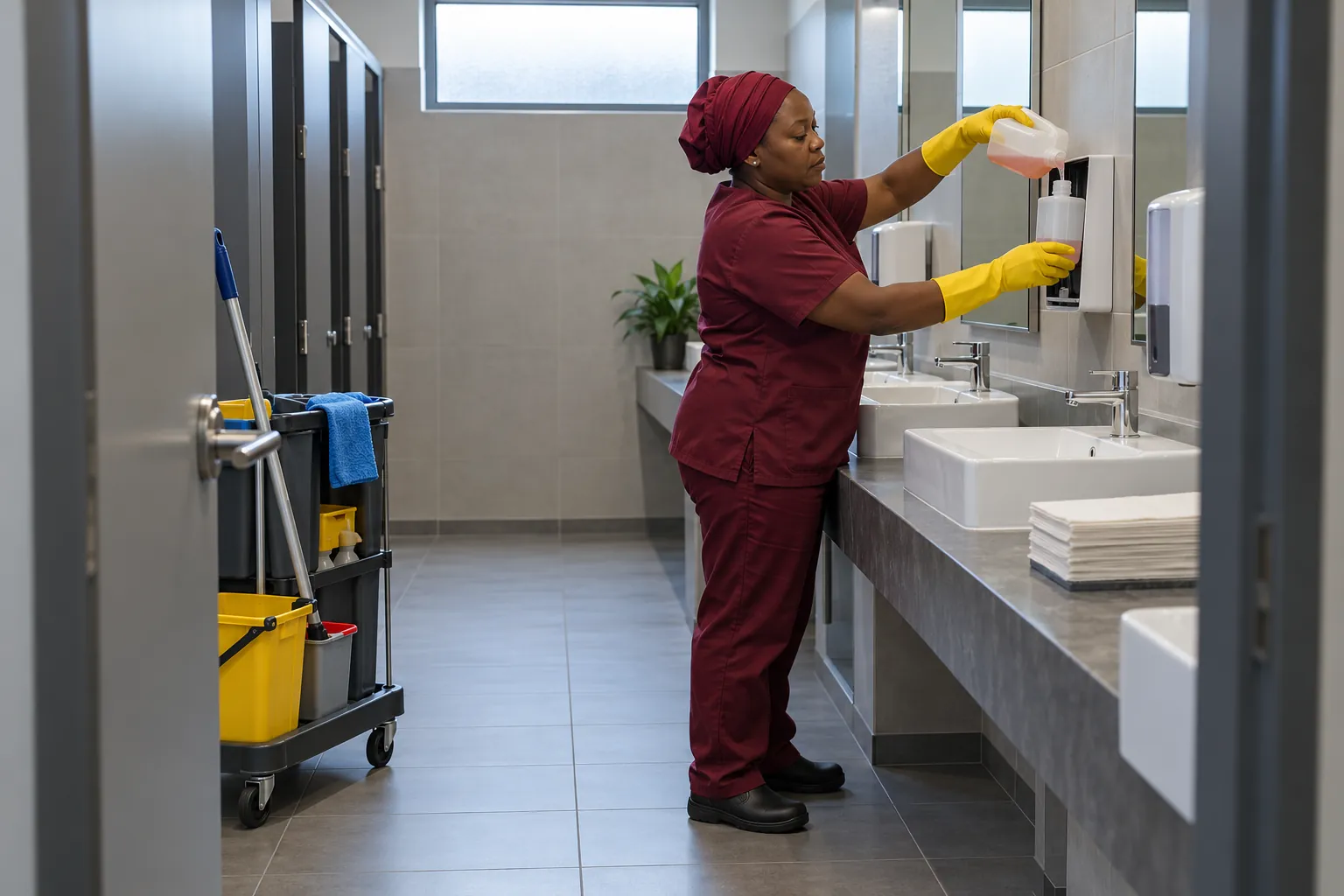
- Ablutions: cleaning toilets, urinals, washbasins and floors and checking them several times a shift; the ablution facilities are what most people judge a building by.
- Restocking: keeping toilet paper, soap and hand drying topped up, because regulation 2(3) of the Facilities Regulations, 2004 (Government Notice R. 924 of 3 August 2004) requires the employer to provide toilet paper and toilet soap or a similar cleansing agent free of charge, and at washbasins a personal towel, disposable paper towels, hot air blowers or clean portions of continuous cloth towel.
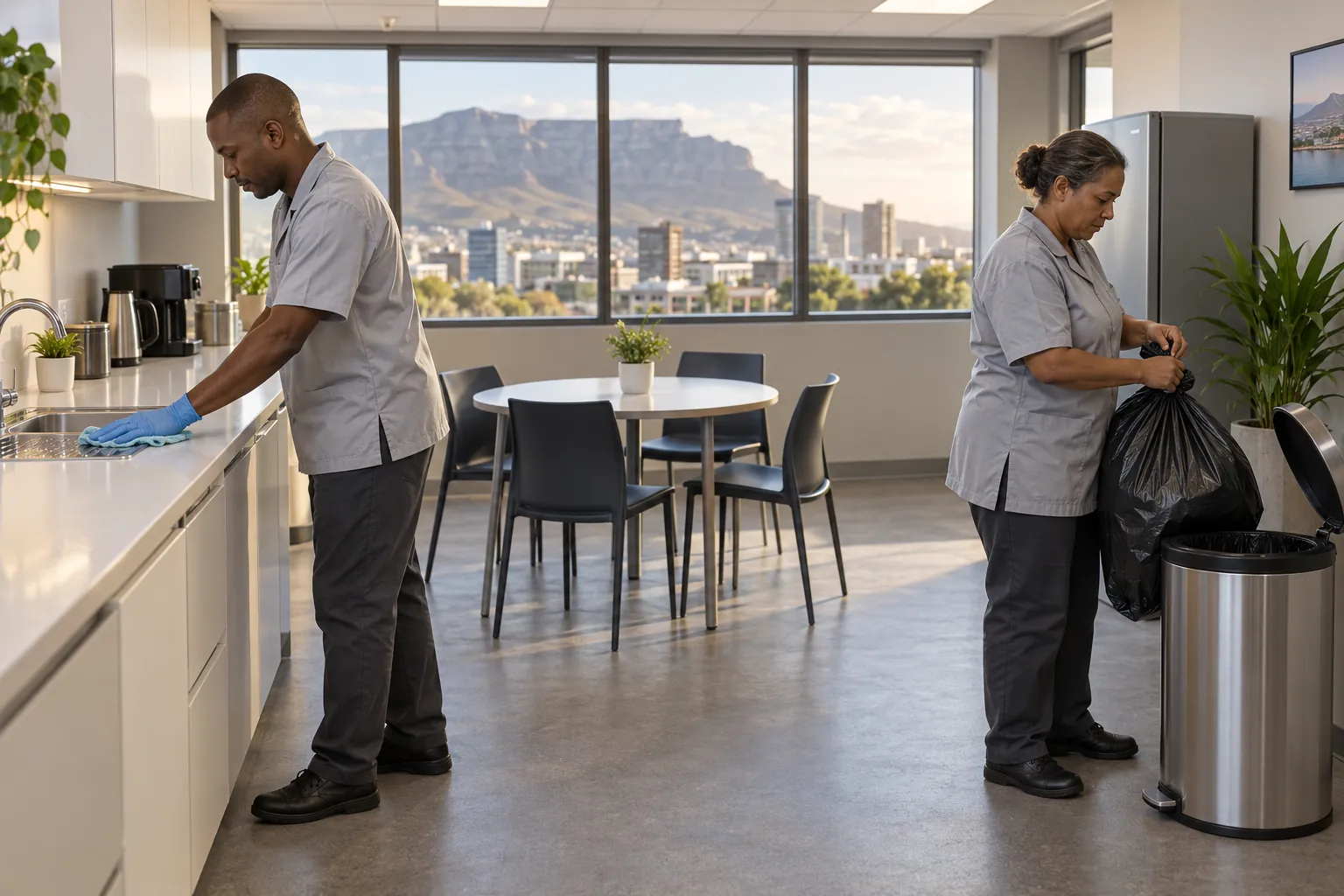
- Kitchens and tea rooms: sinks, counters, microwaves, fridges and floors.
- Waste: emptying bins, replacing liners, separating recycling where the site does, and taking bags to the refuse area rather than leaving them in passages.
- Periodic tasks: high dusting, washing walls, interior glass, and helping with deep cleans or floor polishing on the cleaning schedule.
- Equipment and chemicals: using the trolley, vacuum and any floor machine as trained, and only the chemicals provided, at the right dilution and in labelled containers.
- Reporting: telling the supervisor about leaks, blocked toilets, broken dispensers, spills, missing stock and anything unsafe.
- Security: keeping keys and access cards safe and locking the cleaners' store.
The client's specification sets the standard, but the law sets the floor. Regulation 13H(2) of the General Safety Regulations, as amended by the General Safety Regulations, 2025 (Government Notice 5954, Government Gazette 52226 of 6 March 2025), requires every employer to keep every indoor workplace "clean, orderly and free of materials, tools and similar things which are not necessary for the work done", and all floors, walkways, stairs, passages and gangways skid-free and free of obstructions, waste or materials. Regulation 9 of the Facilities Regulations requires toilets, change rooms and eating areas to be kept in a clean, hygienic, safe, whole and leak-free condition. Those duties are the employer's; in most buildings, the cleaner is how they are met.
03
What a cleaner's shift looks like
Office cleaners often work early morning or evening, before and after the building is busy, with a smaller day team for the ablutions and kitchens. A shift on a contract cleaning site usually runs like this:
- Sign in, put on the uniform and PPE, and collect the trolley, cloths and chemicals.
- Briefing from the supervisor: today's areas, events, complaints and faults.
- The first round: floors, bins and desks in the allocated area, top to bottom and dry to wet, with cloths kept to their own area if the site uses a colour code.
- Ablution checks at the scheduled times, more often after lunch: clean, restock and record the check.
- Responding to spills and requests, with the area signed until it is safe.
- Reporting faults and hazards as they are found, not at the end of the week.
- End of shift: equipment back clean, chemicals in the store, anything not done reported with the reason.
04
Working safely: chemicals, PPE, slips and incidents
Cleaners handle chemicals, wet floors, heavy bins and sharp waste every day. The duties that matter most in practice:
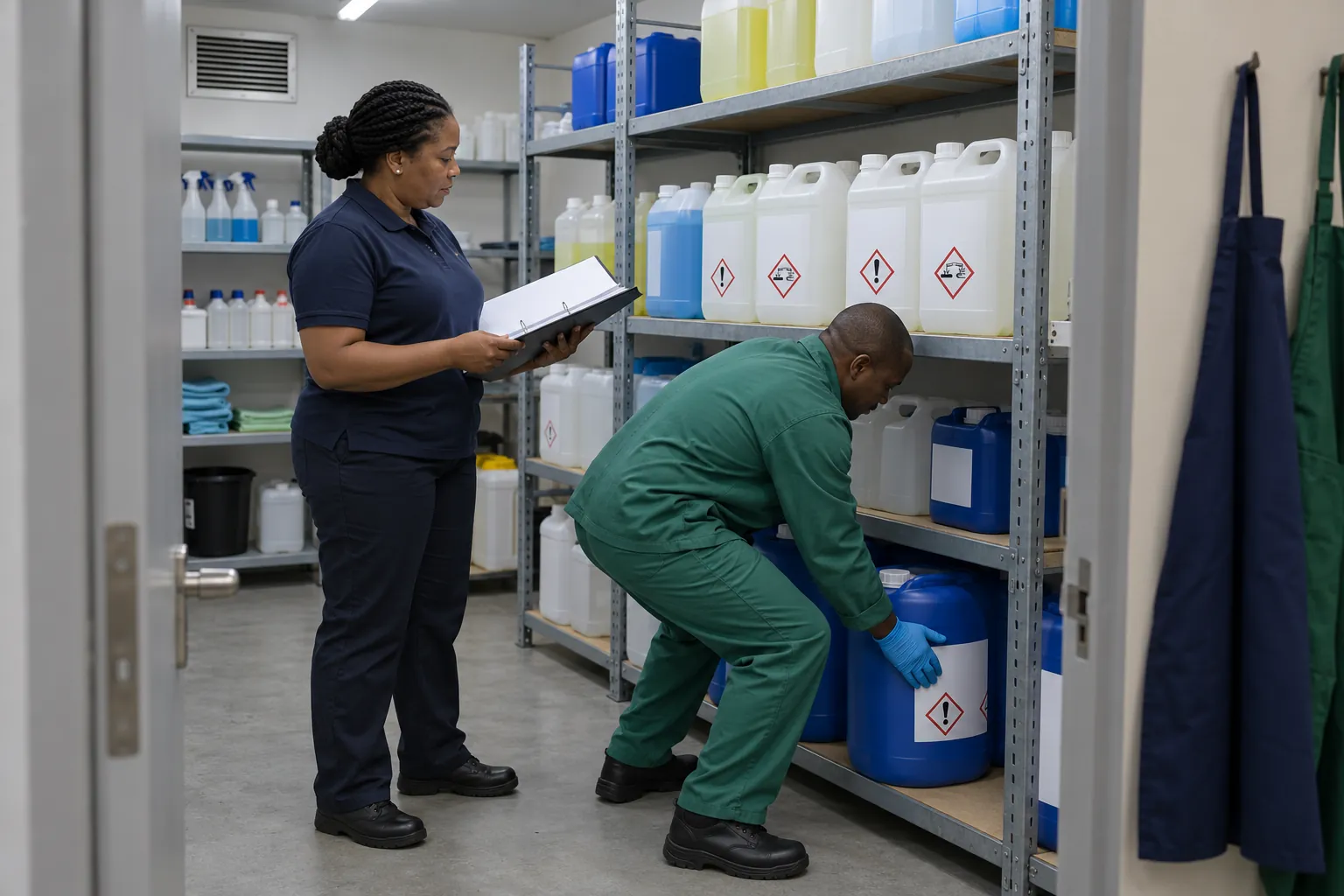
- Cleaning chemicals: many are hazardous chemical agents under the Regulations for Hazardous Chemical Agents, 2021 (Government Notice R. 11263 of 29 March 2021). Regulation 3 requires training before anyone is exposed, including how to find the safety data sheet, what the label means and how to deal with spills; regulation 4 requires everyone exposed to obey lawful instructions on PPE, cleaning up spilt material, and housekeeping and personal hygiene. See hazardous chemical agents.
- Decanting: regulation 14B(1)(d) requires the employer to make sure, as far as is reasonably practicable, that a chemical decanted from its original container goes into a container correctly labelled for it, and that a labelled container is used only for that chemical.
- PPE last, not first: section 8(2)(b) of the OHS Act requires the employer to eliminate or mitigate a hazard before resorting to personal protective equipment. Where gloves or goggles are still needed, the cleaner must wear them under section 14(c).
- No charge for safety: section 23 forbids an employer to deduct from pay, or make an employee pay, for anything the Act requires it to provide in the interest of health or safety.
- Slips and trips: sign wet floors, clean spills at once, and keep trolleys, cables and buckets out of walkways and off stairs.
- Lifting and sharps: split heavy bags, use the trolley, never press waste down by hand, and report needles or broken glass in general waste.
When something goes wrong, the cleaner's report starts a chain the employer must finish: recording and investigating the incident, reporting the serious ones to the Department of Employment and Labour, and reporting an injury on duty to the Compensation Fund. A cleaner who says straight away what happened, where and who saw it makes that possible; see incident reporting and investigation and injury on duty.
Section 26 of the OHS Act protects the cleaner who speaks up: an employer may not dismiss an employee, reduce their pay or alter their conditions to their disadvantage because they gave the Minister, or anyone else charged with administering the Act, information the Act requires or that relates to their conditions of employment, complied with an inspector's lawful direction, or did anything the Act allows or requires them to do.
05
Hours, pay, and how the work is checked
Many cleaners in South African offices and public buildings work for contract cleaning companies, covered by Sectoral Determination 1: Contract Cleaning Sector under the BCEA. From 1 March 2026, Government Notice R. 7083 of 3 February 2026, made under the National Minimum Wage Act 9 of 2018, sets the minimum hourly rate for contract cleaning employees at:
- Area A, R33,27 an hour: the City of Cape Town, Greater East Rand, City of Johannesburg, Tshwane and Nelson Mandela metros, and the Emfuleni, Merafong, Mogale City, Metsimaholo, Randfontein, Stellenbosch and Westonaria local councils.
- Area B, KwaZulu-Natal: the collective agreement of the Bargaining Council for the Contract Cleaning Service Industry (BCCCI) applies.
- Area C, R30,33 an hour: the rest of the country.
The notice bases its weekly rate on a 45-hour week, the limit in section 9(1) of the BCEA: no more than 45 ordinary hours a week, and no more than nine hours a day for someone working five days or fewer, or eight for someone working more. It also warns that any provider who contracts with a cleaning company at levels that make it impossible for the cleaning company to meet the National Minimum Wage Act or the BCEA can be held liable under section 200B of the Labour Relations Act 66 of 1995. A cleaner's duties must fit the hours paid for; see the cleaning contract.
The work is checked in two ways. The cleaning supervisor inspects the quality against the specification, sometimes with the client on a walk-round, at intervals the contract sets, against an agreed cleaning checklist. And the cleaner's own record shows whether each scheduled task was done. It does not need to be long; it needs to be true:
- each check recorded when it was done, by the person who did it, not filled in at the start of the shift;
- a task that could not be done recorded with the reason, such as an area locked or no water;
- a fault reported with where it is and what is wrong, so maintenance can find it.
06
Where the cleaner's record fails, and what SiteClara does about it
The check sheet on the back of the ablution door is the cleaner's oldest record and its weakest. It is signed for the day at the start of the shift, or later by someone who was not there; and when a cleaner mentions a leaking cistern to a passing tenant, the fault often goes no further. The cleaner who did the work properly has nothing to show for it.
SiteClara gives the cleaner a simpler way to record what they did, where they did it. Each location has a printed QR poster, with an optional NFC tag behind it. Enrolled staff scan the code or tap the tag on their own phone, with no app to install, see the checks due there, and mark each one done or say what stopped them, with a photo when one is asked for. A fault, such as a broken dispenser, is reported on the spot and goes onto the team's list of open jobs until someone closes it.
The supervisor sees which checks are due, done or missed, with the reason for a missed one, and approves a daily report that goes to the client or building manager the next morning: what was completed, what is still open, and how the scheduled checks went, for example 12 of 12 completed. The work is credited to the cleaner who did it.
07
Questions people ask
What are the duties of a general cleaner?
A general cleaner sweeps, mops and vacuums floors, dusts and wipes surfaces, cleans and restocks ablutions, cleans kitchens, empties bins and reports faults and hazards to a supervisor. Under section 14 of the Occupational Health and Safety Act 85 of 1993 they must also take reasonable care, follow the employer's health and safety rules, and report unsafe situations and incidents.
What is the minimum wage for a cleaner in South Africa?
From 1 March 2026 a contract cleaning employee must be paid at least R33,27 an hour in Area A and R30,33 an hour in the rest of the country, under Government Notice R. 7083 of 3 February 2026; in KwaZulu-Natal the BCCCI agreement sets the rates. The same notice sets the national minimum wage at R30,23 for each ordinary hour worked.
Can an employer deduct the cost of a cleaner's gloves or overalls from their pay?
Not for anything the OHS Act requires the employer to provide in the interest of health or safety: section 23 of the Occupational Health and Safety Act 85 of 1993 forbids it. The employer may recover the cost only where the employee intentionally caused the loss or damage, after a proper investigation.
08
Where to read the official text, and a list to take away
The OHS Act, the Facilities Regulations, the General Safety Regulations, 2025, the BCEA and the 2026 wage notice are on gov.za; the Regulations for Hazardous Chemical Agents and the department's worker leaflet are on labour.gov.za. The BCEA copy on gov.za is the Act as first published and has been amended since, and wage notices are replaced every year, so check the current text.
A good cleaner, at the end of each shift, can say:
- which areas they cleaned and which scheduled tasks they did, and what they could not do and why;
- that the ablutions were checked at the times set and stocked;
- that they used only the chemicals provided, from labelled containers, with the PPE required;
- that wet floors were signed and spills cleaned at once;
- which faults and hazards they reported, and to whom;
- that any incident was reported before the end of the shift;
- that equipment is clean, chemicals are stored and keys are returned.
Sources
Every document this guide quotes or links to, in the order it first cites them.
- Occupational Health and Safety Act 85 of 1993 gov.za
- Health and Safety in the Workplace: what every worker and employer should know about health and safety in the workplace labour.gov.za
- Basic Conditions of Employment Act 75 of 1997 gov.za
- Facilities Regulations, 2004 gov.za
- General Safety Regulations, 2025 gov.za
- Regulations for Hazardous Chemical Agents, 2021 labour.gov.za
- Government Notice R. 7083 of 3 February 2026 gov.za
Related guides
 CleaningCleaning supervisor duties: what the role involves, and what good looks likeWhat a cleaning supervisor does in South Africa: the main duties, a typical shift, the OHS Act, managing the team, checking the work and reporting to the client.
 CleaningCommercial cleaning checklist: area by area, and how to use it on shiftA cleaning checklist for offices and other workplaces in South Africa, area by area, with the OHS Act duties behind it, how to use it on shift and how to check it.
 CleaningAblution facilities: the legal requirements, and how to keep them cleanWhat the Facilities Regulations, 2004 require of workplace ablution facilities, where the toilet numbers come from, and how to check and record them properly.
 CleaningHazardous chemical agents: what the 2021 regulations mean for cleaning chemicalsWhat the Regulations for Hazardous Chemical Agents, 2021 require of cleaning chemicals: the assessment, the SDS file, labels, the store, training and records.