Cleaning
Gym cleaning checklist: equipment, change rooms and wet areas
A gym cleaning checklist lists the cleaning tasks for each area of a gym, from the gym equipment and studios to the change rooms and wet areas, and says how often each is done: wipe-downs several times a day, daily cleaning, and weekly and monthly deep cleaning.
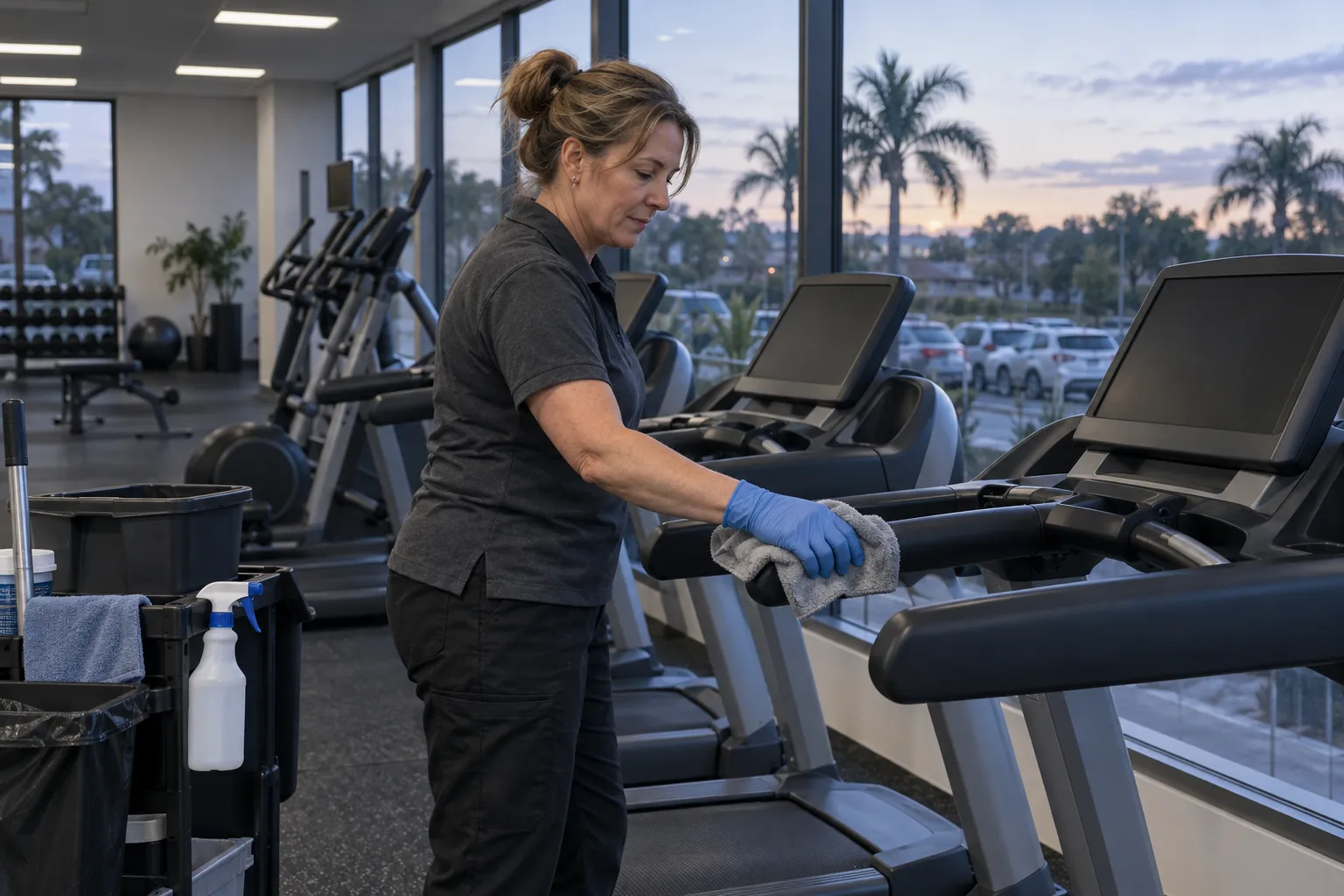
A gym is harder to keep clean than an office. It is open from before dawn until late, a 24/7 club may never close at all, people sweat on the equipment, and the change rooms and pool surrounds are warm, wet and walked barefoot. This guide sets out a gym cleaning checklist area by area, how often each part needs attention, who does what between members, floor staff and the cleaning contractor, and the WHS and OHS duties that sit behind it.
01
The duty behind a gym cleaning checklist
No Australian law prescribes a gym cleaning checklist. The law requires a gym that is safe and clean for the people who work and train there, and the checklist is how the operator and the cleaning contractor show, day by day, that it is.
In every state and territory except Victoria, the duty comes from a Work Health and Safety Act based on the national model law. Queensland's Work Health and Safety Act 2011 is typical. Section 19(1) requires a person conducting a business or undertaking (a PCBU) to ensure, so far as is reasonably practicable, the health and safety of its workers, and section 19(2) extends that to other people, requiring the PCBU to ensure that "the health and safety of other persons is not put at risk from work carried out as part of the conduct of the business or undertaking". In a gym, that means members and visitors.
The regulations are more specific. Regulation 41 of Queensland's Work Health and Safety Regulation 2011, which follows the model regulations, requires adequate facilities for workers, "including toilets, drinking water, washing facilities and eating facilities", maintained so as to be "in good working order" and "clean, safe and accessible". Regulation 40 requires that floors and other surfaces are "designed, installed and maintained to allow work to be carried out without risk to health and safety", which matters on a wet change room floor.
Safe Work Australia's model code of practice, Managing the work environment and facilities, explains how to meet those duties, and each state that has adopted the model law has approved it in its own name. SafeWork NSW's version, the Code of Practice: Managing the work environment and facilities (August 2019), says that workplaces and facilities "should be cleaned regularly taking into account the type of work performed, the likelihood of contamination, the number of workers using them, including during shiftwork, and the type of facility, such as eating areas, toilets, handbasins and showers."
Victoria keeps its own Occupational Health and Safety Act 2004 (authorised version 045). Section 21(2)(d) requires an employer to provide, so far as is reasonably practicable, "adequate facilities for the welfare of employees", and section 23(1) requires an employer to ensure, so far as is reasonably practicable, "that persons other than employees of the employer are not exposed to risks to their health or safety arising from the conduct of the undertaking of the employer". WorkSafe Victoria's Compliance code: Workplace facilities and the working environment (December 2023) covers how to maintain, clean and monitor workplaces.
02
What a gym cleaning checklist covers
Divide the checklist by area, because each has different risks, different surfaces and a different pattern of use.
- Cardio on the workout floor: treadmills, bikes, cross-trainers, rowers and stair climbers, especially handles, consoles, touchscreens and heart-rate grips.
- Strength machines: seats, back pads, handles, pins, cables and adjustment levers.
- Free weights: dumbbells, barbells, plates, collars, racks, benches, and the platform and rubber flooring.
- Functional area: turf, mats, kettlebells, medicine balls, battle ropes, plyo boxes and sleds.
- Studios: group fitness floors, mats, steps, spin bikes, reformers in a Pilates studio, mirrors, and the instructor's microphone and sound controls.
- Change rooms and amenities: floors, benches, lockers, showers, toilets, basins, hand dryers, hair dryers and vanity benches.
- Wet areas: pool concourse, spa, sauna and steam room, and the barefoot routes between them and the change rooms.
- Reception and café: the front counter, entry gates and swipe points, café tables and seating.
- Touch points across the building: door handles, push plates, locker keypads, water fountains and bottle refill stations, light switches and lift buttons.
- Waste: bins on the gym floor, sanitary bins, sharps containers in the amenities, and the bin room or bin store.
Leave out work that belongs to someone else. Pool water treatment and testing is for trained plant operators, equipment servicing belongs to the equipment supplier or maintenance contractor, and the hazardous chemicals register belongs to the PCBU. The checklist should say where a cleaner reports a fault to those people, not ask the cleaner to do their job.
03
The gym cleaning checklist, by frequency
Frequencies follow opening hours and traffic. The routine below suits a typical commercial gym or fitness centre; move the checks to match your own peaks, which in most clubs are before work, at lunchtime and after work.
Several times a day, and after each peak
- Wipe handles, consoles and touchscreens on cardio equipment with a product the manufacturer allows.
- Wipe and disinfect seats, back pads, handles and pins on strength machines, and benches and grips in the free weights area.
- Wipe mats in the functional area and return equipment to racks, which also clears trip hazards.
- Restock wipe dispensers, spray bottles, paper towel and hand sanitiser; check spray bottles are labelled and correctly diluted.
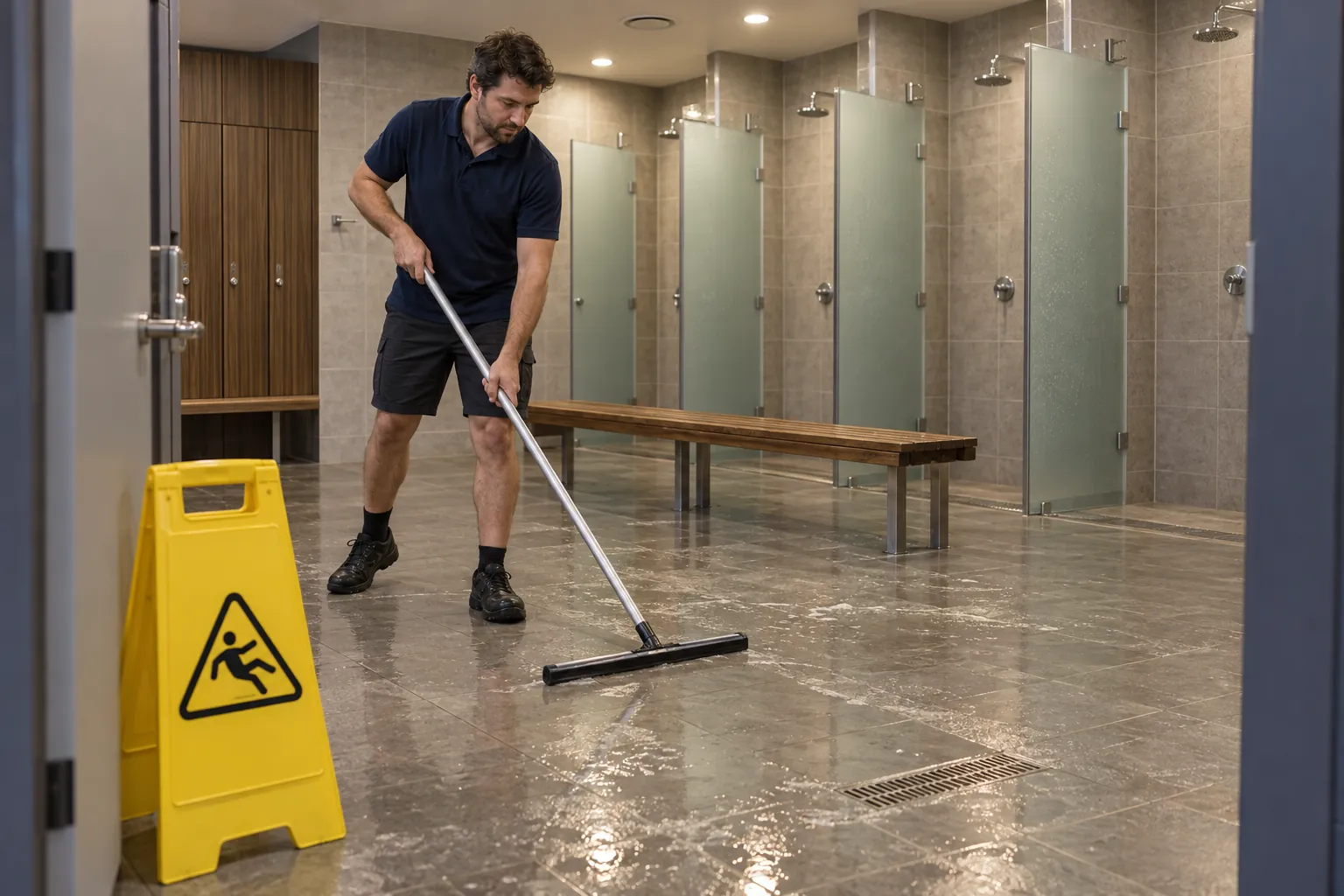
- Walk the change rooms: floors, hair, litter, toilets, soap and toilet paper; squeegee standing water towards the drains.
- Wipe door handles, locker keypads and water fountains; empty gym floor bins.
Daily
- Full clean of change rooms, showers, toilets and basins, including lockers, benches and vanity areas.
- Vacuum and mop the gym floor and studios, moving portable equipment to reach underneath.
- Clean every piece of equipment in full, not only the touch points, and note wear such as split upholstery or worn grips.
- Clean the pool concourse, sauna benches and steam room surfaces as the operating procedures say, when the room is safe to enter.
- Clean mirrors, glass and reception; empty all bins, and arrange sanitary and sharps collections as needed.
Weekly
- Scrub shower floors, walls, grout, drains and shower roses.
- Clean under and behind heavy equipment and racks.
- Wash studio mats in full and clean spin bikes and reformers to the manufacturer's instructions.
- Flush little-used showers and outlets if the building's water management plan gives that task to the cleaning team.
Monthly and periodic
- Machine scrub change room and wet area floors to lift the residue that makes slip-resistant tiles lose their grip.
- Clean inside lockers, dust high ledges, vents and air-conditioning grilles, and arrange filter changes with maintenance.
- Clean or replace upholstery, shampoo carpeted areas and descale taps and shower roses.
- Check wipe stations, dispensers and signage are in the right places and working.
04
Who does what: members, floor staff and the cleaning contractor
Gym cleanliness depends on more people than the cleaners, and the checklist works best when each group knows its part.
- Members wipe down equipment after use. That only happens if there is a wipe dispenser or spray and paper within a few steps of every piece of equipment and signage that asks for it. A member wipe-down adds to the cleaning schedule; it does not replace it.
- Floor staff and personal trainers walk the floor, rack weights, deal with spills and prompt members, and they are usually first to see a fault or a mess. Put their part on the checklist, or it will be squeezed out on a busy evening.
- The cleaning contractor, or the in-house cleaner, does the scheduled cleans through the day and the full clean overnight or in the quietest hours. In a 24/7 club that is often a single cleaner working unsupervised.
Chemicals. Cleaning and disinfecting products are hazardous chemicals under the WHS regulations when they are classified as hazardous. SafeWork NSW's Code of Practice: Managing risks of hazardous chemicals in the workplace says a PCBU must keep a register of hazardous chemicals, which lists each product with its current safety data sheet (SDS), and must ensure the current SDS is "readily accessible" to the workers who use it. It also warns about "domestic cleaning chemicals" bought from a supermarket and used "in a way or quantity which is not consistent with home use", for which an SDS should be obtained. Use products the equipment manufacturers allow, because some upholstery and touchscreens are damaged by strong or alcohol-based products.
Clean, then disinfect. Remove sweat and dirt first, because a disinfectant sprayed over a dirty surface achieves little, and leave it on for the contact time the label gives. Keep colour-coded cloths and mops separate for the amenities, the gym floor and the café.
Spills and bodily fluids. The NSW code says that "spills on floors should be cleaned up immediately". Blood, vomit and other bodily fluids also need a spill kit, disposable gloves, a written procedure and training for floor staff as well as cleaners, because floor staff are usually nearest. Used syringes found in change rooms should go straight into a sharps container, handled with tongs or gloves, never capped by hand.
Checking. A duty manager's walk-round, a regular joint inspection against the contract specification and member feedback show whether the checklist is followed. Complaints are rarely random: note where and when they arise and move the checks to match.
05
Change rooms, showers and the pool concourse
Change rooms and wet areas carry the highest risk and draw the most complaints. They are warm, wet and walked barefoot, which suits the organisms that cause tinea and plantar warts, and the floors are slippery, so hygiene there matters most to members.
- Slips. The NSW code says floors "must be inspected regularly and maintained to eliminate or minimise slip and trip hazards", and that "cleaning methods should also take account of the potential for slips, which may be increased by the use of some cleaning agents." Squeegee standing water to the drains often at busy times to prevent slips, keep drains clear of hair, and put out wet floor signs only while the floor is wet.
- Showers. Remove hair and soap scum, clean the shower roses and descale as needed. If the water management plan asks for little-used showers to be flushed, record it where the person responsible for the plan will see it.
- Mould and odour. Black mould on grout, silicone and ceilings usually means the exhaust fans are not coping. Clean it, and report the ventilation to maintenance rather than cleaning the same patch every week.
- Saunas and steam rooms. Clean benches, floors and walls with products approved for the surfaces and temperatures, and only when the room is off and safe to enter.
- Pool concourse. Clean the concourse, benches and pool equipment on the schedule the pool operating procedures set, and keep cleaning chemicals well away from the pool plant chemicals.
A gym with a pool or spa has a second set of rules. In NSW, NSW Health's guidance on public swimming pools and spa pools explains that a pool the public is admitted to "as an entitlement of membership of a club" is a public swimming pool under the Public Health Act 2010 and Public Health Regulation 2022, that it must be notified to the local council, and that it must meet the operating, monitoring and recordkeeping requirements in Schedule 1 of the Regulation, with daily monitoring records kept for six months. Other states and territories have their own public health rules for aquatic facilities, and the AUSactive code asks aquatic operators to follow Royal Life Saving Society Australia's Guidelines for Safe Pool Operations. The cleaner's checklist should say who to call when something goes in the pool.
06
Where the gym cleaning record fails, and what SiteClara does about it
Most gyms have a cleaning sheet on the back of the change room door and a folder at reception. By the evening the sheet has gaps from the busy lunchtime, the night clean is a single tick, and when a member complains about the showers the duty manager cannot say when they were last checked or by whom. In a 24/7 club the overnight cleaner may be alone, and a missed clean comes to light as a member's complaint the next morning.
SiteClara puts a printed QR poster at each area, each change room, the gym floor, each studio and the pool concourse, with an NFC tag behind it if the team would rather tap than scan. Cleaners and floor staff scan the code or tap the tag on their own phone, with no app to install, see the scheduled checks due at that spot, and mark them done or say what stopped them. Their name and the time are recorded as it happens, with a photo when the check asks for one. A fault, such as a broken shower or a torn seat pad, can be reported at the same tag and goes onto the team's list of open jobs until someone closes it.
The supervisor or duty manager sees what is due, done and missed, can record the reason a check was missed, and can escalate a job to the building manager. At the end of the day they review it, add a note and approve the report, which goes to the nominated management or client contacts the next morning, showing what was reported, completed and still open, and how the scheduled checks went.
07
Questions people ask
How often should a gym be cleaned?
No Australian law sets a number. SafeWork NSW's Code of Practice: Managing the work environment and facilities says workplaces and facilities "should be cleaned regularly taking into account the type of work performed, the likelihood of contamination, the number of workers using them, including during shiftwork, and the type of facility, such as eating areas, toilets, handbasins and showers", and that consumables such as soap and toilet paper "should be replenished regularly". For the industry, clause 4.6(d) of AUSactive's National Code of Practice for the Health and Fitness Industry asks that "all wet areas are cleaned frequently and regularly in order to maintain a high standard of cleanliness". In practice that means touch points several times a day, a full clean daily and deep cleaning weekly and monthly, as the checklist above sets out.
What should a locker room cleaning checklist include?
Appendix B of SafeWork NSW's Code of Practice: Managing the work environment and facilities is a checklist for reviewing facilities, and its questions carry straight over to a gym locker room: "Are facilities cleaned regularly?", "Are toilets cleaned regularly and maintained in good working order?", whether consumables such as soap and toilet paper are "replaced regularly", and whether lockers and seating are "maintained in good condition". The code also says showers should have "a slip-resistant surface that is capable of being sanitised" and lockers should be "well ventilated, accessible and secure". Add the gym's own risks: hair in drains, standing water, mould on grout and the sharps and sanitary bins.
08
Where to read more, and a list to take away
Start with the code of practice your state has approved: in NSW, the two SafeWork NSW codes of practice cited above; in Victoria, WorkSafe Victoria's compliance code on workplace facilities. Read the AUSactive code for what the industry expects of a club and, if you run a pool or spa, your state health department's rules. For the amenities, see the toilet cleaning checklist, and for keeping the record, the cleaning log sheet guide.
Before the next busy season, check that your gym cleaning checklist:
- is divided by area, with change rooms and wet areas treated separately;
- sets frequencies by traffic, with extra checks after the morning, lunchtime and evening peaks;
- names products that are on the hazardous chemicals register, with the SDS within reach, and that the equipment manufacturers allow;
- gives floor staff and members a clear part, with wipe stations close to the equipment;
- has a spill kit, a sharps container and a written procedure for bodily fluids;
- records shower flushing where the water management plan gives it to cleaning;
- works for the overnight cleaner in a 24/7 club, who may be the only person there;
- is checked by a duty manager on a walk-round, not only signed by the cleaner.
Sources
Every document this guide quotes or links to, in the order it first cites them.
- Work Health and Safety Act 2011 legislation.qld.gov.au
- Work Health and Safety Regulation 2011 legislation.qld.gov.au
- Code of Practice: Managing the work environment and facilities safework.nsw.gov.au
- Occupational Health and Safety Act 2004 legislation.vic.gov.au
- Compliance code: Workplace facilities and the working environment worksafe.vic.gov.au
- National Code of Practice for the Health and Fitness Industry ausactive.org.au
- Code of Practice: Managing risks of hazardous chemicals in the workplace safework.nsw.gov.au
- NSW Health's guidance on public swimming pools and spa pools health.nsw.gov.au
Related guides
 CleaningToilet cleaning checklist: what to check, how often, and how to make the record believableWhat a toilet cleaning checklist should cover in Australian workplaces, how often to check, the WHS and OHS duties behind it, and how to make the record believable.
 CleaningEnd of trip facilities: keeping showers, lockers and bike rooms clean and workingWhat end of trip facilities include, what WHS and planning rules say, how often to clean and check showers, lockers and bike rooms, and who looks after what.
 CleaningCommercial cleaning checklist: area by area, and how to know it is followedA commercial cleaning checklist for Australian offices and shared buildings, area by area, with the WHS duties behind it and how a supervisor checks it is followed.
 CleaningCleaning log sheet: what to record, who signs it, and what a signature provesWhat a cleaning log sheet should record in Australian workplaces and food businesses, the WHS and food safety rules behind it, and what a signature proves.