Cleaning
Gym cleaning checklist: equipment, locker rooms and the pool deck
A gym cleaning checklist is a written list of the cleaning tasks for each zone of a fitness center, from the workout floor and shared equipment to the locker rooms, showers and pool deck, with how often each is done and who does it.
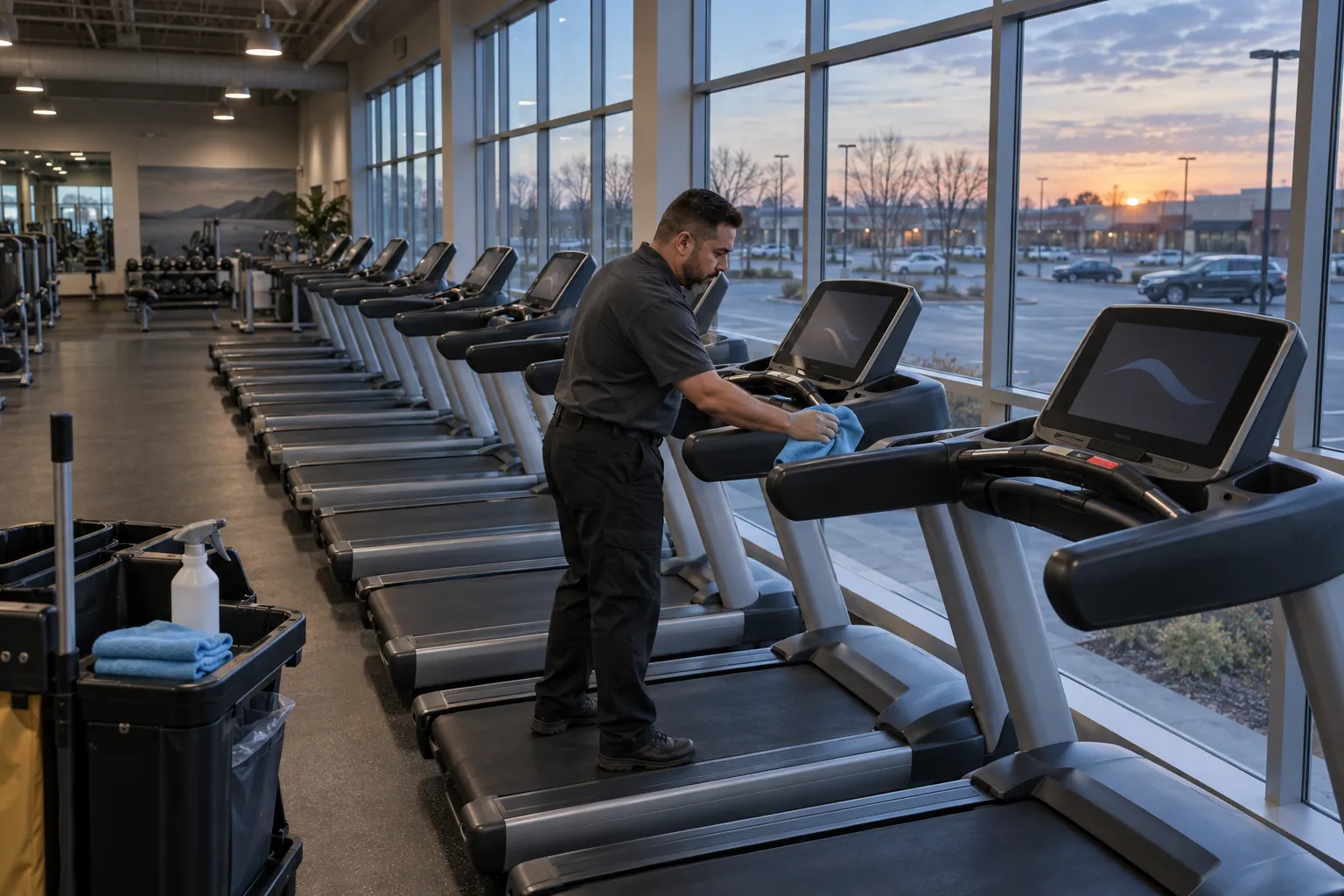
A gym is harder to keep clean than an office. It is open from before dawn to late at night, members sweat on the equipment, and the locker rooms, showers and pool deck are warm, wet and walked barefoot. This guide sets out a gym cleaning checklist area by area, the federal rules and CDC guidance behind it, how often each part needs attention, and who does what between members, floor staff and the janitorial crew.
01
The rules behind a gym cleaning checklist
No federal regulation tells a fitness center to post a cleaning checklist. What the rules set is the outcome the checklist is there to deliver, and for most private employers in the United States that starts with OSHA. Federal OSHA covers private employers in most states. According to OSHA's State Plans overview, 22 state plans cover private and public sector workers and must be "at least as effective as OSHA," and seven more cover only state and local government workers. A public employer, such as a city recreation center or a university rec center, is under OSHA rules only where the state has a plan that covers it. Check which applies before you quote a federal standard.
- Sanitation. 29 CFR 1910.141, Sanitation, says "All places of employment shall be kept clean to the extent that the nature of the work allows," that the floor of every workroom be kept, so far as practicable, in a dry condition, that waste receptacles not leak and be able to be thoroughly cleaned, and that "Washing facilities shall be maintained in a sanitary condition."
- Floors. 29 CFR 1910.22, Walking-working surfaces, requires surfaces to be kept "in a clean, orderly, and sanitary condition," free of hazards such as leaks and spills, "inspected, regularly and as necessary," with hazardous conditions corrected before an employee uses the surface again.
- Chemicals. The Hazard Communication Standard, 29 CFR 1910.1200, requires a written hazard communication program for hazardous chemicals in the workplace, safety data sheets "readily accessible during each work shift," and training at the time of an employee's initial assignment. That covers the disinfectant concentrates, degreasers and descalers in the janitor closet.
- Blood. The Bloodborne Pathogens Standard, 29 CFR 1910.1030, applies to staff with reasonably anticipated contact with blood or other potentially infectious materials in the course of their duties, which usually includes the janitorial crew who clean up after an injury and any staff designated to give first aid. It requires contaminated surfaces to be decontaminated with an appropriate disinfectant immediately or as soon as feasible after a spill.
The workers are only half the picture. OSHA protects employees, not members, so the duty to keep a gym safe and clean for the people paying to use it comes mainly from state and local health codes, the building's insurance and ordinary premises liability. Pools, spas and hot tubs are regulated by the state or county health department, often in a code based on the CDC's Model Aquatic Health Code. The checklist is the day-to-day part of meeting all of these, beside the hazard communication program, the exposure control plan and any aquatic operating procedures.
02
What a gym cleaning checklist covers
Divide the checklist into zones by area, because each area has different surfaces, different risks and a different pattern of use:
- Cardio floor: treadmills, ellipticals, stationary bikes, stair climbers and rowers, especially handles, heart rate grips, consoles and touchscreens.
- Strength machines: seats, back pads, grips, selector pins, cable handles and adjustment knobs.
- Free weights: dumbbells, barbells, plates, collars, racks, benches and the platform.
- Functional and turf areas: mats, kettlebells, medicine balls, battle ropes, plyo boxes, sleds and foam rollers.
- Group fitness studios: studio floors, yoga and exercise mats, steps, spin bikes, mirrors, barres and sound system controls.
- Locker rooms: floors, benches, lockers, showers, toilets, urinals, sinks, hair dryers and vanity counters.
- Wet areas: the pool deck, hot tub, sauna and steam room, and the walkways between them and the locker rooms.
- Front desk and lounge: the check-in counter, turnstiles and scanners, smoothie bar or cafe tables, and seating.
- High-touch surfaces across the building: door handles and push plates, locker keypads, drinking fountains and bottle fillers, light switches and elevator buttons. The high-touch surface cleaning guide covers these in more depth.
- Trash and laundry: trash cans on the floor, feminine hygiene receptacles in restrooms and locker rooms, towel bins, and the dumpster area.
Leave out work that belongs to someone else. Pool and spa water chemistry belongs to a trained pool operator, and equipment servicing belongs to the manufacturer's technician or your preventive maintenance vendor. The checklist should tell a custodian where to report a torn seat pad or a treadmill belt that slips, not ask them to fix it.
03
The gym cleaning checklist, by frequency
Frequencies follow your hours and your traffic. A 24-hour club and a small studio open six hours a day need different lists, and a hotel fitness room with a dozen users a day needs less again. The pattern below suits a typical commercial health club or recreation center; move the extra checks to match your own peaks, which are usually early morning, lunchtime and after work.
Several times a day, and after each peak
- Wipe handles, grips, consoles and touchscreens on cardio equipment with a product the manufacturer approves for that surface.
- Disinfect benches, seat and back pads, grips and pins on strength machines and free weight benches.
- Wipe mats, re-rack weights and return loose equipment, which also clears trip hazards.
- Refill wipe dispensers, spray bottles and hand sanitizer; check spray bottles are labeled and mixed at the right dilution.
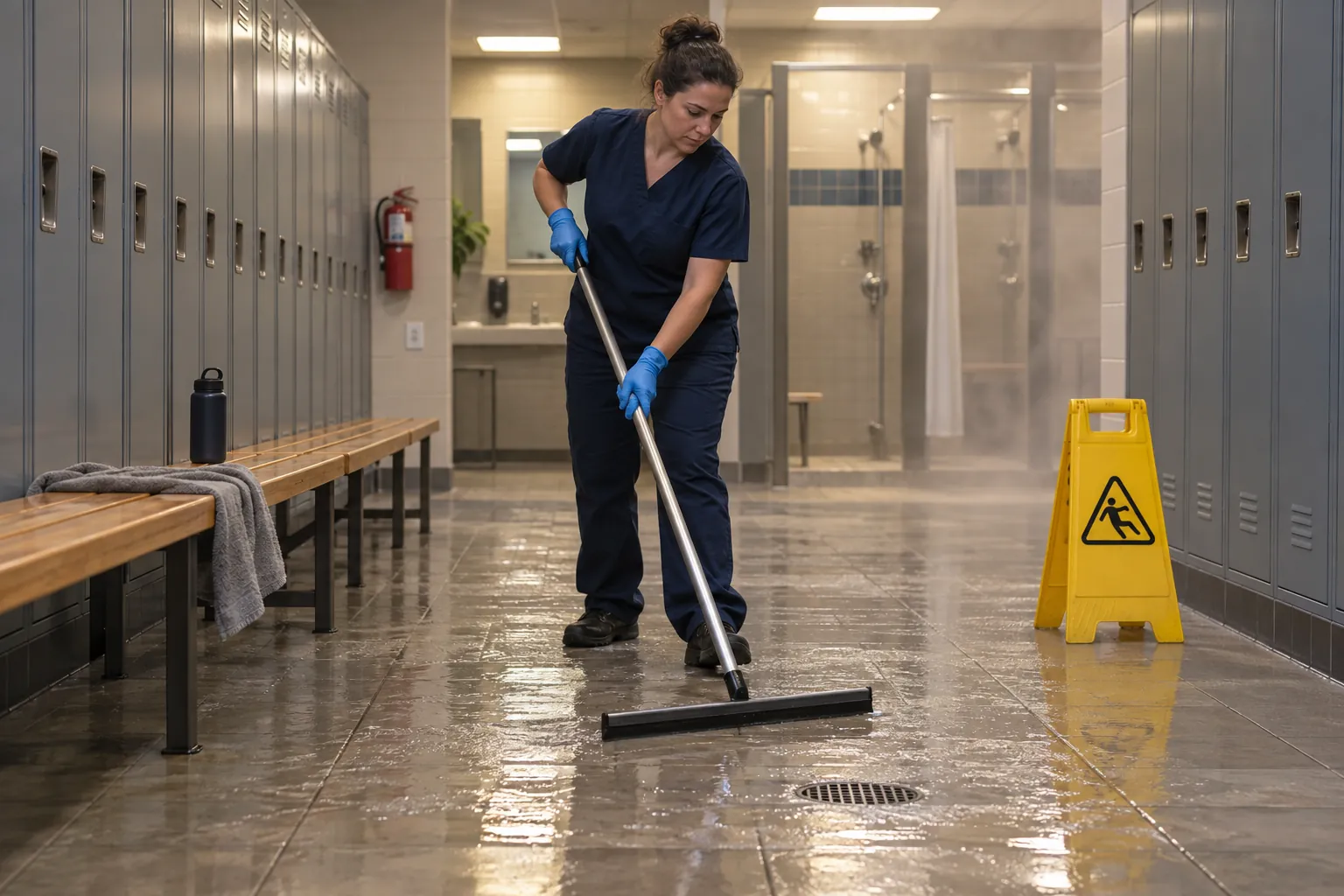
- Walk the locker rooms: floors, hair, trash, toilets and supplies; squeegee standing water toward the drains.
- Wipe door handles, locker keypads and drinking fountains; empty trash cans on the floor before they overflow.
Daily
- Full clean of locker rooms, showers, restrooms and sinks, including benches and locker fronts.
- Vacuum and mop the gym floor and studios, moving portable equipment to reach under it.
- Clean every piece of equipment in full, not only the touch points, and note wear such as split upholstery, frayed cables or worn grips.
- Clean the pool deck, sauna benches and steam room surfaces as the aquatic operating procedures specify.
- Clean mirrors, glass and the front desk; empty all trash and feminine hygiene receptacles as needed.
Weekly
- Deep clean showers, including grout, drains, shower heads and curtains or doors.
- Clean under and behind heavy equipment, racks and platforms.
- Wash studio mats and clean spin bikes in full, including the frames and flywheel guards.
- Run little-used showers and faucets if the building's water management program assigns that task to the custodial crew.
Monthly and periodic
- Floor care: machine scrub locker room and restroom floors, and clean inside empty lockers.
- High dust ledges, vents and diffusers, and arrange HVAC filter changes with the building engineer.
- Clean or replace upholstery, extract carpeted areas and descale fixtures where needed.
04
Products, people and who does what
Gym cleanliness depends on more people than the janitorial crew, and the checklist works best when each group knows its part.
- Members wipe down equipment after use. That only happens if wipe dispensers or spray and paper towels are visible and within a few steps of every station and the signs ask clearly. The CDC's MRSA prevention advice for athletes tells people to use a barrier, such as clothing or a towel, between their skin and shared surfaces such as sauna and steam room benches and weight-training equipment, and not to share towels. A towel policy supports that. Member wipe-downs supplement the cleaning schedule; they never replace it.
- Trainers and floor staff walk the floor, re-rack weights, deal with spills and are usually first to see a fault. Put their part on the checklist, or it gets squeezed out on a busy evening.
- The janitorial crew, in-house custodians or a contractor, does the scheduled cleans through the day and the full clean overnight or in the quietest hours.
- Maintenance and specialist vendors handle equipment servicing, pool and spa plant, HVAC, the water management program and periodic deep cleaning.
Choosing a disinfectant. Use an EPA-registered disinfectant with a label claim for the germs you are concerned about. The CDC's MRSA prevention page lists benches and gym equipment among the surfaces that contact bare skin and should be cleaned, points to disinfectants that work against MRSA, and notes there is little evidence that spraying or fogging a room prevents MRSA better than a targeted approach of cleaning surfaces. The EPA's page on selected EPA-registered disinfectants links its lists by pathogen, including List H for MRSA and VRE and List G for norovirus, and explains that "The only way to accurately identify a product is by the EPA registration number."
Follow the label. The EPA registers disinfectants through its pesticide program, and its introduction to pesticide labels quotes the standard label statement: "It is a violation of Federal law to use this product in a manner inconsistent with its labeling." In practice: the right dilution, the full contact time, a rinse where the label asks for one, and only the surfaces it allows. Check the equipment manufacturer's cleaning instructions too; some upholstery and touchscreens are damaged by strong or alcohol-based products, and a cracked seat pad cannot be cleaned properly.
Training and color coding. Under the Hazard Communication Standard, staff are trained on the chemicals in their work area when they start, and the safety data sheets are kept where the crew can reach them on every shift. Keep separate color-coded cloths and mop heads for restrooms and locker rooms, the gym floor, and any cafe or smoothie bar, and write the colors on the checklist; the color-coded cleaning guide sets out a scheme.
Blood and body fluids. Keep a spill kit and disposable gloves on the floor, cordon off the area, and follow the exposure control plan; the blood spill cleanup guide covers the procedure. Train floor staff as well as custodians, because they are usually nearest.
05
Locker rooms, showers and the pool deck
Locker rooms and wet areas carry the highest risk and draw the most complaints. They are warm, wet and walked barefoot, which suits the organisms behind athlete's foot and plantar warts, and the floors are slippery. The locker room cleaning guide goes further; the essentials for the checklist are these.
- Slips. Standing water in the locker room and on the pool deck is the main hazard, and 1910.22 requires spills to be dealt with. Squeegee it toward the drains often at busy times, keep drains clear of hair, and put out a wet floor sign only while the floor is wet. A sign left out all day stops being read.
- Floors. Barefoot areas need regular cleaning and disinfecting with a product labeled for wet areas, and periodic machine scrubbing to lift the soap and body oil residue that makes slip-resistant tile lose its grip.
- Showers. Remove hair and soap residue, clean shower heads and descale as needed. The CDC's page About Legionella Control names hot tubs among the devices where Legionella can grow and says buildings and devices at increased risk should have a water management program. If yours asks the custodial crew to run little-used showers, record it where the program manager will see it; the water management program guide explains who owns what.
- Mold and odor. Black mold on grout, caulk and ceilings usually means the exhaust fans are not coping. Clean it, and send the ventilation problem to maintenance as a work order rather than cleaning the same patch every week.
- Saunas and steam rooms. Clean benches, floors and walls with products labeled for those surfaces and temperatures, and only when the room is off or cool enough to enter safely.
- Pool deck and hot tub surrounds. Clean them on the schedule in your aquatic operating procedures and your state or county pool code. Keep toilet tools off the deck, and never store or mix cleaning chemicals near pool chemicals.
Many state and local pool codes draw on the CDC's Model Aquatic Health Code, currently the 2024 fifth edition. The CDC is clear that the MAHC "is not a federal law" and "only becomes law if voluntarily adopted by a local, state, territorial, or tribal jurisdiction," and it names gyms among the operators that may be affected. Read the code your health department actually enforces, and keep the water testing record in the pool chemical log, not on the cleaning checklist; the pool chemical log guide explains what goes in it.
06
Where the gym cleaning record fails, and what SiteClara does about it
Most gyms have a cleaning log taped inside the locker room door and a binder at the front desk. By evening the log has gaps from the lunchtime rush, the overnight clean is one set of initials, and when a member complains about the showers the manager on duty cannot say when they were last checked or by whom. For a janitorial contractor cleaning several clubs, the first sign that one location is slipping is usually a complaint or a bad online review rather than a report.
SiteClara puts a printed QR poster at each area, such as each locker room, the cardio floor, each studio and the pool deck, with an optional NFC tag behind it. Custodians and floor staff scan the code or tap the tag on their own phone, with no app to install, see the scheduled checks due at that location, and mark them done or explain what stopped them. Their name and the time are recorded as it happens, and they can add a photo. A fault, such as a broken shower valve or a torn seat pad, can be reported there and goes onto the team's list of jobs until someone closes it.
The supervisor or manager on duty sees what is due, done and missed, can record the reason a check was missed, and can escalate a job to the building manager. At the end of the day they review the totals and photos, add a note and approve the report, which goes to nominated management or client contacts at 8 a.m. the next morning, showing what was reported, what was completed, what is still open and how the scheduled checks went.
07
Questions people ask
How often should a gym be cleaned?
No federal rule sets a cleaning frequency for gyms. The CDC's When and How to Clean and Disinfect a Facility says to clean high-touch surfaces regularly and other surfaces when they are visibly dirty, and adds that in a high traffic area "you may choose to clean more frequently or disinfect in addition to cleaning." For a busy gym, that usually means touch points and shared equipment several times a day, a full clean of every area daily, and deeper tasks weekly and monthly, as in the checklist above.
What is the best thing to clean gym equipment with?
Clean off sweat and dirt first, then use an EPA-registered disinfectant that the equipment manufacturer allows on that surface. The CDC's MRSA prevention page names benches and gym equipment among the surfaces that contact bare skin and says to use disinfectants that work against MRSA, which the EPA lists in List H of its selected EPA-registered disinfectants. Read the label for the contact time, any rinse and the surfaces it is safe on.
08
Further reading, and a list to take away
OSHA publishes its standards in full on osha.gov, and a state plan publishes its own. The CDC publishes the facility cleaning, MRSA, Legionella and Model Aquatic Health Code pages cited above; the EPA publishes its disinfectant lists; your health department publishes the pool code it enforces.
Before your next busy season, check that your gym cleaning checklist:
- is divided by area, with locker rooms and wet areas treated separately;
- sets frequencies by traffic, with extra checks after the morning, lunchtime and evening peaks;
- names EPA-registered disinfectants that the equipment manufacturers allow, with the dilution and contact time;
- gives floor staff and members a clear part, with wipe stations close to the equipment;
- has a spill kit, gloves and a written procedure for blood and body fluids;
- records shower flushing where the water management program assigns it to the custodial crew;
- sends faults to maintenance as work orders rather than noting them and moving on;
- is checked by a supervisor on a walk-through, not only initialed by the custodian.
Sources
Every document this guide quotes or links to, in the order it first cites them.
- State Plans overview osha.gov
- 29 CFR 1910.141, Sanitation osha.gov
- 29 CFR 1910.22, Walking-working surfaces osha.gov
- Hazard Communication Standard, 29 CFR 1910.1200 osha.gov
- Bloodborne Pathogens Standard, 29 CFR 1910.1030 osha.gov
- When and How to Clean and Disinfect a Facility cdc.gov
- MRSA prevention advice for athletes cdc.gov
- MRSA prevention page cdc.gov
- Selected EPA-registered disinfectants epa.gov
- Introduction to pesticide labels epa.gov
- About Legionella Control cdc.gov
- Model Aquatic Health Code cdc.gov
Related guides
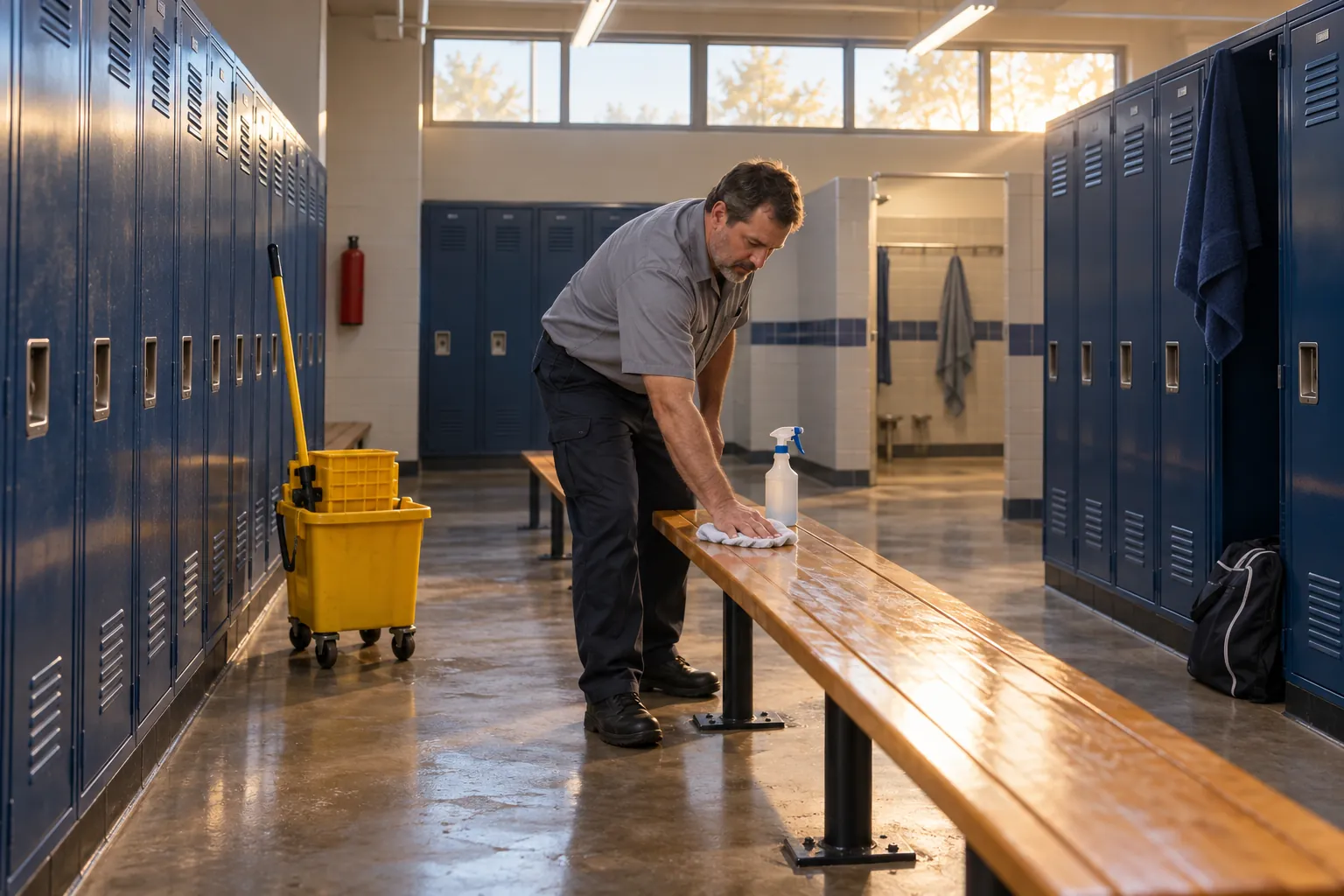 CleaningLocker room cleaning: a schedule that holds up, and a record that shows itHow to clean a locker room in a school, college, gym or workplace: the OSHA rules, CDC advice on MRSA, a schedule by frequency, and a record that shows it was done.
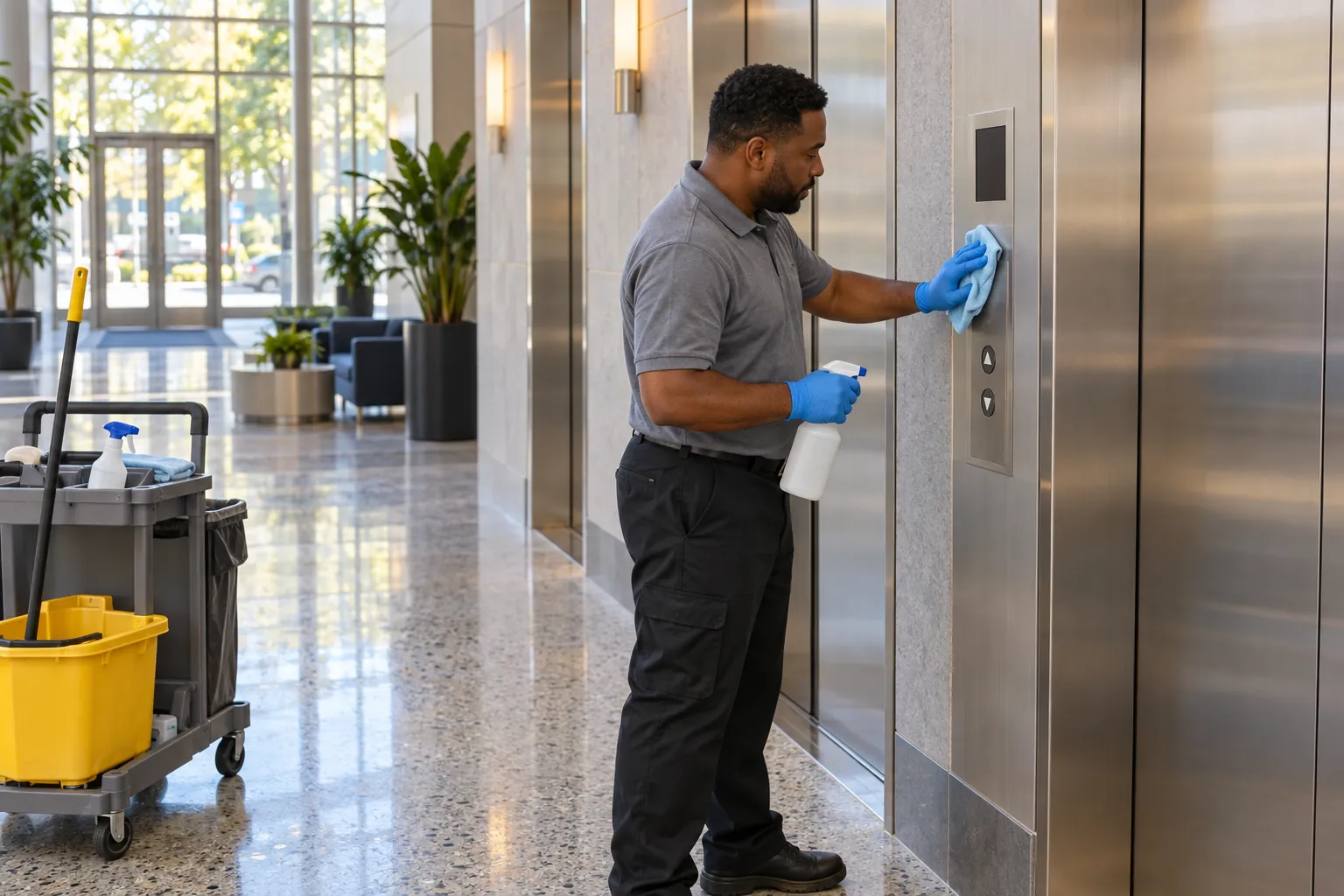 CleaningHigh-touch surfaces: a cleaning routine you can show was doneHigh-touch surfaces as the CDC describes them: which ones to list area by area, how often to clean and disinfect them, the right method, and a record that holds up.
 CleaningCleaning, sanitizing and disinfecting: what each one does, and when a building needs itCleaning, sanitizing and disinfecting defined by the CDC, EPA and FDA Food Code: when each is needed, how to do it right, and what the record should show.
 CleaningBlood spill cleanup: doing it safely, and showing it was doneHow to clean up a blood spill at work under OSHA's bloodborne pathogens standard: PPE, sharps, disinfectants, waste, training and the record to keep.