Premises and facilities management
Slips, trips and falls: what HSWA expects in a building, and the checks that prevent them
Slips, trips and falls are one of the most common causes of injuries at work in New Zealand, and in a building they can happen to anyone: staff, contract cleaners, security officers, tenants and visitors.
They rarely make the news, but the Health and Safety at Work Act 2015 does not treat them as a minor nuisance. The PCBU that manages or controls a workplace must keep its floors, entrances and stairs without risks so far as is reasonably practicable. This guide explains what the law and WorkSafe expect, where slips and trips happen in a building, the controls that work, who does what when several businesses share a site, and how the routine checks are shown to have been done.
01
What the law asks of the PCBU
A slip is too little grip between shoe and floor: a wet entrance, a spill, a freshly mopped corridor. A trip is a foot caught on something: a curled mat, a trailing cable, a step nobody noticed. A fall can follow either, or come from a stepladder or a stair. WorkSafe New Zealand's page on slips, trips and falls puts the causes plainly: "Ground clutter, uneven or slippery floor surfaces, poor lighting or lack of signage all contribute to thousands of workers getting injured every year."
There is no separate New Zealand law about slips and trips. They sit under the general duties of the Health and Safety at Work Act 2015 (HSWA). Two duties matter most in a building:
- The primary duty of care (section 36). Each PCBU (person conducting a business or undertaking) must ensure, so far as is reasonably practicable, the health and safety of its workers and of other people put at risk by its work, so a cleaning company owes it to the people crossing the lobby it has just mopped.
- The duty of a PCBU who manages or controls a workplace (section 37). As WorkSafe's Introduction to the Health and Safety at Work Act 2015 special guide explains, that PCBU must ensure, so far as is reasonably practicable, that "the workplace, the means of entering and exiting the workplace, and anything else arising from the workplace are without health and safety risks" to any person there. Visitors, couriers and members of the public are covered, not just workers.
"Reasonably practicable" (section 22) means what is reasonably able to be done, weighing how likely and how bad the harm is, what could be done about it and whether the cost is grossly disproportionate to the risk. A mat at a door that floods every time it rains is hard to argue away.
The Health and Safety at Work (General Risk and Workplace Management) Regulations 2016 fill in the detail. WorkSafe's interpretive guidelines, General risk and workplace management – part 1, explain regulation 10, which requires the PCBU that manages or controls a workplace to ensure, among other things, that:
- "The layout allows, and the workplace is maintained to allow, persons to enter and exit the workplace and to move within it without risks to health and safety, both under normal working conditions and in an emergency."
- "Surfaces are designed, installed, and maintained to allow work to be carried out without risks to health and safety."
- Lighting is suitable and sufficient for workers to work and move safely, and for a safe evacuation.
Regulations 5 to 8, explained in General risk and workplace management – part 2, set the process: identify the hazards, control the risks using the hierarchy of control measures, keep each control "maintained so that it remains effective", and review the controls when they fail or something changes.
02
Where slips, trips and falls happen in a building
WorkSafe lists the usual ways workers are harmed: unmarked changes in floor level; slipping on floors wet from spills, the weather or cleaning; poor housekeeping and obstructed views, with loose carpet, mats, trailing cables, boxes and bags; damaged flooring, including stairs; not using the handrail; cramped layouts; standing on unstable furniture; and poor lighting. Its guidance for office workers adds that "the injury can range from minor (bruises and scrapes) to more serious, including broken bones or head trauma."
In an ordinary commercial building, school, hall of residence or apartment block, those causes gather in predictable places:
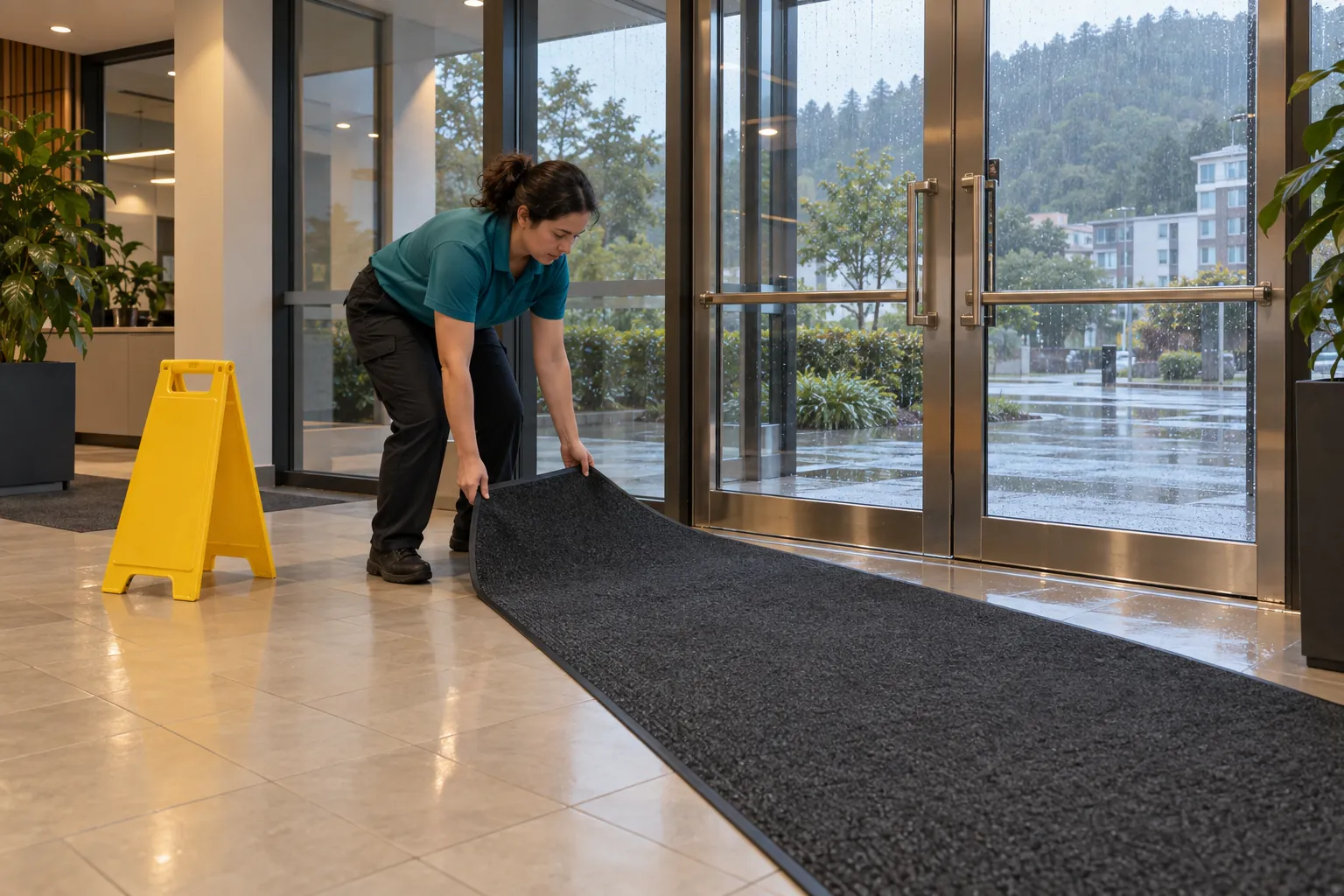
- Entrances and foyers in wet weather. Rain walked in on shoes, umbrellas dripping on a polished floor, a mat that is too short or saturated.
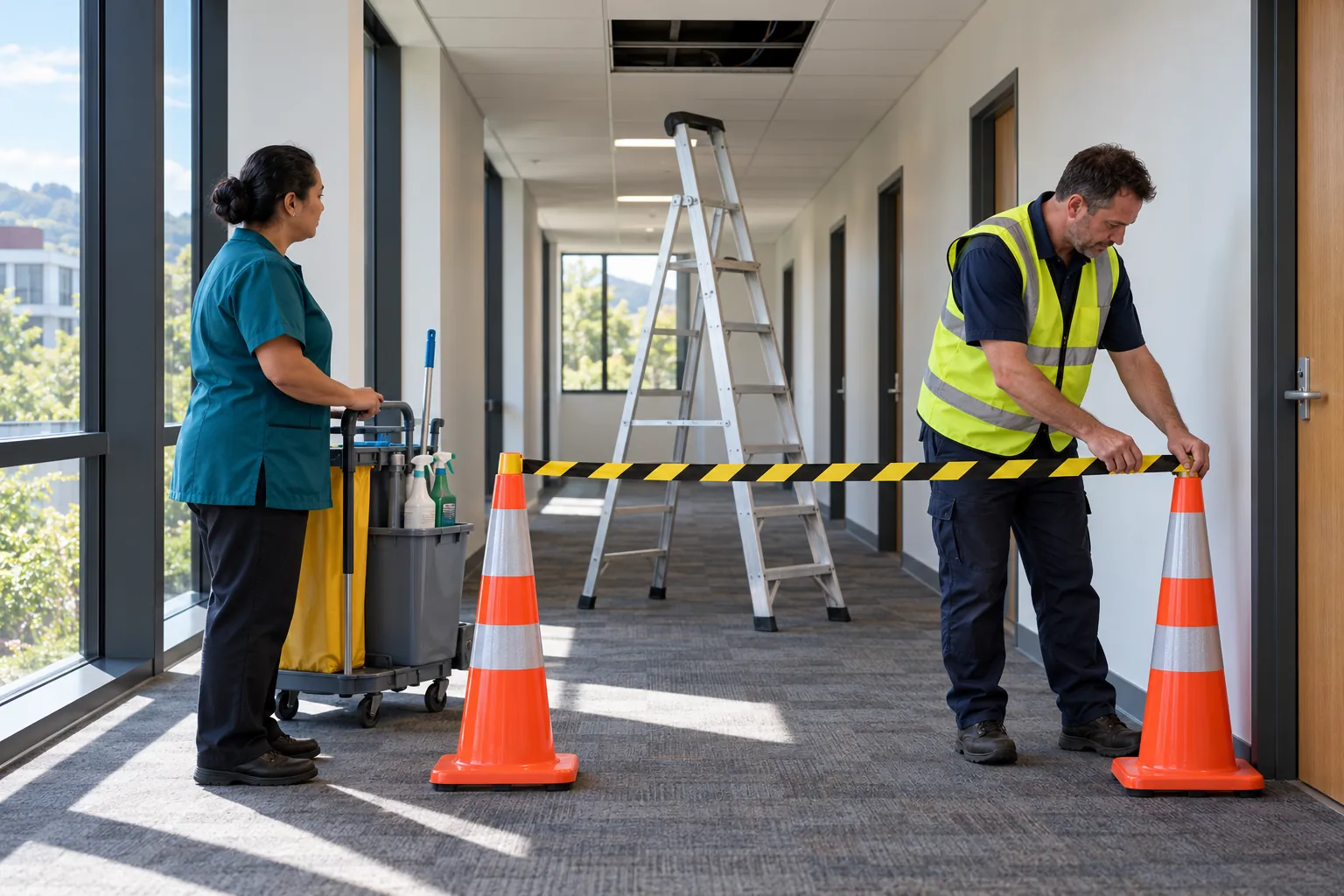
- Floors being cleaned. A corridor mopped in the middle of the day, a wet floor sign left in a cupboard, a scrubber-dryer that leaves a film at the edges.
- Bathrooms and kitchens. Water round basins and showers, food and drink spilt in a staffroom.
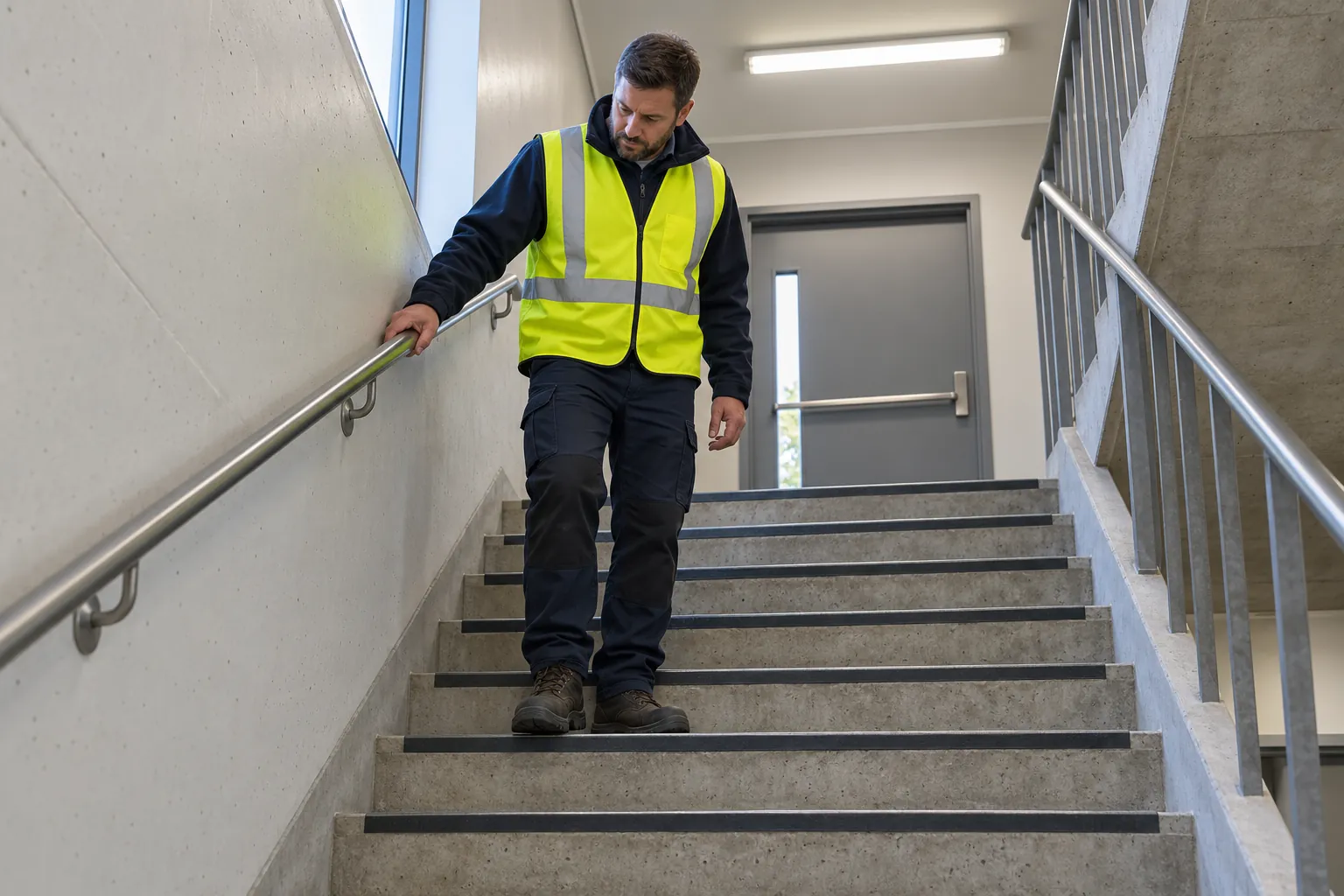
- Stairs and ramps. Worn or loose nosings, a blown light in a stairwell, a handrail that stops short, a step that is hard to see against the floor below it.
- Car parks, paths and loading areas. Leaves, moss and algae on concrete, frost on a shaded ramp in a Canterbury or Otago winter, potholes, kerbs and wheel stops, a dock edge.
- Plant rooms, stores and offices. Hoses, boxes, trailing cables and water on the floor, and a chair used to reach a high shelf.
- Anywhere at night. Security officers and after-hours cleaners walk the building dim and alone, and meet the leak first.
Most are not design faults but conditions that come and go through the day, which is why routine checks matter so much here.
03
The controls that work, in order
Regulation 6 sets the order: eliminate the risk if that is reasonably practicable; otherwise minimise it by substitution, isolation or engineering controls, then administrative controls, and personal protective equipment last. WorkSafe's page is blunt about the first step: "First you must always eliminate the risk where you're reasonably able to."
Eliminate the source. Fix the leaking roof or the dripping chiller rather than mopping under it every day. Re-route the cable, or use cordless equipment, rather than taping it down. Clear the storage out of the corridor, keep work and storage areas tidy, and plan deliveries to keep the materials on site to a minimum.
Choose and maintain the right surfaces. Slip resistance starts with the Building Code. Clause D1 (Access routes) requires that access routes "shall have adequate slip-resistant walking surfaces under all conditions of normal use". MBIE's guidance on slip resistant walking surfaces (February 2014) explains that, under Acceptable Solution D1/AS1, level access routes used by the public need a coefficient of friction of at least 0.4, measured by the method in AS/NZS 3661.1:1993, and that AS 4586-2013 offers further tests. The current D1/AS1, on MBIE's D1 Access routes page, is the place to check before a floor is replaced. A floor that passed when new can fail once worn or polished to a shine.
Engineer out the wet. Entrance matting long enough to take several steps on, canopies over doors, gutters and drains that work, anti-slip treads and contrasting nosings on stairs, handrails on both sides where people need them, and ramps where there is a change in level. WorkSafe suggests treating slippery surfaces with stone or grit and signposting them, and, where a ramp is not possible, using signs to warn of the change in level. It also asks for designated walkways that are signposted and well lit, and designated areas for waste, with bins, where everyone knows who is responsible for removing it.
Light it. Regulation 10 asks for lighting that lets people move safely; a blown lamp in a stairwell or car park is a hazard until it is replaced.
Set safe methods of work. This is where cleaning contracts earn their keep:
- clean spills straight away; WorkSafe's office guidance says "Clean any spills immediately and dry the floor and use signage";
- wet-clean busy areas outside peak times, or half a corridor at a time;
- put out wet floor signs before the floor is wet and take them away when it is dry, so people keep believing them;
- in wet weather, check and change entrance mats, and mop the entrance more often;
- give people stable steps, never chairs, to reach high shelves.
Stepladders. WorkSafe's guidance on safe working with ladders and stepladders says ladders are for "light tasks that are of short duration", should be industrial rated ("minimum 120kg") to AS/NZS 1892, checked before use, and climbed with three points of contact, and warns: "Avoid standing on the top two steps of the stepladder."
Footwear last. Shoes with good grip help, and WorkSafe lists them, but they are not a control on their own for a floor that is routinely wet.
04
Who does what in a shared building
In most buildings several PCBUs share the risk. WorkSafe's property management FAQs say that a commercial property owner or landlord is a PCBU, that a property manager takes on "responsibility for the management and control of the property", that commercial tenants are PCBUs too, and that "Under HSWA, a Body Corporate is considered to be a PCBU", with duties that "apply to matters over which the Body Corporate has influence and control", including work on the common areas of the property. Where duties overlap, the Act expects them "to consult, co-operate and co-ordinate activities" (section 34).
A workable split for slips and trips usually looks like this:
- The owner, property manager or body corporate controls the common areas: entrances, lobbies, stairs, lifts, car parks and outdoor paths. They decide on flooring, matting, lighting and repairs.
- Each tenant controls its own floor or unit: its layout, cables, storage and kitchens, and its own staff's reporting.
- The cleaning contractor controls how floors are cleaned and when, the signs, the chemicals and its operatives' footwear and training.
- The security company walks the building out of hours and should report hazards it finds on patrol, not step round them.
- Workers must take reasonable care and follow reasonable instructions (section 45), which includes using the handrail and reporting a spill they cannot clean themselves. Other persons at the workplace, such as visitors, have a similar duty of reasonable care (section 46).
The gaps are where people get hurt. The cleaner mops the lobby at 10am because the contract says "daily" and nobody said when. A loose stair nosing is mentioned to reception and never reaches the property manager. Agreeing who checks what, and who a fault goes to, is the co-ordination section 34 asks for. Our guide to overlapping duties covers the agreement in more detail, and slips and trips belong in each PCBU's hazard register.
05
Routine checks, reporting and learning from what happens
Because slip and trip hazards come and go, controls only stay effective if someone keeps looking. Regulation 7 asks for controls to be maintained so that they remain effective, and that is mostly done by routine checks. A reasonable programme for a multi-tenant building might include:
- Entrances: checked at opening and through the day in wet weather, mats changed when saturated, floor dried, signs out.
- Bathrooms and kitchens: checked on a set round, with floors dried and spills cleaned, alongside the cleaning and restocking.
- Stairwells: lighting, handrails, nosings and anything left on the stairs, weekly or on each patrol.
- Car parks and paths: leaves, moss, frost and potholes, more often in winter.
- Lock-up patrols: a look for leaks and spills on each floor after hours.
An entrance that is wet every rainy morning needs checking every rainy morning.
Reporting. Everyone needs a simple way to report a hazard to someone who can fix it. WorkSafe's guidance asks PCBUs to make sure workers "know how to make suggestions, ask questions, or raise concerns". It calls workers, contractors and temps "the eyes and ears of your business", who can help spot issues and suggest practical, cost-effective solutions. A slip that hurts nobody is a near miss worth recording.
When someone is hurt. Most slips cause bruises, sprains and embarrassment, and are recorded in the PCBU's own incident records. Serious injuries can be notifiable events. WorkSafe's page on what events need to be notified says: "All injuries or illnesses that require (or would usually require) a person to be admitted to hospital for immediate treatment are notifiable", and lists "A serious head injury that requires immediate treatment (other than first aid)", including a fractured skull or loss of consciousness. The site must be left undisturbed, apart from helping the injured person or making it safe, and records of notifiable events kept "for at least five years from the date the regulator was notified." See our guide to notifiable events.
Review. Regulation 8 requires controls to be reviewed in set circumstances, including when a control does not work, when a change creates a new risk, when a new hazard is found, when worker engagement shows a review is needed, or when a health and safety representative asks. After a slip, ask whether the control was in place that day, whether the check was done and whether the hazard had been reported before.
06
Where the record fails, and what SiteClara does about it
Most slip and trip controls are routine: the entrance mat changed on a wet morning, the washroom floor dried on the round, the stairwell light reported when it failed, the car park walked at lock-up. The record of them is often a sheet on the back of a door, signed for the whole day in one go, or nothing at all. After someone falls, the question is not whether the risk assessment mentioned wet floors, but whether the entrance was checked that morning, by whom and when, and whether the leak reported last week reached anyone who could fix it.
SiteClara records those checks at the location. A printed QR poster, with an optional NFC tag behind it, sits where a check is scheduled, such as an entrance, a washroom, a stairwell or a car park level. Staff scan or tap with their own phone, with no app to install, see the checks due there, and mark each one done or say what stopped them. The time and the named person are recorded as it happens, with a photo when one is asked for, and a hazard someone reports goes onto the team's list of open jobs until it is closed.
A supervisor sees what is due, done and missed, records the reason when a check was missed, and each day reviews and approves a short report for nominated managers or the client, sent the next morning. When controls are reviewed after a slip, that shows how the routine checks actually went.
07
Questions people ask
What is the difference between a slip, a trip and a fall?
A slip is a loss of grip underfoot, as on a floor wet from a spill, the weather or cleaning; a trip is a foot caught on something, such as the loose carpet, mats, trailing cables, boxes or bags WorkSafe lists on its slips, trips and falls page; and a fall can follow either. WorkSafe's page on working at height in New Zealand keeps falls on the level apart from falls from height: "Working at height does not include slipping, tripping, or falling at the same level." A fall from a ladder, a roof or an unprotected edge is managed as work at height, whatever the height.
What are the main causes of slips, trips and falls at work?
WorkSafe's slips, trips and falls page lists eight: unmarked changes in floor levels; floors wet from spills, the weather or cleaning; poor housekeeping and obstructed views, with loose carpet, mats, trailing cables, boxes or bags; damaged flooring, including stairs; not using stair handrails; cramped conditions and poor work flow; standing on unstable furniture; and poor lighting. It sums them up: "Ground clutter, uneven or slippery floor surfaces, poor lighting or lack of signage all contribute to thousands of workers getting injured every year."
What control measures prevent slips, trips and falls?
Those highest in the hierarchy set by regulation 6 of the General Risk and Workplace Management Regulations, which WorkSafe explains in General risk and workplace management – part 2. Eliminate the risk if you reasonably can, for example by fixing the leak that wets the floor. Otherwise minimise it by substitution, isolation or engineering controls, such as slip-resistant flooring, entrance matting and better lighting, then administrative controls, such as cleaning outside busy times and using wet floor signs, with personal protective equipment, such as footwear with good grip, last.
08
Further reading, and a list to take away
WorkSafe's slips, trips and falls page is the short official summary, and its guidance for office workers applies it to an office. The regulations are explained in General risk and workplace management – part 1 (workplace facilities) and part 2 (the risk management process). For floor surfaces, start with MBIE's D1 Access routes page. Our guide to PCBU duties explains who holds which duty in a building.
Before you sign off the slip and trip controls for a building, check that:
- slips, trips and falls are in the hazard register of each PCBU in the building, with the controls named;
- each common area and tenancy has a named PCBU responsible for its floors, lighting and repairs;
- entrances have matting that copes with wet weather, and someone checks it when it rains;
- the cleaning specification says when wet cleaning happens, how a dry route is kept and how signs are used;
- stairs have working lighting, sound nosings and handrails, and are checked on a set round;
- cleaners, security officers and caretakers know how to report a hazard and hear when it is fixed;
- incidents and near misses are recorded, and anyone admitted to hospital is notified to WorkSafe;
- there is a record showing that the routine checks were actually done, by whom and when.
Sources
Every document this guide quotes or links to, in the order it first cites them.
- Slips, trips and falls worksafe.govt.nz
- Health and Safety at Work Act 2015 legislation.govt.nz
- Introduction to the Health and Safety at Work Act 2015 special guide worksafe.govt.nz
- General risk and workplace management – part 1 worksafe.govt.nz
- General risk and workplace management – part 2 worksafe.govt.nz
- Working at height in New Zealand worksafe.govt.nz
- Office workers worksafe.govt.nz
- Slip resistant walking surfaces building.govt.nz
- D1 Access routes building.govt.nz
- Safe working with ladders and stepladders worksafe.govt.nz
- Property management FAQs worksafe.govt.nz
- What events need to be notified worksafe.govt.nz
Related guides
 Premises and facilities managementHazard register: what HSWA expects, and how to keep one that is usedWhat a hazard register is under New Zealand's HSWA, what goes in it, how to assess and control risks, when to review it, and what changes on 1 April 2027.
 Premises and facilities managementNear miss reporting: learning from the harm that nearly happenedWhat a near miss is under New Zealand's HSWA, when one must be notified to WorkSafe, what a good near miss report records, and how to get near misses reported.
 Premises and facilities managementNotifiable events: what WorkSafe must be told, and what to do in the first hourWhat a notifiable event is under HSWA 2015, what to do when one happens in a building, who tells WorkSafe when PCBUs overlap, and the records to keep.
 Premises and facilities managementOverlapping duties: sharing health and safety when several PCBUs work in one buildingOverlapping duties under HSWA 2015: when PCBUs share a building or a contracting chain, how to consult, co-operate and co-ordinate, and how to show it works.