Premises and facilities management
First aid kit checklist: what the HSA recommends, and how to keep the box ready
A workplace first aid kit in Ireland should contain, at the minimum the Health and Safety Authority recommends for 1 to 10 people, 20 sterile plasters, 2 sterile eye pads, 2 triangular bandages, 6 sterile wound dressings in three sizes, 10 disinfectant wipes, paramedic shears, 5 pairs of disposable gloves, sterile water where there is no clear running water, two burns dressings, a crepe bandage, a foil blanket, 2 vomit bags, a hazardous waste bag, a CPR mouth shield and a pen torch.
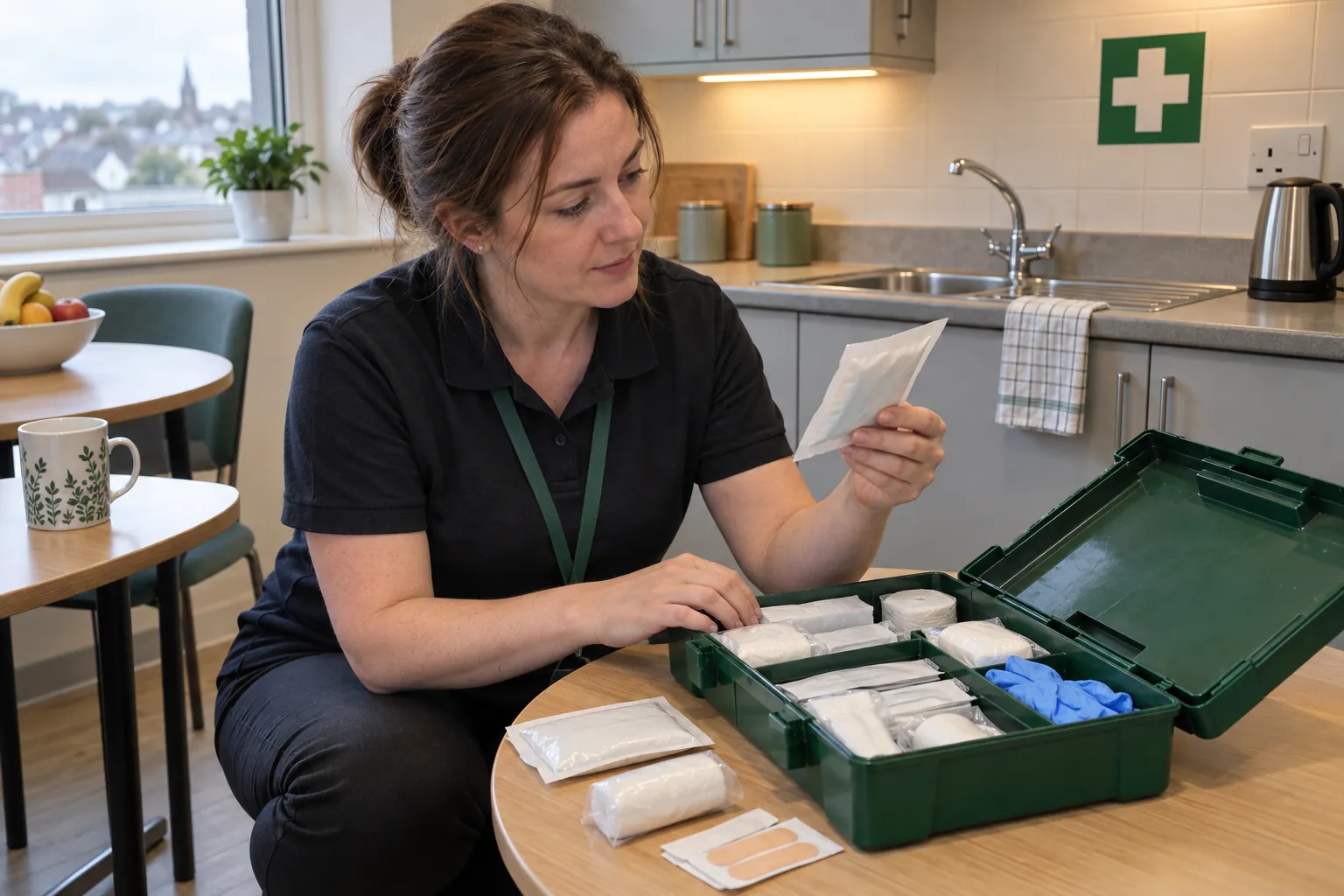
Every employer must provide first-aid equipment that is adequate for the work done wherever working conditions require it, and the HSA says every workplace should have at least one first-aid box or kit, with quantities that rise with the number of people employed and the hazards of the work. Stocking the box is the easy part; the harder part is knowing, on any given morning, that it is still full, in date and where people expect it. This guide covers the legal duty, the HSA's recommended contents, how often to check, who is responsible and what a good record looks like.
01
The duty: Chapter 2 of Part 7 of the General Application Regulations
Workplace first aid in Ireland is governed by Chapter 2 of Part 7 of the Safety, Health and Welfare at Work (General Application) Regulations 2007 (S.I. No. 299 of 2007). Regulation 164 says the Chapter applies to every place of work. Regulation 165(1)(a) then requires every employer to "provide and maintain suitably marked and easily accessible first-aid equipment, as is adequate and appropriate in the circumstances for enabling first-aid to be given to persons at every place where working conditions require it, at a place of work under the employer's control". The quotations from the Regulations in this guide are from the Regulations as made, on the Irish Statute Book.
Maintain means the box is kept stocked and usable, not bought once; suitably marked and easily accessible means people can find and reach it in a hurry. The same regulation requires the employer to designate as many occupational first-aiders as are needed, to make sure their number, training and equipment are adequate for the size and hazards of the place, and, under regulation 165(1)(d), to include the arrangements for first aid in the safety statement, "including the names of occupational first-aiders and the location of first-aid rooms equipment and facilities", and to display the names, addresses and telephone numbers of the local emergency services at each place of work.
Regulation 163 defines first aid in two parts: treatment to preserve life or limit the consequences of injury or illness until a doctor or registered general nurse takes over, and treatment of a minor injury that needs neither. The box has to serve both: the plaster for a cut finger in the canteen, and the large dressing and gloves for someone bleeding severely after a fall on the stairs while the ambulance is on its way.
The regulation sits under section 11 of the Safety, Health and Welfare at Work Act 2005, which requires every employer's emergency plans to "provide the necessary measures to be taken appropriate to the place of work for first aid", among other things. Neither lists what goes in the box. That is left to the employer's risk assessment, with the Health and Safety Authority's guidance as the benchmark.
02
The HSA's recommended first aid kit contents
The Health and Safety Authority's Guidelines on First-Aid at Places of Work are the reference for the contents of a workplace first-aid box in Ireland. They say that "as a minimum every workplace should have an occupational first-aid box or kit", and Table 1 gives the recommended contents by the number of people employed. The quantities below are, in order, for a travel kit, and for a box for 1 to 10, 11 to 25 and 26 to 50 persons:
- Individually wrapped sterile plasters of assorted sizes: 20, 20, 20, 40.
- Sterile eye pads (No. 16) with bandage attached: 2, 2, 2, 4.
- Individually wrapped triangular bandages: 2, 2, 6, 6.
- Sterile unmedicated wound dressings, medium (No. 8, 10 x 8 cm), individually wrapped: 1, 2, 2, 4.
- Sterile unmedicated wound dressings, large (No. 9, 13 x 9 cm): 1, 2, 6, 8.
- Sterile unmedicated wound dressings, extra large (No. 3, 28 x 17.5 cm): 1, 2, 3, 4.
- Individually wrapped disinfectant wipes: 10, 10, 20, 40.
- Paramedic shears: 1 in each.
- Disposable examination gloves, pairs, latex-free where possible: 3, 5, 10, 10.
- Sterile water, where there is no clear running water: 2 x 20 ml, 1 x 500 ml, 2 x 500 ml, 2 x 500 ml.
- Water-based burns dressings, one small (10 x 10 cm) and one large: 1 of each in each.
- Crepe bandage (7 cm): 1, 1, 2, 3.
- Foil blanket, hazardous waste bag, mouth shield for CPR (a pocket mask or flat face shield) and pen torch: 1 of each in each.
- Vomit bags: 2 in each.
The quantities are minimums; where they are insufficient, a risk assessment sets the amount. Where more than 50 people are employed, provision should be made pro rata. Where mains tap water is not readily available for washing out an eye, sterile water or sterile normal saline (0.9%) should be provided in sealed disposable containers of at least 20 ml, CE marked, each discarded once its seal is broken; eye baths, eye cups and refillable containers should not be used because of the risk of cross-infection. A standard blanket should accompany the kit where possible.
The HSA's First Aid FAQ Responses page carries an older version of the table, with safety pins and without the foil blanket, bags or pen torch; this guide follows the current Guidelines. The FAQ adds that the sterile water and burns dressings are needed only where there is no wholesome tap water.
03
How many boxes, and where to put them
Table 1 describes one box. Most buildings need more than one. The Guidelines ask employers to consider the size and complexity of the workplace "to ensure reasonable numbers of first-aid kits are dispersed appropriately", and set out where they should go:
- In a compact workplace, at a point convenient to most of the workforce, or where an injury is most likely.
- In a large or divided workplace, a main facility with supplementary materials in each self-contained area or part of the site.
- Near a specific hazard, such as a chemical store, the special antidotes or equipment for that hazard, with at least one kit of the travel-kit type, as close as possible to where the hazard is.
- Where lighting may be poor, a high-visibility vest and a pocket torch kept near the box.
- In every case, soap, water and disposable drying materials for first aid, or individually wrapped moist cleansing wipes where there is no water, and equipment that is "easily accessed and not restricted by any other equipment".
The box itself should be made of a suitable material designed to protect the contents from heat, damp and dust, and be clearly identified as a first-aid container; the Guidelines give the usual marking, a white cross on a green background, as the example. Schedule 9 of the same Regulations gives first-aid signs a white pictogram on green; one above the box helps people find it from down a corridor.
Think about everyone who may need it. The Guidelines say account must be taken of non-employees on the premises, such as pupils in schools and customers in shops, so a secondary school or a nursing home will usually want more boxes than an office of the same headcount.
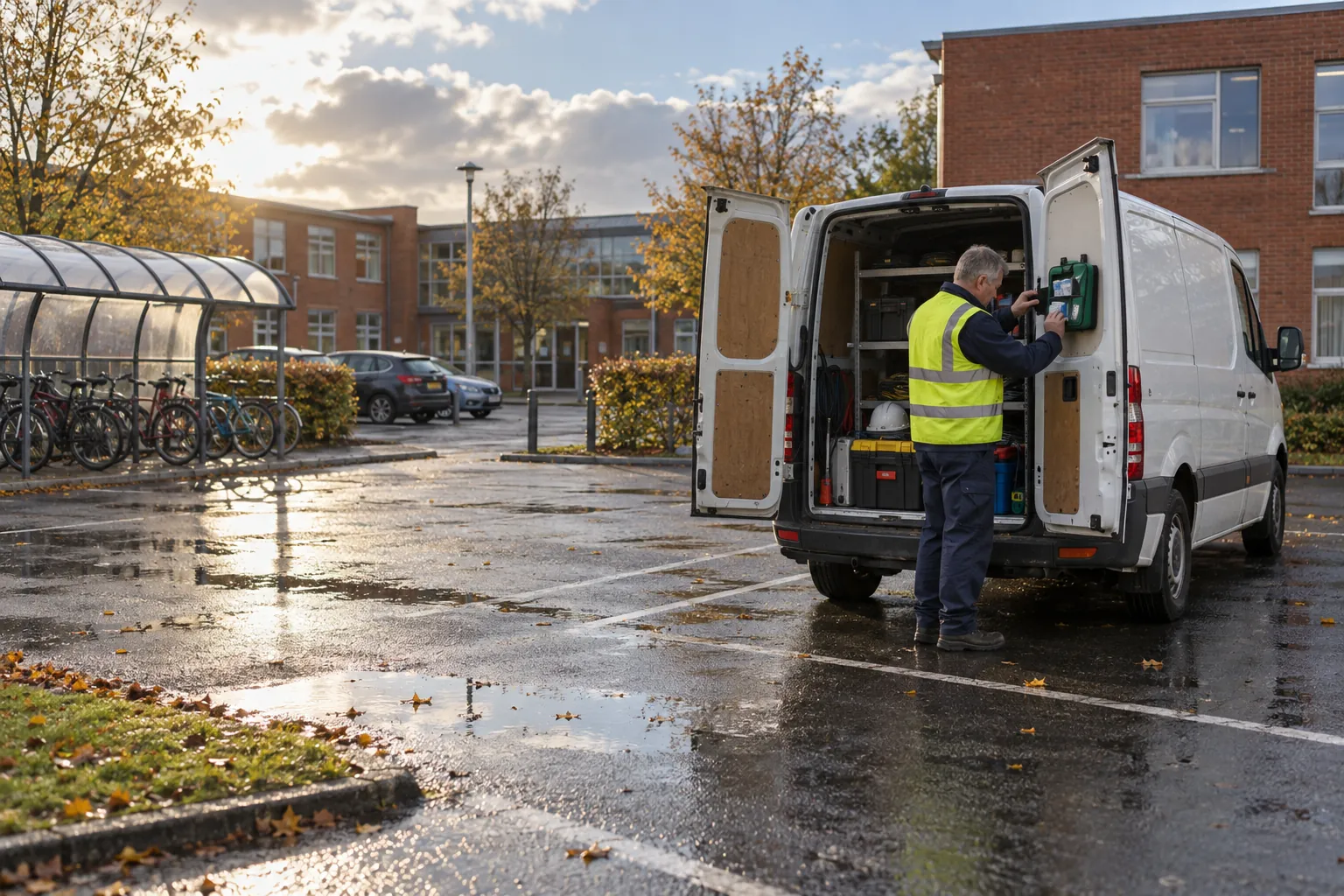
Where employees regularly work away from the premises with dangerous tools or substances, or in isolated locations, the Guidelines recommend the travel kit in the first column of Table 1; they do not expect every employee who travels to carry one otherwise. A maintenance van covering several sites is the common case.
04
Checking and restocking: how often, and by whom
The Guidelines say that first-aid equipment "must be checked regularly to the contents, condition and expiry dates where available", and that "it is therefore essential that first-aid equipment be checked frequently, to make sure that there are sufficient quantities and that all items are usable". They fix no interval: a kitchen or workshop box opened most days needs a weekly look, a quiet corridor box perhaps monthly, with a restock after every use.
Responsibility is set out plainly. Where there are trained occupational first-aiders, the boxes, kits and other equipment, including the AED, should be kept under their control. Where there is no requirement for an occupational first-aider, the boxes and kits should be "the responsibility of a named role in the Safety Statement". Either way, the contents "should be replenished as soon as possible after use to ensure that there is always an adequate supply of all materials".
A good check covers more than counting plasters. For each box, the person checking should confirm:
- It is where the safety statement says it is, clearly marked, and not blocked by stock, chairs or a cleaning trolley.
- The contents match the list for that box, with nothing missing and nothing added, such as tablets or someone's own supplies.
- Nothing is past its expiry date. Many sterile items carry a date; replace expired items and dispose of them safely. If a sterile item has no date, the Guidelines advise checking with the manufacturer how long it can be kept; for non-sterile items without dates, check they are still fit for purpose.
- Packaging is intact: a torn wrapper means a dressing is no longer sterile, and a broken seal means sterile water must be thrown away.
- The box itself is sound, clean, dry and closes properly.
- The notices are current: the local emergency services' names, addresses and telephone numbers on display, and, where there is a first-aid room, the first-aiders' names on its door and the site address and Eircode inside it.
- Anything used since the last check has been replaced, and anything short has been reordered.
Check the kit's neighbours on the same round. The Guidelines ask for a regular checklist programme for any AED (indicator showing ready, pads present and in date, battery charged), and for emergency eye washes and showers, where provided, to be kept clean, inspected and tested frequently.
05
The records that sit beside the box
Three kinds of record go with first-aid provision, and it helps to keep them apart. The first is the safety statement, which under regulation 165(1)(d) must name the occupational first-aiders and say where the first-aid rooms, equipment and facilities are. When a box moves or a first-aider leaves, the statement is out of date.
The second is the first-aid treatment record. The Guidelines say that every case treated by an occupational first-aider should be entered in a first-aid treatment record book, kept securely and confidentially in line with the General Data Protection Regulation, and shown to an HSA inspector on request. Their example records the person's name, the injury or illness, the treatment, whether they returned to work or were referred on, the first-aider's name, and the date and time.
The third is the training record: the dates on which occupational first-aiders obtained their certificates, kept at each workplace for an inspector. The recognised standard is the Pre-Hospital Emergency Care Council (PHECC) First Aid Response (FAR) course, which replaced Occupational First Aid Level 5, and certification lasts two years. For what it calls other workplaces, such as offices and shops, the HSA's indicative table suggests one first-aider for 100 to 399 people present at one time, and one below 100 if the risk assessment shows it is necessary.
Alongside those three, a box check record is the simplest way to show the equipment is being maintained, which regulation 165(1)(a) requires; neither the Regulations nor the Guidelines prescribe its form.
06
Where the record fails, and what SiteClara does about it
First-aid boxes fail quietly. The sheet taped inside the lid has a column of ticks in the same pen. The box was restocked after the last cut hand, except the large dressing, because there were none in the press. The caretaker who looked after it retired and the job never moved to anyone. The evening cleaners assume the client refills the kitchen box; the client assumes the contractor does. The gap shows when the box is opened in a hurry.
SiteClara records the routine check at the box itself. A printed QR poster, with an NFC tag behind it if staff should tap, sits beside each first-aid point: the reception box, the kitchen, the workshop, the maintenance van. The person checking scans or taps with their own phone, with no app to install, and sees the check due there. They mark it done, or say what stopped them, with a photo of the open box when one is asked for, and the time and the named person are recorded as it happens. Something missing or expired is reported on the spot and stays on the team's list of jobs until someone closes it.
The supervisor sees which boxes are due, done and missed, and records why a check was missed. Each day they review the checks and photos and approve a report that goes to nominated management or client contacts the next morning, showing what was completed and what is still open.
07
Questions people ask
What does a full first aid kit contain?
In an Irish workplace, what Table 1 of the HSA's Guidelines on First-Aid at Places of Work recommends for the number of people it serves; the Guidelines call the table "a general guide" and say its quantities "are minimum numbers and can be increased". A box for 11 to 25 people holds 20 plasters, 2 eye pads, 6 triangular bandages, 11 sterile unmedicated wound dressings in three sizes, 20 disinfectant wipes, paramedic shears, 10 pairs of gloves, two burns dressings, 2 crepe bandages, a foil blanket, a CPR mouth shield, a pen torch, 2 vomit bags and a hazardous waste bag, with 2 x 500 ml of sterile water where there is no clear running water.
What are the 18 contents of a first aid kit?
Table 1 of the HSA's Guidelines on First-Aid at Places of Work has 18 lines: sterile plasters, sterile eye pads, triangular bandages, medium, large and extra large sterile wound dressings, disinfectant wipes, paramedic shears, disposable examination gloves, sterile water, small and large water-based burns dressings, a crepe bandage, a foil blanket, vomit bags, a hazardous waste bag, a mouth shield for CPR and a pen torch. Medicines are not among them: the Guidelines say "Drugs or medications should not be stored in occupational first-aid boxes or kits".
What does a first aid kit checklist for 2026 include?
No Irish rule prescribes a form, but section 1.2 of the HSA's Guidelines on First-Aid at Places of Work says the equipment "must be checked regularly to the contents, condition and expiry dates where available", and that expired items should be replaced and disposed of safely. A checklist that follows it records, for each box, that the contents match Table 1, that nothing is expired or damaged, that it has been restocked since it was last used, and who checked it and when.
08
Further reading, and a first aid kit checklist to take away
The law is Chapter 2 of Part 7, regulations 163 to 166, of the Safety, Health and Welfare at Work (General Application) Regulations 2007, read with section 11 of the Safety, Health and Welfare at Work Act 2005. The HSA's Guidelines on First-Aid at Places of Work set out the recommended contents, the number of first-aiders, first-aid rooms, AEDs and records in full, and the HSA's First Aid FAQ Responses answer the common questions, from certificates to painkillers.
For each first-aid box in your building, check that:
- its location is in the safety statement, and it is clearly marked with a white cross on green and easy to reach;
- its contents match the HSA's Table 1 for the headcount it serves, scaled up where more than 50 people rely on it or the risk assessment says so;
- nothing is out of date, opened or damaged, and there are no medicines or unrelated items in it;
- a named person or role is responsible for it, and it is restocked as soon as possible after every use;
- the local emergency services' names, addresses and telephone numbers are clearly displayed, and the first-aiders' names in the safety statement (and on any first-aid room door) are current;
- each check is recorded as it is done, by whom and when, with anything missing reported and followed up.
Sources
Every document this guide quotes or links to, in the order it first cites them.
- Safety, Health and Welfare at Work (General Application) Regulations 2007 (S.I. No. 299 of 2007) irishstatutebook.ie
- Section 11 of the Safety, Health and Welfare at Work Act 2005 irishstatutebook.ie
- Guidelines on First-Aid at Places of Work hsa.ie
- First Aid FAQ Responses hsa.ie
- Guidelines on First-Aid at Places of Work hsa.ie
Related guides
 Premises and facilities managementSafety statement: what the 2005 Act requires, and how to show it is followedWhat a safety statement must contain under section 20 of the Safety, Health and Welfare at Work Act 2005, who needs one, when to review it and how to show it works.
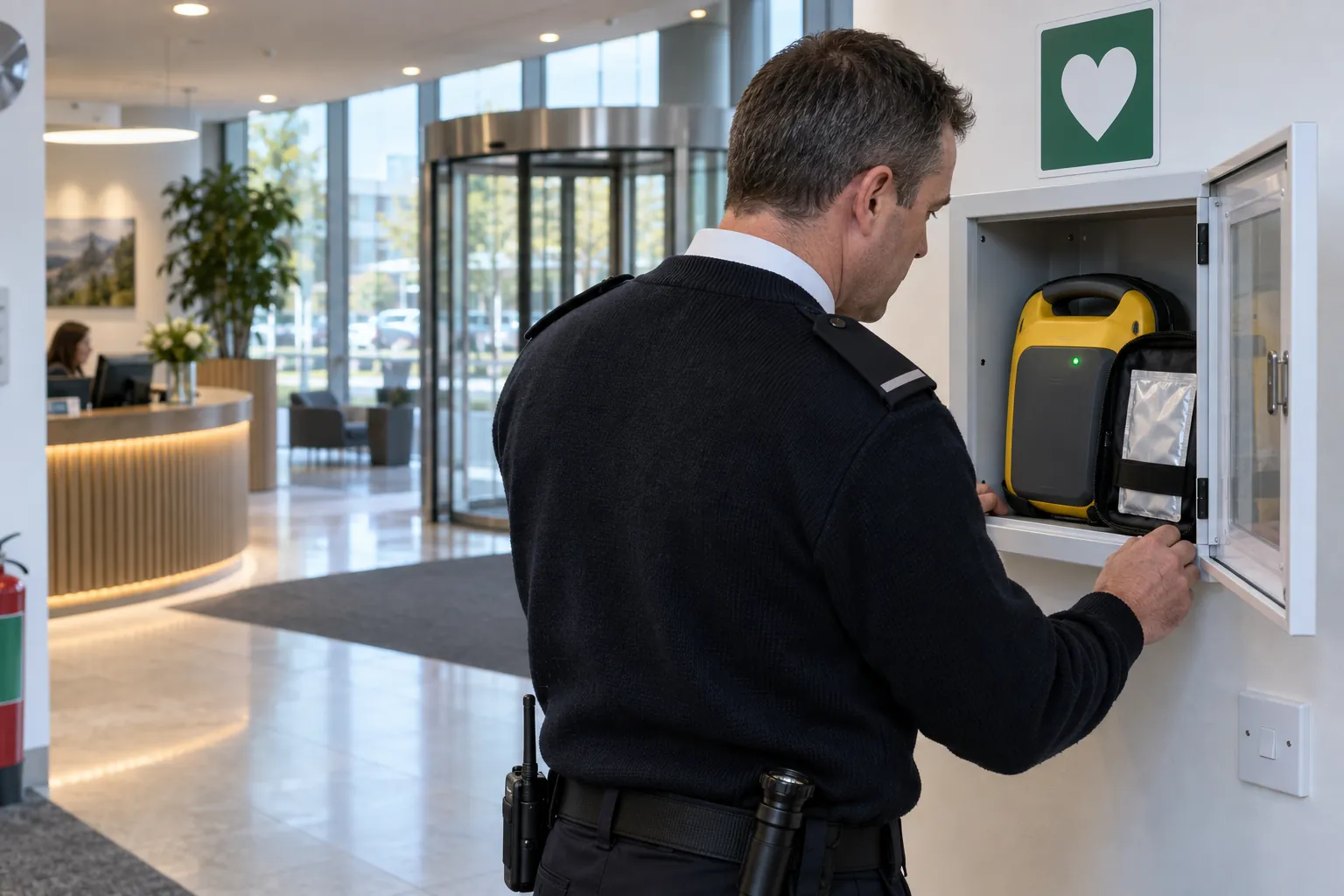 Premises and facilities managementAED checks: keeping a workplace defibrillator ready, and proving itHow to check a workplace AED in Ireland: what the HSA and HPRA ask for, the indicator, pads and battery, who checks, how often, and what a good record shows.
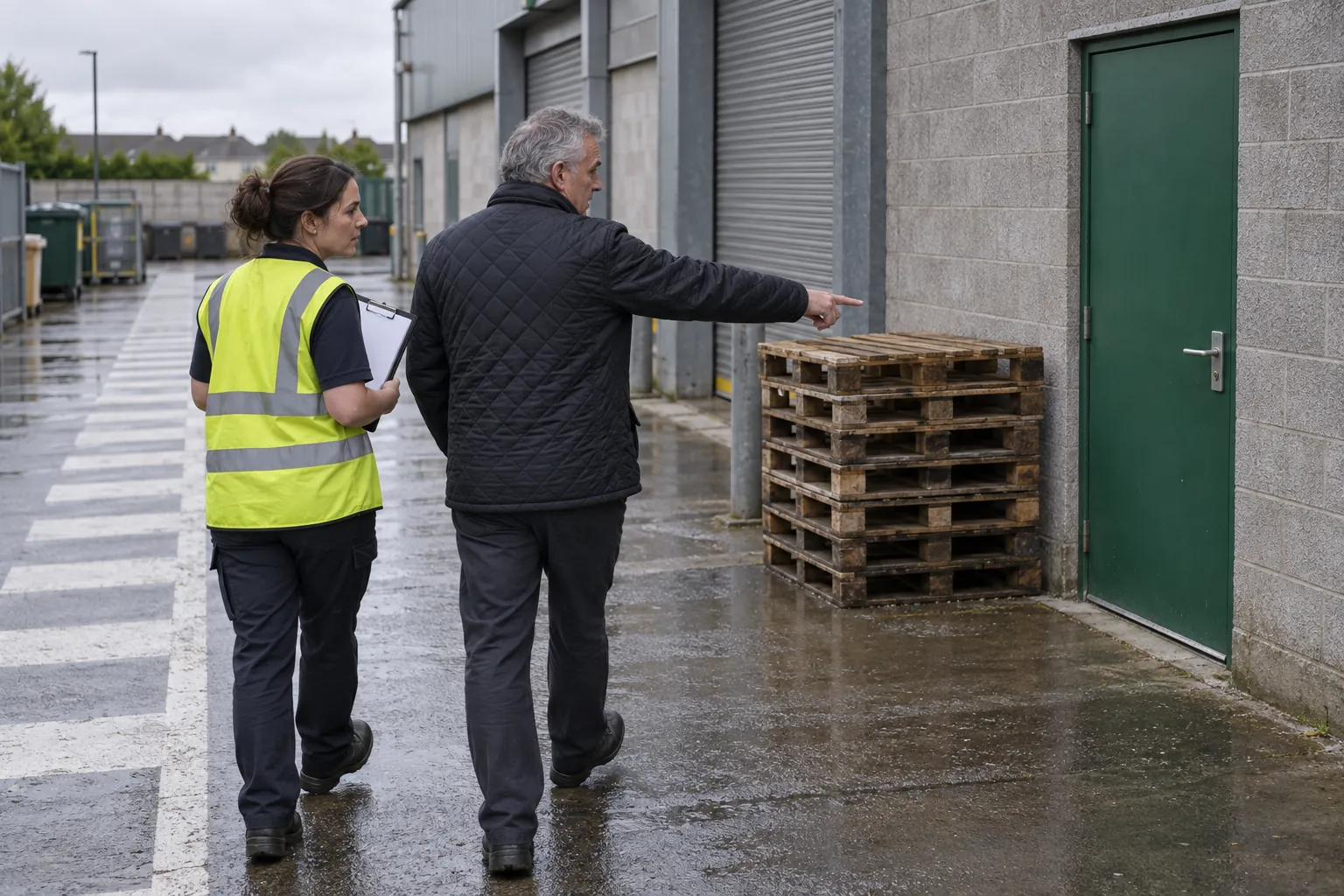 Premises and facilities managementHealth and safety inspection checklist: what to walk, what to record, and what the HSA looks forA workplace health and safety inspection in Ireland: the 2005 Act and 2007 Regulations, what to walk, how often, recording actions, and what an HSA inspector asks.
 Premises and facilities managementCaretaker duties in Ireland: what the job involves, and how to show it was doneCaretaker duties in Irish schools, parish halls, offices and apartment developments: the law behind the job, the daily and weekly checks, lone working and records.