Cleaning
Hotel housekeeping checklist: rooms, public areas and the duties behind them
A hotel housekeeping checklist is the list of tasks a hotel's housekeeping team works through, room by room and area by area, so that every departure, stayover and public area is cleaned, restocked and checked to the same standard before a guest sees it.
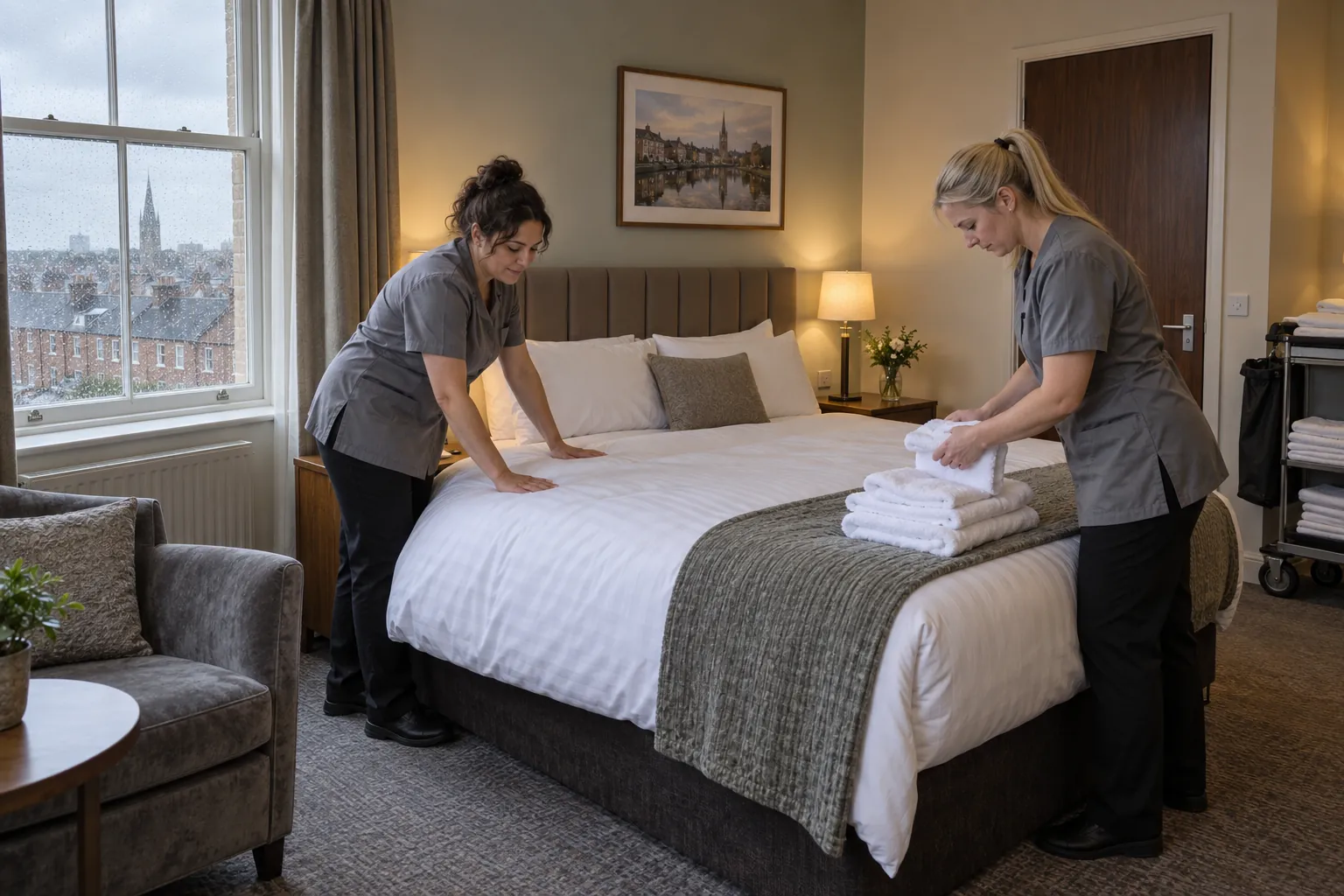
A hotel is cleaned against the clock. Departures have to be turned round before check-in, stayovers serviced around guests who are still in the room, and the lobby, corridors and public toilets kept right all day. This guide sets out a hotel housekeeping checklist for a hotel in Ireland: the registration standards and the health and safety law behind it, what to check in a departure, a stayover and at turn-down, who does what from room attendant to head housekeeper, how to keep the team safe from lifting, chemicals and sharps, and why a vacant room's shower is housekeeping's business too.
01
The duty behind a hotel housekeeping checklist
No Irish law prescribes a hotel housekeeping checklist. What a hotel has is three sets of obligations that the checklist puts into practice: its registration standards, health and safety law, and the fire safety duty.
Registration. Fáilte Ireland's page on statutory accommodation requirements says that under the Tourist Traffic Acts "any tourism business calling itself a hotel must be registered with Fáilte Ireland". The Registration and Renewal of Registration Regulations for Hotels 2016 require the premises, "including the exterior and interior, outdoor areas, grounds and car parking areas", to be "kept clean and well maintained throughout" (paragraph 4.3), toilets to be "properly supervised and kept in a clean and hygienic condition" (paragraph 6.2), and each ensuite to have "an ample supply of toilet requisites" (paragraph 7.8). A hotel that wants a star classification must also meet the criteria for that level in Fáilte Ireland's Hotel Classification Scheme matrix (updated June 2019).
Health and safety. Under section 8 of the Safety, Health and Welfare at Work Act 2005 every employer must ensure, so far as is reasonably practicable, the safety, health and welfare at work of their employees, including safe systems of work and "the information, instruction, training and supervision necessary". Guests are covered by section 12: the employer must run the undertaking so that people at the place of work who are not employees "are not exposed to risks to their safety, health or welfare".
The Safety, Health and Welfare at Work (General Application) Regulations 2007 (S.I. No. 299 of 2007) add the detail. Regulation 18 requires every place of work to be "kept in a clean state", with dirt, refuse and waste removed "by a suitable method as frequently as necessary to maintain an appropriate level of safety and health". Regulation 9 requires floors that are, so far as is reasonably practicable, "not slippery". Chapter 4 of Part 2 deals with manual handling, and the Health and Safety Authority (HSA) warns that in room servicing "lifting furniture, bending and stretching when cleaning can lead to accidents and cause injury". The Safety, Health and Welfare at Work (Chemical Agents) Regulations 2001 require a risk assessment of the cleaning chemicals that "shall be recorded in writing".
Fire. Section 18 of the Fire Services Act 1981 applies to premises used for sleeping accommodation, and section 18(2) makes it the duty of every person having control over them "to take all reasonable measures to guard against the outbreak of fire" and to ensure as far as is reasonably practicable the safety of the people on the premises if one breaks out. Housekeeping staff are in every bedroom and corridor daily, which makes them well placed to spot fire risks.
None of these sets a cleaning frequency or a form. The hotel decides what good looks like, records the risks in its safety statement, and the checklist carries that out room by room.
02
What a hotel housekeeping checklist covers
A single list for the whole hotel does not work, because each part of the building has its own standard, its own timing and its own people. Divide the checklist into these areas:
- Departure rooms: the full clean after a guest checks out, finished and inspected before the room is released to reception as ready to let.
- Stayover rooms: the daily service of an occupied room, fitted around the guest's "Do Not Disturb" and "Please Make Up Room" requests.
- Turn-down or evening refresh, where the hotel offers it.
- Vacant rooms: rooms left empty for days, which need their taps and showers run as well as a dust.
- Corridors, lifts and stairs: carpets, skirtings, lift cars, handrails and the fire doors along the way.
- Public areas: the entrance, lobby, reception, lounges, function rooms and the public toilets, which guests and non-residents judge the hotel by.
- Back of house: linen rooms, housekeeping stores, the laundry if the hotel has one, staff changing rooms and the canteen.
- Leisure areas, usually on their own list; see the gym cleaning checklist.
- Reporting: maintenance defects, fire risks, lost property and anything found in a room that needs a manager.
The registration regulations show what a guest room must contain. Paragraph 7.5 lists the furniture, fittings and equipment each bedroom must have "of good standard, quality and in good condition", among them an adequate supply of linen, from sheets and duvets to "mattress and pillow protectors and towels", and printed advice on summoning assistance at night, which "must be in all bedrooms together with fire instructions notices". The classification matrix requires every classified hotel from two stars up to provide a means of communicating "Do Not Disturb" and "Please Make Up Room", and a five-star hotel to offer an accommodation service until 22.00 hours "with 'room refresh/turn-down service' available on request". A checklist written from the regulations and the matrix makes sure the room attendant checks what the inspector will check.
03
The room checklist: departure, stayover and turn-down
Write the room checklist in the order the room is cleaned, so the room attendant never has to go back. A common order is: air the room, strip, clear, clean top to bottom, make up, then check.
Departure room
- Knock, announce, and park the trolley across the open door without blocking the corridor; switch on every light and note any bulb out.
- Strip the bed and check the mattress protector, pillows and duvet for stains and damage; bag the linen straight onto the trolley.
- Remove rubbish, cups and glasses; check drawers, wardrobe, safe and under the bed for lost property.
- Clean and disinfect the bathroom: toilet, basin, bath or shower, screen, tiles, taps, shower head and mirror; clean the far side of the bath first; replace towels, bath mat and toilet requisites.
- Dust and wipe surfaces from high to low: headboard, lamps, wardrobe top, desk, television, windows and sills, and skirting; polish mirrors and glass.
- Make the bed with fresh linen and restock the tea and coffee tray, glasses, hangers, guest amenities and information.
- Vacuum, working from the far corner back to the door, and mop the bathroom floor last.
- Check the fire instructions notice and the night-assistance notice are on the door, the smoke detector is not covered, and the route to the door is clear.
- Report anything broken, leaking or worn, and anything that looks like a fire risk; then mark the room ready for inspection.
Stayover room. A "Do Not Disturb" is recorded, not ignored, and one shown for a long time is referred to the supervisor. Otherwise make the bed, replace towels left out, empty bins, clean the bathroom and restock, without moving the guest's things.
Turn-down. Close the curtains, turn back the bed, set the bedside lights, replace used towels, empty bins and restock water or anything the hotel offers at turn-down.
Periodic tasks. Mattress rotation, washing pillows and duvets, curtains, high dusting, extractor grilles, carpet shampooing and descaling belong on the head housekeeper's rota. Tick them off by room so a gap shows before a guest finds it.
04
Who does what, and keeping the housekeeping team safe
A housekeeping department runs on a short chain, and the checklist should show each link:
- Room attendants (accommodation assistants) clean and service their allocated rooms.
- Linen or house porters move linen, restock floor stores and help with heavy items.
- Public area cleaners look after the lobby, corridors, public toilets and function rooms, often into the evening.
- Floor supervisors inspect rooms before release to reception and deal with complaints and defects.
- The head or executive housekeeper sets the standards and checklists, allocates the work and orders linen, cleaning supplies and guest amenities.
Where cleaning is contracted out, section 21 of the 2005 Act requires employers who share a place of work to co-operate and keep each other informed. Write down which company cleans what and who the room attendant tells about a fault.
Manual handling. The HSA's Guide on Manual Handling Risk Assessment in the Hospitality Sector explains that Chapter 4 of Part 2 of the General Application Regulations sets three key requirements, "Avoidance of manual handling", "Reduction of manual handling" and "Risk assessment of manual handling tasks", and works through housekeeping examples. Vacuuming a bedroom brings "awkward and repetitive bending postures", fixed by extending the hose to the right length. Dirty linen carried in bags to a distant lift is "too heavy" and "difficult to grasp", fixed with a light trolley or cleaning trolleys "with an integrated storage area for dirty linen". Put the answers on the checklist: the trolley goes to the room, and beds are moved by two people or on castors.
Chemicals, sharps and slips. The HSA's Safe Hospitality Part 4: Accommodation and Housekeeping warns that substances used for cleaning baths, toilets and floors "may cause dermatitis and chemical burns", and that there "may also be hazards from biological material and sharps". Its safeguards include training in the danger of "used syringes", suitable gloves, proper equipment for sharps, "the safest possible cleaning agent", and cleaning "the far side of the bath first to avoid having to lean over a slippery surface". The room checklist should never ask a room attendant to pick up a needle by hand: it should say where the sharps box is and who to call.
Fire. The same HSA guidance asks hotels to "train housekeeping staff to spot and report fire risks, e.g. faulty wiring, faulty fire detection equipment, blocked emergency exits, fire doors propped open". Give those four a line on the corridor checklist, and make sure a report reaches the person who keeps the fire safety register.
Inspection. The floor supervisor tests the checklist: every departure room before release, a sample of stayovers, and a record of what was found and put right, not just a tick.
05
Vacant rooms, showers and legionella
A hotel has more little-used water outlets than almost any other building: every unlet bedroom has a shower, a basin and a bath that nobody runs. The Health Protection Surveillance Centre's Check List for Hotels and other Accommodation Sites including Hostels (2016) lists showers and taps, spa baths and hot tubs among the risk areas in hotels, and names "pipes with little or no water flow (this includes unoccupied rooms)" among the places Legionella bacteria multiply.
Two items in its control programme fall naturally to housekeeping:
- "Run all taps and showers in guest rooms and other areas to draw through water ... for several minutes at least once a week if rooms are unoccupied and always prior to occupation", until the water reaches the temperatures the checklist sets for the hot and cold systems.
- "Keep showerheads and taps clean and free from scale."
The same programme starts with "one named person responsible for Legionella control", trained, with other staff "trained to be aware of the importance of their role". The HSA's page on legionellosis says the employer or person in control must identify and assess the sources of risk, prepare a Legionella control plan, appoint "the responsible person" to manage it, and "keep records and check that what has been done is effective". Where workplaces are shared, it says the plan should record who is responsible for checks such as "the flushing of showers or temperature checks".
Flushing vacant rooms often falls to housekeeping, because housekeeping knows which rooms are empty. Give it its own line: which rooms, which day, by whom. A floor reopened for the season is flushed before the first guest arrives.
06
Where the housekeeping record fails, and what SiteClara does about it
Most hotels know which rooms were cleaned, because the room status in the property management system changes when a room is released. What they rarely know is everything else. The public toilet chart has one set of initials for the afternoon. The flushing sheet for the vacant rooms on the third floor is filled in on Friday for the whole week. And when a guest complains about the lobby toilets at nine in the evening, nobody can say when they were last checked or by whom.
SiteClara is built for those checks between the rooms. A printed QR poster, with an optional NFC tag behind it, goes at each location with a scheduled check: the public toilets, the lobby, each floor's linen store or service corridor, the back-of-house areas. Staff scan the code or tap the tag on their own phone, with no app to install, see the checks due there, such as that floor's weekly flushing of vacant rooms, and mark each one done or say what stopped them. Their name and the time are recorded as it happens, with a photo when one is asked for. A fault they find, a leaking shower or a broken lock, can be reported there and goes onto the team's list of jobs until someone closes it.
The floor supervisor or head housekeeper sees what is due, done and missed, records why a check was missed, and can escalate a job to the building manager. At the end of the day they review the checks and photos, add a note and approve the day's report, which goes to nominated managers or the hotel's client contacts the next morning, showing what was reported, what was completed, what is still open and how the scheduled checks went.
07
Questions people ask
What should I include in my hotel room checklist for housekeeping?
Everything the room must have, and every task that keeps it that way. Paragraph 7.5 of the Registration and Renewal of Registration Regulations for Hotels 2016 lists what each bedroom must contain, including "an adequate supply of linen" (sheets, blankets, duvets, duvet covers, pillows, "mattress and pillow protectors and towels"), curtains or blackout blinds, and printed advice on summoning assistance at night, which "must be in all bedrooms together with fire instructions notices"; paragraph 7.8 requires each ensuite to have "an ample supply of toilet requisites". The HSA's Safe Hospitality Part 4: Accommodation and Housekeeping adds how to do the work safely, such as cleaning "the far side of the bath first" and using "the safest possible cleaning agent". Turn both into tasks in cleaning order: strip, remove rubbish, clean and disinfect the bathroom, dust and wipe surfaces, make up, restock, vacuum and check.
What are the 7 rules of housekeeping?
There is no official list of seven. Seven of the safeguards in the HSA's Safe Hospitality Part 4: Accommodation and Housekeeping make a good set for a hotel in Ireland: train staff, including in "the danger posed by biological hazards and sharps"; provide gloves and other protective equipment, and make sure they are worn; "use trolleys for laundry"; risk assess manual handling tasks such as moving beds; clean "the far side of the bath first to avoid having to lean over a slippery surface"; "use the safest possible cleaning agent and instruct staff how to use chemicals"; and train housekeeping staff "to spot and report fire risks". Each belongs on a hotel housekeeping checklist.
08
Further reading, and a list to take away
Fáilte Ireland publishes the hotel registration regulations, the classification matrix and a set of FAQs on its statutory accommodation requirements page. The Health and Safety Authority publishes the Safe Hospitality series and the manual handling guide for the sector at hsa.ie. The Health Protection Surveillance Centre publishes the National Guidelines for the Control of Legionellosis in Ireland, 2009, to which its hotel checklist refers. See also the toilet cleaning checklist for the public toilets and the cleaning supervisor duties guide for the floor supervisor's part.
Before the season starts, check that your hotel housekeeping checklist:
- is divided by area: departures, stayovers, turn-down, vacant rooms, corridors, public areas and back of house;
- follows the order a room is cleaned in, and matches the registration regulations and the classification matrix;
- covers the fire notices, smoke detectors, fire doors and exits;
- reflects a manual handling risk assessment: trolleys, lifts and two-person moves;
- names the chemicals the chemical agents risk assessment covers, and says what to do about sharps;
- gives the weekly flushing of vacant rooms, and the flush before occupation, its own line and owner;
- sends defects and fire risks to someone who acts on them, and shows when they were closed;
- is checked by a supervisor's inspection, not only signed by the room attendant.
Sources
Every document this guide quotes or links to, in the order it first cites them.
- Statutory accommodation requirements failteireland.ie
- Registration and Renewal of Registration Regulations for Hotels 2016 assets-eu-01.kc-usercontent.com
- Hotel Classification Scheme matrix assets-eu-01.kc-usercontent.com
- Section 8 of the Safety, Health and Welfare at Work Act 2005 irishstatutebook.ie
- Section 12 irishstatutebook.ie
- Safety, Health and Welfare at Work (General Application) Regulations 2007 irishstatutebook.ie
- Safety, Health and Welfare at Work (Chemical Agents) Regulations 2001 irishstatutebook.ie
- Section 18 of the Fire Services Act 1981 irishstatutebook.ie
- Section 21 of the 2005 Act irishstatutebook.ie
- Guide on Manual Handling Risk Assessment in the Hospitality Sector hsa.ie
- Safe Hospitality Part 4: Accommodation and Housekeeping hsa.ie
- Check List for Hotels and other Accommodation Sites including Hostels file.hpsc.ie
- Legionellosis hsa.ie
- National Guidelines for the Control of Legionellosis in Ireland, 2009 hpsc.ie
Related guides
 CleaningCommercial cleaning checklist: area by area, for Irish workplacesA commercial cleaning checklist for Irish offices and shared premises, area by area: the 2007 Regulations behind it, using it on shift and checking it is followed.
 CleaningToilet cleaning checklist: what to check, how often, and a record that stands upWhat a toilet cleaning checklist should cover in an Irish workplace, how often to check, the duty in Regulation 20 of the 2007 Regulations, and a credible record.
 CleaningCleaning supervisor duties: what the role involves in Ireland, and what good looks likeWhat a cleaning supervisor does in Ireland: the duties, a typical shift, the 2005 Act and 2007 Regulations, the contract cleaning ERO, checking work and reporting.
 Fire and water checksLegionella checks in Ireland: the routine that keeps the water safe, and the record that shows itRoutine legionella checks in Irish buildings under the HPSC guidelines and HSA guidance: weekly flushing, monthly temperatures, who does them and what to record.