Fire and water checks
Fire extinguisher checks: the monthly check and the annual service
Fire extinguisher checks in Ireland are mainly a monthly visual check of every extinguisher point by someone on the premises and a yearly service by a competent person to I.S. 291, with both recorded in the fire safety register.
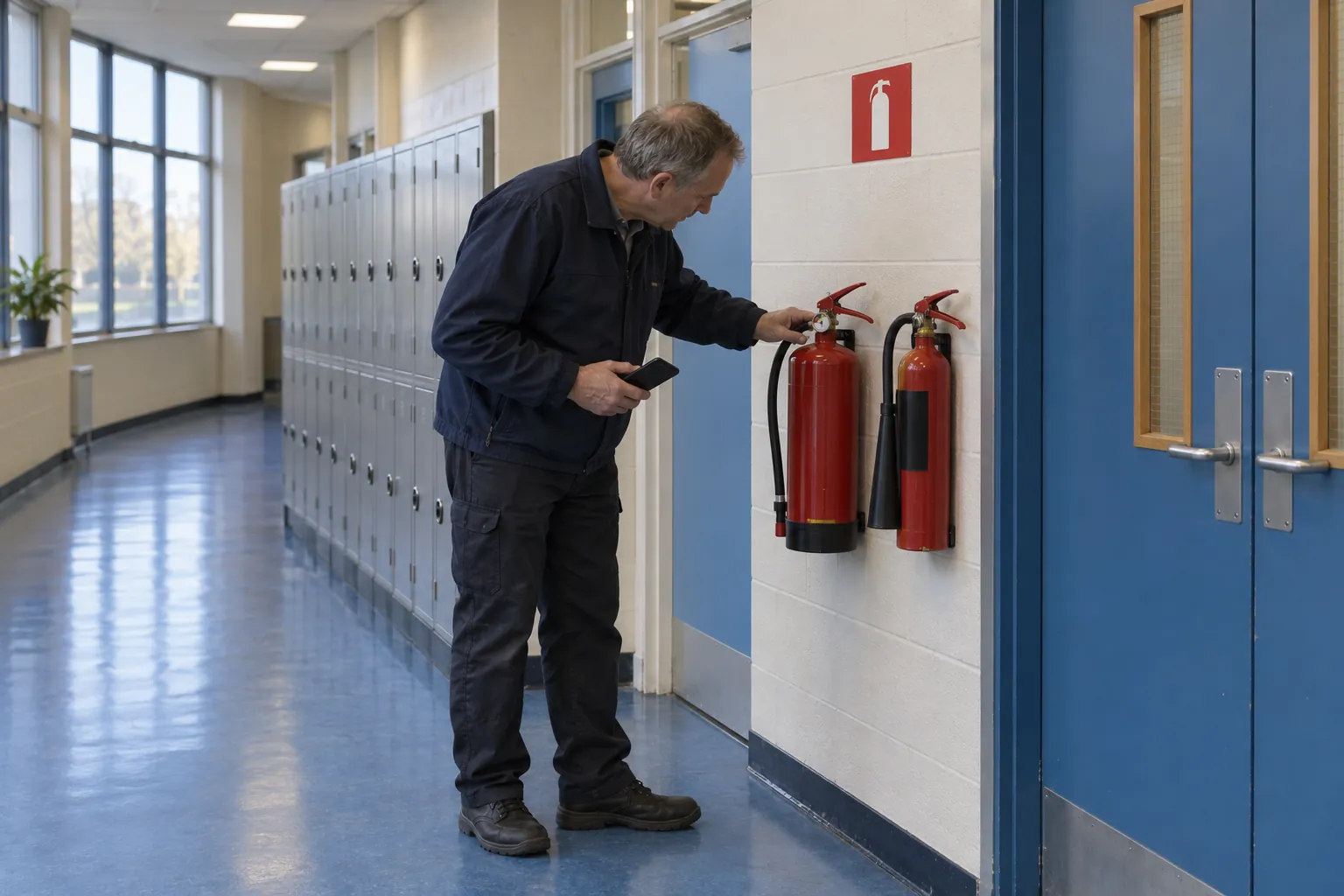
A portable fire extinguisher is only any use if it is where it should be, charged, undamaged and ready within reach when someone needs it in an emergency. This guide covers the Irish law and guidance behind both kinds of work, what each involves, who usually does it, and what the register should show.
01
The duty in Ireland, and the standard behind the checks
The duty to keep extinguishers working comes from two bodies of Irish law, and the practical detail from Irish guidance and an Irish Standard. The British rules often found online, the Regulatory Reform (Fire Safety) Order and BS 5306-3, do not apply here.
- Fire law. Section 18 of the Fire Services Act 1981 applies to premises such as hotels and other sleeping accommodation, places of treatment or care, schools and training centres, and anywhere the public has access. Section 29 of the Licensing of Indoor Events Act 2003 extended it to "any workplace" and substituted subsection (2), which makes it the duty of "every person having control over premises" to "provide reasonable fire safety measures" and to "ensure that the fire safety measures and procedures referred to in paragraph (b) are applied at all times".
- Workplace law. Regulation 13 of the Safety, Health and Welfare at Work (General Application) Regulations 2007 requires an employer to ensure that a place of work is equipped with appropriate fire-fighting equipment, that non-automatic equipment is "easily accessible and simple to use" and indicated by signs, and that fire-fighting equipment is "inspected and maintained as frequently as necessary to ensure that it is in good working order" and "serviced by a competent person as frequently as necessary".
Neither sets a frequency. That comes from the Department of Housing, Local Government and Heritage's Fire Safety Guide for Building Owners and Operators (August 2023), written for persons having control under section 18(2). Its section 6.7 says that, where provided, portable fire extinguishers "should be suitable for the class of fire likely to occur", should conform with European Standard EN 3, and should be "installed, inspected and maintained in accordance with Irish Standard I.S. 291".
The standard is I.S. 291:2015+A1:2022, Selection, commissioning, installation, inspection and maintenance of portable fire extinguishers, published by the National Standards Authority of Ireland, with Amendment 1 issued in 2022. It is the standard the Department's guide names for installing, inspecting and maintaining extinguishers in Ireland.
The Health and Safety Authority puts the everyday version plainly in its information sheet Fire Extinguisher – Safety Checks: fire-fighting equipment "must be inspected and maintained as often as necessary to keep it in good working order, and must be serviced annually by a competent person (usually a fire safety engineer)".
02
Types of extinguisher, and where they belong
Anyone doing the monthly check should know which extinguisher is meant to be where, because the wrong type in the wrong place is a finding in its own right. Extinguishers are designed for particular classes of fire, so the one at each point should match the risk there. The HSA's information sheet offers a general guide to matching the extinguisher to the fire, and says that specialist advice may be necessary for particular situations:
- Fires involving solid materials such as wood, paper or textiles: water, foam or multi-purpose powder extinguishers.
- Fires involving flammable liquids: foam.
- Electrical fires: carbon dioxide.
- Fires involving gases: dry powder, but with specialist advice, because the sheet notes that in some instances it may be better to let the fire burn until the fuel supply can be cut off.
Where a fire blanket is fitted, it belongs on the same monthly round as the extinguishers beside it.
On numbers and position, the HSA says the number provided should be based on the size of the workplace, the equipment and substances it contains and the number of people present. In small premises one or two portable extinguishers may be all that is needed; larger or more complex premises are likely to need more, sited throughout. Extinguishers should be "permanently located in a fixed place – either wall-mounted or placed on a stand", generally on exit routes near the exit doors, with those for a specific hazard placed near that hazard.
Where an extinguisher is not in clear view, signs should mark it. The HSA's guidance on emergency escape and fire fighting says: "Signboards or a safety colour (or both) shall be used to mark permanently the location and identification of fire-fighting equipment."
Choosing the types, numbers and positions is the job of the person having control, advised by a competent person and the fire safety assessment, not of whoever does the monthly check. Their job is to notice when something has changed: an extinguisher moved, swapped, blocked in or gone.
03
The monthly fire extinguisher check
The Department's schedule asks that "all points at which portable fire extinguishers or hose reels are usually located" are checked monthly, that missing extinguishers "should be replaced immediately", and notes that a risk assessment may recommend more frequent checks. Because the same row covers fire hose reels, many buildings walk both on one round. The same row also has a weekly entry for "all gaseous, foam water and powder extinguishing systems", covering pressure gauges, operating controls, indicators and the quantity of extinguishing medium; ask your competent person whether any of your equipment falls under it.
The check is quick and visual and needs no tools, only someone who has been shown what to look for. Drawing on the HSA's information sheet, a sound monthly check confirms at each extinguisher point that:
- the extinguisher is there, on its bracket or stand, the right type for that point, and not moved to another room or left on the floor;
- access is clear: nothing stacked in front of it, and its sign in place and visible from the approach;
- the pressure gauge, where there is one, is in good condition and the needle is in the green; the HSA says that if it is not, the extinguisher should be removed for servicing;
- the pull pin is in good condition, securely fastened within the handle and held in place by its tamper seal, which shows it has not been used;
- the handle, hose and cylinder body are in good condition and undamaged;
- the labels are in good condition, with their dates and detail clearly visible, and the extinguisher is marked with its next due date.
Anything that fails is a fault, recorded against that extinguisher and reported to whoever arranges servicing. A missing or discharged extinguisher is urgent: until it is replaced, that point has nothing. The Department's guide is plain that "any extinguisher used in a fire, or otherwise discharged, should be recharged immediately" and that damaged extinguishers "should be repaired or replaced", so one that has been used, even briefly, goes back to the service company and not onto its bracket.
Who does the monthly check depends on the building: often the facilities or premises manager, a caretaker in a school or an apartment scheme, a security officer on patrol, or a fire warden for their floor. The Department's guide says the person having control "may delegate specific fire safety duties" but "should retain overall responsibility for ensuring delegated tasks are carried out". Name the person and a deputy, and make the check a fixed part of the month rather than something done when someone remembers.
04
The annual service and the test discharge
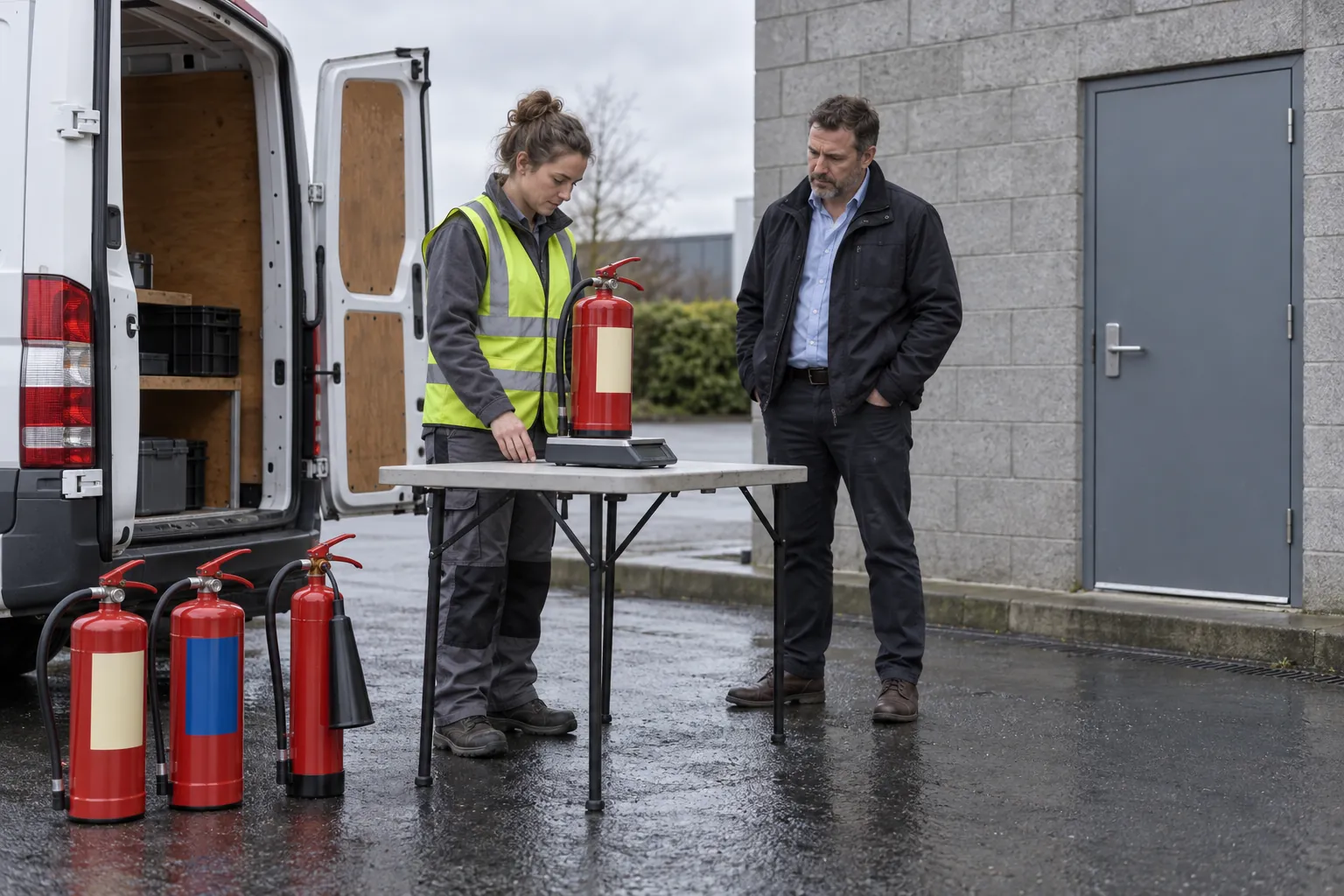
The service is the competent person's job, not the user's. In the Department's schedule, the yearly entry reads: "All portable fire equipment (PFEs) shall be maintained in accordance with Clause 9 of I.S. 291 at intervals not exceeding 12+/- 1 month." In practice that is a visit from a fire protection contractor, whose technician examines every extinguisher and puts right or replaces anything that fails.
The HSA's information sheet describes what to expect when the fire safety engineer calls:
- a visual inspection of all fire-fighting equipment to make sure it is in good condition;
- each extinguisher weighed, the gauge tested, and the seal replaced where the hose joins the cylinder;
- a certificate of service for the equipment once the work is complete.
The same sheet says extinguishers must be marked with the next due date or a maximum period of use, and adds that each extinguisher "should be test discharged and refilled every 3 years", and suggests asking the engineer to demonstrate the use of an extinguisher, outside, whenever one of yours is due for a test discharge.
I.S. 291 also covers commissioning, the checks when an extinguisher is first installed. Ask the contractor what else the standard asks of each type you have, when it was last done and when it is next due, and make sure it is written down, so that nothing depends on one technician's memory.
A competent person is someone with the training, experience and equipment to do the work to the standard. The Department's guide says maintenance "should be arranged with competent companies or persons in accordance with the appropriate standards".
05
What the record should show, and who asks to see it
In Ireland the checks belong in the building's fire safety register, the Irish name for the fire log book. The Department's guide says a register "should be maintained for all premises where section 18 applies", kept on the premises at all times, kept up to date and "available for inspection by an authorised officer of the fire authority". It calls it "a living document – with daily, weekly, monthly, quarterly and annual records", and lists portable fire extinguishers among its contents. It also includes a sample Portable Fire Extinguisher Check Sheet in Appendix J.5. The HSA's sheet agrees: "A fire register is useful for this purpose."
An extinguisher record that stands up has:
- A list of every extinguisher, with a reference, its type and a location someone new could find.
- A dated entry for each monthly check, with the name of the person and the result for each point, not "all extinguishers OK" for the whole building.
- Faults with an ending: what was wrong, who was told, and the date it was put right. The guide says faults "are a life safety issue – not simply a maintenance issue to be dealt with later" and "should be entered in the fire safety register and corrected promptly".
- The certificate of service from each annual visit, with the date, the engineer and the company, kept with the register or referenced from it, and a note of when each recommendation was dealt with.
- The dates of test discharges and any longer-interval work, with the next due.
- Reasons for gaps, such as a closure or a floor out of use during works. A missed check with a reason is better evidence than a blank.
The HSA's guidance on emergency escape and fire fighting gives the reason for all of it in one line: "A record of the work carried out on such equipment and systems will help to demonstrate compliance with the law." Its general page on Fire notes that fire legislation beyond workplace safety law "is generally enforced by the local authority fire officers". Under section 18 as amended, a fire authority's advice may include a warning that a fire safety notice may be served, so expect an officer to open the register at the extinguisher pages.
The usual findings are ordinary: an extinguisher propping open a fire door, one left off its bracket after a fit-out, service labels more than a year old, and a monthly record that stops in spring.
In a shared building, write down who checks and services which extinguishers; the Department's guide says the allocation of fire safety management "should be clear to all parties involved". In an apartment scheme the common-area extinguishers usually fall to the owners' management company, whether or not a managing agent arranges the work.
06
Where extinguisher records fail, and what SiteClara does about it
Monthly extinguisher checks fade. They get skipped in a busy month and become a single tick for the whole building, entered in the register at reception far from the extinguishers on the third floor. A caretaker mentions a broken tamper seal to whoever is passing, it goes nowhere, and the next annual service finds it, or finds the extinguisher missing altogether.
SiteClara records the routine check at the place it is done. A printed QR poster, with an optional NFC tag behind it, goes at a location such as an extinguisher point or a stair core with a group of extinguishers. The caretaker, facilities operative or security officer doing the monthly round scans the code or taps the tag with their own phone, with no app to install, sees the checks due there, and marks each one done or explains what stopped them, for example that the point was blocked by a delivery. The named person and the time are recorded as it happens, with a photo when one is asked for, such as the gauge in the green. A fault found there, such as a missing extinguisher, a broken seal or a gauge out of range, goes onto the team's list of jobs until someone closes it, and the supervisor can escalate it to the building manager, who can answer it.
The supervisor sees what was due, done and missed across the building, and records the reason for anything missed. Each day they approve a report that goes to nominated managers or client contacts the next morning: what was reported, completed and still open, and how the scheduled checks went.
07
Questions people ask
How often do fire extinguishers need to be inspected in Ireland?
Every month on the premises, and every year by a competent person. The maintenance schedule in the Department of Housing, Local Government and Heritage's Fire Safety Guide for Building Owners and Operators says "all points at which portable fire extinguishers or hose reels are usually located" should be checked monthly, notes that a risk assessment may recommend more frequent checks, and says all portable fire equipment "shall be maintained in accordance with Clause 9 of I.S. 291 at intervals not exceeding 12+/- 1 month". The HSA's Fire Extinguisher – Safety Checks sheet adds that each extinguisher "should be test discharged and refilled every 3 years".
What needs to be checked on a fire extinguisher?
The HSA's Fire Extinguisher – Safety Checks sheet lists it: the pressure gauge in good condition with the needle in the green area, and the extinguisher removed for servicing if it is not; the pull pin in good condition, securely fastened within the handle and held in place by its tamper seal; the handle, hose, cylinder body and labels in good condition, with dates and detail clearly visible; the extinguisher easily accessible, kept clear and marked with the appropriate signs; and the extinguisher marked with its next due date or a maximum period of use.
How do I get fire extinguishers checked?
Name someone on the premises to do the monthly check, and book the annual service with a fire protection company. The Department's Fire Safety Guide for Building Owners and Operators says maintenance "should be arranged with competent companies or persons in accordance with the appropriate standards". The HSA's Fire Extinguisher – Safety Checks sheet says the service is done annually "by a competent person (usually a fire safety engineer)", who should give you a certificate of service once the work is complete.
08
Further reading, and a list to take away
Start with the Department of Housing, Local Government and Heritage's Fire Safety Guide for Building Owners and Operators: section 6.7 on first-aid fire-fighting equipment, section 5.6 on the fire safety register, section 8 for the maintenance schedule and Appendix J.5 for a sample extinguisher check sheet. The HSA's two-page Fire Extinguisher – Safety Checks sheet is worth printing for whoever does the round. I.S. 291:2015+A1:2022 is published by the National Standards Authority of Ireland. Your local authority fire service can advise on a particular building.
The HSA's sheet says people need to know how to raise the alarm and how to use an extinguisher, and that fire drills should be held at least annually. Getting out comes first: an extinguisher is for a fire in its early stages, used without exposing anyone to danger.
Before the next service visit, check that:
- every extinguisher is on a list, with a reference, its type and a location someone new could find;
- each point is checked monthly by a named person, with a deputy, who knows what to look for and who to tell;
- each check records the date, the name and the result for each extinguisher, at the extinguisher;
- gauges are in the green, pins and tamper seals are intact, and service labels show the next due date;
- access to every extinguisher is clear and its sign is in place and visible;
- every fault has a date it was reported and a date it was put right, and a used extinguisher is recharged, not rehung;
- the annual service to I.S. 291 is in date, with the certificate of service kept with the fire safety register;
- in a shared building, it is written down who looks after which extinguishers.
Sources
Every document this guide quotes or links to, in the order it first cites them.
- Fire Services Act 1981 irishstatutebook.ie
- Section 29 of the Licensing of Indoor Events Act 2003 irishstatutebook.ie
- Safety, Health and Welfare at Work (General Application) Regulations 2007 irishstatutebook.ie
- Fire Safety Guide for Building Owners and Operators gov.ie
- I.S. 291:2015+A1:2022 shop.standards.ie
- Fire Extinguisher – Safety Checks hsa.ie
- Emergency escape and fire fighting hsa.ie
- Fire hsa.ie
- Fire Safety Guide for Building Owners and Operators assets.gov.ie
Related guides
 Fire and water checksFire hose reel inspection: what to check, how often and what to recordFire hose reel inspection in Ireland: the duty, the monthly checks, annual servicing to I.S. EN 671-3, the five-year pressure test and the record to keep.
 Fire and water checksFire safety register: what to record, who keeps it and how to make it credibleWhat a fire safety register should hold under section 18(2) of the Fire Services Acts, the routine checks behind it, who keeps it, and what makes it credible.
 Fire and water checksFire warden duties: the daily checks, the evacuation and the recordWhat a fire warden does in an Irish workplace: the law behind the role, the daily and weekly checks, the job in an evacuation, and a record that stands up.
 Fire and water checksWorkplace fire safety checklist: what to check, how often, and who does itA workplace fire safety checklist for Ireland: the daily, weekly and monthly checks under the Fire Services Acts, who does each one, and what to record.