Fire and water checks
Fire extinguisher inspection in New Zealand: the owner's duty, NZS 4503 and the checks in between
In New Zealand, a fire extinguisher installed for a building's occupants to use must be maintained by its owner to NZS 4503:2005, which means inspection and servicing, usually by a service agent, at the intervals the standard sets; regular checks on site in between show that each extinguisher is in place, undamaged and ready to use.
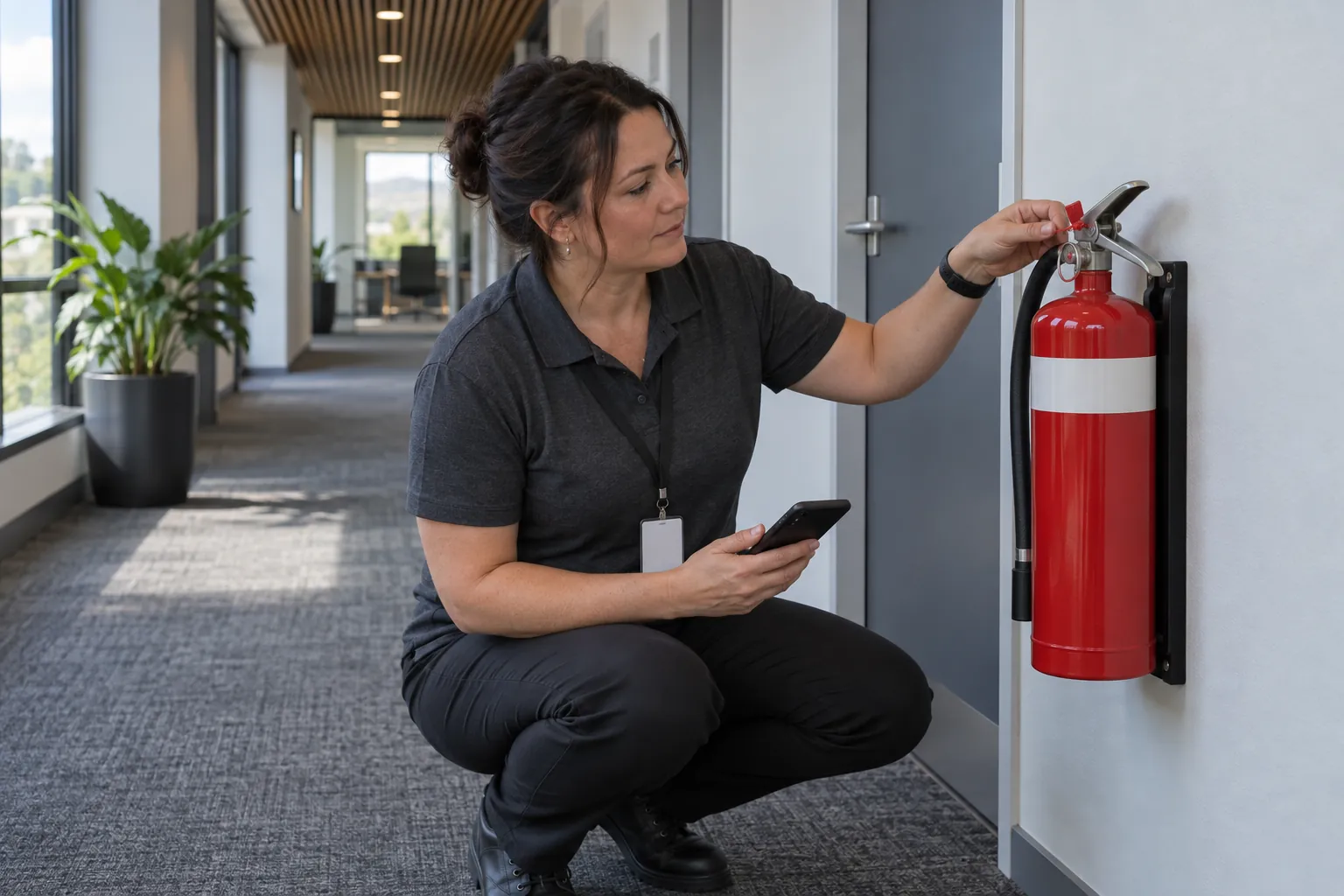
The service agent does the maintenance and tags each extinguisher; the building team is the one that notices, in the months between visits, when an extinguisher has been moved, used, blocked in or taken. This guide covers where the duty comes from, what the standard and the regulators say, what a quick inspection on site looks at, and what the record should show.
01
The duty: regulation 14 and NZS 4503:2005
The maintenance duty is in the Fire and Emergency New Zealand (Fire Safety, Evacuation Procedures, and Evacuation Schemes) Regulations 2018. As Fire and Emergency New Zealand (FENZ) sets out on its page of regulations for building owners, regulation 14 requires "the owner of any hand-operated firefighting equipment installed in a building for firefighting" by its occupants to "maintain it in accordance with NZS 4503:2005", the New Zealand Standard for hand operated fire-fighting equipment. Fire extinguishers, fire hose reels and fire blankets are all hand-operated firefighting equipment.
Two things follow from the wording. The duty sits with the owner of the equipment, which in a leased building may be the landlord for equipment in common areas and a tenant for extinguishers it has bought for its own business premises; agree in writing who owns and services what. And the duty is to maintain what is installed. The same page notes, under regulation 15, that FENZ may require, in writing, the owner of a building listed in schedule 2 of the regulations to install hand-operated firefighting equipment in a particular location where the building has only a single means of escape, no automatic sprinkler system, and activities that make it more likely a fire could affect the means of escape.
Outside that case, the building rules rarely require extinguishers. FENZ's research report Impacts of changes in provision of hand-operated fire-fighting equipment in non-residential buildings (Report 148, 2015) describes the 2012 changes to the Building Code as having "clarified that fire extinguishers (in particular) are not required under the building code". FENZ still recommends them: its fire extinguisher recommendations say that "where fire extinguishers are installed, fire safety regulations require them to be maintained", and that where they are not required they are "still highly recommended", especially near cooking, hot work and some manufacturing processes.
Two more sources of duty apply in many workplaces. Under the Health and Safety at Work (Hazardous Substances) Regulations 2017, a workplace holding flammable or oxidising substances above set quantities must have fire extinguishers: WorkSafe's guidance on hazardous substances that activate key safety controls says they "must have a minimum rating of 30B and must be readily available and accessible in an emergency", citing regulation 5.5 and AS/NZS 1850. And WorkSafe's guidance to PCBUs on preparing and maintaining an emergency plan applies too; its page on emergency plans says a plan's floor plans should show where emergency equipment can be found, and that plans should be tested at least yearly.
02
What NZS 4503 covers, and which extinguisher is for which fire
NZS 4503:2005 is a paid Standards New Zealand document, so it is summarised here rather than quoted. MBIE's Building CodeHub entry for NZS 4503:2005 Hand operated fire-fighting equipment describes its scope as the "selection, installation, distribution and maintenance of hand operated fire-fighting equipment which can be used by one person", including portable and wheeled fire extinguishers, fire hose reels and fire blankets, for commercial and domestic buildings. Amendment 1 is incorporated.
What "maintenance" means is set out in the standard itself. NZQA's unit standard for fire protection technicians, 23586 Maintain hand operated fire fighting equipment, gives the NZS 4503 definition: "the carrying out of inspections, tests, preventative maintenance and repairs at specific intervals necessary to assure the continuing reliability of fire safety systems and equipment". It also lists the documentation the standard requires to be kept, including a logbook, test reports, equipment details and test and maintenance records.
The in-house inspection starts with knowing which extinguisher should be where. New Zealand labels fires by class, and FENZ's commercial use of fire extinguishers page matches each class to the extinguisher it recommends:
- Class A, flammable solids such as paper, plastic and wood: water.
- Class B, flammable liquids such as paint, petrol and oil: foam.
- Class C, flammable gases such as LPG and butane: dry powder, after turning off the gas supply.
- Class D, flammable metals: dry powder, with special-purpose extinguishers for metal fires.
- Class E, electrical equipment such as switchboards and computers: carbon dioxide.
- Class F, cooking oils and fats in fryers: wet chemical.
FENZ's fuller table shows why a swap matters: it rates a water extinguisher, suitable for class A fires, as not suitable for classes B to F, and a wet chemical extinguisher as suited only to classes A and F. A water extinguisher that has drifted from the office into the café kitchen, or away from the switchboard it was never meant for, is a finding in its own right. Which types go where is decided when the equipment is selected and positioned under the standard, usually on the service agent's advice; the person doing the walk-round is there to notice when that has changed.
03
The in-house inspection between service visits
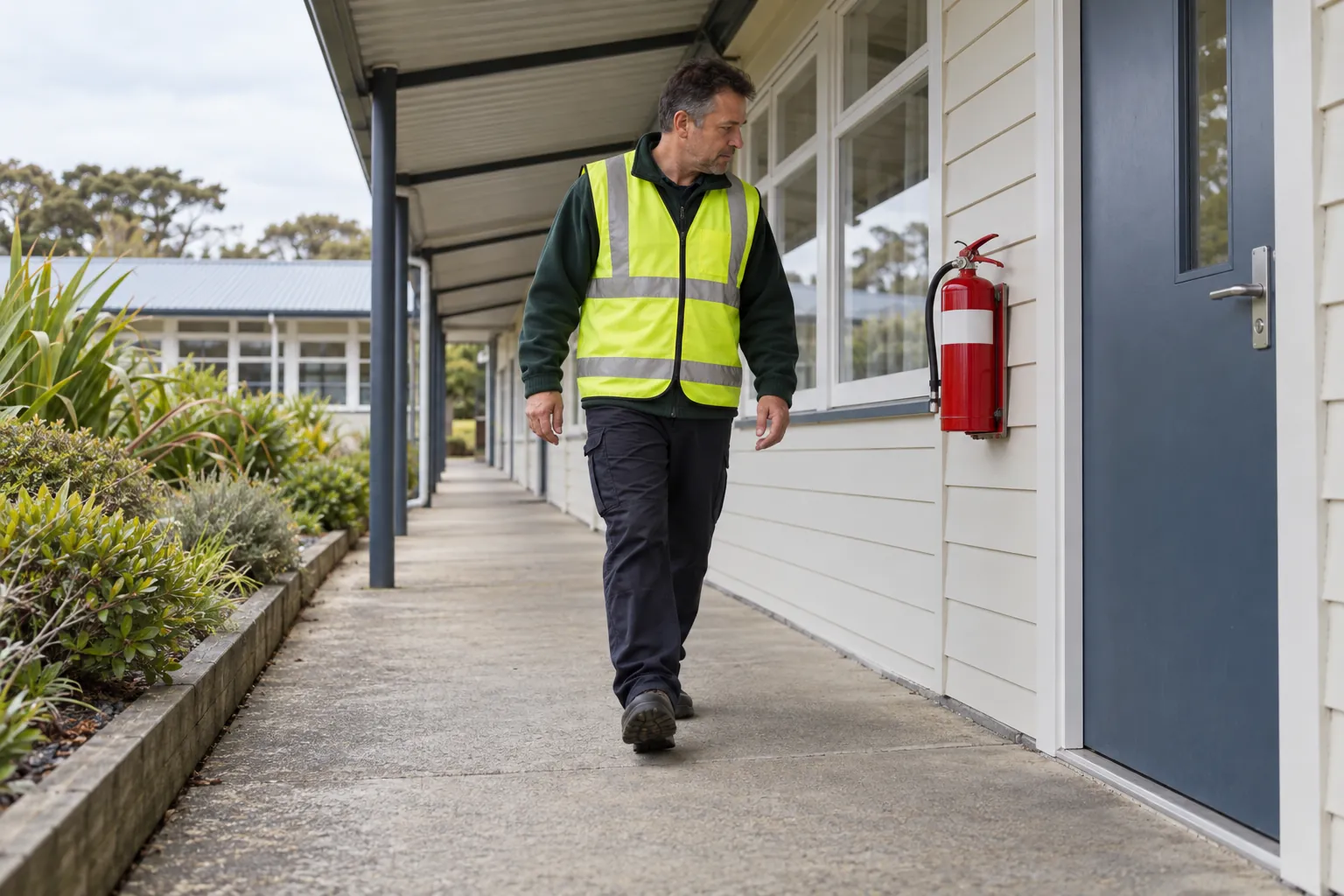
Between the service agent's visits, a quick, regular visual inspection by someone on site is what keeps the equipment where it should be and in a state to use. It needs no tools, only a list of the extinguishers by location and type and a few minutes of instruction from the service agent or whoever looks after fire safety. A monthly check is a sensible starting point, with more frequent checks in busy areas or where the fire risk is higher; agree the interval with your service agent and put it in the emergency plan. At each extinguisher point, look that the extinguisher:
- is there, in its place, on its bracket or stand, not moved to another room, left on the floor or taken away;
- can be seen and reached, with its location sign in place and nothing stacked in front of it, from pallets and cleaning trolleys to chairs and delivery cages;
- is the correct type for the spot, matching the list, so the wet chemical is still by the fryer and the carbon dioxide by the switchboard;
- has its pin and seal intact, which shows it has not been used or tampered with;
- reads in the operable range on its pressure gauge, where it has one;
- is not damaged: no dents, rust, leaks, or a split or blocked hose or nozzle, and the operating instructions still readable and facing out;
- carries a current maintenance tag or label from the service agent, within the interval your contract sets.
Any extinguisher that fails goes to whoever arranges servicing that day, not at the end of the month. A missing or discharged extinguisher is urgent enough to call the service agent straight away, because until it is replaced that area may have nothing to hand. An extinguisher that has been used, even for a second, goes back to the service agent for recharging or replacement; it does not go back on its bracket. The NZQA maintenance standard expects technicians to withdraw from service any item not conforming to requirements, and the building team's job is to make sure the agent hears about it.
Who walks the round depends on the building: a facilities or property manager, the caretaker, a security officer on a lock-up patrol, a cleaning supervisor, or a fire warden for their floor. Name one person and a deputy, give them the list, and make the round part of a routine, so that it does not depend on someone remembering.
04
Servicing by the agent, and periodic cylinder testing
Maintenance to NZS 4503 is a competent technician's job, usually from a fire protection company. NZQA's unit standards for that trade say who they are for: 23586 is "for personnel employed in the fire protection industry" and covers preparing for maintenance, carrying it out, withdrawing items that do not conform, returning equipment to service and completing records. The records it names are "logs or registers, tags or labels, reports". Its companion, 9020 Demonstrate knowledge and use of hand operated fire fighting equipment, covers the types of fire, the extinguishing agents, and the construction and use of the equipment.
The standard sets the intervals and what is done at each; the agent should state in the contract which intervals they work to and what each visit includes. What the owner should expect after every visit:
- a report or register listing every extinguisher by location, type and size, what was done to each, and anything withdrawn from service;
- a maintenance tag or label on each extinguisher showing the latest service;
- recommendations, such as an extinguisher that should be added, moved or changed to another type, set out so someone can act on them;
- a note of replacements and recharges, with the reason.
Extinguishers are also pressure equipment, which brings them under the hazardous substances rules on gas containers. WorkSafe's page on gas cylinders and fire extinguishers says that "all refillable cylinders, including fire extinguishers, must be regularly tested to ensure they are safe for continued use", with the interval depending on the type of cylinder and set out in regulation 15.56 and Schedule 22 of the Health and Safety at Work (Hazardous Substances) Regulations 2017. The same page notes that low pressure extinguishers need a fire extinguisher registration number (FERN) under a product certification scheme. The service agent arranges testing; the owner's part is to make sure it is on the register and not missed.
05
Records, training and the evacuation scheme
Keep the agent's reports, the register and the in-house inspection records together with the building's other fire safety records, so that anyone can see the whole picture: FENZ at a visit, an insurer, a new facilities manager or the next service agent. A useful in-house record shows the date, who inspected, each extinguisher by location, what was found and what happened about each fault, including when the agent came and what they did.
Training goes with the equipment. In a building with an approved fire evacuation scheme that requires a training programme, FENZ's page on regulations for evacuation schemes says the programme must include details of how permanent occupants are trained "at intervals of not more than 6 months" in, among other things, "the use of any firefighting equipment in the building". FENZ is clear about priorities: extinguishers should only be used when it is safe to do so, for example when the fire is no larger than a waste paper basket or a pot on a stove, with a safe path of escape and after FENZ has been called.
Schools have a route of their own. The Ministry of Education's page on school fire evacuation and fire alarm or sprinkler system shutdowns repeats that installed handheld firefighting equipment "must be maintained in accordance with New Zealand Standard (NZS) 4503:2005", and says that for state schools the Ministry's BWOF provider will identify it if this is not the case.
Findings that come up again and again:
- an extinguisher used as a doorstop, which usually means a fire door wedged open as well;
- extinguishers lifted off their brackets during a fit-out and never put back, or moved into a tenancy that has since changed;
- a water extinguisher beside a switchboard, or nothing but carbon dioxide in a commercial kitchen;
- tags out of date because the service contract lapsed when the property manager changed;
- a discharged extinguisher hung back up after a small fire nobody reported;
- an in-house record that stops in the autumn and starts again the week before an audit.
06
Where the record fails
The agent's visits are usually well recorded, because the report and the tags are what the owner pays for. The weak part is everything in between. The in-house inspection is signed off for the whole building in one line, or filled in for the month at the desk. A cleaner finds an extinguisher on the floor of the stairwell and mentions it to whoever is passing, and nobody can later say whether it reached the agent. When something happens, nobody can show whether the extinguisher on level 3 was on its bracket last week.
SiteClara is built for that everyday part. A printed tag at each extinguisher point or group of points lets the person doing the round scan it with their own phone and confirm the inspection, with a photograph when one is asked for, so the record shows which point was looked at, by whom and when. A round that was due and not done shows as not done, and the supervisor records why. A missing extinguisher, a broken seal or a gauge out of range reported at the tag goes on the team's list of jobs and stays there until someone closes it, and a daily report tells the building manager what was checked and what is still open.
It is just as important to say what SiteClara does not do. It does not inspect, weigh, test, recharge or service extinguishers, and it does not replace the service agent, maintenance to NZS 4503:2005, periodic cylinder testing or the agent's tags and reports. It is not the logbook or register the standard requires: where the regulations, the standard or the compliance schedule require a particular record, SiteClara is the working record of the building team's checks between service visits, not the statutory one. It is not a building warrant of fitness, it is not an IQP and it sends nothing to FENZ or the council. It is not a CAFM system and does not manage assets, planned maintenance, rostering or time and attendance.
07
Questions people ask
How often do fire extinguishers need to be inspected in NZ?
As often as NZS 4503:2005 says. Regulation 14, set out on FENZ's page of regulations for building owners, requires the owner of hand-operated firefighting equipment installed for the occupants to maintain it in accordance with that standard, and NZQA's unit standard 23586 Maintain hand operated fire fighting equipment gives the standard's definition of maintenance as "inspections, tests, preventative maintenance and repairs at specific intervals". The intervals themselves are in the paid standard, so ask your service agent to state in the contract which ones they work to. The in-house checks between visits are on top of that, at an interval you set.
Can a 20 year old fire extinguisher still be good?
Age alone does not decide it; testing does. WorkSafe's page on gas cylinders and fire extinguishers says that "all refillable cylinders, including fire extinguishers, must be regularly tested to ensure they are safe for continued use", with the interval depending on the type of cylinder under regulation 15.56 and Schedule 22 of the Health and Safety at Work (Hazardous Substances) Regulations 2017. An older extinguisher that is within its test date and passes maintenance can stay in service; one that is out of test or fails goes out of service, as NZQA's unit standard 23586 Maintain hand operated fire fighting equipment expects of items not conforming to requirements.
08
Further reading, and a list to take away
FENZ's pages on regulations for building owners and commercial use of fire extinguishers are the place to start, with its fire extinguisher recommendations for the full suitability table. NZS 4503:2005 is available from Standards New Zealand. WorkSafe covers extinguishers where hazardous substances are held and the testing of cylinders, and its guidance on emergency plans covers what every PCBU needs. Your service agent and your local FENZ office can advise on your own building.
Before the next service visit, check that:
- there is a register of every extinguisher, by location, type and size, and it matches what is on the walls;
- it is agreed in writing who owns and services each extinguisher, landlord or tenant;
- the contract states the NZS 4503 maintenance intervals and what each visit includes;
- a named person and a deputy inspect every extinguisher point between visits, and each inspection is recorded;
- faults and missing extinguishers are reported the same day and followed through to the agent;
- periodic cylinder tests are on the register, and nothing past its date is in service;
- recommendations from the last visit have been acted on;
- where hazardous substances are held, the extinguishers meet the WorkSafe requirements for that quantity;
- permanent occupants are trained in the equipment as the evacuation scheme requires, and know that getting out comes first.
Sources
Every document this guide quotes or links to, in the order it first cites them.
- Regulations for building owners fireandemergency.nz
- Impacts of changes in provision of hand-operated fire-fighting equipment in non-residential buildings fireandemergency.nz
- Fire extinguisher recommendations fireandemergency.nz
- Specified systems and compliance schedules building.govt.nz
- Hazardous substances that activate key safety controls worksafe.govt.nz
- Emergency plans worksafe.govt.nz
- NZS 4503:2005 Hand operated fire-fighting equipment codehub.building.govt.nz
- 23586 Maintain hand operated fire fighting equipment nzqa.govt.nz
- Commercial use of fire extinguishers fireandemergency.nz
- 9020 Demonstrate knowledge and use of hand operated fire fighting equipment nzqa.govt.nz
- Gas cylinders and fire extinguishers worksafe.govt.nz
- Regulations for evacuation schemes fireandemergency.nz
- School fire evacuation and fire alarm or sprinkler system shutdowns education.govt.nz
Related guides
 Fire and water checksFire warden duties: the everyday checks, and the job when the alarm soundsWhat a fire warden does in a New Zealand building: where the role sits in the evacuation scheme, the everyday checks, the job when the alarm sounds, and the record.
 Fire and water checksFire evacuation scheme: which buildings need one, and how to keep it workingWhich New Zealand buildings need an approved fire evacuation scheme, what it contains, how it is kept up with trial evacuations or training, and what to tell FENZ.
 Fire and water checksFire drill: how to plan, run and report a trial evacuationHow New Zealand buildings plan, run and report a fire drill, called a trial evacuation, under the 2018 FENZ Regulations: timing, what to check, the 10-day report.
 Fire and water checksThe building warrant of fitness: what a New Zealand owner signs each year, and how to make it trueWhat a New Zealand building warrant of fitness declares, who signs it, the Form 12 and Form 12A cycle, the records behind it, and the checks that keep it true.