Premises and facilities management
First aid box checklist: what the law says goes in the box, and how to keep it that way
A first aid box checklist for a South African workplace starts with the 18 items in the Annexure to the General Safety Regulations, 1986, from 100ml of wound cleaner to two CPR mouthpieces, which regulation 3 requires every employer with more than five employees at a workplace to keep in a first aid box at or near it.

The checklist turns that list into a routine: open the box, count what is there against the Annexure, replace what was used or has expired, and write down who checked it and when. This guide sets out the legal contents list, the reduced quantities allowed in shops and offices, how many first aiders a site needs, the notice that must show where the box is, a monthly check you can use, and where the check usually goes wrong.
01
What regulation 3 of the General Safety Regulations requires
The first aid duty for ordinary South African workplaces is regulation 3 of the General Safety Regulations, 1986 (Government Notice R.1031 of 30 May 1986), headed "First aid, emergency equipment and procedures". First made under the Machinery and Occupational Safety Act, 1983, the regulations now sit under the Occupational Health and Safety Act 85 of 1993: the Minister amended them under section 43 of that Act in the General Safety Regulations, 2025 (the amendment notice, Government Notice 5954 of 6 March 2025), which added regulations on housekeeping, flooding and fire escape and left regulation 3 as it was.
Regulation 3 builds up in steps:
- Every workplace. Regulation 3(1): the employer must take "all reasonable steps that are necessary under the circumstances, to ensure that persons at work receive prompt first aid treatment in case of injury or emergency".
- More than five employees: a box. Regulation 3(2): "a first aid box or boxes at or near the workplace which shall be available and accessible for the treatment of injured persons at that workplace".
- What is in it. Regulation 3(3): suitable first aid equipment, taking into account the likely injuries, the activities and the number of employees, which includes "at least the equipment listed in the Annexure", and only those articles "or other similar equipment or medicine".
- More than 10 employees: a first aider. Regulation 3(4): for every group of up to 50 employees, or up to 100 in a shop or an office, at least one person "readily available during normal working hours" holding "a valid certificate of competency in first aid".
- Hazardous substances. Regulation 3(5): where toxic, corrosive or similar substances are used, the first aider must be trained in the first aid and emergency procedures for them.
- A notice. Regulation 3(6): "a prominent notice or sign in a conspicuous place" showing where the boxes are kept and "the name of the person in charge" of them.
Regulation 14, as amended in 2025, makes a failure to comply with regulation 3 an offence, punishable by a fine or up to six months' imprisonment. The regulation sets no frequency for checking the box. The checklist is how an employer shows the box still holds what regulation 3(3) requires on the day someone needs it.
02
The first aid box contents: the Annexure's 18 items
The Annexure, headed "Minimum contents of a First Aid Box" (Government Notice R.2245 of 7 August 1992), lists 18 items. This is the core of any first aid box checklist in South Africa, in the Annexure's order:
- Wound cleaner or antiseptic (100ml).
- Swabs for cleaning wounds.
- Cotton wool for padding (100g).
- Sterile gauze (minimum quantity 10).
- 1 pair of forceps (for splinters).
- 1 pair of scissors (minimum size 100mm).
- 1 set of safety pins.
- 4 triangular bandages.
- 4 roller bandages (75mm x 5m).
- 4 roller bandages (100mm x 5m).
- 1 roll of elastic adhesive (25mm x 3m).
- 1 non-allergenic adhesive strip (25mm x 3m).
- 1 packet of adhesive dressing strips (minimum quantity 10, assorted sizes).
- 4 first aid dressings (75mm x 100mm).
- 4 first aid dressings (150mm x 200mm).
- 2 straight splints.
- 2 pairs of large and 2 pairs of medium disposable latex gloves.
- 2 CPR mouthpieces or similar devices.
The Annexure is a minimum, not a standard first aid kit for every workplace: regulation 3(3) asks the employer to take into account the injuries likely at the site, so the box should contain what the risk calls for. A site where people handle glass, blades or chemicals may need additional items such as more dressings and gloves or an eye wash bottle, and a large site more than one box. The gloves and CPR mouthpieces let a first aider help without touching blood or other body fluids, so they are counted as carefully as the dressings. Regulation 3(3)(b) allows only the Annexure's articles and equipment "or other similar equipment or medicine" in the box, so the check is also a chance to take out anything that is neither. The box is not a drawer for spare keys, batteries and a torch. Where someone is allergic to latex, the words "similar equipment" leave room for nitrile gloves in place of latex. A "Regulation 3" label on the lid proves only what was in the box when it was sold; the first use and the first expiry date change that, which is why the box is checked against the list, not the label.
03
How many boxes, how many first aiders, and the notice
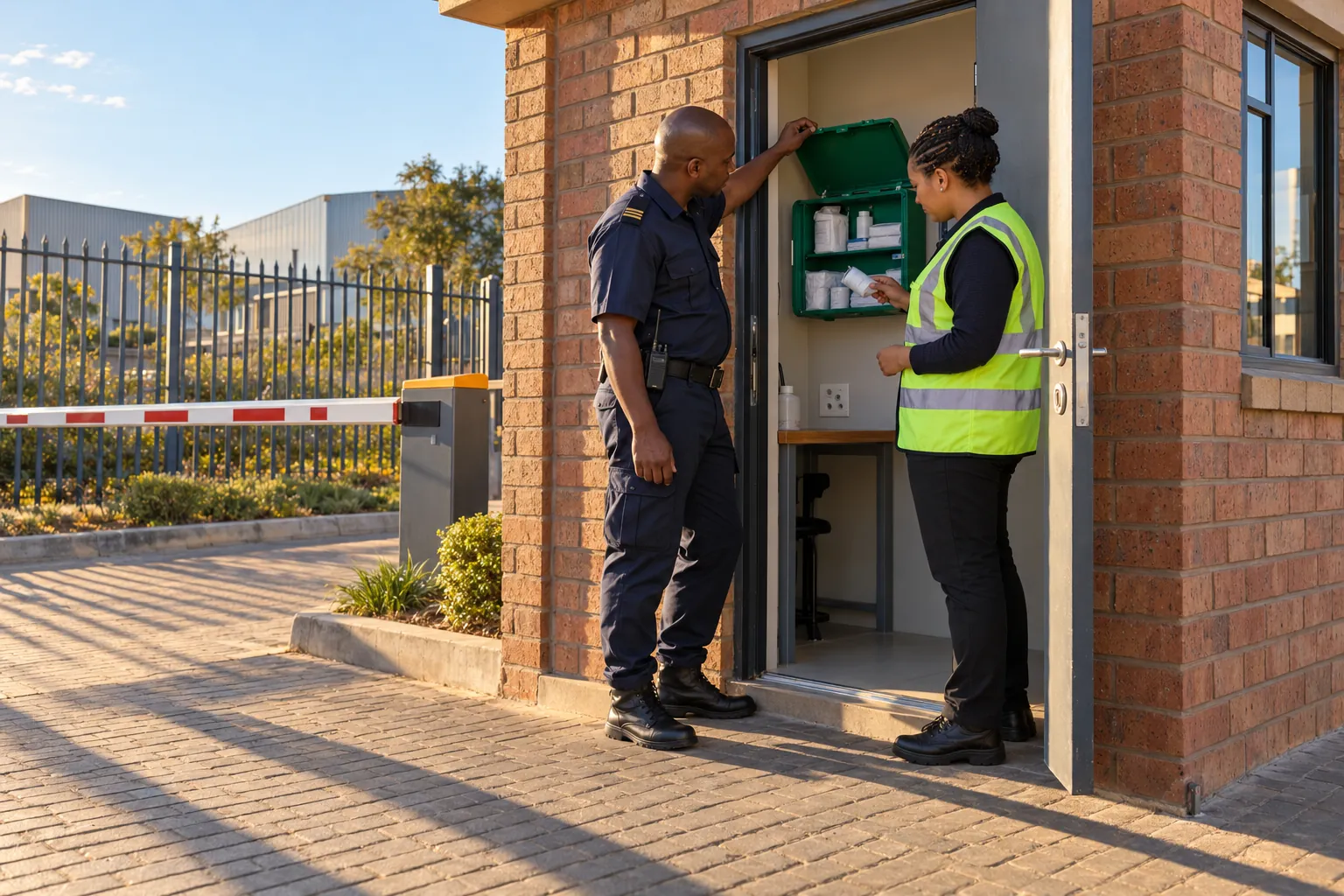
Boxes. The regulation sets no ratio of boxes to people. It asks for boxes "at or near the workplace" that are "available and accessible": a box someone can reach quickly from wherever people work, on every shift. A box in a manager's office locked at 17:00 is not accessible to the night-shift officer at the gate. Larger buildings usually need a box per floor or work area, and one in the guardhouse or control room.
First aiders. Regulation 3(4) applies once there are more than 10 employees: at least one certificated first aider per group of up to 50 employees, or up to 100 in a shop or an office. An office of 180 needs at least two; a warehouse of 120 at least three. In the version the Department of Employment and Labour publishes, the certificate comes from the SA Red Cross Society, St John Ambulance, the SA First Aid League or "a person or organisation approved by the chief inspector". A Chief Inspector's direction of 11 August 2017 (Government Notice 827) says applications for that approval are considered only with a valid accreditation certificate from a quality assurance body, so ask a training provider for proof of approval before booking. The regulation does not say how long a certificate lasts: record the expiry date on each certificate and book the refresher before it passes.
The regulation's words are "during normal working hours", but regulation 3(1)'s duty to ensure prompt first aid applies whenever people are at work, so a 24-hour site should plan for a trained person on every shift, not only days.
Chemicals and eyes. Regulation 3(8) requires an eyewash fountain "or any similar facilities" nearby wherever a biological or chemical substance could reach an employee's eye, and regulation 3(9) a fast-reacting deluge shower where a large splash of a toxic or corrosive substance is possible, with training in both. They are not in the box, but they belong on the same checklist.
The notice. Regulation 3(6) requires a prominent notice showing where the boxes are and naming the person in charge. It goes out of date the day that person leaves or changes shift, which makes it one of the easiest things to fail on an inspection, and one of the easiest to check.
04
A monthly first aid box checklist
A sensible routine is a full check once a month by the person in charge of the box, plus a restock after every use, because a box is most likely to be short straight after it has been opened. For each box:
- Place and access. The box is where the notice says, visible, with nothing stacked in front of it, and whoever is on duty can open it on every shift. If it is locked, the night shift can reach the key.
- Condition. Clean, dry and closing properly; nothing inside damp, torn or soiled.
- Contents against the Annexure. Count each of the 18 items, at the full or the shop and office quantity, and note any shortfall.
- Sterile items. Gauze, dressings and adhesive strips are in sealed packs. An opened or damaged pack is no longer sterile: replace it.
- Expiry dates. Check the wound cleaner, sterile dressings, gauze and gloves, and replace anything past its date or due to expire before the next check.
- Nothing extra that is not first aid equipment, as regulation 3(3)(b) requires, and any site-specific extras present and in date.
- The notice is up, legible and names the right person, and the named first aiders still work at the site with certificates in date.
- Eyewash and deluge facilities, where the site has them, are clear and run clean water.
- The record. The date, the box, who checked it, what was missing or replaced, and what needs ordering.
Two habits keep the check honest. Count the contents, not the seal: a tamper seal shows whether the box has been opened since the last check, but a seal on a box nobody counted proves nothing. And keep the record away from the box: a sheet taped inside the lid is easy to tick in advance, and it goes missing with the box. Restock from spares held by the person in charge, never from another box; that is how two boxes fail at once.
06
Where the first aid box check fails, and where SiteClara fits
The box is rarely missing. The check is what fails. The sheet inside the lid shows a tick for every month of the year in the same pen. The box in the ablution passage was used for a cut hand in March and nobody told the person in charge, so the next cut in May found it short. The notice names a first aider who left last year, and the night-shift officer has no idea where the key is.
SiteClara records routine checks and faults at the place they happen. A printed QR poster, with an optional NFC tag behind it, goes at each location: beside each first aid box, at the guardhouse, in the cleaning store. The person in charge scans it on their own phone, with no app to install, and marks the monthly box check done or says what stopped it; the time and the named person are recorded as it happens, with a photo of the open box when one is asked for. A shortfall or expired item can be reported at the box as a job, which stays on the team's list until someone restocks it and closes it. The supervisor sees which boxes were due, done and missed, and a daily report goes by email to nominated managers or client contacts showing what was completed and what is still open.
07
Questions people ask
What are 10 items in a first aid box?
In a South African workplace, ten of the 18 items the Annexure to the General Safety Regulations requires in every first aid box are wound cleaner or antiseptic (100ml), swabs, cotton wool (100g), sterile gauze (at least 10), forceps, scissors (at least 100mm), safety pins, 4 triangular bandages, 2 straight splints and 2 CPR mouthpieces. The other eight are the two sizes of roller bandage, the elastic adhesive, the non-allergenic adhesive strip, the adhesive dressing strips, the two sizes of first aid dressing and the disposable gloves, and a basic box needs all 18, not ten.
What are 20 items in a first aid kit?
South African law sets a minimum of 18, not 20: the Annexure to the General Safety Regulations lists 18 items for a first aid box, and regulation 3(3) requires suitable first aid equipment for the injuries likely at the workplace, so an employer may need to add more. Where a chemical could reach an employee's eye, regulation 3(8) also requires an eyewash fountain or similar facility nearby, outside the box.
What does a first aid kit checklist for 2026 include?
In South Africa, the 18 items in the Annexure to the General Safety Regulations, at full quantity or, in a shop or an office, with items 1, 8, 9, 10, 14, 15, 17 and 18 halved. A workplace checklist should also confirm the notice showing where the boxes are and who is in charge of them, under regulation 3(6), and, with more than 10 employees, a certificated first aider for every 50 employees, or every 100 in a shop or an office, under regulation 3(4).
08
Further reading, and a list to take away
The Department of Employment and Labour publishes the General Safety Regulations and the General Administrative Regulations; the 2025 amendment, the 2017 direction and the OHS Act are on gov.za. Regulation 3 is short: read it in full.
For each workplace, check that:
- you know, per employer, whether you need a box (more than five employees) and certificated first aiders (more than 10);
- a box is within quick reach of every work area on every shift, the guardhouse and night shift included;
- each box holds at least the Annexure's 18 items, at full quantity outside shops and offices, plus what the site's risks call for;
- first aiders are certificated, one per 50 employees or per 100 in a shop or office, with expiry dates recorded;
- eyewash and deluge facilities are in place where hazardous substances are used;
- the notice shows every box and names the person in charge, correctly, today;
- each box is checked monthly and after every use, with a record of who checked it and what was replaced;
- contractors and the client have agreed in writing whose boxes and first aiders cover whose staff.
Sources
Every document this guide quotes or links to, in the order it first cites them.
- General Safety Regulations, 1986 labour.gov.za
- Occupational Health and Safety Act 85 of 1993 gov.za
- General Safety Regulations, 2025 gov.za
- Chief Inspector's direction of 11 August 2017 gov.za
- General Administrative Regulations, 2003 labour.gov.za
Related guides
 Premises and facilities managementInjury on duty: reporting an IOD under COIDA, and the record the claim rests onInjury on duty (IOD) in South Africa: what COIDA requires, the seven-day W.Cl.2 report, what to record on the day, and how it differs from the OHS Act report.
 Premises and facilities managementIncident reporting and investigation under the OHS ActSection 24 of the OHS Act, the regulation 8 reporting clocks, the Annexure 1 incident register and the seven-day investigation, for cleaning, security and FM teams.
 Premises and facilities managementHealth and safety inspection checklist: what to look at, and what to do nextWhat a workplace health and safety inspection should cover in South Africa, how often, who inspects, and how to record and close findings under the OHS Act.
 Premises and facilities managementHealth and safety representatives: who needs them, and what they doWhen a workplace needs a health and safety representative under section 17 of the OHS Act, how many, how they are designated, and what a SHE rep may do.