Premises and facilities management
First aid kit checklist: what goes in, where it goes, and how to keep it checked
A first aid kit checklist lists what a workplace kit should hold and records each check of it: WorkSafe New Zealand's guidance says a kit should cover cuts, grazes, sprains, minor burns, broken bones, eye injuries and shock, and be checked against its contents list at least once every 12 months.
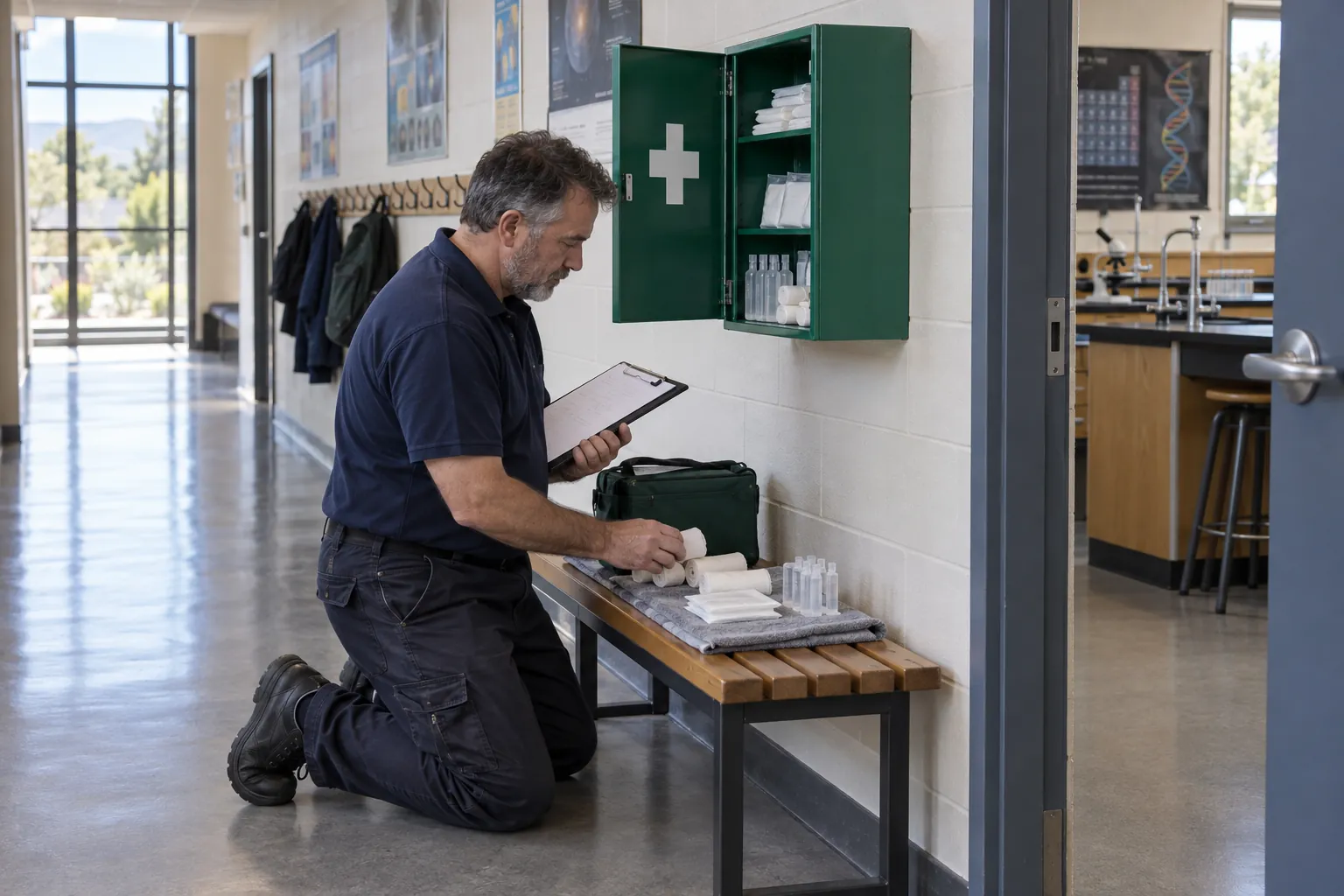
Every New Zealand workplace needs first aid equipment that workers can reach, and many rely on a green box on the wall that nobody opens until someone is bleeding. The duty sits with the PCBU under the General Risk and Workplace Management Regulations, and WorkSafe's guidance sets out what a kit should hold, where it should be and how it should be kept stocked. This guide turns that guidance into a working first aid kit checklist for offices, schools, shops and shared buildings.
01
What the law asks of first aid at work in New Zealand
The duty to provide first aid comes from regulation 13 of the Health and Safety at Work (General Risk and Workplace Management) Regulations 2016, made under the Health and Safety at Work Act 2015 (HSWA). WorkSafe's Interpretive guidelines: General risk and workplace management – Part 1 put it in one line: PCBUs must provide workers with adequate first aid facilities, equipment and access to first aiders. In practice the PCBU, the person conducting a business or undertaking, must:
- provide adequate first aid equipment at the workplace that all workers have access to;
- make sure workers have access to facilities for giving first aid, from a private area set aside to a dedicated first aid room;
- provide its own trained first aiders, or give workers access to other trained first aiders, for example at a nearby business, in an adequate number.
The regulations do not list what a kit must contain. The PCBU must take into account all relevant matters, which WorkSafe lists as the size and location of the workplace, the number and composition of the workers, the nature of the work and the workplace hazards, and the views of workers. "Adequate" is judged against the work and the building, not a catalogue: a contact centre and a road-repair crew both need first aid kits, but not the same one.
WorkSafe describes first aid as the immediate and basic care given to an injured or sick person before a doctor, other health professional or emergency services take over. Providing it is an important part of a safe and healthy work environment, but it does not replace the need to assess work risks and eliminate or minimise them.
WorkSafe's quick guide First aid at work (February 2020) adds two points worth knowing before you buy anything. A PCBU "must not impose a levy or charge on a worker for anything done or provided in relation to health and safety, including the provision of first aid kits and facilities". And the PCBU must, so far as is reasonably practicable, engage with workers on first aid: ask them what the risks are and what they think is needed.
02
What goes in a workplace first aid kit
WorkSafe's guide says you must provide at least one first aid kit for each workplace and make sure workers know where it is. Kits should hold basic equipment for cuts, scratches, punctures, grazes and splinters; sprains and strains; minor burns; broken bones; eye injuries; and shock. Its Figure 1, "Sample contents of a work first aid kit", is the starting list most workplace kits follow:
- instructions for first aid, including CPR, and a resuscitation mask or face shield;
- disposable nitrile gloves, 2 pairs;
- saline, 15 ml, 8 of them, and 10 single wound cleaning wipes (1% cetrimide BP, an antiseptic);
- adhesive dressing strips, a pack of 50;
- non-adherent dressings: 6 small (5 × 5 cm), 3 medium (7.5 × 10 cm) and 1 large (10 × 10 cm);
- conforming cotton bandages, 3 at 5 cm and 3 at 7.5 cm, and 2 triangular bandages;
- hypoallergenic non-stretch adhesive tape (2.5 cm), tweezers, scissors and at least 6 safety pins.
The guide also suggests a small notebook and pen in the kit to record dates, times, observations and equipment used, which helps whoever treats the injury and whoever restocks the kit afterwards.
Adjust the list to the risks. WorkSafe says what goes in the kit should be based on the particular risks of the work. Its example is eye injuries: eye pads are more likely to be needed where workers handle chemical liquids or powders in open containers, spray or hose, risk flying particles, may be splashed with infectious materials, or weld, cut or machine. For a contract cleaner decanting chemicals, a school workshop or a café kitchen, the standard office kit is a starting point, not the answer.
Design. Each kit should be clearly labelled "First Aid Kit" (most carry a white cross on a green background), have a list of what is in it, and protect the contents from dust, moisture and contamination. That list is the basis of every check that follows. If you add pain relief, WorkSafe advises over-the-counter pack sizes in the maker's original pack; unless someone medically trained gives it, the worker takes it themselves.
Remote and mobile workers need the basic kit plus extras where the work calls for them (the guide's Figure 2 adds a torch, whistle, rescue blanket and burn dressing), and a vehicle that is a workplace needs a kit secured where it will not move in a collision. WorkSafe's Interpretive guidelines: General risk and workplace management – Part 2 cover how remote workers get help.
03
How many kits, and where they go in a building
WorkSafe's guidance says first aid equipment should be easy for all workers to reach, ideally within minutes in an emergency. Where there are separate work areas, such as more than one building on a site or more than one floor, there should be a kit in each; a school with a science laboratory or carpentry workshop should have one in each. Emergency floor plans should show where the kits are, and first aid signs should mark them. For a facilities manager, caretaker or school property manager, that gives the kit register for a building:
- one kit per floor as a minimum, and one per building on a campus;
- an extra kit where the work carries more risk: workshops, laboratories, kitchens, plant rooms, loading docks, cleaners' stores;
- each kit at a fixed, signed location shown on the emergency floor plan;
- access for everyone who works there, including night shifts, after-hours cleaners and security officers on patrol, which rules out a kit in an office locked at 5 pm.
Shared buildings. In an office tower, shopping centre or campus, several PCBUs share one workplace: the owner or body corporate, the tenants, and the cleaning, security and maintenance contractors. Where their duties overlap, they must consult, cooperate and coordinate. WorkSafe's first aid guide gives this very example: PCBUs in the same shopping centre complex could together provide trained first aiders and a first aid room for everyone there. Its First aid fact sheet (August 2018) says the same about sharing first aid resources. Sharing works only if it is written down: which common-area kits belong to whom, who checks them, and who restocks them. Cleaners and security officers are often the only people in the building at night, so they need to know the arrangement most.
Other first aid equipment. WorkSafe's guide says to consider an automated external defibrillator (AED) where there is a risk of electrocution, a likely delay before an ambulance arrives, or large numbers of the public; eyewash equipment where eyes could be splashed with chemicals or infectious substances; and an emergency shower where there is a risk of chemical absorption, contamination by infectious substances or serious burns. Where a building has these, put them on the same round as the kits, maintained to the manufacturer's instructions. See AED checks.
First aid rooms are for sites where a risk assessment shows first aid would be hard to give without one. WorkSafe suggests a door at least 1 m wide for a stretcher, privacy, a sink and toilets nearby, and about 14 m² as a guide.
04
The first aid kit checklist: how often, and what to check
WorkSafe's guide says it is good practice to nominate a person, perhaps a first aider, to maintain the kits. That person should monitor usage and replace items as soon as practicable after use; at least once every 12 months, make sure the kit holds a complete set of the required items, with an inventory list kept in the kit and signed and dated after each check; and make sure items work, are within their expiry dates, and that sterile products are still sealed.
That is the floor, not the routine. A kit looked at once a year will be short for most of it in any building where people cut fingers. Sites that get this right tend to work on three levels:
- After every use. Whoever used the kit says what was taken, and the nominated person replaces it. This is WorkSafe's check, and the one most often skipped.
- A short regular look, often monthly. Not a WorkSafe requirement, but a practical interval many sites choose so a used or missing kit is found before it is needed.
- The full inventory, at least every 12 months. Every item counted against the list, every expiry date read, every sterile seal checked, and the list signed and dated.
A checklist for each kit on the round:
- the kit is at its listed location, signed, and accessible without a key;
- the case is clean, dry, closed and labelled "First Aid Kit", with its contents list inside;
- gloves, the resuscitation mask or face shield and CPR instructions are present;
- dressings, bandages, saline and wipes are at the listed quantities;
- sterile items are sealed and nothing is past its expiry date;
- site-specific items are there, such as eye pads near chemical use or burn dressings in a kitchen;
- the notebook has been read and any recent entries followed up;
- the list is signed and dated, with anything restocked or still missing noted.
05
First aiders, information for workers, and reviewing the arrangements
A stocked kit is half the duty. Workers must also have access to an adequate number of trained first aiders. WorkSafe's guide sets no ratio; it gives examples instead. A three-person, low-risk IT business next to a medical centre has no trained first aiders. A tiny-house builder with eight staff doing high-risk work has two. A vineyard half an hour from medical services has two for every 10 workers, and a low-risk contact centre two for every 50. Allow for leave, and for every shift. WorkSafe recommends training by an organisation accredited by the New Zealand Qualifications Authority; the certificate is generally valid for two years, after which first aiders should refresh it.
Information for workers. All workers must be given clear information about where the kits are, the names and locations of first aiders, where any first aid room is, and what to do when they need first aid. WorkSafe says to give it at induction, when a worker's work or location changes, when first aiders change, and at regular intervals, for example annually. In a shared building that includes contractors' staff, who may never see the tenant's induction.
The emergency plan and incident reporting. Regulation 14 requires an emergency plan for every workplace, and WorkSafe's Part 1 guidelines list medical treatment and assistance procedures among its contents, so the kit locations belong on its floor plan. A first-aid-only injury is not notifiable, but WorkSafe's page What events need to be notified? says any injury or illness that requires, or would usually require, admission to hospital for immediate treatment is. See incident reporting.
Reviewing the arrangements. WorkSafe asks PCBUs to review first aid with their workers regularly and after changes, new risks or an incident where first aid was given. Its questions make a good periodic check: do all workers, including night shifts, have access to first aiders and kits? Do they know where the kits are? Do you need more kits or more first aiders? Are first aiders' skills current? Do the contents suit the work? Do you need a first aid room?
Kit usage is useful evidence for that review. If the kit by the loading dock needs dressings every fortnight, the hazard register probably has something to say about the loading dock.
06
Where the first aid kit record fails, and what SiteClara does about it
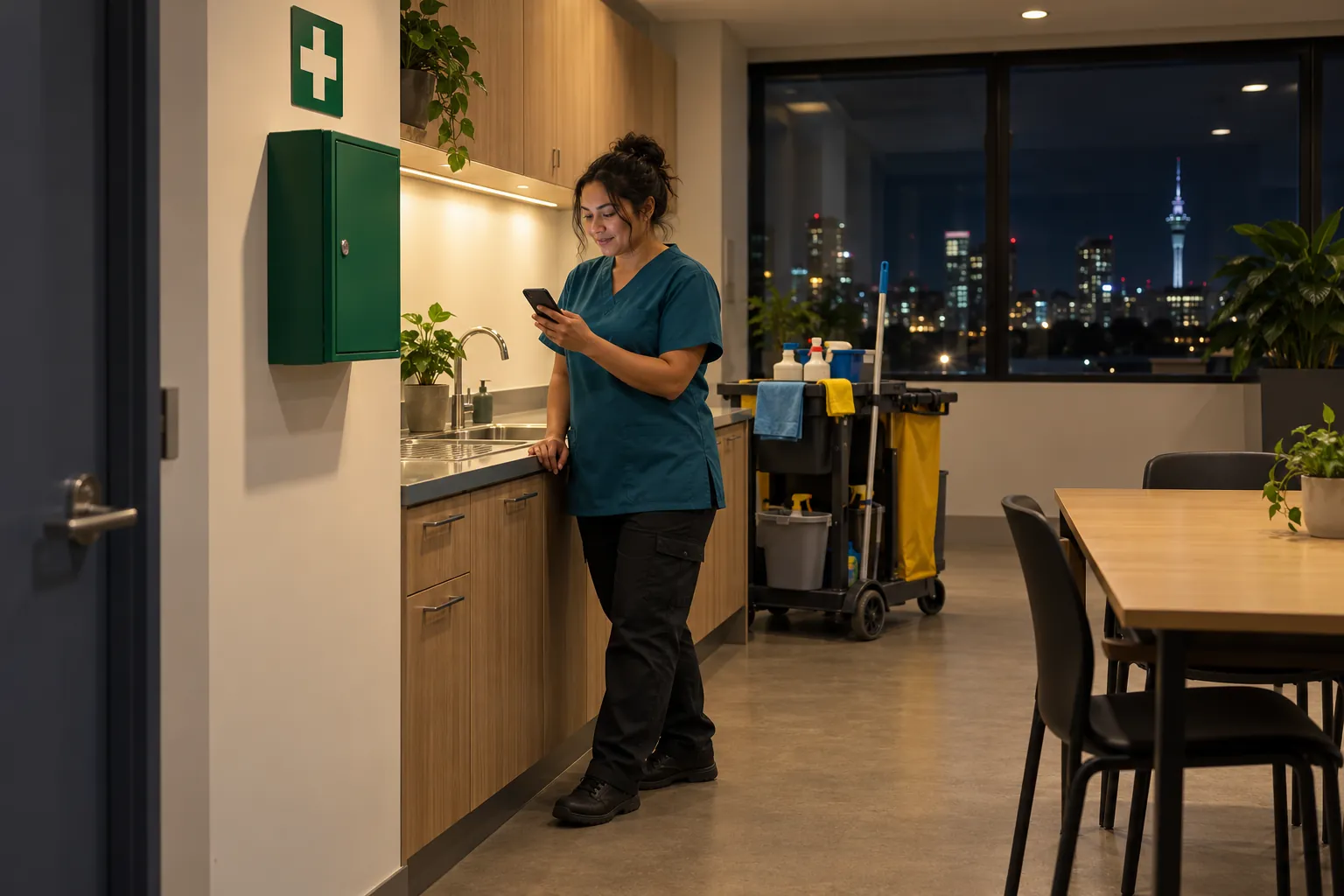
The usual record is a sheet taped inside the lid: a column of initials and dates, sometimes all in the same pen, sometimes filled in ahead. It records that someone opened the box, not what they found. A kit used on Tuesday night by a cleaner is restocked only if the cleaner told somebody who knew who to tell. In a shared building, three companies can each assume the level 3 kit is someone else's.
A kit check record needs to show which kit, when, by whom, what was found, and what happened to anything missing. That is what an owner, a body corporate manager or a health and safety representative would ask to see.
SiteClara records the check at the location. A printed QR poster, with an optional NFC tag behind it, sits beside each kit. The person on the round scans or taps on their own phone, with no app to install, sees the checks due there, and marks each one done or says what stopped them. The time and the named person are recorded as it happens, with a photo when one is asked for, such as the signed inventory list. A missing item or an empty kit can be reported from the same scan and goes onto the team's list of jobs until someone closes it, so the used kit is not lost between the person who used it and the person who restocks it.
A supervisor sees which checks were due, done and missed, records why one was missed, and approves a daily report that goes to nominated managers or client contacts the next morning.
07
Questions people ask
What should be in a first aid kit in NZ?
No regulation lists the contents; the kit must be adequate for the risks of the work. WorkSafe's quick guide First aid at work says you must provide at least one first aid kit for each workplace, that kits should hold basic equipment for cuts, scratches, punctures, grazes and splinters, soft tissue sprains and strains, minor burns, broken bones, eye injuries and shock, and that what goes in the kit should be based on the particular risks of the work, for example eye pads where workers handle chemicals or risk flying particles. Its Figure 1 gives the suggested contents of a work first aid kit.
What are 10 items in a first aid kit?
Ten from the sample contents in WorkSafe's First aid at work (Figure 1): instructions for first aid including CPR, a resuscitation mask or face shield, 2 pairs of disposable nitrile gloves, 8 × 15 ml saline, 10 single wound cleaning wipes, a pack of 50 adhesive dressing strips, non-adherent dressings in three sizes, conforming cotton bandages, 2 triangular bandages, and non-stretch hypoallergenic adhesive tape. The list also includes tweezers, scissors and at least 6 safety pins.
What does a first aid kit checklist for 2026 include?
WorkSafe's quick guide First aid at work is still its current guidance. It says the person who maintains the kits should monitor usage and replace items as soon as practicable after use; at least once every 12 months, make sure the kit contains a complete set of the required items, with an inventory list kept in the kit and signed and dated after each check; and make sure items are in working order and within their expiry dates, and sterile products are still sealed. A checklist built on that records which kit, where it is, who checked it and when, what was missing or out of date, and what was replaced.
08
Further reading, and a first aid kit checklist to take away
WorkSafe's quick guide First aid at work is the main reference, with a worked first aid assessment in Appendix B, and its First aid fact sheet is the two-page version. The duties are explained in WorkSafe's Interpretive guidelines: General risk and workplace management – Part 1 (sections 7 and 8), and the law is regulation 13 of the Health and Safety at Work (General Risk and Workplace Management) Regulations 2016.
Before you sign off your first aid arrangements, check that:
- a first aid assessment covers the work, the building, the workers and their views;
- every floor, building and higher-risk area has a signed kit, shown on the emergency floor plan;
- every kit has a contents list that suits the risks where it hangs;
- everyone, including night shifts and contractors, can reach a kit and a first aider;
- a named person restocks after every use and signs a full inventory at least every 12 months;
- AEDs, eyewash stations and emergency showers are on the same round;
- in a shared building, the PCBUs have agreed in writing who checks which kits;
- workers are told where kits and first aiders are at induction and at least annually;
- the arrangements are reviewed after any change or any incident that needed first aid.
Sources
Every document this guide quotes or links to, in the order it first cites them.
- Health and Safety at Work (General Risk and Workplace Management) Regulations 2016 legislation.govt.nz
- Interpretive guidelines: General risk and workplace management – Part 1 worksafe.govt.nz
- First aid at work worksafe.govt.nz
- Interpretive guidelines: General risk and workplace management – Part 2 worksafe.govt.nz
- First aid fact sheet worksafe.govt.nz
- What events need to be notified? worksafe.govt.nz
- First aid at work worksafe.govt.nz
Related guides
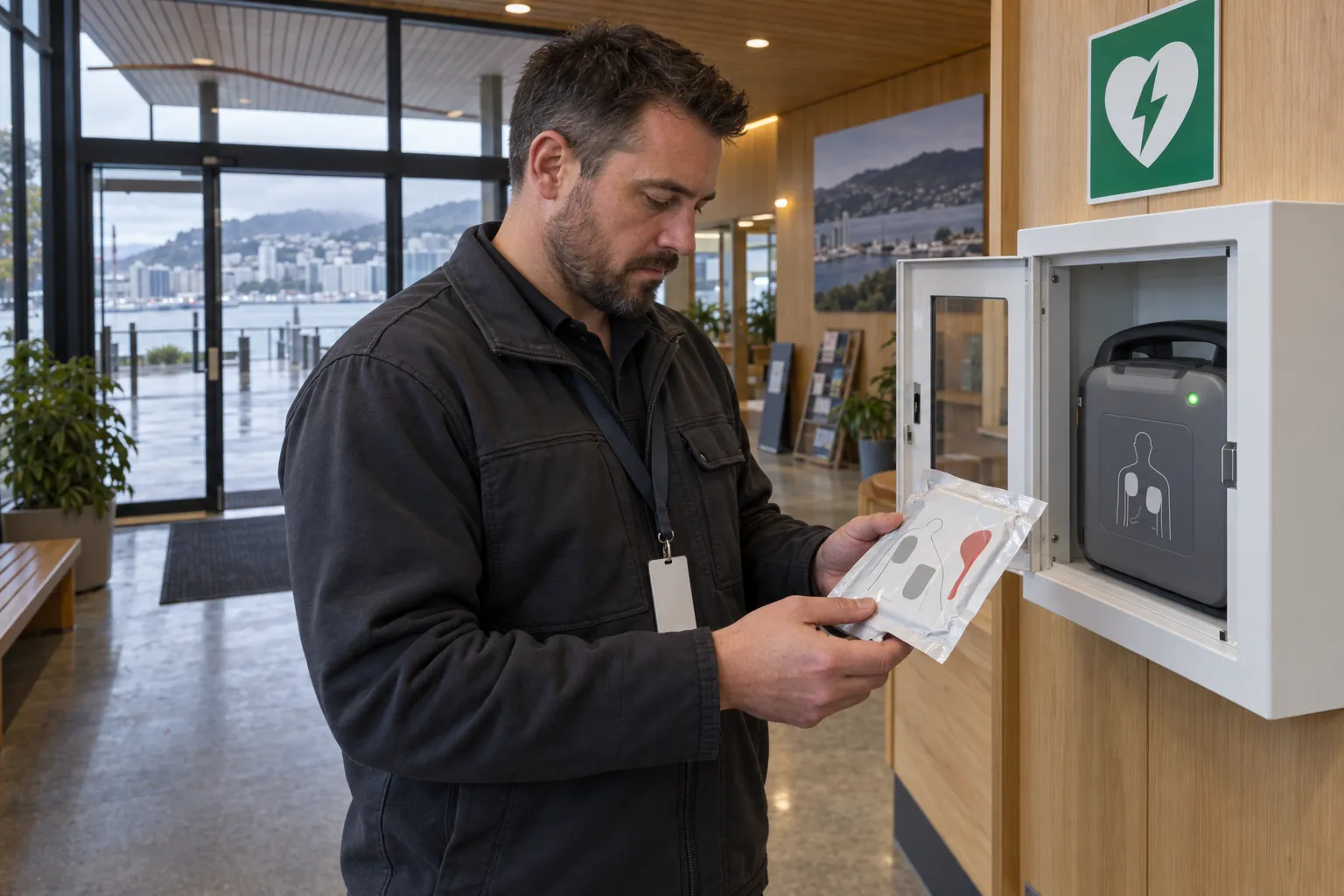 Premises and facilities managementAED checks: keeping a workplace defibrillator ready to useAED maintenance for New Zealand workplaces: what WorkSafe and Hato Hone St John advise, the regular check, pads and batteries, registration and an honest record.
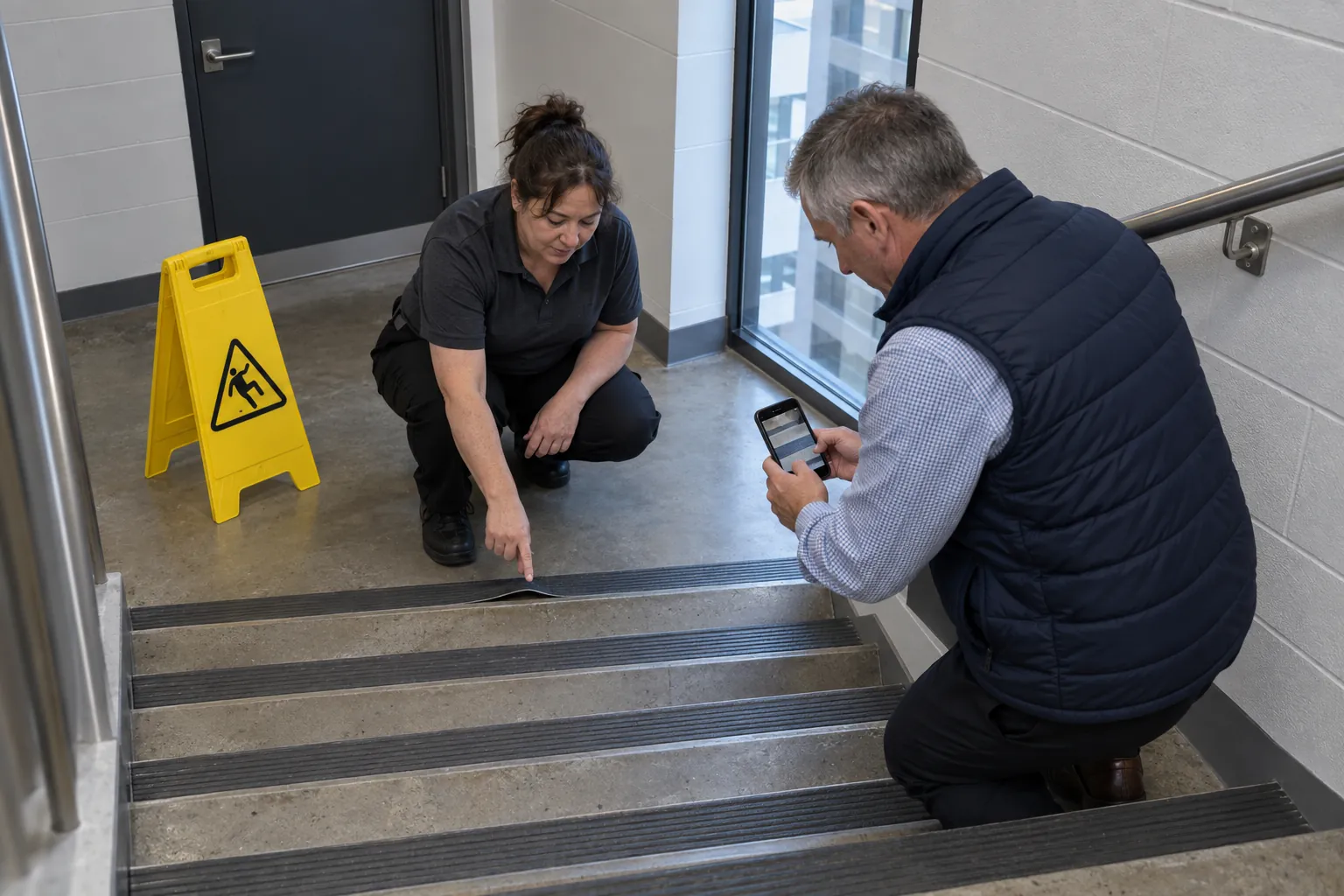 Premises and facilities managementIncident reporting: what HSWA asks for, and a system people will actually useIncident reporting under New Zealand's HSWA: what must be notified to WorkSafe, what records to keep, and how to run incident reporting in a shared building.
 Premises and facilities managementOverlapping duties: sharing health and safety when several PCBUs work in one buildingOverlapping duties under HSWA 2015: when PCBUs share a building or a contracting chain, how to consult, co-operate and co-ordinate, and how to show it works.
 Premises and facilities managementHazard register: what HSWA expects, and how to keep one that is usedWhat a hazard register is under New Zealand's HSWA, what goes in it, how to assess and control risks, when to review it, and what changes on 1 April 2027.